No Laughing Matter
RADIO
ByEDWIN O’CONNER
IN looking back over the considerable number of radio comedy programs presented in recent seasons, I have come to the conclusion that the characteristic quality of such a program is not its intrinsic hilarity, but rather its structure. While radio comedy shows may differ vastly in their over-all comic effects, they all subscribe faithfully to the same blueprint, an architectural pattern which admits of no ad-libbing. Briefly, a radio program, in order to be also a comedy program, must be shaped around the following skeleton: —
1. One orchestra, capable of playing “I Know That You Know” and “There’s a Great Day Coming, Mañana.”
2. One vocalist, male or female, primarily employed to sing “Aren’t You Glad You’re You?” but on holiday broadcasts allowed to experiment with “The Bells of St. Mary’s” and “Trees.”
3. One guest star, whose appearance, despite its having been advertised for a solid week, is always greeted with a proper mixture of joy and incredulity. Thus: “Why, Joan Bennett!” or “Look, it’s Lauritz Melchior!”
4. One comedian.
This format for the radio comedy program is popular and efficient; were it not for the comedian, it would also be airtight. The comedian, poor fellow, is the Achilles heel of the arrangement. Seen against a backdrop woven of mechanically perfect orchestration, the unvarying pattern of song, and the infallible charm of the guest, he is all too often revealed as a creature of imperfection, full of human weaknesses, and capable of missing fire upon occasion.
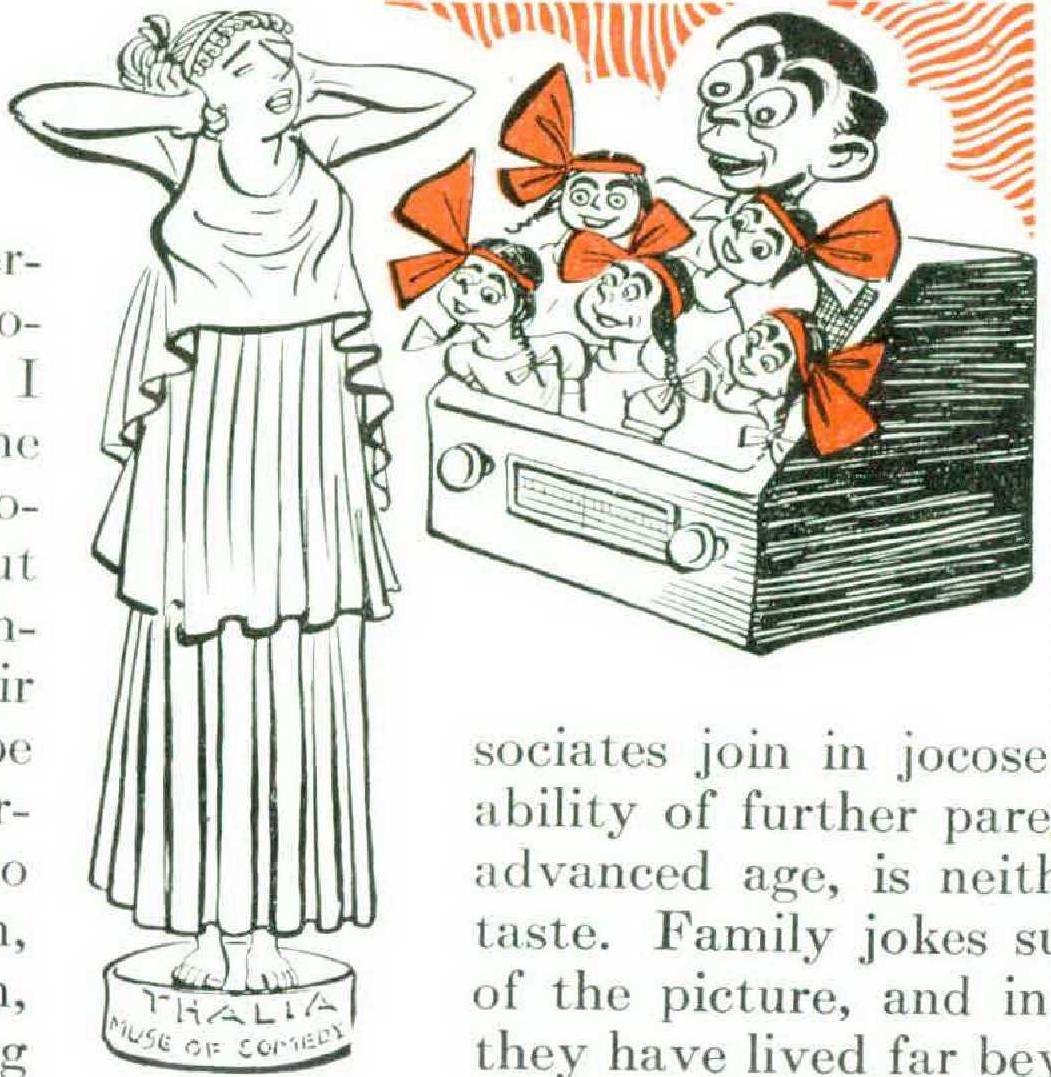
First of all, it would seem to me that strange and wonderful rewards await the comedian who willingly would refrain from commenting on the miracle of procreation. The Eddie Cantor program is a case in point. Like many another American, I have been aware for some time that Eddie is not a bachelor. He has a wife named Ida, five daughters, and no sons. I have been listening to weekly bulletins on Ida and the five girl-babies for so long that there are actually moments when I feel that I too am a part of this familial scheme, when I have the strange feeling that, somehow, Eddie has adopted me.
These five-daughter jokes have increased in deadliness with the passing of each year. They are running jokes that have slowed down to a painful crawl, and should be put out of their misery at once. There has always been a question in my mind whether there is anything amusing or even physiologically phenomenal about a comedian’s siring five females; but certainly whatever humor there may once have been has long ago been beaten to jelly. Moreover, the most recent refinement upon this theme, in which Eddie and his associates join in jocose speculation about the probability of further parenthood, in view of the star’s advanced age, is neither funny nor in the best of taste. Family jokes such as this can well pass out of the picture, and in passing stir no remorse, for they have lived far beyond their normal time.
This brings up the matter of the mortality of the average joke. I believe that the future is rich for the comedian bold enough to act upon the premise that, after all, there is something perishable about topical humor. A joke, like a human, is born to die, and the length of its life depends to a large extent on the care given it at birth. Yet, instead of treating a joke as the fragile thing it is, radio comedians rush it like so many terriers pouncing upon an especially juicy rat, and pass it around from mouth to mouth until the poor thing is no more than a lifeless shred of skin. A joke which is still in circulation two months after its official demise is a mournful object with nothing to recommend it.
As I recall it, during the past season burial ceremonies were unduly postponed for all bits of whimsy dealing with characters from the Dick Tracy comic strip and for the endless chain of moldy references to such film successes as Mildred Pierce, The House on 92nd Street, and The Lost Weekend. In addition, there were the perennial bouts of weary invective predicated upon the assumption that all insult is hilarious when directed against the scalp, the waistline, or the purse. Crosby is balding, Sinatra is skeletal, and Benny is a miser. These slender themes, all but helpless with age, continue to inspire a series of jibes which have all the impact and sparkle of a collapsing soufflé. It has been suggested that since radio is a family medium, more vigorous banter is prohibited. This is possible, although I have the feeling that such greetings as “Hello, Bulge!” and “What cooks, Zoot-Snoot?” accorded respectively to a man with a large midriff and one with a generous nose, perhaps do not represent wholesome, allowable epithet.
I think too that there would be both prayer and praise for the comedian who, while broadcasting from California, would forgo the use of all material of purely local significance. For the comedian who is also a Californian, this represents no casual accomplishment; his position is complicated by a burning loyalty to the golden land and a consequent suspicion of all humor rooted east of the Nevada line. He knows that if he broadcasts to fellow Californians, he speaks to friends to whom the gift of laughter is second nature, and not to a horde of cynics who have been cooped up all winter by four-foot snows coming down from the Canadian border. If he broadcasts from San Luis Obispo it is of small matter to him that the mere mention of the Green Goose Café on West Hyacinth Boulevard is not a source of bellybusting joy to the listener in Montpelier, Vermont.
Bob Hope, in his broadcasts from the different colleges of California, developed localization to such a fine art that each program took on the quality of a private report to the Alumni Association. These broadcasts were stuffed with the names of college lunchrooms, off-campus saloons, popular and unpopular professors, women’s residence halls, and undergraduate trysting places. The students who were assembled at the scene of the broadcasts greeted this intimate data with wild shouts of recognition and acclaim, while three thousand miles removed from the roistering the listener fumbled nervously with his fraternity pin and wished to God that he had had the good sense to go to school somewhere west of the Rocky Mountains. At least he could have kept in touch with the old school by radio.
Also, there would be no disaffection, I think, if a handful of comedians could be persuaded to abandon their comic efforts altogether, in favor of some form of employment more congenial to them. Rudy Vallee, for one. Rudy’s program interests me only because I suspect that it is being written by my dentist. Rudy denies this, and my dentist sputters with fury at the very suggestion, but the program’s style gives the whole thing away. It has just the sort of humor that my dentist is at home with, a humor that flows ceaselessly from a man who has spent the greater part of his adult years in converse with the partially anesthetized. For the benefit of the morbidly curious,
I advance a few samples of the kind of thing my dentist does best, all winnowed from the opening moments of a typical night at Villa Vallee. The “ Pinky” indicated herein is Rudy’s partner, not alone for these triumphant jests, but for the duration of the whole unhappy program: —
RUDY: How much is one rabbit and one rabbit?
PINKY: Two — but not for long!
RUDY: You should always carry on with grace and finesse.
PINKY: I tried to, but Grace left town, and Finesse married a sailor.
RUDY: DO you know Walter Wanger?
PINKY: No — but I know his brother, the Lone Wanger!
This is minor league Abbott and Costello, if there is such a thing. Moreover, while this raw material is ever present in its unsophisticated awfulness, matters are not aided by Rudy’s comedy delivery, which consists principally of clearing his throat apologetically after lines of special point. As I see it, the only solution lies in Rudy’s giving my dentist his release, converting the program into one of saxophone and song, and threatening all participants, not forgetting himself, with immediate destruction at the first attempt to reach for a laugh.
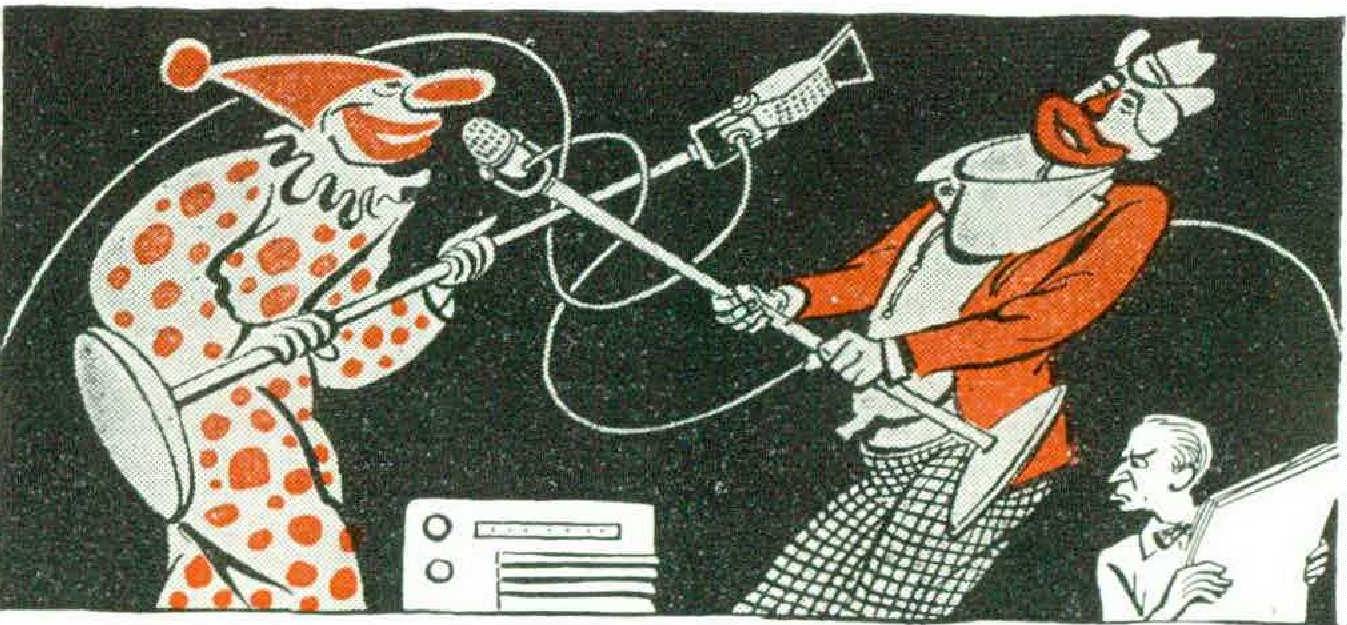
Finally, and above all else, I hope to see the day when Fred Allen decides to consign his present program to limbo, and to strike out on his own. For here is one of the first comic talents of our time smothered by the crazy canvas of the formula strait jacket. Fred Allen is the spiritual affiliate of Ring Lardner and Finley Peter Dunne, not of Hildegarde and Red Skelton, and his astringent gifts are in odd contrast to high-octane orchestration and the uncertain performances of many of his guests. Even within the limits of his current format, Allen produces, week in and week out, a funny and well-written show. If ever he took it into his head to rid himself of the attendant chrome and whipped cream, the result would be a treat for many a listener, and radio would be enriched by its first satirist of adult proportions, a man with a civilized mind and an unequaled sense of comedy.