Looking Down
ByGEORGE PALMER PUTNAM
WHETHER you fly with expensive frills, or travel in the air-transport equivalent of railroad tourist accommodation, you’ll be seeing an altogether different universe from the one you have been brought up to know.
On the ground, for instance, a camel’s hump gives him an unmistakable silhouette. When observed from above, the camel is quite a different creature. He is long, very thin except across the stern, and his hump has disappeared.
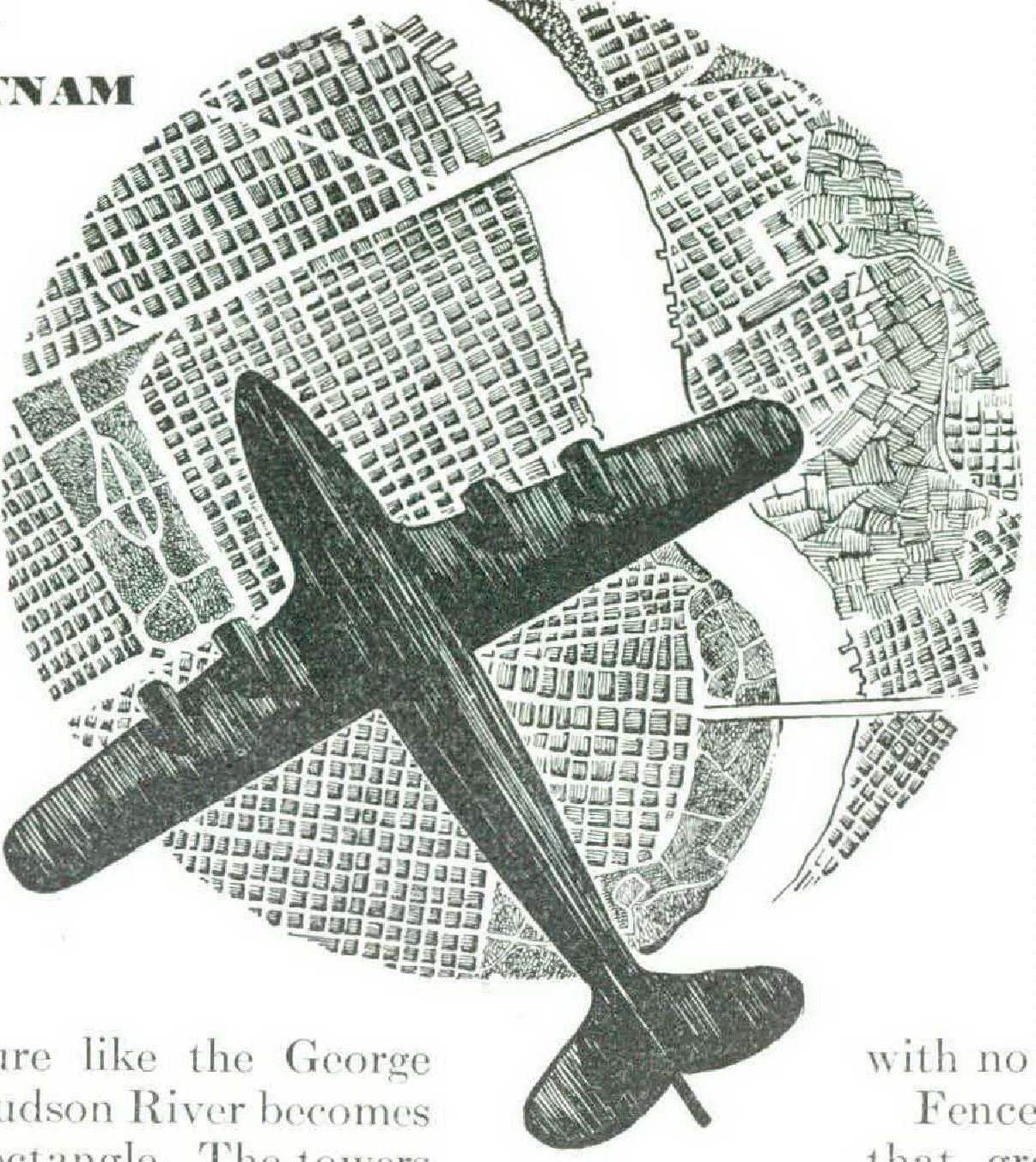
From an airplane, a structure like the George Washington Bridge across the Hudson River becomes simply a pencil-thin elongated rectangle. The towers at each end, if you look directly down on them, are small squares. An oil tank, from aloft, is a circle like the top of a tin can; a tree is an irregular blob, a field of shocked grain an orderly arrangement of dark dots against a light background. An automobile looks like a beetle; a bus becomes an attenuated bug.
Normally, we see the sides and corners of objects. To be at home with the often curious-appearing bird’s-eye world, one has to learn what things look like from the top instead of the side. Shadows, more than anything else, help you to do that. In that vertical air glimpse of the George Washington Bridge, you have no key to how tall the bridge towers are, or how high the bridge itself is, or what the nature of its construction is, unless there are shadows.
Shadow is the sure clue to the identity of a bridge or a structure like a church, whose steeple from directly above looks like a pin point. At high noon, when there is no shadow measuring stick, a volcano crater can seem a shallow saucer instead of a steepsided cup, and a cleft even as huge as the Grand Canyon gives no indication of its depth.
There are homely clues to the identity of much that is encountered on everyday flights. Roads, for example, show as narrow, light bands. If their edges are scarred and without vegetation, recent construction is indicated, if the road is of uniform width and fairly straight, you know it is hard-surfaced. Oil stains determine the number of lanes (you’ll see that the stains are heavier and therefore darker on the uphill side than on the downhill side), and an automobile, with its known dimensions, is a key to the width of a road.
The shape of a building is a good clue to its use. A residential building is very different from a warehouse, and a warehouse has no similarity to a power plant with its tall chimneys and transformer yard, or to a gasometer surrounded by a heavy steel framework.
You’ll come to recognize the basic features of any landscape — such as power lines, which are dark streaks formed by the swaths they have cut through wooded areas, the poles with spindly shadows marching over bare lands. They go straight across ridges and valleys, with no consideration for contours.
Fences, because of the vegetation that grows along them, often appear as hedge-like lines separating fields. A dozen different sorts of fences are recognizable if one is not flying too high: from the stone walls and precise picket fences of New England to the rambling split rails of the South and the barbed wire of Western ranges.
Streams, the leaf veins of an orderly landscape, are of many types. A stream with a relatively straight course is in a narrow valley which bugs its banks. This stream is busy eroding downward in an attempt to reach base level, below which it will cease to downcut, because it has become adapted to the load it is carrying and can carry no more. As this level is attained, the bends in the stream become wider as it begins to rasp away the valley sides in a lateral plane. The valley continues to be widened, and broader meanders are developed. This process may ultimately result in the formation of a low marshy country. The brighter green area of flat fields, by the way, is likely to indicate wet, soft spots that should be marked down as dangerous landing places.
Even when the map on your lap tells you the direction in which streams are flowing, there is a way you can determine that for yourself. The cliffs and steep banks at the bends, where the flowing water is undercutting, always face upstream.
It is everlastingly surprising how flat the land below you seems to be. Until you have become well versed in the telltale tricks, even really mountainous country appears reasonably level. A steep-walled valley may have the look of a dark streak. Rough terrain, with hillocks and hollows as big as business buildings, is likely to seem deceptively smooth. And the stormiest ocean, with waves many feet high, can have the placid look of an expanse of tapestry - unless you detect the darker troughs and the spray flying from wave crests.