Buenos Aires Subways
ByRAY JOSEPHS
TRAVEL
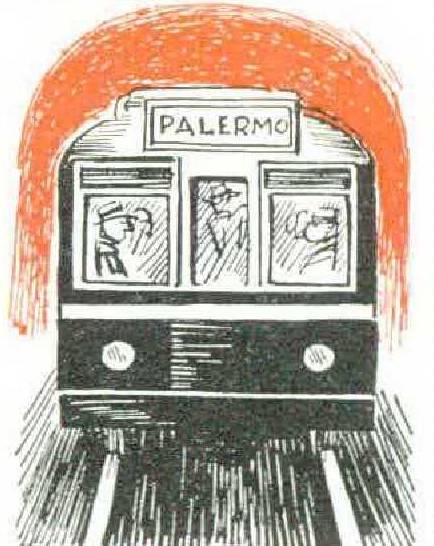
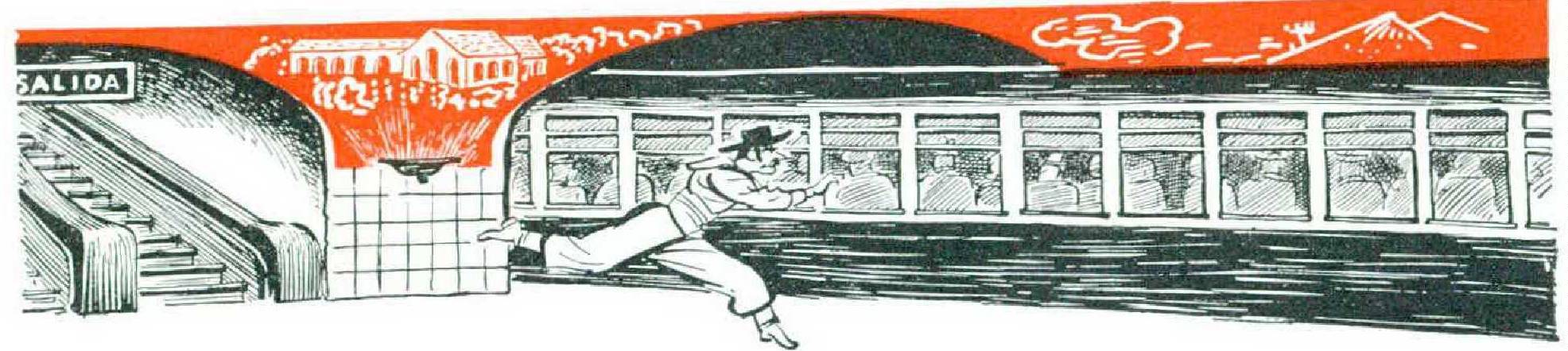
CATCHING the last subway home in Buenos Aires was always a risky business. Rarely was the theater over until 1.00 A.M., and the último tren from the center to Palermo pulled out promptly at 1.20, leaving hardly time enough for a stop at the café and a chance to talk over the merits of the evening’s play before dashing underground. Since the only public transport running after the subterráneo shut down was the erratic little colectivo buses, the impossibly slow trams, and the much too expensive taxi-metros, three quarters of late dining, later theatergoing Buenos Aires seemed to pack its way into the final car.
The custom of the after-work twilight promenade, which eliminated a homegoing rush, and the staggered shop and office openings in the morning meant after-theater was about the only time the subterráneo was really crowded in the Manhattan manner. Even then norteamericano subway essentials were missing — the noise, straphangers, and sardine-packing guards. For the subways of Buenos Aires have never been regarded by the 3,500,000 porteños of Buenos Aires merely as utilitarian carriers. As characteristically speedy as the IRT in New York, they have more surprises than the Métro in Paris, greater contrast than the Underground in London, and an esthetic appeal that not even the widely publicized Moscow tunnels can boast.
Such international comparisons are no mere off-hand references. The five lines which fan out from the Rio de la Plata toward the parkway belt of Avenida General Paz were built by Spanish and British companies, equipped by Germans and Americans, electrified by Belgians, powered by Italians, and financed by bondholders, who are still awaiting dividends, in half a dozen other countries. Typical is the Palermo line — a source of special astonishment to visiting Yanquis, who usually conceive of Latin America’s largest metropolis as moving at burro pace.
Descending at Florida—the Fifth Avenue of Buenos Aires, from which cars are banned — one’s first surprises are the beautifully tiled red and blue entrances, the stainless-steel escalators, and the noiseless turnstiles. The stations themselves advance the same streamlined idea plus an air of fresh-scrubbed cleanliness. Arched like the London tubes, they have brilliant indirect neon lighting in colors harmonizing with the decorative scheme of each stop, illuminated maps with stations clearly marked, direction signs legible half a block away, and clocks that go. These clocks, which were installed by Siemens-Schuckert, have been a subtle but highly effective piece of German propaganda.
Along the station walls, where ordinarily New York, Chicago, and Philadelphia subways post quickly penciled advertisements, are murals in multicolored mosaics. Especially made in Madrid and imported shortly before the war, some are a quarter of a city block long. Others are inset in the wide platforms themselves. Each depicts a phase of Argentine history or economic development - Moreno’s fight for independence; Mitre’s first newspaper; the growth of the cattle industry; wheat growing on the pampa.
The cross-town line connecting the great Plaza Constitución station, terminus of the southern rail lines, and Retiro, where the Central Argentine and northern State lines come in, carries a similar decorative scheme. Its cream, black, and gold fourcar trains haul the greatest flow of traffic. Besides linking the stations, its nine-stop shuttle connects with the Palermo route, the Corrientes line to suburban Federico Lacroze, the original Avenida de Mayo and Rivadavia line to working-class Primera Junta, and the new Calle San Juan subte to Boedo.
Regardless of distance, the fare on both the older, less ornate routes and the new lines is ten centavos — two and a hall cents. A transfer is thrown in for an additional five centavos. With the exception of the Mayo-Rivadavia line, which traverses the length of what Buenos Aires contends is the longest city street in the world, all the subterráneos follow paths as involved as those of the Paris Métro. Thus you can get from almost any part of town to any other without coming up for air though the route is hardly the equivalent of a straight line.
Not only do the routes have their individual character, but even the cars have distinct personalities. Instead of rows of advertising cards extolling the virtues of various products, sponsors take an entire car for their own. The front, back, and sides of each car are tastefully done up to sell cooking oil, soap, and laxatives, the three most widely advertised products in Latin America. Messages from the authorities, civic announcements, and food hints - ideas since copied by New York’s Eighth Avenue and Philadelphia’s Broad Street subways keep - the avisos in proper perspective. In some cars there is even a loudspeaker system to call out the next station, courtesy of the sponsor.
Though the subterráneo is a mass-transportation medium, none of it is pitched for a tabloid-level audience. Kiosks at most stations offer literature, philosophy, technical and other books in English, French, German, and Italian, as well as Spanish. In addition many carry the full line of seventytwo newspapers published in Buenos Aires. There are subterráneo restaurants, laundries, money exchanges, and markets — everything in fact except chewing gum. And at the Obelisk, where three lines meet, the subterráneo connects with an amazing subsurface area six city blocks long, with garages, service stations, exhibition halls, and shops, scooped out from under the Times Square of Buenos Aires.
Not long ago the municipality took over the subway holdings of the operating builders, the Spanish CHADOPYF and the British Anglo. Like New York authorities, they began suggesting a fare increase to get the system out of its financial hole. The response from the Teatro Maipo, whose devastatingly sharp weekly topical satires have so far managed to outwit the Porón regime’s censorship, showed that the Buenos Aires subway rider’s sense of humor was no different from the norteamericano straphanger’s.
Said the Maipo: If the CDTDLCDBA — the Corporación de Transportes de la Cuidad de Buenos Aires — merely cut down its string of initials, the amount saved in carbon copies, restenciling, and red tape would not only obviate a price rise but would permit the installation of plush carpets, the serving of coffee, and other improvements to make the subterráneo the only thing it now is not: a perfect bomb shelter.