House of Leaves
FACTS
By LORUS J.MILNE
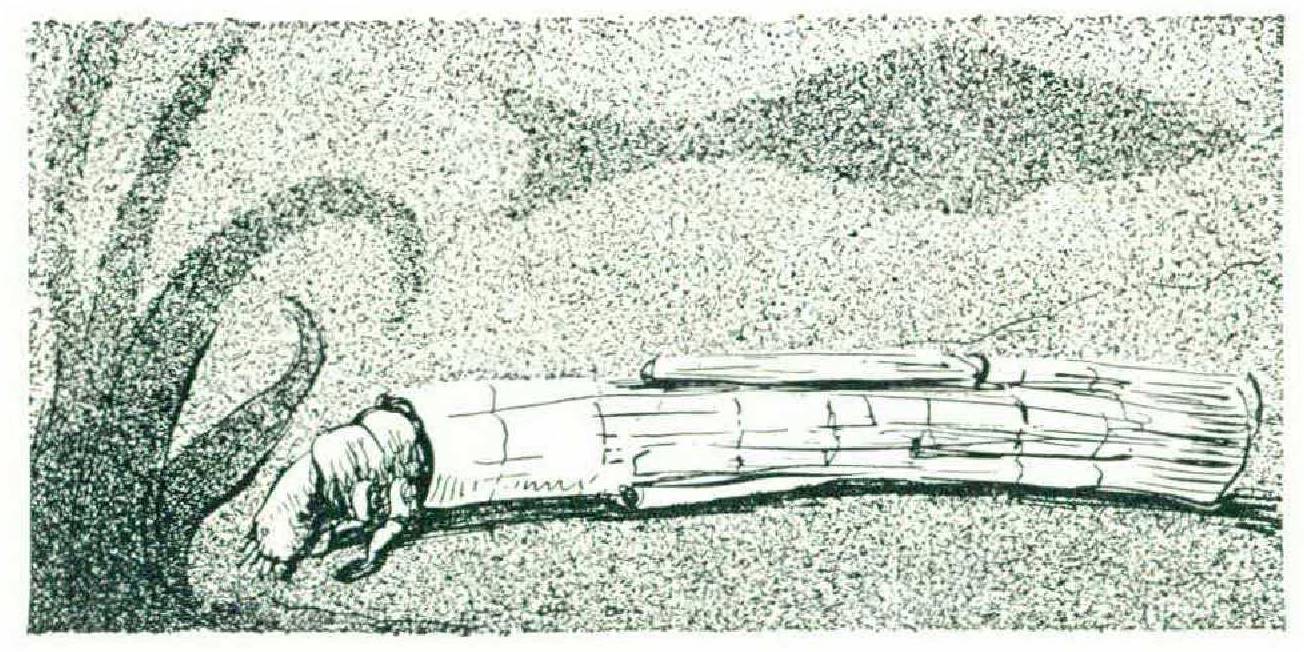
AMONG the litter of vegetable debris on the bottom of a slow stream, a caddis larva is searching out materials for a portable house. The insect had a fine tube until a few moments ago, but on the very briefest notice, she was required to vacate her snug quarters. A homeless relative had simply entered her back door, bitten her from behind, and chased her out the front door. She hadn’t given up without a struggle, or decided to build without exhausting other possibilities. But she must have a covering for her naked body, and every house within her ken is either too small to enter or is occupied by a formidable tenant.
There are no new building materials either. Except for waterlogged fragments scattered at intervals, the bottom of the stream is just clean sand. Hurriedly the insect crawls about, lifting bits of bark, testing tips of twigs, seeking substances she can use. From time to time she finds a fragment of a leaf. These pieces she drags with her, and finally gathers a number of them into a little pile beneath the hinder part of her body. There she protects them while she stretches out with black exploring legs, searching for still more.
Finally she stops amassing particles from the debris around her. She backs up enough to be able to reach a leaf from her collection. With her head as a measuring guide, she uses her jaws as shears to cut out a neat rectangle from one edge. The leaf fragment is large enough to provide a second rectangle of about the same size. But while it is being trimmed to shape, the rest of that raw material drifts away as waste. Still standing over the untouched pieces in the leaf collection, the insect holds the two rectangles below her mouth-parts. By careful maneuvering, with legs and jaws she brings together the long edges of the two rectangles. The crack between their butting sides she fills with cement from her mouth. The cement hardens quickly on exposure to the water and forms a plastic thread sewing the leaf pieces into a continuous sheet.
Working swiftly, the caddis larva snips out an additional rectangle from her hoard of leaves and adds the new fragment to the long edge of one of the preceding pieces. By rapid repetition, she extends the original pair of rectangles into a series of similar sheets, forming a ribbon one rectangle length wide and perhaps six rectangle widths long. With the hinder part of her body still securing the store of untouched leaves, the insect manipulates her ribbon under her forefeet until she is standing on one end of it, with the series of stitched strips extending to one side.
Very dexterously, she draws forward one of her hinder legs on this side and slips her foot under the ribbon — between it and the sandy bottom. Then with great care she stretches her leg backward and at the same time raises it. This motion elevates the free end of the ribbon and wraps it over her back in much the same way that a man puts on a belt. Holding it in place, she reaches up with a hind leg from the opposite side of her body, catches the free end of the ribbon, and draws it down below her to form the beginning of a tube. The loop of ribbon is not drawn tight, although it corresponds closely to the contour of her body. She backs through it until she can apply her mouth-parts to the free edge, and can cement it to the end of the ribbon, on which she has been standing throughout this delicate operation.
The caddis larva has a tube, but it is too short. She must lengthen the tube so that it covers her completely. This she does by cementing piece after piece to the front edge of her loop, adding the rectangles of leaf one at a time. She finishes the attachment of each fragment before shearing off another from her shrinking supply of sodden foliage. At last it is complete.
The new house is slightly larger than the one she lost some hours ago. It fits her body better and provides more space for water currents, which bring her dissolved air to breathe. She extends her head and black-legged shoulder region from the doorway and crawls along the bottom, hitching her house after her to shield her soft hinder parts.
The debris on the bottom offers also much invisible food. Whenever a leaf or a twig settles to the bed of a stream, microscopic plants and animals begin to grow on it. Many of them feed on the multitude of bacteria and water molds which slowly decompose the dead vegetable matter. She creeps about in search of such nourishment, always pulling her tube with her. Occasionally some suitable morsel is in her path, and she drags it into the front door with her, where she can chew on it in peace, protected by her case from the eyes of any hungry fish which might pass her way. When she has cleaned a leaf fragment of all living matter, she may cut it into rectangles and add them to her house.
Two months ago, the caddis larva was a tiny, caseless creature, hatched in the stream a few yards nearer its source than the little bend in which she lives at present. For a week a slender bracelet of translucent jelly had hung gracefully over a submerged twig. The sun had sparkled from many small whitish eggs imbedded in the soft matrix. When first the ring had been affixed to the twig, it measured scarcely half an inch across, but within a few hours it had swollen in the water which buoyed it up, until it spread fully four inches in diameter.
During the week, the translucency of the jelly had been obscured gradually by a thin green film of algae colonizing its surface, and a passing fish had broken the circlet so that it hung limply as two ropes of different length, each still glued to the submerged twig. The ends had swung to and fro with the shifting water. From minute to minute one night, small openings had appeared in the green surface of the ropes. Out of each hole a tiny caterpillarlike animal clothed in long fine hairs had stared awhile into the dark water. Then each had wriggled away from the maternal jelly in which its eggshell was still imbedded. Each had squirmed out into the stream and sunk slowly to the bottom. Because of their hairy coating and small size, the newborn caddis young took minutes to reach the stream bed, and water movements spread them over many square yards of debris-covered bottom. There each one set about building a case after the pattern of its parents.
During her two months on the stream bed, the caddis larva has encountered a number of distant relatives, but only a very few of her own kind. The latter gave her trouble in trying repeatedly to steal her tube. Her other relatives concerned her little, although they competed with her for the few food-covered leaves and twigs which the current brought to her general vicinity. Some of the other caddis larvae live in cases made of sand grains from the bottom, cemented together into slender conical tubes, or into miniature turtle shells, or into flat spirals like a snail shell.
The caddis larva has reached the limit of her growth. Beneath the skin along her back are pads of unused muscles and tissues which some day will be wings. Her period of feeding is past. Her plump body has a store of fats and oils to give her energy for the remainder of her life, a sort of retirement fund to feed her through the exciting days ahead when she will fly and find a mate.
Today she is preparing her tube for the resting period during which she can change over from a crawling feeding animal into a flying breeding one. She
is weaving a net across each end of her tube, the meshes consisting of the same tough cement she had used so often to sew together the rectangular leaf pieces which compose the case. Water can pass through the gratings, but her enemies will be kept outside. She will be able to breathe and yet be safe in spite of her future lethargic condition. Only if a Water Baby like Charles Kingsley’s Tom should come along would she be likely to have her silk grating destroyed, her privacy invaded.
Within her case, protected by the meshes at either end, the caddis larva sheds her skin to become a helpless pupa. She rests quietly while internal changes proceed rapidly. The details of her future adult form can be seen clearly — her legs, wings, and feelers all in protective sheaths wrapped around her body. Day after day her color changes, from a pale yellow to a dark grayish brown. Mottled patterns appear on her folded wings as the fine hairs grow and the pigments take final positions.
Two weeks have passed since the caddis larva wove her gratings and stretched out. within her case to change her form. She is much shorter now, and broader. The muscles which will move her legs and drive her wings have reached their full development and are ready for use.
Her covering fits snugly but has two features which she will use once and then discard. From her mouth-parts, fleshy lobes extend into long, slender, amber-colored jaws — special scissors on the pupal skin, with which she can snip her way through the silken net at the end of her tube to gain her freedom into the water of the stream. Along her back, the covering is set with several broad, brown, oval disks bearing tiny spines. These allow the insect to creep by wriggling through the case.
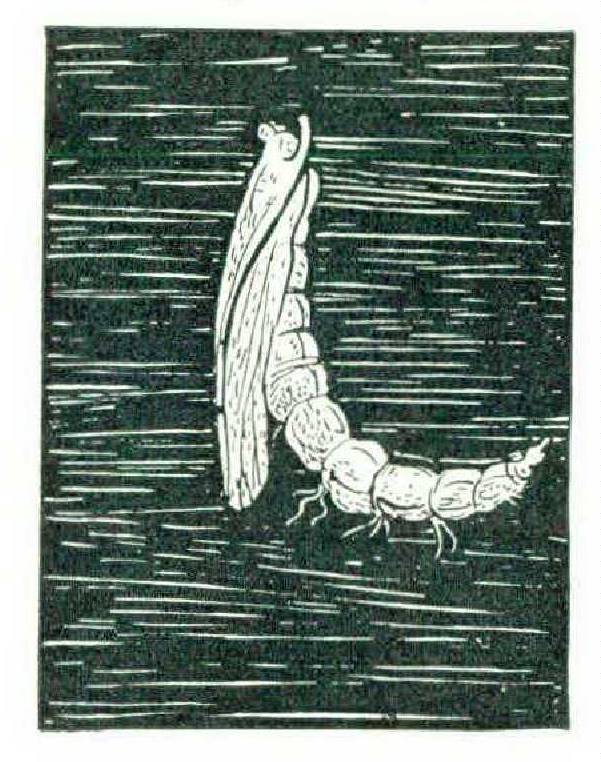
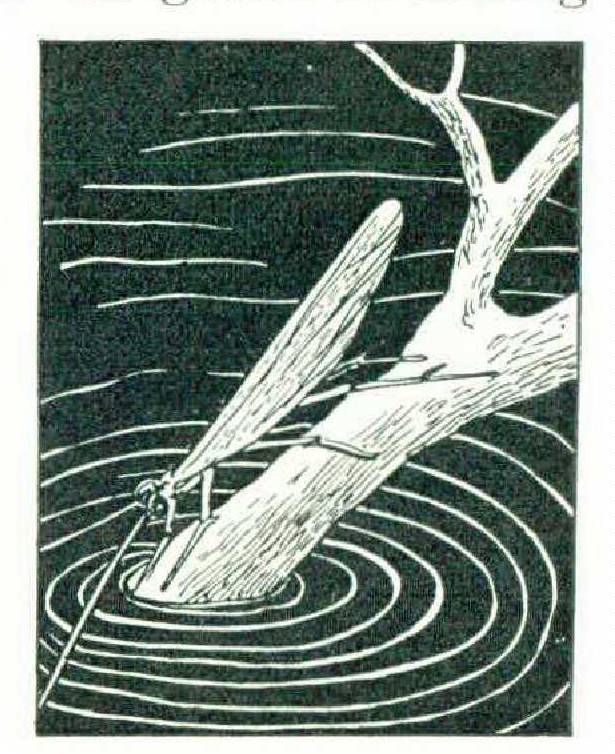
Now that her emergence time has come, she squirms her way to the grating, cuts its strands with her pupal teeth, stretches and strains through the ragged opening into the stream, and floats at once to the surface. There, if no fish or bird interrupts, she spreads her shoulders to split her pupal skin along the back and crawls quickly out on the raft it forms to extend her legs, her feelers, and finally her wings. She springs into the air above the stream and flies away as expertly as though she had been using her new wings for many months.
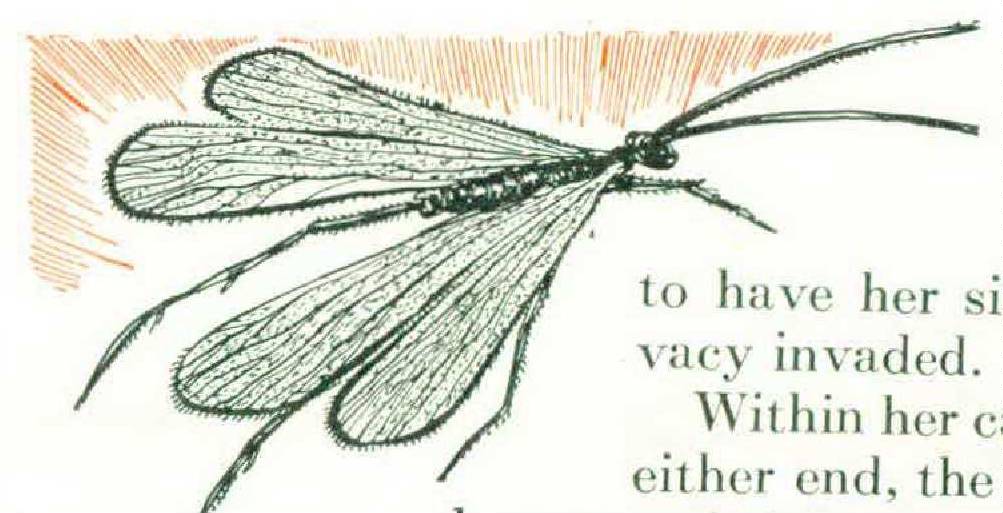
The caddis fly, for such she is, alights on a leaf of a near-by tree. She rests awhile to allow her body to harden in the dry air, and her eggs to complete the final steps in their development. Other caddis flies alight near-by, and by dusk hundreds of them hover over the stream and gather in mating dances above the treetops.
These phases of an active life are not so easy to observe as those which occur in the streams and ponds throughout our land. Few indeed have watched a caddis mother creep cautiously down a slanting branch into a stream, to lay her eggs like a jelly doughnut over the tip of a terminal twig.