The Ghost Crab

ALTHOUGH many people relax on beaches between Atlantic City and Rio de Janeiro, and although these sandy coasts are densely populated by ghost crabs, meetings of man and ghost are not especially common. The crabs are primarily nocturnal and not only stay in their beach burrows when the sun is high, but plug up the openings to them after retiring for the day. A slight wind drifts the fine sand enough to obliterate all traces of the crabs from a beach in which there are hundreds.
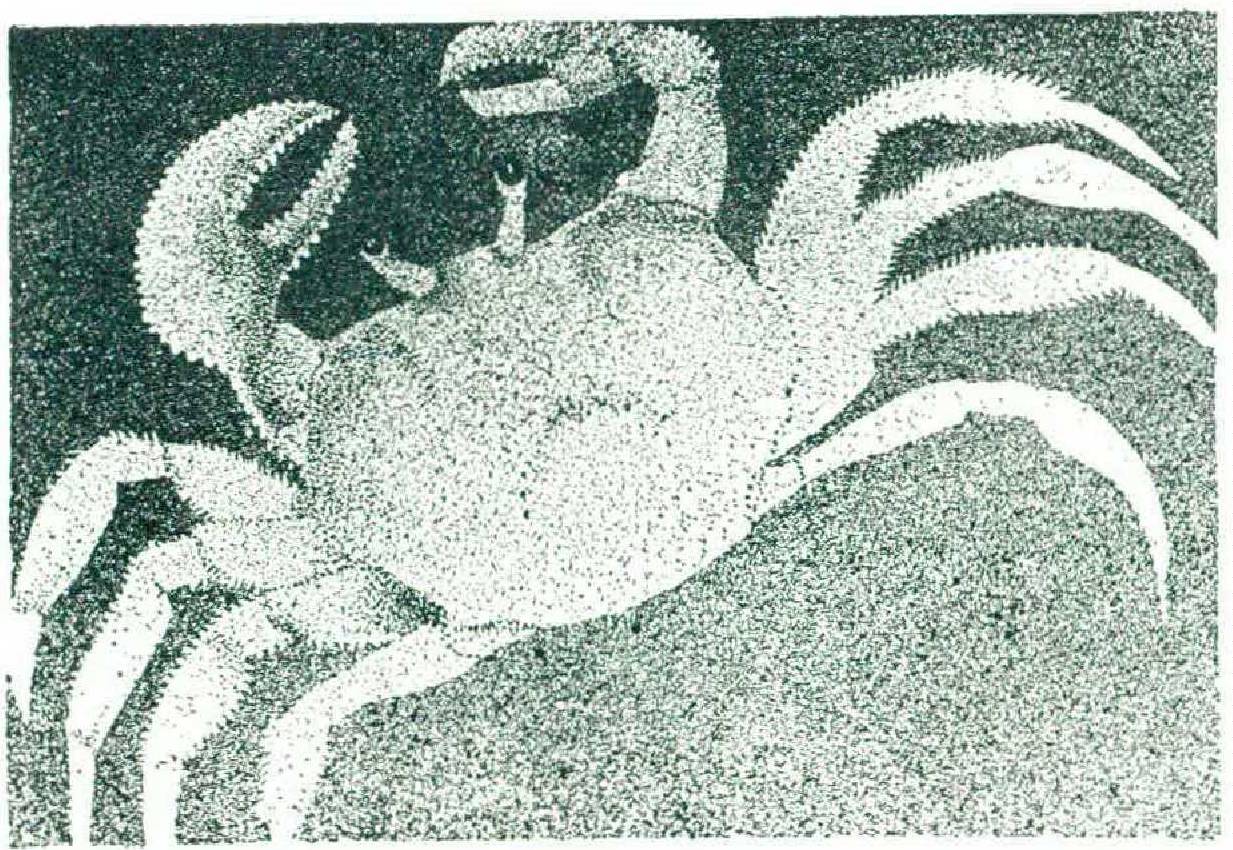
Toward evening, as people go home for supper and the sand cools off in the slanting rays of the setting sun, ghost crabs come out from their places of concealment and run over the beach. They appear one at a time, each standing awhile in the tunnel opening it has just cleared of its daytime plug of earth. The crab is a grayish-brown body with four good running legs of the same color on each side, and with a pair of white pincers and two upright stalked brown eyes. It blends well with the shadow in its burrow mouth, while it views the surrounding beach. Gaining confidence in what it sees, a crab will take another step. Suddenly it runs out lightly for a distance of several feet and stops to watch again.
Unless a person strains his eyes, the crab vanishes and earns its name of ghost. Its body changes to a creamy gray which blends perfectly with the sand, although its eight curved brownish-yellow legs hold it well off the ground and it casts a long black shadow. The legs, fringed with golden hair to which sand grains cling, arch away and back under toward the crab’s shadow, so that the animal stands on the outer surfaces of its sharply pointed, inturned claws. An extra pair of legs which end in pincers are near the mouth, held high, and to the crab are knife and fork, and spade and hod, a means of making love and war, and home and music. The crab uses its hand-like nippers for all these phases of its active life.
By dusk more crabs are running on the beach. Each moves quickly for a short distance, then pauses before continuing its intermittent course across the sand. At every step its eight sharp claws dig slanting footprints in the beach and make a trail such as hunters follow in a winter snow. When night has come, these tracks lead to the water’s edge, and there the crabs find cool relief for gills parched in the day’s dry heat. But the ghost crab is no swimmer and shows no liking for the sea. Each creeps out sideways to where the average waves just reach the shore, and there it waits, one flank toward the ocean, the other with its four sharp feet clinging firmly to the land. At last a larger wave comes rolling in and washes over the crouching crab. When the water recedes, the crab has had enough and hurries up to drier ground. It drips and stands to drain itself of extra moisture. Even its gill chambers are full of water, and the excess is blown out as bubbles which snap and burst among the pure white mouth-parts which hide the crab’s true jaws.
The ghost crab lives out the bargain made by Kipling’s crab. It “can breathe in the dry air " and only once or twice a night needs the sea to wet the spaces where its gills are hidden. The chambers are much larger than these gills require and are lined throughout with a net of blood-rich tissues in which the gas exchange takes place, oxygen from the air replacing carbon dioxide in the blood just as it does in human lungs. Indeed a ghost crab will drown in water. The gills have lost their aquatic usefulness, and the moist lining of the chamber must be exposed to air for the animal to breathe and live.
By midnight the ghost crab population of the beach is near the water’s edge, each searching for flotsam which the tide has lined up along the beach, or feeling with sensitive nippers in the still-wet sand where larger waves have come, finding tiny bits of food to be carried with quick, precise movements to the mouth-parts. Small fish, drowned insects, seaweed, and the lively little beach fleas which feed on even smaller bits of this same refuse of the sea — all these the ghost crabs find or catch and feed upon. Small ghosts are careful to stay well out of reach of larger crabs, while the latter watch each other with a wary eye, the largest having right of way whenever they advance with nippers raised. A full-grown ghost crab straddles nine inches, and is ready and able to do battle whenever dignified retreat seems needless or impossible.
Among the morsels which the ghost crabs seek is the meaty, egg-shaped body of a burrowing animal, familiar to seashore naturalists as Hippa. This is a crustacean too, but it hides in the sand beneath the washing waves or swims out to greater depths to disappear. Sometimes it is left when the tide goes out, and dead ones stud the beach drift until the crabs appear. To watch a ghost crab with a Hippa steak is a lesson in table manners. The crab holds the Hippa in its larger pincer, or perhaps in both at once, and eats away, manipulating the food as human beings do an ear of corn. Or using just the smaller nipper at great speed, the crab picks out tiny morsels as Orientals handle chopsticks. Sometimes a tough connecting fiber stops the meal awhile, and then the crab holds its food firmly in both pincers while horny jaws are brought to play upon the tightly stretched piece. Grinding and munching, the crab is far from its ghostly role, and seems more like an Eskimo wife chewing hides to make them soft. The ghost crab shows the complete gamut of human eating habits, good and bad, even to deftly picking its grinding teeth with the smaller nipper after every meal.
All through the night the ghosts haunt the beach. Until midsummer, large females wade out into the sea at intervals to wash the greenish yellow eggs glued to their swimmerets. The bulky mass keeps each mother from holding her broad maternal abdomen curled under between her legs in its customary place. Instead it droops as the young develop to the hatching stage. The parent gives her brood the best of care. In shallow water she clings to the bottom with eggs hugged tight against her when a wave passes over, but lowers her abdomen still more to expose her charges when the water has partly drained away and cleared itself of coarse, suspended sand. Sometimes when the waves combine in such a way that clean and quiet sea covers the standing mother, she opens the fold of her body just a little more, and quickly rocks completely upside down, to force refreshing water through the strands of eggs.
Ghost crabs show little fear of human beings on the beach at night. If a man lies down, they crawl over him, even enter pockets, and test his hands and feet as food by pinching them. They range the beach from damp sand to the dunes with their stunted vegetation. By morning every stranded sea shell, each log of driftwood, every clump of dune grass, has been investigated by one or more crabs. Early rays of the rising sun cast dark shadows in interlacing tracks of ghosts.
Toward morning the crabs cease their roving and busy themselves with burrows which they will occupy during the day. A few return to tunnels used before and take great care in smoot hing out the entries and rounding up the mouths. Others dig fresh passageways. Where a crab finds a beached fish which will serve for food, it makes a burrow at that spot. In the morning every cast-up carcass has its near-by tunnel mouth. The smaller crabs restrict themselves to areas near the high-tide mark, but larger ghosts dig passageways in dunes and beach far from the water. Most tunnels have a second exit to the surface, a back door from which no tracks are seen. The burrow may be U-shaped or Y-shaped, but the pile of earth is dragged or pushed from only one opening. The other may serve as an emergency escape route for crabs driven from their homes by larger members of their kind which enter by the main “front ” door.
Each ghost crab follows a definite plan in digging a burrow. The four running legs of one side do most of the work; always it is the side with the smaller nipper. With the four sharp claws the crab pulls at the surface of the beach, working up a lump of earth below its body. As the mound becomes uncomfortably large, the animal makes a basket of the digging legs, cupping them over the loose earth and dragging sand and self away from the hole by means of its other four logs. The large nipper remains alertly ready in case of surprise attack. Then over the mound it steps, back into the hole to repeat the process. In less than a minute the crab has a tunnel slanting obliquely downward and large enough to crouch in. The big pincer remains exposed.
As the burrow progresses from this point, the animal must make longer journeys from the digging site to the mouth of the tunnel, where it can leave the loosened earth. Each time it enters the hole, the forward eye is quickly dropped into a trough-like protecting groove, while the other eye watches for any possible danger. Sometimes a crab uses the larger pincer and the four legs on that side as a combined bulldozer blade, to push the sand out into the open. Clear of the tunnel, however, the earth is picked up again into the basket of the digging legs, and hauled uphill to be thrown from the top of the growing mound at the burrow mouth. A large crab weighs two ounces, but pounds of damp earth are moved as the passageway is extended several feet, slanting at a sharp angle into the beach.
Later in the morning each crab spreads out the mound of earth into a neat fan of level beach in front of the burrow mouth, filling in all hollows and evening off the surface, making countless overlapping tracks which fork and branch to end in tiny piles of sand. The sun dries out the moisture which holds the earth in rough masses, and the beach acquires a smoothness which gives no clue to activities in the early hours. The crabs trim the burrow openings of loosened sand, and as the sun becomes hotter or a breeze springs up to drift the sand, a plug of earth is formed at the tunnel mouth to hide its presence while the ghost remains concealed until the evening comes.
During the day a few ghost crabs come forth on errands they alone can know. Each blends with the beach except for two brown eyestalks and a black shadow. Even these escape one’s notice when the crab stands still. If pursued, the crab runs to its burrow and vanishes from sight; or if surprised and driven over unfamiliar beach, it shows another ghostly trick. Hurrying on ahead of you, and finding a small depression in the loose dry sand, the crab squats down and quickly works its legs and body into the earth so that only its upright eyes remain exposed, casting short black shadows as it watches for you to pass it by.
Then out it comes to hurry back to its burrow or quickly to dig another if you chased it far. For dogs which follow and discover such self-buried crabs, another surprise is ready for quick use. Two sturdy pincers grasp a tender spot, and all at once the crab lets go with one (the larger nipper) and sheds the other. This smaller pincer clings tightly while the crab makes good its escape, to grow another nipperended arm if fortune smiles.
The tracks a ghost crab leaves along a beach tell much about how it ran in making them. When coursing only at its own selected speed, the crab uses all four legs on each side, and leaves a trail of parallel footprints. But when pursued and hurrying off as quickly as it can, the crab holds its hindermost pair of legs clear of the sand and runs on six, three to a side. Perhaps this too is a mark of highly developed intelligence; eight legs may be two too many to guide in sequence at high speed.