Bitter Almonds
ByNEWMAN LEVY
CRIME detection, real and fictional, is not difficult if a simple but infallible rule is kept in mind: in real life, if all the evidence points to the guilt of a person, it proves that he is guilty; in fiction it proves that he is innocent.
For instance, if six people see A point a pistol and fire it at B (we crime addicts like to refer to our dramatis personae alphabetically), and if B thereupon drops dead with a bullet in his heart, it is not unreasonable to suppose that A killed B. Many judges and juries would, I believe, come to precisely that conclusion.
If the same thing takes place in a detective story, however, we can promptly cross A off our list of suspects and turn our attention to some other less likely candidate. It will undoubtedly turn out that the bullets were secretly removed from A’s gun and blanks substituted, and that the fatal shot was fired simultaneously by somebody concealed in the house across the street. Moreover, Ellery Queen, Philip Marlowe, or Sir Peter Wimsey, as the case may be, who invariably is hanging around the neighborhood where a crime is committed, will detect the odor of bitter almonds on B, thus proving that he was not shot at all, but died of a rare South American poison.
Let us suppose, however, that there were no witnesses present and that B’s inanimate body has been found under the conditions described. This presents a problem in detection that illustrates the difference between the methods employed in real life and in fiction.
Sherlock Holmes would gather up cigarette ashes from the rug and, after playing a short solo on the violin and giving himself a shot in the arm, would deduce that the murderer had been smoking a strange, exotic tobacco, pre-toasted and flavored with apple honey. This would demonstrate conclusively, of course, that A, who smokes cigars, could not possibly have shot B; and therefore C, who up to that point had not come into the conversation, was the guilty scoundrel.
Poirot would use his little gray cells. Father Brown would meditate mystically in the purple twilight and would pop up after a lapse of time, and for no apparent reason, with C’s name, address, and Social Security number. Nero Wolfe, after insisting upon payment of his fee in advance, would drink a case of beer and, somehow or other, arrive at the identity of the offender.
Our crude but efficient real-life sleuths would do none of these things — except perhaps drink the case of beer. It has been my fortune to be steeped in crime for many years, and I have observed that 95 per cent of the cases are solved in just one way — by information given by informers.
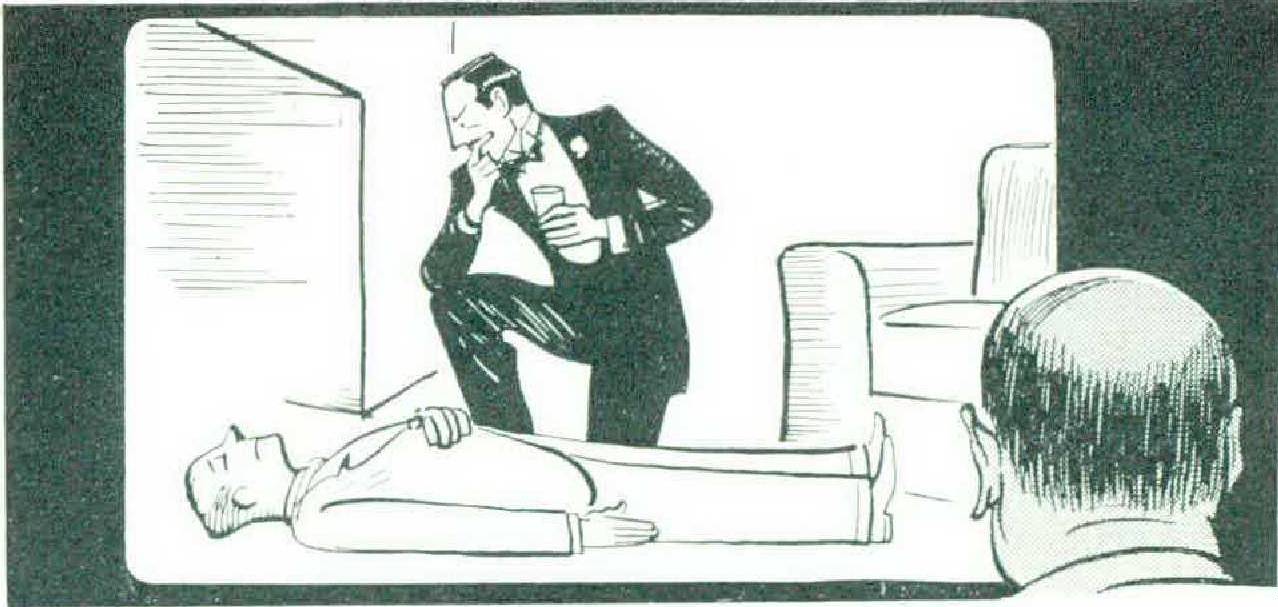
Our police, following their customary method, would round up a number of suspects (usually indicated to them by stool pigeons) and subject them to the genial method of interrogation for which our constabulary is justly celebrated. This technique, 1 hough lacking literary sanction, ordinarily brings results. If it fails, another batch is gathered in. If this second attempt does not do the trick, the case is then generally filed away in the limbo of unsolved mysteries.
I do not mean that scientific methods of crime detection exist only in mystery stories. They are valuable and frequently used. Fingerprinting, ballistics, chemical and microscopic analysis, are important instruments in building a case. For the greater part, however, they are important in proving guilt after the offender has been arrested. In most cases he is arrested because someone has told the police about him.
It has occurred to me that this dependence upon tips from informers and stool pigeons is one of the reasons why many of our best murder mysteries are never solved. If I were to list the ten best murders that a connoisseur would want to take with him to a desert island, I should certainly put the Hall-Mills case near the top. The Elwell case, the Starr Faithful case, the strange assassination of Dr. Elliott Speer, headmaster of the Mount Hermon Academy, and the recent Marigny case would also be included. Also, the mysterious murder of Carlo Tresca, with its overtones of international intrigue, surely belongs to this group. And if I were to delve into less recent history, I should find the Molineux case, the Nan Patterson case, and the Lizzie Borden case — all unsolved to this day.
These cases had to do with people who lived outside the borders of the criminal world, and with whose associates the police did not have the routine police contacts. Witnesses were examined, of course, but the police were hampered in applying the traditional technique of persuasion. This, it seems to me, is why, although most professional crime is quickly cleared up, the non-professional or amateur crime frequently goes unsolved.
The fictional detective is not limited by time, expense, or logic. Charlie Chan, on a hunch, can jump on a steamer in Honolulu and pursue his suspect to London without worrying about the strain on police department finances or the fact that he is going to look pretty silly if his hunch turns out to be wrong. This gives the fictional detective something of an edge on his brother in real life. Peter Wimsey, Ellery Queen, and Philo Vance are not interested in money or what the boss will say, since they pay their own expenses, but I have never run across that kind of detective.
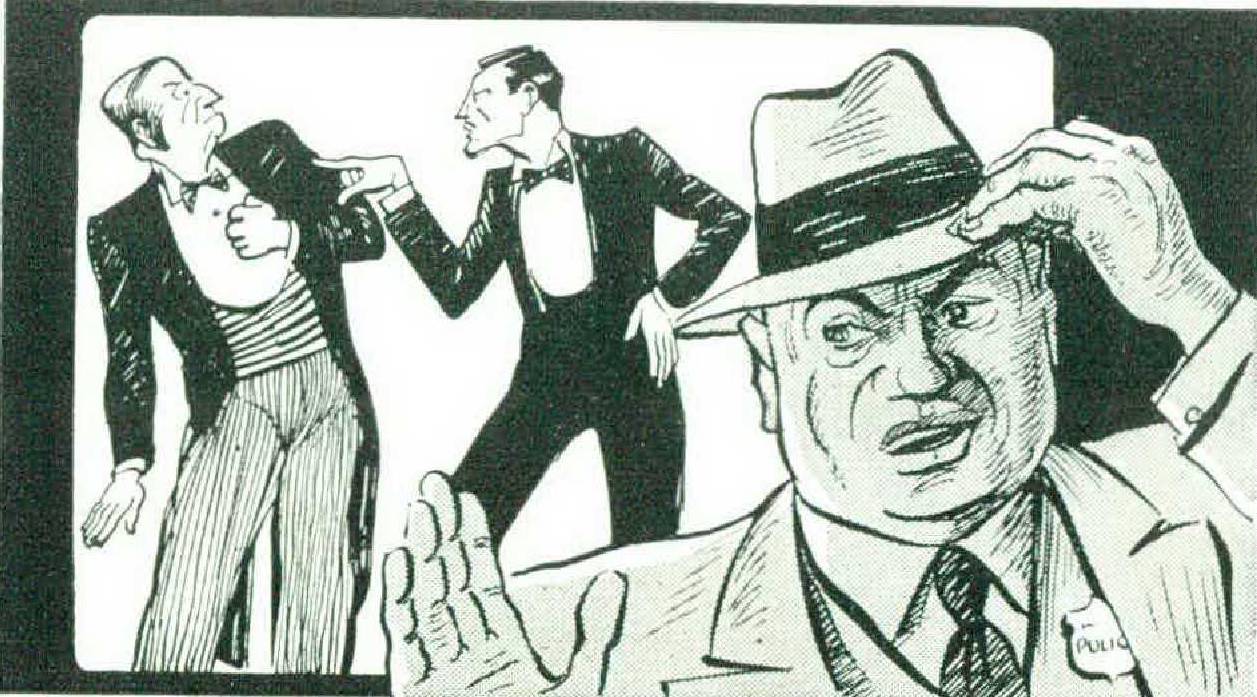
The police method is cruder but it stands up better in court. There is nothing like a good voluntary confession — and all confessions are voluntary by the time they reach the courtroom — to convince a stubborn, hardheaded jury.
I have often wished that I could have an opportunity to cross-examine one of the detective story maestros — Father Brown, let us say.
“You have told us, Father Brown, that you knew the defendant was guilty because —”
“Because he was wearing his hat turned the wrong way.”
“Precisely. Now haven’t you ever put your hat on the wrong way?”
“Yes, but — ”
“And haven’t you known lots of other people to do the same thing?”
“Well — er — yes. But there was something sinister about this hat; something wicked and sinful.”
At this point most judges, if not deterred by respect for the cloth, would hurl the judicial gavel at the witness and direct the jury to acquit. I believe it is because of this kind of evidence that fiction detectives often permit their prey to commit suicide at the end of the book. They know that their evidence will not stand up in court.
Many of the famous detectives in literature are private detectives. They engage in a variety of occupations apart from their sleuthing, such as schoolteaching, raising orchids, collecting ceramics, and ornamenting the British peerage. My experience with private detectives has been fairly extensive, but I have yet to meet one who can quote Euripides in the original Greek, or who has more than a cursory acquaintance with pottery of the Ming dynasty.
The hard-boiled school of detective literature, of which Dashiell Hammett is the dean, bears a closer resemblance to the real thing than does the orchidcollecting Picasso-fancier variety. Raymond Chandler’s Philip Marlowe, for instance, looks like a detective, and, in fact, frequently acts like one.
The private detectives I have known all have certain engaging traits that are so universal that I fancy they must be incorporated in the canons of ethics of their profession. Their one common characteristic is a magnificent artistry in fashioning an expense account. If you engage one to shadow or, to use the technical term, to tail a person, the trail will invariably lead him into the most expensive eating and drinking places.
It matters not that the habits of the subject (as the tailee is called) were previously frugal and abstemious. As soon as he becomes the object of espionage, his tastes expand and he develops a yearning for the fleshpots and the glittering places. The sleuth, who must remain unobserved, finds it necessary as a slave to duty to consume a seven-course dinner, topped off with Napoleon brandy, to allay suspicion.
In a case I had some years ago, it was necessary to hire a detective to follow a man who was taking an extended trip down South. Each day I received detailed reports revealing that my sleuth, undaunted by the dangers of acute indigest ion and delirium tremens, was doggedly pursuing his quarry into the Southland’s most fashionable restaurants and bars. Neither Chicken à la Maryland nor twenty-year-old Bourbon stayed this courier from his appointed round or caused him to flinch from the full performance of his duty. After two weeks of highly enlightening reports, I discovered by accident that the man I was interested in had not yet left New York. My detective had been following the wrong man.
I believe that professional detectives could learn much by reading crime stories. A New York detective once told me of finding a dead body in a hotel room; the cause of death was not immediately ascertainable. “Did you detect the odor of bitter almonds when you entered the room?” I asked him. He looked at me in bewilderment. “I don’t know what bitter almonds smell like,” he said.
There you have it in a nutshell. What can you expect of a detective force that isn’t taught what bitter almonds smell like?