The Water's Skin
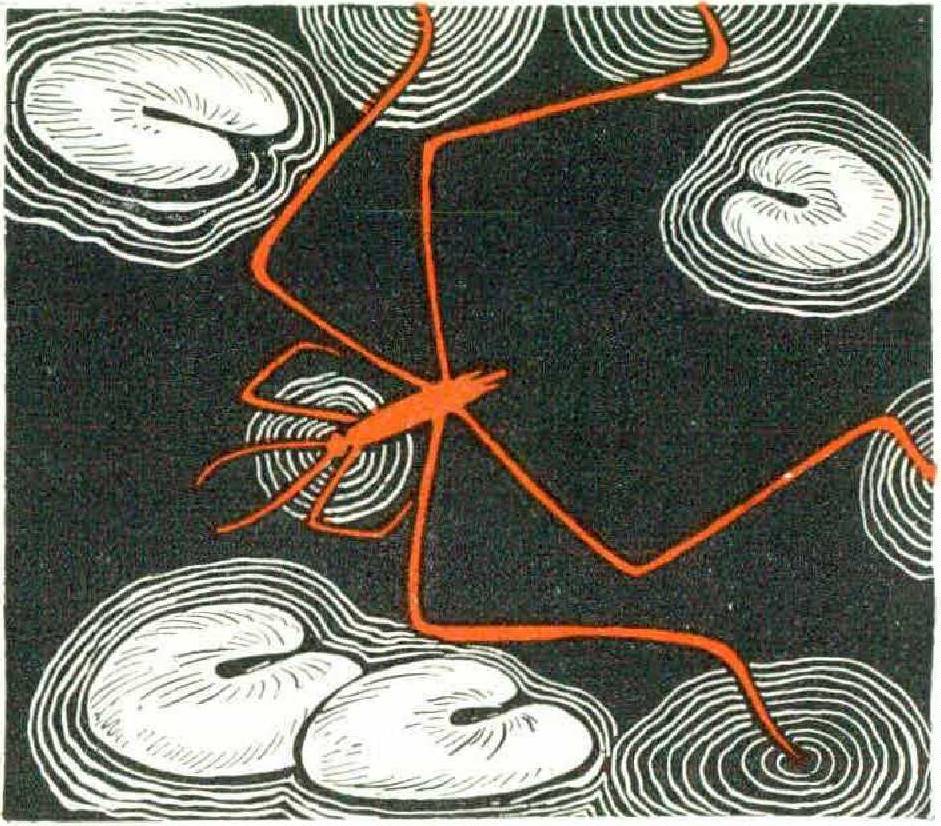
WHEN you sit by a pond or a winding stream, the city’s hurry drains away, and from the corners of the mind thoughts come out and sun themselves. Before you on the water, bugs and beetles skip about. They stay afloat because the surface tension of the water acts as a skin, elastic and smooth, that prevents them from sinking.
Two kinds of air-breathing insects are the most familiar users of the water’s skin. The shiny, black whirligig beetles zigzagging in groups on streams, ponds, and small lakes draw at tention to themselves by their hurried movements. They fascinate the small boy standing dry-shod on the bank. He wants to catch one, but the beetles are safe from cupped hands as they dart and spin. If alarmed beyond their gyrating system of escape, the whirligigs tip their tail ends up to grasp a bubble of air as they dive to the bottom. There they swim around and later surface like a submarine, some distance off, their glossy backs shedding water. The front pair of their six legs are long and slender; the other four are short paddles which whip the insect through the water.
The whirligigs often climb out on floating logs or lily pads to bask in the sun, but are off into the surface film at the slightest movement within sight. The beetles have a water line, below which they are really wet. This line passes through their compound eyes, which are divided actually into two, the upper half for vision into air, the other for watching the water’s depths. In winter the whirligigs crawl under fallen leaves along the banks or in near-by woods, and come out on warm spring days to seek their fellows on little pools or in quiet bays along the river. The female beetle lays her eggs on plants just above the water’s surface; there they hatch into aquatic larvae, which hunt for smaller animals within the pond.
The other commonly seen inhabitants of the surface film are the water-striders, known in Texas as “Jesus bugs,” in Canada as “skaters.” These insects are suspended in the same way that a clean needle can be made to “float” on water in a tumbler. They rest their weight on the short front pair of legs and on the outer third of the long hind pair, and use their middle legs as oars to push themselves along. Their waxy-haired feet press the water surface downward without breaking the film, and form elongate dimples which support them. Actually they ride the water as a result of a combination of surface tension forces pulling upward in the slanting sides of the dimples, and of the buoyant force of water displaced from these depressions in the surface.
It is very striking to watch one of these insects cleaning its legs a pair at a time, rubbing them together in the same way that a housefly does. First it cleans the front pair, the body being held unusually high above the water on the remaining four legs. Next it rubs a middle leg against a front one, lying down on the opposite side to elevate the appendages being cleaned. Finally it cleans the back pair; its head is almost in the water, the chin pressing into the surface, and the middle legs are brought far back to allow the abdomen to be raised up as far as possible.
Toilet completed, antennae brushed, the insect rows forth alertly to seek its fortune. This may be another strider or some floating carcass into which the bug’s slender beak may be thrust and food obtained. Many of their dashes over the pond surface are rewarded with a struggling leafhopper or other small insect which has fallen onto the water and is supported by the surface film. Water-striders dive upon occasion, but only under threat of serious danger. Afterwards they crawl out, wet and obviously miserable, to dry and comb themselves into respectability. All active stages in a water-strider’s life cycle are spent on the water surface, but for winter they fly or crawl (some are wingless even as adults) under leaves much as do the whirligig beetles.
Every so often a water-strider is noticed with a few bright red specks attached to it. On closer inspection, these are found to be the parasitic immature stages of the red water mite. The young mites suck nutritious juices from inside the water-strider. They weaken it a little but do not kill it. After a few weeks the mites drop off and shed their six-legged skins to become proper eight-legged relatives of the spiders. Then as adults, they run nimbly over the water surface, mate, and lay eggs on floating plants, where the young hatch and wait for water-striders or other pond insects. The mature water mites are very handsome with their bright, rich-red bodies. Their swimming is distinctive, for their eight short, hairfringed legs move so rapidly that the globular red body glides along smoothly, in contrast to the jerky movements of the pond insects and crustaceans.
Perhaps the largest walker on the water is the Dolomedes spider, which could straddle a silver dollar without touching it. These are tan-colored, with dark stripes, and are members of the wolf-spider family. They are seen often around boathouses on small lakes and rivers. They run out on the water surface mainly when traveling across some small bay or when driven from the shore by the approach of danger. Fish often snap them up if they hesitate — retribution in kind since these same spiders creep down into the water and snatch small fish in their murderous jaws. The female Dolomedes, like others of her family, does not trust her precious eggs out of her sight. She wraps them up in a creamy white ball of silk and drags the spherical bundle after her through the woods, out on the water, everywhere she goes.
A more frequent spider on the water’s skin is a smaller member of the same wolf-spider family. This is a very active, running spider, which nimbly skips and rushes from lily pad to shore and weed to weed, picking up food as it goes. Dead insects or live, it makes no difference, but the actual eating of the catch is reserved for the safety of some plant stem or the shelter of the bank. Like the Dolomedes, the small water spider drags her ball of eggs, and when the young have hatched, carries them upon her back and legs until they gain confidence to leave her.
Among the more spectacular yet seldom noticed inhabitants of the water film are the springtails, a group of minute insects which have a most unusual means of locomotion. Beneath the hinder end of the body, they have a long appendage, sometimes forked, which reaches forward to engage a catch between their legs. In use, the body is tensed so as to strain the appendage against its catch. Letting go of the catch allows the appendage to strike violently against the water surface on which the insect stands, throwing the tiny body high in the air, to fall somewhere else. For a creature so minute, air has an excellent cushioning effect, so that it lands without damage, often on its feet.
Ever since someone first dropped a piece of camphor into a dish of water, people have been amused to see the chip of waxy white gum dash here and there over the water surface. The explanation was far less interesting — the camphor chip dissolved non-uniformly, and reduced the water surface tension as it dissolved. The side where most was dissolving at any one time was the side where the water surface tension was most reduced momentarily, and the water opposite yanked the chip away. The same experiment may be performed with two toothpicks or wooden matches floated in a dish of water. After a few moments they will cling together in the center of their pond. If a slender, pointed stick of soap is pushed down to touch the water surface between the two toothpicks, the surface tension there is reduced and the water film beyond the toothpicks jerks them apart. II you have a cube of sugar to spend on the experiment, dip it into the water between the spread picks. Back together they come, since the sugar solution has a higher surface tension than the pure water, whereas the soap solution has a lower tension.
All this is entertaining parlor magic, but there is a little rove beetle, Stenus by name, which actually uses this trick. Stenus, like its close relatives, is a hungry little fellow with short wings, and flies around a great deal trying to find food. Often it makes a mistake and falls into water. But it merely expels from its anal glands a substance which lowers the surface tension at its hinder end, so that the water ahead of it can draw it forward rapidly like a toy boat, often causing the beetle to reach a dry object from which it can fly on again.
Even vertebrate animals may cross the water surface if they are quick about it. Barbour tells of small lizards in Central America, the basilisks, which are common around streams and ponds. When disturbed they rush across the water surface on their hind legs, with the fore feet folded against their sides and the tail raised to counterbalance them. Related lizards in Cuba do this too, but instead of hurrying to the opposite bank or some solid refuge, they run over the water merely to some quiet spot, where they stop, sink quickly to the bottom, and remain until they believe the danger has passed. Some of our native salamanders and newts can scamper across the water’s skin in much the same way, although they use all four feet and must touch the water along their bellies too. In all of these, the animal is kept from sinking by its nimble action, feet pressing down on the water and away again so quickly that the water cannot flow around, its own inertia no match for the speed of the animal.

- LORUS J. MILNE is a teacher, biologist, and biophysicist at the University of Pennsylvania and Beaver College.↩