The Omnipotent Oscar
“It will take a long time, however, before the Academy can dispel the popular impression that its annual awards amount to a mutual arrangement for the movie folk to pin medals on each other, all hands around.”
FOR the entire first quarter of this year Hollywood has lain soaking in a marinade of praise. Scarcely a day passed without scrolls of merit and plaques; diplomas-of-honor and golden apples being pressed upon it. Newspapers and magazines whooped; critics’ circles and loose federations of movie zealots fell all over each other in slavish haste to be first and loudest with hosannas.
One fan magazine alone struck off thirty-five solid gold medals commemorating The Valley of Decision as “The People’s Choice for 1945” on the assurance of the Gallup survey which said the same thing about Dewey in ‘44. And though actors, directors, and producers were hung with blue ribbons like premium fat-stock at a cattle show, all this hoopla is small beer compared to the annual award of Oscars by the Academy of Motion Picture Arts and Sciences.
Many of the earlier trophies were richer, and it is readily conceded that a year-end poll among the mass of filmgoers is a more accurate gauge of cosmopolitan partiality. But Oscar is still dearest to the mummer’s heart and none is called hadji until he has borne a gilt statuette away from the Academy’s annual rodeo of self-approbation.
This rapture flames hotter even than the fawnings of the trade press which require acknowledgment by a courtly exchange of compliments at rates up to $600 a page in two colors. To the theater managers who gave Darryl F. Zanuck an icon brevetting him as “Box Office Champion of 1945,” he, in turn, gave them each a handsome wrist watch.
Publicity is not the entire objective of those who seek the Oscar, which only their peers can confer, although it pays off heavily in that currency as well. The Academy’s press agent reported that the bestowal of the statuettes, and the windy ritual that goes with it, fetched more than 1400 full columns of space in the newspapers during the publicity-lean months of March and April, 1945.
The exercises this year, the eighteenth since the Academy of Motion Picture Arts and Sciences was founded, were held in Hollywood’s own vast echo chamber, Grauman’s Chinese Theatre. From habit, because the first fourteen annual awards were made at banquets, the function is still called the Academy Dinner. And it was during those first fourteen years that the affair degenerated to tournaments of shrill bombast with overtones of vainglory. Newspapermen who covered the events slyly quoted the prizewinners, line for turgid line. But during the last four years the tone of the proceedings has become successively more sensible, coincident with the Academy’s efforts to coordinate the best work of the creative elements in the motion picture industry.
The first year of the awards was also the last in which the art of writing titles for silent pictures was recognized. The title writers of those days were a snug and overpaid hierarchy whose arrogance was fabulous. They called themselves The Titular Bishops and wrote chits — but only to each other — on vellum engraved with a miter.
In that year also, Warner Brothers produced The Jazz Singer and this picture had to be memorialized in some way. So a special award was designated: For Marking an Epoch in Motion Picture History. Nothing lavish was intended here since the term epochal until recently was understood to be a degree slightly above terrific and a shade below boffo.
Until the 1943 awards, the annual prize revels of the Academy were gigantic bouts of oratory and tears. In the forensics handicap, Charles Curtis, a former vice-president of the United States, took on all comers and clocked off forty-live minutes of memorable tedium. The shortest speech on record was James Cagney’s when he took the Oscar for Yankee Doodle Dandy. He said, “Thanks. It’s nice to know what the people in his own business think of a man’s work. ”
Virtually all the lady medalists wept at their moment of victory during the banquet years. On accepting the totem, traditionally from the hands of the previous year’s winner, they would open the spillway, finally to be helped off the podium in a condition of restrained hysteria, and streaked with mascara.
The Hollywood Citizen-News reports a recent encounter: “When Anita Colby impetuously rushed up to Claudette Colbert following the premier of Tomorrow Is Forever and told her how wonderful she was in the role, Claudette broke into tears. . . . When she [Claudette] goes before the cameras she is like a finely strung instrument on which human emotions can be interpreted.”
During the Joan Fontaine-to-Greer Garson, or let us say the Suspicion-to-Miniver, exchange of compliments and the earlier Ginger Rogers-to-Joan Fontaine transfer of Oscars, all the soggy stops were pulled out to the nub. Mrs. Miniver opened the sluice a bit and coasted off on the “I-feel-just-like-Alice-in-Wonderland” theme. The retiring excellentissima joined her in about sixteen bars of keening. And from there La Garson took it for what seemed twenty full minutes of humid patter, during which strong men, taut with sirloin and large wines, went awash.
Unblushing braggadocio rattled the glasses during those early carnivals. An aging film magnate some banquets back, on handing the puppet to a younger aspirant, said, “My son — and I can call you my son — keep up the good work and some day you will be a great man — perhaps even as great as I am today.”
When accepting the Oscar, and while fumbling for his notes, the prizeman is most frequently constrained to begin: “My friends— and I can call you my friends — I can’t tell you how delighted and surprised I am.”
Delighted as he may well be, his surprise is pure rhetoric. No winner of an Academy juju has ever failed to show up at the proceedings to tell how the triumph startled him.
A cowardly rumor gets abroad every year to the effect that this perfect attendance record is maintained with the connivance of some gossip columnists who violate the release date on the earth-shaking results of the final ballots. This is denied again and again, but like the Hitlerian lie, it dies hard.
The Academy conducts the balloting with scrupulous fairness, and for their part the 8000 persons who voted this year employed their honest opinions. Yet there was vigorous electioneering by the studios and the contending artists as well. For, to have a film named as The Outstanding Picture of the Year means cash as well as kudos; another whirl around the theater circuits and an additional million dollars in its gross earnings.
While the studios campaign by means of heavy advertising inserts in the film-trade press, leading men glow with amiability toward bit players and electricians. A prima-cinerina notoriously waspish toward extra girls, particularly pretty ones, in the weeks before the voting, began lavishing perfumes, civility, and fifths of wholesome whiskey on all hands.
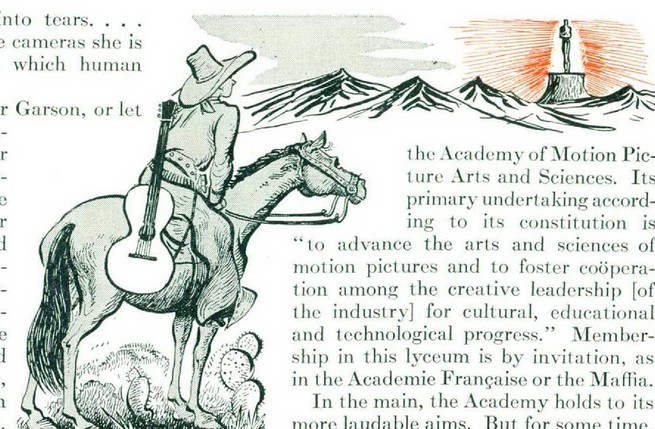
The institution of these prize awards, although the most advertised, is by no means the sole function of the Academy of Motion Picture Arts and Sciences. Its primary undertaking according to its constitution is “to advance the arts and sciences of motion pictures and to foster coöperation among the creative leadership [of the industry] for cultural, educational and technological progress.” Membership in this lyceum is by invitation, as in the Academie Française or the Maffia.
In the main, the Academy holds to its more laudable aims. But for some time, until 1936, it indulged in the risky business of union busting. After denouncing the Academy as “a producer-front to prevent organization of the talent guilds,” Dudley Nichols was offered the Oscar for his screenplay of The Informer. Had the Academy learned the lesson of that picture they would have been saved the ignominy of getting Dudley’s firm turndown.
It has turned over several new leaves since then and now asserts in printed matter designed for general distribution: “The Academy is entirely freed of all labor relations responsibilities and has no concern with economic or political matters.” It goes even further by saying in the amended articles of its incorporation that in the discretion of the board of directors it may “cooperate and or affiliate with any organization or association whose objective is the betterment of the motion picture industry as a whole. . . .”
It will take a long time, however, before the Academy can dispel the popular impression that its annual awards amount to a mutual arrangement for the movie folk to pin medals on each other, all hands around.
To some it is regrettable that only the nonpareil in each block of contenders is announced. Second money here is no money at all. In the general balloting, their writers, the actors, and the others concerned will never know how stood Boston Blackie Booked on Suspicion, A Guy, a Gal and a Pal, Both Barrels Blazing, I Accuse My Parents, and White Pongo.
Take Lights of Old Santa Fe — that color-drenched allegro of the untamed, untamable Border in which the thrum of a singing cowboy’s lute pierced the heart deeper than the bullets of a Colt have ever done.
One vote for it was certain. And there might have been two if that wretched collaborator of mine hadn’t turncoated on us and voted for Leave Her to Heaven.