Heavy Water?

TODAY, after seventeen years, I can remember everything about it. I can remember it better than I can remember last week. This is exactly what happened.
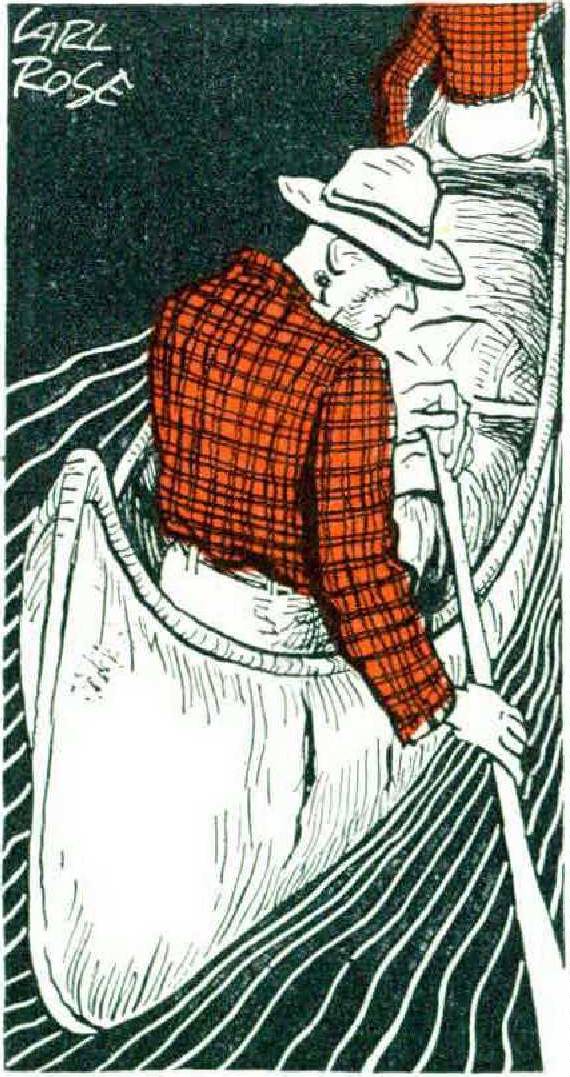
We were traveling westward along the water boundary between Minnesota and Ontario, four of us in two canoes. We broke camp early and, after a good breakfast of bannock and beans, set out lightloaded and strong-handed. We put several portages behind us during the morning, and by noon of a still August day had dropped our canoes into Rat Lake.
I think the name was Rat. It was an insignificant link in the chain of lakes that string out along the border—half a mile long, perhaps, with a low reedy shore, and rather foul-smelling. No one would expect anything unusual to happen on such a lake.
Nothing did at first. The water was absolutely smooth—like plate glass— except for the little wrinkles caused by the water bugs skating about on the surface. It was so clear and still that we could look down and see the black mud bottom stir under the moving shadow of the canoe. Long ribbonlike seaweed streamed up from the mud and waved gently, about four feet, I judged, beneath our keel.
Often in a canoe, you have little sensation of forward momentum — on a big lake, for example, with the wind in your face and the waves flipping over the bow now and then. But on a smooth, dead body of water like Rat Lake you really feel your speed. We put our backs into it and whipped along at a good pace about thirty yards from the shore.
I remember distinctly when I first felt that something queer was happening. Quite suddenly we had slowed down. There was a drag on the canoe. I had the strange feeling that we were being retarded by some invisible, mischievous force.
I remember pulling on the stern paddle until it bowed a little, then looking down to see whether we might not be aground. But we were afloat all right, with a good three feet of water between our bottom and the seaweed below. So I pulled on the paddle again, and with the same effect. It felt dead in my hands, without the little “kick” you expect at the end of a stroke.
And we weren’t moving—much. It was exactly as though we had swung suddenly into a stiff headwind or were bucking a strong current. Yet neither the surface of the lake nor the mud and seaweed on its floor gave any sign of current or other disturbance. Of this I took particular notice.
My partner, paddling in the bow of the canoe, had also noted our sudden slowdown; but his explanation for it was simple.
“Maybe I rest now,” he called back sarcastically over his shoulder, “and you paddle for a while.”
I looked across the lake at our other canoe. It was abreast of us, about twenty yards away, and obviously sharing our own difficulties. The bow paddler glanced over and sheepishly called out something about an old ladies’ outing.
For ten or fifteen minutes, I suppose, we struggled against this strange retarding power of Rat Lake’s “heavy water.” Then, quite suddenly, near the end of the lake, our canoes shot forward, as if given a good push from behind. And after that we made normal progress until we reached our portage. Again I took special notice of the water beneath us. I could see no difference between it and the stretch through which we had just struggled.
At the Stairway Portage, later that day, we met a guide to whom, somewhat self-consciously, we mentioned our experience in Rat Lake. But, in the manner of guides, he smiled enigmatically and said nothing.
Several years passed. Now and again I came across someone who had also traveled the border route, but never one whose experience had duplicated my own. I came to mention the incident rather diffidently, doubting somewhat the reliability of my own recollection. And then I happened across Sir Alexander Mackenzie’s Voyages from Montreal Through the Continent of North America to the Frozen and Pacific Oceans in the Years 1789 and 1793.
Mackenzie, like hundreds of fur traders in the eighteenth century, had followed the border “road" of lakes and rivers northward from Lake Superior. But he was an explorer as well as a trader, having reached the Arctic Ocean and the Pacific Ocean by this very route. And he had kept careful and detailed notes on all his travels.
In Mackenzie’s book I found specific mention of the very lakes through which we had paddled our canoes in the fall of 1929. Each name and each portage was noted and described with care. And on page lXXXiV I found this observation: —
They then embark on the Rose Lake, about one mile from the east end of it, and steer west by south, in an oblique course, across it two miles; then west-northwest passing the Petite Peche to the Marten Portage three miles. In this part of the lake the bottom is mud and slime, with about three or four feet of water over it; and here I frequently struck a canoe pole of twelve feet long, without meeting any other obstruction than if the whole were water: it has, however, a peculiar suction or attractive power, so that it is difficult to paddle a canoe over it.
There is a small space along the south shore, where the water is deep, and this effect is not felt. In proportion to the distance from this part, the suction becomes more powerful: I have, indeed, been told that loaded canoes have been in danger of being swallowed up, and have only owed their preservation to other canoes,
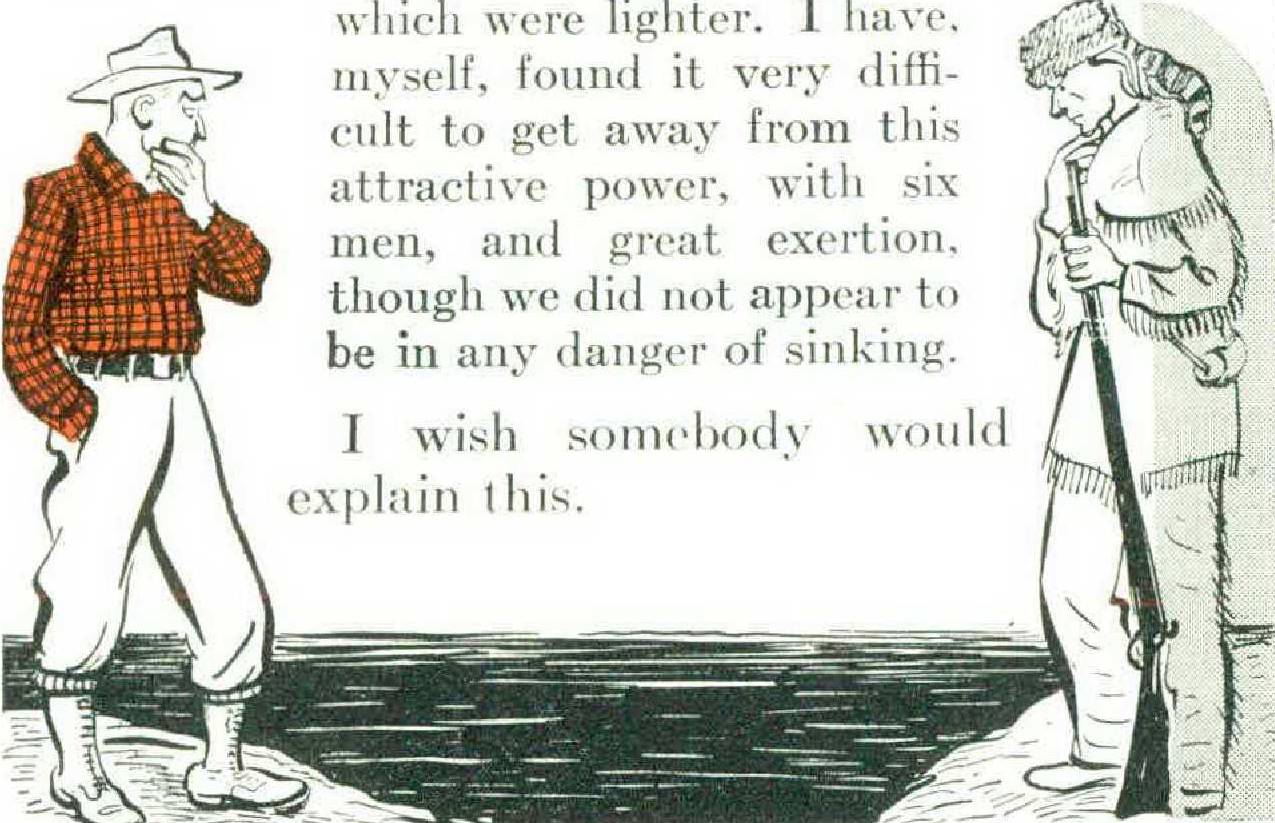
which were lighter. I have, myself, found it very difficult to get away from this attractive power, with six men, and great exrtion, though we did not appear to be in any danger of sinking.
I wish somebody would explain this.