Astronomy
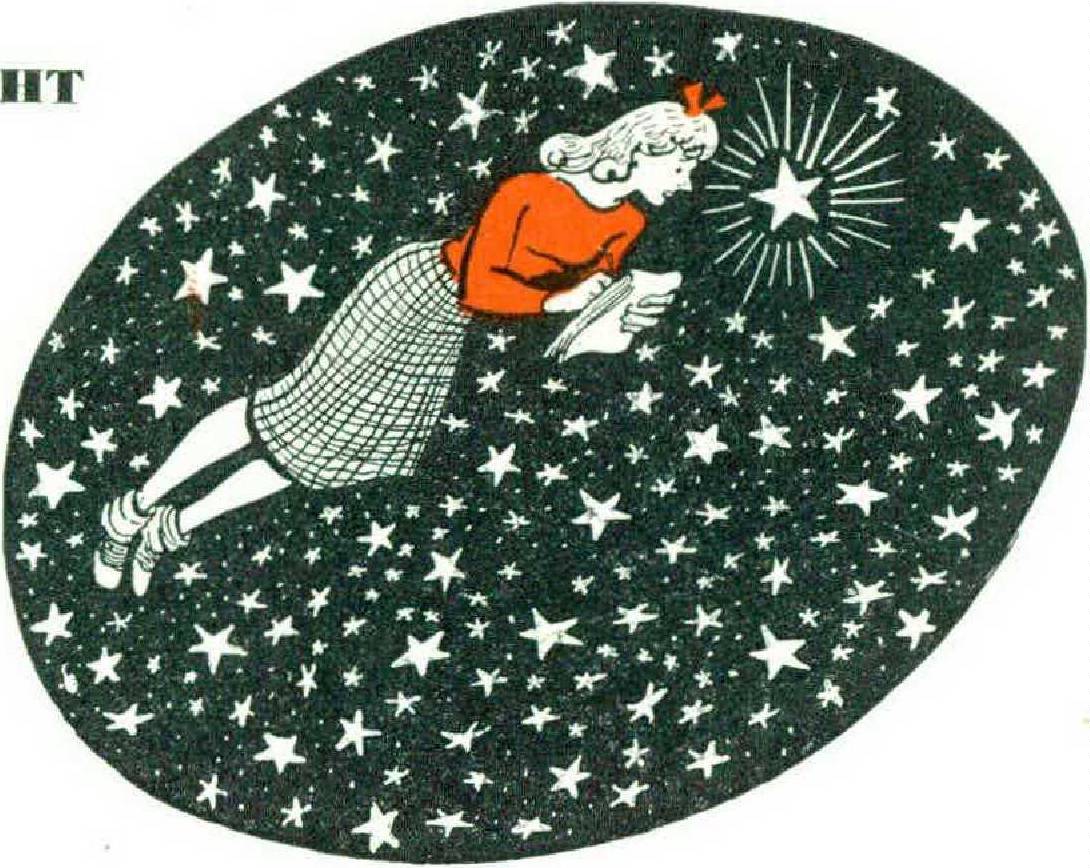
WHEN I went to college, astronomy was one of the subjects considered especially good for young women who, aside from a few teaching positions and secretaryships, had nothing open to them after graduation but the ancient and honorable profession of home-making. Not only was it considered beneficial: it was necessary for the completion of your science requirement — unless, of course, you chose to substitute botany or geology.
New students, freshmen and sophomores who didn’t know better, might sign up for these sciences, but juniors and seniors who had kept their eyes and ears open were too shrewd to be caught. They knew there was more to botany than the clear little flowers, more to geology than the harmless little rocks.
Astronomy was different; astronomy was safe. No exhausting field trips here — and even if there had been, Professor Brown was so old he couldn’t have taken them. He looked rather like Santa Claus, had a fatherly, indulgent attitude toward young women striving for a sheepskin, and wouldn’t think of giving any of them a bad mark. It was reported that never, never had Professor Brown given a student less than a C, and as a rule he passed out only A’s and B’s. Here was the course for the unscientific, the course for the impractical English majors.
The first day in Astronomy 1(a) was most enjoyable. So many students registered for it that it was a large class. Not all were permitted to take it, and I had anxious moments before I knew I was enrolled. It. was my senior year and it was now or never for astronomy. Professor Brown smiled at our eager, upturned faces. He gave us a little pep talk on the planets and we took our pens and notebooks and wrote: “Dear Parents, I’ve been so busy studying I haven’t had a chance to write until now” or “Dear Frank, I can’t tell you how thrilled I was to receive mv Princeton banner!”
Throughout the fall, Ast ronoiny 1(a) lived up to its reputation. Of course there were lab hours, which naturally had to come at night, but everybody followed old Dr. Brown out on the knoll where the tiny observatory was, and looked up at the sky and said, “Oh, yes, now I see!” and “Well, for goodness’ sake, imagine!” and then went back to the dimly lighted observatory classroom and made diagrams of the constellations, while Professor Brown withdrew to his study and said to ask him for help if we had any trouble.
Of course we never had any trouble when all we had to do was open our books and copy the constellations, or hold up one of the students who really knew something and ask her how the thing went. There was a sprinkling of these obnoxious people, some of whom were cagey and wouldn’t impart information.
Then there were the nights it rained, and we couldn’t go outside, but merely got our notebooks and personal correspondence caught up. On special occasions we looked at the heavenly bodies through the small telescope which the observatory boasted and which, I’m sure, wasn’t much more powerful than the one my’ son procured years later with the tops of two cereal boxes. Gravely, however, we peered into it while Dr. Brown carefully adjusted it. Being extremely farsighted, I could do much better with the naked eye, but I never said anything that would hurt Dr. Brown’s feelings.
Yes, everything was going wonderfully, and I was planning on pulling down an A in the course, which would do wonders for my general average, when poor Dr. Brown had a stroke. It didn’t kill him — in fact, he lived for several years in the comparative comfort he justly deserved — but it nearly killed most of the class.
In just a week’s time we had a brand-new professor, a lean, zealous, maiden-lady Ph.D., and from that day on, the heavens were dark and glowering. The new professor was determined to have us know what we were supposed to know. She wouldn’t take no for an answer, or if she did take it she also put a red D beside it. Mathematics not only began to creep into what had been a peaceful science, but to dominate it. You had to know exactly how many miles or light-years things were from one another and draw diagrams of everything.
Lab hours became hours of torture. While the botany and geology students were resting their fallen arches at night, sitting around in their kimonos, stirring up fudge in their chafing dishes, and twanging “Moonlight Bay” on their mandolins, you were miserably trekking in the dark and the cold to that horrible observatory. No letters to dear parents or dear Frank, no conscience-free cribbing from the book and the brainy ones. Alone you stood and alone you fell.
Just before midyears an embarrassing conference made it distressingly clear that I was flunking Astronomy I(a). Impossible! Why, nobody ever flunked that. Everybody got A’s and B’s. Ah, but that was in the days of dear, kind Dr. Brown, not the days of the grim, fiendish follower of Galileo with whom I was having the interview.
Well, I passed it, but at what cost of sleepless nights and care-filled days! Hours and hours were taken from Milton, Shakespeare, and George Eliot and spent on the solar system. I passed with a D minus and after breathing a short sigh of relief was plunged into the second semester and into Astronomy I(b), which was even worse. Throughout the winter and spring I slaved at that observatory, watching the constellations assume with diabolic humor different positions in the heavens so that I would have to graph and compute them all over again. At the final examination I once more prayed and sweated and came out with another D, this time a straight one.
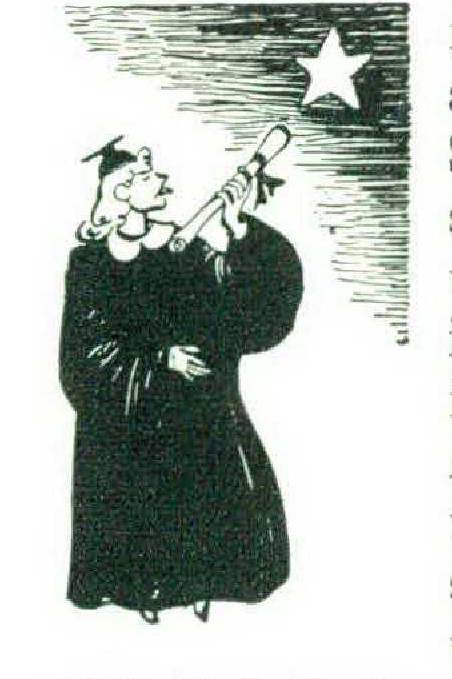
I got my sheepskin all right. It was a long time, however, before I was able to look up into the sky at night with any pleasure; a long, long time before I could forget what I had learned and gaze up at the stars with honest enjoyment, give a healthy, hearty sigh and exclaim, “What a glorious night! I wonder if I can find the Big Dipper!”
- PuiscnLA HOVKV WRIGHT went into newspaper work after her graduation from college, and is the author of several short stories, a novel, and two books of humor. She lives in Braintree, Massachusetts.↩