The First Military Airman
FACTS
ByTOM MAHONEY
AUSTRIAN soldiers besieging the town of Maubeuge in northern France excitedly aroused their officers one May morning in 1794 to report a radical new development in warfare.
Above the town, which was being defended by the rag-tag French Army of the Sambre and Meuse, floated a big pear-shaped bag. It supported a man and was held in leash by long ropes trailing to the ground. Nothing like it had ever been seen before on a battlefield.
“It’s a balloon!” exclaimed an officer who had traveled. “The Montgolfiers have made them in this devilish country for some years.”
Howitzers were elevated in an effort to shoot down the awesome object in the sky, but it was out of range of all the Austrian guns. Meanwhile, the fire of the French artillery became increasingly accurate, and it became obvious to the frustrated invaders that the balloon’s observer was correcting i he aim of the gunners. Surprise and annoyance gave way to consternation in the Austrian camp.
“This is an inhuman violation ol the laws of war, raged one commander. “That man up there is spying on us. Issue orders that every balloonist captured will be shot as a spy.”
The orders were issued and copies were thrown into the French lines, but the balloon rose again on the following day. The devastating artillery fire continued. With the morale of his men very much cracked by the “secret weapon” of the enemy, the Austrian commander broke off the battle and with his Dutch allies retreated to the north. Military av iation had won its first, victory.
It also placed in history as the first military airman, young Captain Jean Marie Joseph Coutelle, the gallant and lucky Frenchman who had gone aloft. His balloon represented long and difficult work on the part of Captain Coutelle and several French scientists. The leading spirit in the undertaking, however, had been a magistrate of Dijon named Guyton de Morveau. He had been aloft and was convinced that balloons could be used for military observation. When named to a body appointed by the ruling Committee of Public Safety to apply scientific discoveries to the service of embattled France, Morveau obtained an appropriation for a balloon and the services of Coutelle, who was serving in a line regiment.
Young Coutelle was chosen been use he had studied physics under the great Dr. J. A. C. Charles, the first man ever to inflate a balloon with hydrogen and also the first to forecast air mail. In 1784, he had written: “Let us not forget lhat the balloons give the possibility of carrying loiters and other articles over the enemy’s army, can ask for help, and probably can. when snow leaves t he countryside, profit by the winds and leap over the mountain barriers to communicate the important news.” Dr. Charles had imparted boldness as well as science to Coutelle.
Sulphur was needed so badly for the making of gunpowder that the Committee of Public Safety stipulated lhat sulphuric acid should not be used for making hydrogen in the usual way for the balloon. Antoine Lavoisier, the chemist who later died on the guillotine, however, showed how the gas could he made by passing steam over red-hot iron. The Committee also left to the enthusiasts the task of inducing the French Army to accept a balloon.
Captain Coutelle was dispatched on this errand and arrived, dusty and weary, late at night at the Army of the Sambre and Meuse and demanded to see the commander. General Jean-Baptiste Jourdan. Instead he was confronted by one Duquesnoy, a representative of the government with the army. He at first regarded Coutelle as a spy and, when the balloon proposal was explained, as an insane man. He threatened to have him shot for taking up time with “ridiculous proposals.”
The noise brought out General Jourdan, who proved more open-minded. He was not afraid of new ideas. He had been a sergeant before he became a general and he later would be a marshal of France. He agreed to use a captive balloon if it would support two men and if it would be thoroughly tested in Paris before being sent to the front.
Mention Castle, formerly an artillery barracks, was converted into a balloon factory and school. Aftercareful calculations, Coutelle and his assistants constructed a balloon 10 meters in diameter and some 160 cubic meters in volume. A special linseed oil preparation was used to treat the light fabric envelope. A basket for the pilot and observer was suspended from a net, and two long cables were dropped from the net to the ground for control of the balloon, which was christened “The Enterprise.”
Three days and three nights were required for the first inflation, but by April, 1794, this had been speeded up a bit, and a corps of balloonists, the first in history, was organized under Captain Coutelle. Next in rank was Lieutenant Delaunay, a carpenter in civil life. There were a sergeant major, four other noncommissioned officers, and twenty-six men. The uniform was blue with a black collar and facings trimmed with red braid. Each man also had a blue working suit.
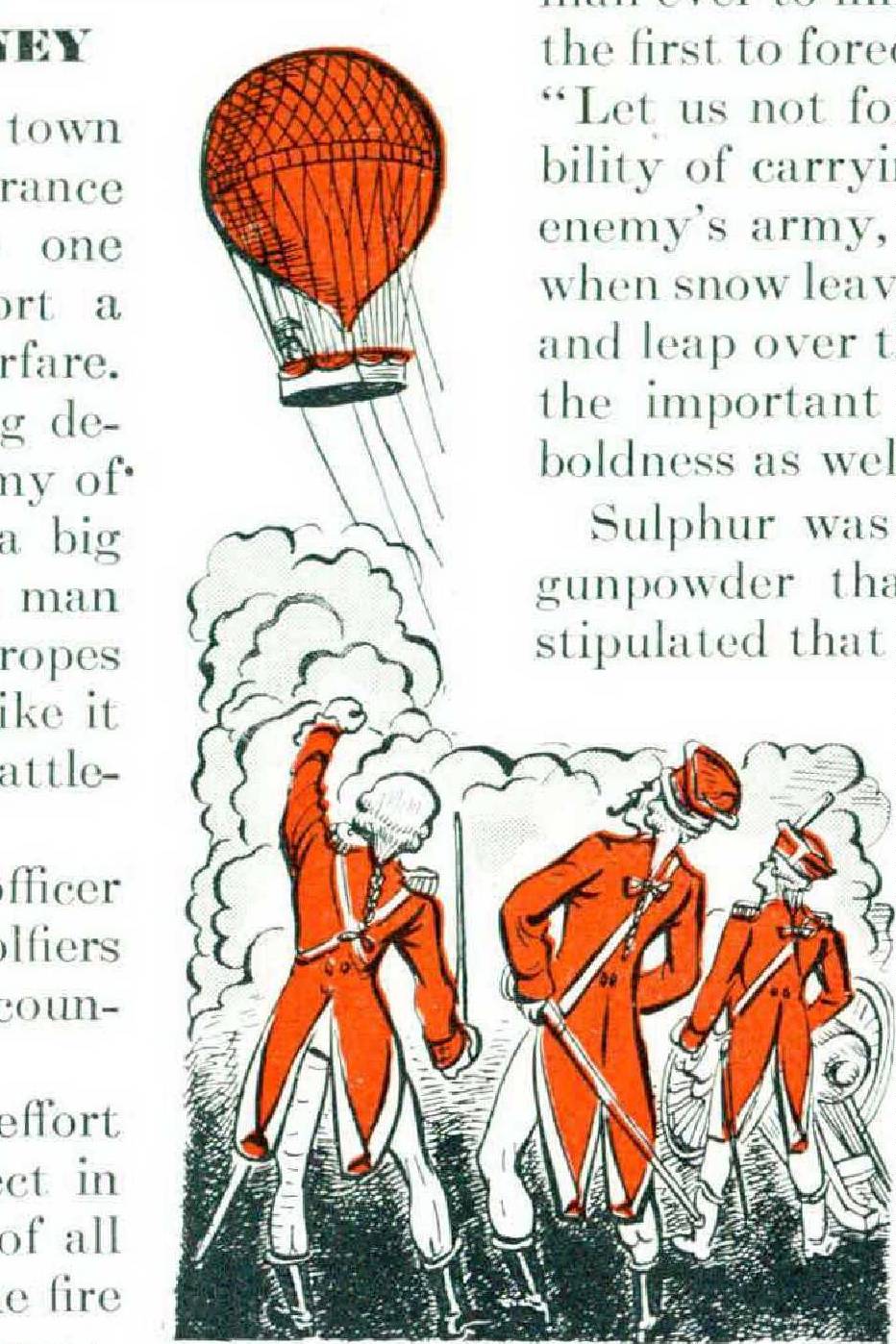
The company was idle several days after joining Jourdan’s army at Maubeuge, because an oven required in the hydrogen-making process was delayed. In the interval, the balloonists were the butt of some ridicule, and to prove their bravery they took part in a ground sortie in which the lieutenant was killed and two of the men were badly wounded. Soldiers, however, cheered “The Enterprise” when the balloon finally rose from a schoolyard carrying Coutelle first alone and then with a companion. The first observations were made from 500 meters with the results already noted.
A French force pursued the fleeing invaders; and to avoid deflating the balloon, Coutelle’s men “walked” it twenty miles through the night toward Charleroi. It was used two or more times daily by the French for several days with General Jourdan sometimes going aloft himself. It contributed to the defeat of the Austrians at several places, notably Fleurus.
Thomas Carlyle in his classic history of the French Revolution wrote: “Over Fleurus . . . hangs there not in the Heaven’s vault, some prodigy, seen by Austrian eyes and spyglasses: in the similitude of an enormous windbag, with netting and enormous saucer depending from it? A Jove’s balance, O ye Austrian spyglasses? One saucer scale of a Jove’s balance. By Heaven, answer the spyglasses, it is a Montgolfier, a Balloon, and they are making signals! Austrian cannon battery barks at this Montgolfier; harmless as a dog at the moon; the Montgolfier makes signals; detects what Austrian ambuscade there may be and descends at its ease. What will not these devils incarnate contrive?”
Before Charleroi, which was occupied by the Austrians, the “devil” Coutelle and a General Morelot remained aloft eight hours. They signaled to the ground by flags and dropped messages in weighted bags. Convinced from what he saw that the place could not hold out, Morelot was about to attack when the balloon-fearing Austrians obliged by surrendering.
Morelot and Coutelle went up in the balloon a I Gosselies and another French victory was credited there to air observation. The balloon traveled widely until the spring of 1795, when Coutelle’s unit joined the Army of the Rhine attacking Mayence. A violent storm caught “The Enterprise” in the air, smashed it to the ground three times, and wrecked it. Coutelle barely escaped with his life.
Five more balloons had been built meanwhile at Meudon and a second company of balloonists organized. These carried on while Coutelle recovered his health, but the luck of the pioneers was at an end. Two more balloons were wrecked by storms. A debated one was abandoned to the enemy in Germany.
When Napoleon embarked for Egypt, Coutelle went along with one of the remaining balloons. Admiral Nelson’s English fleet, however, intercepted the French ships at Aboukir and the balloon was burned. Coutelle escaped, explored the Nile, and recorded weather conditions at Cairo. But his career as a balloonist was concluded. He retired with the rank of colonel and died in bed some years later at Mons, where he had been born.
Though an artillery officer, Napoleon was strangely lacking in appreciation of balloons. When he returned to France, he disbanded both companies of balloonists, closed their school, and had the remaining balloon sold. The Emperor even developed a definite superstition about balloons. A great colored bag carrying 3000 lights was sent up in Paris as part of the ceremonies of his coronation. It blew to Rome, passed over St. Peter’s, and before settling into a lake dropped part of the crown it carried on the tomb of Nero. Napoleon regarded this as a bad omen and forbade mention of balloons.
Waterloo, his final defeat, was fought in the same part of Belgium where “The Enterprise” had helped Jourdan to victory, and a balloon might have reversed the outcome. Because the great Napoleon failed to pursue the balloon development, it was some seventy years before military aviation again had serious attention and Professor T. S. C. Lowe took to the air in the American Civil War.