On the Recorder
MUSIC
BY CARL ANTHON
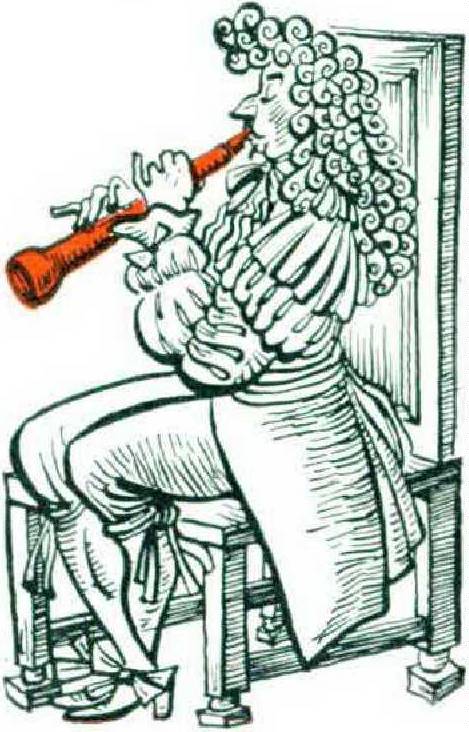
ON February 27, 1668, after attending a performance of The Virgin Martyr by Philip Massinger, Samuel Pepys noted in his diary: “That which did please me beyond anything in the whole world was the wind-musique when the angel comes down, which is so sweet that it ravished me, and indeed, in a word, did wrap up my soul so that it made me really sick, just as I have formerly been when in love with my wife.”And he continued, saying that he remained “transported" all night, and resolved henceforth “to practice wind-musique and make my wife do the like.
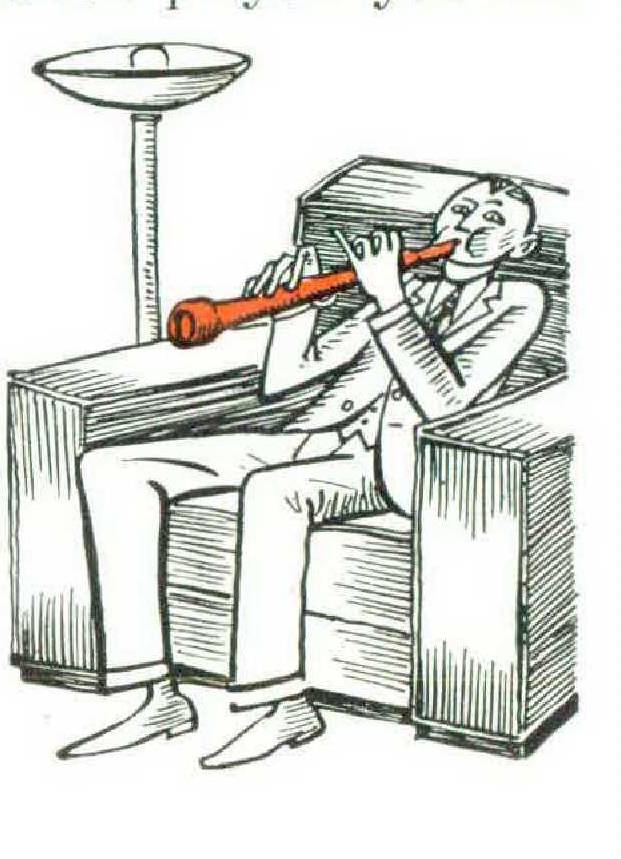
The wind music which Pepys had heard that night was a consort of recorders or vert ical flutes. Recently the recorder has again become very popular, but who on hearing an ensemble of them today would speak of the experience in such extravagant language?
In reading Pepys’s description one has visions of a schoolgirl flushed with excitement after her first dance. But Pepys, a practical-minded, responsible official at the Navy Office, was no mere sentimentalist; he knew what he was talking about. He was a capable singer and a performer on the viol, violin, and flageolet, and was thoroughly at home in the world of music. So captivated was he by the charm of the recorder that a few weeks later he went to Drumbledy’s to buy one, “the sound of it being, of all sounds in the world, most pleasing to me.”
Recorders can be heard frequently today in our schools, in the concert hall, and in the home, but what is the first reaction of the casual listener? Anyone knows the sharp dissonance resulting from two consecutive half-tones struck simultaneously on the piano. Imagine the same discord multiplied by ten, and you have the cacophonous effect of many a recorder ensemble. Unlike Pepys, you feel fit to be tied. Of course, the picture is different when you hear the Trapp Family perform on their excellent German instruments, or when you come across some really good players; but even then one is inclined to be disturbed or amused by the unaccustomed sounds.
What has happened? Has our musical taste changed, or is the recorder of today different from the recorder of Pepys’s day? That there was something uniquely beautiful about the tone of the recorder in his time is borne out by ample contemporary evidence. Besides Pepys, many other writers and musicians have left us descriptions of it, and they all agree on one thing - the incomparable gentleness and purity of its tone. In many passages Sir Francis Bacon refers to its sweet and solemn sound, and in Paradise Lost Milton speaks of “flutes and soft recorders.” The very name by which it was known on the Continent, flauto dolce (soft flute), characterizes its quality. Whenever angelic, heavenly music was required in a play or opera, recorder ensembles were invariably used.
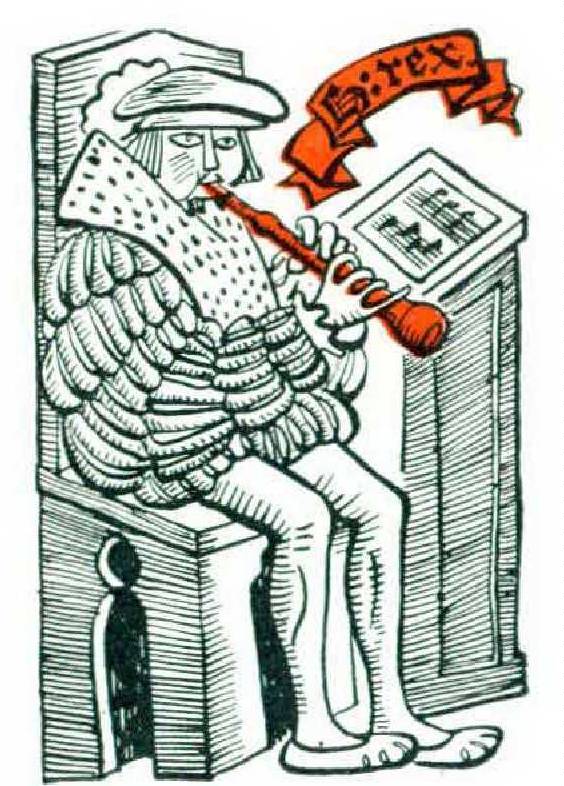
Our generation may be relatively immune to the charm of the recorder, and certainly no busy statesman or captain of industry would feel greatly exalted playing ditties on it. But in an earlier age it was the rage. Of Henry VIII, Holinshed says in his Chronicles that he exercised himself daily in “plaieing at the recorders, flute, virginals, in setting songs, and making of ballads.”
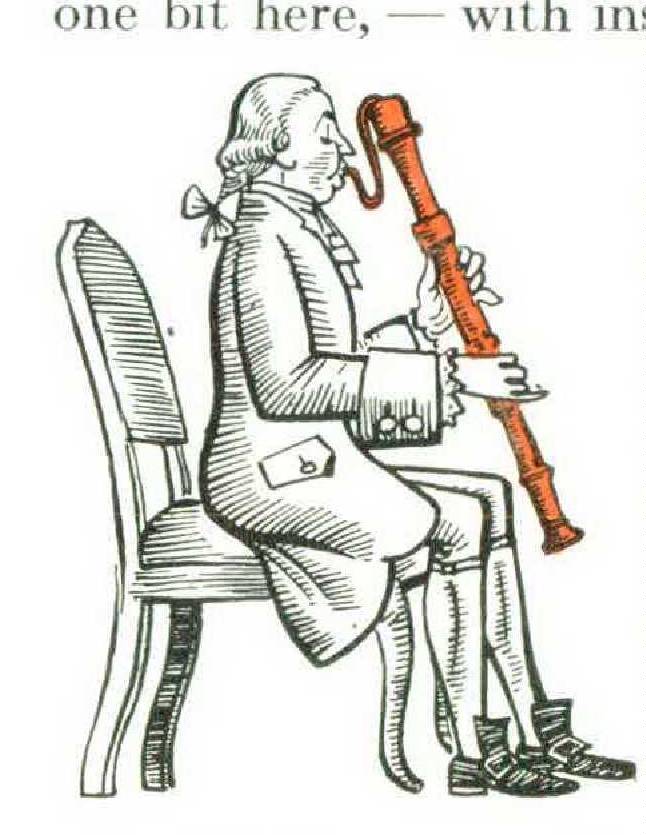
Indeed, the monarch owned no less than seventysix recorders of all types and sizes. Twenty-seven of them were made of ivory; some were ornamented wit h gold and silver. There were tiny “sopranino" recorders, no more than eight inches in length, as well as huge basses, more than nine feet long, whose lowest openings had to be operated with pedal keys. As was true of other wind and string instruments of the time, recorders usually occurred in “chests" or sets of four, sometimes even eight, different sizes; the string quartet is the only present-day survivor of that combinat ion.
Something has obviously happened to our musical taste. The modest little pipe that once gave immense gratification to fastidious kings and courtiers simply does not provide a medium of expression for modern sophisticated man. Until the death of Handel, the recorder was the flute most commonly used; after that it was dislodged from its pre-eminent position by the more versatile and more boisterous, transverse flute. The modern Boehm flute has given us a richer, louder, more accurate tone, but it has sacrificed the gentle, chaste qualities of the recorder.
The same evolution toward more volume and virtuosity has taken place with other instruments. In place of the sensitive, reserved clavichord and the aristocratic harpsichord we have today the piano, capable of an infinite variety of expression and also of much greater volume. The subdued viola da gamba has given way to the lyric cello, and the unassuming viol to the violin. It is perhaps an exaggeration to assert, as does the famous harpsichordist, Wanda Landowska, that the history of musical instruments is the history of noise and more noise; but that noise is an accompanying feature of modern instrumental development there can be no doubt.
Despite its shortcomings the modern recorder has certain advantages over other instruments and can perform an important function in our musical life today. It is very easy to play, and to play well; yet it is not a toy like the ocarina or the harmonica. Hamlet was right when he indignantly chided Rosencrantz and Guildenstern for trying to “fret” (that is, play on) Hamlet when they couldn’t even play the simplest, of musical instruments, the recorder. “ ‘Sblood, do you think that I am easier to he played on than a pipe?" “’Tis as easy as lying,” he had said, showing tin; recorder to Guildenstern. “Govern these ventages [finger holes] with your finger and thumb, give it breath with your mouth, and it will discourse most excellent, music.”
It’s as easy as that, and yet why is it played so badly today? Two things are at fault: a poor instrument (for many people regard it as a toy), and failure to use the ear. Hence, when a group of enthusiastic players get together, — and enthusiasm doesn’t help one bit here, — with instruments vastly different in quality, and ears unaccustomed to listening, the result is inevitably one of insufferable caterwauling. The pitch of any one tone can be changed by both fingering and breathing, according to whatever the ear dictates. It is a pity that so many music teachers fail to train the ear of their students along with the instrument. It is possible to acquire a tolerable fluency on the recorder within a few weeks so as to play sonatas by Handel and Telemann. The unique feature of it is that after a long interval of no practice one can pick up exactly where one left off, whereas with any other instrument, failure to practice constantly would mean a setback. The recorder is therefore the ideal traveling companion, for it can be taken along in the coat pocket and is always in “playable” shape. I have played it among tall Douglas firs in the primeval forests of Oregon, and in the seclusion of my stateroom on an ocean liner, and I know of many soldiers who have taken along a recorder to North Africa and the South Pacific.
A word of advice about purchasing a modern recorder. Before the war, most recorders were imported from Germany, where they were so popular that almost every family owned at least one. In recent years American manufacturers have turned out large quantities of them, mostly of plastic materials and often of inferior quality. But I he connoisseur will look for a carefully made wooden instrument that is perfectly in tune from the lowest to the highest note. Of the four sizes now made, descant (soprano), treble (alto), tenor, and bass, most people unfortunately prefer to buy the descant, the highest in pitch, for reasons of economy. It is likely to be shrill, and the literature for it is extremely limited.
The treble recorder, on I he other hand, at. the time of Bach and Handel was a full-fledged chamber-music instrument and can be used as such today in conjunction with piano, violin, and cello, as well as with other treble flutes. The more ambitious player will soon reach out for the more difficult and satisfying Brandenburg concertos and many cantata movements of Bach. The solo flute parts of the second and fourth Brandenburg concertos were written for treble recorders, but in the absence of capable players these parts are now performed by transverse flutes in our sym phony orchestras.
If you already play a musical instrument, you do not need a teacher to learn to play the recorder. There are very few recorder teachers anyway, and those that do teach it. are themselves self-taught. You can buy a little instruction book for a few cents, and after you associate with a few players you will soon get ihe knack of proper blowing and tonguing. You will have plenty of company in the sport, for there exist enthusiastic recorder groups in almost every large city. Among them is the American Recorder Society in New York, which publishes the Recorder Review as well as music for recorders and recordings.