Gabriel Galloway: Chapters From an Irish Novel
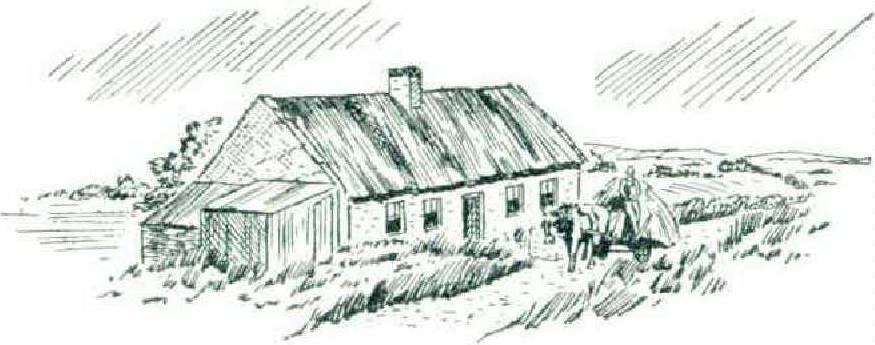

Since before the war, the Atlantic has been steadily encouraging a young Irish storyteller, Mary Lavia by name. Her short stories and the opening chapters of her first novel as they came to us were endowed with a warmth and beauty in the best tradition of the Dublin school. The stories, we published first in the magazine, then in book form, and when Tales from Bective Bridge appeared in England it received — and richly deserved — the James Tait Black Memorial Prize.
Meanwhile the novel was growing, year after year, until in its final draft it comprised over 900 typed pages. To the Atlantic editors and to Lord and Lady Dunsany, who also saw it, it was a keenly perceptive divination of the Irish character. It records the leisurely development of human relations through three generations of an Irish family. Beginning with Theodore Conifl’e, the penny-squeezing landlord of a tiny Irish village, passing on to his three daughters, — Lily, the Cinderella; Sara and Theresa, the spinsters, and ending with the grandson, Gabriel Galloway, who longs to escape to Dublin, this is a timeless story whose truth and beauty are unmarred by the war.
It is, we feel, the most distinctive first novel to come our way in years, and while its prodigious length — and the paper shortage — precluded our serializing it in full, we were tempted to take the unprecedented step of selecting six related episodes from the big book, which can be enjoyed for themselves.
A word about the author. Mary Lavin’s mother comes from County Galway, and her father, Thomas J. Lav in (who has a special fondness for fast horses), from County Roscommon. As a youngster, he migrated to Walpole, Massachusetts. There he worked for many years, there he became a benedict and was naturalized, and there his daughter, Mary, was born. But in Mary’s tenth year the household felt an irresistible tug to Ireland, and back they went. Today Mary makes her own home in Dublin, where she divides her time between her husband, — an Irish solicitor,— their year-old daughter, and her manuscripts.
GABRIEL GALLOWAY
by MARY LAVIN
WHEN you are still several miles outside the town of Castlerampart you can see the spire of the church pricking the distant clouds. After that, with every step you take, the contours of the town rise higher, and if you keep your eyes upon it the whole town, with its steeple, chimneys, and irregular roofs, its ruined gables and jutting walls, will rise out of the flat fields in which it is set.
It is rarely, however, that the traveler can so keep his eyes upon the distant town, for along the way there are several distractions, which, in the monotony of the flat fields, attract attention irresistibly. Upon the left-hand side, just before coming to a crossroad, there is an iron gate leading into a plot in which all that is above the earth is bare anil naked to view. This is the town cemetery; and although the ground slopes downwards ever so slightly at this point, causing people to hurry along involuntarily, the eye is nevertheless drawn to stare for a minute at the whitening headstones that lean to east and west, and at the damp mossy tombstones that solidly support their mountings of urns and angels. Even the simple grassy mounds of the poorer graves attract attention by their decaying heaps of laurel wreaths and their rusting tangles of glass-domed immortelles.
A small but energetic stream runs side by side with the road, and keeps it company with its noisy, rabbling waters. This energetic and rowdy stream, not content with attracting attention by its ceaseless chatter alone, gives a sudden twist every now and then and runs under the road, to come out again on the other side more noisy and boisterous than ever.
These sudden sallies on the part of the stream have resulted in the erection of brief, humped bridges that rise abruptly and descend even more abruptly still in the otherwise unbroken flatness of the road. These bridges have no geographical importance and appear in no known map. The traveler who goes over them in a wheeled vehicle, with any degree of speed, gets a jolt that is out of all proportion. The fact is that, being of such slight importance, they were built by the ordinary road maker, without any great experience; and the sensation of going over them is that of riding over the carcass of an animal.
It is not surprising, therefore, that a traveler, meeting innumerable of these small bridges and receiving each time the disturbing sensation of riding over the back of a ram, spends more of his time looking backwards over his shoulder than he spends looking forward at the road ahead of him. The town, therefore, is upon him before he realizes it, and upon his left-hand side the high walls of its ancient ramparts rise up sheer from the ground.
Under this rampart he must pass for a considerable distance yet, before coming to the entrance to the town. And meanwhile all trace of the steeple, chimneys, and ruins, the roofs and irregular gables, that he had seen from a distance has been completely blotted from view. All that can be seen, up over those ancient walls, is the tops of great and ancient trees that stretch their branches far and wide and press their muscular trunks against the strained masonry in which great fissures have been rent.
Viewed from beneath like this, the rampart looks like a great stone urn in which an overpowerful plant has expanded so much that it has cracked the sides of its container. Through one of these great cracks in the rampart wall a view can be taken of King John’s Castle, a ruin which stands in the center of a wild park, overgrown with trees. This park figures largely on the Ordnance Survey map of the district, and actually covers two fifths of the area occupied by the entire town; yet it is vacant and waste land that is seldom entered by the people of the town. It is a silent and lonely place, with its great tree-shaded stretches of damp grass, its still pools of green-grown water, its creeping shrubs, and its heavy leafy boughs that dredge the grasses. There is a smell of dampness under the trees, and a damp, unhealthy brilliance in the greenery. Insects, wild birds, and wild creeping things are seldom silent..
In winter when the trees are bare, or at night when the lights are lit in the town, you can see beyond this park to the back windows of the houses in Clewe Street, but these houses are separated from the eerie park and its ruin by the town river and by their own long gardens that run up from the riverbank.
Indeed, river and rampart, which once protected their ancestors from dangers without, are now regarded by the people of Castlerampart as protecting them from dangers within. This change of attitude is suggested even more forcibly a little farther up the road by a cluster of povertystricken huts that shelter under the rampart, to which, particularly on wet and windy days, they cling as close as sheep to a hedgerow.
After sheltering these few poor hovels, however, the ramparts are no longer so strong. From this point onwards the fissures become gaps, and some of the gaps so great that in places there are more stones lying in the nettles than are resting upright upon each other, and through these gaps the town is once more fully exposed to view. It is from the town bridge, which was once a toll bridge, the ruined arch’ of which still remains, that the most comprehensive view can be taken of the town.
From this point all its buildings are surprisingly clear, and each one by the simple nature of its architecture immediately recognizable for what it is — the ugly oblong school house with its high windows, the tall stone mill with its coating of slimy fungus and its carpet of bright wood-shavings, the red metal bridge and buildings of the railway in the distance, the friary ruin smothered in nettles, with its east gable blocked with cement to make a ball alley, and the spire of the church splattered white with bird droppings and ornamented by starlings as still as starlings carved out of stone. And between these prominent buildings are the ugly irregular blocks of shops and private houses, with their uneven levels of roof and chimney.
2
ONE afternoon in late summer Theodore Coniffe stood on the summit of the bridge leading into the town. He was standing with his hands shading his eyes in order to see against the slanted rays of the sun. But it was not over the town that he stared, but at the flat road that led into it.
Theodore Coniffe was a tall man. Although he was nearly seventy years of age, his figure was well preserved and straight. His face was thin, and he had the double advantage of good skin upon good bone. He had, moreover, the type of face, longer and wider at the temple than at the jaw, which presents a fine chiseled appearance without suggesting loss of character, as is the case with faces of similar shape where the effect is achieved by a medium-sized forehead with the chin falling away into a sharp and narrow point. His hair was of coarse gray, but in losing its color it had not lost its vitality, and it shot up from his forehead, brisk as a brush.
This afternoon he was dressed in a black-striped suit, and was without an overcoat although there was already a sharp edge to the afternoon air. The neatness and cleanliness of his suit, and his leisurely attitude at a time of day when his fellow townsmen were usually most busy, seemed to indicate that Theodore had a generous adequacy of money. A glance at his smooth white hands, however, made it clear that, whatever way his money was made, it had not been by manual labor. Perhaps it was by using his intensely brilliant blue eyes that he was spared the necessity of using his hands too harshly,
Theodore stood for a few minutes upon the bridge, rather as if he had forgotten what had brought him there in the first place, and then he began to walk back slowly towards the center of the town. Although he was somewhat distracted, nevertheless he kept turning his head continually and looking from one side of the road to the other. At some houses he stared with particularly keen attention. Others he treated with equally great indifference. From this alone it might perhaps he possible to guess the source of his income, but when he turned into his own street — Clewe Street — it would he impossible to remain any longer unaware that Theodore derived his income from house property, for upon his appearance at the top of the street there was furious activity at the bottom.
Fom one window sill, upon which they had been sitting and swinging their legs, a group of children jumped to the ground. Some men who were talking idly outside a small cottage straightened themselves up from the wall on which they had been leaning. And from the gable of a house, near the end of the street, three boys who had been playing handball up against the gable end became so confused at the sight of him that they began to run in different directions like sheep, knocked into each other several times, and finally ran down an alleyway that led between two houses to the river, leaving their ball behind them in the gutter.
Clewe Street was a long, leisurely street, starting out, like all the streets in the town, from the market square, but blocked at the far end by a high wall, and shaded by it and by a pollarded oak tree, around the bowl of which a wooden seat had been built, but upon which, owing to the dampness from the tree above it. no one ever sat.
The fact that no one ever sat on this seat was a sore point with Theodore Coniffe, for the somewhat simple reason that it was he who had put it there, and for the further reason that, although he had put it there to break his tenants of the habit of sitting upon their window sills, they still continued to sit on them.
On this particular afternoon, as he turned into Clewe Street and saw the children jumping off the window ledges at sight of him, he gave an exclamation of irritation. Now, it happened that at that very moment Mrs. Finnerty, the wife of the new bank manager, was just stepping out. of one of the shops at the top of the street; and hearing Theodore’s exclamation, she jumped to the conclusion that she had been the cause of it by startling him with her abrupt appearance before him.
“I beg your pardon, Mr. Coniffe. Did I startle you?” said Mrs. Finnerty, making an effort to step back into the doorway in order to let him pass upon the narrow footway, but Theodore had already sidestepped in order to give her precedence, and this time they banged into each other with considerable force.
In the explanations that followed, Theodore began to elucidate for Mrs. Finnerty the line of thought that had led to his exclamation.
Mrs. Finnerty was a bride — that is to say, it was exactly three months to the day since she had first arrived in the town upon the arm of Mr. Finnerty. However, since the time limit for calling a bride a bride usually corresponded with the length of time during which she could manage to triumph over the other women of the town by producing new costumes, hats, jackets, and blouses, Mrs. Finnerty would soon be regarded as a mere wife, for not only had she begun to repeat her triumphs in such small matters as gloves and scarves, but, as she walked down Clewe Street with Theodore, she was wearing the very same costume she had worn upon her first appearance in the town, upon the arm of her new husband, and with it, moreover, she was wearing the identical hat that she had worn on that day, wreathed with rosebuds around the brim and speared with a steel hatpin in the shape of an arrow.
Indeed, even three months ago, when she first arrived in their midst, it had been difficult for the town to regard Mrs. Finnerty as a bride. There was something a little too thin, a little too dry, and even something a little too neat, about the new Mrs. Finnerty, which made it difficult to call her a bride, and even made it difficult for the people of the town to understand how the choice of the fat and red-faced manager had fallen upon her at all, unless it was assumed that his choice had been made at such an earlier date that the time that had subtracted from her charm had added to his sense of duty towards its memory.
3
UPON one tiling, however, everyone was agreed: that Mrs. Finnerty was the most ladylike and best-mannered person that had ever come to the town. After the first few words he had exchanged with her, the morning after her arrival, Theodore had expressed himself as delighted with her. She had such a gift of dignifying the most trivial conversations with a polite precision of diction that it passed without notice that she never engaged in any others; and she was so diligent in getting to the bottom of every topic that she discussed, it passed without notice that the topic itself was always shallow. When talking to Theodore her sentences were laden with references to lintel and jamb, weatherboard and coping stone, and he always came away from his conversations with her convinced that she was the most intelligent woman he had ever met. He was glad that she and her husband had rented one of his houses, and particularly one that adjoined his own house. As he often remarked, she was not a raw and inexperienced girl who would not understand the care that was due to a house.
He was always pleased to meet her and engage in an intelligent conversation. When he ran into her, this day as they were both going down Clewe Street, he was delighted at an opportunity for airing his grievances about his less intelligent tenants.
“Yes, yes indeed!” he said, as they began to walk down the street together, after he had pointed to the window sill from which the children had jumped down on sight of him. “I had that seat built around the tree at the bottom of the street. But did anyone sit on it? Not a soul. The other day I saw no less than five children sitting on the window sill of Colgan’s cottage, drumming their heels against the plaster of the wall, and singing at the tops of their voices. What do you think of that, Mrs. Finnerty?”
Mrs. Finnerty took time to think before she replied.
“All I can say,” she said at last, “is that if window sills were intended for people to sit on them, why in the world were chairs invented! ”
“That’s what I was just about to say,” said Theodore delightedly, although his delight was due to the fact that it was not at all what he had been about to say, being much better and more effectively expressed than he would have expressed it himself. “Would you like to know the reply I received from Mrs. Colgan? She said that she couldn’t stop the children — if they wanted to sit on the window sill, then they’d sit on the window sill.”
“ I would be interested to hear what reply you made to that. Mr. Coniffe,” said Mrs. Finnerty, deferentially.
Theodore stopped on the pathway and looked at her.
“I need hardly tell you the reply I would like to have given!” he said, with dignity. “It was not the custom in my day for a mother to admit that she had no control over her children. But I restrained myself, and all I said was that she would have to find some way of keeping them off the window sills. That’s what I said.”
Theodore started onwards again. Mrs. Finnerty stepped alongside him, but she turned her head delicately towards him, with a politely interrogative air.
Theodore interpreted this slight gesture correctly and went ahead with his narrative. “Well,”he said, “the very next day when I looked up the street, what did I see but a row of geranium pots ranged along the sill from one end of it to the other!”
From the tone of irritation in Theodore’s voice, Mrs. Finnerty could see that for some reason or other he regarded the geranium pots with more disfavor again than he regarded the children, but her politeness was so great that she went one better than agreeing with him, and simulated instead a certain lack of understanding in order to give him an opportunity for explaining himself in full.
“I must be very stupid,” she said, “but I don’t see what harm the geranium plants could do. It seems to me quite a good idea for keeping the children off the window ledge. I’m afraid that I would have done the very same thing.”
Theodore put his hand upon her sleeve.
“My dear lady, indeed you would not have done any such thing. You have far too much good sense. Why, flowerpots are the worst things in the world that could be put on a window sill. I would go so far as to say that it might be better to have people sitting on a sill than to have flowerpots ranged along it.”
Mrs. Finnerty appeared unable to believe this.
“They look so pretty,” she exclaimed.
“They do!” said Theodore. “But will they look pretty when the window ledge sags under them?
“But surely, Mr. Coniffe,” said Mrs. Finnerty, ”a flowerpot is very light. How could it cause a window ledge to sag?”
Theodore was patient.
“Flowers don’t grow without water, do they?”
“No,” said Mrs. Finnerty.
“And I am given to understand that flowerpots will have to be watered from time to time?”
“Why, yes.”
“I understand further that the water does not all remain in the pot, but that after a certain quantity of it has been absorbed by the soil, the rest will escape from the pot?”
“That’s right,” said Mrs. Finnerty, entering into this byway of the subject with fresh interest. “As a matter of fact there are holes in the bottom of the flowerpot for the purpose of letting the excess water run out.”
“Ha!” said Theodore, and he pressed the fist of one hand into the palm of the other. “I thought so. Precisely. And now let me ask you a question, Mrs. Finnerty. Where does that water go? Doesn’t it run down onto the window sill?”
“Ah!” said Mrs. Finnerty brightly. “I see your point. The water is bad for the sill.” She thought for a few minutes. “But surely the water from the plants cannot hurt the sill any more than rain?”
Theodore smiled tolerantly.
“You are forgetting,” he said, “that the rain gets a chance to dry, but the water from a flowerpot is trapped under the pot and remains lodged there, corroding the mortar and doing untold damage. When mortar is corroded, the stones loosen. When the stones loosen, the sill slips out of place. When the sill slips out of place, the whole window frame is thrown out of balance. And when any portion of a building is thrown out of balance, the whole edifice is in danger! Ah, my dear lady, you have to be constantly on guard. A small thing can start a lot of trouble.” Theodore sighed. Mrs. Finnerty sighed too.
“I often heard my father say the same thing,” she said. “He was always using those very words, talking to my mother. My mother used to be very fond of ivy —
Theodore recoiled slightly in disbelief.
“Yes, ivy,” said Mrs. Finnerty, giving a slight shudder. “My mother, poor thing, loved ivy. It seems when she was a young girl, before she met my father, she had a dress that she was very proud of, and this dress had a pattern of ivy leaves on the bodice. She was always describing it to me as a child. She said that she was always very much attached to ivy because it reminded her of the happy times she had in that dress. And when she got married and got a house of her own, the first thing she did was plant a slip of ivy at the gable end and begin to train it up the wall of the house.”
Theodore was much interested.
“Your father put his foot down, I hope?”
“Oh, certainly,” said Mrs. Finnerty. “He flew into a temper, I’m told, and tore it up by the roots and trampled on it. He was a man with a very strong character.”
Theodore was not thinking about Mrs. Finnerty’s father. He was thinking of her mother.
“How in the world could anyone like ivy?” lie said. “I cannot understand such a thing.”
Mrs. Finnerty put her head to one side. “Well, you may think it strange,” she said, “but though I would never want to have ivy on my own house, I think I can understand how other people feel about it. There are some people, like my own mother, who think that ivy takes away the bare appearance from a house, and in the case of old houses I think people may be glad to have them covered with ivy to hide the cracks in the walls.”
“Cracks! Hide the cracks in the walls!” Theodore became very excited. “If the ivy hides the cracks it’s no more than might be expected from it, since those cracks would never have come if the ivy had not put them there. Ivy! Ivy! The enemy of civilization! It should be uprooted and destroyed every time it ventures to show its head. Have you ever considered the position of those foolish people who allow their houses to become covered with this poisonous plant? You haven’t? Well, I have. I have thought for hours upon the subject. I never pass a house upon which ivy has taken its grip without shuddering to think of the way that it is pushing its way between mortar and brick, penetrating every crevice, dislodging the very cornerstones of the house. And this goes on night and day, day and night. Ivy never rests. Night and day, day and night, while the foolish people within the house are going about their business under the false impression that they are safe within four walls, the ivy they are so proud of is eating away their security, minute by minute, grain by grain! And all because the head of that house was ignorant of the attention that is due to a house.
“Ah, yes, a house is a delicate article. A house is ten times more delicate than the people that live in it. That Is a strange thing, isn’t it? But it’s true. A person may suffer a bruise or a break, but the bone will knit and the skin will heal. That is not the way with a house. A house will not grow new mortar when the old wears out, nor grow new tiles if the old tiles are ripped off. When anything happens to a house, it is necessary to have workmen in to patch it up; and as all the world knows, when workmen are let into a house, they break as much as they mend. They do more damage with their feet than they are able to repair with their hands. I have seen a plumber bring down a whole plaster ceiling with a prod from his ladder. House repairing is a sad business. The only thing for a sensible man to do is to keep out of the way of needing such repairs by treating bis house as gently as if it were a human being like himself — and a human being who is, moreover, more fragile and more delicate than himself.”
4
THEY had come at last to the end of Clewe Street, and were confronted by the three tall houses of cut stone granite which Theodore owned and in the middle house of which he himself lived, having let the house upon the left to Mrs. Finnerty and the one upon its right to a certain Mrs. Molloy, to whose tenancy even after seven years Theodore had not yet accustomed himself.
Mrs. Molloy’s house, although in size and shape it had every appearance of being an ordinary private dwelling, yet had a lamp suspended over the doorway, and a fiber mat spread in front of the doorstep, both of which proclaimed in large block letters that the premises were to be known as the Central Hotel.
These three houses were without doubt the most prosperous houses in the tow n, and if any assurance were needed other than the fine cut granite of which they were built, it could be found in the lavish additions that had been made to the exteriors in the way of bells and brass fittings, footscrapers, and wire mats. Indeed, Mrs. Molloy, having added every exterior adornment that her mind had been able to conceive, had at last resorted to making the inside furniture play its part in the outside appearance. In the front windows of the downstairs parlor she had placed a brass urn upon a pedestal, and in the urn was a large glossy-leaved eucalyptus plant, as plain to be seen from the street as if it were painted upon the glass, and no doubt difficult enough to see from inside the room, since it obscured a great part of the window light by which it might have been seen.
Mrs, Molloy was a large woman with several children and a small, meek husband. Although she was large and matronly in appearance, there were no grounds for assuming that her family was yet complete. And to those who marveled that she should have taken upon herself the running of a hotel when she had already so many dependent upon her, she always replied that if a thing was worth doing, it was worth doing well. In addition to the humankind that were dependent upon her for bite and sup, Mrs. Molloy was always attended in her journeys from room to room by a large number of cats and dogs, and wobbling pups, that rubbed themselves against her ample ankles and constantly clamored for attention.
It was quite understandable that the multiplicity of her duties had taken away any time she might otherwise have spent upon the niceties of the toilette, but unless we agree that human beings always find time for the cultivation of one vanity, it would be hard to understand how Mrs. Molloy had time to take care of her bright mass of yellow hair. This mass of hair was always washed, brushed, and brightly shining, no matter how much dirt w as lodged under her fingernails and how dark the rim of her collar became. It w as her sole pride and vanity.
So bright was this mass of Mrs. Molloy’s hair that it would probably have attracted the attention of Theodore and Mrs. Finnerty had she but come to the window and stood there, but Mrs. Molloy took no such chance. Catching the brass finger-grips of the window sash, she threwthe window upwards with a great force, and sticking out her head she called to them in excitement, “Are they coming? Are they coming?” And without waiting for an answer she leaned out farther, her great bosom pressing against the granite sill, to see as far as she could up the street.
For a moment Mrs. Finnerty had not understood to whom Mrs. Molloy referred, but then she blushed in confusion.
“Oh, Mr. Coniffe!” she said. “How rude you must think me! I forgot to inquire about your daughter. I hear she’s coming home today. What time do you expect her?”
But before Theodore had time to answer, Mrs. Molloy answered for him. “Don’t expect that man to know!” she said. “That man never thinks of anything but his precious houses.”
Mrs. Molloy winked once at each of them and then she leaned out farther over the sill and spoke more particularly to Mrs. Finnerty. “It’s my belief they’ll be here any minute. As a matter of fact, when I heard your voices in the street a minute ago, I was sure it was them. I nearly broke my neck getting to the window. I fell over half a dozen things. Isn’t it awful tire way everything gets in your way when you’re in a hurry? Did you ever notice it? As I was saying, I thought that I heard them arriving and I ran here to the window as fast as I could run. I wouldn’t want to miss seeing them for anything. I always love to see a bride coming home. I like to see if there’s any change in her. There usually is some change. Sometimes it’s for the better; sometimes it’s for the worse. Isn’t that so?”
Mrs. Molloy paused for a minute to look up the street again. “They should be here any time now’.” She seemed to have a new idea. “Wait a minute! I’ll come out into the street. Wait a minute!” And withdrawing her head again suddenly, Mrs. Molloy banged down the window sash so that the frame shook, and the glass shivered, and Theodore trembled with such irritation beside her that Mrs. Finnerty felt her own knees beginning to tremble slightly.
“That woman!” said Theodore. “That woman!”
Poor Mrs. Finnerty looked from Theodore to the window and from the window to Theodore, and the only thing that was clear in her mind was that she should at any cost, escape before Mrs. Molloy came out into the street.
“If you’ll excuse me, Mr. Coniffe, I think I’ll step over to the door and inquire from Miss Theresa what time the travelers are expected.”
Theodore nodded and she supposed that he had heard her. Smiling nervously, she walked over to the door of the middle house, and lifting the brass knocker she gave a delicate arid discreet knock. Behind her back she heard the sound of Mrs. Molloy’s voice raised in good-humored quarrel with Theodore, and one or two phrases came to her ears.
“ Who ever heard such a fuss about a bit of plaster! Two pennyworth of plaster!” she heard Mrs. Molloy exclaim, and another time she heard her roar, laughing, “Man dear, don’t be talking nonsense. If ivy did harm, would the rampart walls be standing today? The rampart is hundreds of years old and yet it’s so covered with ivy that you’d have to put your arm in, up to the elbow, before you could touch the stone. Ivy never did harm. Where did you get that idea?”
The timid knock that Mrs. Finnerty gave on the door was sharply contrasted with the determined sound of the footsteps inside the door as Mary Ellen, an elderly maidservant, came across the flagged hallway to answer the knock.
Mary Ellen was as tall as her master, and like him she was very stiff and straight. She wore at all times a bluestriped apron, starched until it creaked like a board, which emphasized by its vertical lines her unusual height and straightness. She had black hair, striped with gray, and her face was long and pale with a smooth yellowish color and texture that reminded one at once of those dolls whose faces are carved out of soap. And like the faces of those soap dolls, Mary Ellen had a bright medallion of red upon each cheek.
It was quite clear, however, that in Mary Ellen’s case these red medallions had not been applied with paint, for the simple reason that the same bright red color was repeated again in a place where it is almost certain it would never have been artificially applied — the tip of her long nose. As she opened the door to Mrs. Finnerty on this particular afternoon, the red medallions in her cheeks blazed very brightly, and the tip of her nose was afire.
“Good afternoon. Mary Ellen,” said Mrs. Finnerty, smiling and preparing to step into the hall. “I called to see Miss Coniffe and to ask her at what hour she is expecting the return of the Happy Pair.”
Mrs. Finnerty lifted her skirt and put out her small, neatly shod foot to step into the hallway, but to her astonishment Mary Ellen, although she was holding open the door, was herself blocking the ingress thereof, and instead of standing aside to allow the visitor to enter, she herself, after a backward glance over her shoulder, stepped out into the street, in her stiff blue and white striped apron, and pulled the door out after her until only the merest split between jamb and lintel indicated that it was not closed entirely.
“You’ll excuse me. I know, for taking a liberty. Mrs. Finnerty,”said Mary Ellen, “but I think it might be as well if you didn’t ask Miss Coniffe any questions. She’s quite cheerful at the moment, decorating the table and doing odd little jobs. She seems to have forgotten her troubles, but the least remark might upset her, and act on her nerves, and put us all to shame by showing a bad spirit when the poor creatures arrive.”
Now Mrs. Finnerty had the reputation of being a tactful woman, and wishing to retain it, she judged it tactful to withdraw without asking any further explanation. Tact, however, is a fickle commodity. It is hard to say that anyone possesses it permanently. Because you have displayed it yesterday is no guarantee that you will display it again today. In other words, it might, have been, more tactful for Mrs. Finnerty to have delayed Mary Ellen further, and asked her a few questions as to why Miss Coniffe should be upset at the thought of her young sister’s return from her wedding tour. For. to have withdrawn so swiftly, and with such a ready understanding of the necessity for doing so, was an admission that, from one source or another, she knew only too well that the wedding of Lily Coniffe to Cornelius Galloway was a source of bitter mortification to her sisters, Theresa and Sara, but particularly to Theresa.
5
THE story behind Theresa’s attitude was a long one, and to understand it fully the townspeople needed long memories, but those who did not have such memories were not without being able to profit from those who had.
As near as it is ever possible to say when a story has its beginning, this story began eighteen years earlier when Theodore Coniffe’s wife, Katherine, was still alive.
Katherine Coniffe had borne two daughters to her husband, but had thereupon ceased to show any further sign of remedying this poor achievement by the addition of a son. Theodore, however, made the best of things a-s they were, and when the two little girls were old enough to follow him up and down the street, he was flattered and proud of them, and his resignation turned into satisfaction. Soon his satisfaction became so great that be forgot that he had ever been dissatisfied, and on one or two occasions he was heard to say in public that a son only increased a man’s responsibilities but that, a daughter increased his pleasures. Before long, such sayings became habitual to him, and after a while it was noticed that he made a point of inquiring the sex of all the newly born children in the parish. If the infant was a boy, he shook his head in sympathy for the unfortunate parents. Boys were difficult to rear. Boys were a source of worry and responsibility. The times were bad for bringing male children into the world.
The small Coniffe girls were always dressed in their best clothes and walked one on either side of their father when he went around the town to collect his rents. Now, a man will never allow himself the pleasure of telling a son how much money he has made for him. because it might, and indeed possibly would, give him an idea that, there being so much of it ready-made, there would be no need for him to make any more; but with a girl it was different: a girl would not be expected to work, and since all that she would have w ould come to her from two sources, — from her father and from a husband, —Theodore was determined that his daughters would never owe all their gratitude to the latter.
In short, there was no need to conceal from Sara and Theresa that they would some day be rich young women; and as he collected the rents from his cottages, he took them with him, giving them a coin apiece before he tossed the rest, of the coins into his canvas bag secured at the top by two strings. And whenever he acquired a new property, he took the little girls with him on the day that, he took over formal possession of the house. As they stood beside him meekly and watched the signing of bonds and documents, he used to wink at old Jasper Kane, the solicitor, and pinch their ears and question them.
This was the state of affairs when Theresa was just about fifteen years old, and Sara thirteen, and Theodore was as satisfied with his lot as any man could be. The girls would soon be sent to boarding school and after that there would be a grand time altogether hunting down suitable husbands for them. Even Katherine, although she would prefer that they could remain children forever, was beginning to glow with the prospect of this sporting event that promised in the near future.
But the near future held a surprise for Theodore and his wife, and when Katherine began to experience symptoms of ill health, some of which she had already experienced twice before in her lifetime, it was without recognizing their cause. After trying to remedy certain distresses with various brews and tisanes, she began with alarm to notice that her ankles were swelling — and worse still, that she was gaining weight with a dangerous rapidity.
Katherine Coniffe had always boasted a neat figure and had spoken with some contempt of those unfortunate matrons who lost control of their figures at forty.
“I’m only thirty-eight,”she said with dismay to Mary Ellen on one particular afternoon when she felt less well than usual. And taking Mary Ellen’s yellow canvas measuring tape, she ran it round the formerly neat waist.
“Twenty-nine inches! Oh, Mary Ellen!” Katherine threw down the tape in horror and, running over to the mantelpiece, stared at her face in the looking glass. “I’m getting old!" she said with tears in her voice. For a few seconds there was silence as Katherine ran her hand over her hair in search of a gray hair, and closely examined her cheekbones to see if there were scratches of red. But although her eye flew to all the danger spots known so well to women, where age will first show itself. Katherine found nothing to worry her. The hair was black, the skin was light, the cheeks were soft and richly rounded. There was no sign of age. The face was beautiful, but better still, it had still the beauty of youth.
“What good is a pretty face if my figure begins to thicken?” She bit her lip and then held out her hand imperiously. “Give me the tape again,” she said, and when Mary Ellen handed it to her she passed it around her waist once more, drawing it tighter and tighter, and holding in her breath. “I may have made a mistake,” she said, and she held it up again to correct the error. “Twenty-nineinches! ” There was no mistake. “Twentynine inches! Oh, Mary Ellen. What will I do? Once a woman begins to put on weight, she gets heavier every day.”
Mary Ellen had spent the last five minutes trying to convince her mistress that it was only her imagination that made her think she was getting stout. Now, in face of the evidence supplied by her own tape measure, Mary Ellen felt the necessity of taking a new attitude.
“It is not everyone that likes a thin woman,” she said. “There are some people who wouldn’t say thank you for a thin woman. I know a dressmaker and she wouldn’t make a dress for any woman that wasn’t a full thirty-six inches in the bust. She says that you might as well be making dresses for the palings and posts as dressing a woman that was under ten stone weight.”
Katherine stuck her fingers in her ears. “Stop it, Mary Ellen,” she said. “You’re only saying that to console me.
I feel worse now because I see that you think I’m a sight and you’re trying to cheer me up. But nothing can cheer me.”
“I never saw you look prettier,” said Mary Ellen.
Katherine’s spirits rose for an instant, but then her eyes rested on the measuring tape at her feet.
“Nothing will ever be the same again. I used to have the people turning their heads to look at me as I went up the aisle of the church on Sunday, but all that is over.” The tears came into her eyes. “It’s so unfair! It isn’t as if I didn’t take exercise. It isn’t as if I overeat. I never eat much.” She looked up at Mary Ellen, her lower lip caught between her teeth. “Lately I haven’t eaten as much as a bird. I have such a distaste for food that I can hardly sit at the table.”
Up to now Mary Ellen had only paid heed out of courtesy to the complaints of Katherine, but suddenly, when Katherine spoke of her distaste of food, Mary Ellen gave a start and for the first time during the whole conversation, she gave a sharp glance at the waistline of her mistress.
“Perhaps it might be just as well to have a talk with the doctor,” she said.
“Oh, not at all! said Katherine scoffingly. “He’d laugh at me. If I was losing weight, it would be different.”
Mary Ellen said nothing for a few moments. Then she glanced once more at Katherine’s waist. “There are times when putting on weight is just as bad as losing weight,” she said, but further than this she dared not go.
Katherine, however, was without suspicious. “I wonder,” she said. “I don’t feel well; that’s a certainty. Perhaps I might have a talk with old Dr. Simons.”
“I think you should have a talk with him, anyway, ma’am, said Mary Ellen, and to her relief Katherine agreed.
6
KATHERINE CONIFFE was one in whom vanity is so great that it cannot be altogether condemned, since it was the pivot upon which her whole life turned. Through the vanity with which she had decked herself in her girlhood, she had caught the eye of Theodore. Through vanity in his compliments she had gone to the altar with him. His delight in her body had more than paid for the pains of childbirth that had followed. And when her children were born her vanity was increased twofold, for while people began to compliment her upon new scores, they had no cause to cease their compliments upon the old. After the birth of her children she was more graceful and firm than before. Even when the little girls began to grow up, the glances of admiration that were cast on Katherine were more numerous when it appeared that she was their mother.
Perhaps if she had gradually lost some of her youthful attributes she might not have felt the loss of them so keenly, but with this sudden change in her weight she visioned herself as traveling rapidly down the road to wrinkles and old age.
Katherine sent for Dr. Simons, and while she was expecting him she paced back and forth in the front parlor.
”I know that it’s nonsense to see the doctor,” she said to herself. “When age begins to set in, there is no stopping it. There is nothing Dr. Simons can do for me. I may as well give in to being an old woman.
And so well did she resign herself, in the half an hour before his arrival, that when Dr. Simons was announced she was listless and hardly inclined to answer his questions. She was convinced that he and his remedies were powerless.
While he took her hand and felt her pulse, she was looking over his shoulder at the pier glass on the wall, in which there was reflected from the wall on the opposite side of the room a picture of herself and Theodore taken on their wedding day. Her mind was filled with distractions, and when the doctor asked her questions she replied with an easy effortlessness that showed her lack of confidence in the estimates he might make from them. When she tired of looking at the picture reflected in the pier glass, she looked out of the window at the familiar street outside. But all at once, some question startled her into glancing sharply at the doctor.
“ I beg your pardon, Doctor! ” she said, because having sent for him through an impulse of purely secular vanity, he affronted her by asking a question of an intimate medical nature. There was a touch of hauteur in her voice. “Surely there isn’t any need for a medical examination. All I need is a tonic. I just want something to brace me up.”
She looked at the doctor with suspicion, but the old doctor looked back at her with equally great suspicion. Was she making a fool of him?
“Surely, Mrs. Coniffe, it cannot be possible that, having already experienced these same symptoms on two previous occasions, you are unaware of their significance now?” Katherine stared at him. There was a certain censoriousness in the old man’s tone, upon which she spent her astonishment before she concentrated upon what he had said. She stared at him haughtily for a moment and then, starting forward, her hands rushing to her cheeks, she comprehended in a moment both his words and the implications of those symptoms she tried to diagnose without his help. Her youth, far from having begun to decay, had risen within her veins with new richness and fertility. She was with child.
“There is no doubt whatsoever, my dear lady,” said Dr. Simons. “You need not fear any disappointment. Your case is rare, admittedly, but not altogether unusual. Your vitality and your youthful heart. I am glad to say you need not fear any disappointment. There is no doubt whatever.” And then, looking around for his hat and gloves, he dismissed Katherine from his attention, and thinking of Theodore’s pleasure, he was already molding his face into congratulatory smiles, and rubbing his hands together with an unmistakable show of satisfaction. He was not looking at Katherine at all, and had just lifted his gloves from the side table when his attention was drawn back to his patient by a most astonishing outburst of sobbing, which made him turn in fright and drop the gloves upon the floor.
He was astonished. “My dear lady! My dear lady! What is this? What is this?” And he began to agitate his hands over the bent and sobbing figure with gestures as ineffectual as those he might make if trying to catch a moth in a circle of lamplight. “This is very bad for you. What on earth is the matter? Why are you crying? Calm yourself. Calm yourself.” As he spoke, he wiped his forehead with his handkerchief, and then, seeing the bell cord hanging on the wall, he ran to it and, gripping it, gave it a violent tugging while he kept on exclaiming, “This is very bad for you. I can’t understand this at all.”
A moment later Mary Ellen ran into the room. Having heard the sound of sobbing and having been so impatient to reach her mistress, she would not have waited much longer for permission to rush into the room.
“Don’t upset yourself, ma’am,” she cried. “This is something to be glad about. You ought to be throwing up your hands for joy, and not crying. It’s a great blessing. I often heard my mother say that a late child was God’s way of blessing a house tenfold. There, now. Don’t cry. Wait till you see, you’ll feel better when you have a cup of tea. The blackest things are often the brightest when you’ve had a cup of tea. There, now. There, now.”
Dr. Simons stood still during this excited gabble, and his hand still remained upon the bell cord, from which indeed he drew support. When he rang the bell, he had expected Mary Ellen, but he had hardly expected that she would arrive fully equipped and prepared to cope with the situation, and apparently endowed, moreover, with a full understanding of the situation with which it would be necessary to cope. And in his mind he wronged her, and decided that, although she was with the family fourteen years, she was no better than others of her class and that she had prepared herself for this emergency by the simple expedient of listening at the keyhole. Whatever he may have thought, of her honesty, however, Dr. Simons was glad to rely upon her efficiency, and as she comforted Mrs. Coniffe and coaxed her, and tumbled over her tongue with words of encouragement, he slipped out of the room and made his way down the hall to find Theodore and tell him the news.
7
THEODORE was easily found. He was superintending the thatching of a house at the top of Clewe Street, and was himself holding the foot of the ladder upon which the thatcher stood, in case it might slip. “I saw a ladder slip one time during roof repairs,” he said, talking up to Murty Rod, the thatcher upon the roof, “and it slashed down the front of the house and tore a gash in the mortar from the top of the wall to the bottom.”
“What happened to the thatcher?” said Murty from overhead.
“Oh, it was a slated house,” said Theodore impatiently. “It wasn’t a thatcher that was working on it at all; it was a slater. And of course that was worse, as you can see. It was a two-story slated house, and there it was with a gash down the face of the mortar — that showed up even ater it was patched. It looked bad. There was no real damage done, but it looked bad.” He shifted his weight from one foot to the other. “That is a thing that some people neglect to look into — the appearance of a house. But appearances count. Give me a good-looking exterior and I’ll show you a well-kept interior.” Theodore looked down the street, in order to pick out a house which he did not own himself, to illustrate the converse of this maxim, but when he looked he saw the doctor leaving his own hall door.
“My wife wasn’t well these last few days,” he said, talking upwards to Murty, but keeping his eyes on the doctor. “So I asked old Simons to step in and give her a tonic.” Murty stopped his work and looked down the street at the advancing doctor.
“He’s looking pleased with himself, anyway. It’s fellows like that have the easy time. I suppose he got more for walking down the street than I’ll get for doing the whole of this roof, and it will take me three days.”
Normally Theodore would have suggested to Murty that he expected the job to be finished in less than three days, but his mind was occupied with Katherine at the moment.
“He must have found her well, when he’s looking so pleased with himself,” he said, watching the doctor advancing with a springing step and every appearance of eagerness upon his face as he drew nearer. Theodore wanted to advance to meet him, but he did not dare to leave the foot of the ladder.
“I hope he didn’t find her too well,” said Murty, and be selected another scollop of sally rod for the thatch.
Theodore looked up at him. He was friendly with the men that worked for him, but he felt that Murty had overstepped himself; but as the doctor was upon them he could not say anything to Murty, and instead he pretended not to have heard him at all, and waving his left hand to greet the doctor, he raised his voice so that he might overcome the distance that still divided them.
“Well, Doctor! I see you found the patient in better health than you expected.”
Dr. Simons looked at Theodore and then he looked up at Murty, who was thatching away with great industry, having realized even quicker and clearer than Theodore that his last remark had been better unmade.
“If you could step a few paces down the road with me,” said Dr. Simons, “I would like to have a few words with you, Theodore.”
“I’d like to oblige you, Doctor,” said Theodore, “but I’m afraid this ladder will slip. When someone comes along to hold it. I’ll step over to your place and have a chat with you. I can see by your face that you’re pleased with your patient. She was worried herself, but I knew it was nothing. Mary Ellen had me persecuted to send for you, but you know what women are. I knew there was nothing serious.”
Dr. Simons wasn’t satisfied. “Couldn’t you put a stone to the foot of that ladder?” he said. “There’s something particular I’d like to say to you.”
He lowered his voice.
Theodore scented something unusual. He put his foot firmly to the base of the ladder and leaned his long, thin body forward towards the doctor, indicating that the latter might care to lower his voice and impart the message there and then. But the doctor looked uneasily at Murty. Murty was twisting the sally rods with unusual concentration. Dr. Simons leaned very close and whispered to Theodore.
“What?” Theodore drew back, Murty stopped twisting the sallies.
“You don’t mean it? Katherine? Is it true? Why on earth didn’t she tell me? It can’t be true. Are you sure?” And not waiting for an answer to any of these questions, all at once he let go the ladder and began to run down Clewe Street with no more apology to the man on the top of the ladder than to the man at the foot of it.
Now, a ladder will usually remain upright without being held, but like many a thing that received support when support was unnecessary, no sooner was Theodore’s support withdrawn than the ladder began to slip.
“Watch out, Murty!” shouted the doctor, and he grabbed the ladder by one leg as it tottered, but it was too late; and although the ladder remained upright, Murty came slipping down the slanted pathway of the bright glossy straw of the thatch he had just laid, and in another moment was sitting, legs outspread, in the mass of rough black straw on the pavement.
“Are you hurt, Murty?” said the doctor, rushing forward. Coming so soon after the spiritual collapse of Mrs. Coniffe, the collapse of Murty, and the ladder upon which he stood, unnerved the old doctor completely. “Are you hurt, man?” he said. “If you are, you can take an action against Theodore Coniffe. He might have been the cause of your death.”
“If I was killed, it would be yourself that would have been the cause of my death. Doctor,” said Murty, picking himself up and rubbing himself reflectively. “If that ladder was nailed to the road, I’d have fallen off it all the same, when I heard the news you gave him. Do you think, will it be a son this time? Sure, the Almighty would never have let so many years go by if he was only going to send the man another daughter at the end of them!”
(To be continued)
With each twelve months of the Atlantic
THREE GREAT BOOKS OF THE YEAR