Sugar in the Gourd
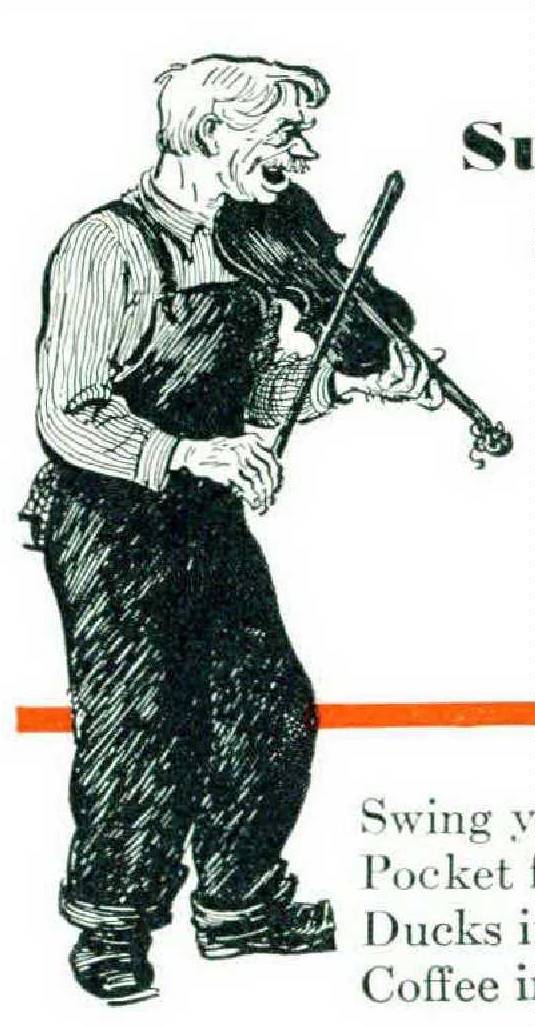
Pocket full of rocks to hold me down.
Ducks in the river going to ford;
Coffee in a little rag, sugar in the gourd.
The nursery tales and rhymes American children know are mainly of English origin; the classic stories of heroism and righteous living come from the literature of other lands and the Bible; and the legendary patrons, such as Santa Claus, were imported along with nearly all religious holidays.
Even the folk frolics and dances come from all over the world. But the quaint calls of the square dance sprang from the soil of America.
Take, for example, this old favorite of the country dance: —
And that just made us work and strive;
Swing that gal as long as she’s alive.
A cotton-belt youth, excited by the rapid tempo of a liddle and bow, patting feet, and whirling skirts, sang it out at a country dance, perhaps after a hack-breaking day in the cotton patch.
The chant is the sort of thing the radio critics refer to as “corny,” but, just the same, it is based on a t ime-honored and universal plaint of the cotton farmer and contains the American down-to-earth characteristic of liking humor spiked with stark reality. And, when cried out to the right kind of foot-action music, it sends the dancers whirling.
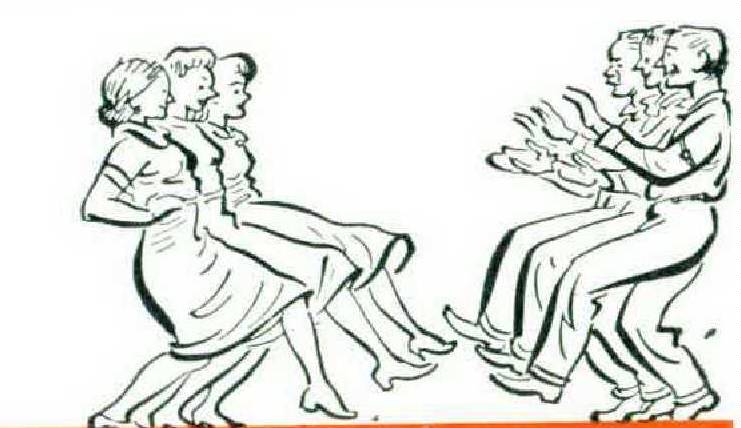
There are two kinds of chants: one is specific instruction to the dancers on movement, steps, and formations; the other is a line of chatter with which the caller connects his instructions and, incidentally, docs a little entertaining. An example: —
A-shaking ‘simmons down.
Grab your partner by the hand
And swing her twice around.
The last two lines are specific instructions, but in introducing them, the caller zipped through the singsong rhyme about the opossum and its favorite fruit. This connective chant, correlated with actual instruction on movement, is real American folklore; the hundreds of such extemporaneously composed, but lasting, chants reflect the vigor of the people, the region, mariners and customs, moral issues, and the ups and downs of life.
The square dance typifies the sort of vigor hardworking Americans have always demanded in their play—whirling, swinging, stamping the floor—and the chant of the caller is quite as healthy. Here is a good example of how the caller chooses words in keeping with the tempo of the dance: —
All join hands and get in your places.
Pull off your shoes and shake your socks;
Swing those girls till you rattle their hocks.
There’s quite a bit of rattling when the dance gets under way. This notion of action isn’t a regional thing; the chants used all over the country appeal fnr briskness and vivacity. Dance calls arc almost universal in their central idea; they include in crude rhyme the expression of the things with which, and by which, the people live and work. They are regional only in tone. Here’s one credited to Arkansas: —
It’s a party good wagon but most broke down;
Now promenade vore pardner round and round.
Each section of the nation colored its own chants. The West developed some of the more picturesque. The origin of this one should be recognized anywhere: —
And now with the one that brought it home;
Now with the one that ate the meat
And with the one that gnawed the bone.
That takes in just about everybody; and, crude as the call may sound, the dance movement is artistic and beautiful.
Regardless of the tone of the calls and the local color injected, the actual dance movements are about the same everywhere; and there’s at least one chant, just a single line long, that is jammed full of universality as far as the square dance is concerned : —
Such fragments went, unrecorded for years, but they passed from one community to another and crossed vast territories and state lines with westward-moving settlers.
The chants are full of reference to common animals, such as the opossum, dogs, cats, cows, mules, horses; to rivers, the weather, soil, farming, food, clothing, ranching, general awkwardness, wooden legs, and poult ry. Perhaps the best-known of all the chants covers the poultry situation: —
Pecking out dough.
“Granny, will your dog bite?”
“No, child, no.”
Meet your partner and do si do.
Most of the chants were composed like exclamations— without much thought; but the composers, like the creators of lasting literature, touched frequently on religious and moral issues.

The rollicking square dance hasn’t always been so universally approved in all circles as it is now. In some of the rural communities not so many years ago the dance was considered a sin, or something leading to a sin. In some sections of the rural South it was an established custom to “church” people who danced. The way to “church ” a person is simply to kick him out as a bad example. The biggest objection was to the music. The fiddle was known as the instrument of old Sain Scratch himself, and several tunes, such as “Hell Among the Yearlings” and “The Devil’s Dream,” were titled accordingly.
The movements — that is, the hand-holding, body contacts, swinging, whirling, stamping, and then doing it all again were not considered too vile unless there was music. Consequently, ihe “swinging play” came into being. The play was about the same as the dance; action on the floor followed the singsong chant of the caller, but there was no music, no atonement, no fiddler to pay.
This bit of Yankee ingenuity, North, South, and California, in lifting the dance to a plane high enough to suit all, gave us such swinging play chants as “Old Joe Clark,” in which ihere arc as many verses as could ever be necessary. Here is a little of it: —
And I hope he’s doing well;
He ate so many black-eyed peas
They made his stomach swell.
Round and round, Old Joe Clark,
Round and round, I say;
Round and round. Old Joe Clark,
I didn’t come here to stay.
Such dances without music gained some popularity and gave the caller vast opportunities to bring hi folklore; but there never was a time when the sound of a man tuning a fiddle couldn’t unjoint ihe best swinging play ever to damage a floor. And the lirst tiling anyone knew, “Turkey in 1 he Straw” had started something. Those who hesitatingly considered the consequences stood around the walls.
The reformist caller came through with a little subtle daring, such as: —
We’ll all go to heaven in a wooden shoe!
If that didn’t bring in all the wall flowers, the caller had other chants along the same general line.
An effective one: —
You’ll he a preacher bye and bye!
The creators of such subtle protestations didn’t stop with panning those who opposed dancing as a manner of having a good time; they went so far as to tease fate. There was only merriment at the dance, but the chant maker stuck to realism even in the midst of fun and frolic and fiddle music. Many a clear-toned caller brought results with: —
Swing those doctors, then the nurses!
The soil-born dance chants seldom change. The oldest of chants is as popular today as it: was fifty years ago.
Same old shoes that won’t wear out!