The Preacher on the Air
By“THE LISTENER”
TODAY is a Sunday.
Some twenty million of our people are members of the Roman Catholic Church. Some five million belong to Jewish churches. Some thirty million belong to one or another of the 250 other denominations which confirm our grant of freedom of worship.
The mission of the church is to spread the word of God. Radio long since has granted to the Church generous and regular free time to speak to the thirtyone million radio homes of our nation of 250 denominations of free worshipers.
That put the preacher on the air.
That put the preacher likewise on the spot.
Today, Sunday, the radio stations of a single city having some four and one-half million church members (most of whom are not in church) offer their listeners twenty-nine religious programs. Preachers have this Sunday something like twenty-nine new opportunities to rekindle the flame in the hearts of the people. This listener has heard all twenty-nine.
His bleak report is that not so many people will listen to those programs as will listen to most other programs offered today on those same stations.
Cruel statist ics of audience-measurement confirm that. Such statistics arc received variously by the shepherds. Some say: “ You can’t measure t he spirit with a yardstick.” Some say: “Religion is too delicate a matter to be sullied by cheap transmission” — as they said when people first rode to church in noisy horseless carriages. Some say: “I am now speaking not from a pulpit to a handful in a church, but from Sinai, and to the multitudes. Dare I presume so far? How can anything I have to say deserve such a horizon?” And some few say: “Very well, then —you tell me the windows of my church have been torn away, and that I may now be heard in Chillicothe and Guadalcanal and Osaka ? So be it. It thus becomes my mathematical duty to be more widely understood, and believed. I don’t mind adding that this is the toughest assignment you ever gave me, but I welcome it!”
Any open-minded listener knows that the reason the average religious program leaves him cold is that it is too often unpleasant to listen to. And the chief reason for this is failure at the source, or neglect by the preacher (who after all is a public speaker and therefore must be some part of a vocal actor) to sound sincere and human to the mass audience.
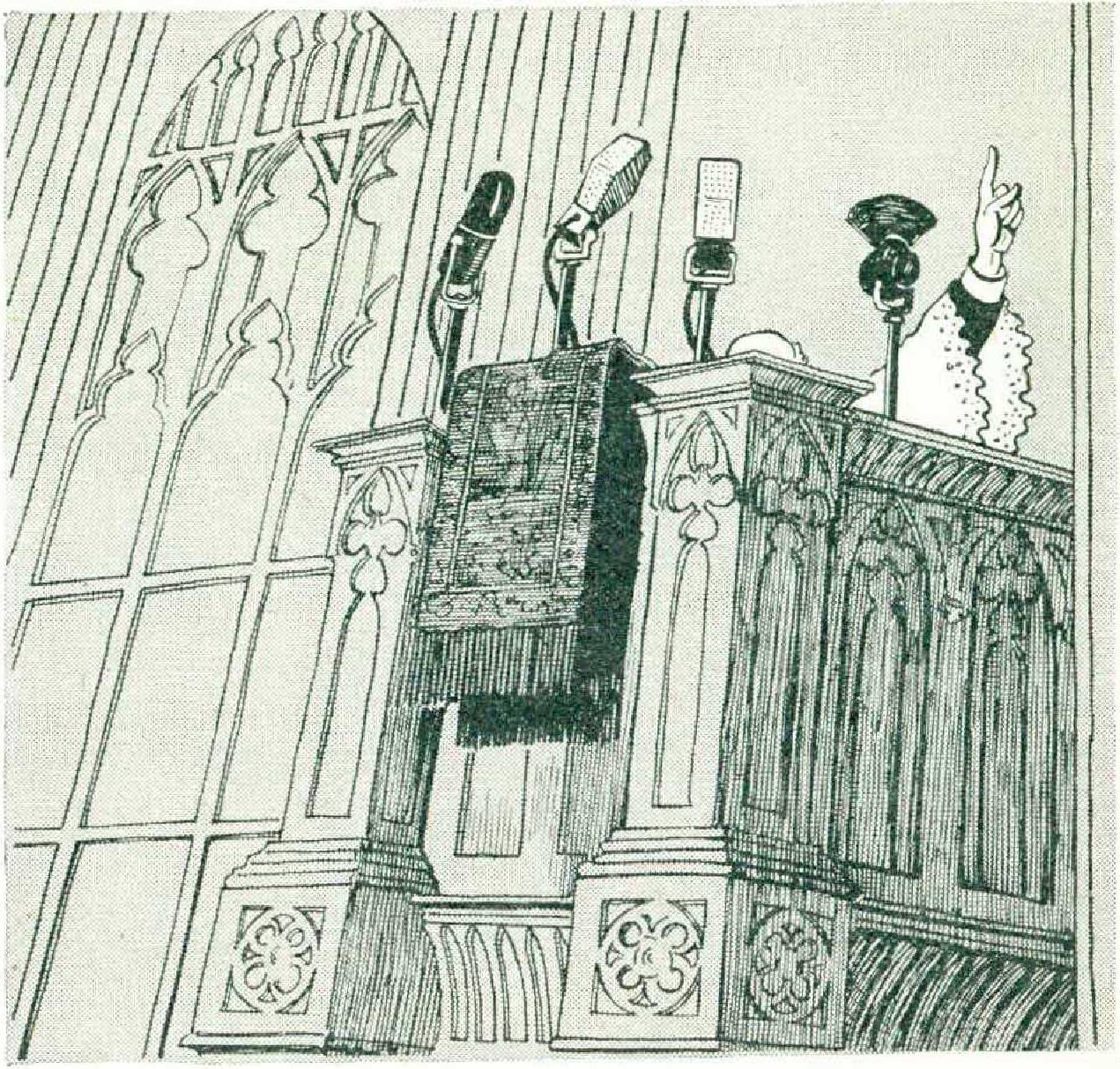
The tradition of the “holy tone,” the tradition of reading or citing the Scripture as hollow, throaty chant, instead of the bravest language ever written, hangs damp and heavy upon most preachers. Some talk on tiptoe. Some bark, roar, howl, and bemoan. Some croon. Some lisp. They can and do read the greatest prose in the language as if it were a gargle. They speak not as Demosthenes spoke, with pebbles in their mouths, but with soft-boiled golf balls. They do not speak like ordinary men and women; they do not speak even like their own parishioners.
The preachers (to judge them by their voices, which are after all the only instruments by which t hey can be judged on the radio) have mostly made no effort to master the basic principles of a simple technique which opens to them the doors of thirtyone million homes containing fifty-four million church members.
One wonders why and one worries. Preachers are not necessarily dumb. They observe, read, hear, and for the most part they are in the habit of learning the hard way, by first-hand contact with angular and brittle life. They hear Orson Welles read Thomas Paine’s, “These are the times that try men’s souls . . .” and they say “Aye.”
But it must be said — by a single hopeful churchgoing listener at least —that their run-of-the-mill effort to send their words out into the blind air to make active converts to God is as clumsy as though radio simply did not exist. Church service on the air is as dreary as it must have been indoors before the miracle plays took the Scripture to the people in a new, entertaining idiom, around the year 976.
For a small sum, or for less, or for nothing at all, any preacher’s voice on the air can be recorded and played back to him. How many preachers have thus heard their own voices? How many preachers have said to themselves: “ I’ve got to do something about this at once!” How many have sought the calm professional guidance of the people who know how radio sounds in the nine hundred radio stations of the country?
How many preachers have really learned to read words for sense? Not reading for mooing cadence, the recitative which passes as the spurious currency of obsequious “reverence” in the pulpit — but reading for the basic spirit and meaning in the deathless language? The sad fact, of course, is that the artificial vulgarism known as the “preacher manner” has pretty nearly suffocated the beauty and the sense of the whole Scripture.
2
All this commentary may vex the preachers. The Listener is vexed, too. He feels that there’s no good reason why, if they are empowered to mission God on the air, preachers should run last in public listening. Their subject certainly warrants first place, at least on the ordained day of rest. There has never been a time when people had greater need of spiritual balance to face the brutal paradoxes of each day.
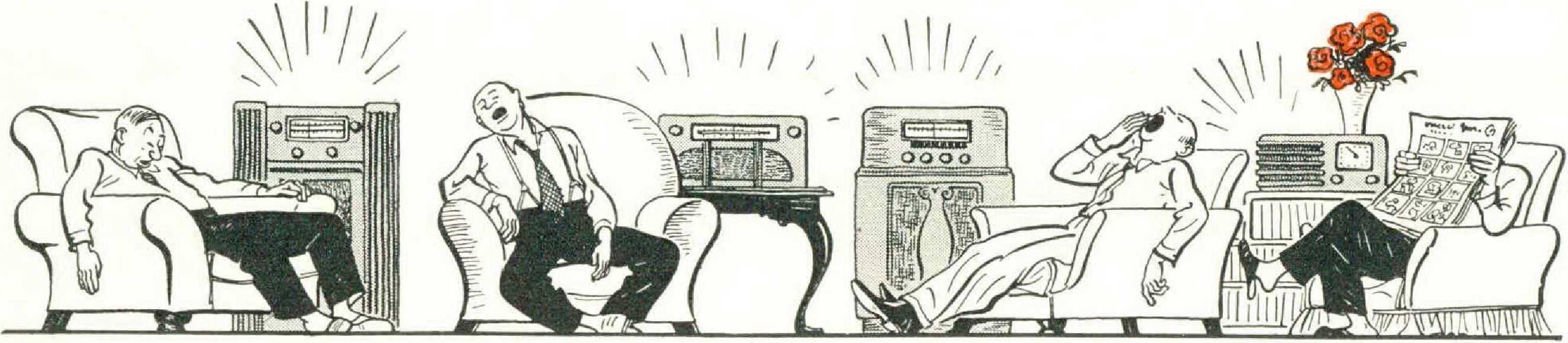
Do the preachers want a specific target? Good, here is one. Let them attack and exterminate intolerance. Let them attack the miserable paradox of our democracy with all the combined thought, good will, skillful technique, and radio engineering they can mobilize. There is an oversupply of ugly racial and religious intolerance in our country—far too much to tolerate. When a Baptist preaching Christianity declaims (as he did on this Sunday’s air) against “ritualism, with its downsittings and uprisings and murmurings,” he is not preaching Christianity at all; he is taking a crack at other denominations; he is preaching intolerance. So, not long ago, was the priest who is now silenced. If every one of the preachers of every one of the 250 denominations really wants to convince the American people that God says that all 250 meet on the level at His feet, radio offers an interstate passport.
But this passport is not to be abused. The preacher given time to broadcast his church service abuses that time when he devotes ten minutes of it to perfunctory parochial notices, or “house plugs”: “There will be no meeting of the Finance Committee this week. . . . I am one of two people on earth who own movies of the final collapse of the Honeymoon Bridge, and Thursday night I will show them to the Young People’s Group and deliver a sermon on the text‘Build Higher.'. . .Our regular pastor is in Washington,D. C. . . . God must bless these offerings in our drive,” and so on.
Let the preacher not waste but multiply his Talent. If he has within him the dynamics of God but no gift of speech, let him get off the air. If he has the gift of speech, let him not ignore the power of music to enrich that gift. If he is himself a man of feeling, but of poor writing power, let him find help to compress his words into audible sequence. If he is a man of great speaking who cannot write a sermon worth hearing, let him make his air-church famous as the one point at which the home churchgoer may count on hearing the great sermons of the past, and may thus be reconvinced of the durability of the Word.
To put it baldly, it is high time the preacher woke up to the fact that this new medium which takes his voice to the ends of the earth carries as much technical obligation as does the act of transmission itself. And if he think himself above trafficking in the black art of the electron, let him remind himself that it was John Donne who said: “No metaphor, no comparison is too high, none too low, too triviall, to imprint in you a sense of God’s everlasting goodnesse towards you.”
The crusade against intolerance is only one specimen target for the preachers. It is advanced only in constructive criticism. For indeed there has not been a time in the life of man when sensible spiritual balance could be more swiftly brought to bear upon a whole people — thirty-one million radio families who have absolute freedom to tune in what they want most to hear are waiting eagerly at their dials.
(The preachers are no worse than the professors or the lawyers — except in that their inherited material is more universal and more glorious. Upon them therefore rests the greater obligation, and in them is the greater hope.)