Mark Twain and the Tiehenor Bonanza
By LOWRY CHARLES WIMBERLY
MARK TWAIN knew them all — crack-brained inventers, stock swindlers, and promoters of easy-money schemes. So it is not surprising that the Tichenor bonanza, of Calistoga, California, should have struck his funny-bone and given rise to one of his most laughable bits of farcicality.
It was nearing mid-September, 1880, when a dispatch from the San Francisco Call announced to the world that Anson C. Tichenor, proprietor of the Hot Springs Hotel at Calistoga, had invented a marvelous process for extracting gold from the “gold-bearing” waters near that town.
The dispatch, copied by newspapers throughout the country, created a nation-wide stir. Mark read it in the New York Evening Post, and it was to the Post that he addressed his burlesque of Tichenors process, a money-making humbug that bade fair to start another gold rush to California. But its exposure came too soon for the rush to get under way. Here is the Call dispatch just as it caught Mark’s eye at his home in Hartford, Connecticut, September 12, 1880: —
“A dispatch from Calistoga says that great excitement has existed in that place for two weeks, over quantities of gold in solution in the water of the springs. A. C. Tichenor, who recently bought the Hot Springs Hotel property, has been at work for the past two weeks extracting gold from the water by a process known only to himself. The clear-up yesterday showed that he has succeeded in extracting a thousand and sixty dollars from ten barrels of water. The gold is of the highest grade of fineness, and as springs in that locality are very numerous, and the volume of water is exceedingly large, it would be useless to attempt to estimate their value if they continue to yield as rich returns as the experiments have produced thus far.”
2
Though he had lived in California — he had even been a reporter on the Call — it is doubtful that Mark Twain had ever heard of Tichenor until he read in the New York Evening Post an account of the great bonanza. The account moved him to write the following letter: —
Hartford, Conn., Sept. 14, 1880
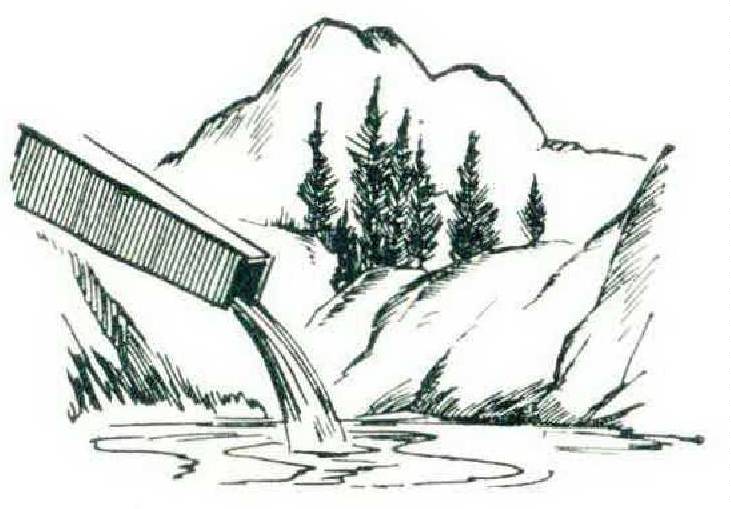
I have just, seen your dispatch from San Francisco in Saturday’s Evening Post about gold in solution in Calistoga springs, and about the proprietor having extracted $1,060 in gold of the utmost fineness from ten barrels of water during the past fortnight, by a process known only to himself. This will surprise many of your readers, but it does not surprise me, for I once owned those springs myself.
What does surprise me, however, is the falling off in the richness of the water. In my time the yield was a dollar a dipperful. I am not saying this to injure the property in the case contemplated; I am saying it in the interest of history. It may be the proprietor’s process is an inferior one. Yes, that may be the fault. Mine was to take my uncle — I had an extra uncle at that time, on account of his parents dying and leaving him on my hands — and fill him up and let him stand fifteen minutes to give the water a chance to settle well. Then I inserted him in an exhausted receiver, which had the effect of sucking the gold out through the pores. I have taken more than $11,000 out of that old man in a day and a half. I should have held onto those springs but for the badness of the roads and the difficulty of getting gold to market.
I consider gold-yielding water in many respects remarkable, and yet no more so than the goldbearing air of “Catgut Cañon " up there toward the head of the auriferous range. This air, or this wind, for it is a kind of trade wind which blows steadily down six hundred miles of rich quartz croppings during an hour and a quarter every day, except Sundays, is heavily charged with exquisitely fine, impalpable gold. Nothing precipitated and solidified this gold so readily as contact with human flesh heated by passion. The time that Wm. Abrahams was disappointed in love he used to step outdoors when the wind was blowing, and come in again and begin to sigh and sigh, and his brother and I would extract over $1.50 out of every sigh.
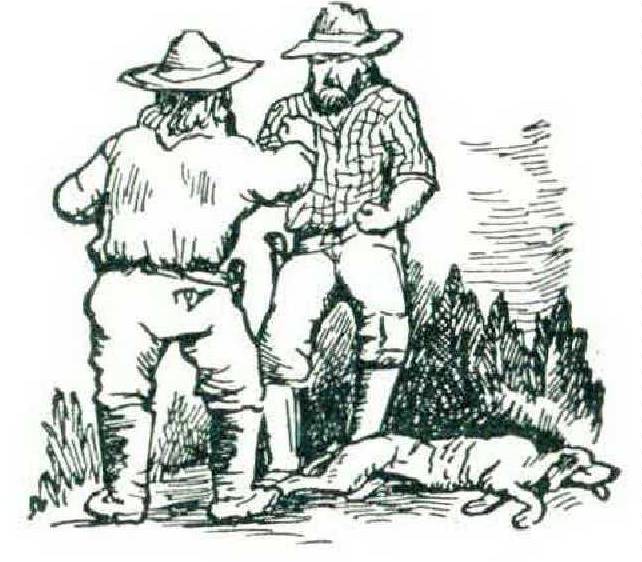
He sighed right along, and the time that John Habison and Alick Norton quarreled about Habison’s dog, they stood there swearing at each other all they knew how, and what they didn’t know about swearing they couldn’t learn from you and me, not by a good deal; and at the end of every three or four minutes, they had to stop and make a dividend. If they did not their jaws would clog up so that they couldn’t get the big nine-syllabled ones out at all; and when the wind was done blowing they cleaned up just a little over $1,000 apiece.
I know these facts to be absolutely true, because I got them from a man whose mother I knew personally. I did not suppose a person could buy a water privilege at Calistoga at any price, but several good locations along the course of the “Catgut Cañon ” gold-bearing trade winds are for sale. They are going to be stocked for the New York market. They will sell, too. People will swarm for them.
MARK TWAIN
Two weeks, lacking a day, after Mark wrote his letter to the Post, Professor Henry G. Hanks, California state assayer, arrived in Calistoga. He tested the “gold-bearing” water, found no sign of gold in it, either metallic or in solution, and called Tichenor a quack to his face. “A dozen hogsheads of the fluid,” he said, “would contain not a perceptible trace of the aureate metal.”