The Children
AUTHOR OF THE $10,000 PRIZE NOVEL, THE FAMILY
CHAPTERS XX-XXIX
THE Children
BY NINA FEDOROVA
★
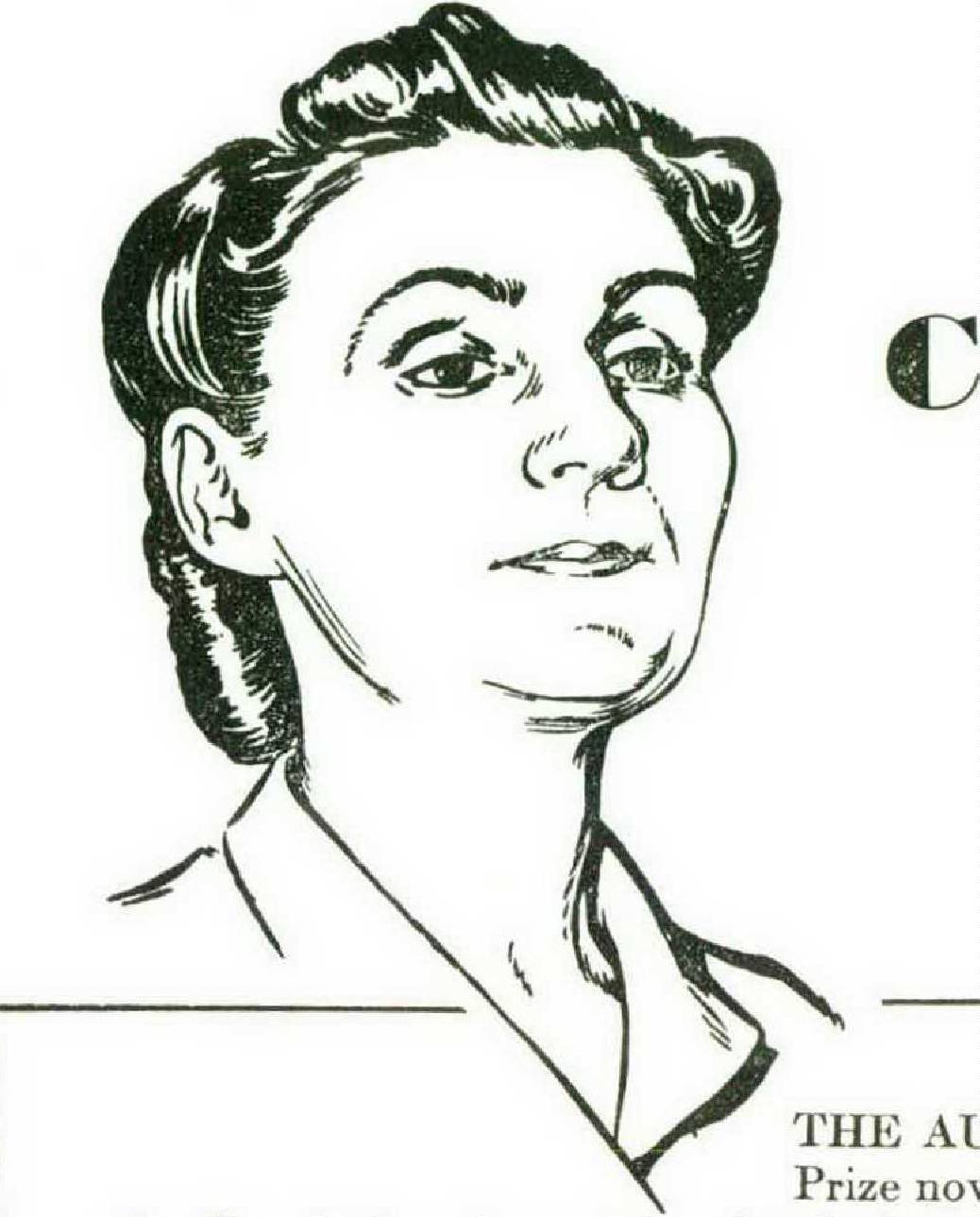
THE AUTHOR: Nina Fedorova, the Atlantic Prize novelist, was born in South Russia. After the Revolution she and her family became part of the exile movement which flowed across Siberia into Manchuria and thence to China. In 1938 she and her husband and her two sons crossed the Pacific to make a fresh start as American citizens in Eugene, Oregon. There she wrote her first novel, The Family, which in 1940 was awarded the Atlantic Prize of $10,000.
THE NOVEL: This is the story of Russian exiles in China in the year 1938 — of parents and young people living on the ragged edge of poverty with only the strands of family affection to hold them together. As the book opens, Lida, a young girl with a lovely voice, is making ready for her first concert in Tientsin. Her voice has been trained (without fee) by Madame Manuilova, a faded but once famous opera singer; if the girl does well in this amateur performance, her teacher has promised to take her on to Harbin for professional engagements.
Lida and her mother share an attic together. Mother supports them on her slender earnings as a nurse, but her duties at the hospital prevent her attending Lida’s concert. The girl is escorted by their landlord, Count Diaz, a Spanish refugee. At the hall they are joined by Leon, the Count’s son, and he, with the rest of the audience, is swept off his feet by the fresh and appealing beauty of Lida’s singing. Caught up as she is by the ecstasy of her music and the remembrance of her American lover, Jimmy, the girl turns him down when he proposes.
Lida and her teacher, Mme. Manuilova, make the trip to Harbin in the company of Mr. Rind, an elderly, benevolent American. In Harbin, Lida finds shelter with her friends, the gay and impecunious Platov family. In this colorful city she again scores an instant triumph with her singing and she endears herself to Mr. Rind. Mr. Rind is a conscientious traveler. He plans to visit Russia and asks the Consul to provide him with a translator; so Dasha comes into his life, a young girl of Lida’s age and an ardent communist whose arguments have no effect on Mr. Rind but whose pathos touches his heart. Their friendship is brought to a tragic close when Dasha is shot and killed in a raid upon a communist meeting.
Lida returns to Tientsin distraught at having hail no word from her American lover for so long a time. The nervous strain of her concerts and the deep disappointment result in an illness from which she is revived when the faithful Leon tells her he will trace Jimmy through the Spanish Consul in San Francisco.
THE CHILDREN.
BY NINA FEDOROVA
XX
MME. MILITZA’S life in Shanghai was ill-starred. She had a small annuity which, when broken into twelve monthly parts, became so meagre that it hardly could pay for the rent and Mme. Militza’s coffee. For the rest, she had to provide the money herself. But how?
There are many different ways of earning money. All of them are well known and constantly practised in Shanghai. Yet the bulk of the population has to live on charity or credit. In that otherwise cynical city the way of paying money is romantic: it is based on an invincible belief in human honor. One signs the chit with one’s name, that is all. It seems unbelievable, still it is a fact. People who cannot hope to have one hundred dollars cash quietly sign chits for a thousand. People without any financial standing or any kind of work or salaries eat, dance, gamble, have servants, marry, divorce, die. Only they have to do it all in Shanghai, under the strict observance of their creditors. They cannot travel. They are chained to the place by their debts.
But Mme. Militza, always in need of money, followed the trodden path: she resumed her former profession. On the entrance door of her apartment she fixed a black wooden frame holding a removable sheet of cardboard on which was printed: —
MME. MILITZA
SCIENTIFIC FORTUNE-TELLER
Nothing more. Simple and dignified. Not a hint of her glorious past, of her fame in the Far East, Rumania, Bessarabia, Siberia. Confidently she waited for customers. They came. At first they were numerous, then fewer and fewer.
One morning she opened her door to slip the printed card into the signboard, thus beginning business for the day. But there was a card in the frame. It ran: —
MME. MILITZA
Scientific mis-fortune teller
Quietly she took it out and put hers in. In the evening when she came to take it out, her card had been replaced by one which ran: —
MME. MILITZA
Swine-typic fortune teller
There must be a certain limit even in offenses. Whatever Mme. Militza’s physical defects, there was nothing akin to a swine in her. An owl, perhaps. But a pig? Never. She felt wounded. Who would not? Still she took the outrage with the dignity proper to a philosopher: as something to be expected from the world of barbarians. With a perfect outward tranquillity she destroyed that alien cardboard. Next day when she came home from market the signboard ran: —
MME. MILITZA
Scientific torture seller
and the next day: —
MME. MILITIA
Scientific fortune yeller
Now it was an insult, that obscure hint. The word ‘militia’ had specific significance for Mme. Militza’s memory. She had been born in Bessarabia where ‘militia’ meant ‘police.’ She had an obscure aversion to any kind of encounter with the police, a caution common among all soothsayers. Yet she took even that offense stoically. She only increased her watchfulness in order to find out who the offender might be. They were schoolboys.
The boys of Shanghai are a rare specimen of human child. To begin with, most of them are paupers. The rich foreigners of Shanghai usually have no children. On the rare occasions when they do, the babies lead a secluded life among yellow servants, are rarely seen in their parents’ quarters, and on reaching school age are exported to the parents’ native country for education. Thus a Shanghai boy of ten to fourteen is a pauper, a proletarian with no class feeling, a person with a deplorable past, blameworthy behavior, sarcastic mind, trenchant speech, philandering manners. He knows something of life’s adversities, of blind luck and even blinder unluck, about injustice, humiliation, hunger, and even about that misery of adults — loneliness of soul and despair of spirits. He is fair game for police, missionary philanthropists, social workers, and spiritual advisers of any kind. He lives on the alert. His accomplishments are many. He knows how to meet a drunken father, how to treat an irritable mother, how to take care of an elder sister, how to waylay a landlord in rage, a neighbor with a mania for universal peace; how to pet a dog, to kill a cat, to cheat a peddler, to win in cards, to count small change, to fool a teacher; how to cry, to swear, to run, and many other things. He faces an omnipresent danger, and his persistent will to live and to remain free is worthy of meditation. He knows war, flood, epidemics, explosions at the arsenals, fires, bombardments — and he is never really afraid. A Shanghai boy is a materialist. He has a practical mind. He would appreciate a good sandwich or twenty cents cash, but never a lofty quotation or spiritual advice. He feels above all that.
Some of the boys have no families at all. Some are of obscure origin. The place where they find each other and form a caste is the school. There they form a kind of spiritual fraternity with an adamant moral code of their own, a peculiar code and in some points even noble, severe, and lofty. According to it, one can deceive a teacher but never another boy. There is no power to make one boy betray another.
The boys — as a whole — face the world as their willing enemy. They are given to suspicion. There is not much confidence toward outsiders among them. Their first enemies are teachers, then the citizens of the town, of course the police, and — at last — humanity as a whole. It was such boys that had become Mme. Militza’s foes. There could be no other motive for that hostility except the ancient and never explained hatred between boys and prophets.
As the boys had a kind of inner organization, the leaders gave daily orders what to do and where. Every day, going to school or coming back, the boys had plenty to do of their own and also of things carried on in the plan of their common activities. There were houses on which they spied from pure, disinterested motives, suspecting crimes or mysteries going on there. They were busy with giving messages, dealing in commerce. To change Mme. Militza’s signboard became one of the manifold daily duties of the boys living in her neighborhood.
When Mme. Militza spied out the truth, she soberly weighed her chances and understood that forces were not equal. Being masterly in the occult arts is nothing to daunt a boy. And Mme. Militza behaved as a practical philosopher. She scorned them as adversaries and despised them as prey. Even if the chase were quick and the capture certain, she had her dignity to maintain. She just stoically tried to keep on her door: —
MME. MILITZA
SCIENTIFIC FORTUNE-TELLER
That was her answer to the savagery. Whatever the other people did, Mme. Militza preserved her dignity among the sordid facts of everyday existence.
XXI
When Lida, all eagerness to see an old friend of the family, for Mme. Militza used to live with them in Tientsin, mounted three crooked steps and faced the door upholstered in black oilskin, her eyes fell on the signboard and she read
MME. MILITZA
Liar-thief-ique fortune trailer
Lida rang the bell. She heard unhurried steps and Mme. Militza solemnly appeared in the door frame.
She had not changed. She was the same. Mme. Militza was not subject to the spiteful influences of time, and space, and climate, as were the rest of mankind. Her insulation from the tragedies of doubts, her detachment from the fleeting fallacies and prejudices of the twentieth barbarous century, her aloofness from any personal intrigue, kept her high above the level of what we call daily life. Black — as usual — was predominant in her person and attire. But hers was a peculiar black, not dull, dead, and quiet, but a shimmering black, with a wink in it, with a mystery, a promise.
She did not embrace Lida, nor kiss her. She did not hurry her visitor into greetings, smiles, and an exchange of news. No, she bowed ceremoniously, offered her a chair, and proceeded with the preparation of coffee.
The absence of many ordinary things manifested that Mme. Militza was jointly an aristocrat and a philosopher in taste, preferring space and silence to the vulgarity of encumbrance and noise. Her setting — from her apparel to her cuisine — proved the same, all except her hairdress, which remained a complicated system of black locks, ringlets, and tassels, but this was too artistic to be approached and measured with the common values applied to ladies’ attire. Yes, Mme. Militza remained herself, regardless of the mundane tragedy going on around her.
Only when coffee was ready and the hostess and her guest could share its fragrant stream gurgling from the snout of an earthenware coffee pot — only then did Mme. Militza find it timely to indulge in the polite art of colloquial hospitality, all the time busy with coffee, for Mme. Militza was a great adept of it. She would scorn arguments in behalf of any other beverage, be that the ascetic poverty of water, the lascivious wine, the infantile cocoa, or the cheap sophistication of tea. Some say coffee is not good for the heart. Well, all the best things in this world are not good for one’s heart. A philosopher never bemoans the inevitable payment.
When a pleasant personal touch had been introduced into conversation, Lida asked how her ‘affairs’ were going — meaning, of course, her business. Mme. Militza answered that her high price of one dollar per fate kept the common populace away. She hinted that perhaps the gruesome glory of a true prophet had something to do with the absence of a clientele too. Thus gently the fact was stated: fortune-telling at Shanghai had not met broad popular consumption.
The news that Lida had come to sing in concerts made Mme. Militza press her lips cunningly and nod her head in emphasis. She solemnly confessed that, having been informed about Lida’s imminent arrival, she had thrown the cards for Lida and a rare fate had been revealed. Lida had to live and die in glory. She could count on a long happy life.
Lida jumped.
‘Married?’
‘Yes.’
‘To whom? Jimmy?’
Mme. Militza scorned the naïveté of the question. She said what was in the cards.
‘To a blond foreigner. In a foreign country. Three children. Long struggle, great glory. Always having heart’s desires fulfilled.’
‘What else?’
That was all. Lida had an impulse to embrace Mme. Militza, to kiss her, but it seemed absolutely infeasible.
When Lida gave her the free concert tickets she had brought as a present, Mme. Militza took them with a bow, read them thoroughly, bowed again, and said with royal dignity that Mme. Militza knew how ‘to return a compliment.’ Here she looked very enigmatic and lofty, as if ready at any instant to vanish in smoke and send a gift from the beyond.
Lida was shaken by the prophecy, for she never had had any reason to doubt Mme. Militza’s talents. A marriage to a blond foreigner could mean only Jimmy. She sat silently with tears in her eyes.
The visit could not be prolonged, for Lida had to be at the hotel to practise with Mme. Manuilova for tomorrow’s concert.
Lida had scarcely taken ten steps along the street when a boy bumped into her as he came around the corner. A cardboard fell from his hand to the pavement. The card bore an inscription: —
MME. MILITZA CAGLIOSTRO
Siren-tific voodoo fairy teller
In an instant the boy was across the street, on the run.
‘Come back here,’ Lida cried. ‘Unless, of course, you’re afraid . . .’
‘Afraid?’ the boy cried, hot with anger. ‘Afraid of whom? What did that hag prophesy for you? A plague? Shipwrecks? Fire?’
‘Me?’ Lida said with haughtiness. ‘Why, she told me that my life ends in glory.’
‘What kind of glory?’ the boy asked mockingly.
Several other boys had now appeared, from out of the doors, from around the corners, from nowhere.
‘Real glory,’ Lida said with reserved pride. ‘I am a singer.’
‘You are a liar,' a smallish boy cried aggressively — and he stamped his foot toward her, as if ready for an attack.
‘I?’ Lida was red with wrath. ‘You . . . take away that foot . . . Have you seen the newspapers today?’ And she quickly produced one from her handbag. ‘See? Who is that?’
The tallest boy snatched the paper, the others looked at it eagerly over his arms. He read aloud: —
‘A young, talented, and charming singer. The brilliant pupil of the once world-famous artist and teacher Mme. Manuilova, who predicts for her a glorious career . . .’
He looked at Lida with a short fugitive glance and read again: —
‘We are happy to state that in spite of the tragic grandeur of our Russian decadence, as a cultural class, we still bring forth young artists, before the wondering eyes of the world. . . . Welcome, Russian youth, charm, modesty! Greetings to you, a Russian child. We are happy to tears to have such children.’
‘See?’ Lida asked modestly.
‘Wait a moment,’ the tallest boy said. He unfolded the paper and examined Lida with a critical investigating eye. Then he said curtly: —
‘All correct. It is she.’
‘Want some free tickets? I have three still left,’ Lida said magnanimously.
‘Give me one? Me too?’ eager voices cried.
‘Stop it,’ the tallest boy said with dignity. He folded the paper and, offering it to Lida, bowed ceremoniously: —
‘Thank you, Madam. Honored to meet you, Madam.’
The other boys looked at him with amazement.
‘But the tickets?’ one asked.
‘The school may have some free ones. The rest we shall buy.’ He was grand in this new rôle and the boys looked at him with the uncertain looks of wondering appraisal.
‘Madam,’ he said, ‘ we must not detain you . . . from your great responsibilities.’
At that Lida made a sign to a rickshaw coolie and with a polite smile bade the boys good-bye.
Curious, almost admiring eyes followed her dignified departure.
Next morning when Mme. Militza looked at her signboard it ran: —
MME. MILITZA
SCIENTIFIC FORTUNE-TELLER
The same the next morning. And the next and the next. She never tried to find out the reasons for that sudden cessation of hostilities. She was not interested. Barbarians — at war or at peace — could have only her scorn.
XXII
The two concerts Lida gave at Shanghai were most successful.
She had a precious quality, rare in actresses: she was not nervous. She gave her whole soul to music, never thinking how she looked, or whether she was admired or not. That lack of selfconsciousness, her simplicity and naturalness, made her very attractive.
The Russian public in Shanghai was more exacting than elsewhere. The spirit of criticism and suspicion is natural to people who had behind them about twenty years of continuous disillusionments. There was some professional envy too, for Shanghai was subject to the overproduction of international artists, most of them unsuccessful and naturally hostile to any new reputation. But Lida’s unassuming attitude carried the day even with them.
The most intriguing figure of the audience was that of Mme. Militza. She would come half an hour before the beginning and spectacularly proceed to her place in the first row.
On this solemn occasion she wore a huge black dress, of a burdensome weight, adorned with a lace pelerine of unheard-of thickness, crocheted of something akin to tarred rope. A huge brooch in the image of a fleshy heart added about a pound of extra weight to this gala dress. There she remained in the solemn pose of a Pythia, and her rare applause sounded fanfares. She comprised the geometrical centre of the audience, and also its point of gravitation.
The boys of Shanghai were the other feature among the audience. Their personnel was different at each concert, except for the tallest boy, who attended both.
After the meeting with Lida, at the corner of Mme. Militza’s abode, clouds of suspicion arose in the minds of the boys concerning their leader’s sobriety. With a keen eye to the fluctuations of his value in the hearts of his subjects, the tall boy understood where the danger lay. He had to reaffirm himself once more as one aloof from any human weakness. His love for Lida — for love it was — he had to disguise under the masquerade of mass admiration for a talent.
He reasserted his authority of being a wit on the next day, during the geometry lesson. Having good mathematical brains he was always given the problems with the assignment to find the solution by himself and then to explain it to the class. He usually did it successfully, which made him dear to the hearts of monks, for Catholic monks love science.
Father Andrew, indefinably old but still jovial, always felt sleepy on Wednesdays and Fridays after his luncheons of fish. They say fish is not good for people after sixty. For those after seventy it certainly is not. To sleep it off was the only way to have the end of it.
Father Andrew gave the tall boy a theorem. Seeing that his inscriptions were perfectly correct, he yawned, crossed his heart, and bade the boy to recite the solution to the class in detail. Then he sank peacefully into a nap.
The tall boy, while pointing out at his drawing the formulas and inscriptions, in the order required by the problem, was reciting meanwhile in the expressionless voice of a pupil at his daily task: —
‘Father Andrew, here is a rectangular triangle — A B C. Are you well asleep, old barrel? Then let us build a square on the hypotenuse of the triangle, for you are a shameless glutton as to fish. Let us call it B C M N — you, poor wretch of a gormandizer, I am sure, had some wine with your fish. Let us build another square on this cathetus, for your wine was red, old sinner — I see it in the color of your cheeks. Why not call that square A B P R. Why not? Are you well asleep by now? Then I will risk calling you more names. In spite of it all, I like you, old man. I shall even build for you a third square, for we do not believe, after all, that you really pretend to be a saint.’
And so on. When, at last, he felt it was enough: —
‘Father Andrew,’ he cried into the monk’s hairy ear, ‘I have finished.’
‘I see, I see.’ Father Andrew instantly opened his small merry eyes. The fish had been slept through. ‘I see,’ he said with more dignity. ‘You did it well. I shall give you a good mark.’
A trick like that instantly reëstablished one in the esteem of one’s classmates. Still, going to two concerts in succession —twice actually buying the ticket — was unprecedented. The tall boy had to put it on patriotic grounds. He was a Russian too. Let all the Russian boys support a new talent, alone abroad. This seemed an adequate explanation, to a certain degree.
The boys came with one of their tutor monks. The face of an old Catholic monk is a great study for an artist. Profound individual traits are rare today, when the speed of life makes faces shallow and the look of the eyes mostly meaningless. Facial expressiveness belongs to people who live in spiritual aloofness.
Thus the Shanghai boys would march in under the guidance of a perfect Savonarola, or a Cardinal Richelieu, and under the subguidance of the tallest boy. Under the latter’s inquisitorial eye, they had to applaud to exhaustion and make a line, afterwards, at the door to see Lida’s glorious departure in a rickshaw — all the time clapping with all their might. Savonarola would sit or stand meanwhile, deep in theological schemes, perhaps never noticing there was a concert. The tall boy would feel that nobody ever had loved like him, and would try to convert his love and despair into a fullblown patriotic demonstration.
Many psychological phenomena and events were interwoven in the making of Lida’s success. There was one feature worthy of being mentioned, for it greatly influenced Lida herself.
Mme. Manuilova had arranged that, after covering Lida’s travel expenses, the rest of the money from the concerts would go to the Russian charity institutions of Shanghai. When several ladies came, as deputies, and thanked Lida warmly, she was very much moved.
The idea of ‘giving’ arose in all its grandeur before Lida’s eyes. She had never thought of life from that point of view. She who had never had ten dollars all for herself now gave two hundred to the poor.
With wonder she thought now of how easily she had accepted things from others, never looking deeply into motives. A vision of all the human active kindness going on in the world, like fresh underground waters, mostly invisible, but nourishing so much of life, charmed Lida’s mind. So that was the force which kept so much of suffering humanity from utter despair and perils. Amidst the turmoils of this life, externally so materialistic and egoistic, one can always meet a kind soul, an outstretched hand with help and encouragement. Not the strict laws of governments, nor the mathematical approach of statistics, nor philanthropical organizations, nor anonymous help sent through the church — none of these things, but an individual approach of a kind and humble heart, saves humanity from an utter disillusionment in the possibilities of brotherhood.
Lida understood now why Mother worked at the hospital for that ridiculous salary (hardly enough to buy even their daily bread), and why she would not look for easier work with bigger pay. Although nations, governments, and societies are painstakingly looking for better ways — in wars, in competition and such conflicts — the way lies open to individuals. One is free to be kind, to be noble, even to be a saint — everywhere, always. There are no obstacles which can prevent one from being good, and they can never be invented.
This new understanding of life filled Lida’s heart with warmth and happiness. A great peace entered her mind.
‘This cannot be taken from me, this my new happiness.’ And she shut her eyes to be alone with it for a while.
With a sigh of relief she realized that her new discovery would keep her alive, whatever happened to her personally. The new truth was bigger than one’s personal fate. The new truth — the love of humanity and life — was life itself and gave vitality and happiness in proportion to its development in one. Love for Jimmy, for the family, enthusiasm for her music were only different — and smaller — expressions of that fundamental love.
XXIII
Lida was late with her third call in Shanghai, for Mother Abbess died several days before Lida’s arrival.
All she could do was attend the solemn post-funeral services daily performed in the convent with severe splendor. Lida, as well as all the others who had known Mother Abbess in person, had a feeling of irreparable loss. She had belonged to the old life, and such characters could hardly be formed amidst the constant changes of modern existence. Her genuine unshattered faith in God, in saints, in miracles, along with her love for humanity and an active kindness, had made the Mother Abbess a link between the two worlds of here and hereafter. Her simplicity and naturalness made the other world seem easily approachable, miracles real, and life wholly acceptable. Now that link was broken, and a feeling of having been left alone entered many a heart.
On the eve of her departure from Shanghai, Lida went to the convent for the last time. She looked at the fresh tomb and her heart refused to admit that the whole of Mother Abbess’s being was there. It had been too broad, too buoyant of life and kindness to be secluded in that small, limited space. A clear, sober mind refuses to admit the final and total death of a soul, while its shell, those cells and atoms, is kept permanently existing.
While Lida was walking back to the hotel, her face pale from tears and fatigue, she suddenly caught sight of Miss Clark entering a taxi. A thought, quick as lightning, identified Miss Clark, recalled the latter’s casual words in Harbin about returning to the States, to her native town of San Francisco.
‘Miss Clark! Miss Clark!’ Lida cried and ran after the taxi.
Miss Clark tapped the chauffeur’s shoulder and sat waiting for Lida.
‘Miss Clark!’ Lida cried, all out of breath. She leaned over the door of the taxi: ‘Are you going to America?’
Only now did Miss Clark recognize Lida, and her pathetic tear-stained face moved her.
‘Yes,’ she said gently. ‘I am leaving tomorrow for San Francisco.’
‘Miss Clark! It is so near to Berkeley!’ and Lida began to cry.
‘Darling! What is the matter?’
‘It is so near . . . so near to Berkeley.’ Lida could not say anything else.
‘Jump into the car,’ Miss Clark invited her. ‘We shall go to my hotel and you will tell me what troubles you.’
At the hotel she let Lida wash her face, ordered tea, made her visitor and herself comfortable, and then with absorbed attention listened to Lida’s story.
Whatever their complicated national traits, Americans have at least one in common: they like people. Nowhere in civilized countries are people so much liked as in the United States. Miss Clark took Lida’s sorrow straight to heart, as if it were her own.
‘Every girl must have the boy she wants,’ she said decidedly and she began to organize help. She had the practical sense and the efficiency of American women. To a trembling Lida she promised to take all the trouble upon herself, asking the latter only to follow her instructions. With a calendar in her hands she said on which day she would be in San Francisco, on which in Berkeley, what time was allotted for visitors in the hospitals, on what day Lida would have the message. She fixed all this in terms of hours, miles, telephones, and the like, not in terms of fate, destiny, occasions and hazards, as Lida was accustomed to plan. She promised to make the situation definite and clear. In case Jimmy wanted to see Lida, Miss Clark promised her help with visas, money, tickets, and support in finding work in the States. Happily Miss Clark was rich.
‘You could be one of my father’s secretaries, until you would earn money for yourself singing on the radio,’ she decided.
Then she said Lida must start with her make-up. On Lida’s words that she had never used it and never had had the implements, Miss Clark almost groaned. She presented Lida with an assortment and ‘made’ Lida’s face personally.
With that queer new face, all radiant with colors and joy, Lida kissed her good-bye.
When Lida and Mme. Manuilova left Shanghai, a spectacular group of friends and admirers came to see them off.
There was Mme. Militza with her ‘return of compliments.’ She presented Lida with a small parcel from which a strong smell of coffee emanated. There stood several ladies with a box of candies, several nuns with a ‘prosfora,’ and three of the Shanghai boys with a bouquet. The boys made a picturesque group, one of them holding the bouquet in his outstretched hand, the two others standing at his sides as guards of honor. When they saw Lida they marched straight up to her, but the chief deputy suddenly grew shy and his hand drooped, the ribbons of the bouquet sweeping the asphalt. One of the deputies kicked him from behind with a whistling whisper: —
‘You do not even know how.'
He snatched the bouquet and, slightly bending his right knee, with a generous and flourishing gesture of his hand he offered it to Lida. He knew this was the right way, for he had seen The Three Musketeers on the screen and copied it.
The comic side of this was wasted on Lida, for she had seen the same version of The Three Musketeers, and behaved accordingly as a gracious queen of France. She accepted the homage, made a light bow, and smiled a royal smile.
Later she saw a letter attached to the bouquet. ‘To Our Greatest Russian Singer’ ran the address, and a long list of names followed, evidently the names of those who had given their mites in cash for the flowers. Lida’s eyes ran over the names with indifference. Suddenly she gave a start and the mist of tears filled her eyes. In small letters, with an almost visible emotion, had been written ‘Eternally your Jimmy.’
XXIV
Coming back to Tientsin proved to be eventful. Owing to the hazards of the Sino-Japanese war, there was no direct communication between Tientsin and Shanghai by railway. Mme. Manuilova and Lida decided to go to Tsingtao on a steamer, take a railway train there, change in Tsi-nan-fu, and from there proceed to Tientsin. The day of their arrival was the tragic fourteenth of June of 1939 when the Japanese announced a blockade of the British and French concessions at Tientsin. The blockade was announced at seven o’clock in the morning, and the train came in at eight, just one hour later.
Although the threat of the blockade had hung over the town for months, nobody was prepared for it. And anyway, how one has to prepare for a blockade no one knew.
When Lida and Mme. Manuilova left the railway station, an awesome sight met them.
The place before the station, the square, the streets, were literally packed with people. The usual way to the French and British concessions went through the drawbridge, and now that bridge was raised. Thousands of people, hundreds of rickshaws, cars, horses, trucks — all was a compact mass. The noise was deafening. The frightened horses neighed and pawed. Honks of motors, cries of the injured people, voices of frightened women and children, made a formidable chorus.
To make the situation worse, the constant pressure of people pushed crowds nearer and nearer to the banks of Hei-ho River, which was deep enough for big steamers to pass. All the buildings around, the shops and houses, closed their windows and doors in fear of the mob.
Lida was frightened. She did not know what was going on in the town, and how it was with Mother. Mme. Manuilova, broken with fatigue, looked for help.
For five dollars a rickshawman promised to bring them home by a circuitous route. They had to go through the Japanese concession, along the Asahi road, to the French border. When they reached the goal, they saw no less of a crowd and heard the same deafening noise and tumult. Japanese policemen singled out all the Europeans and told them to go to the police station. The small barrack was filled with people who were being searched. Some had to take off their shirts and footwear. Many were offended. Some were beaten. Our travelers, being ladies, met with more consideration. They were not searched at all, only asked to show their papers and answer numberless questions.
When were you born? Who was your father? What did he do in 1905? In 1914? In 1918? In 1921? What did your mother do at the same time? Do you like communism? Why ‘yes’? Why ‘no’? Do you approve the New Order in Asia? Tell why (give twenty reasons). Then there were easier questions about one’s present activities.
It took hours to write all that. At three o’clock Mme. Manuilova and Lida finished, signed, and were free to go home.
The sight of the British concession, quiet behind its wires, was in striking contrast. Lida entered the house with a fast-beating heart. She was met with the usual silent courtesy by the Diazes, and Mother came running down when she heard Lida’s voice.
Only then was Lida told what happened in Tientsin. It was the famous blockade, which brought no glory to Japan, nor success to her army, nothing except more suffering to the people the least guilty in the Sino-Japanese conflict.
But the room in the attic! An island all to oneself! Oh, the quietness of a home! And then Mother’s mysterious smile and her eyes squinting toward the small triangular table, in the corner, under the icons, under the light of the lampada.
What could be there?
There lay a postcard. From Jimmy. The first after months of waiting. Unmistakably his hand, his handwriting. Only several words — but . . . what words! They could imply so much. . . . He was better. . . . He would write!
She studied the postcard all evening long. It had been mailed before the letter sent with Leon could reach Jimmy. It had been sent before Miss Clark could have come to the Berkeley hospital. It was written by Jimmy willingly, spontaneously, without being urged to write. He just remembered about Lida and wrote her. And he promised to write again.
She had to cry — hours — from happiness. Fatigue? Blockade? Tientsin could have been heavily bombarded that night without Lida’s hearing the sounds.
XXV
That small postcard of Jimmy’s was a messenger of great changes. News and events began to throng into Lida’s life, as if they had been forcibly kept somewhere, away from her, but then broke the dam and poured down in plenitude.
The most important were Jimmy’s letters. One week after her arrival home, Lida had the letter in answer to the message brought away by Leon; then days later came a cablegram acknowledging Miss Clark’s arrival and interference, then a letter from Miss Clark herself, and then constantly, with every mail, came letters, often in twos — from Jimmy and Miss Clark, sometimes written jointly, for Miss Clark instantly took up the business phase of Lida’s love story.
Jimmy’s first letter brought enlightenment on the reasons why Jimmy had stopped writing one month before the accident.
Leon was the cause. In her simplicity Lida had written about Leon in warm, laudatory tones, for she really admired him. She had written Jimmy that Leon was strikingly handsome, noble, polite, generous. She had written that the Diaz family was the one she admired most in the world. They offered a room free and never consented to take a penny for it, although Mother was earning some money. They always tried to help; Lida was free to play their piano at any time. Then came the news the Diazes were restored to almost a half of their property. Leon became rich, and Lida seemed to gloat over his luck. Then another letter told about Leon’s proposal. Here Jimmy stopped answering Lida’s letters.
In the simplicity of his heart he saw himself as a potential hindrance to Lida’s brilliant future. With Leon she would be rich and could follow her vocation. With him?
Jimmy saw before himself years of struggle. He had to go through college with only half his way paid by his parents. The other half he had to earn himself. Not that his family was very poor, but his parents were subject to the common American notion that children must earn their way, and the sooner the better. After college Jimmy could, perhaps, have means to marry and support his wife, but not to pay for Lida’s voice training in a good school.
Not that he doubted Lida’s heart. Her letters never showed any change of tone toward him, but he thought he had to give her the chance of a freer choice. He could not write all that plainly. He understood the nobleness of Lida’s nature. If given to understand that Jimmy was stepping aside only because he was not the luckier party, she would never leave him. He did not like to base his marriage on her pity or her future regrets. Thus he decided not. to write for a while, or to write casually, until Leon would leave for Spain and Lida would decide her future. Then Jimmy’s accident occurred and, afraid of remaining an invalid, Jimmy felt ashamed to offer himself— a burden, perhaps, for life — to a girl with such a future ahead of her.
Lida’s announcement that she was happy Leon was going, for he could bring her message to Jimmy in the quickest way, put an end to the trial.
Since only love letters were written and sent by the two, both sides diligently used the obsolete and naïve dictionary of love.
But what is a language, what are words? Moving in a constant noise of a multitude of them, we still have but few and always the same to designate the cardinal life’s events: ‘The child is born’; ‘I love you’; ‘We are mortal.’ Ages came and passed away, but when one is in love no complicated or refined expression would state the fact as plainly and nobly as the obsolete ‘I love you’ that Lida and Jimmy wrote each other.
Other news followed quickly. Miss Clark took upon herself the trouble of visas and money. Jimmy came out of the hospital. Lida was promised work on the radio after her arrival, and Miss Clark hoped a scholarship for voice training could be obtained too.
Every letter was definite, practical, like a new brick, heavy, cemented, adding to a solid building of happiness.
Meanwhile the blockade at Tientsin continued. Loud-speakers were established at crossroads and roared in Chinese explaining that all the evils in the world came from the British quarters. Surrounded by wire, padded with sandbags on the borders, the concessions were locked out from the rest of the country. Only five places were fixed as gates opened to communication. Numerous Japanese officials, soldiers, and policemen were attached to those places day and night. Only those who had ‘passes’ were allowed to go through gates. After having been sanctioned by the Japanese officials, those curious documents were distributed by the consulates. Meanwhile there were thousands of people whose daily business was at one place while they lived in another. There were doctors hurrying to their patients, teachers to their pupils, priests to churches, vendors to consumers.
The foreign concessions of Tientsin did not grow their fruit or vegetables; dairies were not allowed there either; in short, all that the people there needed in the way of their daily food, clothing, building materials, labor, came from the outside. Now thousands of those workers were standing crowded at the wires of the borders urging, requesting, imploring. All were searched. Many were insulted. Some were beaten.
One could never guess whom the Japanese officials would beat and why, since they had outgrown their timidity toward the person of a white man. Their long experience with the unprotected masses of Russian refugees gave them audacity in using force, instead of argument. Now they tried the same with other nationalities, and applied the methods of unprovoked insults and beating to the English, Americans, French, always successful and never punished. Even society ladies were beaten, only because they wanted to get home after a party in their own Country Club. If the officials of the victims protested, the Japanese readily answered; ‘Sorry.’
Whatever the personal offenses, the question of food supply became the most important. The Japanese officials taxed outrageously every truckload of victuals. Their routine of collecting taxes being slow, milk grew sour before it could be brought to the concession, vegetables and meat and fish quickly spoiled under the hot summer sun.
The uncertainty, rumors, anxiety, the lack of food and exorbitant prices, the fewer opportunities of earning one’s living, made life harder with every coming day.
At that terrible time Lida and Mother found themselves well braced with good news from Jimmy, invigorated with the coming change in Lida’s life, busy with her plans and preparations, and — in addition — with two new financial assets. The Diaz family left them the house, the rent paid until March 1940. As it was only August 1939, Mother could let rooms for months and have the money for herself. The rooms on the British concession were always in high demand. Cook asked and was granted the permission to live in his quarters, until he would find another place. With joint efforts Mother, Lida, and Cook tried to perform the cleaning of the house before letting the new people in. One could see Lida in every window frame in turns, washing the glass panes and singing at the top of her voice Russian folk songs. Informed that Lida was going to America, Mme. Manuilova changed the course of lessons, teaching Lida to sing Russian songs, in order to prepare her to earn money in the new country.
The second financial asset was the piano left to Lida as a present from the Diazes. It was decided that the piano would be sold and thus cover Lida’s fare to the United States. It would spare her the humiliation of starting her happiness on credit.
Quickly and simply all the obstacles to happiness were giving in, one after the other, and a new life began to shine for Lida.
Mother and Lida decided to remain in the attic room. They were accustomed to it. It had been a silent witness to so many events and thoughts that they were unwilling to part with it.
Now long hours Lida and Mother spent in talking about the future.
‘Mother,’ Lida would say, ‘the moment I shall be able to earn, I shall send for you. Promise to come?’
‘Of course I shall.’
‘Then we shall live together. A family again . . .’
XXVI
On Sunday, the twentieth of August , in the evening, Lida was in their small garden.
The high bushes of nicotine stood along the fence, their big, rare flowers full of fragrance. Light seemed to be emanating from their petals and to stand in a tender vibratory halo around the flowers. The twilight was quickly wrapping the world. Lida lingered in the garden admiringly; she had never seen that kind of nicotine.
Suddenly she heard cries: ‘Water! Water!’ They sounded first only as wondering and amazement. Lida, who frequently gave only half of her attention to reality, did not comprehend their meaning.
‘Water! Water!’ The shouts arose from all sides. Now anxiety and fear rang in them.
Suddenly Lida felt something stealthily crawling around her feet. Looking down she saw water. It appeared furtively. Not that it poured from a certain direction; no, it rose from below. Lida, who had forgotten rumors of the coming flood, could not place the phenomenon in her mind; she just stood there and looked down.
It was not the kind of water she was accustomed to see. This was dark and thick and sticky. When her feet were in it up to the ankles, Lida ran to the porch and the flopping sounds seemed to run after her. Standing on the steps, she saw the water slowly rising. Dog came from somewhere. He clung to Lida’s feet, gave out several growls, and shivered all over, his bristle standing up and moving.
Lida slowly went into the house. Dog refused to come in. Mother was at the hospital. She was alone. It was dark in the hall.
The house was full of small, stealthy sounds. They went all round, like sighs, or whispers, or slight movements. Lida could not discern what they might be. She fit the lamps and shrank from what she saw. The hall was full of living beings: mice rushed here and there on the floor; centipedes slid in zigzags across the walls; cornices and corners were alive with rustling cockroaches; lizards seemed glued to the door frames.
They were all running away and upward, from the flood. Awed by the light from the lamps, they began to move on, with better speed.
Lida rushed upstairs. She did not know what to do. Looking out of the window she saw that the water was rising. It seemed dangerous to venture out. Voices and cries came from everywhere. Night seemed in haste to come, and the darkness moved onward quicker than usual.
Lida tried to calm herself. In any case, her attic room was the safest place. The disaster was not very big, perhaps, and only their part of the town was being flooded. It would be wisest to wait until morning.
She called Dog, but he seemed to have disappeared and did not come. Lida prayed, then took Jimmy’s letters and read them slowly, one after the other.
Now sounds were coming from downstairs. Lida rushed down. The floor of the hall was hidden under water.
‘But how?’ Lida thought. ‘Where does it all come from? The doors are locked.’
With an effort she opened the entrance door. There was Cook with two big parcels. His low quarters were flooded.
Cook was calm and efficient.
‘We must move things upstairs,’ he said, ‘to the second floor.’
The piano was already standing in water. Lida grew cold with apprehension.
‘Let us take it . . . upstairs . . .’
But of course they could not.
At midnight the eleclricity went out, and a thick menacing darkness filled the world. Groping the way, Lida went to her room in the attic, shut the door, and sat at the window until the morning came.
The night was unusually dark with not a single star in it. It was full of sounds. They were different, those of peoples and animals, but all expressing the same things: anxiety and fear . . .
Cries of the drowning cattle, coming from afar, seemed unbearable. The howl of dogs was dreadful. In the concessions it was quieter. All the houses were at least two-storied, and packing upstairs was the natural way to safety.
But Lida thought about the low Chinese huts on the outskirts of the town, about farms and small houses of the poor.
Morning came — and there was no more earth in view. Houses had become islands.
With the first rays of dawn, life arose as a cry for help and safety. With their usual calm and invention the Chinese began to build boats from everything available, and charged twenty dollars for a ride.
When Lida went downstairs she saw a black island in the waters of the hall — it was her piano. Its keyboard was under water. It was spoiled, dead as a piano and as a financial asset too.
But there was not much time to brood over the loss, for with the rising sun lodgers came or, better, swam to the house.
Mother’s friends knew that she now had an apartment all for herself. Several of them, whose living space was in the basements or on the first floors, came to live in the second floor of the apartment. Naturally, nobody asked permission, and the question of money was never raised. Thus the family’s second financial asset was gone.
Mme. Klimova came first. She was driven in a small boat into the hall and anchored at the staircase, which had since become a haven. Disheveled, her dress and slippers wet, Mme. Klimova increased the moisture with her abundant and now quite sincere tears. She threatened she would at once curse with bell, book, and candle the very day of her own birth, for she had lost all her belongings. The impatient Chinese pilot demanded his fare, of which she could provide only a half.
The quarrel arose. But seeing that time and a boat were money, the pilot neatly spat into the water and departed from the hall in his boat. Here Mme. Klimova dried her tears and said she came to take a room for herself before somebody else could arrive and make the best choice, for people were always like that, greedy for the best morsel of everything.
Then Mother was driven in on a kind of raft made of a door, on which the staff of the hospital was being removed after their night duty. Seeing that Lida was well, Mother crossed herself and began her activities.
She instantly sent Cook on the same raft to call at Mme. Klimova’s place and ask the General to come immediately. Other friends began to arrive and places were found for all. Only in the afternoon did they remember about food and begin to think over the complicated problems of living. There was no electricity, no telephone, no fresh water, no food, and almost no means of communication, for nobody in the house had cash ready for the fares, and the boats were not handy.
The old General took the post of a commander and gayly organized works for the common welfare. Men tore away doors and made rafts. Cook drove in a zinc bathtub, not only in the yard, but also to market. Only there was no market on that day and on many days to follow.
Life began on the third day only, when a fresh water supply was offered to the population and the news of it was cried from house to house in several languages at once. Then the Jewish bakery, happily not flooded, offered bread at their own expense and claimed volunteers for free delivery to those who could not move themselves. Then a market was opened in the yard of a French Club, situated high — and those who had much money could buy some food.
The fact that the Japanese refused to remove the blockade seemed a wanton cruelty. The borders, the wire, could not be seen now; still, Japanese soldiers with bayonets, sitting in boats, did their best to harass the population which tried to get food.
But in spite of all the terrors of heat, thirst, hunger, bad smells, corpses in the street waters, in spite of pains and sufferings going around, there were a few who tried to save the rest from despair and utter disillusionment.
XXVII
Of all the towns in the world Tientsin was, perhaps, the most self-restrained in its reaction to the declaration of the new war which acquired the title of the Second World War. The third of September found the town with less water, but no less misery. Water had been partly pumped out with the special machinery brought aboard special steamers from Shanghai, but human misery grew and left a harvest sorrowful to the eye.
Still there is always another side to everything. The fearless people are usually those who have seen many dangers. The charitable people are usually those who have suffered themselves. The gayest people are usually those who are accustomed to shed their tears alone at nights and have not a drop left toward morning. The most vital people are usually those who live among perils. The inhabitants of Tientsin were welltrained people, hardy and sturdy.
Why should they worry about the declaration of a war? The Russians have lived at war among themselves and the rest of the world for many years now. Some were born to it and had never seen it stopped. Then Chinese wars, mostly undeclared, became a part of their lives. The Japanese, evidently, liked being in trouble with wars. The other nations in Tientsin, although representing local financial powers, were but a minority in number, and seemed so engrossed in the commercial aspects of war that a new one could be looked at, perhaps, as an asset, not a liability. In short, everybody was so busy with his own business that the heroical part of the World War, its ideology, so to say, was fully wasted upon Tientsin, which rushed to gnaw at its possible economical effects.
Thus only minor changes appeared in view because of the war. The Russians, noisiest part of the population, were quick with the conclusion that, to whomever the glory, things were bound to become worse for them. Let the credulous souls hope for better. There is no lock or law for hopes. As to themselves, they were not naïve any more.
The General’s reaction was, perhaps, the most remarkable. During the flood he had lost all his maps and could not buy them anew. Unexpectedly he turned into a radio maniac. Having none of his own, he ran over the town — walking, sailing, wading — to ask permission to listen in somebody else’s house.
He was a funny listener. He clenched his lists and smiled satirically and laughed sardonically. He rebuked vainglorious boasts, angrily shouting at the radio; he pointed at the geographical and historical mistakes of the radio man, he called him an ‘ignoramus,’ a ‘ perfidio,’ a ‘ profaner,’ and beat his fist against the wall. He poured tears over strategic blunders and gnashed his teeth in the anticipation of victory.
Mme. Klimova was one of the very few who looked forward to a great personal advantage coming from the European collision.
‘Now, now,’ she choked with excitement, ‘Germany will move to the Ural Mountains from the west. Japan will move to the Urals from the east, the communists will be crushed and our allies will restore the monarchy to us.’
And she would sit for a while silent, as if considering all this coming glory.
‘But who will be our Tsar?’ and she grew fussy. There was none she could wholeheartedly recommend. She foresaw Russia restored to the very old order, and the General given a high post at the court. Too old for battles, he could be a master of ceremonies at the court. She dreamed about the splendor of the regimental reunions, parades, and balls. She saw herself being met with public addresses of welcome. And every day it was a better, a newer version of the glory to come.
Mother was busy with her immediate problems: with more illness and work in the hospital, with Cook ill at home, with the sixteen non-paying lodgers in the house often quarreling among themselves, and with the constant anxiety about the obtaining of food.
Lida watched the flood level in the hall, now much lower; the ugly corpse of the piano bulging out of the water; the walls, once ivory in color, now greenish, grayish, blistered and peeling their plasters. She looked round, and tried to imagine that joy and happiness could rise from all that pain and destruction. The mailman’s boat appearing in the hall seemed unreal, and Jimmy’s letters coming to all that misery from another world seemed more miraculous than anything else she had ever heard about.
XXVIII
Everybody was invited to Lida’s farewell party, provided one was a Russian and was willing to come. The house, now free from water, could accommodate all. Much of genuine good will was displayed toward Lida. It was sweet to think that luck and happiness did occur in the Russian quarters too. Was not that an encouragement to go on patiently hoping?
On a quiet afternoon, late in October, the party was held. Elderly people spoke about politics. The very old ones kept to a mood of reminiscences of the life of long ago, in Russia. Some played cards and mah-jongg. The younger people danced, sang, played guitars, mandolins, everything available.
The General orated, addressing nobody in particular: —
‘Times of escapism and comfort are gone! All will be busy. All will fight. Man, woman, child. Martial law everywhere! Military service compulsory for even body! Fight! The courageous will win the universe!’
‘Let us postpone the war talk until tomorrow,’ somebody said from the other corner of the room. ‘Today let us enjoy this party.’
‘We have no more “tomorrows” to postpone to,’ the General cried. ‘The peace of “tomorrow” is all spent in advance. With every hour the future victory is becoming harder, costlier — whoever might win. No, gentlemen, throw away cards! Young men — away with dancing. To guns!’
‘Well,’ the priest said, ‘you do not sound like a Christian at all.’
‘I do not know what I do not sound like, I know what I do sound,’ the General said with a slight note of offense in his voice. ‘I sound the law of necessity, of common sense. I speak in the name of urgency. Right or wrong, guilty or innocent, we all have come to that — the only answer to the situation is to fight — actually, I mean, with a gun in hands— fight for one’s life, belief, food, shelter, survival. Afterwards one will see what was right. . . .’
‘Wait!’ cried an old man. ‘Nonsense. Fight today, see reasons tomorrow. Shame on you. General!’
‘Shame? But that is the usual way with wars. Nobody ever knew exactly what one would win with victory. Look at the examples. . . .’ And he was ready to give the history of humanity in wars. . . .
They interrupted him.
‘Say something effective in the conclusion— and away with your speech.’
‘Well,’ General cried, ‘I have fought wars — on the right side as well as on the wrong — now let me say this: neither might, nor right wins — but patience, persistence, and courage.’
‘Those military men!’ a gentleman said with reproach. ‘Are they not blind to realities of life, to progress . . .’
‘Ha!’ the General cried. ‘Let me tell you, sir, my civilian colleague, you who are at the top of life and activities, you, men of science, social workers, politicians, missionaries, visionaries, prophets, traders, bankers — all of you, of course, know the truth and the realities of life. But why then do your activities always bring you into a mess? Then you call the army, those “blind” men, sir! Those men with will, courage, discipline, order, obedience, and you say: “Now, please, you go and fight for us! ” And you — oh, hypocrites! — you even have no decency to back us wholeheartedly. . . . Once the war is won, you push us back into barracks, on pensions, and exclude us from office. A new crop of diplomats and traders and visionaries and missionaries begin to reap the harvest and sow the new seeds of disorders. . . . Really,’ he added naïvely, ‘I do not know why we always readily answer your call. . . .’
All laughed.
In the old women’s corner a wrinkled lady drank her tea with gusto, saying to Lida who waited on her: —
‘Go, my darling, to America and write me what it looks like. Is it true that even the poor have cars there?’
‘And would you like to go there, Olga Alexeevna?’
‘I? No. Enough of moving for me. All my life I have been on the move, running from disasters. Now only Death is chasing me. Let her come for me to my own kitchen.’
‘The centre of our activities must be not our own life, but that of our children,’ an elderly gentleman said. ‘Planning for ourselves we are dragging future into past. Planning for them we build future on the basis of the past — which is reasonable and solid. Whatever we plan or start, our children’s activities bring to achievement.’
‘Lida! Lida!’ young people cried. ‘Sing for us now!’
‘I am glad,’ Mme. Klimova said, ‘that Lida’s love is coming to something, at last . . . even if there are only a few letters . . . but I must say I can’t call it an interesting love affair. . . .’
‘But real love is always like that . . . uneventful. Based on devotion, it knows no changes. . . .’
‘But where is romanticism, adventure?’ Mme. Klimova insisted.
‘All the great things are natural and simple, the same in essence: birth, love, death. . . . Simplicity is the core of love. Romantic or vampiric or gothic cases are only fashionable varieties. . . . Lida has, so to say, a classic love.’
And a young man said: —
‘Thank goodness, girls still fall in love! Whatever happens with their civilizations one still can be loved, have mothers and fathers, and wives and sons.’
Mr. Rind, who had returned to Tientsin on recovery from his wound, was also one of the party and enjoyed attention from everyone. He was soon to sail for home. Mme. Manuilova had arranged that Lida should travel in his care to the United States, and that had come as a great relief to Mother. But Mme. Manuilova was the only one of the party who felt sad and disappointed. Although no words were spoken, she realized that Lida’s decision to go to America put an end to her artistic career.
The passers-by slowed their pace nearing the house. Songs, cries, laughter, kept a constant group of curious Chinese before the house.
‘What is going on in there, in that house?’ a passer-by would ask.
‘Russian people giving a party.’
‘Really,’ the foreigner would say and shrug his shoulders.
XXIX
Saying good-bye to Mother seemed unreal. Her promise to come to America sounded like something promised in the next millennium. Traveling in a motorboat to Tan-ku was a fearful adventure. Looking into the distance of an empty gray sea seemed a dream. Being afraid of meeting Japanese warships added to the acuteness of anxiety. Should the Japanese officials controlling the sea near Tientsin ask for her papers and see that Lida had no permission from the Japanese Consulate sanctioning her departure, they might put her under arrest. The delay would ruin all the arrangements for passage on the American liner. All those emotions and dangers made the hours spent in the motorboat assume the semblance of a nightmare.
It all ended in the afternoon when the motorboat stopped in the open sea, near Tan-ku, and Lida, as it was agreed upon, was taken aboard a small English liner going to Shanghai, where they were to board the boat for the United States. Mr. Rind smiling down from the deck, while she was climbing the ladder, cheered her very much.
Only there, standing on the deck and feeling the liner’s engines begin to move, did Lida understand and believe in what was happening: she was going away. She was leaving behind her mother, China, her Russian friends, part of her life. The puffs of smoke melting in the air would not reach the shore. No more material ties were left.
Suddenly she knew she was leaving for good, that never again would she return to those strands and people again.
And in spite of bright hopes looming ahead, she dwelt on the past. She remembered it chiefly as an emotional experience. And it all seemed so dear, so gentle, so much her own, that tears stood in her eyes for the love of it. She could not tear herself from it. It talked to her now in a more comprehensible language: she saw it as a school lor life, full of hardships, privations, and misery, yet a perfect school for the future.
(The End)
With each twelve months of the Atlantic
THREE GREAT BOOKS OF THE YEAR