The Contributors' Column
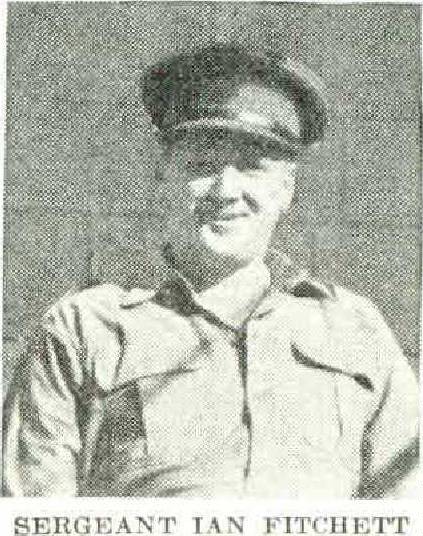
THE defense of Tobruk saved the Suez Canal in the spring of 1941. It did more than that. It proved at last that the Allied troops could stand up to a full panzer attack. The Atlantic has long been searching for a first-hand account of that engagement in which the Australian Infantry, the English artillery, and the Indian brigades more than held their own against the veterans of the Polish and French Conquests.Sergeant Ian G. Fitchett (p. 267), whose account we now publish, was born in New South Wales thirtyfour years ago, and trained as a barrister. Enlisting on the outbreak of war, he went abroad with an advance party of the First Australian Imperial Forces. In Egypt he was detached as a temporary war correspondent. He went through the entire siege of Tobruk and is at this writing the official observer with the Australian troops in Malaya.
Edward Weismiller (p. 276) was born in Wisconsin of mixed Swiss and Scotch-English stock. But it was during his years on a Vermont farm seven miles southwest of Brattleboro that he gathered the material for his first book, The Deer Come Down, which appeared in the Yale Series of Younger Poets. A graduate of Cornell College, Iowa, he went abroad as a Rhodes Scholar in the autumn of 1938, and when war put a stop to his studies, he returned to Cambridge, Massachusetts, where he has been teaching English ever since.
In The Yearling Marjorie Kinnan Rawlings (p. 277) gave us the most appealing novel that has ever been written about the piney woods. In her forthcoming book, from which the Atlantic is drawing two delightful chapters, she takes us to that tiny up-creek community in Florida where she grows oranges and does her writing with the help and humor of her neighbors, black and white. It is good to know that we have not lost all such frontiers!
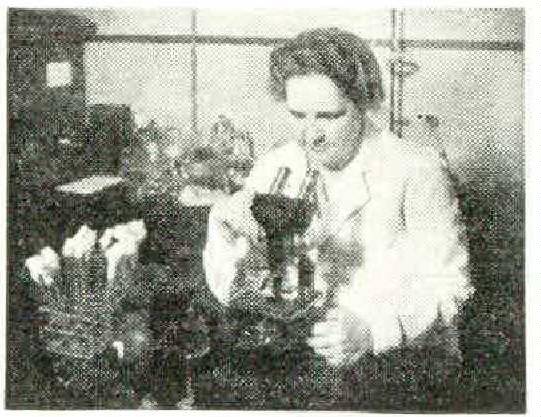
Every parent with a boy in training will want the answer to the question: what has medicine done to protect our fighters since the last war? Justina Hill (p. 286), an associate in the Johns Hopkins Medical School and the author of Germs and the Man (1940), has collected all available evidence from the battle fronts in Europe, Africa, and Australia, from the bomb shelters in London and the typhus areas on the Russian Front. On the whole, the record is a reassuring one.
Armchair strategists, those who are conservative, will tell you today that air strength has been overemphasized because, they argue, the Luftwaffe failed to score a knockout in the battle over Britain. This is a fallacious argument, for the essential question is why did the Germans fail, and what can we learn from their failure. No man is better qualified to answer that question than Major Alexander P. de Seversky (p. 293), a close friend of the late Billy Mitchell and one of the foremost designers of aircraft and strategy.
Three times since 1939, in articles written exclusively for the Atlantic,Francis Vivian Drake (p. 302) has hammered home the fact that heavy bombers, and heavy bombers alone, would give us the hitting power and the defense force imperative for this country’s survival. This is the record :
The Air Force We Need January 1940
Hitting Power October 1940
Air Power: A Specific Proposal
June 1941
The truth in these articles has been amply vindicated by events. Now in his new paper he outlines the bold strategy which alone will save us from a war of endless exhaustion.
Robert Richards (p. 307), whose first novel, I Can Lick Seven, is soon to be published under the Atlantic imprint, is a 28-year-old Kentuckian who was educated in the high school and state college at Memphis, Tennessee, and who since his graduation has been sports writer and reporter for the Memphis Press-Scimitar. This is his second story in the Atlantic.
That rare combination, a man of action and a philosopher, Antoine de Saint-Exupéry (p. 313) has written in his Flight to Arras a book which, in our judgment, will long survive our present era of destruction. The picture which he gives of France in disruption and of the anguished but abiding loyalty of man to man will not be soon forgotten by those who can quiet their minds for contemplation. The Atlantic is proud to have published in three successive issues this book which was, of course, first written in French and then admirably translated by Lewis Galantière.
A graduate of Middlesex School and of Harvard, an American poet who has won the Pulitzer Prize and the praise of critics and editors on both sides of the Atlantic, Conrad Aiken (p. 334) is now contributing to us poems from his new volume, Brownstone Eclogues.
In this issue Raoul de Roussy de Sales (p. 335) addresses himself to that problem which has tortured more minds than any other in our lifetime: ‘Human nature being what it is, he writes, ‘a mixture of good and bad, this appalling thing called Germanism is certainly not sufficient to destroy in every German all the good that is in him. But to expect anything but brutality, stupidity, and barbarism from this same German when acting as a unit in the mass is expecting too much. Germanism, in its most positive manifestations, is one of the most dangerous forms of human destructiveness that history has known.’ Mr. De Sales’s analysis of the German character will appear as a chapter in his new volume, The Making of Tomorrow, soon to be published by Reynal and Hitchcock.
Born in Galesburg and always a loyal son of Illinois, Carl Sandburg (p. 344) is equally famous today for HOWARD his prose (his magnificent biography of Abraham Lincoln, The Prairie Years and The War Years), for his poetry (Corn Huskers and The People, Yes), and for his unforgettable songs with his guitar.
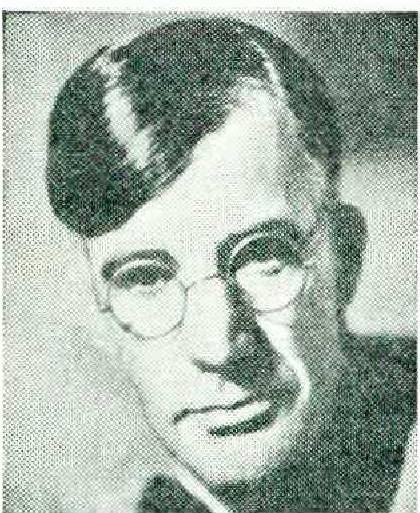
Like Anthony Trollope, Howard Spring (p. 347) began to write novels in his middle forties. My Son, My Son! and Fame Is the Spur won immediate attention here and in England. Now, in a mood of candor and reminiscence, Mr. Spring tells us the training he received as a novelist during his fifteen years as a member of the staff of the Manchester Guardian.
The foremost industrial architect in the United States and a man whose firm has gone ‘all-out ‘ in its construction of defense plants, Albert Kahn (p. 355) was born in Westphalia, Germany, March 21, 1869. He cairn’ to America in 1881, received an American scholarship for study abroad in 1890, and has been practising in Detroit since 1904. No one can tell better than he the lessons architects and contractors have learned as they work together in this emergency.
New York publisher and then a producer of Broadway hits, Philip Goodman (p. 361) never forgot his early days in Philadelphia, which he has now made memorable in his posthumous volume, Franklin Street, which is to be published this spring by Alfred A. Knopf.
Director of Tropical Research in the New York Zoological Society, William Beebe (p. 366) is a welcome contributor to the Atlantic. He is at present outward bound for his oceanic laboratory off the coast of Venezuela.
Nina Fedorova (p. 379) exemplifies in her career a phenomenon which will be more often observed in American letters, the phenomenon of a refugee — in this case a Russian born in Poltava and educated at the University of Petrograd, who with her family found a new lease on life in this country and who is now writing novels in which her Russian background, her experiences in exile, and her rebirth in America are, as it were, the operating forces. Her first novel, The Family, was the winner of the Atlantic $10,000 Prize in 1940. Her second, The Children, traverses the border line between tears and laughter to tell the story of those young men and women without a country in the Far East today.