To the Indies
CHAPTERS 18-24
TO THE INDIES A NOVEL OF ADVENTURE
By C. S. FORESTER
Author of “Captain Horatio Hornblower“
NARCISO RICH, a clever young Barcelona lawyer, is sent on the third voyage of Christopher Columbus as special representative of the Crown, to make sure that Columbus’s erratic genius does not overstep Ferdinand’s authority in the new lands. The ships, after passing the northwest corner of Trinidad, reach the Pearl Islands. Rich is given charge of a landing party. They find endless forest, eat oysters and iguana flesh, and come on a great inland lake. Rich’s fears for the natives are aroused by the swaggering brutality of the hidalgos.
Having tasted the tender meat of iguana, some of the gentlemen on a second trip ashore attack a huge one asleep on the sands — García’s sportive idea. In the struggle of hidalgos with noose and crossbow, it is Rich who gives the creature its deathblow, so for the first time his sword wins him respect. A friendly party of Indians confirm the Spaniards’ suspicion that the stinking beast is not edible, nor iguana, but caiman a crocodile. With his new prestige, Rich is able to curb the hidalgos’ easy ways with native women.
They return eventually to the flagship, where Rich gives the Admiral his report about the mighty Orinoco, which, with other signs, points to the existence of some vast continent behind the shore. Columbus, suspicious, uneasy in his authority, disbelieves him, and orders the voyage to continue to Española. The Holy Name lays her course northwest, and for days the hidalgos, who have never learned the rudiments of navigation, mutter with boredom on the hot decks. They arrive at San Domingo to find Bartholomew Columbus, the Admiral’s brother and the Adelantado, involved in a native mutiny enflamed by Roldan, Chief Justice of the island, a rogue who was once the Admiral’s valet. The Indians are being slaughtered with ferocious cruelty. Roldan pursues his treachery, waylays one of the King’s boats, and forces Columbus into a treaty with him which Rich knows is a direct affront to the Crown. Sick at heart, he sits down to write his report to Ferdinand. . . .
TO THE INDIES
BY C. S. FORESTER
XVIII
ROLDAN and his followers had come to San Domingo under the protection of the free pardon which had been solemnly proclaimed at the foot of the flagstaff. They were swaggering about the place, Roldan and Bernardo de Tarpia and Cristobal García and all of them. They had brought a long train of Indian slaves with them, well-set-up and handsome young women, each bearing burdens. Slaves and burdens, in accordance with the recent treaty, were to be sent to Spain in the Holy Name; the crop-eared Martinez was to sail with them as agent for all the recent mutineers, and he was to be armed with a long list of the luxuries which he was to buy with the proceeds of this plunder.
Rich’s report was completed, signed and sealed. Rich had given it with his own hands to Ballester, who was sailing as captain in the Santa Ana. The action had reminded him — if reminding were needed — of the impermanence of life In this world. He was taking the precaution lest the Holy Name, with him on board, should never reach Spain at all. Perhaps the next week would find him with the saints in Paradise, or suffering the pangs of purgatory, or — he felt a shudder of fear — more likely cast into the eternal flames of hell as a result of his recent heretical thoughts. He was in a state of profound dejection and agitation of mind which was not relieved in the least by the suspicious glance which Ballester darted at him when he received the letter; Ballester could suspect only too well what the contents were, and Ballester was one of those who loved the Admiral.
Should anyone of the Admiral’s party come to know exactly what was written in his report, Rich knew that his life might be in danger. There were subtle poisons in this island, — the deadly manchineel was one, — even if it might not be the more simple matter of a knife in his back. He had to set himself, for these last few days before the ships sailed, to play the part of the conscientious supporter, critical but not too much so — certainly not the man who would write to the King that the Admiral was not fit to govern a farmyard, let alone an empire. It was a comfort to him now that Roldan knew of the letter. Certainly neither the Admiral nor Ballester would dare to incur the penalties of high treason by tampering with a sealed document addressed to His Highness himself — at least not while an enemy knew that such a letter existed. Rich could not trust either the Italians or the Andalusians, and he waited with impatience during the interminable delays in fitting out the Holy Name.
He was walking back in the dark after dining with the Adelantado. The Santa Ana had actually sailed with his report on board; the Holy Name was almost ready; another thirty-six hours and he would have seen the last of this island. Overhead the stars were brilliant; the moon would rise soon in all her splendor. The cicadas were singing wildly all round him, and the lusty croaking of the frogs in the stream supplied a cheerful bass. Fireflies were lighting and relighting their lamps about his path, far more brilliant and mysterious than their duller brothers of Spain. Altogether he was in a cheerful mood — two cups of the Admiral’s wine may have had something to do with that.
A denser shadow appeared in the darkness close at his right hand, and then another at his left. There was a man at either elbow walking silently in step with him; Rich felt the skin creep on the back of his neck, while between his shoulder blades he felt the actual spot where the stiletto would enter. Yet even in that moment he found time to wonder why they were troubling to murder him while his report was on its way to the King and beyond recall.
And then the walking shadow on his right spoke to him with the voice of García.
‘Don Narciso,’ he said, ‘I must trouble you to turn back and come with us.’
‘And if I do not, Don Cristobal?’
Both men pressed in close upon him, forcing his elbows against his sides.
‘I have a dagger here, Don Narciso. I will use it if you cry out.’
‘And I have another,’ said the voice of Diego Moret on his left. ‘And I will use it, too. There will be one in your back and one in your belly.’
‘Turn back with us, Don Narciso,’ said García, insinuatingly.
Rich turned; he felt there was nothing else he could do.
‘Where are you taking me?’ he asked; he had to try hard to keep the quaver out of his voice.
‘This is not the time for explanations,’ said García grimly. ‘I would prefer you to keep quiet.’
They were walking down the slope from the citadel; the little town lay on their right, and there was only one solitary gleam of light from it. Rich decided they were going to lead him into the forest and kill him there. His body might lie forever in that tangle of vegetation and never be discovered, even within a mile of the place. But he was still puzzled as to the motive, so puzzled that quite involuntarily he broke the silence with another question.
‘What do you want to kill me for?’ he asked.
‘Be quiet. And we are not going to kill you,’ said García.
‘Probably not going to,’ amended Moret in the darkness on his left.
Even with this amendment the statement was reassuring. The wave of relief which surged over Rich astonished him; he realized that he had been far more afraid than he had suspected at the time. He trembled a little with the reaction, and then battled with himself to stop it. He did not want these two men at his elbows to know he was trembling. They were coming nearer to the trees and the forest.
‘There are four horses here, Don Narciso,’ said García. ‘One of them is for you. The others are for Don Diego and myself and Don Ramon, who is waiting for us. There will be no reins for you to hold — the reins will be in my charge. But I hope you can stay in the saddle by holding on to the saddlebow.’
‘I can try,’ said Rich — the whinny of a horse told that they were drawing near to them.
‘Did you find him?’ asked an unknown voice.
‘Yes,’ said García, and then to Rich, ‘Mount.’
Rich felt in the darkness for the stirrup, and with the effort usual to him he hoisted up his foot and got it in. By the time he had swung himself into the saddle Moret was already mounted; García sprang into the saddle of the third horse. They began to move along a path — the unknown Ramon, who had been waiting with the horses, in front, followed by Rich and García, while Moret brought up the rear. The horses blundered along in the darkness; Rich felt his face whipped painfully occasionally by branches, and his knees received several excruciating knocks. For a space his mind was too much occupied with these troubles, and with the necessity of keeping his seat in the saddle, to have any thought to spare for the future, but as soon as the forest began to thin, and the rising moon gave them light to an extent quite remarkable compared with the previous blackness, he inevitably began to wonder once more. Suddenly a new aspect of the situation broke upon him, with a shock which made him sweat and set him moving restlessly in the saddle.
‘Mother of God!’ he said. ‘The Holy Name sails tomorrow. You will let me get back in time to sail in her?’
The first reply he had was a lighthearted chuckle from Moret behind; the question seemed to amuse him immensely. García allowed a painful second or two to elapse before answering.
‘No, my pretty one,’ he said. ‘You will not be sailing in the Holy Name. Rest assured about that.’
‘ Assured ‘ was not at all the right adjective to describe Rich’s mental condition. There was bitter disappointment at the thought of not returning to Spain, but his other doubts overlaid that at the moment; he was intensely puzzled. It could hardly be ransom that these kidnappers were seeking; they must know that in the island he possessed practically nothing that anyone could desire. Then it occurred to him that perhaps he was being carried off to give legal color to some plan they had in mind. They might be intending to force him to construct some binding agreement regarding their grants of land.
‘I will do nothing,’ he announced stoutly, ‘to distort the law for you. I have my professional honor to consider.’
Moret seemed to find this announcement extremely funny too. He broke into high-pitched laughter again; Rich, who could not see him, could imagine him writhing convulsed with merriment in his saddle.
‘Be damned to your professional honor,’ said Garcia. ‘Do you think a man like me needs a lawyer to chop straws for him in this island?’
‘Then why, in the name of God . . .’
They wanted neither his wealth nor his legal services, and he could think of nothing else they could want of him. Unless perhaps — it was a most uncomfortable thought — they wanted him as a hostage. If that were the case, his doom was certain; nobody of the Admiral’s party would lift a finger to save him. The sweat on his face felt suddenly cold, and he shuddered in the warm night.
‘We want you—’ began García, slowly.
‘It’s too good a joke to spoil yet,’ interjected Moret, but García ignored him.
‘We want you as a navigator,’ said García.
‘As a navigator?’
‘Didn’t you hear what I said?’ snapped García.
‘But I’m no navigator,’ protested Rich. ‘I know nothing about it.’
‘We saw you on the voyage out,’ said García. ‘The Admiral was giving you lessons. You looked at the sun every day through his astrolabe, and at the stars each night. You were enough of a navigator to lecture us about it. Or have you forgotten?’
Rich certainly had forgotten until he was reminded of it.
‘But I could no more take a ship to Spain — ‘ he began.
‘Spain? Who said anything about Spain? It’s west we sail, not east. And I’ll warrant you could find your way to Spain, too.’
‘Holy Mary!’ said Rich, faintly. ‘Sainted Narciso of Gerona!’
He was too stunned for a space to say more, but slowly realization came to him.
’I will not go with you,’he burst out. ‘I will not. Let me go back. Please! I beg of you.’
He writhed about in his saddle, entertaining some frantic notion of flinging himself to the ground and taking to his heels. The sound of a sharp whirr of steel behind him made him refrain; Moret had drawn his sword and was ready to cut him down. He forced himself to sit still, and from that he proceeded to force himself to appear calm. He was suddenly ashamed of his exhibition of weakness; it was especially shameful that he should have been guilty of an undignified outburst before men like García and Moret, whom he despised. And — such is human nature — there was the faint hope growing in his breast already that he might yet escape.
‘What is the plan?’ he asked, steadying his voice.
‘A week back,’said García, ‘we caught an Indian. He is not of this island, although our Indians can understand him. He is taller and stronger, and his lower lip has been cut off in a V, so that we call him el Baboso, the Slobberer.'
‘But what has he to say?’
‘He has told us of a land to the north and west, a vast country full of gold. Gold vases and gold dishes. There are vast palaces, he says, reaching to the sky, and the chiefs have their clothes sewn all over with precious stones so that in the sunshine the eye cannot bear their brightness. That is where we are going. We shall bury our arms elbowdeep in gold dust.'
‘But in what ship?’
‘The caravel Santa Engracia lies less than twenty leagues from here. Her captain is dead of fever, and her crew tried to run off, but we have caught four sailors who can work the sails, and now we have you to navigate her.’
‘My God!’ said Rich. ‘I suppose Roldan is captain?’
Moret giggled again behind him.
‘Roldan? Good God, no! Who would want to sail under that lout? It is I who am captain, as you will do well to remember in future. We are twenty gentlemen of coat-armor, and we shall carve out our own empire in the West.'
For a moment Rich felt a sensation almost of pleasurable excitement at the thought of such an adventure. He had to catch himself up suddenly and bring down his thoughts to a matter-of-fact level. How could he possibly navigate a ship from Española to China or Cipangu? Perhaps, as García had in mind, the sailors would know how to trim the sails and attend to the other details of the practical handling of the ship. Perhaps he himself was capable of estimating the speed of the ship, and with the needle he would know something of her course. The astrolabe would give him a notion of their position relative to the equinoctial line; he raked back in his memory to see what he knew of the Admiral’s table of the sun’s height above the horizon — he could at least make a rough allowance for its variation, or perhaps there was a copy of the table on board the Santa Engracia. That would be a check on the other calculation, and would help him in the matter of allowing for currents and leeway and the uncertainty of the needle. Vaguely, very vaguely, he would have some sort of notion as to where they were. He could never hope to find his way back to Española if they wanted to return, but he could at least turn the ship’s head and sail her eastward — eastward — eastward until he had found Africa or Spain or Portugal or France or even England. The Old World was too big a place even for him to miss.
Then, like a cold douche, common sense returned again. The whole plan was too mad, too insane. How could he be expected to handle a ship, with only his sketchy theoretical knowledge? There would be all kinds of emergencies to deal with — he remembered how the Admiral had brought the Holy Name through the Serpent’s Mouth and then through the Dragon’s Mouths. He could not handle a ship like that. He knew nothing about beating to windward off a lee shore. He did not have the practised seaman’s uncanny knack of guessing the trend of a shoal from the successive casts of the lead. These hotheaded Spanish caballeros had no conception at all of the difficulty of the task they proposed to set him — if for no other reason, because they were accustomed to the Admiral’s phenomenal seamanship.
‘I never heard of such a ridiculous plan in all my life,’ he burst out.
‘So that is what you think?’ replied García. There was a polite lack of interest in his manner.
‘Yes!’ said Rich. ‘And what’s more —’
Nobody appeared to listen to what more he had to say. The horses broke into a trot, and Rich, joggling about in his saddle, found his flow of eloquence impeded. He knew then that nothing he could say would deter these hotheads from their plan. Nothing would induce them to set him free to return to San Domingo and the Holy Name. He relapsed again into miserable silence, while the horses pushed on in the darkness, trotting whenever their fatigue and the conditions would allow, and walking in the intervals. Fatigue soon came to numb his misery. He was sleepy, and an hour or two on horseback was quite sufficient exercise for his soft limbs. The men of iron who rode with him had no idea of fatigue. The loss of a night’s rest, the riding of a dozen leagues on horseback, were nothing to them. Rich bumped miserably along with them through the night; before dawn he had actually dozed once or twice in the saddle for a few nightmare seconds, only saving himself from falling headlong by a wild clutch at his horse’s invisible mane.
XIX
At dawn García broke his long silence. ‘There’s the Santa Engracia,’ he said.
The path had brought them down to the sea’s edge here, and the horses were trotting over a beach of firm black sand overhung by the luxuriant green cliffs. A mile ahead a torrential stream notched the steep scarp, and in the shelter of the tiny bay there lay a little ship, a twomasted caravel, her curving lateen yards with their furled sails silhouetted in black against the blue and silver sea. There were huts on the beach, and at their approach people came forth to welcome them. There were Bernardo de Tarpia and Mariano Giraldez, Julio Zerain and Mauricio Galindo — all the hotheaded young gentlemen; Rich could have listed their names without seeing them. There were four or five swaggerers whom he did not know; he presumed they were followers of Roldan whom he had never met before, and the notion was confirmed by the raggedness of their clothing. There were a few depressed Indians, and one with a gap where his lower lip should have been, through which his teeth were visible; this must be el Baboso, of whom García had spoken. There were a dozen Indian women whose finery proved that they were the mistresses of Spaniards and not the wives of Indians.
‘You found him, then?’ commented Tarpia. ‘Welcome, learned DoctorSailing Master.’
‘Good morning,’ said Rich.
The longboat lay beside the beach; the Indians pulled at the oars — the hidalgos could not sink their dignity sufficiently to do manual work as long as there was someone else who could be made to do it for them — and within five minutes of leaving shore Rich was hoisting himself wearily up over the side of the caravel. João de Setubal, the eccentric Portuguese, was there, and three or four others; apparently their duty had been to prevent the escape of the remaining four seamen.
‘Here’s your crew, Sailing Master,’ said Tarpia.
The four seamen grinned at him half nervously, half sullenly. It was clear that the new venture was not at all to their taste. Rich looked as sullenly back at them. The sun was already hot, and pained his eyes; he felt the Santa Engracia heave under his feet as a big roller lifted her.
‘Who are you?’ he said. ‘What service have you seen ? ‘
They answered him in Catalan, like sweet music after the harsh Castilian. They were fishermen from Villanueva, pressed the year before for service on the ocean. They could reef and steer, and had spent their lives at sea.
‘One of you must be boatswain,’ said Rich. ‘Which is it to be?’
Fortunately there seemed to be no doubt about that. Three thumbs were pointed at once to the fourth man, the blue-eyed and broad-shouldered Tomas — stoop-shouldered, too, for middle age had begun to curve his spine.
‘Tomas, you are boatswain,’ said Rich. It was a relief to have found someone on whom he could fob off some of his responsibility.
The second boatload from the shore was already alongside; García had come with it.
‘We are ready to sail now, Sailing Master,’ said García.
This was all mad, unreal. It must be a nightmare — it could not really be happening to him, the learned Narciso Rich. As though battling with a nightmare he strove to postpone the moment of departure; he felt that if only he could postpone it long enough he might wake up and find himself back in San Domingo, about to sail for Spain in the Holy Name.
‘But what about stores?’ he asked. ‘Food? Water?’
‘We have spent the last week collecting food,’ said García. ‘The ship has dried meat, cassava, and corn for forty people for two months. There is forage for the horses, and every water cask is full.’
‘And charts? And instruments?’
‘Everything the captain had is still in his cabin. He found his way here with them from Spain when he came with Ballester.’
‘I had better see them first.’
García’s thick brows came together with irritation.
‘This is not the moment for wasting time,’ he said. ‘Hoist sail at once — you can do the rest when we are on our way.’
García’s little eyes were like an angry pig’s. He glowered at Rich, his hands on his hips and his body inclined forward towards him.
‘I know enough about navigation,’ he said, menacingly, ‘ to know we must sail westward along this island before we turn north. I might find I could do without a navigator altogether, and in that case —’
He took his right hand from his hip and pointed significantly overside. Rich could not meet his gaze, and was ashamed of himself because of it. He turned away.
‘Very well,’ he said, faintly.
And even then the prayer that he began to breathe was cut short without his realizing it by the way the problem of getting under way captured his interest — if his active mind was employed it was hard for him to remain frightened. He looked up at the masthead; the pennant there was flapping gently in an easterly wind; the land wind had dropped and the sea breeze had not begun yet to blow. The ship was riding bows on to the wind; he had to turn her about as she got under way. The theory of the manœuvre was simple, and he had often enough seen it put into practice. It was an interesting experience to have to do it himself.
‘Tomas,’ he said, ‘set the Indians to up-anchor. And I want the foresail ready to set.’
Tomas nodded at him, blinking in the sun. ‘Who’ll take the tiller, sir? It’ll take the four of us to set sail.’
‘I will,’ said Rich, desperately. He had never held a ship’s tiller in his life before, but he knew the theory of it.
He walked aft and set his hand on the big lever, swinging it tentatively. It seemed easy enough. Tomas had collected a band of Indians at the windlass — from the docility with which they obeyed him it was obvious that they were already accustomed to working under him, presumably during the business of provisioning the ship. The windlass began to clack, the Indians straining at the handles as they dragged the ship up to her anchor against the wind. The seamen were ready to set the foresail — two of them had just finished casting off the gaskets.
‘Straight up and down, sir!’ shouted Tomas, leaning over the bows to look at the cable.
‘Hoist away!’ shouted Rich; he swallowed hard as soon as the words were out of his mouth.
The anchor came up, and Tomas rushed back to help with the foresail. As the ponderous canvas spread, Rich felt the tiller in his hand come to life; the ship was gathering sternway. He knew what he had to do. He put the tiller hard over, for the ship had only to lie the tiniest fraction across the wind for the big foresail to swing her round like a weathercock. She lurched and hesitated, and Rich in a sudden panic brought the tiller across to the other side. Tomas was watching him, apparently awaiting more orders, but Rich had none to give. Nevertheless, Tomas kept his head — he saw on which side Rich had at last decided to hold the tiller, and ran with his men to brace the yard round. Rich felt the motion of the ship change as she swung across the swell; a glance at t he island revealed the shore to be slowly revolving round him. He struggled widly to keep his head clear; it was the ship that was turning, not the island. The big foresail was doing its work, and he flung his weight against the tiller to catch the ship lest she swing too far.
‘Set the mainsail, sir?’ asked Tomas. He was so obviously expecting an affirmative answer that Rich was constrained to give him one, though he doubted his strength to hold her if more canvas were spread. He felt the ship under his feet gather increased speed as the mainsail bellied out in the wind, and it seemed as if the tiller would pull his arms out of their sockets. And then suddenly it ceased to be a thing to be fought and struggled with; it became a sweet tool of whose every motion the ship was immediately conscious.
‘Send a hand to the tiller, Tomas,’ he called.
It would be as well to get as far to the southward as he could; on the other hand, if he set too southerly a course it might take him out of sight of land.
Rich suddenly realized that he was not nearly as afraid of that as he was of finding himself on a lee shore during the night. He yearned to have plenty of sea all round him, and it was delightful to discover that he was quite confident of finding Española again should he run it out of sight. He bent over the compass and took in his hand the white peg which marked the course to be set, hesitated for a space, and then with decision put it into the next hole to the east of south.
XX
The voyage went on, somehow. On the third day they doubled Cape Alta Vela and were able to set a westerly course along the southern coast of Española, the old Santa Engracia, leaking like a sieve and encumbered with weeds a yard long on her bottom, lumbering along before the persistent urging of the wind. Far on the horizon to the north rose the green mountains of the island. Each day brought its scorching sunshine and its torrential rain, its blue skies and its rainbows.
Each day brought afresh to Rich the strange feeling of the unreality of it all, despite the harsh realism of the ship’s routine, the bailing and the constant repairs. He practised diligently each day with astrolabe and cross-staff — he told himself that his very life might depend on his skillful use of them, while at the same time he found it impossible to believe it. He worked out the little calculation necessary to ascertain the speed of the ship by measuring, with his pulse, the time taken by an object thrown overboard from the bow to reach the stern. He pored long and diligently over the Admiral’s chart of the Indies, the long sweep of islands at its eastern end, where — as the last voyage had ascertained — lay Trinidad and the mysterious country of the Orinoco and the Earthly Paradise. Westmost of the chain lay Española, divided by a narrow strait from the long peninsula of Cuba which jutted out two hundred leagues or so from the unknown mainland of China or India. So the Admiral had drawn it; Rich was aware that there had been whispers that Cuba was merely another island, the vastest of them all. The Admiral had silenced the whispers by decreeing that any such whisperer would lose his tongue.
But whether Cuba were an island or not, the task García had laid upon him was to steer the Santa Engracia up through the strait between Cuba and Espanola, and then northwesterly, on and on until they reached the country where the temples reached the sky and worked gold was to be seen everywhere.
Seventy leagues to the west of Alta Vela lay Cape San Miguel, the westernmost point of Española; it interested Rich to find that they reached it at the very moment which he predicted. His dead reckoning had been correct, and so was the Admiral’s chart — or else they both contained the same error. Rich might at one time have speculated deeply on the philosophy of compensating errors, but nowadays he was too engrossed in hourly problems to waste time. He accepted God’s mercy with gratitude and left it at that; as soon as he saw the shore of Española trending away back to the eastward from the bluff green eminence of San Miguel, and knew he had made all the westing necessary, he had to lay a fresh course through the straits, for there was no leeway to spare at all on this next leg of the passage.
No leeway to spare; indeed it became apparent that they would never double Cuba in a single tack. For as they bore northward the wind backed northward as well. Rich and Tomas laid the Santa Engracia as close to the wind as they could, striving to make northing while they still had sea room, but she drifted away to leeward spiritlessly, encumbered by her weeds. Rich gazed despairingly at the telltale angle which his unaided eye could observe between the trace of her wake and the line of her masts. The cliffs of Cuba loomed in sight, a hard line on the horizon ahead, and still the wind blew from the north. They had to wear the ship round, heading back almost in the direction from which they had come.
García watched the manœuvre curiously and suspiciously.
‘Why back to Española, navigator?’ he asked. There was a grim jocularity in his tone. ‘I ask you to sail northwest and ‘ — he glanced up at the sun — ‘even a poor landsman like myself can see you are sailing southeast.’
Rich endeavored to explain the difficulty he was encountering. Today there was none of the elation which previously had led him to answer with spirit. He was too frightened of García again.
‘I see,’ said García, consideringly, but with still a hint of unsatisfied suspicion in his voice. ‘But you do not want to go too close to Española, do you? We should not like to lose you, learned Doctor — not now that you have proved your worth. And I might add that we will see that we do not.’
There were two days when the wind failed altogether, and the Santa Engracia wallowed helplessly in the calm, with San Miguel still in sight to the eastward, and the porpoises sported round her as if to show their contempt for her sluggishness, and the flying fish furrowed the deep blue of the water. When it blew again, the wind was still hardly east of north, and day by day the Santa Engracia beat back and forth across the wide channel, gaining hardly more than a few yards each day, while tempers grew short on board and the murmuring hidalgos, who had actually come to recognize the shores which encompassed them, asked bitterly how long the blundering incompetence of their navigator was going to keep them confined. Rich began to pray for a southerly wind, which would carry them off towards the mad adventure which he so much dreaded.
XXI
Long afterwards Rich remembered those prayers; he suspected that it was because of his impiety and incipient heresy that his petition was granted in the fashion which God chose. It was two weeks before the feast of San Narciso of Gerona (who had always stood his friend) to which he had been looking forward as perhaps bringing relief from his troubles. The wind had died away again when they had nearly clawed their way northward to the open sea, and the Santa Engracia drifted helplessly, with Cuba barely in sight from the masthead and Española invisible over the horizon. It was oppressively hot, although there was a thin veil of cloud over the sky, through which the sun showed only at rare intervals and then a mere ghost of his usual self. The Santa Engracia pitched and rolled in a swell which was extraordinarily heavy for the narrow waters in which they lay. Spaniards and Indians sat helpless about the decks, gasping in the heat; Rich felt his clothes wot upon his back.
He prayed for a wind, any wind, and the wind came. Gently it came at first, only a mild puff, steadying the ship in her rolling and making the sails flap loudly. Rich started from the deck in wild excitement. Those puffs of wind were from the south — a few hours of this would see them through the straits, and free. Tomas noticed the puffs of wind too; he was having the yards braced round in haste. Soon there was quite a breeze blowing from the southward, piping in the rigging, and the Santa Engracia was under full sail before it, heading gallantly to the northward over the gray sea.
But the breeze had brought no relief from the heat, curiously enough. It was a hot wind, a fiery wind. Rich felt his skin still drip, even while the breeze blew upon him. There was an Indian on the forecastle chattering excitedly to Tomas, and Tomas was trying to puzzle out what he was saying. He led the Indian aft to where Rich stood with García, and the Indian babbled in panic.
‘Hurricane,’ he was saying, or some word like that. He was frantic with the desire to express his meaning — it was a most vivid example of the curse of Babel with which God had afflicted the world because of its impiety.
‘Hurricane,’ said the Indian again, wreathing his hands. ‘Hurricane—big wind.’
He pointed up to the sky and waved his arms; the clouds to which he was pointing had a baleful yellow gleam now which was echoed in the sea below.
‘Big wind,’ said the Indian, and now that he had the Spanish words he had sought he amplified them.
‘ Big — big — big — big wind,’ he said wildly. He was trying to convey to his stolid taskmasters the impression of a wind bigger than their imagination could conceive. Rich and Tomas exchanged glances.
‘Wind’s freshening,’ said Tomas. It was blowing half a gale, certainly, and 1 he Santa Engracia was heaving and plunging before it over the topaz sea.
‘You had better shorten sail, Tomas,’ said Rich, and then, as a bigger gust came: ‘No, heave her to.’
The force of the wind suddenly redoubled itself. It shifted a couple of points and flung itself howling upon the Santa Engracia — Rich saw the line of the wind hurtling over the surface of the water. The Santa Engracia lay over, took a huge wave over her bows, and then wearily came up again. The wind was nearly taking the men off their feet. They felt as if they were being pushed by something solid, and it was still increasing in force; they had all been dashed against the lee rail and it was with incredible difficulty that they regained their footing. Rich felt, himself being swept away again. He seized a rope’s end and began to tie himself to the rail, with great clumsy knots — it seemed mad for a grown man to tie himself to his ship for fear of being blown away, but everything in this world was mad. The deck forward was strangely bare — only Tomas and another man were to be seen there, clutching the rail. The sea they had shipped must have swept the others away.
Tomas saw Rich looking at him, and pointed up to the mainsail. The small rag of canvas which had been left spread there was blowing out, expanding like a bladder as the gaskets gave way. Next moment the whole sail was loose; a moment later it had flogged itself into fragments which cracked like gigantic whips in the gale with a noise which even the wind could not drown.
The ship must be hurtling to leeward at an astonishing pace, thought Rich, with a mad clarity of mind. He wondered how, when he next worked out the ship’s position, he could allow for all this leeway whose pace and direction were quite unknown to him. Then he told himself he would most likely never work out the ship’s position again. And he was in mortal sin — he had been intending to confess before sailing in the Holy Name. He was frightened now, for the first time since the gale began, and he tried to pray into the shrieking wind.
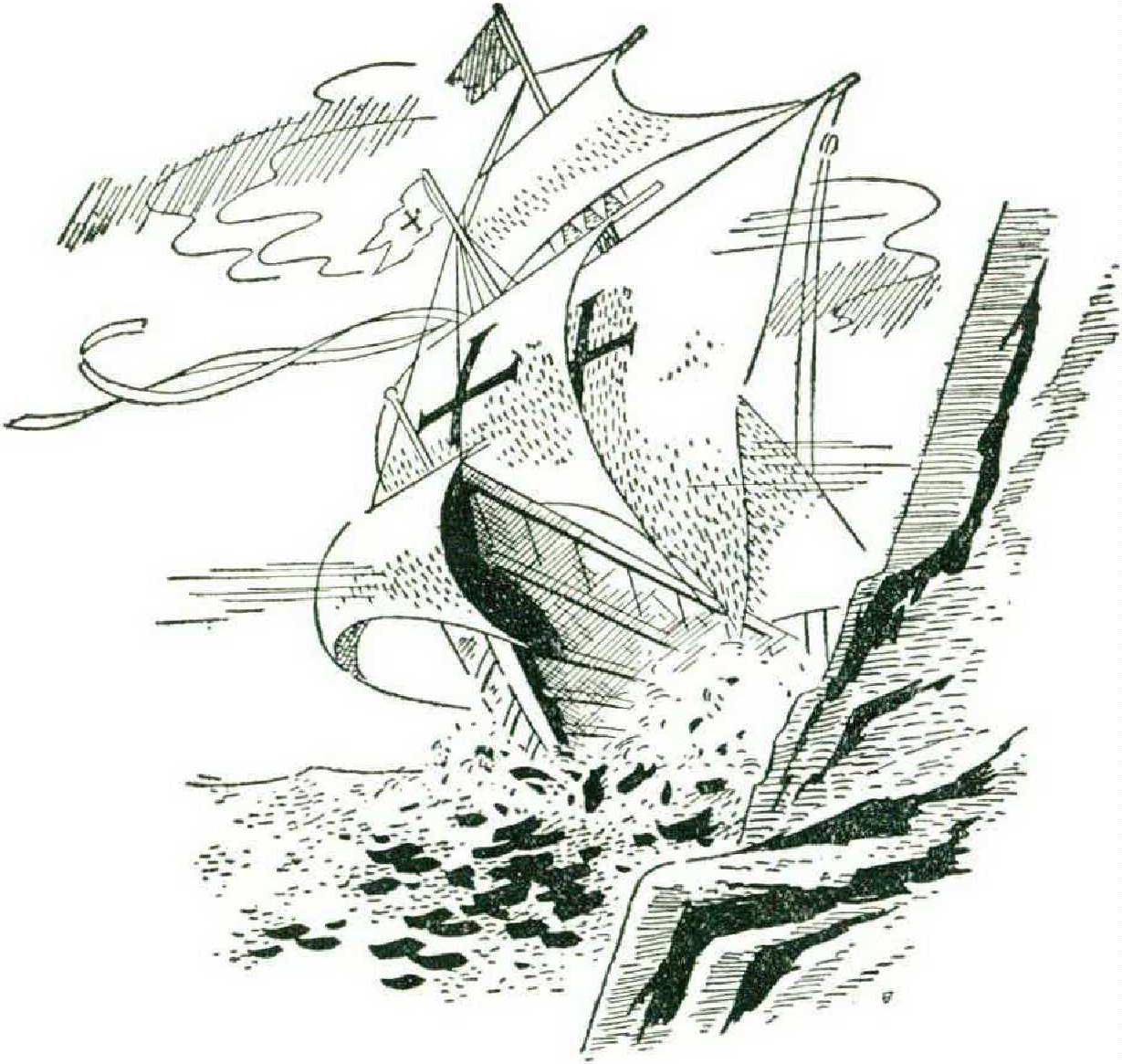
At nightfall he was still alive, drooping half conscious in his bonds as the seas swept over him, and deaf to the wild roaring of the wind in his ears. He was not aware of the moment when the ship struck land, although he must have come to his senses directly after. Wind and sea were more insensate than ever in the roaring night; there was white foam everywhere, faintly visible in the darkness, and huge waves seemed to be beating upon him with a more direct violence than before. Under his feet, and through the mad din of wind and water, he was conscious of a thundering noise as the ship pounded and broke. He guessed that the ship had struck land — and in panic, like waking from a nightmare, he struggled to free himself from the rope that had bound him fast so far. The deck heaved and canted, smothered under a huge roller. Then the poop broke clear, hurtling over the reef and across the lagoon. Rich felt himself and the deck tossed over and over, and they struck solid land in a welter of crashing fragments. The wind took charge of him as he hit the beach, and blew him farther inshore. He clutched feebly and quite ineffectively at the darkness, while the wind flung him through and over, up the slope. He felt vegetation — some kind of cane — under him. Then he fell down another slope; there was water in his face until he struggled clear. A freak of the wind had dropped him into the lee of a nearly vertical bank, so that the giant’s fingers of the hurricane could no longer reach under him and hurl him farther. He lay there, half conscious; at rare intervals a shattering sob broke from his lips, while overhead the gale howled and yelled in the pitchy black.
XXII
It was down into the depths of a ravine that the wind had dropped Rich, perhaps the safest place in a hurricane that chance could have chosen for him. There was a stream flowing in the depths — Rich lay half in and half out of it for most of one day until he roused himself to crawl clear. The fresh water probably saved his life, for he was much too battered and bruised and ill to be able to move far. Overpowering thirst compelled him to bend his tortured neck and drink, the first time and at intervals after that; he felt no hunger, only the dreadful pain of his bruises, and he moaned like a sick child at every slight movement that he made. He had neither thought nor feeling for anything other than his pain and his thirst; late on the second day he raised himself for an instant on his hands and knees and looked round the ravine, but he collapsed again on his face.
It was not until the day after that the feeble urge of life within him caused him to pull himself to his feet and stand swaying, while every tiny part of him protested fiercely against the effort. He was like a man flayed alive. He had hardly an atom of skin left upon him — his only clothes were his shoes and his leather breeches — and in addition to his innumerable deep bruises he had several serious cuts, caked now with black blood. He was weak and dizzy, but he made himself stagger along the ravine; he could not hope to attempt its steep sides, but after the first few steps progress became easier as his aching joints loosened, until fatigue caused him to sit down and rest again.
He emerged in the end upon the beach, at the point where the ravine cut through the low cliff, round the corner from where the Santa Engracia had been blown ashore. The dazzling sunshine, in contrast with the comparative darkness of the ravine, blinded him completely for a space — the silver sand was as dazzling as the cloudless sky above. He sat on a rock again with his hands to his eyes while he recovered, but as he sat he became conscious of hunger, and it was the prodigious urge of hunger which drove him again to wander along the beach, seeking something to devour.
For several days, even in that smiling island, the problem of food occupied his attention to the exclusion of all else. The first solution was supplied by the discovery of a bag of unground Indian corn, cast up on the beach from the wreck of the Santa Engracia, all that he ever found of her except a few timbers. The grain was soggy with sea water, but he pounded it between two rocks and made a sort of raw porridge out of it which at least sufficed to fill his belly and give him strength to continue his search. Then he managed to kill a land crab with a rock, and ate the disgusting creature raw — he became accustomed very quickly to a diet of raw land crab. Most of the trees in the little island had been broken off short by the hurricane, and at his second attempt to push through the wild tangle to the low summit of the island he found a plantain treetop full of fruit, tasteless and tough and not very digestible, but of considerable use in keeping his soul in his body — although the very violent reaction of his interior to this stimulating diet made him wonder more than once if the frail partnership were going to dissolve.
He was not very conscious of the curse of loneliness. Indeed, rather on the contrary: he caught himself almost on the point of smiling once or twice at the irony of it that, of all the complement of the Santa Engracia, he should be the sole survivor. García with his bull’s strength, Tarpia with his skill at arms, Moret, young Avila, Tomas the seaman — the storm had killed them all except him, and he felt no particular regret for any of them, save perhaps for Tomas. And even for Tomas he was mainly regretful because with his aid it might have been easier to build a boat.
For he was naturally determined to build a boat. Española might lie just over the horizon, and even if he hated Española he wanted to return there if only as the first stage of his road to Spain.
Rich was altogether of much too intellectual a turn of mind to have any illusions as to the magnitude of the work before him; it is all the more to his credit that he set himself doggedly at his task, exploring the island for timber that might serve his purpose, and perfectly prepared with shells and stones and his two big nails to dig himself a dugout canoe from a suitable tree trunk — his mind was already busy with schemes for tying a keel of rock under the bottom to stabilize the thing, not merely to make it less likely to roll over, but to save the labor of hollowing it out more than a sketchy amount.
It took him only a single day to discover a suitable tree trunk; but it took him two weeks to discover stones suitable to work with, to chip them to any sort of edge, for he spoiled nine tenths of them. He was consumed with a furious energy for the work — his busy mind could not tolerate the empty idleness of the island, with only the monotonous beating of the surf to windward and the cries of the birds. He chipped away remorselessly, sparing himself only the minimum of time to hunt for food; he grew lean and hard, and the sun burnt him almost to blackness. He reminded himself that when he was home again at last he would have a delightful time building up once more the corpulence essential to the dignity of a successful professional man.
His most exciting discovery was of a thin vein of rock in an exposed scar in the very ravine where he had first fallen. It was of a dark green, nearly black, and when he chipped out a lump, and smashed it, it broke like glass into a series of points best adapted for spearheads, perhaps, but with a dull cutting edge which made them possible for use as knives. With infinite patience he quarried out one heavy lump with as perfect an edge as he could hope for. Using that as an axe, he quite doubled his rate of progress in the weary business of trimming off the boughs of his tree trunk.
Rich had made one miscalculation when he was considering his chances of being rescued. He had had only Spanish ships in mind, and he had never given a thought to Indians in canoes; and so it came about that all his labor was quite wasted. It was one noontide that the canoe came, at a moment when his log was poised on the brink of the last slope down to the beach and a few more heaves upon his lever would have sent it careering down to the water’s edge. How long the canoe had been in sight he did not know, for he had been engrossed in his work; it was only when he paused that he saw it, with three men at the paddles, threading its way in through the shoals. He threw himself down into hiding the moment he perceived it, — instant decision was easy to him now, — and he waited until it reached the shore and the three Indians had dragged it up the beach before he seized his heavy lever and rushed down upon them.
They looked up at him in fright as he arrived, and scattered, squeaking with dismay; they may have recognized him as one of the terrible white men of whom they had heard, but just as likely his mere appearance was sufficiently terrifying to strike them with panic. One ran along the beach and the other two dived into the vegetation, and Rich found himself master of a canoe which, crude as it was, was far better than anything he could have hoped to make in three months. But it was a big boat for a single man to handle, and Española was far away. He would prefer to have a crow for the voyage, and he set himself to wonder how he could catch the Indians.
The Admiral had always managed to play upon their curiosity, he knew, — he had studied his reports closely enough to remember that, — and somehow he must manage to coax them within his reach. He looked into the canoe; it contained only a crude creeper fishing net and gourds of water and a few cakes of cassava bread, — the sight even of cassava bread made his mouth water after his recent diet, — nothing by which he could get them into his power. He wanted to eat their bread, but he thought that the sight of a man eating bread would be hardly sufficient to excite their curiosity. He took up his big lever, balanced it upright on his open hand, and walked solemnly down the beach with it. Then he raised it to his chin, and he was able to keep it poised there for a few unstable seconds. He picked up three white lumps of stone and tried to juggle with them — as a boy he had been able to keep three balls in the air at once, and he managed to make a clumsy effort to recapture his old skill.
Stealing a glance sideways, he saw that the Indian who had run along the beach had halted and was looking back, mystified; he was even retracing a few of his steps, hesitant, just like a child. Rich juggled all the harder, tossing the white stones higher and higher. He took his lever again, and spun it in his fingers, and he sat down on the thick gunwale of the canoe with his back to the land, twisting his lever and working his left elbow as if he were doing something mysterious with his left hand, out of the Indians’ sight. It was while he was so engaged that he heard soft footfalls on the sand behind him, and whisperings; he was careful to turn round as slowly as possible, lest a sudden movement might scare them away.
They were standing in a row, half a dozen yards off, and staring at him bigeyed; they jumped when he turned, and were poised for flight again, but they did not flee. Rich put down his lever and extended his hand in the gesture of peace.
‘Good day,’ he said, soothingly.
They looked at each other, and nudged each other, but they said nothing.
‘This is a very charming island,’ he said. ‘Do you come here for fish or turtles?’
They actually were smiling at the strange noises he made — these children of nature were never far from laughter if the white man had not actually laid his hands on them. He racked his brains in an effort to be more conversational. He pointed southwestwards.
‘Cuba?’ he asked.
They knew that name, and stirred with recognition.
‘Cuba,’ said one of them, nodding, and another added something unintelligible.
Rich pointed to the south.
‘Española?’ he asked, and then, correcting himself: ‘Hayti? Hayti?’
They shrank back a little at that — to them, clearly, the name of Hayti was accursed. But the boldest one managed to nod in reply.
‘Hayti,’ he said.
The assurance was worth having, even if nothing else came from the interview. One of them stepped forward again, asking a question. He pointed to Rich and then to the south; Rich caught the word ‘ Hayti ‘ repeated several times — he was being asked if he came from there, and he judged it best to disclaim all acquaintance with the place.
‘Oh, no,’ he said, shaking his head. ‘Me Cuba. Me Cuba. Hurricane.’
They knew that word too, and there was a faint light of understanding in their faces; they chattered to each other as they debated how a hurricane could possibly have blown this queer bearded stranger all the way from Cuba. One of them sidled past him to the canoe, picked out a cassava cake, and gave it to him. He nodded and smiled his thanks and ate, the cooked food grateful to his stomach, although he did his best not to appear too hungry. The more normal his reactions, the easier it would be to win their confidence. He rubbed his stomach and pointed down his throat — a plan was forming in his mind.
He picked up the end of the creeper net and pointed to the sea; they knew something of what he meant. He pointed to the sea again with a sweeping gesture of his arm, and rubbed his stomach again. They grasped what he wanted; this simple stranger needed some fish, and they were perfectly willing to oblige, here on this admirable seining beach. They came fearlessly forward now; one of them took up the end of the net while the other two, smiling, prepared to push the canoe into the water. Rich smiled too, and casually picked up his lever and dropped it into the canoe before he bent to help them shove out. The canoe floated, and one of the two Indians prepared to paddle while the other paid out the net; they were only a little surprised when Rich climbed in behind them.
The canoe danced over the small surf as the single paddle drove it slowly forward; the other Indian, standing precariously, dropped the net overside armful by armful. Farther and farther out they went, in a curve, until Rich, watching narrowly, decided that half the net was out and they were about to curve back to the beach. The decisive moment had come. He scrambled forward and seized the whole remainder of the net, and lifted it in his arms and dumped it overboard amid the Indians’ ejaculations of mild protest. He picked up his lever, poised it menacingly.
‘Hayti,’ he said, and pointed southward.
They protested much more strenuously at that, piping in their shrill voices and gesticulating despairingly.
‘Hayti,’ said Rich inexorably. He swung his club back; he was ready to strike one Indian down if by so doing he could terrorize the other into paddling. The one he menaced screamed and cowered under the impending blow.
‘Hayti,’ said Rich, again, pointing to the paddles.
They gave way before his snarling ferocity — Rich was desperate now that t here was this chance of reaching home. They picked up their paddles and began work; one of them was weeping like a girl.
They headed out through the shallows to the open sea, while from the distant beach came the wailing of the third Indian, standing there puzzled and deserted. His voice mingled with the weird cry of the sea birds.
XXIII
The canoe effected its passage to Española in the course of that night, with Rich steering by the sun while daylight lasted, and by the North Star — he had to stand up in the unsteady canoe to discover it low down on the horizon — at night. The steady hours of paddling wore out the Indians entirely; even before darkness fell they were sobbing with fatigue and Rich had to goad them to work.
Just before dawn there was a sudden squall of wind, and rain which blotted the world from sight, and for a few minutes Rich felt, for the first time, a sense of danger. He turned the canoe bows on into the wind and sea, and had to struggle hard to hold it there; but the odd little canoe, with its thick sides of light wood, rode the waves in a fantastically self-confident manner, threading its way through difficulties as though endowed with an intelligence of its own. Then the squall passed, and with the end of the squall dawn was lighting the eastern horizon, and to the southward there were mountains reaching to the sky, wild and jagged.
‘Hayti!’ said the Indians.
They turned faces yellow with fatigue towards him, dumbly imploring him not to force them to approach nearer to the accursed land, but Rich hardened his heart. With a stroke or two of his paddle he swung the canoe round towards the island, and then used the paddle to prod them into activity. The canoe danced and lurched over a quartering sea in response to a last effort from their weary arms, and the mountains grew steadily nearer until the white ribbon of surf at the base of the rocks was visible, and then the canoe ran alongside a natural pier of rock and Rich stepped out, so stiff and cramped that he could hardly stand straight.
The Indians still looked up at him apprehensively. They had not the spirit — or else the strength — to try to escape, and they could only sit and wonder what awful fate now awaited them in this land which the white devils had come to plague. Rich returned their gaze, looking thoughtfully down on them. He could still find a good use for the canoe, employing it to take him along the coast until he found a Spanish settlement; but the two Indians were so depressed and apprehensive and pitiful in appearance that he found it difficult to bring himself to detain them further. He tried to debate the pros and cons of it coldly and practically, but he suddenly thought of what might happen to the poor wretches if his fellow Spaniards laid hands on them.
‘Go!’ he said, suddenly. ‘Go home!’
Rich walked a hundred and fifty miles through the forests before he found what he sought, and he spent sixteen days doing it. There were tracks through the forest, now almost vanished as the Indians had ceased to use them. Three times they brought him to ruined villages whose decayed huts and deserted gardens had almost become part of primitive nature again, but there he found a few ears of corn and was able to dig up a few roots which kept him alive. The Indian inhabitants, he supposed, had died in battle or of disease, or were toiling away to the south gathering grains of gold in the mountains of Cibao. But the fort of Isabella was somewhere to the eastward, and even though Isabella had been Roldan’s late headquarters he would be able to obtain assistance to make his way to San Domingo. So Rich walked through the forest to Isabella.
They gave him help when he reached it; they even were anxious to make him welcome when once he had explained who he was and whence he came. They gave him clothing and food — it was good to set his teeth into meat again — and listened sympathetically while he told them of García’s wild scheme to discover a land of gold to the northwestward. They had heard of that land themselves — more than one vague account of it had drifted into Española. In return they told him their news, of the wild disorders which had spread through the island again; how Anacaona, the mistress of Bartholomew Columbus, had been hanged for treason, and sixteen petty chiefs roasted alive at the same time.
They told him of madness and battle and bloodshed, but whal they were most interested in was the fact that a new expedition had just reached San Domingo from Spain. It was under the command of one Francisco de Bobadilla, a High Steward of the royal household in Spain, and the greatest noble who had as yet set foot in Española. He had some mysterious new powers; he had an army with which to enforce them. At the first news of his coming Roldan himself had made his way to San Domingo.
How matters stood between the Admiral and Bobadilla they did not know, but — was Don Narciso acquainted with Don Francisco? That was very interesting. Did Don Narciso wish to repair at once to San Domingo? Of course. They would provide him with a horse and a guide immediately. Was there anything else they could do for him? A sword? Armor? He had only to ask. And if Don Francisco were to consult him on the legality of their recent behavior, and of their grants of lands and slaves, Don Narciso would go to the trouble of assuring him that at Isabella they were all devoted subjects of the Crown, would he not? Rich nodded without committing himself, and took his guide and mounted his horse and rode for San Domingo.
It was five months and a week since García had kidnapped him. The court of Spain must have acted with unusual promptitude on receipt of his report, and he could guess what sort of orders and what sort of powers had been given to Don Francisco de Bobadilla, and the haste with which he had been sent out. But he hardly cared about that. Soon one at least of the ships which had come out would be sailing back to Spain - perhaps it might already have sailed. That was the rub. Rich urged his horse forward in his panic lest he should arrive too late to be able to sail in her.
XXIV
There had been a hazy dreamlike quality about many of his adventures when Rich had been experiencing misfortune; there was the same unreality about his good fortune. Rich could hardly believe that this was really he, sitting in the stern sheets of a boat pulling out to the caravel Vizcaya on his way to Spain. The boat’s side on which his hand rested, the ladder which he climbed, the deck on which he set his feet — all were quite surprising in their solidity, considering how he felt that they might at any moment dissolve like wreaths of cloud. The bustle of the ship making ready for departure, the screaming of the sea birds, were like noises heard in a dream. He was free, and he was returning home; perhaps at that very moment the sucking pig was being engendered which he would eat as soon as he set foot in his own house again — sucking pig with onions and a thick slice of wheaten bread.
A boat was coming out to the Vizcaya; presumably it had on board Alonso de Villegio, the captain, with Bobadilla’s final dispatches for Spain, and they would be under way directly. Villegio was a man of capacity, who had listened, at Bobadilla’s side, with much attention to Rich’s account, of the island. He would be pleasant, sane company for Rich during the long voyage home, and a word in the King’s ear (for Rich could be certain of the King’s attention for a space on his arrival) could give him much-deserved promotion.
But in the stern of the boat, beside Villegio, was a strangely familiar figure. Rich recognized the bent shoulders and the white hair and beard immediately, and only hesitated because of the unlikeliness of what he saw.
The boat came alongside, and Villegio sprang lightly to the deck, his captain’s eye taking in at a flash all the preparations for departure. Then he stood by the rail to help up the man who followed him; another sailor came to help, and the head of a third was visible over the side engaged on the same task. And the man who mounted was in need of this help, for he was old and feeble and stiff. Furthermore, as he raised his hands to the rail, there was a dull clanking to be heard. The Admiral was coming on board with chains upon his wrists.
Rich was inexpressibly shocked. He had approved of the temporary confinement of the Admiral, on the grounds that it was necessary to keep him harmless until the reforms should be under way. But that the Admiral of the Ocean, the Viceroy of the Indies, the man who had discovered a new world, should be thus publicly put to shame by being packed off home in chains, without either trial or sentence, was a dreadful thing, and the more dreadful because it showed that Bobadilla was a tactless man who would never manage the Indies.
Rich hurried across to where the Admiral still stood by the ship’s side, looking about him blindly and unseeing, the chain dangling from his wrists and the land breeze ruffling his white beard.
‘Your Excellency,’ he said, and bowed low. His heart was wrung with pity as the Admiral peered at him with rheumy eyes.
‘Ah, Don Narciso,’ said the Admiral, slowly.
All about them were clamor and bustle, as Villegio was giving orders for sail to be set and the anchor to be got in. Farewells were already being shouted from the boat alongside.
‘It is dreadful to see Your Excellency treated in this fashion,’ said Rich.
‘It is not dreadful for me,’ said the Admiral. ‘This is the sort of gratitude that benefactors can always expect of the world. And Christ had His cross and crown of thorns, while I have only this chain.’
‘Your Excellency,’ interposed Rich. ‘Take the chain off now for the sake of your own comfort. You can put it on again when we sight Spain.’
‘No, no, no!’ said the Admiral. ‘ I will not! ‘
Rich and Villegio exchanged glances. They both recognized the sort of fanaticism which brooked no argument.
‘As Your Excellency pleases,’ said Villegio, bowing again. He was already looking round him at his ship; there must have been scores of matters clamoring for his attention. ‘I must ask Your Excellency’s kindness to spare me for a few minutes again.’
The Admiral motioned him away with superb dignity.
‘I understand,’ he said. ‘I myself was once a captain of a ship.’
As Villegio departed the Admiral rounded upon Rich.
‘I had forgotten until now,’ he said, ‘but. I suppose, Don Narciso, that I have you to thank for this treatment. What did you say in that lying report of yours to Their Highnesses?’
‘I said nothing but what I saw to be the truth,’ said Rich, taken quite aback.
‘Who bribed you?’ asked the Admiral. ‘What friend at court have you to put in my place?’
‘No one,’said Rich hotly, stung by the monstrous imputation. ‘I have done my duty, that and no more.’
His genuine indignation may perhaps have been remarked by the Admiral.
‘No matter,’ he said. ‘I care not whether you are my friend or my enemy. I am strong enough to stand alone against all the liars and detractors in Spain or in the Indies. Half an hour with Their Highnesses and these chains will be struck off and I shall be Admiral and Viceroy again. I have only to tell them of the discoveries I have made on this voyage — of the mines of Ophir, of the Earthly Paradise, of the westerly passage to Arabia. I have only to remind them of the wealth to be won, the new kingdoms to be discovered.’
The dull blue eyes had a light in them now, and the wrinkled face, until now wooden and impassive, was animated and alive. The Admiral had forgotten Rich’s presence; he was staring at the horizon and dreaming dreams, just as he had always dreamed them. Rich, gazing at him, realized quite fully that the Admiral was right — that he had only to talk in that fashion, as he undoubtedly would, to Their Highnesses for a few minutes to have all he wanted again. Within a year, perhaps, he would be at sea again in command of a squadron provided by Their Highnesses — and seeking the Fountain of Youth, or the Tree of Knowledge, or the Golden City of Cambaluc. And he would find God only knew what he would find; but, being the Admiral, he would find something.
Rich glanced astern to where Española’s mountains were fast sinking into the sea. There was a magnificent rainbow across them, adding fresh richness to their superb green summits lowering above the blue, blue sea. He caught his breath a little at the sight, and felt a fresh twinge of regret at leaving the Indies behind. He had to think very hard about the solid realities of the island to allay that twinge. He shook off his momentary depression. He was on his way home.
(The End)
With each twelve months of the Atlantic
THREE GREAT BOOKS OF THE YEAR