The Contributors' Column
WHAT part did Labor play in the projection of the New York World’s Fair? There have been ugly rumors, but what are the facts? ‘Any honest account of the Fair,’ says Charles Stevenson (p. 1), ‘must portray a small but casehardened group of New York union agents applying theirnew-won power not to enforce the legitimate union wage, but to bully and squeeze the last drop of tribute from an exposition so tremendous and so motivated that it must stand as a measure and advertisement of American calibre.’ His accuracy as a fact gatherer is attested by his thirteen years as Washington correspondent for such papers as the Philadelphia Bulletin, Washington Post, and Houston Chronicle, as a syndicator of articles to many other papers, and as a contributor to the Atlantic, American Mercury, Current History, Nation’s Business, and Reader’s Digest.
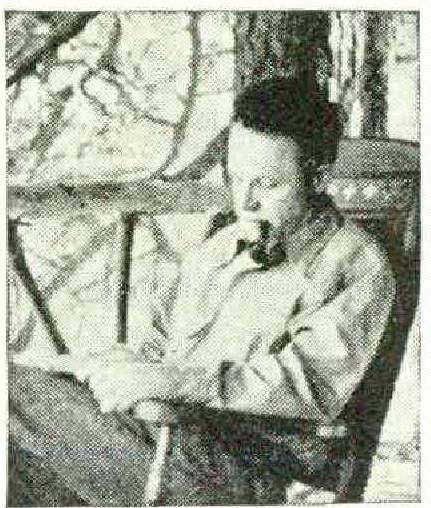
Born in Greenville, Mississippi, in 1896, David Cohn (p. 13) graduated from the University of Virginia and took his Master of Laws at Yale. ‘Then,’ he writes, ‘I went into business—instead of into writing—because my family went bust on a cotton plantation they had bought. I had a successful business career in New Orleans, rising, as they say, to the head of a large mercantile corporation. In 1934 1 quit in order to write. In the meantime I had managed to attend the late war in a highly minor capacity, and to travel extensively from Turkey to Tahiti.’ Mr. Cohn is the author of God Shakes Creation and Picking America’s Pockets. His new book, Those Were the Days, is to be published early in the year.
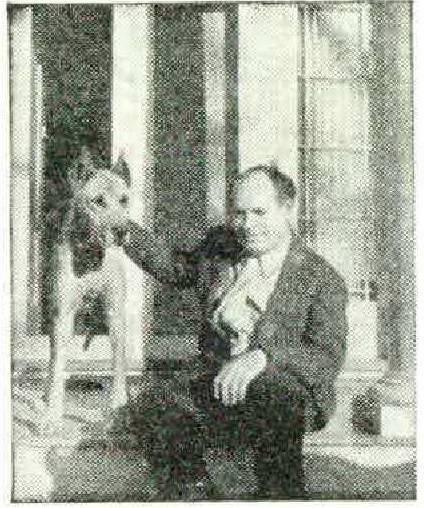
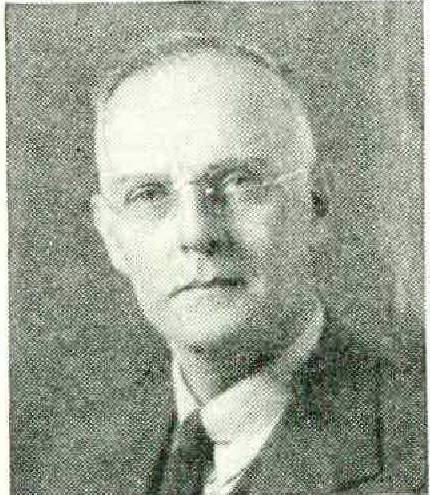
Henry W. Holmes (p. 20) has been Dean of the Graduate School of Education, Harvard University, since 1920. A beloved and discerning teacher, he reminds us of the vital responsibilities that have to be met by the American public schools.
Born in Belfast in 1856 and educated under circumstances which would have aroused the ire of Charles Dickens, Sir John Lavery (p. 28) was created a knight of the British Empire in 1913 and has been President of the Royal Society of Portrait Painters since 1932. Here, if ever, is an artist who pulled himself up by his own bootstraps. Further chapters of his autobiography will appear in subsequent issues of the magazine.
Son of a pioneer editor in Colorado, Thomas Hornsby Ferril (p. 35) is a native of Denver, the author of two books of verse, High Passage and Westering, and the winner of live national poetry awards. Says Carl Sandburg, ‘To me he is the most eminent and significant citizen of Colorado. The question of whether America can be herself culturally is involved in his work. He knows his own direction better than America knows hers.’
President of the Salvo Chemical Corporation, Francis Vivian Drake (p. 39) studied Aerodynamics under Handley Page. In 1917 he was commissioned as a pursuit pilot in the Royal Flying Corps. In 1917 he was attached to the United States Signal Corps to give instruction in air fighting, and thereafter served in Texas and Canada. He went into business in New York City, was married, and became an American citizen. Mr. Drake has flown all the European, South American, and United States airlines, and has had plenty of opportunity for direct observation of the aircraft of Germany and elsewhere. He has, however, no connection whatever with the aircraft industry.
Atlantic readers will enjoy the glancing wisdom and the touch of melancholy
with which Agnes Repplier (p. 46) has portrayed the Brothers Housman. With her manuscript came this brief note: ‘This is shorter than I intended, but I was too tired to write more. I think I may be too tired ever to send you anything else again. But Lord knows I have written plenty.’ Miss Repplier actually has threescore Atlantic contributions to her credit, but her audience will demand an encore.
rchitect turned poet, Christopher La Farge (p. 50) 1ms published two long narrative poems, Hoxsie Sells His Acres and Each to the Other, selected by the Book-of-the-Month Club in 1939.
A native of Massachusetts, Phillips Endecott Osgood (p. 51) graduated from Harvard in 1904 and received his B.D. at the Episcopal Theological School of Cambridge in 1907. Rector of Emmanuel Church in Boston since 1933, Mr. Osgood ventures where some churchmen would fear to tread — into an unsparing discussion of church financcs. ‘What a queer notion it is,’ he writes, ‘that churches are expected to be like orchids, to thrive and be exotically luxuriant on air.’
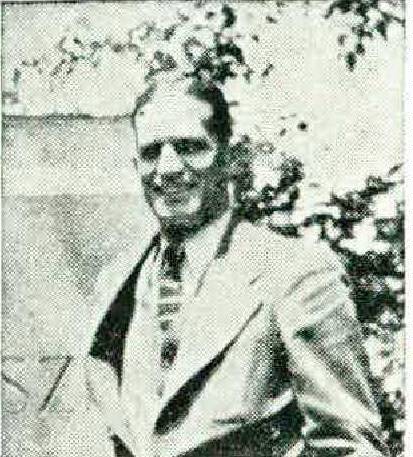
Son, nephew, and grandson of writers, Selden M. Loring (p. 58) of Lexington, Massachusetts, now makes his first appearance in the Atlantic. ‘My father, he says, ‘should be credited as co-author; he owned the original of War Feather, and patiently corrected my errors in the lore of the firm hand on the light rein.’
Novelist and critic, Bernard DeVoto (p. 66) sizes up three possible candidates for the Pulitzer Prize. Editor of the Saturday Review of Literature from 1936 to 1938, and the present and provocative occupant of the Easy Chair of Harper’s Magazine, Mr. DeVoto will be remembered for his novels, The House of SunGoes-Down (1928) and We Accept with Pleasure (1934), his study of the Southwest, Mark Twain’s America (1932), and his essays, Forays and Rebuttals (1936).
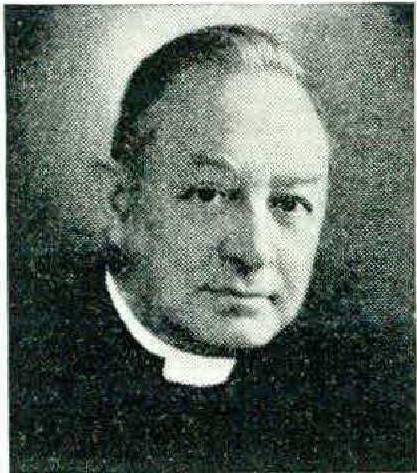
An English naturalist in the direct descent from Richard Jefferies and W. H. Hudson, Henry Williamson (p. 75) is today attending to his farm, his books, and his children in Norfolk.
Robert Littler (p. 81) is a practising lawyer in San Francisco; has represented employers and unions (both A. F. of L. and CIO); is lecturer in Labor Law at Stanford Law School; was chairman of the Board of Arbitration to set hours, wages, and conditions of labor in the hotel industry in San Francisco in 1938, and was invited back to serve again in 1939; and is the permanent Impartial Chairman for the cloak and suit industry in San Francisco.
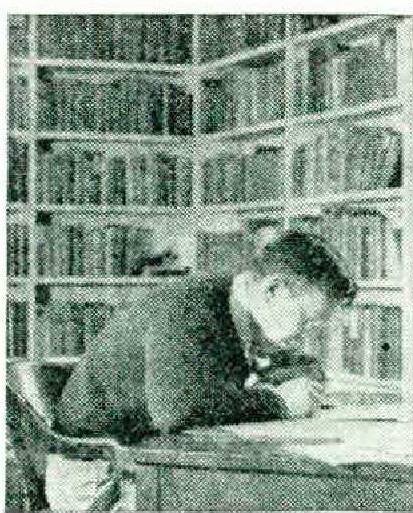
T. Jefferson Coolidge (p. 89) is a Bostonian who served as Undersecretary of the Treasury from May 1934 to February 1936.
A poet who divides his time between his teaching at Harvard and his seclusion at Pomfret, Connecticut, Robert Hillyer (p. 94) is a fellow of the American Academy of Arts and Sciences, winner of the Pulitzer Prize for Poetry in 1934, and always a welcome contributor to the Atlantic.
H. E. Bates (p. 95) was born in the English Midlands thirty-four years ago. Writing was his first love, and from it he has never deviated. He began at seventeen, and by nineteen he had finished his second book, The Two Sisters, which was good enough to merit a preface by Edward Garnett. Now recognized as one of the ablest short-story writers in England, he is represented this winter by two new volumes of tales, The Flying Goal and My Uncle Silas.
Walter Duranty (p. 101), one of the Atlantic’s correspondents at the front, sends us by wireless his impressions of the peaceful Italian sector.
This month the testimony from ‘ Under Thirty ‘ is as contrariwise as Tweedledum and 4 weed led ce, X.Y. Z. (p. 108) is an optimistic young householder in Toronto who married on I he installment plan and has never regretted the risk; Mark Clutter (p. 109), a resident of Wichita, Kansas, has no patience with those who are content to live from day to day. He wants the long view and, one suspects, a planned economy. ‘You pays your money and you takes your choice.’
Each month the Atlantic awards a prize of $250 for the best essay of a thousand words submitted to the Contributors’ Club. This month the prize goes to Charles It. Walker (p. 111), author of American City (1937). The recipient of a Guggenheim Fellowship, Mr. Walker is now working on his new book at Wellfleet, Massachusetts.
Wilson Follett (p. 115), who has firm opinions about modern English usage, can he agreed or argued with at his farm in Bradford, Vermont.
With considerable pride the Atlantic embarks upon t lie publication of its new serial, More Truth Than Poetry, by Hans Zinsser (p. 117). Born in New York in 1878, Dr. Zinsser took his A. B. and his A. M. at Columbia and his M.D. at the College of Physicians and Surgeons in 1903. In 1905 he embarked upon his career as a bacteriologist — a career which has taken him to the plague spots of the world and has marked him as one of the great teachers in the history of American medicine.