The Contributors' Column
THE Atlantic is privileged to publish a selection of chapters drawn from The Flowering Seed, the new book by Donald Culross Peattie (p. 291). With the manuscript came this appetizing Foreword from the author: —
’I have spent twenty years getting ready to write this book, and more than two writing it, and all the things that would make it thorough and dull I have left out. It is on the subject I find happiest in the world, the same subject often made inconceivably tiresome under the name of botany. It is none other than life, green life, the plant kingdom, which has flowered into our present home, from the earliest seeds ol vitality on earth. This is my story; some of biology’s great commandments are in it, a little detective writing, and a good deal of the history of green growing. I have put in some of my own adventures, too, and a lot of my own enjoyment. If anybody learns botany out of it, it will be by the way.'
Ruth Gordon (p. 302) made her first big hit as the wife in Saturday’s Children, Maxwell Anderson’s comedy of young love. Jed Harris selected her for the title role of Serena Blandish, and the Theatre Guild chose her to play Idly Malone in Hotel Universe, Philip Barry’s drama of disillusioned expatriates. She has appeared as a reticent secretary in A Church Mouse and a madcap poetess in Here Today, and her character delineation in Ethan Frome is still in fresh memory. Finally, she is the only American actress who has ever played a leading role at the Old Vic in London.
The Diary she kept in 1914 will be an open-sesame for those who remember what America was like before the war.
‘I am a “spender", yessir. not because I like it, but because I am convinced — with Keynes, Hansen, and many others — that our economy will go plumb to hell unless money is circulated and goods are bought. Which is another name for spending. . . . This piece tells what the Ameriean economy is up against as fairly as I know how to tell it. I have tried to keep the piece from degeneratirlg into an argument, and to found it as solidly as possible upon verifiable facts and trends. I have tried to steer clear of words and phrases which stir emotion and cloud straight thinking. In a way I have been addressing if to a Republican president with the idea: “Here is the fundamental situation. Now see what you can do with it."'
So wrote the economist Smart, (’base (p. 312) in the Idler which accompanied his stalwart paper in defense of Deficit Financing.
Born in Polizzi in 1882, G. A. Borgese (p. 327) received his Ph.D. at the University of Florence in 1903. A scholar of marked ability, he taught first, at the University of Rome, then at the University of Milan. Premier Orlando appointed him the director of the Press and Propaganda Bureau in 1917-1918, and a year later he went to London as the head of the Italian Delegation to the Interallied Conference. Fascism he opposed from the first, and, having refused to take the Fascist oath, he went into voluntary exile in 1931. Today Dr. Borgese is an American citizen and Professor of Italian Literature at the University of Chicago. His book, Goliath, is the most profound analysis of Fascism in print.
For this issue the editors have selected three short stories characteristically European in their style and substance. It was in Vienna that Franz Werfel (p. 310) first made his reputation as dramatist and novelist. His The Eternal Road, was a success in this country, and his novel, The Forty Days of Musa Dagh, was read from coast to coast. His present story, which has been skillfully translated by Heinz and Ruth Norden, came to us from Sanary, France, where the author now writes in exile.
If you like to go places and he in the know, consult pages 432-434
In his thirty-fifth year, H. E. Bates (p. 344) is generally conceded to be the ablest of the young short-story writers in England.
Newspaperman,playwright, and satirist, Roda Roda (p. 354) earned a sound reputation in preHitler Germany and Austria, where his name is now anathema for obvious reasons. Strange as it may seem, his story has its basis in fact.
Born in 1907, W. H. Auden (p. 358) took his degree at Christ Church, Oxford. Nine volumes of plays and poetry have come from his pen since 1930; he has edited several anthologies of poetry; and in 1937 he was awarded the King’s Gold Medal for the best poetry of the year. Meantime, he has been scholar, teacher, and an ambulance driver for the Loyalist cause in Spain; he has traveled in China, and at this writing has pitched his tent in the Rocky Mountains.
It was while clearing up the havoc of the hurricane last September that Wilson Follett (p. 360) of Vermont became most keenly aware of the animosity between town and country.
Gerald Donoghue (p. 370) knows at first hand the hard facts, horse sense, and American humor which, taken together, have made the oil boom in Texas a matter for legend and history. Mr. Donoghue was born in Beaumont, Texas, thirty-three years ago, and has been on the reportorial staff of the Houston Chronicle ever since his graduation from Holy Cross.
Formerly Dr. ‘X’ (p. 378) was a leading medical authority in Germany, which had been his homeland for more than sixty years. In terms which are not exaggerated he lulls what he and his fellow Jews had to endure in a concentration camp.
A graduate of Princeton whose teaching was for a decade a stimulus at Harvard. Theodore Spencer (p. 383) has recently been appointed University Lecturer in English Literature at Cambridge. He is the author of Death in Elizabethan Tragedy (1936) and co-author of Studies in Metaphysical Poetry (1939). Readers (particularly those who have struggled with Finnegan’s Wake) will of course realize that his Feeble, is a parody — and a good one! —of James Joyce and those other esoteric spirits who make up words to suit their whims.
The Atlantic is always glad to welcome Theodore Morrison (p. 386), who once served as Associate Editor and is now lecturer in English and Director of English A at Harvard University. Mr. Morrison is the author of two volumes of verse, The Serpent in the Cloud (1931) and Notes of Death and Life (1935).
Graduate of Rugby and Oxford, George Allen (p. 387) is an English poet who held for two years a Commonwealth Fellowship in the United States. His poem was written shortly after his departure from our shores.
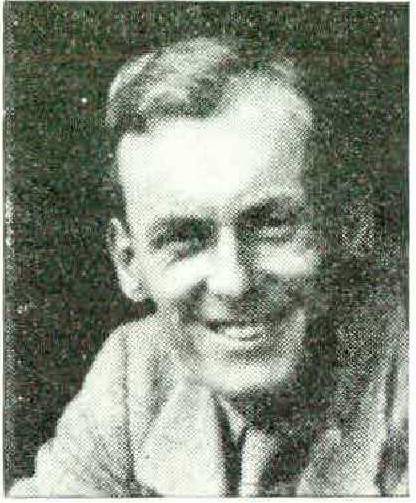
When Waller Duranty (p. 388) writes as lie pleases, he does so with a warmth and human sympathy such as he cannot show within the terse limits of his newspaper dispatches. With this issue he begins a series of five articles which will tell Atlantic readers what it feels like to live on the gridiron of Europe to-day. His first paper is on Poland; his second on Rumania.
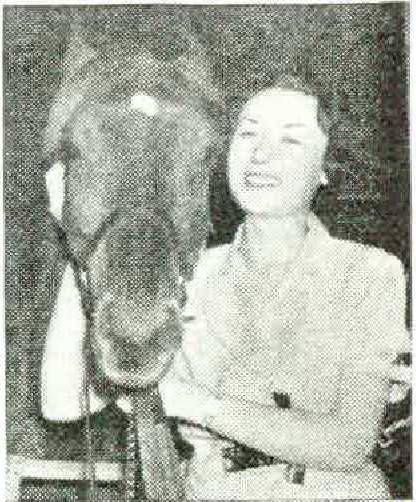
With candor and conviction, Lewis W. Ware (p. 397) presents the aspiration of the young American who is also, and incidentally, a Negro. A Radoliffe graduate, Hamlda Bauer (p. 398) follows the horses where they lead. Writes Miss Bauer. ‘The horse in the photograph is named “Idolatry.”But shortly alter the photograph was taken I sold him. At present my stable consists of one three-year-old filly called “The Trout,”which I recently claimed. She is by “The Scout” out of (believe it or not) “Emmy Fish.”She was third yesterday, and I expect her to win very soon, within her next two starts. If she doesn’t, I’ll probably be tearing out large gobs of hair.’
The Atlantic would have no hesitation in placing Geoffrey Household (p. 403) in that small list of young English authors who are able to make Americans sit up and take notice. He went down from Oxford with a First Class in English literature, and since then he has lived in the four quarters of the earth —in the Balkans, in Spain (his other country), in South America, New York City, and Portugal. With the encouragement of the Atlantic editors, Mr. Household settled down in London in the fall of 1938 to write the story of a modern Don Quixote. Rogue Male was the result, a novel which, as it has appeared in the Atlantic, has drawn readers forward to the edge of their seats.
For people who like to go places and be in the know, Stop Light offers suggestions for September in the pages directly following the serial.
Letters on birth control, pro and con, have been pouring into theAtlanticoffice since the appearance of Eduard C. Lindeman’s article in the July issue. The debate on this vital subject will be renewed in the October number.
Philadelphia, Pa.
Dear Atlantic, —
Since the Atlantic Monthly has always been regarded as a liberal periodical. I thought it might be well to suggest that a responsible writer be invited to answer Eduard C. Lindeman’s article, ‘The Responsibilities of Birth Control.’
There are many points in this article of which I disapprove from two standpoints — religion and reason. As a Catholic, I do not agree with his unhesitating acceptance of the use of contraceptives to prevent birth, or the dictatorial power he assumes (p. 26, paragraph 2; p. 28 at top) in saying that certain persons be kept from having children—which statement, by the way, he contradicts in the last paragraph and the prerogative which he gives married couples of saying how many children they will have. I believe that in encouraging the above he is usurping God’s authority over man.
As a reasoning person, I do not agree with his statement that, in the past, reproduction was controlled by war, disease, pestilence, and so forth, and in the future it will be by voluntary choice on the part of those who desire parenthood. What guarantee have we that the past will not repeat itself? Further, his Machiavellian statement in regard to population planning is impossible. Likewise, it is impossible to agree with his conclusion that all will be well ‘when procreation becomes a matter for enlightened and voluntary choice.’ Again, what is his guarantee?
Regarding the implication in the first paragraph on page 25, it is generally known that the Catholic Church is the only organization of its kind which opposes the Birth Control Movement. To imply the charge of insincerity in the face of the Labor Encyclicals of Popes Leo XIII and Pius XI is unfair.
MARY C. GEISY
United Catholic Organizations
Press Relations Committee
Springfield. Illinois
Dear Atlantic,—
At a meeting of the Board of Directors of the Springfield Maternal Health Center tills morning, it was unanimously decided to write to you, congratulating you upon and thanking you for your article, ‘The Responsibilities of Birth Control.’
Our clinic, which has been established only a few months, came into being in the face of seemingly insurmountable opposition. We undertook the work with great enthusiasm, tempered, however, with tin* realization that it carried with it a grave responsibility. To our sincere crities we have been able to quote figures and reiterate our belie! in the cause, but it has been very difficult to find, among the many articles written on the subject, one which brought out clearly all the issues involved. This Mr. Lindeman has dispassionately done, reviewing the pros and cons of the birth-control controversy and arguing them through to their logical conclusions. We shall be proud to present this article to any of our adversaries who question our motives. It says just what we should like to say if we had the command of language and the background the author has.
It is a most satisfactory feeling for us to know that the question of birth control is being thus presented through your magazine to a class of people who should be sufficiently well informed to understand the import of Mr. Lindeman’s conclusions.
SPRINGFIELD MATERNAL HEALTH CENTER
Louise S. Lamphier, Secretary
Let’s be honest about Panama.
Providence, Rhode Island
Dear Atlantic. —
According to R. L. Martin, if I have not misunderstood the article ‘Watch Out for Panama’ in the August issue, the Axis Powers are insidiously working to turn the Republic of Panama against its benefactor, the United States. The author does not mention what steps should be taken to keep Panama on friendly terms, but just warns us to watch out.
R. L. Martin may be right about the danger to the canal from a military point of view. I have read the testimony of military men before various Senate committees and I must admit that I couldn’t get greatly excited about it. On the other hand, when I read that a theoretical black navy has theoretically wiped out the city of New York I don’t get much excited either, so perhaps I am not a fair judge.
I have been interested in the new Panama treaty, which has been reported out of committee. This treaty gives Panama the equivalent of $430,000 American dollars per annum, just about the equivalent of $250,000 in gold, which is exactly what we originally promised to pay. Some people seem to think Panama should be very grateful for this increase in the annuities, which is really no increase at all, but when we consider how valuable the canal is to us the sum shrinks a little in comparison. Simply from a commercial point of view the annual payment on the new basis represents less than the canal tolls which we now take in every fortnight.
We have also made other friendly gestures to Panj ama that the article does not mention. This year we have raised our diplomatic representation in Panama to ambassadorial rank. I am sure an extra ambassador in Washington won’t do us any harm and I hope the new American ambassador in Panama may do some good.
Perhaps if we keep on along this line we may offset some of the blandishments of the Axis Powers.
There is one statement in ‘Watch Out for Panama,’ however, that sounds thoroughly realistic and that seems to be a sufficient cause for alarm: ’Without meaning to discount in any sense the polite doctrine of independent sovereignty, one must admit that little Panama by means of its strategic position on the Isthmus seems to have been created in perpetuity for the role of protectorate.’
Isn’t this a fart? If so doesn’t it mean that we do not honestly consider Panama to be an independent republic, but that in reality it must take its orders from the United States? If Panama is to be considered as under the domination of the United States, then, according to the principles of our forefathers. we ought to give the country fair representation. If we should invite Panama to become a state or a territory of the United States, and if the proposition were accepted after a fair plebiscite, we could honestly dominate the country. Otherwise our dictation to an independent, republic is something that might be considered reprehensible, to say the least. It would certainly seem in some respects analogous to the relationship between some of the Axis Powers and their protectorates—which I take it we deplore.
Of course Panama might not care to become a small part of a great republic such as ours, with its towering tax structure and steadily mounting debts, but we might persuade the Panamanians to like it. We might even split the canal tolls with them.
In any case it would seem that we should honestly face the question as to the real status of Panama. If it is an independent republic the fact should be recognized, and the new treaty, described by President Roosevelt as ‘a fair and equitable solution of the peculiar problems which have arisen between the United States and Panama’ and warmly sponsored by Secretary Hull, does not go any too far in placating Panamanian nationalism.
If, however, Panama is to be run by the United States, should we not try to do it openly and with the full understanding and consent of the little country through which runs the life line of the American navy?
PHILIP C. GIFFORD
Posies, and other things, for Richard Aldington.
Gouvieur, Oise, France
Dear Atlantic,—
Posies to the magazine and to Richard Aldington for the review of Joyce’s Finnegans Wake in June.
Common sense in book reviews is refreshing, when so much reviewing seems given to exalting the morbid, the bizarre, and the straining to be ‘significant.’
There was personal gratification in Mr. Aldington’s reference to ‘Jabberwock words,’which arc not Joycean ‘inventions’ to anyone who ever heard of Lewis Carroll,
I wish the esoteric critics would some day tell us common folks when — and why — a piece of writing needs to he ‘interpreted’ in the same language in which it is presumably written. Most of us regular readers agree. I believe, that a fundamental purpose of language is to be a means of clear expression of thought and of accurate communication.
BERNARD J. MULLANEY
Cambridge, Massachnsells
Dear Atlantic, —
It was with a great deal of amazement that I read Mr. Richard Aldington’s review of Finnegans Wake. Mr. Aldington’s attempts at humor were in particular most distasteful. He assuredly has a right to his own opinion about Joyce’s work; one cannot quarrel with honest criticism. Bui why need he be insulting? I certainly do not claim to grasp what Joyce is trying to do but I am sure that, whatever it is. it is worthy of something better than the sophomoric jibes launched by Mr. Aldington. How could your reviewer expect to comprehend within two weeks a work which one palpably much his superior labored over for nearly tw o decades?
As a friend of several years’ standing of the Atlantic, I am genuinely distressed by this type of thing.
EDWIN HEWITT (Harvard 1940)