The Contributors' Column
After standing at the steering wheel of the Atlantic for thirty years, a term of service thrice as long as has been enjoyed — or suffered — by any of his predecessors, the Editor relinquishes his duties. His decision, made more than twelve months ago, has until the actual completion of his term been kept an office secret. From 1908 to 1938! It has been a long voyage, and on the whole a fair one. There have been gales, as there will always be when duty and conviction are involved, but the sun is warmer than it used to he and t he sky bluer. After all, our readers are the weather gauge, and their number, eight times what it was three decades ago, seems to show that the Atlantic’s barometer is still rising. The Mate is now Master, and the ship is away on a true course.
Like his friends Henry James and George Santayana, Logan Pearsall Smith (p. 731) is an American author who has done the major part of his writing abroad. Acknowledged to-day as one of the great stylists of our time, the author of those books of enduring interest, Trivia, On Reading Shakespeare, and The English Language, Mr. Smith has found in England the congenial climate for a man of letters. There he has done his writing and indulged his lifelong hobby of hunting for old and valuable manuscripts.
A native of Pennsylvania, Mr. Smith was educated in the approved style at Haverford and Harvard. After the Grand Tour, business beckoned, but his cousin, Miss M. Carey Thomas of Bryn Mawr, shook him loose from this compulsion by urging him to write. In 1888 he crossed to England and went, up to Oxford, where at Balliol College under Benjamin Jowett he ‘shared in that Oxford life which, in its setting of old colleges and gardens and little rivers, is surely the happiest and most enchanting life that is possible to young mortals.’
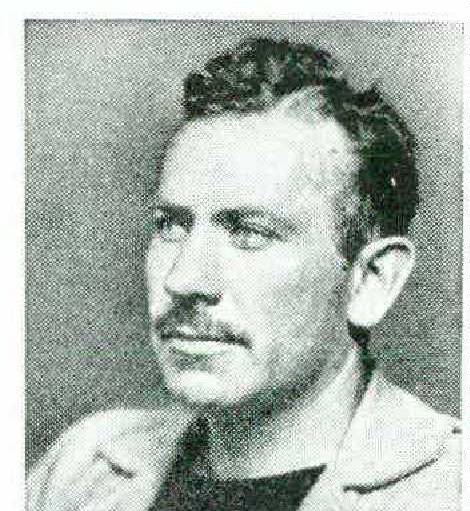
It was his book and play Of Mice and Men which first thrust John Steinbeck (p. 741) into the limelight, although readers who pride themselves on discovering had long before begun to praise Tortilla Flat and In Dubious Battle. Still in his early thirties, he has been, we understand, a newspaper man, ranch hand, carpenter’s helper, painter’s apprentice, chemist, and Jack-of-all-trades. That he knows migratory labor, its humors, loyalty, anil pathos, is abundantly clear from his writing.
In the Atlantic for May we began the publication of a new essay in which Virginia Woolf (p. 750) urges that ‘the daughters of educated men’ unite in concerted opposition to man-made war. She has a definite and trenchant programme, elaborated in her book, Three Guineas, which is to be published by Harcourt, Brace and Company, and from which our essay has been extracted.
The daughter of Sir Leslie Stephen and the wife of Leonard Woolf, a London economist and man of letters, Mrs. Woolf is the moving spirit of ’the Bloomsbury Group.’ For years the Woolfs’ home in Bloomsbury has been a literary centre; here were to be met John Maynard Keynes and his Russian wife Lydia Lopokova, Lytton Strachey, Desmond MacCarthy, E. M. Forster, Arthur Waley, V. Sackville-West, Raymond Mortimer, and Lord Berners. Mrs. Woolf’s novels, The Voyage Out, Jacob’s Room, Mrs. Dalloway, and Flush, and her essays, The Common Reader and A Room of One’s Own, have earned her high rank in contemporary letters.
Wellesley Atkinson (p. 760) was graduated from Leland Stanford in 1928. He was first, employed as bookkeeper, then as purchasing agent for a large dairy. When the inevitable layoff occurred after the depression, Mr. Atkinson decided that gold is where you find it.
Sir Herbert Gepp (p. 770) is a distinguished Australian with long experience in the business and economy of his own dominion. While on a recent visit to the United States it. occurred to him to attempt a modest comparison of Australia’s recovery from depression with our own.
He is a firm believer in democracy and he has seen his own people work off a burden which now weighs on us.
American poet and prize novelist {The Seven Who Fled),Frederic Prokosch (p. 776) is at present at King’s College, Cambridge, a place most conducive to intellectual stimulus.
It was while lunching with General Queipo de Llano in Seville that Ellery Sedgwick (p. 777) first heard the inside story of Queipo’s almost single-handed capture of that city. The facts have been substantiated from many contemporary accounts and from first-hand conversations with other actors in the drama.
A Paris journalist, Jean Prevost (p. 785) has been in this country for the past eight months collecting material for a book about a dozen Americans who will best express in their own individuality the American way of life. At home he is a novelist, a constant contributor to the Nourelle Revue Francaise and other periodicals, and incidentally a close friend of Martin du Gard, about whom he has been lecturing in this country.
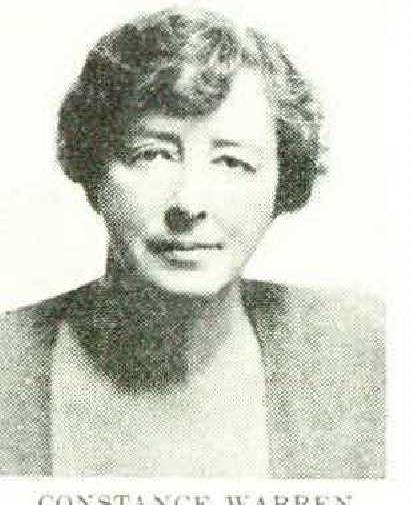
A graduate of Vassar with degrees from Columbia, New York State Teachers College, and Russell Sage College, Constance Warren (p. 788) is an educator who has led the way as President of Sarah Lawrence College since 1929.
When the editor asked Wilson Follett (p. 792) if he was a Thomas Mann enthusiast, this was the reply that came back by return mail from Bradford, Vermont: ‘Of course, I am not only a Thomas Mannite, but the original American Mannite. Thomas Mann, back in the period when he sent me large paper copy No. 1 of Unordnung and frühes Leid, inscribed as I should blush to quote, would have told you that I was the No. 1 Mannite in these parts.'
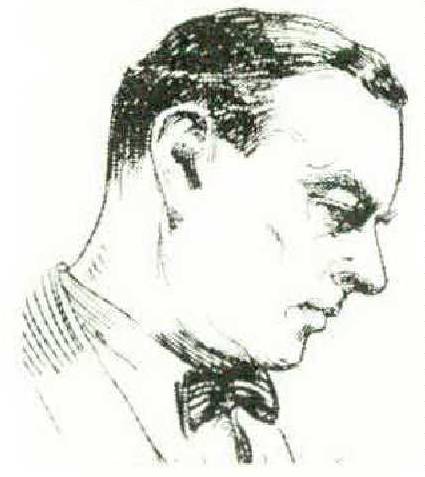
‘The shrinkage of classical studies during the last fifty years in the field of education is comparable to the disappearance of the buffalo from the prairies in the earlier days.’ So writes Emily James Putman (p. 795). She learned her Latin and Greek under Professor Paul Shorey at Bryn Mawr, and as she recalls the inspiration of his teaching, and the classical studies which he defended with every breath, we see emerge the portrait of one of the greatest teachers in American education. Mrs. Putnam carried the torch herself at Barnard College, where for fifteen years she was lecturer in Greek literature and history. Loyal readers will remember the short stories of brilliance— ‘Helen in Egypt,’ ‘Hippoclides Doesn’t Care,’ and ‘Candaules’ Wife’—which in 1926 she contributed to the Atlantic.
Mrs. Putnam and other members of Bryn Mawr’s first class, the class of ’89, hope to announce on their Fiftieth Anniversary the foundation of a Paul Shorey Memorial Chair.
Clear-cut as cameos, yet evocative in their feeling, are the essays in which Agnes Repplier (p. 805) recalls the tragedies of one’s First Decade.
‘By and large,’ says John Crosby Brown (p. 813), ‘our American private philanthropies have been on a starvation diet for the past six years. The question is, can they survive another era of exacting struggle?’ That question he analyzes in some detail, for, as the president of Tamblyn and Brown, he has had considerable experience with those colleges and philant hropies in need of funds.
Within recent months the Atlantic has published two short stories by William Saroyan (p. 819) — ‘The Pomegranate Trees’ in the February number and ‘The Journey to Hanford’ in April. When the cupboard was bare, the editor wrote the author asking if there might not be a new manuscript on hand. Back from San Francisco came a friendly note with these closing lines: ’I am sending along the story I wrote yesterday.
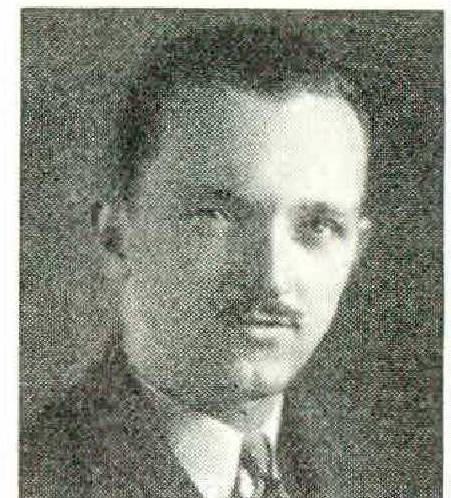
Many thanks for your letter; except for it I dare say I should not have written “The Fifty-Yard Dash,”being naturally very lazy.’
A graduate of Princeton with an A.M. from Columbia, Arthur C. Holden (p. 823) is a New York architect who, in addition to private practice, has served on a number of commissions relating to city planning and housing. To the editor he wrote: ‘We have not been able to finance housing on a large scale because we have no philosophy of finance. We need a better mental attitude more than anything else. I authorize you to write this phrase right into the article if you feel I have not made that point clear.’
Poet and teacher, Edward A. Richards (p. 833) received his Ph.D. at Columbia and is at present in charge of the Columbia Home Study Department. His poem ’The Intercession’ appeared in the Atlantic for November 1937.
Hartley W. Barclay (p. 834) has been editor of Mill and Factory for the past seven years. In January 1936 he created a sensation in the industrial world by devoting an entire issue to the Ford production methods, a detailed analysis eventually published in book form by Harper and Brothers. His story of Weirton attracted considerable attention this past winter. Recently Mr. Barclay and his staff of experts have made a case study of General Motors. A book comprising their research charts, statistics, and conclusions will be published in July by the Atlantic Monthly Company under the title, The American Economy: A Case Study in the Production of Value.
The Atlantic undertakes a new departure in setting aside space for letters from young people Under Thirty. In this opening discussion, William P. Bundy (p. 840), a native of Boston and a member of the class of 1939 at Yale, speaks his mind clearly and vigorously about the Rift between the Generations; Elizabeth —(p. 841) gives an admirably candid account of her predicament in dealing with her father, her husband, and her son; and Robert James (p. 812), a twenty-year-old Californian, makes a personal appeal for a reconciliation between Dictatorships and Democracies.
As secretary for the Book Club of California, an association of book collectors which publishes limited editions on California history and literature, Oscar Lewis (p. 849) has had time and incentive to know as much as can be known about his native state. His first three books reflect the loyalty of a native son—Hearn and His Biographers (1930), The Origin of the Celebrated Jumping Frog of Calaveras County (1931), and A History of San Francisco (1932). Thereafter he had intended to write a novel about San Francisco in the '70s and '80s, but his research led to the fascinating and factual story of California’s Big Four — a story of how Charlie Crocker, Mark Hopkins, Leland Stanford, and Collis P. Huntington built up the Central Pacific, and incidentally their own fortunes.
In the name of justice.
Tokyo, Japan
Dear Atlantic, — I have just finished reading, for the third time, the article entitled ‘Memory Train’ in the Contributors’ Club of the February number of your magazine. And it has forced me to write for the sake of justice to some who are misunderstood.
I too was in England — in London during the Great War. I too was wakened at night by the droning of enemy craft. I loo saw a Zep brought down in flames. I remember a bomb that landed on a house in the next block, and when the occupants returned from the City all they found was débris and their baby’s bootee with the foot still in it. I know all that. And, w hile I have no baby brother, I have Chinese friends. I also have Japanese ones — one gains many during fifteen years in their country. And it is on their behalf that I speak.
For the War Lords who send fleets of planes to bomb defenseless towns, for the Generals who order the wholesale destruction of prisoners, I hold no brief. No one not a devil could. But they are not the common people. And the common people do not know. Much they cannot imagine, it is so far beyond their experience. Still more they are in total ignorance of. 1 was talking to a country innkeeper a few months ago, and he was telling me how his little town had been robbed of nearly all its young men. I murmured vaguely, ’How terrible,’ whereat he looked at me with the gravely bewildered eyes of a child and remarked. ’It is very puzzling. I wonder what it is all about? Can you tell me?'
An old woman came to visit me a week or so ago, full of what she had heard from a young friend. This girl, after not having heard from her twenty-year-old brother somewhere in China’ since September, received eight letters all at once. One of them was written from a heart sick with horror at an order that had just come from the High Command — an order to kill every young Chinese they saw . (How that letter passed the censor I cannot imagine.) The old woman’s face was horror incarnate as she told me. ‘ Sensei (Teacher), our boys don’t really do that, do they?’ And when I sadly said, ‘ Yes,’ the tears came into her eyes for the brutality, the inhumanity of it.
I have not once — and I have talked, in their own tongue, with all ranks from taxi drivers to retired colonels—heard expressed any hatred for China; merely among the common people an ingenuous wonder as to what it is all about, and a pity for the Chinese, who ‘seem such a nice, gentle, pleasant people — if only they would realize how wrong Communism is.'
There are stories, of course, — unfortunately true, —of Japanese atrocities in China. But are our own nations so free from war-inspired hate that we condemn with so righteous an indignation? In Kobe, five years after the war, one of my English friends refused to know the German musician who had taught her until 1914. I tried to enter America in 1931 and the immigrat ion officer was so offensively rude that, had I not been under contract with an American firm, I would have given up the attempt. I found he was of German extraction. What, then, must be the war hate of the soldiers in the heat of fighting?
I know there are those who are of the opinion that if no more Japanese goods are bought the people, deprived of a living and understanding why, will force the War Lords to halt the operations in China. But that is impossible.
In the first place, they will never know why. We, of course, in touch with the Western world, know from magazines, from newspapers, from personal acquaintance with war correspondents of other nations, what is going on in China. But the Japanese people — the everyday ‘ man in the street’ and not in the inner councils of the War Office — do not. It is because of the way things are presented to them. Even the sinking of the Panay and the attack on United States Consul Allison are known in a very different way in Japan from what they are elsewhere. The news movies, the war posters, the tracts and pamphlets, show the man in the street pictures of Japanese soldiers nursing Chinese children, of Japanese soldiers giving refugees five-yen notes, of Japanese soldiers feeding Chinese prisoners, and of Chinese greet ing the Japanese occupation of their city by a glad waving of Rising Sun flags. And to 999,999 out of 1,000,000 that is the truth, and the whole truth. How shall they know unless they hearP And ‘how shall they hear without a preacher?'
Perhaps those at home will wonder why there are no preachers. There are—but they are in prison. Early this year there was a roundup of nearly 400 ‘Reds and Dangerous-thoughtists’ whose crime was mainly that of saying that war is unrighteous. A few days later one issue of a certain magazine was withdrawn because the word ‘peace’ appeared too often on its pages. At the beginning of this month a magazine called Jiyu (Freedom), published by a count, was discontinued in face of the police campaign against radical and progressive writers, although professedly it aimed only at the popularizing of the five avowals of the Emperor Meiji, the avowals that form the Japanese Constitution. On February 2, the Metropolitan Police of Tokyo arrested sixteen ‘alleged’ radicals, mostly university professors. And the ‘ radicalism’ for which men are imprisoned and honored professors dismissed would be considered on the conservative side of liberal in the United States. Wherefore the thinkers must choose between thinking and not saying, or saying once and being put where they can do so no more, except to reveal the names of ‘accomplices’ under the torture of the thumbscrew or the branding iron, and other things that make one sicken even to imagine. And that is my second reason.
How, then, can the people — the ‘little people’ who work in factories and shops and offices, or in their homes in city or country — bring pressure to bear? They cannot. And can we blame them?
I have written all this to you because I know your magazine as one that is fair and just and broadminded. And if it could be printed I should be grateful for the sake of those for whom I write. I am not blind. I see their faults, which are many and sometimes peculiar, but I feel I must be fair.
But if it should be printed, could it be kept anonymous? The Atlantic has a large circulation in Japan, and I have said things here that might make it uncomfortable for me if they came to the ears of the authorities.
Yours truly,
A TEACHER
Cheers for ‘The Judas Goose.'
Des Moines, Iowa
Dear Atlantic, —
My compliments to you and to Winifred Van Etten for ‘The Judas Goose,’ in the February number. That story comes very close to being a modern parable, for it epitomizes the tragedy of all wild life on the North American continent. Furthermore, behind that simple tragedy lies a foreboding symbol of far deeper significance.
When they drained the marshes and stripped away the vegetation and coves which sustained the wild things they started the slow but sure disintegration of the sustaining resources of nature necessary for man’s existence. Thinning soil anil falling water tables are the direct descendants of drainage and stripped vegetation and the antecedents of ‘dust bowls.’ Enter dust bowls, exit man. Curtain.
What a lot of ‘Judas Geese’ we have bred within our own species!
JAY N. DARLING
Concerning the stories in the March Atlantic.
San Antonio, Texas
Dear Atlantic, —
Your ‘departure from tradition’ in publishing four very short stories in your March issue has been most enjoyable in our family. I don’t know which is the best. They are all good. But that ‘Mole-Bane’ is a little jewel. Keep up that departure.
Yes; and that very long story, too. I refer to Peattie’s ’Prairie Grove.’ Such things are done only once in a great while. It is powerful. Such pictures of the forces of nature at work — the priests, the sod, the Indians, breaking of the prairie land, the birds and buffaloes, Rhoda looking with ‘blind eyes’ at the pigeons Hying by when her father had told her about Delia running away with Chance. And such language! Bight along with Shakespeare’s metaphors, I have stored in my memory that personification when Peattie speaks of the prairie chickens and the squirrels invading Goodner’s cornfield: ‘In its grand impartial bounty, this America, this continent, put her man child and her wilderness offspring each to a flowing breast.’ Such creative power must have made all the gods stand up and applaud! Let some great sculptor take that sentence for his theme. And yet the cold marble could n’t express it with the force that Peattie has given it. The whole story of the Grove is the background for it, the setting of it.
S. ENGELKING
Questioning Mr. Holden.
Boston, Massachusetts
Dear Atlantic, —
Mr. Holden’s article in the March number, ‘No Santa Claus in Housing,’ is one of the best discussions on housing that I have seen. It brings out many pertinent questions that have been given too little consideration by the advocates of public housing. I think he strikes the keynote of the fallacy of our subsidized housing programme when he says, ‘For a nation that almost invariably dodges its problems instead of solving them, these partial remedies of a bad mortgage-financing system represent real progress, though nowhere near enough.’
I should like to mention, however, what seems to be a misinterpretation of the United States Housing Act of 1937. Mr. Holden states that this Act ‘makes a rent subsidy system possible and likely to be tried out.’ The annual deficit subsidy provided by the United States Housing Act is not a bona fide rent subsidy. Quoting from the Act, The United States Housing Authority may make annual contributions to public housing agencies to assist in achieving and maintaining the low-rent character of their housing projects.’ The annual contributions will be applied to the financial structure of a project to mate up the annual difference bet ween the operating costs and the income from the rents charged. The rents charged will not be an economic rent as Mr. Holden states. A bona fide rent subsidy involves giving direct grantsin-aid to indigent families so that they may pay an economic rent. This is the system advocated by the New York Committee on Economic Recovery of which Allie Freed was chairman, and is an extension of the system used by the Overseers of Public Welfare in granting rent relief.
I question the accuracy of Mr. Holden’s figures relative to the time and cost of the mortgage foreclosure process. I note in the November issue of the Home Loan Bank Review that the time and cost of foreclosures completed by the Home Owners Loan Corporation in the forty-eight states are given. The cost varies from $5.18 in Texas to $354.30 in Illinois, as compared to Mr. Holden’s average figure of $400 to $500. The time for HOLC foreclosures ranges from twenty-two days to twenty-five months. Mr. Holden’s average figure for time may be correct.
CALVIN H. YUILL
Executive Director, Housing Association
of Metropolitan Boston, Inc.
Voters are still registering their opinion of the Atlantic’s cover, this time largely in approval.
Redlands, California
Dear Atlantic, —
I notice you ask for opinions on the cover —r whether it ‘clashes.’ Indeed it does — with almost everything in my room.
I dislike the glaring color; it ruins I he appearance of my library table. It is not even pleasant on the porch — too glaring when the sun strikes it. I long for the old-fashioned cover the Atlantic used to wear.
You brought this upon yourself. I have no criticism — only praise — for the interior of the Atlantic.
JANNETTE L. STURGES
Warwick, New York
Dear Atlantic, —
For my part I do not need to be reminded that my old friend is waiting to be read by having it clothed in a color that screams at me when I enter the room.
How about a pastel shade of green that would be welcome anywhere?
HELEN C. BEATTIE
Lansing, Michigan
Dear Atlantic, —
I love your orange-vermilion cover. It’s just the touch that every living room or library needs. How tiresome all those weak pastel tablecloths and slip covers without an accent of strong color such as you furnish! Please never change the color.
HAZEL BRODY BURHANS
New York City
Dear Atlantic, —
As to the color of your cover, I want to place myself squarely on the side of the angels, which would leave it in statu quo. Don’t be afraid to nail the drapeau to the masthead and brighten up the world, which is drab enough certainly, and does not seem to be getting any better. I hope to see the same bright reflection month after month and to feel better for it.
U. S. GRANT
Albany, New York
Dear Atlantic, —
Would you mind letting the elephant waggle the little ribbon on his tail once more?
I refer to the dear lady with the hooked rug and the bathroom who found that the Atlantic (as is) clashes. For I too have a bathroom, a small bathroom with a bright, sunny window at the end away from the bathtub; and there I often sit reading the Atlantic. It is so peaceful to sit in a sunny window and to read about Japan and Conscience and Decay and Things: I just love it.
And I too have a rug, a very expensive Bokar, smooth and shiny and slippery when wet. It is of a deep Woolworth ultramarine and I frequently drop the Atlantic on it.
I desire to let you know that the color combination is adorable (with the brilliant sunshine and all); and I do hope that Miss Hemphill’s letter in the March issue will not induce you to return to the old fulvous cover. Let the dear lady get rid of the offending rug.
JOHN H. COOK
How shall we refer to England — or Germany — or our own country?
Washington, D. C.
Dear Atlantic, —
If Britannia rules the water waves and is presented to us as an ample matriarch, why is England also constantly pictured and referred to as John Bull? Although Britannia holds sway over the waterways of the globe, it must be John who mans the battleships of the British Navy! Perhaps Britannia and John are joint rulers — truly a vigorous, well-fed, and fullblooded couple for these days of lean budgets.
Over on the Continent, at Bingen, the abundant maternal figure of Germania dominates the Rhine and the steep fertile vineyards. She apparently is content to rule merely an inland waterway. But she, too, must be merely a joint ruler, for her country is called the Fatherland. And since this is true, why is the belligerent-looking John Bull content to let England be called the Mother Country?
And why are these and other virile and often warlike nations so willing to be referred to year after year by the feminine pronouns? Armed to their eyebrows and at times engaged in experiments of the boldest, why is each one ‘she’ and ‘her’ to all who would write of them? We can understand why the Sister States of our Union might he fitting antecedents for these female for-words, but scarcely why their wiry, active, and much-governing Uncle Sam should be tagged with them — and much less those certain aggressive neighbors across the sea.
Perhaps it would be too great a wrench to attempt to change to the use of the masculine pronoun, appropriate as that would be to John Bull, John Chinaman, Uncle Sam, and the Fatherland. But why not use that once-innoeent little word — it?
CAROLINE SHERMAN