A Tale of New Japan
I
THE impression grew and flourished that Fuji was an innkeeper’s legend. Of course, there were pictures in every shop of this chiefest miracle of nature, but there is no sect in Japan which can boast more devotees than that which troops after the God of Advertising, and the story grew that, like the imperious dragons with curly tails and the Thousand-armed Buddhas, the sweep and lift of Fuji was the vision of some supreme artist which Hokusai and Hiroshige had translated into the vernacular of everyday life. Every morning, it is true, the newly arrived were told to look southwest from Tokyo, for a northerly breeze would part the clouds and disclose the heaven-ypointing pyramid; but each day clouds, thick with rain, where Fuji ought to be, confirmed the suspicion of a profitable and patriotic hoax. It was all of a piece with Santa Claus. Once you were let into the secret you joined the conspiracy.
Now, if any man were responsible, it was obviously mine host at Miyanoshita, Mr. Yamagouchi. His delectable inn, the Fuji-ya, where the splash of water tumbling into a camellia-shaded pool all but drowns the tinkle of cocktail glasses on the verandah, is dedicated to pilgrims searching for Fujisan — Fuji-Sir, as the Japanese say in affectionate respect. Never was hostelry more nicely calculated to assuage disappointment. Food, bed, service, all tempt the visitor to stay one more day when it ‘will be sure to clear’; and Fuji after rain, you are told, is the supremely perfect Fuji.
How satisfying are these best inns of Japan! How fastidiously they minister to the sentimental traveler! The maid, in her gay kimono and gayer obi, comes in to bring you tea.
‘What a charming view you have given me from my window,’ you say. ‘How beautiful it would be to see the sun.’
She looks out, lost for an instant in the loveliness of young willows bursting into leaf.
‘Yes,’ she says with a smile, ‘a beautiful place to see the sun, but it is a more beautiful place still to see the moon.’
Where else among chambermaids radiates the soft influence of Diana?
Mr. Yamagouchi is a necromancer, but even his lively wit and the majesty of his moustache, eighteen inches from tip to tip, cannot drive from the visitor’s mind the thought that Fuji, one sight of Fuji, is the hope that lured him to Miyanoshita. Still, that moustache is no trivial eccentricity lightly to be passed over. Not merely does it give our host primacy in the Moustache Club, where you may see, from authentic photographic records, mustachios rampant, couchant, undulant, recessive, rococo, flamboyant, sometimes with beards, sometimes in solitary magnificence of line, black, white, and gray; mustachios in the structural harmony of flying buttresses or in delicate finials pointed to the airy filament of a single hair — from such competition one may not lightly bear away the capillary crown. Not only, I say, docs this masculine achievement divert one’s thoughts from the pursuit of Fuji; it elevates one’s standards from the dandified mustachios of Paris to purer and nobler forms, where, freeing itself from parasitical adornments, it becomes its own triumphant vindication.
Three days of rain had been followed by three days of cloud, but the wind still blew from the northeast. If you do not know what that means, you have only to walk down the streets of a Japanese city and note the precautions which the architect whose site is the northeast corner of a block must take if the devil of that quarter (the most exasperating, I am told, of all devils in Hell or out of it) is to be barred out. The devil is smart, but the architect is smarter, and, instead of constructing the ordinary right-angled corner, he folds the corner inward in a sharp recessive angle, thus: This is unexpected, and to the devil looks so remarkably like a trap that he follows the way of prudence and makes no attempt to enter.
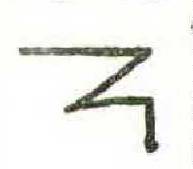
Well, we were out to know the secret of Fuji, and after a day of blackest cloud we awoke the second morning to broad sunshine. All things were auspicious. The line of little bowing boys in the hall smiled in unison. The waitress, her kimono bright with plum blossoms, brought us coffee and toast, and the promise of a lovely ‘cherry day,’ while Mr. Yamagouchi twisted the fierce extremities of his mustachios and said we had brought the south wind in our valises — which meant that this day we were to be let into the secret of Fuji-san, whatever that might be.
II
Have you ever noticed that when a traveler tells of Fuji he attempts to describe the incredible? You learn that the peak is 12,365 feet above sea level, a figure you were obviously intended to remember on account of the days of the year, but after that single intelligible remark the pilgrim becomes rapturously mystical. Fuji-san is a dream, a vision, a symbol of the unattainable, an exhalation of the Divine Spirit returning again to God, the single perfect abstraction in Nature. This is not description. This is rhetoric, and the reason is that the indescribable cannot be described. You can speak of the mists circling about the base of the peak, now white as snow, now golden with the sun, now purpling under the passing shadow of a cloud, but all this might be said of other mountains, and Fuji is no more like the Alps, or the Rockies, or the Andes, than the Grand Canyon is like a Western gulch. Prose is futile. Painting tells of it only what is in the mind’s eye, but Fuji is the vision, not of what is, but of what might be.
Mr. Yamagouchi was on the porch to welcome us when we returned from our all-day drive about the five lakes which lie, the posters tell us, in a great circle about the mountain. We were in his secret. We complimented him on the compact completeness of his lunch boxes — chicken, beef, ham, tongue, salad, bamboo knife and fork, bamboo salts and peppers, bamboo sprouts to eat, and bamboo to pack them in; and he complimented us on knowing what we knew.
That evening a seven-course dinner meandering pleasantly from caviar to strawberries and cream, and that current of loving-kindness toward all men that comes from half a bottle of Burgundy and a glass of port! Then my wife left me with the injunction to be careful not to wake her when I came up, for we had driven that day from nine to six.
Now a lonely cigar is not the way to end a day of days. Seeking out Mr. Yamagouchi, I found him in expansive mood, and baited my hook for his story. The Japanese, I remarked, are not a people of individual achievement. They work in pairs, or groups, or crowds. In fact, one of the constant miracles of a miraculous country is the continual transition from individual incompetence to collective genius. Watch the helplessness of the man called to mend your water pipe, but note the swift dispatch of the business when his mates rally to his aid. Every Cabinet Minister has his Vice Minister, every executive his alter ego, but if now and then you come on an individual Japanese who has ‘done it all himself,’ depend upon it he has a story to tell well worth your attentive ear. This is the story that Mr. Yamagouchi told me.
His father and, for that matter, his father’s father had been innkeepers in Japan. They were a stiff, unbending race, who had found that there was one right way to do everything, and cared not to learn another. They had made a success of their business, and it was the duty of the sons to plant their small footprints precisely in their father’s confident tracks. But Mr. Yamagouchi — it was before his adoption, and his name was Kanaya then — had a will and ideas of his own, and when he left school to enter the hotel kitchen as an apprentice, although he was quick to learn every detail of the Japanese style of cooking, serving, and living, he was acutely aware of the changing world about him, and knew that when the hordes of the West swarmed over his country they would cry out to be fed with their own food and to sleep in their own beds — and incidentally would pay well for the trouble. Month in and month out, the boy plead with his father to be allowed to cross the ocean and study Western ways. But always his father repulsed him, not too gently, and thrust him back into the kitchen to keel the pots and fill the hibachis with fresh charcoal.
The Japanese boy does not disobey, but by persistence he can make a father’s life unendurable. I suspect that it was by pressing his talent in this direction that this particular boy finally wormed out of his father permission to go to England, if he could pay for the journey. It was a prudent promise to make to a penniless boy of sixteen, whose wages were three meals of rice with a bonne bouche of raw squid or eels on festal occasions. But where there is a Japanese will, there is an ultimate way, and the boy, who had picked up some knowledge of English, contrived to make himself so useful to a prospective traveler that his new friend agreed to pay his transportation to San Francisco in return for service assiduously rendered.
So the first barrier was crossed, but once in America the boy was left to his own devices. Everywhere he sought for work, and everywhere he was refused. His dollars dwindled to pennies; he lived on bananas, and slept in the open. His foot was in the doorway, but the door was slamming in his face.
Very close to despair, the little stranger sat on a San Francisco pier, gazed toward the home he had longed to leave, and idly watched a big ship warp into the dock. Then came the miracle which, whatever pessimists say, never fails him who waits patiently, wisely, and courageously. A certain great lady, now on her way to London in advance of her husband, who had been named ambassador, chanced to be amongst the passengers. The boy had seen her at his father’s inn, and now came forward, bowing and smiling, to make her welcome. He poured out his story. ‘How fortunate!’ she said. ‘A sick friend of my husband, now on his way to London, needs an interpreter and guide.’ And so it was, that the young pilgrim reached his Promised Land.
But for him that land flowed not with honey, neither with milk. London was larger than San Francisco, and food cost less, but it costs something even for an appetite nourished on rice and porridge. The boy starved and shivered, but at last in the Savoy he found a scullion’s job. Now he had English pots to clean, instead of Japanese ones, but all the while he watched how things were done. When work failed at the Savoy, he found a job at the Cecil, and, before the year was out, all there was to know belowstairs in the great West End hotels he knew.
But times grew hard again, and work faded away. Now was his chance to perform his own miracle. He called again on the ambassadress who had helped him in his despair. Starvation is a liberal education for the wits, and he addressed her with confidence. ‘I have heard,’ said he, ‘you need a diligent Japanese in your service, really versed in English. That is no longer accurate, for here he is.’ The lady demurred, hesitated, accepted, and Yamagouchi was on his way.
Still the boy’s salary was tiny, and none of his native astrologers could have called his future bright. But, earning money by hook and crook, within two years he was attending lectures at Cambridge. And then came the third miracle. It chanced that at Cambridge there was another Japanese boy, homeless, friendless, and poor. In childhood he had been a chum of Yamagouchi’s, and now the two small exiles took to roaming the countryside together. One day, in better spirits than usual and needing exercise, they proposed a bout of jiujitsu, in which Yamagouchi was proficient and his friend hardly an ignoramus. Taking off their shoes on a Cambridge green for the same reason that leads young Westerners to put on gloves for their bouts, the boys fell to, and in an instant \ amagouchi tossed his friend over his shoulder.
Again they went at it. The novelty of the show — this was early in the nineties — brought a crowd, and in the thick of it a tall young Cambridge boxer who looked on in amazement. A third time Yamagouchi flicked his friend over his shoulder as if he had been a feather pillow. The crowd huzzaed, but the watching athlete, six feet two of brawn and muscle, who, every inch of him, lived for sport and understood it, gave vent to his incredulity: ‘It’s all very well for little codgers, but that’s no man-size game.’
‘Come on,’ said Yamagouchi.
The Englishman hesitated, as an Englishman might before an antagonist sixty pounds under his weight and twelve inches under his height.
’Try it on,’ said Yamagouchi.
Off came the athlete’s coat and shoes, He started to spar, but in less than thirty seconds went flying through the air for a fall, heavy as on the hunting field.
‘You don’t drop right,’ said Yamagouchi.
’I say, panted the Englishman, that’s too good for you Japanese to keep to yourselves. You teach me and I will pay you a pound an hour.’
So it came to pass that Yamagouchi became the first master of jiujitsu in England. In a day his reputation was established in Cambridge. In a month the young bloods in London knew of the strange new sport. With the backing of his English friend he formed classes. His gift for organization asserted itself. He taught his own instructors, and supervised their work in a long chain of classes. Within a year his income had jumped from ten shillings a week to a hundred pounds.
It was time to write home, now that he could write with dignity, but his father’s reply was disconcerting: ‘Come home, my son, I need you.’ In vain the son expostulated. A fortune was in his grasp. His work was organized. It was interesting. It was rewarding. He wrote with patience, setting forth the facts.
To understand this story you must realize that this young man was now of age. He had received nothing from his father. His success was due to himself alone. Now he was asked to give up an independent fortune and to return to servitude. But as the teller of the tale remarked by way of simple comment, ‘We Japanese obey our fathers.’
So back he went, back to the drudgery of his father’s inn, back with only the memories of his independence; but he had taught himself to be the master of circumstance, and to-day he and his brother have a whole string of hotels, both native and foreign. Of these latter two are, I verily believe, the most comfortable and satisfying inns in the world. So perhaps his father was right after all.
III
The Fuji-ya Inn at Miyanoshita owes part, at least, of its comfortable air to the extreme irregularity of its form. Its general ground plan is a half circle, but wing after wing has been added, one detail of ornament or structure nicely assimilated to another, corridor joined to corridor, and one walks upstairs and down, over bridges and up inclines, in the daily round. To go to bed that night involved something between a stroll and a walk. My route was unconsciously familiar, and as I strolled down the long halls and through the series of swinging doors I pondered on the relations of fathers and sons, Western education, jiujitsu, the teaching of initiative, and quite a number of other philosophic matters which resolved themselves into extremely complex equations. But all the time the subconscious part of me was taking note: be sure to count the number of swinging doors, bear left through this corridor, then sharp left, then right, now up a flight of broad stairs, turn left again, note the bell-shaped windows of ground glass which mark the particular hallway and give an unmistakable sense of rightness to one’s direction, then on through a corridor, — this time a short one, — face left before the last door, and there you are!
There I undoubtedly was, but I pride myself on the meticulousness of my observation, and it annoyed me to note that the young Boots, usually so careful, had misplaced my wife’s shoes and substituted therefor certain imitations of lace in leather which to a man of my upbringing are peculiarly obnoxious. I must not wake my wife. I made no fuss over the shoes. I turned the knob with infinite care, opened the door silently, slipped within, and turned the key in the lock with so noiseless a precision that the final click as the bolt caught was absolutely inaudible. A faint light filtered dimly through the narrow transom, but I knew the terrain; the bathroom was directly to my left, while a step beyond opened out our vast room with four windows, two to the south, two to the west, and two beds, one in the far corner where I could just discern the shrouded outline of my partner as she lay in her first deep, refreshing slumber.
I am a considerate husband, well used to going to bed in the dark, and with the geography of the room I was familiar to the last detail. Slipping my feet out of my pumps, I took six stealthy steps which brought me to the bureau. It had, as I well remembered, a glass top, and I ran my hand over it seeking an unencumbered place for my keys and loose change. It was annoying to me to find a continuous litter of small objects effectually covering its surface. I do wish, thought I, my wife would leave me my share of bureau space. But knowing the feminine axiom that a man’s belongings, being few and simple, require at most two hooks and a corner of a shelf, I felt for the drawers.
The first was chock-full. In the second I felt the fluff of skirts. In the third was a considerable series of nondescript articles which my wandering fingers could not identify, but which seemed associated with the charm of woman. But the fourth and lowest was empty. Triumph! To prevent the indiscretion of a rattle, I refolded my silk handkerchief and laid upon it my keys, money, knife and pocketbook. I then pushed the drawer home, and, standing upright, relieved myself of my coat and waistcoat. These I hung over the back of the chair, which, as I congratulated myself, I had drawn conveniently to the foot of my bed against just such a contingency. I wound my watch, and slipped it under my pillow. The details stick in my memory. Then, removing my trousers and shirt, I draped them over my coat, and was sitting on the bed taking off my socks when of a sudden there was an unmistakable rattle at the door. Someone was trying to get in.
The wandering idiot, thought I, will wake my wife; but after a twist or two the handle was silent, and I continued my undressing. One by one I rid myself of my remaining garments, and was shivering in the night wind, which filtered through the shutters, when an unpleasant thought struck me — suppose my wife had not laid out my pyjamas. I felt along the bed — not there. Under the pillow — not there either. On one of the pegs above the washstand — again, no. Upon my soul, it was careless of my wife, of whose comfort I was so careful.
Now this counsel has frequently been given me: when something is missing, do not look aimlessly in unlikely places; think out carefully where the missing object probably is. So I took thought, and while I was thinking, as a mere mechanical activity, I felt for my toothbrush. To go into domestic detail, my toothbrush has a curved bone handle, my wife’s a handle of some translucent fabrication which I never patronize. Now in the neighboring toothbrush mugs were two brushes with two fabricated handles. How miserably awkward! My wife had obviously noticed that one was missing, and had supplied a substitute from her store of replacements. But in toothbrushes it is not probabilities, but certainties, that one seeks, and I did feel that she might have left some explanatory signal. However, selecting the one which I felt was still dry, I was crossing to the bathroom with it to make absolutely sure, when I was startled by a sudden and violent shaking of the door. The lunatic was at it again. Surely my wife would wake. But the breathing from the further bed was perfectly regular, and the noise stopped as suddenly as it was begun.
My irritation was growing. The innocence of my physical condition absolutely precluded my going to the door. Where were those pyjamas? Well, if they were still packed, I could slip into my dressing gown. Thank goodness that was still where I had hung it! I could feel the refreshing crispness of the poplin suspended from the hook. I seized it and was about to slip it on, when, like the first ominous crash of a thunderstorm, my door was violently shaken, and I heard an English voice shout, ‘He is in there!’
I am a forbearing man, but my temper was up — this British cheek in informing me at midnight that I was in my own room! I wound the dressing gown round my middle, and, still grasping the toothbrush in my left hand, unlocked the door with my right and threw it angrily open. A gentleman in clothes of English cut was standing in the hall, one arm in the air in a gesture of violent amazement, his face the color of claret, and behind him were ranged, rank on rank, eight little Japanese bellboys. I could see their scared white faces.
I held my temper in control. “I should like to ask, sir,’ I said, ‘the meaning of this unwarranted interruption.’
The stranger made no direct reply, but his ejaculation had a peculiar intensity. ‘By God,’ he cried, ‘he’s got my toothbrush, too!’
Never was there so shattering an irrelevancy. My complacence, even my anger, dissolved like mist. In a flash the whole horror of my situation flooded over me. The wronged husband in every French drama fleeted across my mind. There I was, my clothes dispersed, clad in the most temporary of loincloths, in a room precisely like my own, but in a different wing. Stretched on a couch by my side was an unconscious lady, while her husband gave voice to his indignation. For a full second I was speechless. Then I cried out, ‘Sir, my mortification will last through life! It is a mistake, sir, a hideous mistake!’
He looked as if he were gazing at some terrible apparition.
‘My wish, sir, is to explain.’
‘And my wish, sir, is that you would get out.’
The advice was excellent — and I took it.