A Realist Looks at Ethiopia
I
THE ambitions of Italy to build up an empire in East Africa were evident even to such a casual visitor as I was.
My reasons for being in Addis Ababa were strictly scientific, but if one is to do scientific work in a country like Ethiopia one needs permits. In order to obtain them some observation of local politics is necessary, and while waiting for such permits the daily events in a strange city cannot pass unnoticed. In Ethiopia there is a normal, permanent tension between the native inhabitants and all whites; but toward Italy this latent animosity was already in 1933 flaring into the dangerous hatred which it has since become.
By November 1933, mutual murders had begun. There was no lack of incidents of Ethiopian aggression. For example, one member of the Italian service, while on caravan in the western part of the country, had already been assassinated, presumably for being a spy. His son and daughter, attractive young people in their early twenties, were considered martyrs and heroes by the rest of the Italian colony. In citing his list of provocative acts perpetrated by Ethiopians, Mussolini has no need to resort to his imagination. Citizens of other nations, notably Americans and Frenchmen, have also suffered, but their countries have been content to make formal protests. It is Italy’s place, apparently, to avenge the growing xenophobia which Hailie Selassie seems unable to control, despite his seven-o’clock curfew law in Addis Ababa, and despite his efforts to prevent white men, when possible, from traveling about the country.
Italy has other excuses than incidents of aggression to bolster up her case against Ethiopia. Chief among them is her oft-repeated intention to civilize Ethiopia, just as the Roman ancestors of the Italians conquered and civilized Britain. The Britons in those days were wont to paint themselves blue, as do the Southern Arabs to-day, while the Ethiopians delight, upon ceremonial occasions, in the consumption of raw meat and the acquisition of tapeworms. The idea of civilizing people who already have an ancient culture is perhaps a noble one, but we must hope that Italy does not follow the policy which she instituted in Libia. The ultimate result of such practices may be an increase in civilization, but the immediate result is nausea. Italy’s best excuse is her intention to uproot the Ethiopian institution of slavery, which definitely deserves destruction; but if all Ethiopian slaves were offered freedom from their masters at the price of political domination by Italians, few if any would be willing to change their form of servitude.
As I have already indicated, Italian designs on Ethiopia’s political integrity were, as far back as the fall of 1933, becoming increasingly obvious. The most evident external sign of this was the presence in the Ethiopian capital of numerous horsemen, Eritreans by birth, dressed in well-cut khaki uniforms, and crowned with high red fezzes surmounted by elegant pheasant plumes. These horsemen rode about fully armed, delivering messages for the Italian Legation and running its errands. It was impossible to go out upon the street without seeing at least one of them, and their presence was a constant psychological affront to Ethiopians. An innocent stranger newly arrived in Addis Ababa, and seeing these ornate messenger boys for the first time, might well imagine them to be some crack corps of native police.
Like the representatives of other countries, the Italian minister and his aides rode about in cars with the flag of their nation fluttering over the front fenders. In addition to this, however, the ministerial coach was usually preceded by a troop of lancers clattering down the street, kicking up clouds of dust into the envoy’s proudly arched nostrils. The sight of these gayly caparisoned troopers aroused the mirth
of a sporting member of the Addis Ababa foreign colony, who in derision dressed his two grooms as bellboys, with a double row of brass buttons running down the front of each tunic and with tiny pillbox caps perched on their fuzzy craniums.
II
At this point one may ask, what is all the fuss about? Why should a sane European nation wish to pick a fight with Ethiopia?
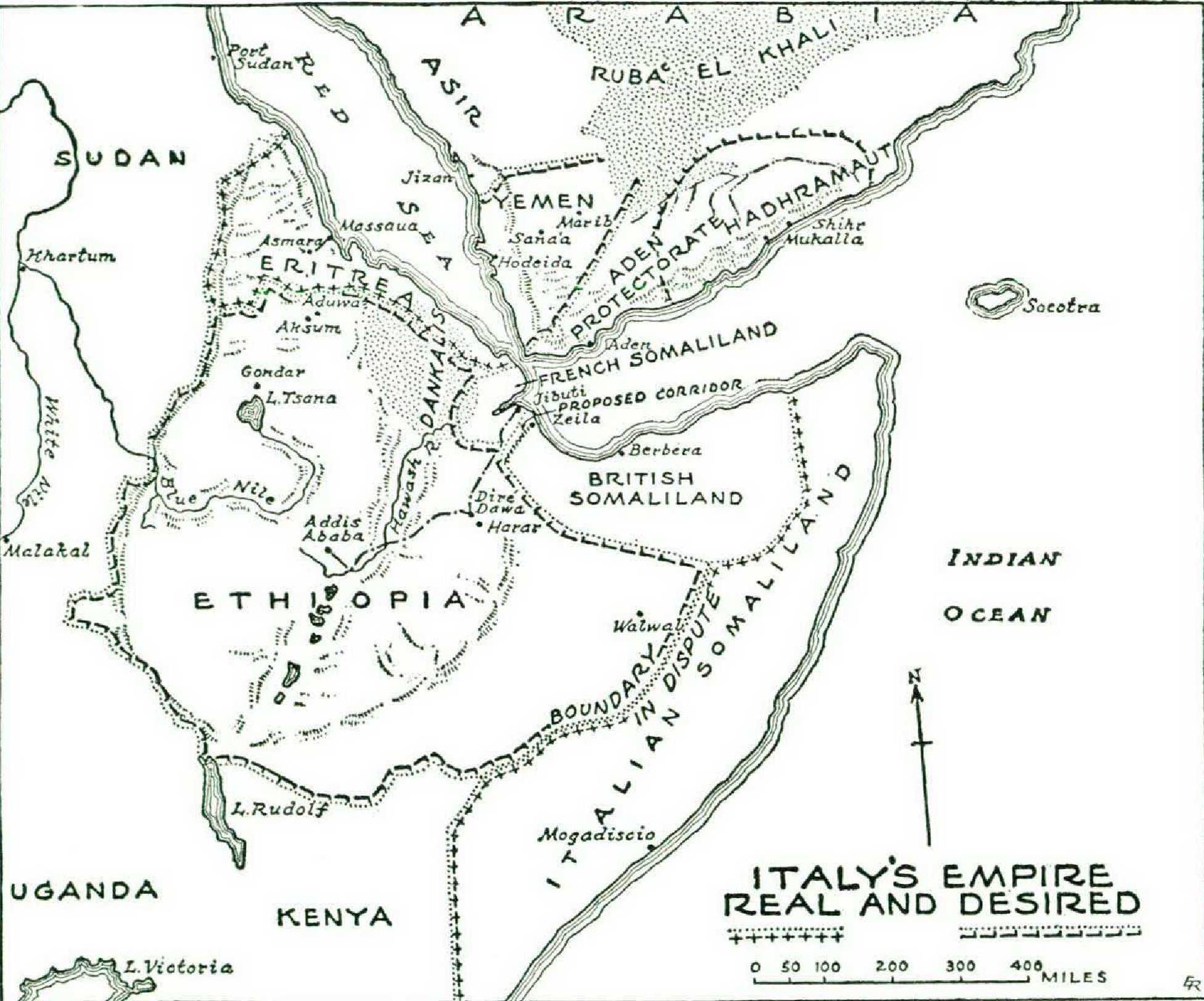
The economic position of Italy is well known. Mussolini’s success in building up both industry and agriculture is admired by most of the world. The need of resources, then, is one potent reason; population pressure increased by Mussolini’s distaste for ‘gymnastic love,’ as well as by the closing of the American gates, is a strong second. Ethiopia, from the European point of view, is a sparsely settled country, and her highlands are no hotter than summertime in Sicily. The third reason is the one which leads a calm observer to suspect that Italy may not be entirely sane, for it is purely an emotional one. It is revenge for Aduwa. The picture of Italy’s cherished thousands lying on that hot and gory field, their emasculated corpses the prey of kites, is one that is firmly engraved in the Italian imagination.
Spain, after four hundred years, was ready to avenge herself upon the Moors in the persons of the Riffians. Why, then, should not Italy seek revenge after forty? ‘We Italians have always defeated the black races in battle,’ says Mussolini, with accuracy sometimes characteristic of the contemporary historian. The Ethiopians, recalling their only important combat with Italian troops, hold an opposite opinion.
In justice to Italy it must be said that all of the great colonizing powers have taken their extra-Continental territories with as flimsy excuses as those which Italy now broadcasts, if not flimsier. Old Menelik himself needed no justification to conquer the Gallas, Somalis, and Shankallas. All that Italy now lacks is a Kipling to glorify her rapacity. The chief trouble is, however, that Italy has begun fifty years too late; the civilized world is becoming decadent, for it now has developed what one may hesitantly call a conscience.
Two years ago Italy’s ambitions in Ethiopia were, without doubt, well formulated, and everyone was aware of their existence; but they could not have crystallized in their present form because Italy had not, at that time, given up her ambition to turn the Red Sea into a Mare Nostrum. At that time Italian agents in the Yemen were leading the Imam about by the nose, a procedure his pious Majesty found most distasteful but highly unavoidable, since he needed their guns sorely, though he bitterly resented their intrusion into his private affairs. In the summer of 1934, however, after the Imam’s abortive war with Ibn Saud had flickered out and after King Abd el Aziz, with the backing of the British, had taken over the Yemen in a mild sort of protectorate, Mussolini’s agents were forced to leave Sana’a, while the British, from behind the scenes in Aden, emitted vigorous cheers.
The Italians wanted control of the Yemen, and almost obtained it; at the same time they wished to extend their influence into the Hadhramaut, which lies just across the Gulf of Aden from the eastern tip of Italian Somaliland. To the notion of Italian interference in the Hadhramaut the British were inalterably opposed; the brief sojourn of one hardy Italian in Mukalla, whence he was speedily ejected by the minions of the local Sultan, aroused much talk of espionage and provocation.
Having lost out to Ibn Saud, and incidentally to King George, in their attempt to control the Yemen; having been warned off the turf in the Hadhramaut, the Italians saw, by the fall of 1934, that the eastern half of their projected Red Sea Empire had been definitely withdrawn from their grasp. This left the African half open for them; here they could concentrate their attempts at the building of empire, and their ante-bellum campaign against the Lion of Judah had then its definite inception. Few persons other than diplomats realize the importance of this abortive Arabian interlude in the formation of Italian policy.
Even before this it was rumored in Addis Ababa that England and France had agreed to let Italy step in, partly as a means of blocking Japanese commercial ambitions in the Red Sea region, and partly as a sop to keep Mussolini from making trouble elsewhere. France has hundreds of thousands of Italian subjects in North Africa, and nothing would delight Mussolini more than to control Tunisia and Morocco, if not Algeria. England has hundreds of thousands of idle spindles in Lancashire, and to replace Japanese sheeting, from which almost all Ethiopian costumes are made, with stouter but more expensive British cloth would bring a smile to John Bull’s face. The Japanese angle of the situation is one of extreme importance, and one which, for various reasons, has not been overemphasized.
So far the Italian colonies in Africa are largely desert, and Italy has no colonies anywhere else. Only in Cyrenaica, where the indigenous farmers are already as thickly settled as the land will permit, has she acquired good agricultural land. In contrast with Libia, Eritrea, and Italian Somaliland, the rich, green meadows of Ethiopia, high and cool, are infinitely desirable. Here olive oil would replace Galla butter, spaghetti would nourish a civilization which teff (native cereal) failed to stimulate, and the axe and fagots would shatter in pieces the slender and more graceful spear.
III
Through the winter and spring of 1934-1935, the world was not allowed to ignore Italy’s preparations for war in Ethiopia. At first France and England were ominously impassive, but, with the arrival of Italian troops in Eritrea, England began to take action, for it is now her desire to prevent a war if possible. She has given up the idea of financing the Lake Tsana dam, over which American engineers struggled so mightily; and this renunciation is a tacit admission that trouble appears inevitable.
Furthermore, much to the amazement of newspaper readers in June of this year, a British envoy offered to give Ethiopia an outlet to the sea through British Somaliland, in compensation for proposed concessions to Italy on the part of Ethiopia. The House of Commons rose as one to protest. This was plainly against all British traditions. But the envoy was authorized by his government to make the proposal, and the envoy was unquestionably months ahead of the members of Parliament in his knowledge of the situation. England has never been known to give land away willingly, and why she has become so eager to preserve peace, when two years ago she was apparently reconciled to an Italian conquest of Ethiopia, her diplomats will probably not reveal until after the Italian-Ethiopian episode has become history — if they ever do reveal it.
Nevertheless there is no harm in guessing, and many will probably guess the same answer. The first and most obvious conclusion is that England is no longer sure that Italy will win — or, at least, win easily. Conditions in Europe are shakier than they were two years ago. There are Hitler and the Hapsburgs. There are the Balkans.
Italy cannot afford to leave her own borders unguarded, and cannot divert her entire strength to the conquest of Ethiopia. If Italy, through necessary caution or actual defeat, suffers a second Aduwa, her prestige as a world power will suffer immensely; furthermore the tenuous prestige of white men in all of Negroid Africa will sink to so low a level that black men will no longer come running with newly shined boots or whiskey and soda at a snap of the fingers; and even in some of England’s territories, especially in the Anglo-Egyptian Sudan, where Britons admittedly suffered their one defeat at the hands of black men, centres of revolt, born of new confidence, may conceivably arise.
Even if, in the event of an Ethiopian victory, none of King George’s subjects or protégés rebel, a puffed Ethiopia, crazed with victory and entirely out of the control of the intelligent and peaceloving Hailie Selassie, might strive to extend Menelik’s empire by invading British territory. In many parts of Africa, and especially in the Sudan, the white man holds his supremacy by a very narrow margin, and thousands of Negroes and Negroids over large areas are administered by single Europeans. Obviously these Europeans do not rule by physical strength alone, nor by superior armament. They rule because they personify a threat, that if their charges do not obey them other white men with terrifying weapons will arrive in swarms to avenge their kinsmen.
A victory of Ethiopia over Italy would destroy the notion that all European powers can necessarily defeat all Africans. It would destroy the conviction of the inevitability of white vengeance. Unless the administration of the purely native parts of Africa is to become more expensive than the returns warrant, the belief in this inevitability must be maintained.
Any reasonable person will admit that England could, if she so desired, conquer Ethiopia, but few now feel the same regarding Italy. Italy may well have the advantage, but the outcome is not inevitable. The Italians are not used to colonial wars in the British sense. There is no great Northwest Frontier tradition in their heritage. They conquered Libia, but to do so was costly, and the conquest involved butchery rather than strategy. It is one thing to drive tanks, armed with machine guns, across flat desert; it is another to make them climb cliffs and dart gracefully down precipices. Mountains, ravines, bogs, deserts, deep river canyons, poisoned wells, heat, and distance all stand against Italy, not to mention men. Italians must bring with them their food and most of their water. The Ethiopians carry nothing but cartridges and a pouch of grain. Living off the country may prevent large concentrations, but it greatly increases mobility. Italians receive a few months of training in brokencountry fighting; Ethiopians have been fighting that way all their lives.
IV
Although I would not trade one Riffian for ten Ethiopians, it may not be out of place to compare the Rif of 1922 with the Ethiopia of 1935. Roughly speaking, the Rif was to Spain as Ethiopia is to Italy, in numbers, in resources, and in degree of modern training. The Riffians fought in much the same way as the Ethiopians do, except that they were even more individualists and less given to mass emotion. They inspired terror by practices basically similar to those of Ethiopians. All of the Riffian munitions were either captured or smuggled, mostly captured; the leadership in their army was almost entirely native; they had possessed no national unity before the struggle; and yet the forces of the King of Spain melted before them, and disappeared with a splash into the sea. The Rif was free, the Christian vanquished, and the Riffians would have remained free had not the French stepped in. Even with the whole strength of the French army against them, they did not yield to the superiority of modern mechanism until 1926.
The one thing that raised havoc with the Riffians, and ensured their eventual defeat, was the airplane. In 1935 the airplane is an even more effective arm of offense than it was in 1926. Italy has one of the best air forces in existence; Ethiopia has, or had, the most photographed single plane in the world. Italy could easily blow up Addis Ababa, but Addis Ababa is not, for the most part, worth blowing up. A new capital of straw tukuls could soon be erected elsewhere, and, with the railroad destroyed as the first overt act, the city would be isolated in any case. The airplane, then, could prevent concentrations, but it could destroy nothing of irreparable value except the railroad. It could knock down churches at Gondar and Axum, and it could maim a few thousands of women and children as it did in the Rif; but maiming women does not defeat a nation.
In the United States much sympathy has been aroused for the plight of Ethiopia. This is felt especially by the American Negroes, whose concern is most accurately voiced by the very articulate burghers of Harlem. Let our Negroes remember, however, that the Ethiopians do not consider themselves to be Negroes; that the Ethiopians have always discouraged, and often illtreated, American Negroes in Ethiopia; and that the Ethiopians hold in bondage thousands of persons blacker than themselves. Then let our Harlemites glance at any of the current portraits of Hailie Selassie, who is far from being a Negro. If the Harlemites do all of these things, their enthusiasm must seem, upon reflection, a hollow and groundless form of idealism, based entirely on misconceptions. They are much better off on the island of Manhattan, where they can throw bricks at an occasional Italian who probably has no use for Mussolini, than in Ethiopia, where, if the Italians do not kill them or at least make their lives miserable, the Ethiopians will.
It is rather difficult to imagine what England would do in the event of an Ethiopian victory. But one thing is comparatively certain, that she would not sit back and see Hailie Selassie disregarded, the Ethiopians running rampant over East Africa, and her own colonies jeopardized. Either England will follow the role of France in the Rif, and take and be obliged to keep land which she does not particularly want, — otherwise she would have had it already, — or she will, before the climax, find some means of ejecting Ethiopia from the League of Nations, and, with the consent if not the help of France, step in and help Italy.
At this stage of the game it would be foolish to predict the outcome of a purely Italo-Ethiopian conflict, if such a conflict is really to develop. Italy has many advantages, but they are mostly things that can be bought with lire, and lire are not inexhaustible. Ethiopia’s advantages are of the earth, which cannot be bought, and of men, who in the present crisis are probably not for sale, although one cannot be too sure even of this. Ethiopia’s greatest advantage is the memory of the battle of Aduwa, which her bards and artists never permit the victors to forget. Sensitive Latin flesh quivers at the thought of emasculation, and the Ethiopians still wield the bloody knife.