Premium Versus Discount in Bond Buying
This department is designed to help readers to a better understanding of the general business conditions which affect their investments. It is obviously impossible to give advice as to specific investments.
by HOWARD DOUGLAS DOZIER
WHEN the layman drops in to talk bonds with his banker he is likely to hear some such statement as this: ’Here are some First Mortgage 3‘s, 1950 of Corporation A quoted at $90,90, to yield about 3.3 per cent currently, or 3.8 per cent if held to maturity. A few months ago these bonds were selling to yield currently around 4 per cent, but lately they have risen so that they are now selling to yield around 3per cent. Before the inquirer recovers from this broadside he will probably hear of an issue of 5¼’s due the same year, issued by the same company under the same mortgage, and selling at $116.46 to yield currently per ceul, or 3.8 per cent if held to maturity.
All this may be confusing to the amateur bond buyer and may lead him into a common error. It is the purpose of this paper to point out what this difficulty is, how and why it arises, and how it may be avoided.
In order to be able to make my point sharply, let me ask the reader to slop here a moment and glance over the first paragraph again before reading further, select tentatively one of these two hypothetical bonds as a purchase, and note to himself the reason for his selection. If he picked the one selling at $90.90, he did what probably ninety out of a hundred of his fellow readers did. This bond purchased at this price seems to otter a chance of appreciation of $9.10 between the date of purchase and that of maturity at $100.00. The one selling at $116.46 seems to threaten a depreciation of $16.46 during this interval.
The prices of these two bonds are their most arresting feature. The interest they promise is less arresting. There is a natural propensity to overemphasize price, and this frequently leads even the conservative into trouble, as we shall see. The actual fact with respect to these two bonds is that either of them purchased at the price quoted and held to maturity will yield the same rate of return on the investment, Let us now proceed with a comparison of the two.
There are any number of reasons why a bond may sell at a discount. One is that the interest which it promises in the contract may be less than that which is prevalent in the market. Then also the bond may be inherently poor as regards both principal and interest.
When a bond sells at a discount for the first of these reasons, and for no other, it may be as good as the best. In that case it is only different from, not inferior to, other good bonds. In spite of its goodness, however, it sells in the price class with many bonds of poor quality. An interest rate in the face of a bond less than the market rate causes the bond to sell in bad price company.
On the other hand, a bond may sell at a premium because the interest rate which it promises oil its face may he high in relation to the market rate. A bond may sell high because of the high interest promised on its face or because of other a I tractive features which safeguard it as to interest and principal, or because of all these reasons. These considerations automatically bring premium quoted bonds of high quality into the same price group.
In the premium group are to he found the good, the better, and the best, while in the discount group are to be found the good, the worse, and the worst. One may get as good a bond out of the discount group as out of the premium group, but lie will have more trouble in finding it. The fruit lover who reaches into a poke tilled with oranges of varying high quality will get an orange, but he who reaches into a like poke tilled with some good oranges and many lemons may draw out a lemon.
AN elaboration of this proposition requires an explanation of some financial terms which border on the technical, ‘Current yield’ is one of them. Current yield is the quotient obtained by dividing the interest rate named in the bond by the price of the bond. For instance, our 3 per cent bond sells at $90.90 and the current yield is 3.30 per cent, found by dividing $3.00 by $90.90.
Current yield is not an infallible measure of rate of return; it leaves out of consideration some important elements. It serves, though, as a rough-andready gauge of the bond market, going down as bond prices go up and vice versa. It may seem paradoxical to speak of a rise in bond prices when the current yield drops from 5 per cent to 4 per cent, but this need not bother one. This seeming paradox arises (jut of the fact that the language is that of income thinking employed in principal evaluation. The statement is of a piece with saying that recently sugar was selling twenty pounds to tile dollar but has now gone so high that only ten pounds can be had for that money. So it is with interest income on bonds. When interest income can be had $.>.00 to the hundred of investment, the bond which produces the income is cheaper than when its interest can be had at the rate of only $4.00 to the hundred. The reverse of this statement is also true.
Now ’yield to maturity.’ There is nothing rough-and-ready about this. It is a precise statement of a situation with mathematical exactitude and leaves out of consideration no factor of moment. For verification let us again resort to the two bonds with which we have now become familiar. They are on a parity so far as safety is concerned. Each is secured by a first mortgage on the same property, matures on the same day fifteen years hence, and pays $100.00 on that day, but one yields an income of $4.00 a year and the other $5.25 for fifteen years. The real test of comparability, however, is the yield to maturity, which is 3.8 per cent in each instance. This means that the purchaser of either of these bonds will get 3.8 cents annually per dollar of investment provided he holds it to the date of maturity and collects its face value.
The falsity of the hope of making a ’profit’ on the ‘cheap’ bond and the groundlessness of the fear of suffering a ‘loss’ on the ‘dear’ one may be made to disappear by the hypothetical financing of an annual income of $3.80 for a period of fifteen years. 1x4 us suppose that the reader, the Atlantic, and the writer start out to buy an annual income of $3.80 for fifteen years without loss or gain in principal. The reader buys the 3 per cent bond for $90.00, the Atlantic the 5¼ per cent for $116.46, and the writer lends $100.00 in cash for 3.8 per cent, the note falling due on the date of maturity of the bonds. The reader gets $3.00 of his $3.80 from the interest on Ids bond. He needs $.80 more. Let us suppose that he buys this $.80 for future delivery on that day in each year when Ins interest is paid. This series of $.80‘s will cost him $9.10 if the market, rate of interest is 3.8 per cent. Thus his outlay is $100.00, $90.90 for his bond and $9.10 for his annuity. The cost of Ins annuity ate up his seeming ‘ profit.’
The Atlantic, having bought the 5¼ percent bond for $116.46, receives $5.25 a year, which is $1.45 greater than its objective. It sells for future delivery annually, on the day it receives its interest, a series of $1.45’s. The selling price of this series the day it bought its bond was $16.46. The receipt of this reduced its expenditures to $100.00, and the sale of a part of its income reduced that to the figure aimed at, and its ‘loss’ was recouped the day it was incurred.
The writer pul in $100.00, look out a hundred, and received $3.80 a year. The rate of interest which made all this possible was 3.8 per cent, which represents the yield to maturity on the bonds. Each of us got $.038 on each dollar invested. This is merely the demonstration of a fact.
In everyday life wo do not go to all this trouble. What we really do is to find out what a bond is selling for in the market, what interest it pays, how many more years it has to run —and then we run to the bond book. We find the page headed fifteen years and the column showing the interest rate promised in the bond under consideration, look down it, and stop at the figure corresponding to the market price. On the margin will be stated what the yield to maturity is. We buy this income per hundred dollars of investment by buying the bond, or we refuse to do so.
But how does the bond book know? We shall have to go to school again. Most readers will recall how they wrestled with the subjects of compound interest and discount in arithmetic. To find the amount of $130.00 for three years at G per Cent they found the interest on one dollar for the first year and added to it the dollar. Then they found the interest on $1.06 for the next year and added that to $1.06, and so on for the number of years involved, and finally multiplied the result by 130. If the problem was to find the present worth of $130.00 to be received in three years they set down the figures as follows: —
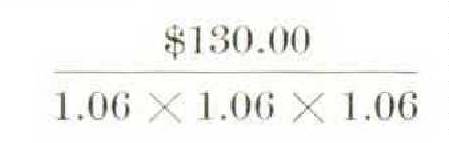
Then they performed the indicated operations, and came out with the answer in the back of Wentworth’s Complete or Hay’s Higher.
The man who made the bond book did precisely this, but he did it infinitely more times than the rest of us did. He too must have gone to school.
THUS we come again to the main point of the paper, the one that may save the reader money. A buyer can gel just as high a rate of return on his investment by buying a good bond selling at a discount as he can by buying an equally good one selling at a premium. The trouble is not with the return or the quality of the bond, but lies in the danger inherent in making the selection. A bond selling at a discount because the interest promised in its Face is low in comparison wit h the market rate, and for no other reason, may be as good as any other bond, but it is in low-priced company. The premium-priced bond on the other hand, whatever the cause of the premium, is automatically brought into high-priced company. Both it and its associates have quality. The chances of a successful choice are greater when one picks his purchase from the latter.
It generally pays to marry into a good family.