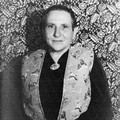
The War and Gertrude Stein: Autobiography of Alice B. Toklas, Iii
I
AMERICANS living in Europe before the war never really believed that there was going to be war. Gertrude Stein always tells about the little janitor’s boy who, playing in the court, would regularly every couple of years assure her that papa was going to the war. Once some cousins of hers were living in Paris; they had a country girl as a servant. It was the time of the RussianJapanese War and they were all talking about the latest news. Terrified, the servant dropped the platter and cried, ‘And are the Germans at the gates?’
We went to England July 5, 1914, and went according to programme to see John Lane, the publisher, at his house Sunday afternoon.
There were a number of people there and they were talking of many things, but some of them were talking about war. One of them — someone told me he was an editorial writer on one of the big London dailies — was bemoaning the fact that he would not be able to eat figs in August in Provence as was his habit. ‘Why not?’ asked someone. ‘Because of the war,’ he answered. Someone else, Walpole or his brother I think it was, said that there was no hope of beating Germany as she had such an excellent system — all her railroad trucks were numbered in connection with locomotives and switches. ‘But,’ said the eater of figs, ‘that is all very well as long as the trucks remain in Germany on their own lines and switches, but in an aggressive war they will leave the frontiers of Germany, and then, well I promise you then there will be a great deal of numbered confusion.’
This is all I remember definitely of that Sunday afternoon in July.
As we were leaving, John Lane said to Gertrude Stein that he was going out of town for a week, and he made a rendezvous with her in his office for the end of July, to sign the contract for Three Lives. ‘I think,’ he said, ‘in the present state of affairs I would rather begin with that than with something more entirely new. I have confidence in that book. Mrs. Lane is very enthusiastic, and so are the readers.’
Having now ten days on our hands, we decided to accept the invitation of Mrs. Mirlees, Hope’s mother, and spend a few days in Cambridge. We went there and thoroughly enjoyed ourselves.
It was a most comfortable house to visit. Gertrude Stein liked it; she could stay in her room or in the garden as much as she liked without hearing too much conversation. The food was excellent — Scotch food, delicious and fresh — and it was very amusing meeting all the University of Cambridge dignitaries. We were taken into all the gardens and invited into many of the homes. It was lovely weather, quantities of roses, morris-dancing by all the students and girls, and generally delightful.
We had been hearing a good deal about Dr. and Mrs. Whitehead. They no longer lived in Cambridge. The year before, Dr. Whitehead had left Cambridge to go to London University. They were to be in Cambridge shortly and they were to dine at the Mirlees’. They did, and I met my third genius.
It was a pleasant dinner. I sat next to Housman, the Cambridge poet, and we talked about fishes and David Starr Jordan, but all the time I was more interested in watching Dr. Whitehead. Later we went into the garden and he came and sat next to me and we talked about the sky in Cambridge.
Gertrude Stein and Dr. Whitehead and Mrs. Whitehead all became interested in each other. Mrs. Whitehead asked us to dine at her house in London and then to spend a week-end, the last week-end in July, with them in their country home in Lockridge, near Salisbury Plain. We accepted with pleasure. We went back to London and had a lovely time. We dined with the Whiteheads and liked them more than ever, and they liked us more than ever and were kind enough to say so.
Gertrude Stein kept her appointment with John Lane at the Bodley Head. They had a very long conversation, this time so long that I exhausted all the shop windows of that region for quite a distance, but finally Gertrude Stein came out with a contract. It was a gratifying climax.
Then we took the train to Lockridge to spend the week-end with the Whiteheads. As one of my friends said to me later, ‘They asked you to spend the week-end and you stayed six weeks.’ We did.
II
There was quite a house party when we arrived — some Cambridge people, some young men, the younger son of the Whiteheads, Eric, then fifteen years old but very tall and flower-like, and the daughter, Jessie, just back from Newnham. There could not have been much serious thought of war because they were all talking of Jessie Whitehead’s coming trip to Finland. Jessie always made friends with foreigners from strange places; she had a passion for geography and a passion for the glory of the British Empire. She had a friend, a Finn, who had asked her to spend the summer with her people in Finland and had promised Jessie a possible uprising against Russia. Mrs. Whitehead was hesitating but had practically consented. There was an older son, North, who was away at the time.
Then suddenly, as I remember, there were the conferences to prevent the war. And then, before anything further could happen, the ultimatum to France. Gertrude Stein and I were completely miserable, as was Evelyn Whitehead, who had French blood, and who had been raised in France and had strong French sympathies. Then came the days of the invasion of Belgium, and I can still hear Dr. Whitehead’s gentle voice reading the papers out loud, and then all of them talking about the destruction of Louvain and how they must help the brave little Belgians. Gertrude Stein, desperately unhappy, said to me, ‘Where is Louvain?’ ‘Don’t you know?’ I said. ‘No,’ she said, ‘nor do I care, but where is it?’
Our week-end was over and we told Mrs. Whitehead that we must leave. ‘But you cannot get back to Paris now,’ she said. ‘No,’ we answered, ‘but we can stay in London.’ ‘Oh no,’ she said, ‘you must stay with us until you can get back to Paris.’ She was very sweet and we were very unhappy and we liked them and they liked us and we agreed to stay. And then to our infinite relief England came into the war.
We had to go to London to get our trunks, to cable to people in America, and to draw money, and Mrs. Whitehead wished to go in to see if she and her daughter could do anything to help the Belgians. In London everything was difficult. Gertrude Stein’s letter of credit was on a French bank, but mine, luckily small, was on a California one. I say luckily small because the banks would not give large sums, but my letter of credit was so small and so almost used up that they without hesitation gave me all that there was left of it.
Gertrude Stein cabled to her cousin in Baltimore to send her money, we gathered in our trunks, we met Evelyn Whitehead at the train, and we went back with her to Lockridge. It was a relief to get back. We appreciated her kindness because to have been at a hotel in London at that moment would have been too dreadful.
Then one day followed another and it is hard to remember just what happened. North Whitehead was away, and Mrs. Whitehead was terribly worried lest he should rashly enlist. She must see him. So they telegraphed to him to come at once. He came. She had been quite right. He had immediately gone to the nearest recruiting station to enlist, and luckily there had been so many in front of him that the office closed before he was admitted. She immediately went to London to see Kitchener. Dr. Whitehead’s brother was a bishop in India and he had in his younger days known Kitchener very intimately. Mrs. Whitehead had this introduction and North was given a commission. She came home much relieved. North was to join in three days, but in the meantime he must learn to drive a motor car. The three days passed very quickly and North was gone. He left immediately for France and without much equipment. And then came the time of waiting.
Evelyn Whitehead was very busy planning war work and helping everyone, and I as far as possible helped her. Gertrude Stein and Dr. Whitehead walked endlessly around the country. They talked of philosophy and history. It was during these days that Gertrude Stein realized how completely it was Dr. Whitehead and not Russell who had had the ideas for their great book. Dr. Whitehead, the gentlest and most simply generous of human beings, never claimed anything for himself and enormously admired anyone who was brilliant, and Russell undoubtedly was brilliant.
Gertrude Stein used to come back and tell me about these walks and the country still the same as in the days of Chaucer, with the green paths of the early Britons that could still be seen in long stretches, and the triple rainbows of that strange summer. They used, Dr. Whitehead and Gertrude Stein, to have long conversations with gamekeepers and mole-catchers. The molecatcher had said, ‘But sir, England has never been in a war but that she has been victorious.’ Dr. Whitehead turned to Gertrude Stein with a gentle smile. ‘I think we may say so,’ he said. The gamekeeper, when Dr. Whitehead seemed discouraged, said to him, ‘But Dr. Whitehead, England is the predominant nation, is she not?’ ‘I hope she is, yes I hope she is,’ replied Dr. Whitehead gently.
The Germans were getting nearer and nearer Paris. One day Dr. Whitehead said to Gertrude Stein (they were just going through a rough little wood and he was helping her), ‘Have you any copies of your writings, or are they all in Paris?’ ‘They are all in Paris,’ she said. ‘I did not like to ask,’said Dr. Whitehead, ‘ but I have been worrying.’
The Germans were getting nearer and nearer Paris, and the last day Gertrude Stein could not leave her room — she sat and mourned. She loved Paris, she thought neither of manuscripts nor of pictures, she thought only of Paris and she was desolate. I came up to her room; I called out, ’It is all right, Paris is saved, the Germans are in retreat.’ She turned away and said, ‘Don’t tell me these things.’ ‘ But it’s true,’ I said, ‘it is true.’ And then we wept together.
The first description that anyone we knew received in England of the battle of the Marne came in a letter to Gertrude Stein from Mildred Aldrich. It was practically the first letter of her book, The Hilltop on the Marne. We were delighted to receive it, to know that Mildred was safe, and to know all about it. It was passed around and everybody in the neighborhood read it.
Another description of the battle of the Marne, when we first came back to Paris, was from Alfy Maurer. ‘I was sitting,’ said Alfy, ‘at a café, and Paris was pale, if you know what I mean,’ said Alfy, ‘it was like a pale absinthe. Well I was sitting there and then I noticed lots of horses pulling lots of big trucks going slowly by, and there were some soldiers with them and on the boxes was written “Banque de France.” That was the gold going away just like that,’ said Alfy, ‘before the battle of the Marne.’
III
In those dark days of waiting in England of course a great many things happened. There were a great many people coming and going in the Whiteheads’ home, and there was of course plenty of discussion.
First there was Lytton Strachey. He lived in a little house not far from Lockridge. He came one evening and he and Mrs. Whitehead discussed the possibility of rescuing Lytton Strachcy’s sister who was lost in Germany. She suggested that he apply to a certain person who could help him. ‘But,’ said Lytton Strachey faintly, ‘I have never met him.’ ‘Yes,’ said Mrs. Whitehead, ‘but you might write to him and ask to see him.’ ‘Not,’ replied Lytton Strachey faintly, ‘if I have never met him.’
Another person who turned up during that week was Bertrand Russell. He came to Lockridge the day North Whitehead left for the front. He was a pacifist and argumentative, and although they were very old friends Dr. and Mrs. Whitehead did not think they could bear hearing his views just then. He came and Gertrude Stein, to divert everybody’s mind from the burning question of war or peace, introduced the subject of education. This caught Russell and he explained all the weaknesses of the American system of education, particularly their neglect of the study of Greek. Gertrude Stein replied that of course England, which was an island, needed Greece, which was or might have been an island. At any rate Greek was essentially an island culture, while America needed essentially the culture of a continent, which was of necessity Latin.
This argument fussed Mr. Russell, he became very eloquent. Gertrude Stein then became very earnest and gave a long discourse on the value of Greek to the English, aside from its being an island, and the lack of value of Greek culture for the Americans, based upon the psychology of Americans as different from the psychology of the English. She grew very eloquent on the disembodied abstract quality of the American character and cited examples, mingling automobiles with Emerson, and all proving that they did not need Greek, in a way that fussed Russell more and more and kept everybody occupied until everybody went to bed.
There were many discussions in those days. The bishop, the brother of Dr. Whitehead, and his family came to lunch. They all talked constantly about how England had come into the war to save Belgium. At last my nerves could bear it no longer and I blurted out, ‘Why do you say that? Why do you not say that you are fighting for England? I do not consider it a disgrace to fight for one’s country.’
Gertrude Stein used to get furious when the English all talked about German organization. She used to insist that the Germans had no organization, they had method but no organization. ‘Don’t you understand the difference?' she used to say angrily. ‘Any two Americans, any twenty Americans, any millions of Americans, can organize themselves to do something, but Germans cannot organize themselves to do anything. They can formulate a method and this method can be put upon them, but that isn’t organization. The Germans,’ she used to insist, ‘are not modern; they are a backward people who have made a method of what we conceive as organization, can’t you see? They cannot therefore possibly win this war because they are not modern.’
Then another thing that used to annoy us dreadfully was the English statement that the Germans in America would turn America against the Allies. ‘Don’t be silly,’ Gertrude Stein used to say to any and all of them. ‘If you do not realize that the fundamental sympathy in America is with France and England and could never be with a mediæval country like Germany, you cannot understand America. We are republican,’ she used to say with energy, ‘profoundly, intensely, and completely a republic, and a republic can have everything in common with France and a great deal in common with England, but nothing in common with Germany.’
The long summer wore on. It was beautiful weather and beautiful country, and Dr. Whitehead and Gertrude Stein never ceased wandering around in it and talking about all things.
From time to time we went to London. We went regularly to Cook’s office to know when we might go back to Paris, and they always answered ‘Not yet.’ We also had to go to the American Embassy to get temporary passports. We had no papers, nobody had any papers in those days.
By the fifteenth of October Cook’s said we could go back to Paris. Mrs. Whitehead was to go with us. North, her son, had left without an overcoat, and she had secured one and she was afraid he would not get it until much later if she sent it the ordinary way. She arranged to go to Paris and deliver it to him herself or find someone who would take it to him directly. She had papers from the War Office and Kitchener, and we started.
IV
The boat was crowded. There were quantities of Belgian soldiers and officers escaped from Antwerp, all with tired eyes. It was our first experience of the tired but watchful eyes of soldiers. We finally were able to arrange for a seat for Mrs. Whitehead who had been ill, and soon we were in France. Mrs. Whitehead’s papers were so overpowering that there were no delays and soon we were in the train, and about ten o’clock at night we were in Paris. We took a taxi and drove through Paris, beautiful and unviolated, to the rue de Fleurus. We were once more at home.
There were not many people in Paris just then and we liked it, and we wandered around Paris and it was so nice to be there, wonderfully nice. Soon Mrs. Whitehead found means of sending her son’s coat to him and went back to England, and we settled down for the winter.
Gertrude Stein sent copies of her manuscripts to friends in New York to keep for her. We hoped that all danger was over, but still it seemed better to do so and there were Zeppelins to come. London had been completely darkened at night before we left. Paris continued to have its usual street lights until January.
The dreary winter of 1914-1915 went on. One night, I imagine it must have been about the end of January, I had, as was and is my habit, gone to bed very early, and Gertrude Stein was down in the studio working, as was her habit. Suddenly I heard her call me gently. ‘What is it?’ I said. ‘Oh nothing,’ said she, ‘ but perhaps if you don’t mind putting on something warm and coming downstairs I think perhaps it would be better.’ ‘What is it,’ I said, ‘a revolution?’ The concierges and the wives of the concierges were always talking about a revolution. The French are so accustomed to revolutions, they have had so many, that when anything happens they immediately think and say ‘revolution.’ Indeed Gertrude Stein once said rather impatiently to some French soldiers when they said something about a revolution, ‘Oh you are silly; you have had one perfectly good revolution and several not quite so good ones; for an intelligent people it seems to me foolish to be always thinking of repeating yourselves.’ They looked very sheepish and said, ‘ Bien sûr, mademoiselle,’ in other words, ‘Sure, you’re right.’
Well I too said when she woke me, ‘Is it a revolution and are there soldiers?’ ‘No,’ she said, ‘not exactly.’ ‘Well what is it?’ said I impatiently. ‘I don’t quite know,’ she answered, ‘but there has been an alarm. Anyway you had better come.’ I started to turn on the light. ‘No,’ she said, ‘you had better not. Give me your hand and I will get you down, and you can go to sleep downstairs on the couch.’ I came. It was very dark. I sat down on the couch and then I said, ‘I’m sure I don’t know what is the matter with me, but my knees are knocking together.’ Gertrude Stein burst out laughing. ‘Wait a minute, I will get you a blanket,’ she said. ‘No, don’t leave me,’ I said. She managed to find something to cover me and then there was a loud boom, then several more. It was a soft noise, and then there was the sound of horns blowing in the streets and we knew it was all over. We lighted the lights and went to bed.
The next time there was a Zeppelin alarm, and it was not very long after this first one, Picasso and Eve were dining with us. By this time we knew that the two-story building of the atelier was no more protection than the roof of the little pavilion under which we slept, and the concierge had suggested that we should go into her room where at least we should have six stories over us. Eve was not very well these days and fearful, so we all went into the concierge’s room. Even Jeanne Poule, the Breton servant who had succeeded Hélène, came too. Jeanne soon was bored with this precaution and so, in spite of all remonstrance, she went back to her kitchen, lit her light, in spite of the regulations, and proceeded to wash the dishes. We too soon got bored with the concierge’s loge and went back to the atelier. We put a candle under the table so that it would not make much light, Eve and I tried to sleep, and Picasso and Gertrude Stein talked until two in the morning, when the all’s clear sounded and they went home.
As soon as we were back in Paris we went to see Mildred Aldrich and stayed with her several days. She was much the most cheerful person we knew that winter. She had been through the battle of the Marne, she had had the Uhlans in the woods below her, she had watched the battle going on below her, and she had become part of the countryside. We teased her and told her she was beginning to look like a French peasant, and she did, in a funny kind of way, born and bred New Englander that she was. We saw her several times that winter.
V
At last the spring came and we were ready to go away for a bit. Our friend William Cook, after nursing a while in the American hospital for French wounded, had gone to Palma de Mallorca. Cook, who had always earned his living by painting, was finding it difficult to get on and he had retired to Palma, where in those days when the Spanish exchange was very low one lived extremely well for a few francs a day. We decided we would go to Palma too and forget the war a little.
We arrived in Palma and Cook met us and arranged everything for us. William Cook could always be depended upon. In those days he was poor, but later when he had inherited money and was well to do and Mildred Aldrich had fallen upon very bad days and Gertrude Stein was not able to help any more, William Cook gave her a blank check and said, ‘Use that as much as you need for Mildred; you know my mother loved to read her books.’
William Cook often disappeared and one knew nothing of him, and then, when for one reason or another you needed him, there he was. He went into the American army later, and at that time Gertrude Stein and myself were doing war work for the American Fund for French Wounded and I had often to wake her up very early. She and Cook used to write the most lugubrious letters to each other about the unpleasantness of sunrises met suddenly. Sunrises were, they contended, all right when approached slowly from the night before, but when faced abruptly from the same morning they were awful. It was William Cook too who later on taught Gertrude Stein how to drive a car by teaching her on one of the old battle-of-the-Marne taxis. Cook, being hard up, had become a taxi driver in Paris; that was in 1916 and Gertrude Stein was to drive a car for the American Fund for French Wounded. So on dark nights they went out beyond the fortifications and, the two of them sitting solemnly on the driving seat of one of those old two-cylinder, before-the-war Renault taxis, William Cook taught Gertrude Stein how to drive.
Life in Palma was pleasant, and so instead of spending only the summer we stayed until the following spring. We walked a great deal and ate extremely well.
The feelings of the island at that time were very mixed as to the war. The thing that impressed the Mallorcans the most was the amount of money it cost. They could discuss by the hour how much it cost a year, a month, a week, a day, an hour, and even a minute. We used to hear them of a summer evening, ‘Five million pesetas, a million pesetas, two million pesetas, good night, good night,’ and knew they were busy with their endless calculations of the cost of the war. As most of the men, even those of the better middle-classes, read, wrote, and ciphered with difficulty and the women not at all, it can be imagined how fascinating and endless a subject the cost of the war was.
Life in Mallorca was pleasant until the attack on Verdun began. Then we all began to be very miserable. We tried to console each other, but it was difficult.
In the port of Palma was a German ship called the Fangturm which had sold pins and needles to all the Mediterranean ports before the war. It had been caught in Palma when the war broke out and had never been able to leave. Most of the officers and sailors had gotten away to Barcelona, but the big ship remained in harbor. It looked very rusty and neglected and it was just under our windows. All of a sudden, as the attack on Verdun commenced, they began painting the Fangturm. Imagine our feelings. We were all pretty unhappy and this was despair. We told the French consul, and he told us, and it was awful.
Day by day the news was worse and one whole side of the Fangturm was painted, and then they stopped painting. They knew it before we did. Verdun was not going to be taken. Verdun was safe. The Germans had given up hoping to take it.
When it was all over, we none of us wanted to stay in Mallorca any longer, we all wanted to go home.
VI
We came back to an entirely different Paris. It was no longer gloomy. It was no longer empty. This time we did not settle down, we decided to get into the war. One day we were walking down the rue des Pyramides and there was a Ford car being backed up the street by an American girl, and on the car it said, ‘American Fund for French Wounded.’
‘There,’ said I, ‘that is what we are going to do. At least,’ said I to Gertrude Stein, ‘you will drive the car and I will do the rest.’ We went over and talked to the American girl and then interviewed Mrs. Lathrop, the head of the organization. She was enthusiastic, she was always enthusiastic, and she said, ‘Get a car.’ ‘But where?’ we asked. ‘From America,’she said. ‘But how?’ we said. ‘Ask somebody,’ she said, and Gertrude Stein did; she asked her cousin and in a few months the Ford car came. In the meanwhile Cook had taught her to drive his taxi.
As I said, it was a changed Paris. Everything was changed, and everybody was cheerful.
During our absence Eve had died and Picasso was now living in a little home in Montrouge. We went out to see him. He had a marvelous rose-pink silk counterpane on his bed. ‘Where did that come from, Pablo?’ asked Gertrude Stein. ‘Ah ça,’ said Picasso with much satisfaction, ‘that is a lady.’ It was a well-known Chilean society woman who had given it to him. It was a marvel. He was very cheerful. He was constantly coming to the house bringing Paquerette, a girl who was very nice, or Iréne, a very lovely woman who came from the mountains and wanted to be free.
All this time we were waiting for our Ford truck which was on its way, and then we waited for its body to be built. We waited a great deal. It was then that Gertrude Stein wrote a great many little war poems; some of them have since been published in the volume, Useful Knowledge, which has in it only things about America.
This winter Paris was bitterly cold and there was no coal. We finally had none at all. We closed up the big room and stayed in a little room, but at last we had no more coal. The government was giving coal away to the needy, but we did not feel justified in sending our servant to stand in line to get it. One afternoon it was bitterly cold; we went out and on a street corner was a policeman and standing with him was a sergeant of police. Gertrude Stein went up to them. ’Look here,’ she said to them, ‘what are we to do? I live in a pavilion on the rue de Fleurus and have lived there many years.’ ‘Oh yes,’ said they, nodding their heads, ‘certainly, madame, we know you very well.’ ‘Well,’ she said, ‘I have no coal, not even enough to heat one small room. I do not want to send my servant to get it for nothing, that does not seem right. Now,’ she said, ‘it is up to you to tell me what to do.’ The policeman looked at his sergeant and the sergeant nodded. ‘All right,’ they said.
We went home. That evening the policeman, in civilian clothes, turned up with two sacks of coal. We accepted thankfully and asked no questions. The policeman, a stalwart Breton, became our all in all. He did everything for us, he cleaned our home, he cleaned our chimneys, he got us in and he got us out, and on dark nights when Zeppelins came it was comfortable to know that he was somewhere outside.
There were Zeppelin alarms from time to time, but like everything else we had gotten used to them. When they came at dinner time we went on eating, and when they came at night Gertrude Stein did not wake me; she said I might as well stay where I was.
Our little Ford was almost ready. She was later to be called ‘Auntie’ after Gertrude Stein’s aunt Pauline, who always behaved admirably in emergencies and behaved fairly well most times if she was properly flattered.
One day Picasso came in, and with him and leaning on his shoulder was a slim elegant youth. ‘It is Jean,’ announced Pablo, ‘Jean Cocteau, and we are leaving for Italy.’ Picasso had been excited at the prospect of doing the scenery for a Russian ballet, the music to be by Satie, the drama by Jean Cocteau. Everybody was at the war, life in Montparnasse was not very gay, Montrouge with even a faithful servant was not very lively, he too needed a change. He was very lively at the prospect of going to Rome. We all said good-bye and we all went our various ways.
The little Ford car was ready. Gertrude Stein had learned to drive a French car and they all said it was the same. I have never driven any car, but it would appear that it is not the same. We went outside of Paris to get it when it was ready, and Gertrude Stein drove it in. Of course the first thing she did was to stop dead on the track between two street cars. Everybody got out and pushed us off the track.
The next day when we started off to see what would happen we managed to get as far as the Champs-Éilysées and once more stopped dead. A crowd shoved us to the sidewalk and then tried to find out what was the matter. Gertrude Stein cranked, the whole crowd cranked, nothing happened. Finally an old chauffeur said, ‘No gasoline.’ We said proudly, ‘Oh yes, at least a gallon,’ but he insisted on looking, and of course there was none. Then the crowd stopped a whole procession of military trucks that were going up the Champs-Élysées. They all stopped and a couple of men brought over an immense tank of gasoline and tried to pour it into the little Ford. Naturally the process was not successful. Finally, getting into a taxi, I went to a store in our quarter where they sold brooms and where they knew me and I came back with a tin of gasoline, and we finally arrived at the Alcazar d’Éité, the then headquarters of the American Fund for French Wounded.
Mrs. Lathrop was waiting for one of the cars to take her to Montmartre. I immediately offered the service of our car and went out and told Gertrude Stein. She quoted Edwin Dodge to me. Once Mabel Dodge’s little boy said he would like to fly from the terrace to the lower garden. ‘Do,’ said Mabel. ‘It is easy,’ said Edwin Dodge, ‘to be a Spartan mother.’
However Mrs. Lathrop came and the car went off. I must confess to being terribly nervous until they came back, but come back they did.
VII
We had a consultation with Mrs. Lathrop and she sent us off to Perpignan, a region with a good many hospitals that no American organization had ever visited. We started. We had never been further from Paris than Fontainebleau in the car and it was terribly exciting.
We had a few adventures, we were caught in the snow, and I was sure that we were on the wrong road and wanted to turn back. ‘Wrong or right,’ said Gertrude Stein, ‘we are going on.’ She could not back the car very successfully, and indeed I may say even to this day, when she can drive any kind of a car anywhere, she still does not back a car very well. She goes forward admirably, she does not go backwards successfully. The only violent discussions that we have had in connection with her driving a car have been on the subject of backing.
On this trip South we picked up our first military godson. We began the habit then which we kept up all through the war of giving any soldier on the road a lift. We drove by day and we drove by night and in very lonely parts of France and we always stopped and gave a lift to any soldier, and never had we any but the most pleasant experiences with these soldiers. And some of them were, as we sometimes found out, pretty hard characters. Gertrude Stein once said to a soldier who was doing something for her — they were always doing something for her; whenever there was a soldier or a chauffeur or any kind of a man anywhere, she never did anything for herself, neither changing a tire, cranking the car, or repairing it — Gertrude Stein said to this soldier, ‘But you are tellement gentil, very nice and kind.’ ‘Madame,’ said he quite simply, ‘all soldiers are nice and kind.’
This faculty of Gertrude Stein of having everybody do anything for her puzzled the other drivers of the organization. Mrs. Lathrop, who used to drive her own car, said that nobody did those things for her. It was not only soldiers; a chauffeur would get off the seat of a private car in the Place Vendôme and crank Gertrude Stein’s old Ford for her. Gertrude Stein said that the others looked so efficient, of course nobody would think of doing anything for them. Now as for herself, she was not efficient, she was good-humored, she was democratic, one person was as good as another, and she knew what she wanted done. ‘If you are like that,’ she says, ‘anybody will do anything for you. The important thing,’ she insists, ‘is that you must have deep down as the deepest thing in you a sense of equality. Then anybody will do anything for you.’
It was not far from Saulieu that we picked up our first military godson. Our taking him up was a good example of the democracy of the French army. There were three of them walking along the road. We stopped and said we could take one of them on the step. They were all three going home on leave and walking into the country to their homes from the nearest big town. One was a lieutenant, one was a sergeant, and one a soldier. They thanked us and then the lieutenant said to each one of them, ‘How far have you to go?’ They each one named the distance and then they said, ‘And you, my lieutenant, how far have you to go?’ He told them. Then they all agreed that it was the soldier who had much the longest way to go and so it was his right to have the lift. He touched his cap to his sergeant and officer and got in.
As I say, he was our first military godson. We had a great many afterwards and it was quite an undertaking to keep them all going. The duty of a military godmother was to write a letter as often as she received one and to send a package of comforts or dainties about once in ten days. They liked the packages but they really liked letters even more. And they answered so promptly. It seemed to me that no sooner was my letter written than there was an answer.
We did finally arrive at Perpignan and began visiting hospitals and giving away our stores and sending word to headquarters if we thought they needed more than we had. At first it was a little difficult, but soon we were doing all we were to do very well. We were also given quantities of comfort bags, and distributing these was a perpetual delight — it was like a continuous Christmas. We always had permission from the head of the hospital to distribute these to the soldiers themselves, which was in itself a great pleasure, but also it enabled us to get the soldiers to Write postal cards of thanks, and these we used to send off in batches to Mrs. Lathrop, who sent them to America to the people who had sent the comfort bags. And so everybody was pleased.
VIII
Perpignan is not far from Rivesaltes, and Rivesaltes is the birthplace of Joffre. It had a little hospital and we got it extra supplies in honor of Papa Joffre. We had also the little Ford car showing the red cross and the A.F.F.W. sign and ourselves in it photographed in front of the house in the little street where Joffre was born, and had this photograph printed and sent to Mrs. Lathrop. The postal cards were sent to America and sold for the benefit of the fund.
In the meantime the U. S. had come into the war, and we had someone send us a lot of ribbon with the stars and stripes printed on it and we cut this up and gave it to all the soldiers, and they and we were pleased. Which reminds me of a French peasant. Later in Nimes we had an American ambulance boy in the car with us and we were out in the country. The boy had gone off to visit a waterfall and I had gone off to see a hospital and Gertrude Stein stayed with the car. She told me when I came back that an old peasant had come up to her and asked her what uniform the young man was wearing. ‘That,’she had said proudly, ‘is the uniform of the American army, your new ally.’ ‘Oh,’ said the old peasant. And then contemplatively, ‘ I ask myself what we shall accomplish together. Je me demande, je me demande qu’est ce que nous ferons ensemble.”
Our work in Perpignan being over, we started back to Paris. On the way everything happened to the car. I do not know how often Gertrude Stein used to swear and say, ‘I am going to scrap it, that is all there is about it — I am going to scrap it.’ I encouraged and remonstrated until the car started again.
On the way back to Paris we, as I say, had everything happen to the car, but Gertrude Stein with the aid of an old tramp on the road, who pushed and shoved at the critical moments, managed to get it to Nevers where we met the first piece of the American army. They were the quartermaster’s department and the marines, the first contingent to arrive in France. There we first heard what Gertrude Stein calls the sad song of the marines, which tells how everybody else in the American army has at some time mutinied, but the marines never.
Immediately on entering Nevers, we saw Tam McGrew, a Californian and Parisian whom we had known very slightly, but he was in uniform and we called for help. He came. We told him our troubles. He said, ‘All right, get the car into the garage of the hotel and to-morrow some of the soldiers will put it to rights.’ We did so.
That evening we spent at Mr. McGrew’s request at the Y.M.C.A. and saw for the first time in many years Americans, just Americans, the kind that would not naturally ever have come to Europe. It was quite a thrilling experience. Gertrude Stein of course talked to them all, wanted to know what state and what city they came from, what they did, how old they were, and how they liked it.
The next day she spent in the garage with California and Iowa, as she called the two soldiers who were detailed to fix up her car. She was pleased with them when, every time there was a terrific noise anywhere, they said solemnly to each other, ‘That French chauffeur is just changing gears.’ Gertrude Stein, Iowa, and California enjoyed themselves so thoroughly that I am sorry to say the car did not last out very well after we left Nevers, but at. any rate we did get to Paris.
We did not stay in Paris very long. As soon as the car was made over we left for Nimes; we were to do the three departments, the Gard, the Bouchesdu-Rhone, and the Vaucluse. We arrived in Nimes and settled down to a very comfortable life there. We went to see the chief military doctor in the town, Dr. Fabre, and through his great kindness and that of his wife we were soon very much at home in Nîmes.
Soon the American army came to Nimes, a regiment of the S.O.S., the service of supply; how well I remember how they used to say it with the emphasis on the ‘of.’ We soon got to know them all well, and some of them very well.
Gertrude Stein always said the war was so much better than just going to America. Here you were with America in a kind of way that if you only went to America you could not possibly be. Every now and then one of the American soldiers would get into the hospital at Nimes, and as Dr. Fabre knew that Gertrude Stein had had a medical education he always wanted her present with the doughboy on these occasions. One of them fell off the train. He did not believe that the little French trains could go fast, but they did — fast enough to kill him.
This was a tremendous occasion. Gertrude Stein, the wife of the prefect, and the wife of the general were the chief mourners. The Protestant pastor asked Gertrude Stein about the dead man and his virtues, and she asked the doughboys. It was difficult to find any virtue. Apparently he had been a fairly hard citizen. ‘But can’t you tell me something good about him?’ she said despairingly. Finally Taylor, one of his friends, looked up solemnly and said, ‘I tell you he had a heart as big as a washtub,’
I often wonder, I have often wondered, if any of all these doughboys who knew Gertrude Stein so well in those days ever connected her with the Gertrude Stein of the newspapers.
IX
Time went on, we were very busy, and then came the Armistice. We were the first to bring the news to many small villages. The French soldiers in the hospitals were relieved rather than glad. They seemed not to feel that it was going to be such a lasting peace. I remember one of them, when Gertrude Stein said to him, ‘Well here is peace,’replied, ‘At least for twenty years.’
The next morning we had a telegram from Mrs. Lathrop. ‘Come at once. Want you to go with the French armies to Alsace.’ We did not stop on the way. We made it in a day. Very shortly after we left for Alsace.
Soon we came to the battlefields and the lines of trenches of both sides. To anyone who did not see it as it was then it is impossible to imagine it. It was not terrifying, it was strange. We were used to ruined houses and even ruined towns, but this was different. It was a landscape. And it belonged to no country. I remember hearing a French nurse once say, ‘ Cest un pay sage passionnant, an absorbing landscape.’ And that was what it was as we saw it.
Another thing that interested us enormously was how different the camouflage of the French looked from the camouflage of the Germans, and then once we came across some very, very neat camouflage and it was American. The idea was the same, but as after all it was different nationalities who did it, the difference was inevitable. The color schemes were different, the designs were different, the way of placing them was different; it made plain the whole theory of art and its inevitability.
Our business in Alsace was not hospitals but refugees. The inhabitants were returning to their ruined homes all over the devastated country and it was the aim of the A.F.F.W. to give a pair of blankets, underclothing, and children’s and babies’ woolen stockings and babies’ booties to every family.
We distributed. We went into all the devastated villages. We usually asked the priest to help us with the distribution. One priest who gave us a great deal of good advice and with whom we became very friendly had only one large room left in his house. Without any screens or partitions he had made himself three rooms, the first third had his parlor furniture, the second third his dining-room furniture, and the last third his bedroom furniture. When we lunched with him, and we lunched well and his Alsatian wines were very good, he received us in his parlor, he then excused himself and withdrew into his bedroom to wash his hands, and then he invited us very formally to come into the dining room. It was like an old-fashioned stage setting.
We distributed, we drove around in the snow, we talked to everybody and everybody talked to us, and by the end of May it was all over and we decided to leave. We went home by way of Metz, Verdun, and Mildred Aldrich.
X
We once more returned to a changed Paris. We were restless. We were still in the shadow of war work and we went on doing some of it, visiting hospitals and seeing the soldiers left in them, now pretty well neglected by everybody. We had spent a great deal of our money during the war and we were economizing, servants were difficult to get if not impossible, prices were high. We settled down for the moment with a femme de ménage for only a few hours a day.
Jessie Whitehead had come over with the peace commission as secretary to one of the delegations, and of course we were very interested in knowing all about the peace. It was then that Gertrude Stein described one of the young men of the peace commission who was holding forth as one who knew all about the war; he had been here ever since the peace. Gertrude Stein’s cousins came over, everybody came over, everybody was dissatisfied, and everyone was restless. It was a restless and disturbed world.
Gertrude Stein and Picasso quarreled. They neither of them ever quite knew about what. Anyway they did not see each other for a year, and then they met by accident at a party at Adrienne Monier’s. Picasso said ‘How do you do’ to her and said something about her coming to see him. ‘No I will not,’ she answered gloomily. Picasso came to me and said, ‘Gertrude says she won’t come to see me. Does she mean it?’ ‘I am afraid if she says it she means it.’ They did not see each other for another year, and in the meantime Picasso’s little boy was born and Max Jacob was complaining that he had not been named godfather. A very little while after this we were somewhere at some picture gallery and Picasso came up and put his hand on Gertrude Stein’s shoulder and said, ‘Oh hell, let’s be friends.’ ‘Sure,’ said Gertrude Stein, and they embraced. ‘When can I come to see you?’ said Picasso. ‘Let’s see,’ said Gertrude Stein, ‘I am afraid we are busy but come to dinner the end of the week.’ ‘Nonsense,’ said Picasso, ‘we are coming to dinner to-morrow,’ and they came.
It was a changed Paris. We saw a tremendous number of people, but none of them as far as I can remember that we had ever known before. Paris was crowded. As Clive Bell remarked, ‘They say that an awful lot of people were killed in the war, but it seems to me that an extraordinarily large number of grown men and women have suddenly been born.’
As I say, we were restless and we were economical and all day and all evening we were seeing people, and at last there was the defile, the procession, of the Allies under the Arc de Triomphe. Luckily for us, Jessie Whitehead’s room in her hotel looked right over the Arc de Triomphe and she asked us to come to it to see the parade. We accepted gladly. It was a wonderful day.
We got up at sunrise, as later it would have been impossible to cross Paris in a car. This was one of the last trips Auntie made. We left her near the river and walked up to the hotel. Everybody was on the streets — men, women, children, soldiers, priests, nuns. We saw two nuns being helped into a tree from which they would be able to see. And we ourselves were admirably placed and we saw perfectly.
We saw it all. We saw first the few wounded from the Invalides in their wheeling chairs wheeling themselves. It is an old French custom that a military procession should always be preceded by the veterans from the Invalides. They all marched past through the Arc de Triomphe. Gertrude Stein remembered that when as a child she used to swing on the chains that were around the Arc de Triomphe her governess had told her that no one must walk underneath since the German armies had marched under it after 1870. And now everybody except the Germans were passing through.
However it all finally came to an end. We wandered up and we wandered down the Champs-Élysées and the war was over, and the piles of captured cannon that had made two pyramids were being taken away and peace was upon us.
(To be concluded)