Taking a Man's Measure: A Practical Study of Aptitudes
I
ALTHOUGH the physical characteristics of the human race have emerged from the dominion of the four cardinal humors and have come one by one into the realm of the modern laboratory, mental characteristics are still, to many persons, nebulous unrealities beyond the reach of any scientific technique. Are there discernible mental characteristics? Can they be measured objectively, evaluated numerically? Are they reducible to scientific terms?
With the aim of making mental characteristics more real than they have perhaps seemed in the past, I propose to use three pieces of apparatus which in form are little more than kindergarten playthings, accessories without intrinsic value. Like most laboratory apparatus, like chemists’ bottles and funnels and filter paper, they may be used in the finding of significant scientific laws.
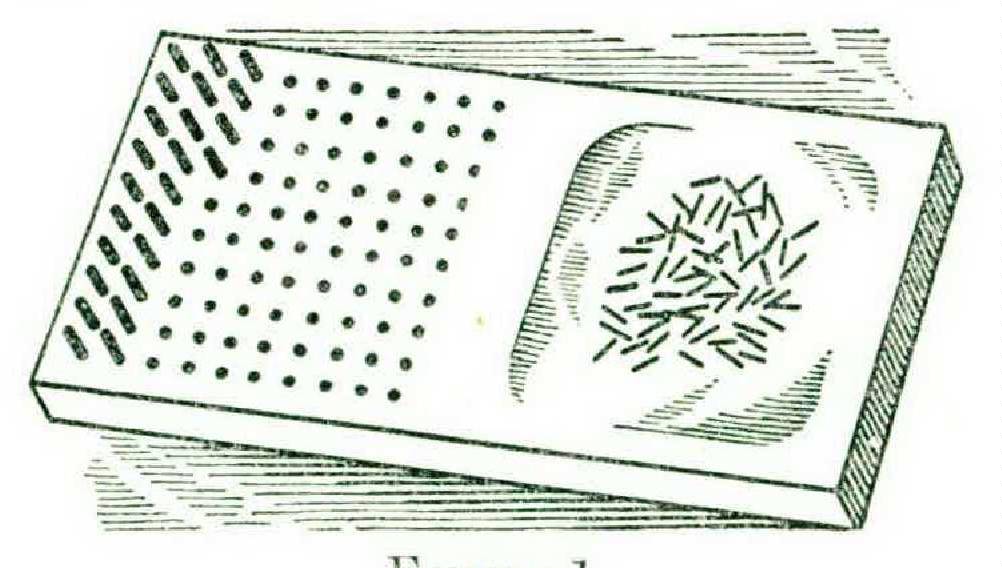
The simplest piece of apparatus, shown in Figure 1, is a board with one hundred holes drilled at one end and a shallow tray at the other. In this tray are piled three hundred small metal pins. In the course of our experimentation a thousand girls were asked to come to the laboratory, to take the pins from the tray three at a time, and to place each three pins in one of the drilled holes. Among the thousand individuals, one finished in slightly less than five minutes, another needed more than fifteen to do the same task under similar conditions. At first glance a ratio of three to one—the slowest three times as long as the fastest — seems a small difference to find among a thousand persons, but compare this with the contrasts in such a familiar physical characteristic as height. A man five feet tall walking with another six feet two or three attracts instant attention. No normal man is three times as tall as another. Yet in finger dexterity, an invisible characteristic, one person actually takes three times as long as another to perform the same operation under as nearly as possible similar conditions.
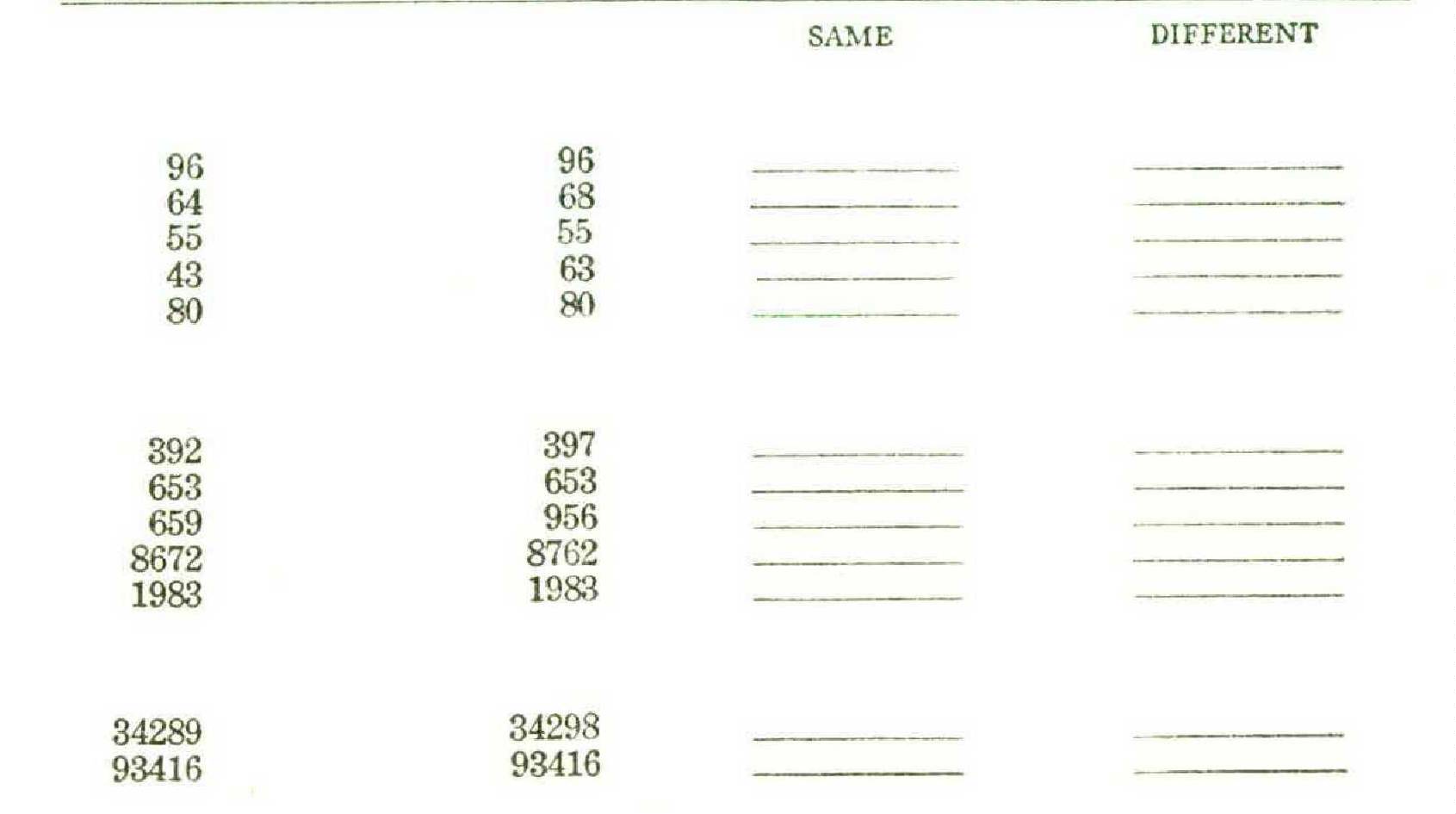
The second bit of apparatus is a paper with two columns of numbers, a part of which is shown in Figure 2. At the top, 96 and 96 are the same, and the person taking the test checks opposite them in the third column under the word ‘same.’ The next two numbers, 64 and 68, differ, and he checks in the fourth column under the heading ‘different’; and so on through the list. Among a thousand men, one finished in forty seconds, while another took three minutes. The slowest required four or five times as long as the fastest, again a contrast more striking than is shown by most familiar physical characteristics. Even five to one was not the full difference, because the man who finished in forty seconds checked correctly, whereas the one who spent three minutes made five mistakes in the process.
One continually hears of the slowbut-sure, and yet the laboratory results of the last eight or ten years show that the slow-but-sure man is almost a myth. The group who finish in less than a minute make fewer mistakes than those who take more than this time. The group who take under a minute and a half make, in turn, fewer mistakes than those who take longer. One can, of course, find exceptions, men who rush through and make mistakes and others who go slowly, carefully, and correctly; but, even including the exceptions, the fast group is accurate, the slow group inaccurate. On combining the time and the errors, the best man proves twenty to thirty times better than the poorest.
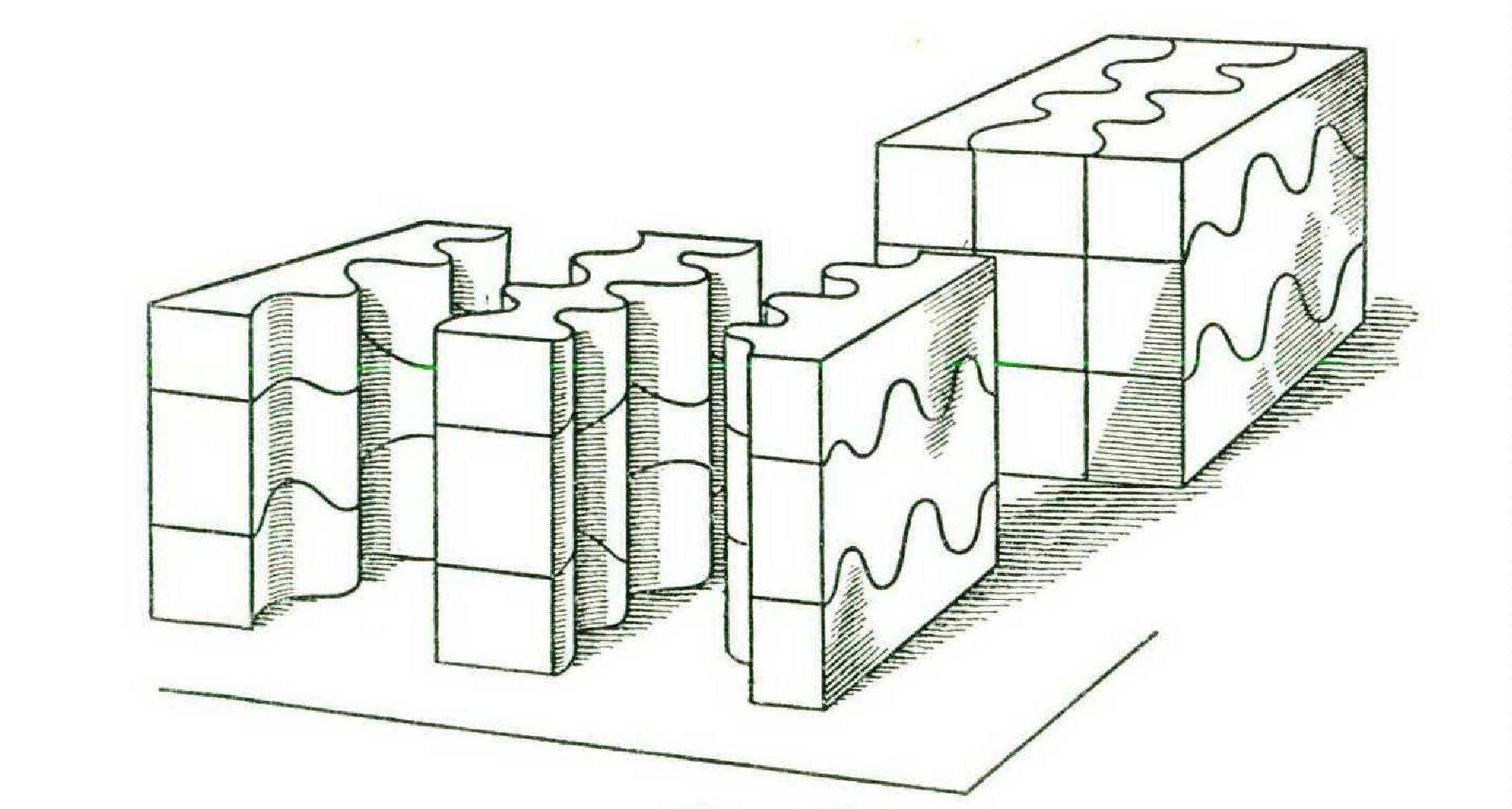
Turn to a third experiment. Two college men who came to the laboratory were shown the so-called wiggly block (Figure 3). They were told that it had been cut vertically into three piles of three blocks each, and horizontally into three layers, again of three blocks each. The nine pieces were then disassembled and mixed and the two men were asked to put them back together. One did it with no difficulty in thirtytwo seconds, an exceptionally fast time; the other worked nearly half an hour before finally succeeding. There is considerable luck in happening upon the first two blocks to fit, and in order to reduce the chance factor the blocks were mixed a second time. The fast man finished again with approximately the same speed, while the half-hour man improved, needing this time less than twenty minutes, and on a third trial not more than twelve. Still he required roughly twenty-four times as long as his companion.
II
What causes these striking differences, making some men thirty times better than others in number checking and some sixty times faster in solving a wiggly-block puzzle? It is not entirely what we ordinarily call education, because both the college men had good records in the same highstanding technical college. They had, in fact, been roommates the last two years of their course. Both had much the same home background. Yet one worked sixty times as long as the other on the wiggly block.
In this case the difference was not in education. But it is extremely difficult to recognize exactly what education does and what it fails to do. There are many variables. Occasionally a boy fails in school because he earns his way and spends on outside work the time he should devote to his studies; occasionally he lives in a home where the atmosphere is such that he cannot work efficiently; occasionally he wastes an unreasonable amount of time and energy in commuting. Rather than attempt to analyze education, turn once more to the simplest of the three bits of apparatus, to the picking up of the pins, and follow what specific training does in this case.
We asked one of the slowest girls in the pin assembly, one who required fifteen minutes, to repeat the experiment. She improved, needing on a second trial less than thirteen minutes. We then suggested that as an experiment she should try the task once a day for a week, and, finally, every day for a month. She improved steadily, and apparently, had we persisted, would have continued to improve, although the rate of improvement at the end of the month was already small.
Improvement takes place in every test with which we have experimented. The constant repetition of any task improves its performance. With the sweep of the general intelligence test through schools to-day, this ability of every man to learn is often overlooked. No one reaches the limit of his capacities, for they are boundless.
Instead of watching one individual and marveling at the amount of improvement which accompanies the repetition of any task such as assembling the pins, let us compare two persons, or rather two groups, in order to eliminate some of the individual idiosyncrasies which continually affect the study of human beings. Two groups of girls, one averaging in the neighborhood of six minutes and the other approximately half again as long, nine minutes, repeated the pin test. On second trial the nine-minute group improved, approaching eight minutes. The six-minute group also improved to about five and one-half minutes. The slow group still took half again as long as the fast.
The two groups then repeated the assembly once a day for a month. The nine-minute group improved strikingly, requiring at the end of the month not more than six minutes. The six-minute group also improved, needing only about four minutes. The initially slow group even after considerable practice was still relatively slow, the initially fast group still fast; the slow were still approximately half again as long as the fast.
This holds for many tests. Two persons given equal opportunity, equal practice, equal education, keep throughout practice much the same relationship to one another. Both improve, but the slow individual remains relatively slow, the fast relatively fast. If the slow beginner practises, and the fast one does not, the slow, of course, gradually overtakes the fast; but given equal opportunity, equal practice, the slow continues relatively slow, the fast continues relatively fast.
If parallel improvement is a general law, it is important to start each boy and girl at the particular type of work for which he is best suited. No amount of practice, no amount of training, no amount of education, will ever make the boy who starts at unsuitable work quite as successful as he would have been could he have started originally at the right type, and been allowed the same practice, the same training, and the same education.
As a first step toward helping a boy to get started in a promising direction, a set of ‘worksamples’ have been devised, each representative of a specific type of work. In a morning a boy can try a dozen such samples of a dozen varieties of work, and gain some idea, from the way in which he does each, how he is likely to succeed at the vocation represented. The board with the tray of pins at one end and the hundred holes at the other is a sample of such small, rapid, shortcycle factory work as meter or instrument building, or radio assembling. A measure of finger dexterity is not perhaps of direct interest to the reader, but, because on the border line of the physical, it appears more logical than measures of such intangible characteristics as creative imagination and executive personality, and has therefore been used to illustrate laws which are generally applicable.
The number checking is a sample of banking, of auditing, and of accounting in general; for women it represents secretarial work and the higher types of clerical work, such as typing and stenography. It measures an instinctive gift for grasping the significance of symbols.
The wiggly block is a sample of engineering. It indicates ability to visualize three-dimensional structure, and is done well by so wide a range of workers as architects, surgeons, scientists, and mechanics, all of whom work in three dimensions with concrete structures. One type of man sees a picture or blueprint as a flat surface, and only with difficulty and conscious effort visualizes in three dimensions the object portrayed; another sees instantly and easily in spatial terms. Relative assembly times in the wiggly block distinguish these two types from one another.
III
Let us use the wiggly block as an illustration this time because it is less obvious than the pins, and review step by step the development which led to its use as a yardstick. The purpose was to measure an aptitude for engineering, something which distinguishes potential engineers from men in general.
We devised a simple engineering task whose solution we felt did not involve knowledge or training, but a natural aptitude for engineering. With the meagre background which existed on which to base judgment, the selection of the sample, although ostensibly based upon reasoning, was in reality little more than a guess. A group of successful engineers, men obviously engineers regardless of the manner in which they did our particular problem, were then asked to try its solution. They did poorly — that is, no better than men in general. We had obviously erred in selecting the sample, for our subjects had proved their success in the engineering profession and the fact that they did the problem no better than did unselected groups showed that that particular task was not a fair representative sample of engineering. We therefore discarded it and devised another. Again a group of successful engineers were asked to try the task, and again they did not distinguish themselves from the mass. We had failed once more, and discarded that test.
In this way, twenty-five to thirty supposedly representative samples of engineering work were devised and tried before we ultimately stumbled upon one (the wiggly block) which 85 per cent of the engineers of known success who tried it did better than men in general. Speed in performing this mechanical, objective measure segregates engineers of known success from men in general.
A further step is essential. The successful engineers may have done well because of training, because of experience, — they were all trained, experienced men, — or they may have done well because of a flair for engineering, an instinctive feeling for the work. We needed to make certain that we were measuring aptitude, a gift, and not merely such acquired training or experience as any boy might gain in either a technical college or an engineering position.
The next step, therefore, was to measure with this same test a group of boys with no engineering background, no previous engineering training. We did this eight years ago, and at that time graded nearly a thousand boys A, B, C, or D, — A representing the best 25 per cent and D the poorest, — and have since followed as far as possible their various successes and failures. Of each one hundred boys who eight years ago graded A on the wiggly-block assembly, between sixty and eighty, an average in the neighborhood of seventy, are to-day earning their living at some type of engineering; of each one hundred who eight years ago graded B, approximately thirty are to-day earning their living at engineering; of each one hundred who eight years ago graded C, about ten are to-day earning their living at engineering; and of each one hundred who graded D, only two or three are to-day in engineering.
We have now measured enough hundreds to know that these chances carry over from one hundred to another, repeating themselves with reasonable accuracy, so that to-day when a boy grades D we cannot say that he will never become a successful engineer, for the two or three D boys in a hundred are apparently as successful as are the seventy A’s. We can, however, say that his chances in engineering are not as good as in a type of work where he grades A. In all probability we shall never be justified in saying autocratically to any boy, ‘You should be an engineer,’ or to another, ‘You should not.’ We can say, ‘Your chances in engineering are better than in accounting, or selling, or executive work.’
Even though a boy makes no use of the actual statistical results, the mere fact that he tries a group of worksamples makes him realize that there are diverse opportunities and that he should analyze his own future more carefully than do most boys before selecting one vocation in preference to another. Too many drift into jobs with no real thought as to whether or not they are entering an occupation for which they are naturally well fitted.
The care with which a representative sample of work must be selected cannot be overemphasized. Psychological tests are apt to do more harm than good, partly because they are so easily applied dictatorially to restrict a boy’s aspirations and limit his future, and partly because so many are used without sufficient proof of validity, used often with unwarranted confidence because they look as if they ought to work.
There is a standard well-recognized test for memory, a characteristic which should be easy to measure. Read to the subject three digits, 597, and ask him to repeat. If he succeeds, read four, 6823; and so on until he fails. Obviously a good memory should enable one to repeat a large number of digits. Nevertheless, when this test was actually tried, a surprising difficulty materialized.
In a manufacturing plant where it is customary to deliver the week’s pay in individual envelopes with each worker’s designating number — such, for instance, as 35015 — printed on the outside, a block of four hundred of the numbers were changed. The paymaster, who had learned the numbers after years of association, gave out the revised envelopes with no hesitation.
I personally saw him give out over a hundred and ask the new number only twice to check his memory. He remembered four hundred numbers with sufficient confidence to risk paying money on the strength of his recollection.
Here was a remarkable memory with which to experiment, and, having made a set of numbers running to twenty digits, I asked the paymaster to try them. I read 597, and he repeated 597. I read 6823; he repeated 6283. Apparently he could not repeat four digits accurately. At his suggestion I wrote the numbers instead of reading them and found that he could repeat seven but not eight. I, with no comparable memory, could also repeat seven. Finally, after experimenting together at intervals for over a year, we stumbled on a technique which showed sharply the difference between us. I exhibited for a second a printed number of six digits and then took it away. After allowing him ten seconds to fix it in his mind, I showed another six-figure number, and then another, and another, until he had seen eight such six-figure numbers, He repeated seven of the eight numbers, while I could remember only the last, the one just seen.
We might have reasoned that a paymaster needs an excellent memory; that the standard test obviously measures memory; and, putting the two together, might have advised the youngster who did poorly in the standard memory test never to enter pay-office work. Such advice would have been wholly unwarranted. Every test must be checked with the utmost care, first with men of known success, and second by predicting the futures of boys and then following them to see what percentage of the predictions come true.
Ninety-nine per cent of the tests which we have tried do not meet these two criteria. And even the one in a hundred which does is not infallible and must be used with constantly tempered judgment in pointing out to boys promising possibilities which they have perhaps not considered, and in warning them of difficulties which they may encounter and should be prepared to overcome.
IV
Thirty industries are now using the measures described in this article, sometimes as an aid in placing an applicant at the type of work for which he or she is best fitted, sometimes in transferring an employee from one position to another, sometimes as a guide in reassigning a worker who is failing. A distinct failure can often be turned into a success by transfer to carefully selected work, but few industries feel justified in spending two or three hours individually with the normal man in studying his peculiar problems and giving him individual vocational advice.
In addition to this industrial testing, approximately fifty schools are applying these methods to exceptional cases, to boys and girls who are especially outstanding, to the one-sided, and to the backward child. The real problem of the normal boy or girl is hardly touched, for most schools wish to test groups of ten or twenty or one hundred at a time and do not ordinarily feel warranted in devoting two or three hours to the individual.
For some time there has been need of a laboratory where any normal boy or girl can have full benefit of modern research findings. To fill this need there are now in existence two Human Engineering Laboratories, one in Boston and another in New York, where any boy or girl can try a complete set of psychological measures under ideal conditions and have opportunity of discussing vocational problems and receiving as sound advice as it is possible for science to supply. To supplement the industrial and the school testing, and the work of the Human Engineering Laboratories, it is necessary to learn more about the measures and their exact significance. Stevens Institute has, therefore, organized a research laboratory which is attempting each year to penetrate a bit further into this unknown field.
V
The type of psychological measurement with which the reader is most familiar is probably the so-called ‘general intelligence’ test. There are as many definitions of general intelligence as there are psychologists, but beneath the diversity are three fundamentally different concepts. Intelligence may be, as the words say, truly general; it may act like the rays of a searchlight in that it can be turned upon any problem and aid in its solution. Or there may be tasks so simple that intelligence plays little or no part, in which case we must think of intelligence not as general in the broadest sense, but as limited in certain directions. Or the word ‘intelligence’ may be used in a third way, to designate a group of abilities; in this sense the larger the collection of abilities, the more intelligent is their possessor.
Consider these three possibilities in terms of the apparatus which has been pictured. If intelligence is general in the broadest sense of the word, the intelligent man should assemble the pins more rapidly than the unintelligent. He may not do it perfectly, but a truly general intelligence should aid in even so simple a task.
The same general intelligence should play its part in the number checking, and the intelligent man again should finish more quickly and more accurately than the unintelligent. We should on this assumption expect to find two groups, the intelligent group doing both pins and numbers well, and the unintelligent group doing both poorly. On actually measuring large numbers of individuals with these two tests, we find no such groupings; these two abilities, assembling pins and checking numbers, are independent of one another and scatter among men by the laws of chance.
Should we deal two playing cards to each of a number of persons, one quarter would receive two black cards each, one quarter two red cards each, and one half one black card and one red card each. The cards would fall by the laws of chance. So with these two abilities. One quarter of those whom we have tested do well in both tests, one quarter poorly in both, and one half well in one and poorly in the other.
The fact that a certain person assembles the pins rapidly tells nothing of his ability to check numbers; that he does the numbers rapidly and accurately tells nothing of his speed in assembling the pins. Intelligence is not sufficiently broad to include two such diverse tasks as assembling pins and checking numbers.
One might have drawn the same conclusion without trying the experiment, for one hardly thinks of picking up pins as of a sufficiently high intellectual level to involve intelligence. It is finger dexterity, not intelligence. Lay aside the pins, therefore, with the conclusion that intelligence, while perhaps still general, is not sufficiently broad to play a part in so simple a task.
Intelligence should aid in assembling the wiggly block, a more difficult task on distinctly a higher level. Again we should find a group of men, the intelligent group, who do both the numbers and the block well, and another, the unintelligent group, who do both poorly. And again when we try large numbers of men we find no such groups.
We might continue and divide intelligence into a number of separate and distinct parts, each independent of the others, so that a man may do exceptionally well in all but one of our tasks and yet poorly in that, or poorly in all but one and well in that. So far, we think we have isolated and studied five of these atomic mental elements; undoubtedly there are many more still to be disentangled from the tremendously complicated structure of the human mind.
It is difficult to realize how distinct abilities are, one from another. Despite the scientific evidence to the contrary, we instinctively think of men in terms of general intelligence, general characteristics. I once made this statement before a group of teachers in the western part of New York State and was instantly questioned by the superintendent of schools, who felt that he could recognize intelligence and believed that he could pick from any class the most intelligent and the most unintelligent groups. There is, of course, a middle range within which it is difficult to classify, but he knew that he could recognize the extremes. So he asked if, as an experiment, he might bring four boys to our laboratory, boys of sixteen years of age who had never been able to complete fourth-grade school work and who were, therefore, decidedly retarded. I offered willingly to test them, if he himself would try the tests first.
The next day he came to the laboratory and did exceptionally well on everything except the wiggly block, on which he spent some eighteen minutes. The following day he brought in one of the feeble-minded youngsters, who did the block instantly and easily in a minute and a half. We had him repeat the test several times and each time he did it without difficulty in remarkably fast time. I spent ten or fifteen minutes attempting to teach him to check the numbers of Figure 2. He had no notion whether two numbers were the same or different, and it was apparently impossible to give him any clear conception of the idea. The difficulty was not eyesight, for he could read the numbers aloud, but could not grasp either the significance or the importance of the paper and pencil type of task. But any problem which he could visualize in three dimensions he solved rapidly and accurately.
When we saw this boy he had been thrown year after year with younger children and had been told repeatedly that he was a failure; his whole personality had been warped out of shape and it was probably too late to do much for him. But I cannot help feeling that, could we have taken the boy years before, the first year that he failed in school work, and trained him along some mechanical line, we might have made him into a selfsupporting member of society, whereas now he is in a school for abnormal children and will probably always continue there, living at the expense of the state.
This is, of course, an extreme case, consciously selected to serve as an illustration; but almost everyone has similar outstanding characteristics which he may never have recognized. Sometimes these can be used in broadening the scope of a man’s daily work so that it taxes a larger portion of his total personality and so becomes not only more important and more valuable to the world but more interesting to him as a complete individual; sometimes they can be used as hobbies with which to broaden a man’s personal life and range of interests.
A brilliant New York engineer, who came to the Stevens Institute Human Engineering Laboratory, tried the engineering tests and did well, as he should. Then, largely for my amusement, he took a musical test and to my surprise made a perfect score, the only one I had encountered. Had he cultivated the musical side of his personality? Made use of it in any way? His answer was no. Forced to earn his own way through school and college, he had been too busy to develop his gift or his interest in music. Immediately after college he had gone to work and was again too fully occupied with other affairs. Later he married, and his wife, who is musical, naturally smiled at the thought of an engineer starting music at his stage in life. Later she herself took the test and made two errors; for a while, at least, the tables were turned.
Obviously this man should not have chosen music as a profession, for he is a brilliantly successful engineer, but could he have done something with his music as a hobby, he might have lived a fuller life, been a more interesting individual, and made a larger circle of friends than by limiting himself exclusively to engineering. Few of us develop all of our aptitudes. If these worksamples do no more than occasionally call a man’s attention to an aptitude which he might otherwise neglect, they have justified their existence and the labor expended in their standardization.
Many attempts to measure human beings have failed because they have treated the individual as a machine, dealt with him cold-bloodedly. They have arranged boys on an arbitrary intelligence scale running from zero at the bottom to one hundred at the top in such a way that everyone, except the one top individual, is discouraged, made to feel inferior to someone else.
The application of science to the study of man must be inspiring, not disheartening, strengthening, not weakening; must aim first to prove to each individual that he possesses a unique combination of abilities, one which the world has perhaps never seen before, and one which he can use to new purposes, to create new things, new thoughts; and, having convinced him of his own strengths, must then show him in what practical, concrete ways he can best use his particular combination of characteristics.