Three Sentinels of the North
I
THERE are more than three sentinels in all. Ten states of the Federal Union actually touch the land border of Canada, but we are here concerned with three of them only, — Maine, New Hampshire, and Vermont, — the highland states of New England which guard the eastern end of more than three thousand miles of national boundary.
A certain degree of individuality attaches to the older states — in particular to the original thirteen. But of all the sentinels on our northern border from east to west, — with the exception of New York, — the north-country New England trio have the most varied and interesting history.
Nearly a century and a half has elapsed since these three states were made the easternmost sentinels of the young Republic. Within this period state after state has taken its place in the Union. But what of the three sentinels themselves? In the importance of that which is guarded, it sometimes happens that the outposts are forgotten.
As a matter of fact, north-country New England is progressing too slowly. These areas are primarily agricultural, but agriculture is languishing, and manufactures, never extensive for obvious reasons of remoteness from markets and raw materials, are not showing satisfactory increase. These border states are a mountain country, a land of wonderful charm in summer and of biting cold in winter. Life is hard, and there are few natural advantages to tempt modern settlers. The north country requires for citizens strong, patient men and women, willing to live frugally and, like their forbears, ready to face hardships. To the modern American, the attraction is small. Yet here they are, three sovereign states of the Union, of noblest tradition and finest citizenship, increasing slowly in resources and either declining in population or stationary, while sister states advance in wealth and numbers. What can be done to increase progress?
All New England comprises but sixty-six thousand square miles of land and water — relatively a small area. Nineteen states of the Union have each a larger area than Maine, New Hampshire, Vermont, Massachusetts, Rhode Island, and Connecticut combined. The average area for the New England group is eleven thousand square miles, and that average applied to our national domain would produce nearly three hundred states.
The division of New England into colonies and then into states came about through haphazard apportionments of a vaguely known wilderness by the government of Great Britain during the seventeenth and early eighteenth centuries. It was thus extremely arbitrary. Of the total area, the three highland states absorb nearly five sixths, but they contribute only about one fifth of the inhabitants. A sparse population in the north country, of about a million and a half, is scattered over more than fifty thousand square miles. But in the three lowland states, nearly six millions of people are crowded into an area of approximately fourteen thousand square miles.
This contrast has been growing more marked. A century ago, the three north-country states contributed about half of the population of New England. Half a century ago — 1870 — the proportion had fallen to one third, and in 1920 stood at one fifth.1 Thus lower New England has kept pace with population increase in the nation, but the north-country states have lagged far behind. Of the eight instances in which states have returned a decrease in population at a federal census, Maine, New Hampshire and Vermont have made each one contribution.2
The population of these states increased during the last census-decade less than thirty-five thousand, or a little more than two per cent. But the three lowland states recorded an increase of sixteen per cent, or, in absolute figures, twenty-three times the number of persons represented by the increase shown by the highland states.
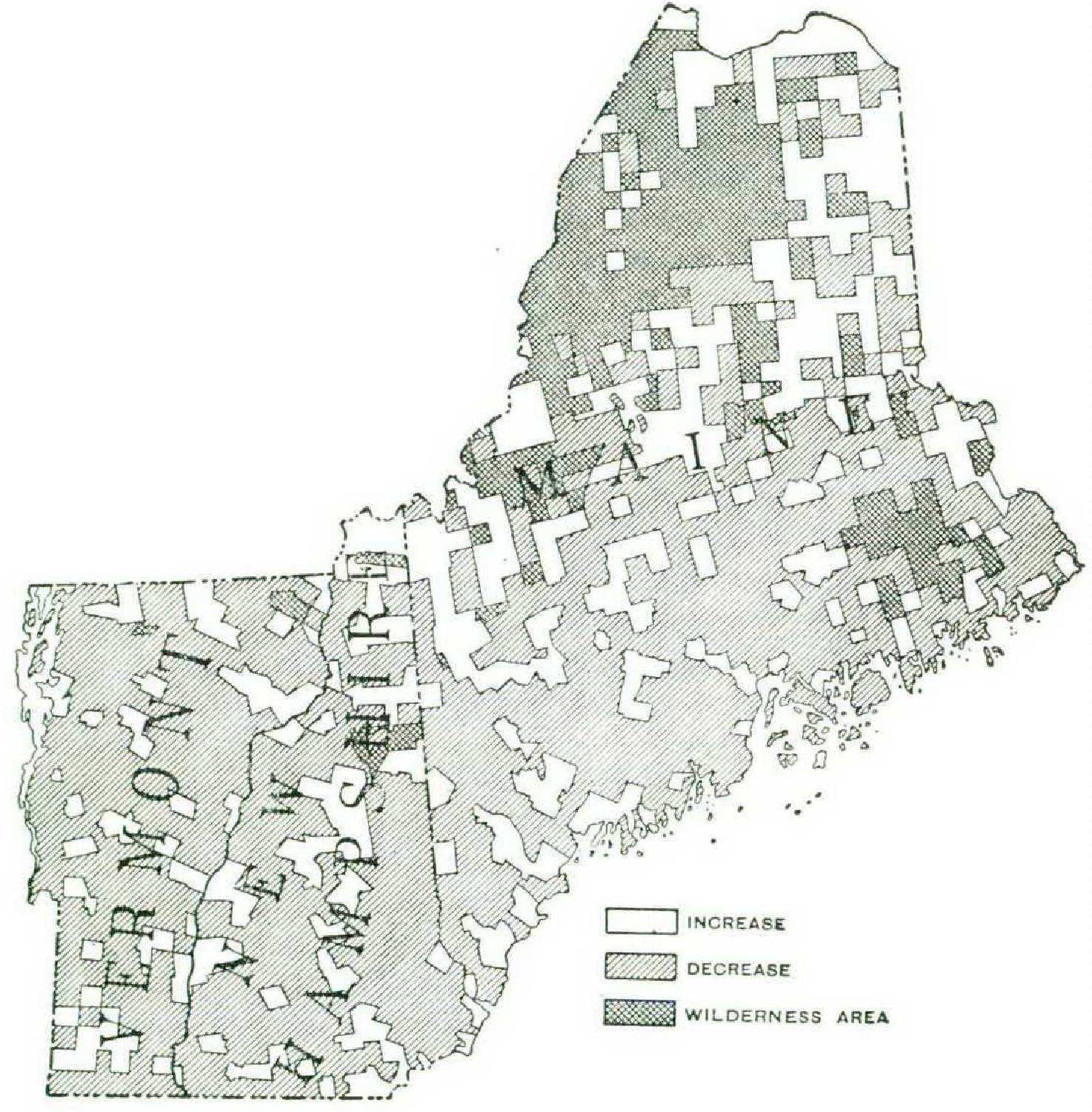
In New England, counties offer a poor standard by which to observe population changes. They usually include geographic areas differing widely in contour, resources, and accessibility, and, in the north-country states, the average county is unusually large. Nevertheless, of the forty counties which Maine, New Hampshire, and Vermont together contain, eighteen decreased in population at the last census.
In these three states there are 1211 cities and organized minor civil geographic divisions known as towns. Of these, two thirds returned decreased population in 1920. In many of these communities population has decreased uninterruptedly for many decades. Very small communities tend to decline; the proportion of towns decreasing in population grows less as the group-standard becomes higher. This of course is consistent with the national tendency to drift front distinctly rural communities to larger places.
In 1870 there were but two cities having more than twenty thousand inhabitants in all the north country. In the three lower states there were thirteen. Half a century later, the three northern states could claim but seven, while the number in Massachusetts, Rhode Island, and Connecticut had swelled to fifty-one.
Here the real significance of the north-country problem begins to appear. Increase in the United States during the past half-century has been principally urban. The distinctly rural element, — the isolated farm family and the crossroads hamlet, — in most sections of the country and especially in New England, has shown decrease more frequently than it has shown increase, and most of the growth in state population has been derived from cities and large towns. For example, in 1920, in the trio of growing South New England states, cities of 25,000 or more aggregated 3,700,000 population. These places, half a century earlier, returned less than a million inhabitants. In the northern trio the five corresponding cities increased from an aggregate of 100,000 inhabitants to about 230,000, a very small increase, and yet these five communities contributed nearly half of all the half-century increase shown by the highland states.
In all New England there were 156,000 farms in 1920, but that number was 32,000 less than were counted ten years earlier, a shrinkage of 20 per cent. Of this striking loss, the northcountry states contributed 22,000 farms and 21,000 farmers. Naturally, land in farm areas, when no longer classified as separate farms, if not lost to cultivation, must have been consolidated with land in going farms. Does the shrinkage reported at the last census merely mean that farm units grow less in number but become larger in average acreage? In 1910 the average size of farms in the three states bordering Canada was 118 acres; in 1920, 125 acres. This small increase accounts for but 685,000 acres, or less than one third of all the shrinkage reported. Similarly, the improved land in farms showed an average gain of but three acres. This accounted for less than 300,000 acres, and that was but half of the shrinkage in improved land. Thus the north-country states, largely depending on agriculture, sustained in the brief period of ten years the loss of one fifth of all farms; one million acres of land previously included in farms as farm land lapsed in 1920 into ‘unclassified’ or woodland, and 300,000 acres of improved farm land disappeared completely from that desirable class.
The apparent increase in the value of all farm property in the United States from 1910 to 1920 — the war decade — was approximately 90 per cent, but in north-country New England the corresponding rate of increase in values was less than one third of the national rate of increase. The increase in value of all farm crops produced by the nation, as shown at the last census, was 182 per cent. For northern New England it was 148 per cent.
Maine, New Hampshire, and Vermont, together have large industrial interests, but they returned value of manufactured products amounting to but one sixth of the aggregate value of products of the southern group. This combined value of products in 1919 was much less than that of Connecticut alone. Connecticut, in fact, increased in value of products, during the five-year period from 1914 to 1919, 155 per cent, while the north country per cent of increase was considerably less. In fact, at the north-country rate of increase, the value of Connecticut’s vast manufactured product, as returned in 1919, would have been less by $170,000,000.
The census returns of manufactures merely confirm what is obvious to every observer — that the northern mountain states are not so well adapted to general industrial expansion as the lower states, which are more accessible, have better rail facilities and a slightly milder climate. This is a period of greater conformity to economic laws and less attention to individual initiative and ingenuity.
Of far greater importance is the human side, for a mountain country generally breeds men. And it is here that the north-country states thus far present a conspicuous contrast to the changes which have been in progress in the three lower New England states.
Seventy years ago, — in 1850, — in Maine, New Hampshire, and Vermont combined, the native white element contributed 928 persons out of every 1000 of the population, to 70 persons of foreign birth or parentage. In 1920 this high proportion of native stock had dropped to 612, and the foreign element had increased to 385. The native element thus continued to contribute the greater part — almost two thirds — of the entire population. In the southern New England group, on the other hand, the change in seventy years was almost revolutionary. In 1850 the native white element contributed 816 persons out of every 1000, to 170 contributed by the foreign-born and their children; but in 1920 the proportion of the native white element in each thousand inhabitants had decreased to 367, and that of the foreign element had advanced to 619.
Between the two sections of New England, therefore, it has come about that a remarkable contrast has been set up. In the north, almost two thirds of the population is of old native New England blood, and one third of various foreign nationalities — FrenchCanadian predominating; while in the southern group the native element now contributes about one third of the population, and the foreign element — composed of all nationalities — about two thirds.
In this group of states, the native white stock, from well-nigh complete dominance seventy years ago, is now on the way to submergence.
Half a million natives of the three north-country states, nearly one third of all persons born in those states, no longer reside in the state of their birth. The proportion of natives living elsewhere is thus almost one out of every three. The census enumerator finds the natives of the three border states in large numbers in every other state in the Union, from nearly 1000 in Nevada, feeblest of states, to 41,000 in New York, leader in population and wealth. On the other hand, only one in six of all the whites born in the southern New England states have left the home state to reside elsewhere. While the lower states have succeeded in keeping their sons and daughters for the most part at home, Maine, New Hampshire, and Vermont have been giving their most precious possession to the upbuilding of all the other states in the Union. The net loss to the northern trio through interstate migration was 300,000, while the lower group was making a net gain, by the same process, of 125,000.
II
Thus far, consideration as a whole of the problems of the north-country states has permitted rapid and striking comparisons. The states adjoin each other. They resemble each other in location, topography, climate, and population, and consequently many of their public problems are similar. Nevertheless, each state is jealous of its individuality, since each possesses a stirring historic past. Therefore no study of this kind would be complete if confined exclusively to a group analysis.
Beginning with the northeastern coast of Maine and swinging westward to New York, the three sentinel states are, in general, highland areas. Maine, with half of all New England within her boundaries, is primarily a state of mountains, lakes, and forests comprising nearly two thirds of the entire area, or about 20,000 square miles, while all land in farms amounts to a little less than one third, or about 10,000 square miles. This is a far lower proportion of land in farms than that shown for the United States as a whole. In fact, there are but six states in the Union which exceed Maine in proportion of land not in farms.3 Of these Florida alone is even remotely comparable. Hence Maine, considered from its geographic extent of agriculture, has made less progress than any other state in the Union. The settled area is in the southeast, follows the coast, and turns westward about midway in the state. Five of the eight coast counties, extending from the New Brunswick line along two thirds of the Atlantic frontage, decreased at the last census. Two of these counties have been reporting decrease decennially for seventy years, and two for forty years. Since 1860 the inhabitants of these counties have decreased 25 per cent. All other Maine counties show increases, but the sinister fact remains that, in fifteen of the sixteen counties, a majority of the towns reported decreased population. The eight cities having in excess of 13,000 population in 1920 furnished all the state’s increase and contributed an excess of 3000 applicable on the net loss of population returned by the smaller towns.
In the number of persons of native stock, Maine has remained stationary for three censuses. Hence 60,000, or about all, of the state’s entire twenty-year increase was contributed by the foreign element (mostly Canadian) and principally by the second generation. Maine is a state of wonderful natural beauty. It is preëminently the summer vacation land of the nation. It has extensive fisheries, large manufacturing interests, unusual agricultural possibilities, — such as the Aroostook potato region, — great timber reserves, and some mineral resources; but the plain fact remains that progress for this faithful sentinel in the far northeast is discouragingly slow.
To the southwest, following the dip in the boundary, lies New Hampshire, somewhat more ruggedly mountainous; but, like Maine, it is a vacation state, and shares with Maine the tendency to mix the care of summer visitors, agriculture of a small and desultory sort, and manufacturing — in some instances on a large scale — as the state’s sources of prosperity. Decreasing population in New Hampshire in 1920 was shown by half of the ten counties, mostly midland; but in nine of them, towns decreasing in population formed a large majority. Out of 251 towns and cities, 179 decreased in population. The combined increase reported by the four cities having over 15,000 inhabitants amounted to slightly more than the entire state’s decennial increase in population. Here again, as in the case of Maine, climate, location, emigration, rather unencouraging soil, and comparatively little economic reason for industrial growth, tend to hold down increase in numbers and resources. Since 1900 the state has lost about seven per cent of the native white stock, but has increased 31,000 in population. The loss was made up and the increase contributed by the children of foreign-born. Again, the majority of the foreign-born are French Canadians.
Farthest west of the trio of border states lies Vermont. — in some respects presenting the most unique history of any commonwealth in the Union. At the outbreak of the Revolution what is now Vermont was an unnamed wilderness, containing scattered settlements, and claimed by the three bordering colonies, New Hampshire, Massachusetts, and New York. The people of Vermont achieved a wonderful record. Treated with extreme injustice by their neighbors, the subject of political intrigue in the Continental Congress, appealed to by Great Britain, — with offers in return for allegiance so tempting that, had such concessions been made earlier to the entire group of colonies, the Revolution might not have occurred, — nevertheless the citizens of Vermont stood firm. They sided with their blood brothers in the effort to secure freedom, but were even more resolutely determined not to yield their own. The close of the Revolution found this area an independent state which finally, by negotiation, entered the Union.
With this background the people of Vermont have been singularly independent and intelligent throughout their history. They have been an agricultural people, and have withstood to a large degree the great wave of industrial growth which swept over New England after 1850. It is a state of small communities, with practically no cities; a land of mountains, of irregular valleys, rushing streams, and deep lakes. The soil in general is rich. Drawbacks to cultivation are due principally to the hilly country. In consequence of these conditions, life has been hard and there has been a continuous drain of sturdy and self-respecting population to other and more favored areas.
The state itself decreased in population slightly from 1910 to 1920. Of the 241 towns, 129 reached maximum population before 1850, consequently, within the last seventy years, only a minority of the towns have recorded their largest number of inhabitants. Nearly three fourths of the entire number showed decrease at the last census. Outside of the ten large towns and cities, the population was smaller by 30,000 than in 1850. On these ten communities, therefore, fell the burden of making good this loss and of furnishing the net increase of 40,000 which occurred in seventy years.
Agriculture has felt the effect of the immense competition of the West and South. Transportation facilities have been poor, and little by little it has become more difficult, for the small farms having miscellaneous crops to stand up against competition, and hence for their owners to wrest a living from the soil. This has tended to create a vague discouragement in the smaller communities and to accentuate the problem, so general throughout the country, of maintaining successfully the rural element against the increasing lure of urban life.
The absence of large towns and cities makes it almost certain that the discontented boy or girl citizen in the small community, having decided to move, will keep on across the state’s border to larger communities outside. In Maine, Portland stands for much to the state as an urban centre. The first tendency is to drift in that direction. In New Hampshire, Manchester, largest of the cities north of Boston, and several other smaller and somewhat industrial cities, offer at least a reasonable attraction to the intending emigrant; but in Vermont the tendency is to push down the Connecticut Valley even as their forbears a century ago pushed up, and perhaps land in Springfield or New York, or, following the eastern channels, land at once in Boston.
There is, of course, a considerable manufacturing industry in the state, but Vermont, by its training and its traditions, is not an industrial state.
But if the foregoing comparisons reveal in some instances striking differences in growth or in composition of population between northern and southern New England, it must not be supposed that the ‘three sentinels of the north’ are seeking, or would accept, sympathy or aid.
They are, however, for economic and other reasons, obviously lagging a little behind in the federal march of progress, and having sketched the condition it remains to consider the problem itself and possible methods of solving it.
III
Briefly stated, it is the old problem of country against city, under conditions especially unfavorable to the rural side. In northern New England many of the villages, from the standpoint of our time, ought not to have been settled. Many an isolated farm has no reason for existence. Yet village and farm are still more or less maintained. Thus, economically, the small north-country town has a struggle to survive. It is a pathetic struggle. Numbers at best are few, fewer still are the really capable citizens. At the rumored departure of one more, perhaps a community standby, a feeling of hopelessness strikes into the hearts of those who remain, and a pall of apathy and inefficiency tends slowly to settle over the small declining community, its church, and its activities.
This is not the soil from which spring enterprise and successful ventures, and it is to this depreciation of the town, the basic unit, more than to anything else, that the prevailing tendency to stagnation in population, agriculture, and business is due. Under this influence it is forgotten that times have changed, and that methods of business and marketing may require radical readjustment to make them newly effective. More than that, so far has degeneration of energy and real business sense progressed in nearly all the small communities, that to-day revival of activity and an attempt to induce prosperity and growth means that there first must be systematic instruction in the rudiments of doing things well and quickly. The stock is there, but the ability, once so alert to business, has now tended to become latent, and to be utilized in this period, inspiration and instruction are first needed.
In any attempt to improve population conditions in the north-country states and to transform stagnation or decline of enterprise into progress, obviously effort must concentrate upon reduction of emigration and upon increase of opportunity to earn a reasonable living. Can these two essential objectives be even partially attained?
Every community is composed of two general classes of citizens — those of the more alert and energetic type, and those who tend to be sluggish and ineffective. The progress and prosperity of town, city, and state depend mainly upon the proportion of the former element to the entire citizenship. If it is low, stagnation or decline is usually inevitable.
From the north-country states for many years there has been a continuous drain to large cities and the West, of persons mostly in the most fruitful period of life. These losses have been drawn almost exclusively from the stronger element, — since the mere act of emigration requires both energy and ambition, — leaving a lessened proportion of that element. On the other hand, the poorer element, seldom reduced by departures, has tended steadily to increase in numbers by breeding down.
Here is the basic cause of the clear present tendency to stagnation. Northern New England, rural New York, and all other rural areas can never advance while the drain of the community’s life-blood is in progress.
No serious attempt appears ever to have been made in Maine, New Hampshire, and Vermont to keep the discontented at home. Departures have come to be sadly accepted as inevitable, and in consequence these three states are, to an increasing degree, mere breeding-grounds to aid other commonwealths. There may have been excuse for this in the past, with a nation to be developed by the old settled states. There is none to-day. This attitude is now merely part of a general and tragic let-down in efficiency.
What can be done to keep the young people contented and at home? At least two possible and practical methods present themselves. The first is to begin some simple and definite instruction in the public schools concerning duty and obligation to the state and community. It is no light matter in this period for parent and village to bear the cost and strain of creating, feeding, clothing, and educating boys and girls, merely to see them vanish at the earliest moment in which they can stand alone. Unquestionably this almost certain result is one of the causes of the low birth-rate. In these hard-pushed communities, where loyalty should be instinctive, the boys and girls ought to be taught to think out their future in some such way as this: ‘Before I decide to abandon the old home and state which have given me being, nursed me, and made me all I am, with no cost to me, what can I find to do here at home of real value and service to my native state? If I cannot find suitable opportunity to advance myself and serve the community, then, and then only, I must go elsewhere.’ Some such pledge should hang in every district school.
The second possible move in attempting to keep the young people at home logically deals with finding something worth while for the bright boy and girl to do. This is not an easy task in stagnant communities, but who shall say that such quests — if earnest — fail more than half the time? The proportion of failures will be even less if live organization is effected. There should be a state organization to persuade young people to remain at home, with agents in every town. Alert, inspiring men and women should conduct this organization, and the best men and women in every town should be the local representatives. It is inevitable that, as the efficiency of this organization increases, the problems that it confronts will slowly decrease, because the proportion of the efficient is slowly being raised, and the efficient create opportunity.
A British statistician, in an analysis of the cost of the Great War which appeared in the Journal of the Royal Statistical Society early in the conflict, discussed in interesting fashion the value of individual citizens to the state, and assigned a money-value to each. The amount varied from $600 for a Russian to $2000 for an Englishman. These estimates were made on a pre-war basis of values. They were of necessity entirely theoretical, but no one will be likely to dispute an advance to-day to $3500 as the per capita value of the choicest element of north-country Americans. If the three states contribute annually to other states an average of only eight young men and women per community, judged by the material money standard of value suggested, the north country is giving away each year human power worth at home no less than $35,000,000. The 300,000 persons recorded by the census as representing the net excess of emigration of native stock over immigration, piles up to the staggering total value of $1,000,000,000.
It is significant that individual experiments in attempting to check departures prove that much can be accomplished even under present adverse conditions.
IV
But what of the second problem to be solved? How shall jobs be provided sufficiently attractive to hold the young people at home? If communities are composed of two general classes of inhabitants, states likewise are composed of two corresponding classes of communities — those which progress and prosper, and those which are stagnant or declining. In the three north-country states the line is sharply drawn. With few exceptions evidences of progress and prosperity are confined to large towns and cities; the small communities chiefly are backward or actually declining. For the most part, the residents in the former group ignore, or observe with complete indifference, the embarrassments of their neighbors in the less fortunate class of communities. No thought is given by cities to the plight of the neighbor towns, no assistance planned, no systematic patronage offered. Chambers of Commerce are excellent institutions for those whom they serve, but they are supremely selfish. At the city limits, ‘boosting’ stops.
Meanwhile, the rural communities struggle to help themselves. The Grange and Farm Bureau are doing brave work in a discouraging cause. As they confront it, it is well-nigh hopeless. The farmer, especially the north-country farmer, having a small farm and limited resources, is not a business man. He has no executive ability. He has no outside connections. He has very small capital, and has lost much of his courage and confidence. What can such a class, even in combination, effect unaided in these days of big business and executive genius?
Here we reach the heart of the north-country problem. Agriculture is the prevailing calling of this class of failing communities; agriculture can do nothing alone. A new ally is needed. The prosperous element of the state must come to the aid of the weaker element. The strong men of affairs in the cities of Maine, New Hampshire, and Vermont, with resources, ability, and executive capacity, instead of ignoring the languishing communities, — possibly towns in which they themselves were reared, — and expending their resources and sympathies on the Near or Far East, no matter how worthy, should bestir themselves to aid their own blood. Genuine service begins at home.
Something can be done to increase industrial activity, especially where water-power can be developed; yet even there tragedy sometimes follows in the wake of ruthless power-corporations, which have seized land and water-rights and invaded the fields of the harassed farmer. In one instance, at least, in Vermont, a plucky farmer kept invaders from his fields only by tireless vigil with a shotgun.
The conviction cannot be escaped, however, that the future prosperity of the north country must be worked out along agricultural and lumbering lines. The other Sentinel States, stretching across the continent to the Pacific, find their prosperity primarily in fruit, grain, and dairy farming, and in lumbering. None of these states — except New York — possesses the wonderful opportunity which the northern New England states possess in having almost at their door the market afforded by the congested urban area of the nation. Fourteen millions of people in large cities are potential customers.
The first step is organization. There should be a Tri-State Association with state branches. A survey should be made, a programme formulated, and money raised. The northern New England states can be made the Denmark of America, the producers of the finest dairy and poultry products — perhaps put out under state guaranties, and laid down in their own warehouses in all large Eastern cities. Orchards can be greatly developed, and the Eastern market wrested from Far-West producers who now possess it under a handicap of three thousand miles. With brains, enthusiasm, and capital all things can be accomplished in our time. Only when the highland states are compelled to admit that these three essentials cannot be supplied, is the battle for progress surely lost. Can they meet this challenge?
In its widest aspect this is not a local New England problem. The states of the Federal Union have become so accustomed to growth and prosperity that they do not know how to meet any unfavorable signs. Yet such signs exist in many states. Rural decline is a national problem. Counties aggregating one million square miles in area — one third of the national domain — declined in population at the last census. In New York seventy-five per cent of all the cities and towns returned decreases; but New York’s vast urban resources made these changes relatively unimportant. In northern New England there are few cities to sustain the state’s prosperity, and the rural decline becomes correspondingly serious. Let the north-country states point the way to even partial success in restoring and maintaining state prosperity, and the nation will be their debtor to a vastly greater degree than by the free gift of men and women.
It has been estimated recently that summer visitors annually expend about $45,000,000 in Maine. Much of this great sum goes out of the state at once for the purchase of supplies, but the amount retained is an important part of the state’s income. In lesser degree, New Hampshire and Vermont also secure considerable revenue from the summer visitor. This source of income can easily be made to yield large increase. Economists may cynically contend that Maine, New Hampshire, and Vermont are destined ultimately to become mere winter and summer playgrounds; but no real lover of these states will ever admit that a higher and more dignified destiny may not be theirs — for the effort.
Northern New England offers vast unsettled areas, capable of supporting frugally self-respecting and hard-working families. It needs new blood of the sort not afraid of cold weather and work. The three states might wisely buy in unoccupied farm land and use it for homesteading for American immigrants or newly arriving Dutch, English, Scotch, and Scandinavian immigrants.
Wake up, northern New England! You need more people of a strong and resourceful type, not of the incoming peasant class; you need to abandon inaccessible farms and perhaps entire villages, and to improve and expand the more favored areas; you need to keep your boys and girls at home by showing them that you are doing things for them. You need to produce and sell goods and spend money, just as any large business corporation does.
Finally, there is no other project on earth with such a vast throng of advocates and salesmen. They are all members of the family. They are your sons and daughters. There ‘s a queer quality in the mountaineer. It was old a thousand years ago when the Scotch Highlander began to teach the world what loyalty meant. There is no escaping the fact that the man born in a land where he looks off at the sunrise or sunset across wide-sweeping hills and valleys, or watches the clouds break on ragged mountain-tops, is different from the dweller on the plains; and wherever you place him, he never forgets the old home. That is the Maine and New Hampshire man a thousand miles from home — it is preëminently the Vermonter.
There are 500,000 of these men and women, natives of the north-country states, earning their living elsewhere and everywhere in the United States — outside of home. Wherever they are, they will not fail you.
On a still and beautiful September morning some years ago, a freight train dragged its slow way upgrade on a northern Vermont cross-state line. On the back platform of the caboose stood an old man and a young man. The older one wore a Grand Army badge and he explained that he had been attending a reunion in Boston. ‘I live in Nebraska,’ he said; ‘moved there after the war, and went to farming.’
‘Why are you here in Vermont?’ asked the other.
‘Born in Hardwick. I had to visit the old home before I went back to Nebraska.’
‘Pretty flat out there, is n’t it?’
‘Awful fiat in my section.’
Just then the train pulled out on the hillside, and there opened up a wide expanse of tumbled hills rising on and on to a far blue horizon, and in the foreground the flaming colors of the maple groves in Vermont’s golden September.
‘When you look over your fiat acres,’ said the younger man, ‘don’t you miss the old hills of Vermont?’
The veteran turned on him almost savagely. ‘My God! I can’t shake it.
I ‘ve been thinking about that ever since I ‘ve been back here.’
Three sentinels of the north — sentinels also in the hearts of all their children! By taking thought, the north-country states can provide for themselves increasing numbers, resources, and influence. It means progress against stagnation. It requires organization, as do all great efforts in our time; but progress can be secured for the effort.
| Group | 1820 | 1870 | Increase 1820-1870 | 1920 | Increase 1870-1920 |
|---|---|---|---|---|---|
| Northern New England | 778,477 | 1,275,766 | 64% | 1,563,525 | 23% |
| Southern New England | 881,594 | 2,212,158 | 151 | 5,837,384 | 164 |