The Scandal of Euclid: A Freudian Analysis
IT is the merit of those who have been applying the psycho-analytic method to the interpretation of life, that they have gone at their work in the spirit of tight-reined enthusiasm which is the true scientific temper. Masters of an instrument that probes down to the very roots of being, they have nevertheless been content to feel their way slowly into the realities of human experience, ever measuring, testing, scanning, and rechecking, until the result finally approved can be consigned with confidence to the permanent stock of world-knowledge.
In no other field, perhaps, has the search after new meanings anti values by the light of the Freudian principle been carried on with such painstaking labor and such extraordinary restraint as in the sphere of imaginative literature. No disciple of Freud has ventured to interpret an entire literature as the precipitant of the repressed desires of a nation. For that, it is recognized, the time has not come. A great deal of preliminary spadework still remains to be done. That work is now being carried on by a rapidly growing band of devoted investigators on both sides of the ocean. Here a poem of Goethe’s, there a masterpiece of the art of the short story by Gautier or Robert Louis Stevenson, or a full-length novel by Stendhal, Balzac, or Stefanovic (who stands easily at the head of the new school of Jugo-Slav fiction), has been subjected to a minute analysis and its origins and content traced back to an infantile neurosis in the life of the author, a persistent anxiety-dream of middle childhood, or a kineto-zeugmatic sex-inhibition of early adolescence, as the case may be.
Among such pioneer studies, a place in the first rank must be assigned to Wilbur P. Birdwood’s latest contribution to applied Freudianism,1 a field in which the writer has already made his mark. Even if it were my intention to give a complete summary of Mr. Birdwood’s account of the unconscious lovelife of the great Greek geometer, the Atlantic editor’s space inhibitions would make the thing impossible. Mr. Birdwood’s subject is fairly narrow, but within its limits he delves deep, as the publishers’ net price and the charge for transmission through the mails would indicate. I shall therefore content myself with the very briefest outline of Mr. Birdwood’s thesis.
I
Our author tells us in his preface that he was impelled to a psycho-analytic investigation of Euclid by the promise of an exceptionally rich sex-content which earlier students seem oddly to have overlooked. In no writer of ancient or modern times, with the possible exception of Legendre and Wentworth & Smith, does the theme of the eternal triangle run so persistently as in the pages of Euclid, and particularly Book I, Propositions 4 to 26 inclusive. In the later books Euclid evidently makes a desperate attempt to break away from the obsession of the triangle, an obsession obviously arising out of a profound attachment developed by the geometer at the age of two for his grandmother on the father’s side, who never came to visit the child without a bagful of honeycakes and dried sunflower seeds, of which the little Euclid was inordinately fond.
I have said that the great geometer tried hard to rid himself of this haunting Triangle Complex. He took refuge in parallel lines, in quadrilaterals and the higher polygons, in circles of various diameter. He never succeeded. Regularly the-two parallel lines transversed by a third line would bring into being new triangles with their vertical angles equal. The quadrilateral would resolve itself into two triangles with the same total amount of base line and altitude. And the circle, symbol of a completely rounded existence liberated from all debilitating psychoses, became to Euclid only an enlarged obsession. Continually he would be circumscribing the circle of life around the triangle of sex, or inscribing the circle of life within the triangle of sex. He would start out blithely from the centre of the circle of life, at A, along the radii to the circumference of existence at B and C, and before he was aware of it he had drawn a chord BC connecting the two radii, and producing ABC — a triangle!
‘And more than that,’ says Mr. Birdwood. ‘ Frequently we find Euclid under the inner necessity of determining the shortest distance from the centre of his circle to the base of his sex-triangle. Euclid called it the perpendicular, but to us it is plainly the sex-transmutation of the bee-line which the infant Euclid would make for his grandmother under the spur of the Œdipus Complex, the honey-cakes, and the dried sunflower seeds.’
Such were the general memories of Euclid which impelled Mr. Birdwood to undertake an intensive examination of the Elements of Geometry, with Solutions for Teachers Only. But as a preliminary to the investigation of Euclid’s works it was essential, naturally, to study the facts of Euclid’s life, in order to establish the connection between the geometer’s psychic eruptions, inhibitions, and permanent suppressions on the one hand, and the Axioms, Definitions, Postulates, Problems, and Theorems on the other.
Now what do we know of the principal events in the life of Euclid? our author asked himself. The answer was, not a thing. As that admirable textbook of pre-Freudian science, the Encyclopœdia Britannica has it, ‘We are ignorant not only of the dates of his birth and his death, but also of his parentage, his teachers, and the residence of his early years.’ The Britannica is an expensive publication, but, as Mr. Birdwood remarks, even at two or three times the price it could not have put the case about Euclid’s life more completely.
‘With this as a basis,’ continues Mr. Birdwood, ‘are we not justified in filling in the sketch until the entire career of the great, geometer rises vividly before us? We see him born on the island of Cos in the early summer of 342 B.C. — which fact, incidentally, makes it hard to understand why he should have been so frequently confounded with another Euclid, who was born in Boeotia six hundred years earlier and attained fame as a wholesale cattle-dealer. He was born of a native mother, probably a member of the ruling family of the Delta Upsilons. His father w as a trader from Crete who, on one of his voyages, presumably in the open winter of 344 B.C., was shipwrecked on the coast of Cos, but succeeded in making his way to land carrying his mother on his shoulders. This we must assume, since we have seen that our interpretation of the later career of Euclid demands the intimate association of a paternal grandmother.
‘The boy grew up fair-haired, large for his years, but with a slight stammer which frequently accentuated his nervous react ion in the presence of the aforesaid honey-cakes. Except for the Grandmother Complex of which we catch a startling glimpse in Proposition 18, “The greater side of any triangle has the greater angle opposite to it,” the boy’s life was one of more than normal happiness. It naturally would be. The study of Greek came easily to him, and Latin, Modern History, Manual Training, and Geometry, of course, had not yet been invented. When the boy was six years old, his father perished in a raid upon the island of Cos by the Phi Beta Kappas, a pirate tribe inhabiting the adjoining mainland. His mother was carried off into captivity, but the lad and his grandmother were left behind as of doubtful commercial value. Thus the early Complex between the two was strengthened in the course of the next three years; for when the boy was nine years of age the old lady died, but not without leaving a profound impress on the future Proposition 16, “If one side of a triangle be produced, the exterior angle is greater than either of the interior opposite angles.” ’
Concerning the attachment between the lad and his grandmother, — altogether unnatural from the standpoint of present-day psycho-analysis, — the historian Archilongus has preserved the following legend. To the end of his life, — and Euclid lived to be seventy-six years, eight months and odd days old,
— the famous geometer, on the anniversary of his grandmother’s death, would refuse to meet his students, array himself in a purple robe, comb his beard with special care, sacrifice to Hermes Mathematikos, partake of no food whatever, and give himself up to contemplation. To his favorite disciple, when he questioned him on the subject, Euclid explained that he devoted that day to evoking the memory of the aged woman who, after he lost his mother, would go out every sundown into the olive groves to pick kindling for a fire, and rock the boy to sleep on her lap before the hearth. Such an exhibition by an old man of three score and ten can be explained on no other ground than a recurrence of the Œdipus Complex.
II
We are now in a position to follow the detail of Mr. Birdwood’s method, as applied to what is perhaps the best known of Euclid’s literary productions:
If two triangles have two sides of the one equal to two sides of the other, each to each, and have also the angles contained by those sides equal to one another, they also have their bases or third sides equal; and the two triangles are equal; and their other angles are equal, each to each, namely, those to which the equal sides are opposite.
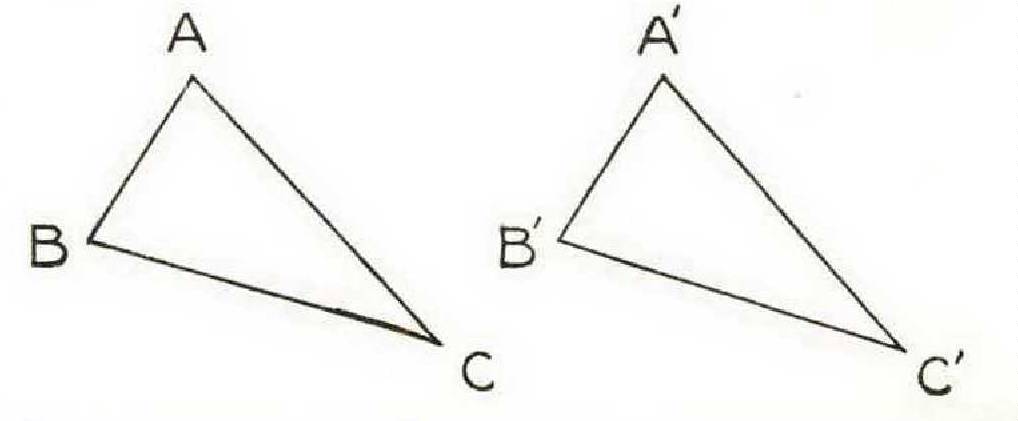
Euclid’s demonstration is a model of condensed, if somew hat dictatorial, literary expression. He says, virtually: — In the above triangles let the line AB be equal to A艂B艂, and the line AC to the line A艂C艂, and the angle BAC to the angle B艂A艂C; then will the line BC be equal to the line B艂C艂 and the two triangles will be equal in every respect.
For, superimpose the second triangle on the first. Then will the line A艂B艂 coincide with AB and the point B艂 will fall on point B. But since the angle B艂A艂C艂 is equal to the angle BAC, the line A艂C艂 will take the direction of the line AC, and point C艂 will coincide with point C.
Now, if point B艂 coincides with B and point C艂 with C, the line B艂C艂 must coincide with the line BC and the two triangles are equal in every respect.
Q. E. D.
Now the first question which arises from an examination of the preceding theorem is this: If the two figures are indeed equal in every respect, why bother with two triangles? Life is so short. Similar doubts constantly arise in the study of Euclid, as in the demonstration that any one side of a triangle is shorter than the sum of the other two sides, a truth that is obvious to every small boy with a bigger boy after him.
Our author admits the difficulty if we persist in reading Euclid in the old manner. But how if we bring psychoanalysis to bear on the subject?
Let us suppose, continues Mr. Birdwood, that the triangle ABC represents the infant Euclid’s unconscious and exaggerated emotional reactions to his grandmother, and the triangle A’B’C’ is the resultant emotional expression of his later life. In the infant triangle, ABC, point A would be the child Euclid catching sight of his grandmother coming in with the honey-cakes at the front door B, or with the sunflower seeds through the back garden C. Then the line BC would represent the locus or base of the child’s inordinate appetite.
What follows is simple. In the adult sex-triangle A艂B′C艂, the aged Euclid sets out from the same point, A’, himself, and goes on thinking along the line A艂艂 until the ancient inhibition brings him to a stop at B艂, the honey-cakes. Or, if he starts out in another direction, the permanent angle given to his infant soul by his grandmother impels him along the line A艂C艂 till the same inhibition brings him to a stop at the point C艂, the dried sunflower seeds. Thus the line A艂C艂, representing the neural life of a mature scientist, is predetermined along the old honey-cake-dried-sunflower-seed line, AC. Euclid, of course, thought he was inventing Geometry. Actually he was rehearsing a vivid anxiety-dream of his childhood.
And all through the books of Euclid, when we find it demonstrated that ABCDXWJZ is equal in every respect to A艂B艂C艂D艂X艂W艂J艂Z艂, we are only in the presence of a phenomenon technically described, for obvious reasons, as the Przemysl Complex.
I have cited but a single theorem to illustrate the infinite concentration and the sympathetic insight which Mr. Bird wood has brought to the study of Euclid the Elemental Amorist. In order to seize the full sweep of the argument, the reader must be referred to the book itself. He will there find the analysis of Euclid’s other preoccupations. There are, for example, the straight lines that never meet, so aptly characterized by the author as the ‘deadly parallel,’ and traced back without difficulty to the long walks which the infant Euclid used to take with his grandmother, hand in hand. A separate chapter is devoted to the bisection, or, as our author prefers to call it, the bisexualizing, of angles; resulting, not as Euclid puts it, into two equal halves, but in a better half and the other kind. From whatever angle Mr. Bird wood approaches the subject, acutely, or obtusely, or just perpendicularly, the sexpredominance at once leaps forth.
Another chapter has to do with the triangle having two of its sides equal, commonly known as an isosceles triangle, but by Mr. Birdwood described as the homosexual triangle.
Nor need I do more than make the briefest reference to our author’s analysis of the connection between Euclid’s infant day-dreams and the highly personal Euclidean literary style. Given a childhood full of suppressions, and it is easy to understand the sharp kick-back in later years to a dogmatic, fingerpointing literary manner, with its ‘Let this be A and B,’ or ‘Draw a line from C to D,’ its ‘nows’ and ‘thens’ and ‘therefores’ and ‘Q. E. D.’s.’ Our author has confined himself to the first five books of Euclid, but he pauses a moment to point out what rich fields of study lie in the later books. ‘If,’ he says, ‘in the Euclidean Plane Geometry we find the transfigurement of a child’s day-dreams, in the Solid Geometry we enter the domain of nightmare.’
III
No appraisal of Mr. Birdwood’s contribution to the sum of human knowledge would be complete without a few words on Part III of his book, which deals exclusively with Euclid, Book I, Proposition 5, ‘If two sides of a triangle are equal, then the angles opposite these sides are equal.’ In the history of mathematics, this celebrated Proposition has come to be known as t he Pons Asinorum, the Bridge of Asses, and the common explanation has been that at this point in the development of the Euclidean geometry, the dull-witted scholar usually balks and cannot or will not cross.
This matter-of-fact interpretation is rejected out of hand by our author. He finds instead that both the thing described, namely the triangle with two equal sides, and the descriptive epithet, the Bridge of Asses, are rich in sex-significance. He proceeds to show that both Bridge and Ass have always borne an esoteric connotation, if you know what I mean. The Bridge has obvious reference to the transition period from childhood to early adolescence, coinciding with the eighth grade in the elementary school and the first semester in high school, at which time the modern school-child passes from the consideration of arithmetical square root, ratio and proportion, and practical problems in cementing floors and papering walls at so much a square yard (excluding the windows), to the first principles of Euclid. The Pons Asinorum would thus fall very near the period in which childhood, passing into youth, is filled with the vague hesitations and perplexities to which psycho-analysis has given us the key. Mr. Birdwood finds the same meaning in ‘The Bridge of Sighs,’ and ‘I Stood on the Bridge at Midnight,’ with which children at this stage are in the habit of afflicting their elders; but he refuses to go with the extremists who discern the same significance in the much earlier ‘London Bridge is Falling Down.’
As for the Ass, that familiar animal has in all ages and all climes been the symbol of eroticism, together with the Bird, the Cat, the Donkey, the Eagle, the Fur-bearing Seal, the Giraffe, the Hyena, the Irrawaddy Woodpecker, the Jaguar, the Kangaroo, the Llama, the Mesopotamian Fishhawk, the Narghili, the Ox, the Penguin, the Quadriga, the Rhinoceros, the Swan, the Tourniquet, the Uganda, the Vituperative Buzzard, the Weasel, the Xingu, the Yuban, and the Zebra.
From this general consideration our author goes on to an examination of a number of the most famous erotic Asses in history. Out of a long list we can quote only two: Balaam’s Ass and t he celebrated Ass of Buridan. In the earlier case the Biblical student will recall how the Ass, representing primitive instinct, was immediately aware of the angel blocking the road, while its rider Balaam, representing conscious pride of intellect, remained in dangerous ignorance. First the Ass turned aside into a field, then it crushed Balaam’s foot against the wall, then it fell prostrate in the road. Meanwhile, Balaam wit h his heavy staff was cruelly engaged in repressing the Ass’s desires, until the inevitable neurotic discharge occurred: the mouth of the Ass was opened, and it addressed its master in a few wellchosen words with which we are not particularly concerned. The significant fact is that the Ass did break into speech.
There is a difference of opinion whether the celebrated French philosopher Buridan actually did make use of the famous parable of the Ass, or whether the Ass was, so to speak, saddled on him by his enemies. At any rate, Buridan is supposed to have illustrated the paralysis of the human will when confronted with two equally powerful motives by the example of an Ass permanently immobilized between two equidistant bales of hay. Mr. Birdwood asserts that this story of an Ass dying of hunger without choosing either bale of hay is beyond doubt the most extraordinary case of repressed desire on record. But he takes the death of the animal only in a symbolic sense. His own belief is that the prolonged inhibition must have ultimately resolved itself into a neurosis, though he does not venture to say what particular form the nervous discharge assumed. Probably the Ass wrote a book.
- Sex-Elements in the First Five Books of Euclid. New York: Wilkins & MacNab. $2.60 net; postage 18 cents.↩