Mauna Loa, 1916
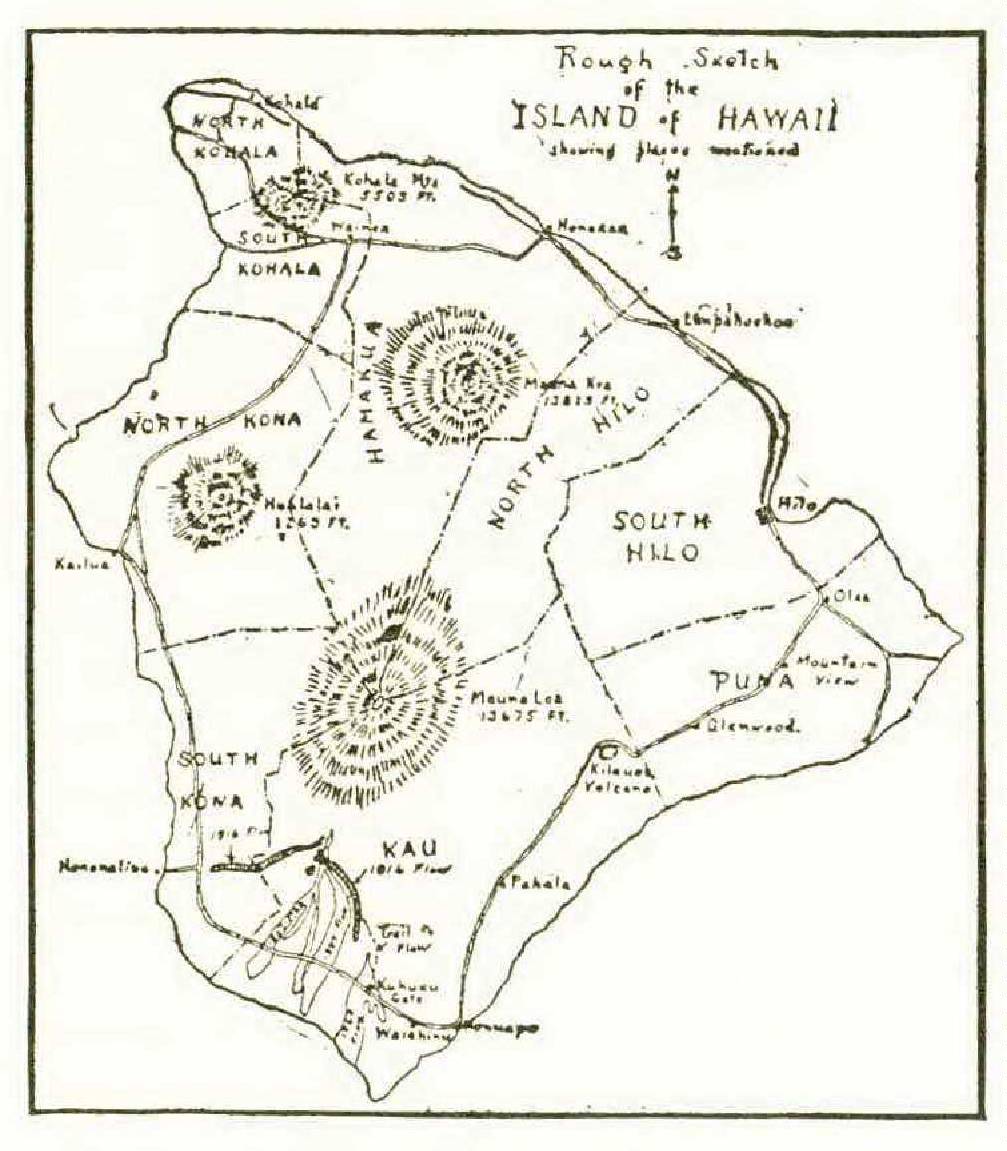
I WAS on my return to Hilo from an inspection trip to Kohala. It had been a hard ride over the mountains that morning, raining hard most of the twenty-five miles, and the wind blowing a regular gale. As I drew up in front of the little hotel in Waimea to fill my faithful steed with the necessary gasoline and water, and also to pick up my sergeant instructor, whom I had left there on my way over to the north coast, a crowd of people were talking excitedly, and I concluded that something out of the ordinary was up. I was right, for one of the crowd came over and said, ‘Mauna Loa’s in eruption.’ The expected had happened, and Pele 1 was once again on the rampage. In answer to my question as to the location of the flow, each had a different story to tell. One, that the flow had already come down from the mountainside and crossed the government road near Kailua, North Kona. Another, that the flow was farther south, and was nearing Honomalino, South Kona. Another, that both these were wrong, and the flow would cross the road somewhere near Waiahinu, Kau.
I concluded that nobody knew much about it, and that the best thing to be done, if I wanted to see the flow, was to open the throttle and make for Hilo, sixty-five miles away. Once there, I expected to get something definite; so off we started. The less said about this part of the trip, the better; but at four o’clock I drew up at my house in Hilo, having come the sixty-five miles in about four and a half hours. That does not sound like speeding, does it? But try to travel stretches of that road between Honokaa and Laupahoehoe, where five miles an hour is fast time, and you will change your opinion.
On our arrival at Hilo, we found a deserted town — few people on the streets, and hardly an automobile. It took only a few moments to realize that Hilo en masse had gone to pay a call on the Goddess Pele. I had thought the reports at Waimea a little inaccurate, but they were nothing to the rumors circulating in Hilo. It would seem that the whole island was being covered with lava. I decided at once that, if I wanted to know anything definite, I had better get started and see for myself.
My steed by this time had worn herself rather thin, especially as regards tires, so I made arrangements to go with three of my Hilo friends who were just starting out. This arrangement precluded taking my family, and you may be sure I got no royal send-off. It did seem a shame that they could not go too; but there was not an automobile to be found, as all the garages had closed up, and Hilo itself had shut up shop as soon as the news of the outbreak arrived. I finally compromised by arguing that the trip might be dangerous at night, and by promising to be back early the next morning (about one hundred and eighty miles to do in the meantime).
At a quarter to five I was off again. As long as I live I shall never forget the ride of that afternoon and night. We were among the late starters, and, as you may imagine, that only stimulated our desire to get — I was going to say ‘there,’ but as yet we did n’t know where ‘there’ was. We were only ‘on the way.’ We all speak of that night as the ‘Rush.’ Those people, fortunate or unfortunate, who have gone through a gold rush or a land-settlement rush, will have a good idea of it. Every kind of automobile, big and little, old and new, was going or trying to go — somewhere. And each driver apparently thought his life depended upon passing the car that happened at that moment to be in front. Providence must have had an eye on Hawaii that night. A narrow country road, speeding automobiles, and no fatal accidents, do not often go together. It was a night to remember.
On we flew. Past Olaa, the ten-milelong sugar-plantation. Then to the first steep rise at Mountain View. Next, Glenwood, the terminus of the railroad, slid past. We were now climbing in earnest, and soon the glow of Kilauea, our well-behaved volcano, came in sight. The lava must have been boiling merrily, for the glow from Halemaumau seemed to have an added brilliance. As we were not seeking any tame or domesticated volcanoes that night, we gave Kilauea only a hurried and very disrespectful glance.
On the rise just before reaching Kilauea, we got our first view of what we were seeking, the glare from the new outbreak, high up on the slope of old Mauna Loa. It was an awesome sight. Far to the southwest, the entire heavens were illuminated with a brilliant, fiery-red glow. Now we felt sure that we should soon see a real lava flow, so on we dashed, leaving Kilauea and her house of everlasting fire behind. From this time on, we had the wonderful sight of the glare from two active craters — Kilauea behind us, the outbreak from Mauna Loa in front.
Next, we came to Pahala, but with that terrible and beautiful spectacle in the sky to draw us on, we made no stop. On through Honuapo, until finally we had to stop at Waiahinu to give our panting steed a drink. Here it was that we met the first of those who had returned from the front. The news was disappointing, for we heard that no lava could be seen, but only that terrific glare in the sky. There was a rumor, however, that a flow was somewhere near Honomalino, but that one could not get to it through the forest. Not having been to the front, we of course knew a lot better than those who had, and said to ourselves that surely we would see something worth while.
So once more we headed our car toward the glow, and on the top of the great hill to the west of Waiahinu, we got our first real view of that glow, miles above us, high up on the slopes of Mauna Loa. Oh! the thrill of it, and deep down in the heart of each one of us, the reverence for nature’s forces! About seven miles from Waiahinu we came to the Kuhuku Ranch Gate, and here we found Hilo, or at least most of the inhabitants of that deserted town. Here were about one hundred automobiles— some stationary, some wanting to go on, while others wanted to go back. The road is rather narrow at this point, and is built over an old lava flow, so you may imagine that there was some confusion. Hawaiian policemen from Hilo were working to straighten out traffic, and to get some semblance of order.
As we came up, right in the midst of it all was an excited Japanese, halfstanding in his Ford. The car was moving forward and backward about ten feet each way, and the man all the time yelling like a Comanche Indian. He was not the only one, either, who had apparently lost his head for the time being that night. Having a friend at court, in this instance in the person of a policeman, we managed with some backing and filling, and much time lost, to break through and resume our dash Kona-ward.
We were now passing through the Kau Desert. Here, for centuries, flow after flow of molten rock had poured down the slope of Mauna Loa, each making its way to the sea, and leaving behind a country the most desolate, fantastic, and weird that can be imagined. For miles the road traverses a land of desolation and destruction. Nowhere have I seen such land. Nothing but masses of lava, for the most part ‘a-a,’ as the Hawaiians call it, consisting of rough, individual, scoriaceous pieces which look like slag, or again stretches of ‘pahoehoe’ lava, which, when hot, runs like molasses. Yet not absolute desolation, for here and there were bunches of fern, and that tree which seems to flourish on lava, the flowering lehua, with its brilliant crimson blossoms. At the end of the desert you come to the forest. Tall ohia, the silver-colored kukui, and the ever-present guava, rose as a wall to block our advance.
It was about here that we met a returning automobile, and were told that police officials were stopping all cars a few miles farther on, and turning them back. It was feared that the flow would soon cross the road near Honomalino, and people were being warned back to prevent any one from being caught. We were told also that the forest was so dense that nothing could be seen. In fact, we could see very much more right where we were, for ahead the trees effectually shut off all view, even of the glowing heavens. It was impossible to see anything from the road, and no one knew for certain where the head of the flow was. In any event, it meant miles of walking over lava, through a totally unfamiliar forest. So, heavy-hearted, and sorely disappointed, we decided that it was useless to push on. Around we turned, and began our ninety-mile ride back to Hilo, all the enthusiasm of the early night gone.
At the Kuhuku Gate we stopped awhile to talk it all over with those who had stayed behind. We added our bit of information to that already going the rounds, and in return were given the latest rumors. Off at one side of the road, a crowd of Hawaiians were sitting around a fire, the women cooking, and the men singing to the accompaniment of the ukulele; and all the while every one of us watched, with eyes fastened on that far-off glow, fascinated and unwilling to leave. However, realizing that we had a long, hard trip ahead, we bade them ‘Aloha’ and were off. Earlier in the evening, that tremendous glow ahead had made us feel sure that we should presently see the river of fire itself creeping down the mountainside; but all we had actually seen was the vivid reflection in the sky of this molten stream. Ordinarily this sight alone would have repaid us ten-fold for all our trouble, but now it only accentuated our disappointment. What we had set out to see was there, but we could not get to it. The sun was just coming up, far out on the Pacific, as we made our way through Olaa again, and in a half-hour more we were back in Hilo, a tired-out, sleepy, and disappointed set of men.
My work, however, was just half done, for I had n’t forgotten the promise I had made to the family the afternoon before. Hoping against hope that they would not want to go, I told them what I had seen, and told it in a very unenthusiastic manner; said there was not much to see, that the flow was far up the mountain, and the trip a long and tiresome one. No luck — they were all excited and ready to go. So after much preparation, and an hour or two of rest for me, off we started — wife, baby, nurse, little son, and my sister. My only instructions were that I should be kept awake, for a moment’s doze would land us in a ditch; and landing in a Hawaiian ditch, strewn with lava boulders, is more or less dangerous. Two drivers the night before had gone to sleep at the wheel, and the escapes from death were miraculous.
It was the same trip over again, only now we were traveling by day, and that fiery glow in the sky could not be seen. There was none of the glamour or excitement of the night before, and taking it slowly, we arrived at Waiahinu in mid-afternoon. We made ourselves comfortable at Becker’s, a delightful little inn which weary travelers eagerly look for when nearing Waiahinu. It was here that we got the first definite news of the flows. Two of these were in action. The larger, at that time, had reached a point within a few miles of the belt road, and was moving very slowly through the forest towards Honomalino. The smaller was headed in the general direction of Waiahinu. It was still high up on the mountainside, but moving rapidly.
After a good supper, we all bundled into the automobile and climbed the Waiahinu hill. It was getting dark as we arrived at the Kuhuku Gate, and we watched the glow from the flows begin to come out. At first it gave a pinkish tinge to the sky, hardly perceptible; but as the night came on, and darkness increased, the whole heaven was illuminated with the light from the rivers of fire.
How enthusiastic the family were, and how appreciative of being able to see even that much! Now and then great banks of clouds would rise, their lower surfaces fiery red, imperceptibly shading upward to a duller red, then a salmon pink, which grew fainter and fainter, finally blending into the darkness above. Now and again the glow would brighten and the sky seem to blaze, as if the lava at that moment were tearing its way through a forest, setting fire to and consuming everything in its path. For a long time we watched and wondered, and it was with difficulty that we finally tore ourselves away. As I had been riding more or less continuously for forty hours, bed and its concomitant, sleep, were an inviting prospect.
As we were getting ready to turn in, Professor Jaggar, the scientist in charge of the observation station at Kilauea volcano, came in, telling of his experiences, and mentioning that he had been invited to go on horseback up the mountain next morning to get right alongside of the Kau flow. How I wished to go along! But not being able to invite myself, there was nothing to do but be resigned, and hope that the mountain would come to me, instead of my having to go to the mountain. However, I began to think it all over. If he could get up, why could not I? The longer I thought, the more determined I was to go, if a guide and the necessary horses could be procured.
At breakfast next morning, I mentioned my idea to a friend from Hilo, who immediately became enthusiastic, and together we started out to see if a guide and horses could be found. Luck was with us, for we soon found a Hawaiian cowboy who was thoroughly familiar with the up-mountain country. Horses were arranged for, and it was all quickly settled. During the negotiations, a haole2 resident of Waiahinu said that he would like to go along too, and as no objection was made, he was allowed to do so, making the fourth member of our party. Back to the hotel we hurried to get together blankets, kaukau,3 and water, for we did not know how long we were to stay on the mountain. Above certain levels there is no water, while higher up vegetation ceases, and at the summit of Mauna Loa, 13,675 feet above the sea, snow and ice can be found the year round. Somehow, snow and ice on the top of an active volcano have always seemed rather paradoxical to me. But to get back. We soon had everything in readiness, and having sent the horses on ahead, rode in the automobile to the Kuhuku Gate, the point where we were to leave the road and strike the mountain trail. When the horses arrived, we packed up, slinging our bundles and blankets from the saddles; and leaving a note pinned to the automobile telling of our destination, we hit the trail mauka,4 the guide leading, my friend R. T. and I in column behind him, and our volunteer haole friend bringing up the rear.
The trail was one used by the cowboys of the Kuhuku Ranch to get to the paddocks high up on the mountain. At first it was fairly easy, and our horses, mountain-bred and sure of foot, made good going. The trail led through scattered lehua trees for a while, until we began to climb in earnest. The forest was now closing in. Giant fern trees growing thick among the ohia soon made the trail the only apparent way through. I was told, however, that cowboys out on the hunt for cattle ride all over this country. How they do it, is beyond me.
At one point I started to pick a crimson flower from the lower branch of a lehua, when R.T. saw me and laughingly said, ‘Don’t do that — it will bring rain.’ The old Hawaiians firmly believe that rain will surely follow the picking of a lehua blossom. I did not pick the flower, but some one somewhere else must have, for we had plenty of rain later on. Up we climbed, giving our horses a breathing-spell now and again, until the last water-hole was passed, and from there onward we had to rely on just what we had carried with us. The trail was getting steeper now, and to make matters worse, very much rougher; nothing but bare lava, with little or no earth underneath.
Stopping again for one of our breathing-spells, we heard, through the forest above, voices of people approaching. In a few moments Professor Jaggar and the manager of the Kuhuku Ranch, with a party of cowboys, hove in sight, and told us they had been right up to the flow itself, had followed it along for some time — and a lot of other things that made us hurry on and resume our climb. A light rain had now started, and we hoped that it did not presage a mountain fog. We thought that it must be raining quite hard farther up the mountain, for we heard what at first we believed was thunder, a low rumbling sound. As we approached, the sound grew louder and louder, and we soon realized that it was not thunder, but the noise made by the object of our search, the river of molten rock forcing its way down the mountainside. Higher and higher we climbed, until at last, by the clearness of the sound, we knew our goal was not far off. The noise now was not a steady rumble like thunder, but more a mingling of many sounds, a sort of grinding, tinkling, hissing, all combined.
As yet we had seen nothing of the flow itself, on account of the heavy forest which surrounded us. Here lehua had given place to mighty koas (Hawaiian mahogany): koas one hundred and fifty feet high, with wide-spreading branches and trunks that it would take three men with arms outstretched to girdle. Continuing on our way, we passed through a clearing where a forest fire in times gone by had swept bare the mountainside, leaving only a few dead trunks, looking like wraiths in the misty rain. Then, immediately before us, we came upon a sharp rise or ridge made by some prehistoric flow; and as the noise now seemed so near, we decided to dismount, go up the ridge, and from its height see if we could not actually get a glimpse of the flow. This we did, and, to our great delight, way up the mountain in the distance an occasional red line of fire could be seen. We had reached our goal.
I cannot well describe the feeling that came over me at that first sight— a great deal of thankfulness, combined with a mixture of dread and awe. The flow was coming our way, but we could not see it distinctly, so decided to get back to the horses, make a détour, and catch it higher up. This done, our next stop brought us to the flow. Oh, that sight! Never shall I forget it. A river of molten rock flowing majestically by, not five hundred yards off. Up the river about a thousand yards was a cascade, a true cascade with red-hot lava running and dashing over its front, while downstream it was running on top of an old ‘ a-a’ flow, called Pele-OIki. A hundred yards away, and high above us, was a new flow which had apparently stopped moving; but in its cracks and holes fiery gleams still shone out. Human nature is surely an elastic element. I had at first a feeling of awe and respect; then in a little while, a feeling of confidence; until, later on, when we got within ten or fifteen feet of the moving mass, there came upon me a sense of perfect enjoyment, as if the whole affair had been planned just for my benefit.
The moving flow was about four hundred yards off, so out we started for it, over the old lava bed, passing the head of the now stationary part of the flow. Those who have never walked over an ‘a-a’ surface have no idea what hard work it is, with millions of sharp, jagged lumps of rock under your feet, none firmly seated. You cannot make fast time over it. I had been told that these stationary fronts were dangerous, as one could never tell when the forward movement had entirely ceased, or when a new start might be made. Flows, apparently stationary, have taken a sudden spurt due to accumulated pressure, and for a time have moved very rapidly; so you may believe I kept a weather eye open on that stationary flow, lest it decide to start up again. The moving head at this time was traveling at the rate of about fifteen feet a minute, and was a wall or bank about ten feet high.
The head of an ‘a-a’ flow moves, not as a solid stream, but rather by a continuous falling or breaking down of the front. The walls are constantly breaking, and the top parts falling down. The effect is more that of an avalanche than anything I know; a tremendous force from behind is shoving and pushing the crumbling wall in the front. Great boulders, some the size of a small house, sailed by until they reached the brink, when over they would go, scattering everything before them. Luckily for us, a stiff breeze was blowing and we were well to windward, so that we did not have the disagreeable effect of the fumes and gases to contend with, and it also allowed us to get very close, as the heat was blown back. Now and then an explosion would rupture the mass, and a scattering of molten rock would follow, while in the meantime that sound, peculiar only to an ‘a-a’ flow, went on continuously. Imagine millions of pieces of glass breaking, crashing, and clinking, and you get a fair idea of the weird sound. It was surely an awe-inspiring sight: tons and tons of molten and red-hot rock, rushing and crashing on, with a force no man-made barrier could withstand.
By now, the front wall or head had passed considerably below us, and we were left standing on the edge; so we decided to retrace our steps and make for a point lower down, to watch the head pass by again. A détour of seven or eight hundred yards, and we had again caught up with ‘our’ flow. Another stop to watch the tremendous force pass on, and again another ride downward to watch the same thing. Fascinating is not the word for it. The ever-changing surface of the molten mass, the roar and crashing, gave surfeit to the emotions. Here, at the fourth stopping-place, the flow suddenly started to spurt, and as we could see the end of the Pele-O-Iki flow, with the forest below it, we decided to make for a vantage-point still farther down. There we knew we would see the sight of our lives — a molten river tearing and forcing its way through the giant koas.
As we had had nothing to eat since early morning, we felt that supper would be appreciated, especially as our table was sure to be brightly lighted. Tying our horses at a safe distance, we undid our bundles and moved up on foot to where we judged the flow would strike the forest. At the foot of the old flow was a deep ravine, one hundred and fifty to two hundred yards across, and it was on the near bank of this ravine, among the trees, that we spread our feast. Scarcely had we begun our meal, when the head came crashing down. As if it knew that the hardest part of its task was before it, the front wall had banked up, and, as it rushed into the ravine, was about thirty feet high. It was now getting dusk, and the color effects ware beyond imagination. Pandemonium reigned. Great trees, every branch and leaf on fire, came crashing to earth. One monster tree was carried along upright for about a hundred yards, when suddenly it burst into flame, and came thundering down. Smaller trees, when the flow hit them, would be snapped off at the base and a log-jam would form, till all of a sudden, by an extra spurt, they would all be buried under tons of molten rock, incinerated instantly, and the gases imprisoned. Then in a few minutes an explosion would follow, and high into the air red-hot lava would fly. In some cases, no explosion followed, but the imprisoned gas would escape with a tremendous flame, and accompanied by a noise for all the world like the exhaust of a giant locomotive. At first, the puffing would be slow, then faster and faster, till at last you could imagine the engine rushing along at sixty miles an hour. Very soon we had to move our position, as falling trees were getting too close for comfort. It was quite dark now, and as we moved higher up the side of the ravine, we could see the flow for a distance of about two miles up the mountainside: a true river of fire — blue, green, gold, and white lights playing over the fiery surface. It was a sight which had to be actually seen to be fully realized, and we felt that we were indeed fortunate.
Back to the horses again, and another détour makau5 to get ahead of the flow. We had no difficulty, as our way was as bright as day, from the glow of that awful fire. As we were watching, this time on horseback, not thirty feet from the flow, out of the gloom, as unconcerned as you please, walked a solitary Japanese. He did not know that any one was within miles of him, yet here he was, out on a little ‘look see’ for himself. When we left, he was still there, apparently unafraid, and enjoying himself hugely. We had come prepared to stay all night if necessary, but there was a decided chance that the flow would take a turn to the east, and in so doing cut us off from the only trail back. We had been alongside of the flow for hours, and had seen it in all its different aspects and phases, so we decided to hit the trail down the mountain before it should be too late. For a little while, the going was good, for the light from the flow illuminated the trail fairly well; but as we got farther along, and deeper into the forest, every bit of light was shut out until there was nothing but blackness as deep as pitch.
That was a very exciting ride. All we could do was to trust to our horses, and this trust was not misplaced, for after a four hours’ slide down that so-called trail, we came to the more open portions of the forest, and below us we could see the lights of automobiles at the Kuhuku Gate. Reaching the road without mishap, tired out, wet, and bedraggled, this time there was no disappointment, for we had seen a real lava flow, close to, and in action. It was with a sense of full satisfaction and thankfulness that we tumbled into bed.
- The Hawaiian Goddess of Fire. According to legend she was residing in Halemaumau, the fire-pit of Kilauea volcano. — THE AUTHOR.↩
- Haole. White man or foreigner.↩
- Kaukau. Food; anything to eat.↩
- Mauka. Toward the mountain; in this case, up the mountain.↩
- Makau. Toward the sea; in this case, down the mountain.↩