General Smuts's Campaign in German East Africa
IT is somewhat of a reflection on the late Mr. Gladstone’s foreign policy that the two chief campaigns in the subcontinent of Africa have taken place owing to the existence of two German colonies, which were acquired largely through his indecisive, vacillating attitude — an attitude which caused Bismarck to remark that had he done as much mischief to Germany as Gladstone had to England, he would never dare look his countrymen in the face again. The sins of the fathers are visited on the next generation, which is also handicapped by having to pay for the political blunders of its predecessors. And, just as the price of the Liberal Government’s too pacific demeanor after Majuba was a costly three years’ war, so the Union in 1916 has had to purify two great districts, which, under happier circumstances, would never have become the foci of Teutonic aggression.
The history of operations in East Africa during 1914 and 1915 affords little but a meagre record of sporadic raids, isolated bush fights, and attacks on blockhouses, the result on the whole being in favor of the Germans, who, at the beginning of this year, still occupied a small section of British territory. As regards naval warfare, they had less cause for self-congratulation, as their surprise of the Pegasus in Zanzibar had been completely offset by the bombardment of Dar-es-Salam and the bottling up and destruction of the Königsberg in the Rufiji River. It was plain, however, that the Germans would not be left for long in enjoyment of their partial success; and the conclusion of the campaign in Southwest Africa left the Union free to assist the mother-country in another theatre.
The Imperial government first invited the enrollment of an overseas contingent: and it was only when this had been dispatched to Europe that attention was concentrated on German East Africa. A detachment of home troops under General Smith-Dorrien was sent out; and those South Africans who, for various reasons, had been unable to volunteer for Europe, were delighted at the prospect of serving under one of the heroes of Mons. But this was not to be. On landing at Capetown, Smith-Dorrien’s health became impaired, and by the time he had reached Johannesburg to confer with Smuts, who had already offered his services, he fell seriously ill, and was unable to take up his command.
In selecting a substitute, the Imperial government was happily inspired, for Smuts was at once offered the appointment, with the rank of full general in the British Army. This further mark of confidence in the Dutch was hailed enthusiastically throughout the country: and it was confidently hoped that he would accomplish his arduous task as brilliantly as his colleague, Botha, had done in Germany’s sister colony.
The physical character of the country to be attacked (to say nothing of its evil reputation as the haunt of the tsetse fly, that dread enemy of horses and cattle) had persuaded the military authorities in the beginning to employ only infantry; but at the eleventh hour it was felt that the innate genius of the South African for mounted tactics should at least be given a trial, and the first batch of troops had hardly been landed at Kilindini (the port of Mombasa) when a mounted brigade was raised and taken up in
[A small portion of this article has been destroyed by the Field Censor.]
At Mombasa they were then sent up by rail to the branch terminus, where they detrained and opened operations.
Anything more different from the campaign in which most of the South African troops had taken part a few months previously, than the one on which they were now embarked, could not be imagined. Instead of the arid sandy tracts of German Southwest Africa, they found a country covered with thick bush, while on the southern horizon Kilimanjaro, within a few degrees of the equator, raised its snowcapped peak nearly twenty thousand feet above sea-level.
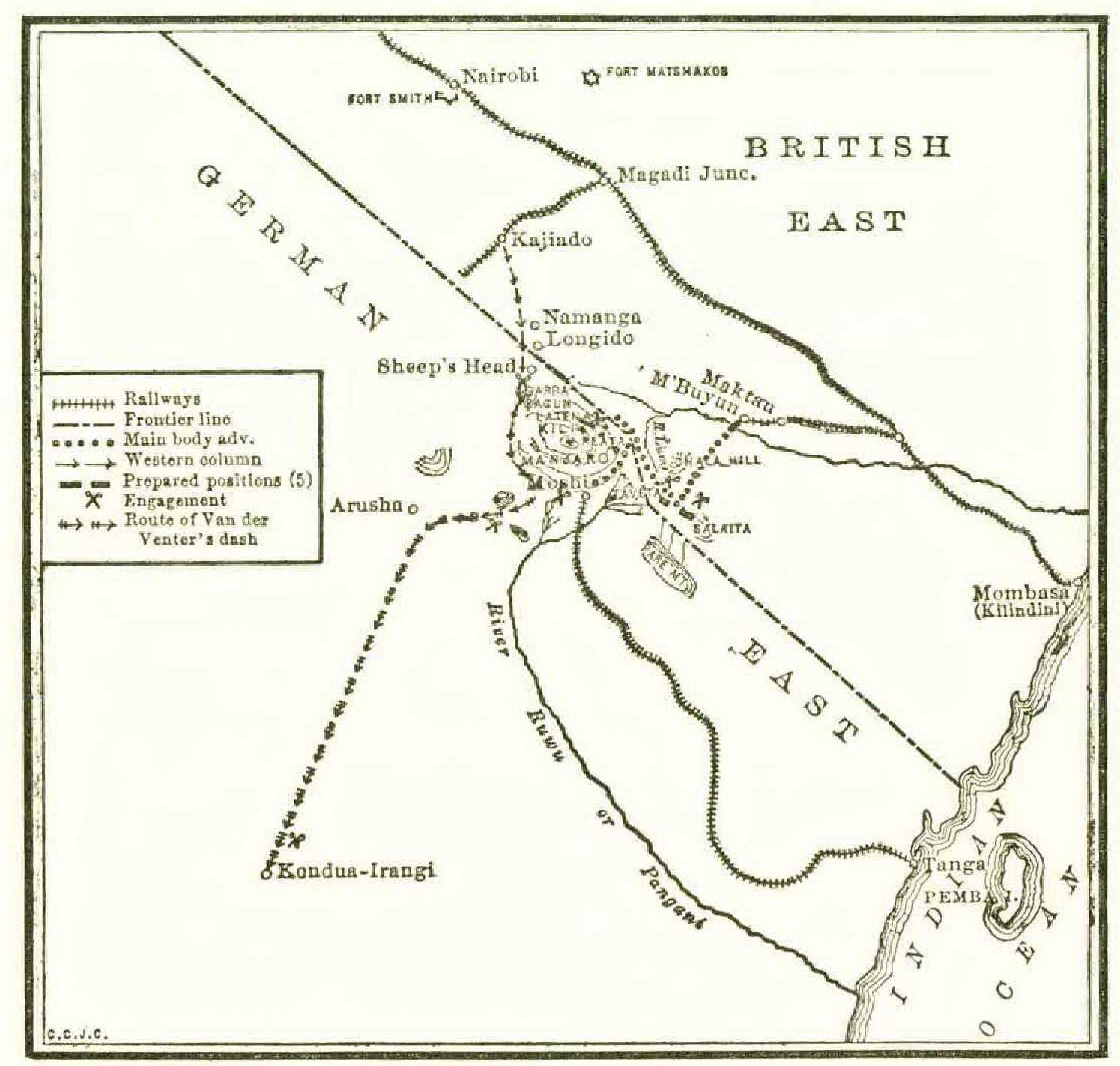
The first march was to M’buyuni, where a light railway was already in process of construction from Maktau, to be continued up to the German frontier. The advance guard waited for the arrival of the other arms, and a reconnaissance in force was directed against Salaita Hill, which revealed the enemy in great strength upon the eastern slopes of Kilimanjaro. The terrain was very difficult, and the men deployed against the German position received a severe grueling from ‘ pom-poms ’ and mountain guns, which were admirably placed and difficult to locate. Shortly after this General Smuts arrived in person, and at once decided to employ the traditional tactics of South Africa, used in the first instance by T’Chaka, the Lion of the Zulus, who based his idea on the horns of a bull and enveloped his enemy by a double outflanking movement before driving home the impis stationed in his centre. Acting on this principle, Smuts directed the mounted brigade, based north of Kilimanjaro, to sweep along the western foothills of the mountain, and concentrated his forces for a thrust at Moshi, the terminus of the Tanga-Kilimanjaro railway.
This enveloping movement achieved its object, for, as the Germans felt the pressure on their centre, they were obliged to fall back lest they should be cut off from their base; but they stubbornly contested every foot of the thrust on Moshi. The fighting took place over a terrain unique even in this world-war, for the scene of the action was chiefly in the shadows and amid the tangled undergrowth of the primeval forests which clothe the slopes of Kilimanjaro; and, as the advance progressed, the forests revealed great masses of the enemy. Apart from the exigencies of the military situation, it was desirable to convince the Askaris (German native soldiers) that white troops were more than their match even in bush warfare. Consequently, when they pulled out and bolted, the South Africans went after them with butt and bayonet in a workmanlike manner,— a procedure which proved particularly effective.
The second position taken up by the Germans in their retirement was as formidable as nature could produce. Lying behind the Lumi, they were protected in front by seven miles of dense bush; on the right by the Pare Mountains and the swamps of the Ruwu, and on the left by the dangerous broken spurs of Kilimanjaro. By a very arduous night march through the bush, the South African troops secured the passage of the Lumi, and a dash made by some mounted men resulted in the occupation of Chala Hill and other positions dominating Taveta and Salaita. As the enemy were found to hold their line in great strength, the infantry brigades, on March 11, were ordered to attack the precipitous bush-clad hills of Reata and Latema, which formed the main position. The ground at this point was covered with a thick thorny scrub, which rendered an advance difficult and afforded little shelter from the rain of projectiles poured forth from guns of all calibres, from the tiny ‘pom-pom’ to naval guns salved from the Königsberg. What endless toil and labor their transport and emplacement must have cost the Germans and their native auxiliaries, the swamps and forests alone can tell!
The progress of the attackers was slow and painful, but at last they managed to get within one hundred and fifty yards of the German trenches. Their main objective was a green kopje, surmounted by a fort, at each corner of which were stationed flagposts flaunting alternately the German banner and the green flag of the Mohammedans — a striking illustration of Lutheran Germany’s benevolent fathering of Islam. The first and second lines of trenches were rushed, but this proved of small advantage to the South Africans, who found themselves enfiladed by maxims, while snipers, cunningly hidden in giant baobabs and ant-heaps specially hollowed out for the purpose, took their toll of lives. These had to be silenced before a further advance could be made. But late in the evening the British secured a position and dug themselves in, until reinforcements could be hurried up in the morning, and their advantage pressed home.
Three times during the night the enemy made counter-attacks, their native troops fighting like demons — a fact which was less surprising when later investigation of water-bottles found on corpses showed they had been filled with raw spirit. At dawn the Germans were finally driven out, to retire sullenly on Moshi, consolidating their position on the interior lines and railhead. Their defeat was severe; the hills were found covered with their dead. On all ordinary occasions their dead and wounded had been carried with them, and traces of blood were the only proof of casualties; but now they were left behind. Three maxims and a gun were also abandoned.
Meanwhile the western column, comprising the mounted brigade, the mechanical transport, and some artillery, were sweeping round the foothills. A base camp had been formed at Kajiado, about forty-five miles south of Nairobi, on the branch line from Magadi Junction, and from there on March 9 the mechanical transport started on its way. The cars had all traveled down to their base by road through the Masai district — the paradise of the big-game hunter. Wildebeeste, buffalo, zebras, giraffes, kongoni, Thompson gazelles, rietbuck, and stembuck were to be seen in thousands. At first, roads were practically non-existent; the modern motorcar, however, is not to be stopped by the ordinary difficulties of veldt travel, though a series of very bad sluits necessitated the rescue of some cars stalled through carburetor and magneto trouble. The third stage, from X— to Y—, led through great forests and black swamps of evil reputation, to cross which a corduroy road of logs was constructed from the abundant timber of the neighborhood.
The scenery was magnificent, with its imposing vistas of heavily wooded hills and valleys, somewhat reminiscent of Switzerland, while lording it over all rose the stately crest of Kilimanjaro, which, in the vernacular, means ‘the mountain of falling water ’ — a tribute to its abundant rain. At Namanga the General Staff, who had left Kajiado three days before the beginning of the general advance, were caught up with, and the next stage was Longido, where an advance base had been established. Several regiments were stationed here, including some Indian troops, and preparations were at once made for the coming operations.
The advance guard was composed of cavalry, a sprinkling of infantry, and a mountain battery. It was the boast of this latter that it could bring a gun into action within 45 seconds, and find its range by the third shot. The men are recruited from a particular district of India; the regiment is very proud of its record and jealously resents the enlistment of outsiders, entrance to the ranks being an hereditary privilege. After this advance guard came the General Staff and the main body guarding the principal convoy. The rear guard, composed mainly of colored troops, was preceded by a second convoy, the ammunition supply, and the motor-car section attached to the artillery, the duty of which was to keep the guns provided with shells.
The enemy had not neglected to place outposts on several commanding positions, and before the next halt at Sheep’s Head the cavalry got in touch with some Askaris and drove them from their hill. Next day the column proceeded on its way, the Staff and advance guard getting well ahead, leaving a portion of the convoy in front of the artillery, while the main convoy of commissariat and stores fell behind. In the afternoon, just after the guns had surmounted a steep hill at Garraragua, the enemy made a surprise attack on the main convoy, and the artillery wheeled out to march parallel with the advancing column on the side from which danger was apparent. The convoys were ordered to take up positions well to the right, so that the motor-cars might have sufficient scope to supply the guns with ammunition. A brisk artillery fire then broke out, the men finding range quickly; but it was difficult to estimate the damage, as the enemy seemed to be scattered in small detachments among the numerous kopjes.
Sunset brought a lull, but up to that time the firing had been incessant, despite the fact that the Germans tried to cause confusion by sounding British army calls, chiefly ‘Cease firing’and ‘Retire.’ The officers, however, trumped these tricks by ordering the ‘Fire’ to be blown on the bugles. When dusk fell, the commander decided to disengage, but the movement was not carried out without disorder. The ammunition column on a neighboring hill was now under double fire, and it was realized that a return along the road to Sheep’s Head was necessary. Unfortunately, there were not many men to guard the convoys; the motor-cars turned off into the veldt, becoming separated from the column in the dim moonlight, and later they got bogged and could not move. Some Indians on mules luckily found them in time to report the approach of some Germans with fixed bayonets; after strenuous exertions, on the part of men and mules, all but three were rescued, and two of these were hidden in the long tambouki grass. An anxious night was passed, smoking and even whispering being forbidden; next morning, however, the convoys were reinforced, and on reaching Garraragua once again, the position was found to be evacuated.
A splendid road now helped the column across thirty miles of desert, so that the cars got within eleven miles of Moshi with no further trouble save at the rivers, through which they were towed by oxen. The country was well irrigated at this part, and a government farm, through which they passed, afforded a welcome profusion of grain and vegetables. The boundary stake had been removed en route amid loud cheering. Kilimanjaro had presented a series of wonderful aspects, as the advance progressed. The towering peak is covered with perpetual snow, while glaciers can be traced above the forests. Seen against an azure sky, it is an unforgettable sight. At evening it seems like a marvelous jewel in a setting of delicate emerald, while by moonlight its outline is softened to a fairylike effect.
The actual advance into Moshi was preceded by a heavy bombardment of five hours, but no resistance was offered when the troops entered, as the place had been evacuated. Once, however, the invaders were fairly established in the town, the Germans, who had taken up new positions on hills commanding the station, opened up with their artillery early in the morning. Another engagement ensued, which secured Moshi, though not without heavy losses. The enemy were now in a somewhat precarious situation; their line of retreat toward Tanga was no longer safe, since at any moment they might be headed off by the mounted brigade occupying Moshi. But any doubt as to the course of action which they ought to pursue was settled by Smuts’s next move. Detaching a force to his left rear along the Tanga railway to prevent the Germans breaking back on to British soil, he concentrated his main body, which had been employed in the thrust, in Moshi, and dispatched Van der Venter, the hero of the lightning cavalry raid across the deserts of German Southwest Africa, to make a dash dead west on Arusha, a junction commanding the caravan roads to Moshi, Dar-es-Salam, and Nairobi. The Germans had now split up into small bands making for their main rail artery from Tanganyika to the coast, and one scattered unit, taking advantage of a prepared position, tried to bar Van der Venter’s way. After a brief engagement they broke, leaving one of the guns of the ill-fated Königsberg in British hands, and Van der Venter occupied Arusha without further hindrance. In this way Smuts’s tactics had proved completely successful, and one cannot do better than quote the concluding passage of his own dispatch: —
‘During these operations the enemy has been severely defeated and has been flung south of the Ruwu River. We have cleared him finally out of British territory, and we are now in occupation of the healthiest and most valuable settled parts of German East Africa, comprising the Kilimanjaro and Meru areas.’
But Smuts is not the kind of man to sit idle while the enemy may be re-forming, so, as soon as he was apprized of the occupation of Arusha, he ordered Van der Venter to penetrate into the heart of the enemy’s country. His subordinate carried out his command with marked success, and pushed straight on to Kondua Irangi, an important station only about a hundred miles off Dar-es-Salam and ominously near the Tanganyika railway. After a sharp engagement Van der Venter occupied the place, while his daring was also rewarded by the seizure of an important supply column, with rifles, ammunition, wagons, and cattle.
It would be idle to prophesy what course of action the Germans are likely to adopt under these circumstances, but it is not impractical optimism to assert that they can do little but carry on a guerrilla warfare in the faint hope of prolonging the inevitable end. There was some ground for the supposition that they intended at the worst to retire inland along the Tanganyika railway, but whether they will do so with Van der Venter hovering on their flank is doubtful. Meanwhile the cordon is being drawn closer and closer. To west and southwest they are barred by the chain drawn through Rhodesia to the Belgian Congo, while the entry of Portugal into the war has not only closed the one remaining frontier, but has put an end to the surreptitious smuggling of supplies landed at Beira in soi-disant neutral bottoms. Moreover, the prospects of a guerrilla warfare can scarcely be said to be inviting, since the Germans would be pitted against men who are past masters of that game; and the Prussian school of war, with its doctrine of iron discipline and suppression of all initiative, is the last training likely to turn out soldiers who can maintain dashing operations and unconventional tactics.
Within a few weeks General Smuts has completely altered the whole aspect of this minor campaign, and the whole secret of his success is mobility. A study of the two African colonial campaigns affords a striking similarity, despite the difference of the physical characteristics of the two countries. In a previous article 1 on the Southwestern expedition I described the laborious preparations made by the Germans to defend Aus; yet the position was later evacuated without a blow. This was effected by Van der Venter striking right across from Upington and threatening the German lines of communication. Consequently the Aus garrison, confronted with the danger of being entirely cut off, had no alternative but to retire. Similarly, in this campaign mobility has neutralized all the elaborately prepared defensive positions of the enemy, which became untenable owing to the menace on flank and rear. It was a maxim of Stonewall Jackson’s that mobility and secrecy were the two essentials of successful strategy, and he acted up to his words by attacking his enemy where he was least expected. Aërial reconnaissance has robbed the modern general of much of his chances of secrecy, but Smuts has shown that speed and mobility, properly applied, can still play a most important part in modern war. The success of his operations was facilitated by the accuracy of the information obtained by his Intelligence Department and air scouts; and in all his movements he gave evidence that peace and politics have not blunted the skill which he displayed a decade and a half ago, when he led a cavalry raid through the Cape Province, until his burghers rode their horses down to the beaches of the Atlantic.
A final word as to the composition of the victorious army. Not since the days of the Roman Empire has a force of such diverse peoples, creeds, and castes been gathered together under one standard; but whereas Saxon and Gaul, Scythian and Iberian, Dacian and Numidian, followed the eagles through compulsion or in hope of loot, the various types under Smuts — Englishman and Dutchman, Canadian, Australian, South African, Indian, and Haussa — are fighting for liberty. And history teaches us that in the long run the defender of liberty wins the day.
- ‘ Campaigning under Botha.’ The Atlantic Monthly, May, 1915.↩