Meissner Pasha on the Egyptian Adventure
I
IT has been well said, in summing up the development of colonial railways throughout, the world, that the Briton has built his lines to help him carry ‘The White Man’s Burden,’ while most of the German lines were constructed to help shift ‘ The White Man’s Burden’ back upon the shoulders of the black. This same diversity of spirit has been observable in many phases of British and Teutonic colonial endeavor in all parts of the world. The one represents what has been called the ‘humanitarian school,’ the other the ‘repressive’; and the results — British success and German failure — are pretty well commensurate with their respective deserts.
Germany ‘bludgeoned’ and blundered in China, Polynesia, and on both coasts of Africa, and the place where she ‘bludgeoned’ the least happens to be the only one in which she was able to get a really comprehensive constructive programme well under way. This was in Asiatic Turkey, and possibly some explanation of Teutonic success there is found in the fact that Asiatic Turkey was not a German colony, and Germany therefore did not, up to the outbreak of the war, have a sufficiently free hand to warrant swinging the bludgeon in quite the same way as where the standard of the double-headed eagle was already planted. Now that the Kaiser has been supreme for a year over a considerable portion of this region there is ample evidence that the old repressive policy has begun to act automatically in alienating the peoples to whom it is applied. However that may be, it is also true that a very potent factor in gaining for Germany the strong position which there is no denying that she held in the several years immediately preceding the war, was Meissner Pasha, the railway-builder.
Meissner, who is but a few years older than the Kaiser, went out to Turkey as a young engineer shortly before Wilhelm ascended the throne, and has made one portion or another of the Ottoman Empire his special field of endeavor ever since. As Germany’s ‘Eastward Ho!’ policy was a nebulous hope rather than a definite plan, up to the beginning of the present century, the first decade or so of his work in Turkey was as unselfish in character as were the labors of those distinguished Britons who have built the railways of Argentina and Peru or reformed the customs of China. During this period the foundation of the present railway system was laid in what was then Turkey in Europe, and considerable construction was also carried on in Asia Minor. How much of Meissner’s work of the last fifteen years has been in direct furtherance of the Kaiser’s farreaching Eastern ambitions, it would be very difficult to say; probably, indeed, he has little idea himself. But however much he has been made a pawn in the game of Realpolitik, I am confident that there are very few who have followed his work of the last thirty years who will not grant that the mainspring of his personal efforts was a deep and sincere affection for Turkey and the Turkish people. The type is a common one in the last century of British history, but Meissner is the only German I have ever met worthy of inclusion with the elect.
‘Meissner’s looks and accent are Teutonic,’ an American missionary of Basra said to me in 1912, ‘but his humanity is distinctly Anglo-Saxon. He has enough heart to qualify for an Indian civil servant — a mighty rare thing in a German — and there is no question of the sincerity of his devotion to the Turks.’
There was no doubt of the sinister activities of the great majority of the Germans whom one met in all parts of Asiatic Turkey in 1912-13, whether they professed to be archæologists, engineers, officials, or masked their missions behind cloaks of inconsequent bluster or disdainful reserve. Yet meeting Meissner Pasha among all of these, I nevertheless formed an opinion of him very similar to that quoted above, and I distinctly recall bracketing him — in an article which I wrote, in 1913, for Indian Eastern Engineering of Calcutta — with Sir William Willcocks as one of the ‘Restorers of the Garden of Eden ’; this, of course, on the assumption that railways were quite as essential as dams and canals to Mesopotamian reclamation. Doubtless he, like all the rest of his countrymen, was entirely cognizant of, and committed to, the ‘Deutschland über Alles’ programme; but iu his case at least, I am sure, this was leavened with a strong desire to be also of service to Turkey. Whether or not he had an ulterior motive, it is undeniable that, as Chief Engineer of the Hedjaz and Bagdad railways, he played — and is still playing — a highly important part in the extension of Germanic influence over Asiatic Turkey; and for this reason, if for no other, some of his observations regarding the possibilities and limitations of these lines, in the event of Germany’s ever trying to ‘consolidate’ her position beyond the Mediterranean, should be of especial interest at this time, when such an attempt seems about to be launched. I am setting down no statement that I have any reason to believe was made to me in confidence, nor yet anything that Herr Meissner could have especial grounds for desiring to withhold from publicity, either now or in the future.
II
My most extended conversation with Herr Meissner took place during a tour I made in his company over the Bagdad-Samara section of the Bagdad Railway, — work upon the southern end of which was just getting under way, — and a political turn was given to our talk, if I remember correctly, by my inquiring why, when it was apparent to every one that the descent of Italy on Tripoli meant the almost inevitable defection of the former from the Triple Alliance, all the German officers I had met in Bagdad appeared to be so well pleased with the course events had taken.
‘I think you will find,’ said Herr Meissner, raising himself on his elbow to ease the jolting of the arabanah by which we were traveling, ‘ that they are pleased because, while it is fairly certain that Italy has been lost to the Alliance, there is no possible doubt that Turkey has been gained.’
‘Then you believe that Turkey is more powerful than Italy? ’ I asked incredulously.
‘Not I necessarily,’ he corrected, ‘but they — the German officers. They believe that Turkey is, not more powerful than Italy, perhaps, but far more useful to Germany, especially in certain contingencies. As for myself, I heartily regret anything that might make war more likely, for my own country in the first place, and, in the second place, for Turkey — especially Asiatic Turkey — which I have spent the best part of my life trying to build up.’
‘You mean that Germany believes she could strike a successful blow at Egypt and the Suez Canal through Palestine?’ I queried in surprise.
‘I mean that a certain section of German military opinion holds such a thing possible, and that, also, command of — or shall I say coöperation with? — Turkey, might exert potent influence on events in the Middle as well as the Near East.’
‘You mean — India?’ I asked with dawning comprehension.
Herr Meissner neither spoke nor even nodded; but his smile was palpably confirmative.
‘Germany, even with Turkey, could not threaten India across these endless miles of deserts, in a hundred years,’ I protested. ‘Russia, incomparably better situated geographically and strategically, and with an age-long thirst for warm water, has shrunk from the task for half a century.’
‘Possibly you are correct,’ was the reply. ‘But our militarists probably tell each other (though they would hardly tell you) that, with the Bagdad Railway all the way to the Persian Gulf, with two or three branches to the Persian border and beyond, and with the not invulnerable Russo-Perso-Indian Railway through to Baluchistan and Karachi, things might eventuate which would enable them to turn these deserts and their peoples to good account. Also, they doubtless tell each other that the Egyptian adventure would be consummated first, and that the success of this could not fail to have a great influence on India.’
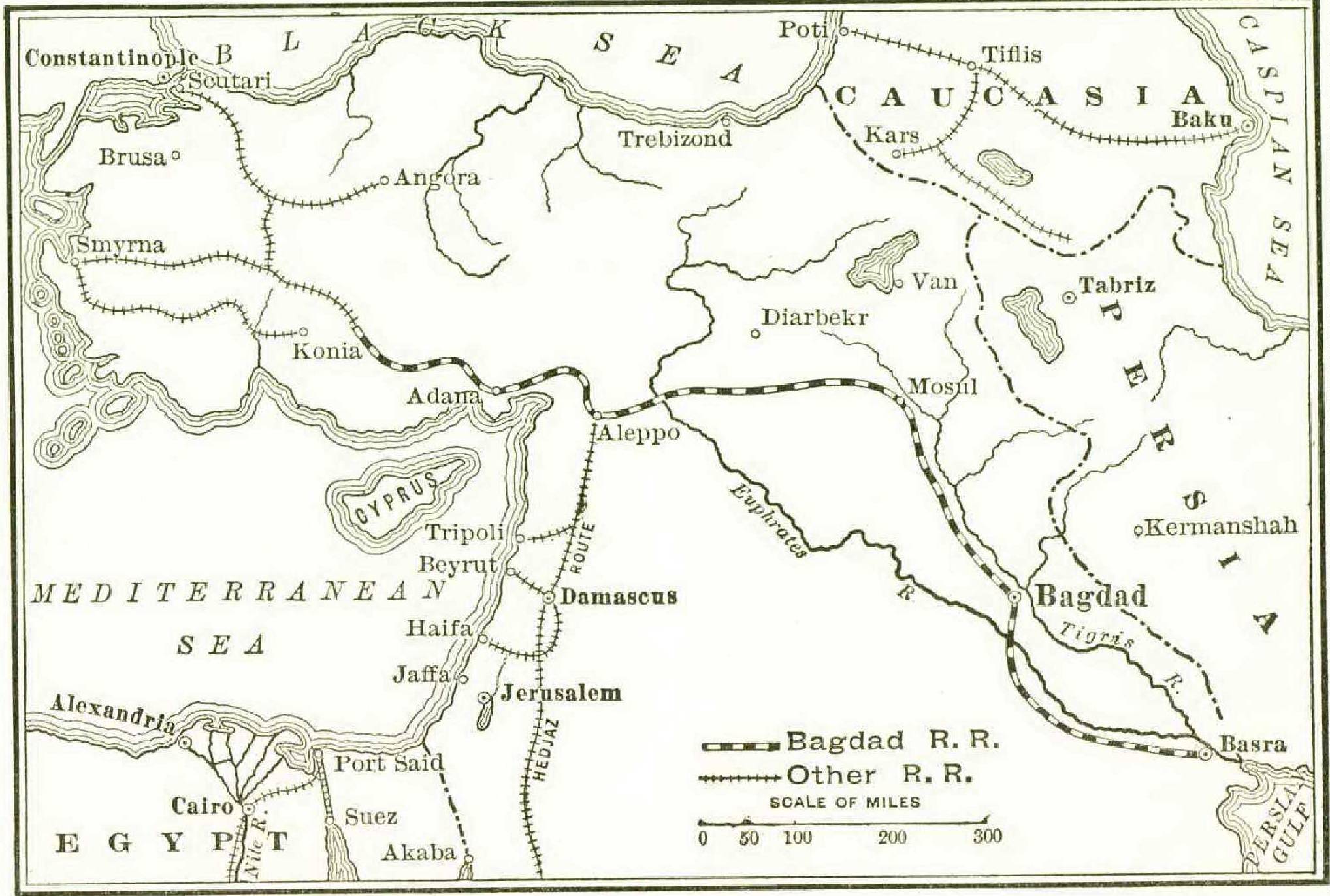
A blue print map of Asiatic Turkey and the route of the Bagdad Railway was spread out across our knees, and suddenly there leaped to my mind what I felt sure was the correct explanation of that long détour of the railway to Mosul, on the Tigris, concerning which I had heard so much puzzled speculation in India.
‘Your Excellency has, I think, furnished me with a clue as to why the Bagdad Railway is being built three or four hundred miles out of its way, through the sterile north Mesopotamian region and down the almost desert right bank of the Tigris, when it could have followed the direct route along the old caravan road by the Euphrates, where it would have been in a potentially fruitful country all the way to the Persian Gulf,’ I hazarded boldly. ‘Was it not because this more roundabout route flanks Armenia on the south and parallels the Persian frontier for four hundred miles on the west, while Mosul, situated at the hub occupied by old Nineveh, is an ideal point of departure for the penetration — either peaceful or warlike — of Northern Persia?’
Again Herr Meissner confirmed my conjecture with a smile though not with words.
Since the ‘Egyptian adventure’ had been hinted to be held as a condition precedent to the threatening of India, I now began to grope for light in that direction.
‘But surely Your Excellency does not believe it possible to push a sufficient force across the Egyptian frontier to create more than a temporary diversion at the Suez Canal,’ I said. ‘The Turks would never be equal to organizing an adequate army, to say nothing of the task of transporting it across the great stretches of desert between the Hedjaz Railway and the Canal.’
‘True,’ admitted Herr Meissner, ‘but the organization would hardly be left in Turkish hands. As for transportation — as the builder of the Hedjaz Railway, the problems in that connection would doubtless be turned over to me. I should probably be called to look after the task in person if I were still active in Turkey, and at least in an advisory capacity if I had been superannuated home.’
‘And do you think the thing could be done? Would you welcome the task?’ I asked.
‘It would hardly be proper for me to state my views on the transportation problems,’ he replied, ‘but I may say that certain influential German strategists believe that the Suez Canal could be cut and held if sufficient strength could be concentrated for the attack. Just to what extent they would count on favoring diversions elsewhere I cannot say. As to whether or not I would welcome the task, let me register a most emphatic negative. Its success — let us say the cutting of the Canal and the conquest of the Nile Delta — would bring a series of events in its train that could do no good and might result in much harm to Turkey; while its failure would mean the end of her as a nation—perhaps actual dismemberment. How great a blow such an event would mean to me I will hardly need tell you. My thirty years of work in this country have made me almost as much of a Turk as I am a German.’
In reply to further questions Herr Meissner stated plainly that anything in the way of a ‘surprise’ attack on the Canal could be nothing more than a raid, which might or might not inflict some damage before retiring. A real attack would involve many months of preparation, including not only the laying of light railways across the desert, but the practical reconstruction — preferably a double-tracking — of the Hedjaz line to Damascus, the Frenchbuilt railway from Damascus to Aleppo via Rayak, and the main trunk of the Bagdad Railway from Aleppo through Asia Minor to the Bosporus. The completion of the tunnels on the Bagdad Railway through the Taurus and Amanus mountains would, he considered, be an absolute sine qua non to the success of such an expedition as that under discussion.
‘Ten years from now a force operating from the north and east against Suez might be fed from Mesopotamia, but it is certain that the reclamation of that region will not have gone far enough in less than a decade to make it a considerable exporter of food As it will be for the next ten years, then, with the enemy in front, deserts to the south and east, and Palestine and Syria hardly able to feed their own populations, an army moving on Suez would have to be fed from Asia Minor and munitioned from Europe. For that very considerable task an unbroken double track all the way from Scutari, opposite Constantinople, to near the Palestine frontier would seem to be almost imperative. As you have doubtless observed, railway construction in Turkey is beset with more difficulties and fraught with more delays than in any other country in the world. The throwing down of two, or even four, tracks of light railway to and across the Egyptian frontier would be no prohibitive task at any time, —the country is hardly so forbidding as that stretch of the Sudan across which Kitchener laid track at the rate of a mile or two a day when he tried to relieve Gordon at Khartum, —but the providing of really adequate communications with the Bosporus might well be a matter of years. I should greatly deplore, for reasons I have already stated, the undertaking of this operation at all; but if it has to come, I should at least hope that it may not be inside of five years, or, better still, ten.’
To my inquiry as to whether or not he meant to imply that an operation against Suez undertaken inside of five years — say, previous to 1917—would be foredoomed to failure, Herr Meissner was noncommittal, but to a somewhat less pointed question he vouchsafed a qualified answer.
‘Supposing,’ I said, ‘that five or ten years had gone by, and that the adequate railway communications which you have stipulated had been established in the interim, and that only three or four months of light-railway construction at high speed were necessary to throw an attacking army upon Egypt, would not those three or four months— considering the central position of Suez — always be sufficient for the massing of overwhelming forces — English, Indian, Egyptian, and Australian — at that point for its protection ? ’
‘ Frankly, I am not competent to express an opinion,’ replied Meissner; ‘ but ’ — after a moment’s hesitation — ‘I think our strategists — though they discount help from Egypt, India, and Australia — would reckon on being faced by superior numbers and base their expectations of success on superiority of organization, personnel and matériel; and they might hint at “ diversions ” among the Mohammedans of North Africa and the Middle East.’
The foregoing sums up, so far as my notes and memory go, the main points of Meissner Pasha’s observations — as expressed in the course of our meetings of 1912 — regarding the rôle likely to be played by the Hedjaz and connecting railways in the event of a TurkoGerman attack upon Egypt. Worth pondering over, however, by those who have taken it for granted that Germany’s establishment of unbroken communications with Constantinople means anything like a breaking of the Allies’ blockade through the opening up to her of the mineral and agricultural wealth of Asiatic Turkey, is this remark of Meissner’s regarding the resources of the region in question: —
‘There has been far too much of a tendency in Germany and England to look upon this part of the Ottoman Empire as a great storehouse, the wealth of which would become available to the world immediately the doors were unlocked by means of railways. This is a most erroneous impression. The wealth is here, but it is potential, not existent, wealth, and will only be won at the end of many years of patient preparation. Mesopotamia may be shipping a few foodstuffs five years from now, but I do not look to see the oil of Hitt, or the copper of Diarbekir, figuring in world returns before 1920.’
These facts are, of course, known to any one who is familiar with the vast voids of the interior of Turkey-inAsia, but they seem very little appreciated by people in general. As a matter of fact, the Central Empires will gain nothing whatever of use to them from Mesopotamia, Arabia, Syria, and Palestine, and from Asia Minor they will secure only an almost negligible food-supply and an even less considerable amount of short-staple cotton.
III
I left lower Mesopotamia in the spring of 1912, and made my way to Mosul and Aleppo over the route of the Bagdad Railway, stopping not infrequently at the camps of the engineers along the way. From Aleppo I went to Damascus and Beirut, and spent the following two months in Palestine and Arabia, not a little of the time along the route of the Hedjaz Railway. Returning to Aleppo in the autumn, I encountered Meissner Pasha — who had come up the Euphrates by arabanah from Bagdad — and had the pleasure of another evening in his company. Almost his first question, on hearing where I had been, was, ‘What do you think of the Hedjaz Railway?’ And in reply I took from my pocket the manuscript of an article I had just completed and was about to dispatch to the Railway Age Gazette of New York, on the railroads of Syria and Palestine, and indicated the following paragraph: —
‘Although it still bears evidence — in solidly constructed culverts and bridges and well-run levels — of the skill of the distinguished engineer who built it, the Hedjaz line, opened scarcely half a decade ago, has deteriorated to a point where it has no rival for the title of “The Worst Run, and the Worst Run-Down Railway in the World.” Most of its engines — their boilers eaten out by the alkali water — are on the scrap-heap, and the rest are on their way there. The trains, nominally run on the constantly varying Arab time, can rarely be depended upon to leave even their termini within an hour or two of the minute scheduled. All in all, the much vaunted “Pilgrim’s Railway” rivals the remains of Baalbek for the completeness of its ruin, failing to come up to the latter only on the score of picturesqueness.’
‘That about epitomizes my impression of the Hedjaz Railway as it is today, your Excellency,’ I added, ‘and I might say further that, if it has ever to be put in shape for that little operation against Egypt which we discussed in Mesopotamia, the cleaning-up job will be on a scale to make Hercules’s labor with the Augean Stables look like a sideshow.’
It was a flippant, not to say a rude, speech, and I regretted it the moment it had passed my lips. Meissner’s reply, however, was ‘more in sorrow than in anger.’
‘ I don’t wonder that the Hedjaz Railway seems a joke to you, or to any foreigner, or to any but myself who have spent some of the best years of my life in the building of it. So perhaps you will find it hard to believe me when I say that its steady destruction — I can use no other word — under the laissezaller policy of the Turks has been to me the nearest approach to a tragedy I have ever known. Less than five years ago, I turned over to the Ottoman government one of the best built railways Asia had ever known, and they have made of it — yes, you have used the right word — a ruin. Do you wonder that I refused to undertake the construction of the Bagdad Railway until the Porte had agreed to operate it, after completion, under German management?
‘As for having to employ it for operations against Egypt (there would be no use in denying to you after what you have seen of where it runs, that strategic considerations were not lost sight of in keeping it so far from the coast and the dangers of a sea raid), if that contingency ever arises, why, we will simply have to make out the best we can with it. There is no other line of communications available — assuming of course that sea-control were in the hands of the enemy. But please believe me when I say that, from the bottom of my heart, I hope that contingency may never arise.’
I met Meissner Pasha more or less casually on several other occasions during my subsequent travels in Asiatic Turkey, but at no time did I hear him say, nor yet have I ever had authentic word of his doing, aught to indicate that — personally at least — he was not entirely sincere in the sentiments expressed that evening in Aleppo regarding a possible attack upon Egypt from Turkey. I have of course always known that, like all the other Germans in the Near East, he was chained for life to the Kaiser’s war chariot, and it is, therefore, with no surprise that I read in the late Berlin papers that he is directing the railway preparations for the long-heralded advance on Suez. There can be no doubt that he is doing the best he can with the facilities at his disposal, and it may be taken for granted that Meissner’s best — because he is trusted by the Turks and Arabs and has the faculty of getting on with them
— will be a good deal more than any other German could accomplish under the circumstances. But deep in his heart he knows that, however good his best is, it will not be good enough, for the task ahead of him is far more nearly prohibitive than it was at the time he told me that an indispensable condition precedent to its success was a double-track railway between Sinai and the Bosporus. Not only is there no double track — except for considerable sidings
— along any portion of this tenuous line, but even single-track communication is still unestablished through the Taurus and Amanus mountains. Practically all of the food, and every bit of the munitions, of an army operating against Suez will have to break bulk at least twice and be portaged over what are now snow-clogged passes of considerable altitude, and after that be worried along a zigzag route to Palestine over lines which, though connecting, are not of uniform gauge, and were, up to the outbreak of the war, under German, French, and Turkish management respectively. Then will come the trans-shipment to the light desert railways in the rear of the army. To tinker this sorry patchwork into an efficient line of communications for a modern army is the task set for Meissner Pasha and his engineers, and there is no doubt that they will ’do the best they can ’ at it, however far that best would seem foredoomed to fall short of what would be necessary for anything approaching success.
It might also be pointed out that the actual military problem of attacking Suez — according to the views outlined by Meissner Pasha as being those of the German strategists of three years ago — has become an incomparably more difficult one. The ‘diversions’ in North Africa and the Middle East have failed utterly to materialize, while, on the other hand, the active coöperation of India and Australia with Great Britain has become afait accompli. With undisputed sea-control, the ability of Britain to concentrate overwhelming numbers for the defense of Suez is greater than ever before, while — more important still, perhaps — the vaunted superiority of Teutonic personnel and matériel has been proved a myth on every field of Europe. Even with the way clear between Germany and Constantinople, Suez is safer to-day than it was at the outbreak of the war.
For the resolute and energetic Meissner Pasha, the consolation obtained through being able to restore the ruin of the Hedjaz Railway will probably be a good deal more than offset by the realization that the words he spoke in 1912 regarding the consequences of a Turko-German-Egyptian adventure hold good with added force to-day; and, moreover, that the worst of the alternatives he conceded at that time —the dismemberment of the Ottoman Empire — seems in process of inevitable fulfillment.