The House on Henry Street: IV. Children and Work
I
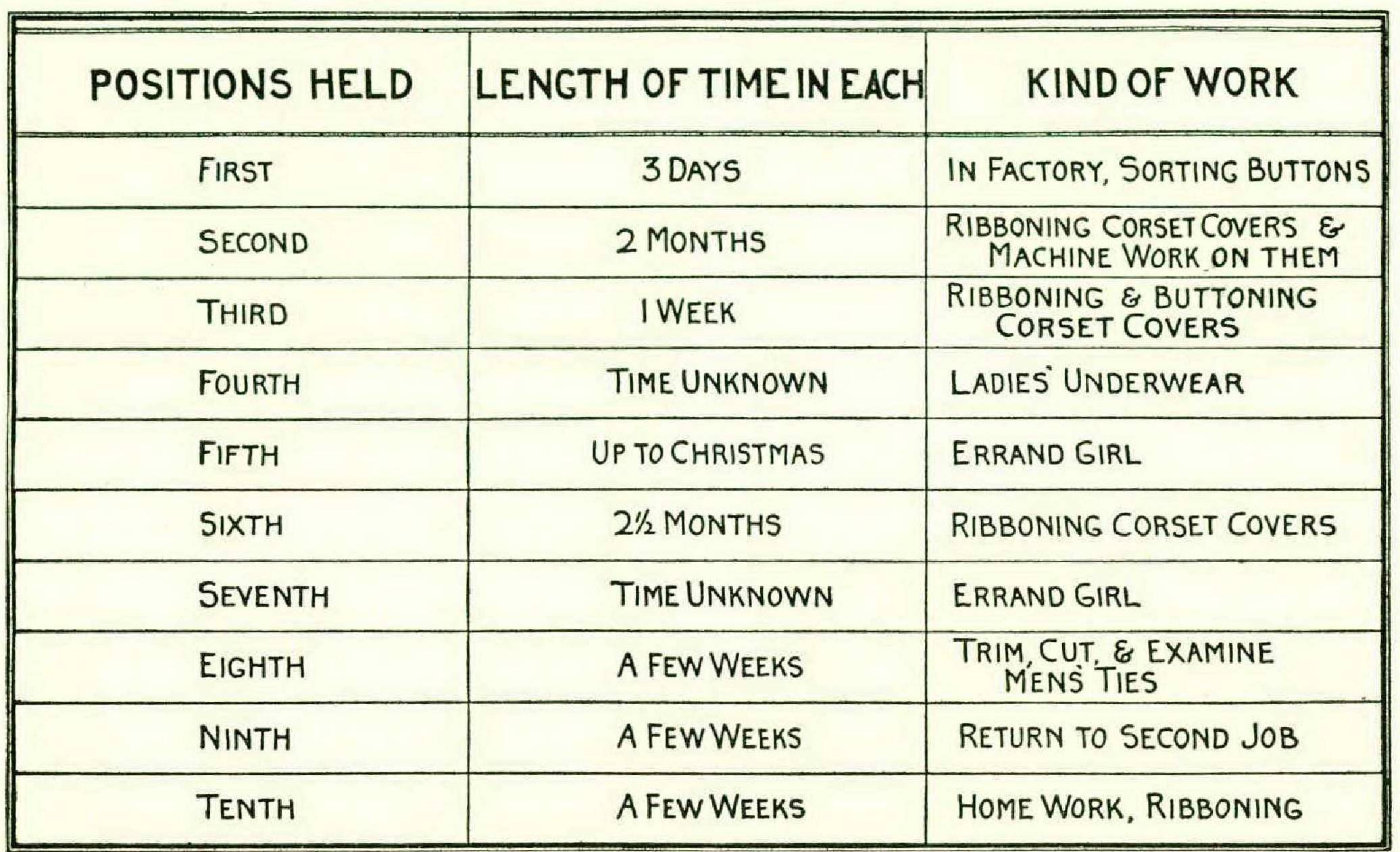
BESSIE has had eight ‘jobs’ in six months. Obviously under sixteen, she has had to produce her ‘working papers ’ before she could be taken on. The fact that she has met the requirements necessary to obtain the papers, and that her employer has demanded them, is evidence of the advance made in New York State since we first became acquainted with the children of the poor. Bessie has had to prove by birth certificate or other documentary evidence that she is really fourteen, has had to submit to a simple test in English and arithmetic, present proof of at least 130 days’ school attendance in the year before leaving, and, after examination by a medical officer, has had to be declared physically fit to enter shop or factory.
No longer could Annie, the cobbler’s daughter, by unchallenged perjury obtain the state sanction to her premature employment. Gone are the easy days when Francesca’s father, defying school mandates, openly offered his little ones in the labor market. Yet we are far from satisfied. Bessie, though she meets the requirements of the law, goes out wholly unprepared for self-support; she is of no industrial value, and is easily demoralized by the conviction of her unimportance to her ‘ boss,’ certain that her casual employment and dismissal have hardly been noted, save as she herself has been affected by the pay envelope. Her industrial experience is no surprise to her settlement friends, for she is a type of the boys and girls who, twice a year, swarm out of the schools and find their way to the Department of Health to obtain working papers. Bessie’s father is a phthisis case; her mother, the chief wage-earner, an example of devotion and industry. The girl has been a fairly good student and dutiful in the home, where for several years she has scrubbed the floors and ‘looked after’ the children in her mother’s absence.
Tommy also appeared at the office with his credentials and successfully passed all the tests, until the scale showed him suspiciously weighty for his appearance. Inquiry as to what bulged one of his pockets disclosed the fact that he had a piece of lead there. He had been told that he probably would not weigh enough to pass the doctor. Talking the matter over with Mrs. Sanderson, I learned that the immediate reason for taking Tommy out of school was his need of a pair of shoes. The mother was not insensitive to his pinched appearance. A few days later Tommy was taken to visit our children at the farm, and it was pleasant to see that the natural boy had not been crushed. He devoured the most juvenile story-books and was ‘crazy’ about the sledding. The self-respecting mother was not injured in her pride or independence by a little necessary aid carefully given; and though I have not seen Tommy recently, I am sure that neither he nor his employer lost anything because of the better physical condition in which he entered work after his happy winter at the farm.
This attempt to cheat the law by the very children for whose protection it was designed, and the occasional disregard of the purposes of the enactments by enforcing officials, suggest Alice’s perplexity when she encountered the topsy-turvy Wonderland.
It was about twelve years ago that a group of settlement people in New York gathered to consider the advisability of organizing public sentiment against the exploitation of child workers. The New York Child Labor Committee thereupon came into existence, under the chairmanship of the then head of the University Settlement, and that committee has since been steadily engaged in advancing standards of conditions under which children may work. Through legislative enactment and publicity it has endeavored to form public opinion on those socially constructive principles inherent, in the conservation of the children of the state.
Of necessity child-labor laws approach the problem from the negative side of prohibition. To meet the problem positively, the Henry Street Settlement established in 1908 a definite system of ‘scholarships’ for children from fourteen to sixteen, to give training during what have been termed the ‘ two wasted years,’ to as many as their funds permitted.
A committee of administration receives the applications which come from all parts of the boroughs of Manhattan and the Bronx, and preference is given to those children of widows or disabled fathers whose need seems greatest. Careful inquiry is made by the capable secretary to discover natural inclinations or aptitudes, and these are used as guides in determining the character of the instruction to be given. Three dollars a week — somewhat less than the sum the children might have been earning — is given weekly for two years, during which time they are under continual supervision at home, at school, and through regular visits to the settlement. They are looked after physically, provided with occasional recreation, and, in the summer time, whenever possible, a vacation in the country. The committee keeps in close touch with the educational agencies throughout the city, gathers knowledge of the trades that give opportunity for advancement, and to aid teachers, settlement workers, parents, and children, publishes from time to time a directory of vocational resources in the city.1
Approval of this endowment for future efficiency comes from many sources, but no encouragement has been greater than the fact that, while the plan was still in its experimental stage, my own first boys’ club, the members of which had now grown to manhood, celebrated their fifteenth anniversary by contributing three scholarships; and that the Women’s Club, whose members feel most painfully the disadvantage of the small wage of the unskilled, have given from their club treasury or by voluntary assessment for this help to the boys and girls.
The children who show talent and those whose immaturity or poverty of intellect makes their early venture into the world more pitiful, have equal claim upon these scholarships.
Pippa was one of the latter. She was scorned at home for obvious slowness of wit and ‘bad eyes’; her mother deplored the fact that there was nothing for her to do but ‘getta married.’ Pippa’s club leader’s reports were equally discouraging, save for the fact that she had shown some dexterity in the sewing class. At the time when she would have begun her patrol of the streets, looking for signs of ‘ Girls Wanted,’ the offer of a scholarship prevailed with the mother, and she was given one year’s further education in a trade school. After a conference between the teachers and her settlement friends, samplemounting was decided upon as best suited to Pippa’s capacities. She has done well with the training, and is now looked up to as the one wage-earner in the family who is regularly employed.
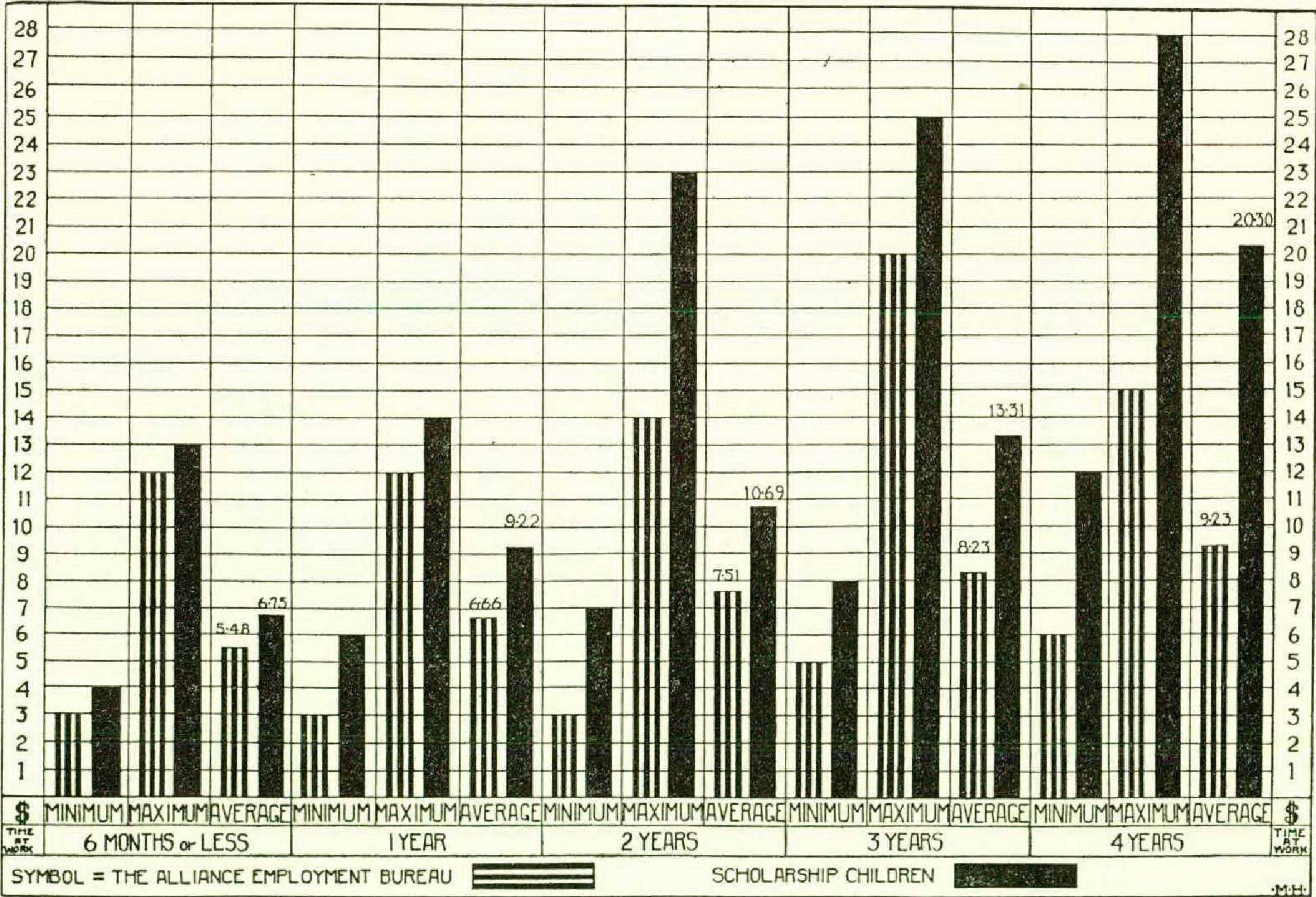
One of the accompanying charts compares the wage-earning capacity of the boys and girls who have had the advantage of these scholarships, with that of an equal number of untrained young people whose careers are known through their industrial placement by perhaps the most careful juvenile employment agency in the city.2 The deductions that we made from the experience of the Henry Street children were corroborated by an inquiry made by one of our residents into the industrial history of one thousand children who had applied for working papers at the Department of Health. The employment-record chart was compiled from data obtained in that inquiry.
POSITIONS HELD
LENGTH OF TIME IN EACH
KIND OF WORK
FIRST
3 DAYS
IN FACTORY, SORTING BUTTONS
SECOND
2 MONTHS
RIBBONING CORSET COVERS MACHINE WORK ON THEM
THIRD
WEEK
RIBBONING & BUTTONING CORSET COVERS
FOURTH
TIME UNKNOWN
LADIES UNDERWEAR
FIFTH
UP TO CHRISTMAS
ERRAND GIRL
SIXTH
254 MONTHS
RIBBONING CORSET COVERS
SEVENTH
TIMEUNKNOWN
ERRAND GIRL
EIGHTH
A FEWWEEKS
TRIM, CUT, & EXAMINE MENS TIES
NINTH
A FEWWEEKS
RETURN TO SECOND JOB
TENTH
A FEWWEEKS
HOMEWORK, RIBBONING
Our connections in the city enable us occasionally to coax opportunities for those boys and girls for whom experience in the shop itself would seem best. Jimmy had lost a leg ‘ hooking on the truck,’ and his mother supposed that ‘such things happen when you have to lock them out all day.’ In the whittling class the lad showed dexterity with the sloyd knife, and he was thereupon given special privileges in the carpentry and carving classes of the settlement. When he reached working age, one of our friends, a distinguished patron of a high-grade decorator, induced the latter to give the boy a chance. Misgivings as to the permanency of his tenure of the place were allayed when Jimmy, aglow with enthusiasm over his work, brought a beautifully carved mahogany box and told me of the help the skilled men in the shop were giving him. On the whole, he concluded/ a fellow with one leg ’ had advantages over other cabinet-makers; ‘he could get into so many more tight places and corners than with two.’
Bessie and Jimmy and Pippa and Esther and their little comrades stir us to contribute our human documents to the propaganda instituted in behalf of children. In this, as in other experiments at the settlement, we do not believe that what we offer is of great consequence unless the demonstrations we make and the experience we gain are applicable to the problems of the community. On no other single interest do the members of our settlement meet with such unanimity. Years of concern about individual children might in any case have brought this about, but irresistible has been the influence exercised by Mrs. Florence Kelley, now and for many years a member of the settlement family. She has long consecrated her energies to securing protective legislation throughout the country for children compelled to labor; and, with the late Edgar Gardiner Murphy of Alabama, suggested the creation of the National Child Labor Committee, which in its ten years’ existence has affected legislation in forty-seven states by securing the enactment of new or improved child-labor or compulsory-education laws. On this and on the New York Committee Mrs. Kelley and I have served since their creation.
Though much has been accomplished during this decade the field is immensely larger than was supposed, and forces inimical to reform, not reckoned with at first, have been encountered. Despite this opposition, however, we believe that the abolition of child-labor abuses in America is not very far off.
In Pennsylvania, within a very few years, insistence on satisfactory proof of age was strenuously opposed. Officials who should have been working in harmony with the committee persisted in declaring that the parent’s affidavit, long since discarded in New York State, was sufficient evidence, despite the fact that coroners’ inquests after mine disasters showed child workers of ten and eleven years. The Southern mill children, the little cranberrybog workers, the oyster shuckers, and the boys in glass factories and mines have illustrated the fact that this disregard of children is not peculiar to any one section of the country, though Southern states have been most tenacious of the exemption of children of ‘dependent parents’ or ‘orphans’ from working-paper requirements.
In the archives at Washington much interesting evidence lies buried in the unpublished portions of reports of the federal investigation of the work of women and children. One mill-owner greeted the government inspectors most cordially, and, to show his patriotism, ordered the flag to be raised above the works. The raising of the flag, as it afterwards transpired, was a signal to the children employed in the mill to remain at home. In the early days of child-labor reform in New York the children on Henry Street would sometimes relate vividly their experience of being suddenly whisked out of sight when the approach of the factory inspector was signaled.
It is perhaps unnecessary to mention the obvious fact that the child worker is in competition with the adult and drags down his wages. At the Child Labor Conference held in Washington in January, 1915, a manufacturer in the textile industry cited the wages paid to adults in certain operations in the mills as fourteen cents per hour where there were prohibitive child-labor laws, and eleven cents an hour where there were none.
The National Child Labor Committee now asks Congress through a federal bill to outlaw interstate traffic in the labor of children. Such a law would protect the public-spirited employer who is now obliged to compete in the market with men whose business methods he condemns.
II
Sammie and his brother sold papers in front of one of the large hotels every night. The more they shivered with cold the greater the harvest of pennies. No wonder that the white-faced little boy stayed out long after his cold had become serious. He himself asked for admission to the hospital and died there before his absence was noted. After his death relat ives appeared, willing to aid according to their small means, and the relief society increased its stipend to his family. At any time during his life this aid might have been forthcoming, had not the public unthinkingly made his sacrifice possible by the purchase of his papers.
Opposition to regulating and limiting the sale of papers by little boys on the streets is hard to overcome. A juvenile literature of more than thirty years ago glorified the newsboy and his improbable financial and social achievements, and interest in him was heightened through a series of pictures by a popular painter, wherein ragged youngsters of an extraordinary cleanliness of face were portrayed as newsboys and bootblacks. In opposition to the charm of this presentation, the practical reformer offers the photographs, taken at midnight, of tiny lads asleep on gratings in front of newspaper offices, waiting for the early editions. He finds in street work the most fruitful source of juvenile delinquency, with newsboys heading the list.
I am aware that at this point numerous readers will recall instances of remarkable achievements by the barefoot boy, the wide-awake young newsseller. We too have known the exceptional lad who has accomplished marvels in the teeth of—sometimes because of — great disadvantages; but after twenty years I, for one, have no illusions as to the outcome for the ordinary child.
When the New York Child Labor Committee secured the enactment of a law making it mandatory for the school boy who desired to sell papers to obtain the consent of his parents before receiving the permissive badge from the district school superintendent, we sent a visitor from the settlement to the families of one hundred who had expressed their intention to secure the badge. Of these families, over sixty were opposed to the child’s selling papers on the street. The boy wanted to ‘ because the other fellows did,’ and the parents based their objections, in most cases, on precisely those grounds urged by social workers, — namely, that street work led the boys into bad company, irregular hours, gambling, and ‘waste of shoe-leather.’ Some asserted that they received no money from the children from the sale of the papers. On the other hand, a committee of which I was chairman, which made city-wide inquiry into juvenile street work, found instances of well-to-do parents who sent their little children on the streets to sell papers, sometimes in violation of the law.
The three chief obstacles to progress in protection of the children are the material interests of the employers, many of whom still believe that the child is a necessary instrument of profit; a sentimental, unanalytical feeling of kindness to the poor; and the attitude of officials upon whom the enforcement of the law depends, but who are often tempted by appeals to thwart its humane purpose. A truant officer of my acquaintance took upon himself discretionary power to condone the absence of a little child from school on the ground that the child was employed and the widowed mother poor. Himself a tender father, cherishing his small son, I asked him if that was what he would have me do in case he died and I found his child at work. Oddly enough he seemed then to realize for the first time that those who were battling for school attendance for the children of the poor and prevention of their premature employment, even though the widow and child might have to receive financial aid, were trying to take, in part, the place of the dead father.
To meet cases where enforcement of the new standards of the law involves undeniable hardship, another form of so-called ‘scholarship’ is given by the New York Child Labor Committee. On investigation a sum approximating the possible earnings of the child is furnished until such time as he or she can legally go to work. An indirect but important result of the giving of these scholarships has been the continuous information obtained regarding enforcement of the school-attendance law. Inquiry into the history of candidates disclosed, at first, many cases in which, although the family had been in New York for years, some of the children had never attended school, and perhaps never would have done so had they not been discovered at work illegally. The number of these cases is now diminishing.
Allusion to these two forms of * scholarships ’ should not be made without mention of one other in the settlement, known as the ‘Alva Scholarship.’ The interest on the endowment is used to promote the training of gifted individuals and to commemorate a beloved club leader. The money to establish it was given by the young woman’s associates in the settlement, and small sums have been contributed to it by the girls who were members of her own and other clubs.
III
Few people have any idea of the extent of tenement-house manufactures. There are at present over thirteen thousand houses in Greater New York alone licensed for this purpose, and each license may cover from one to forty families. These figures give no complete idea of the work done in tenements. Much of it is carried on in unlicensed houses, and work not yet listed as forbidden is carried home. To supervise this immense field eight inspectors only were assigned in 1913. Changing fashions in dress and the character of certain of the seasonal trades make it very difficult for the Department of Labor to adjust the license list. This explains, to some extent, the lack of knowledge concerning home work on the part of officials, even when the Department of Labor is efficiently administered.
Twenty years ago, when we went from house to house caring for the sick, manufacturing was carried on in the tenements on a scale that does not exist to-day. With no little consternation we saw toys and infants’ clothing, and sometimes food itself, made under conditions that would not have been tolerated in factories, even at that time. And the connection of remote communities and individuals with the East Side of New York was impressed upon us when we saw a roomful of children’s clothing shipped to the Southern trade from a tenement where there were sixteen cases of measles. One of our patients, in an advanced stage of tuberculosis, until our appearance on the scene sat coughing in her bed, making cigarettes and moistening the paper with her lips. In another tenement in a nearby street we found children ill with scarlet fever. The parents worked as finishers of women’s cloaks of good quality, evidently meant to be worn by the well-to-do. The garments covered the little patients, and the bed on which they lay was practically used as a work-table. The possibility of infection is perhaps the most obvious disadvantage of home work, and great changes have been wrought since the days when we first knew the sweatshop; but we are here discussing only its connection with the children.
When work is carried on in the home all the members of the family can be and are utilized without regard to age or the restrictions of the factory laws. One Thanksgiving Day I carried an offering from prosperous children of my acquaintance to a little child on Water Street whose absence from the kindergarten had been reported on account of illness. He had chicken-pox, and I found him, with flushed face, sitting on a little stool, working on knee pants with other members of the family. They interrupted their industry long enough to drag the concertina from under the bed and to join in singing Italian songs for my entertainment, but the father shrugged his shoulders in dissent from my protest against the continuance of the work.
Examination of the school attendance of children who do home work bears testimony to its relation to truancy. Josephine, eleven years of age, stays out of school to work on finishing; Francesca, aged twelve, to sew buttons on coats; Santa, nine years old, to pick out nut meats; Catherine, eight years old, sews on tags; Tiffy, another eightyear-old, helps her mother finish; Giuseppe, aged ten, is a deft worker on artificial flowers.
It is painful to recall the R-family, who lived in a basement, all of the children engaged in making paper bags which the mother sold to the small dealers. Something, w’e know not what, impelled one of the five children to come for help to the nurse in the First Aid Room at the settlement. His head showed evidence of neglect, and when our nurse inquired of him how it had escaped the school medical inspection, the fact was disclosed that he had never been in school. Immediate inquiry on our part revealed the basement sweatshop and the fact that none of the children, all of whom had been born in America, had ever been to school. When the mother was questioned, she answered that she did not like to ask for more aid than she wras already receiving from the relief society; and when we reproved the other children in the tenement for not having drawn our attention to their little neighbors, they answered that they themselves had not known of the existence of the Rchildren because ‘ they never came out to play.’ The stupidity of the mother and the circumstances of the family have continually tested the endurance of their well-meaning friends; nevertheless at this writing the eldest boy is in high school and supporting himself by work outside school hours at a subway news-stand.
What I have written thus far has been in large measure confined to the lower East Side of New York; but it may not be necessary to remind the reader that through the nursing service and other organized work, our contact with the tenement home workers extends over the two boroughs of Manhattan and the Bronx. The settlement has never made a scientific study of work done in the homes, but our information regarding it. is continuous and current. This cumulative knowledge is probably the more valuable because it is obtained incidentally and naturally, and not as the result of a special investigation, which, however fair and impartial, must be somewhat affected by the consciousness of its purpose.
In 1899 a law was passed in New York State licensing individual workers in the tenements for certain trades. In 1904 this law was superseded, primarily at the instigation of the settlement, by one licensing the entire tenement house, thus making the owner of the house responsible. In 1913 a law recommended by the New York State Factory Investigating Commission was passed by the legislature; this law brought under its jurisdiction all articles manufactured in the tenements, prohibited entirely the home manufacture of food articles, dolls or dolls’ clothing, children’s or infants’ wearing apparel, and forbade the employment of children under fourteen on any articles made in tenements.
All our experience points to the conclusion that it is impossible to control manufacturing in the tenements. Restrictive legislation (such as the law forbidding the employment of children under fourteen) is practically impossible of enforcement, for it. is a delusion to suppose that any human agency can find out what manufactures are going on in tenement-house homes. The inspectors become known in the various neighborhoods; and at their approach the word is passed along, and garments on which women are working may be hidden, or the work taken from children’s hands. The more painstaking and conscientious the attempts at enforcement, the more secretive the workers become, and one is forced to the conclusion that the only practical remedy is to prohibit this parasitic form of industry outright. More of the men in these families would go to work if it were not so easy to employ the women and children; and many of the women would be able to work regular hours in establishments suitably constructed for manufacturing purposes and under state inspection and supervision. During the period of transition, suffering will doubtless come to some families whose poor living has been maintained by this form of industry, and relief measures must carry them over the time of adjustment. Most families working at home are already receiving aid from societies which thus indirectly help to support the parasitic trade.
IV
In 1913, 41,507 children of Greater New York secured working papers. The record for 1914 shows about 10,000 fewer seeking work, and consequently that many more in school, because of the amended statute which raised the minimum educational requirement. A public sentiment which keeps boys and girls longer in school emphasizes the need of more educational facilities adapted to industrial pursuits. The children least promising in book studies may often become adepts in manual work, and respond readily to instruction that calls for exercise of the motor energies. The armies of children who go to work immature, unprepared, uneducated in essentials, with no more than a superficial precocity, are likely to be thrown upon the scrap-heap of the unskilled early in life, and yet many of these have potentialities of skill and efficiency.
It is not surprising that with increasing knowledge of the children’s condition, plans for their reasonable employment, guidance, and training should have made advance in the last decade. In some places provision has been made for vocational guidance, and the settlement is now interested in promoting an inquiry for New York City that should lead to the establishment of a juvenile bureau intended to combine vocational guidance and industrial supervision,—a bureau associated with an educational system and dissociated from the free employment exchanges which as yet do not inquire into the character of employment offered.
We believe that continuation schools are necessary for all boys and girls engaged in shop or factory work, and that expert vocational guidance and educational direction should be offered those who leave school to become wage-earners. It is inevitable that to people at all socially minded, close contact with many children should exercise the humanities. The stress that we lay on the enforcement of these protective measures comes from a conviction that the children of the poor, more than all others, need to be prepared for the responsibilities of life that so soon come upon them.
The great majority of the boys and girls accept, passively the conditions of the trade or occupation into which chance and their necessities have forced them. The desire for something different seldom becomes articulate or strong enough to impel them to overcome the almost insuperable barriers. Occasionally, however, the spirit of revolt asserts itself. ‘I work in a sweat-shop,’ said a young girl who brought her drawings to me for criticism, ‘and it harasses my body and my soul. Perhaps I could earn enough to live on by doing these, and my brother bids me to display them and she added, ‘ I could live on three dollars a week if I were happy.’ The drawings were promising and the temperamental young creature, in answer to my questioning, admitted that she had illustrated David Copperfield for pastime and had ‘given David a weak chin.’
The difficulty of proper placement in industry experienced by the ordinary boy and girl is intensified in the case of the colored juveniles. It is now nine years since a woman called at the Henry Street house and almost challenged me to face their problem. She was what is termed a ‘ race woman’ and desired to work for her own people. It was not difficult to provide an opening, and the Henry Street Settlement has now a distinct branch of its work in the section known as ‘ San Juan Hill,’ on the West Side of the city. To find admirably trained and efficient colored nurses was a comparatively simple matter; and the response of the colored people themselves in this respect was immediately encouraging. Necessity for patient adherence to the principle of giving opportunity to the most needy children, that they may be better equipped for the future, is emphasized in the case of the colored children in school and w’hen seeking work; but difficulties, mountainous in proportion and testing the most buoyant optimism, loom up when social barriers and racial characteristics enter into individual adjustments. The restricted number of occupations open to them discourages ambition and in time reacts unfavorably upon character and ability; and thus we complete the vicious circle of diminishing opportunities and lessening vigor and skill. Colored women are often conspicuously good and tender mot hers, and as I have watched large groups of them assembled in their club rooms, exhibiting their babies with justifiable pride, I have felt a wave of unhappiness because of the consciousness of the enormous handicap with which these little ones must face the future.
A distinguished musician told me not long ago that he gave specially of his time and talent to the colored people of New York because of a debt that he owed to a gifted colored neighbor. When he was a boy, his attempts to play the violin attracted the man’s attention; the latter offered his services as instructor when he learned that the boy could not afford to take lessons. The colored man had great talent and had studied with the best masters in Europe, but when he returned to America he was unable to obtain engagements or procure pupils, and in order to earn his living was obliged to learn to play the guitar. Discouraging as was his experience, there is, I believe, relatively freer opportunity for the exceptionally gifted of the colored race in the arts and professions than for the ordinary young men and women who seek vocational careers.
V
Experience in Henry Street, and a conviction that intelligent interest in the welfare of children was becoming universal, gradually focused my mind on the necessity for a Federal Children’s Bureau. Every day brought to the settlement, by mail and personal call, ■— as it must have brought to other people and agencies known to be interested in children, — the most varied inquiries, appeals for help and guidance, reflecting every social aspect of the question. One well-known judge of a children’s court was obliged to employ a clerical staff at his own expense to reply to such inquiries. Those that came to us we answered as best we might, out of our own experience, or from fragmentary and incomplete data. Even the available information on this important subject was nowhere assembled in complete and practical form. The birth-rate, preventable blindness, congenital and preventable disease, infant mortality, physical degeneracy, orphanage, desertion, juvenile delinquency, dangerous occupations and accidents, crimes against children, are questions of enormous national importance concerning some of which reliable information was wholly lacking.
Toward the close of President Roosevelt’s administration a colleague and I called upon him to present my plea for the creation of this bureau. On that day the Secretary of Agriculture had gone South to ascertain what danger to the community lurked in the appearance of the boll weevil. This gave point to our argument that nothing that might have happened to the children of the nation could have called forth governmental inquiry.
The Federal Children’s Bureau was conceived in the interest of all children; but it was fitting that the National Committee on which I serve, dedicated to working children, should have become sponsor for the necessary propaganda for its creation.
It soon became evident that the suggestion was timely. Sympathy and support came from every part of the country, from Maine to California, and from every section of society. The national sense of humor was aroused by the grim fact that whereas the federal government concerned itself with the conservation of material wealth, mines and forests, hogs and lobsters, and had long since established bureaus to supply information concerning them, citizens who desired instruction and guidance for the conservation and protection of the children of the nation had no responsible governmental body to which to appeal.
Though the suggestion was approved by President Roosevelt and widely supported by press and people, it was not until the close of President Taft’s administration that the Federal Children’s Bureau became a fact, and the child and all its needs were brought within the sphere of federal care and solicitude. The appointment of Miss Julia Lathrop, a woman of conspicuous personal fitness and adequate training, as its first chief, was a guaranty of the auspicious beginning of its work. In the brief time of its service it has had continuous evidence that the people of these United States intelligently avail themselves of the opportunity for acquiring better understanding of the great responsibility that is placed upon each generation.
The Federal Children’s Bureau would not fulfill the purpose of its originators if its service were limited to the study and record of the pathological conditions surrounding children. Its greatest work for the nation should be, and doubtless will be, to create standards for the states and municipalities which may turn to it for expert guidance and advice. With the living issues involved it is not likely to become mechanical.
The Children’s Bureau is a symbol of the most hopeful aspect of America. Founded in love for children and confidence in the future, its existence is enormously significant. The first time I visited Washington after the establishment of the bureau I felt a thrill of the new and the hopeful, and I contrasted its bare office with the splendid monuments that had been erected and dedicated to the past. Some day, I thought, a lover of his country, understanding that the children of to-day are our future, will build a temple to them in the seat of the federal government. This building will be more beautiful than those inspired by the army and navy, by the exploits of science or commemoration of the dead. As my imagination soared I fairly visualized the Children’s Bureau developed, expanded, drawing from all corners of the land eager parents and teachers, not only to learn the theory of child culture, but to see demonstrations of the best methods in playgrounds, clinics, classes, clubs, buildings, and equipment. The vision became associated with a memory of the first time I saw the Lucca della Robbias on the outer wall of the Florentine asylum and felt the inspiration of linking a great artist with a little waif. But these lovely sculptured babes are swathed. Some day, when the beautiful building of the Federal Children’s Bureau is pointed out in Washington, I have it in my heart to believe that the genius who decorates in paint or plastic art will convey the new conception of the child, — free of motion, up-looking, the ward of the nation.
(To be continued.)
- Because of economic conditions in New York during the winter of 1915 and the compulsory idleness of many unskilled workers, the Scholarship Committee of the Henry Street Settlement, among other efforts for relief, rented a loft in a building near a trade school, and thus made it possible for 160 untrained girls to receive technical instruction, the Board of Education providing teachers and equipment. — THE AUTHOR.↩
- That the ephemeral character of work available for children of fourteen to sixteen years of age is not peculiar to New York City is shown by the following figures from the report of the Maryland Bureau of Statistics for the year 1914. In Maryland, working papers are issued for each separate employment. The number of original applications in one year was 3,580 and the total of subsequent applications 4,437. Of the 3,580 children 2,006 came back a second time, 1,036 a third time, 561 a fourth, 363 a fifth, 194 a sixth, 116 a seventh, 53 an eighth, 29 a ninth, 18 a tenth, and one child came back for the eighteenth time in a twelvemonth, for working papers. Many of the children told stories of long periods of idleness between employments. — THE AUTHOR.↩