Large Fortunes
I
THE hostility to large fortunes does not diminish with time and events. The violent denunciations of the discontented classes, or of the more extreme socialists, find an echo in the ranks of the more conservative groups. Into these expressions, evidently based on strong convictions, has entered the sting arising from a passionate sense of wrong: that these enormous accumulations are possible only at the expense of the poor; and that women and children go cold and hungry in order that others may go warmly clad and live luxuriously. In this point of view there is a hopelessness which serves as the incentive to brute force, to wild assaults upon the bulwarks of property and institutions. What are we coming to ? Are the times out of joint ? Certainly, we are forced to face the facts as found in the thinking of great numbers of people.
To say that a man is a multi-millionaire is to many equivalent to saying that he is an enemy of society, reaping where he has not sown, and protecting himself in his vast possessions only by the corrupt control of municipal councils, legislatures, and even the highest courts. It is this state of mind which leads some intelligent writers to hint of another French Revolution, and of prison bars for the financial kings. Yet, as we look back a century, there was not, at least in the United States, any such antagonism between rich and poor. Perhaps the contrasts between the richest and the poorest were far less marked then than now, and the causes of dissatisfaction due to impotent rivalry were more generally absent. In those earlier days, obviously, the total wealth of the community in all forms was very small in comparison with its diffusion to-day.
In Parkman’s account of La Salle’s marvelous winter journey from Fort Crèvecœur on the Illinois to Fort Frontenac at the eastern end of Lake Ontario, we get a vivid picture of a region now covered by a busy, struggling, commercial community. Then, “The nights were cold, but the sun was warm at noon, and the half-thawed prairie was one vast tract of mud, water, and discolored, half-liquid snow.” Often without food, watching by night against Indians, and marching by day, loaded with baggage; “sometimes pushing through thickets, sometimes climbing rocks covered with ice and snow, sometimes wading whole days through marshes where the water was waist-deep,” La Salle spent sixty-five weary days in this thousand-mile journey to Fort Frontenac. How far in the past all that is now! Over against the picture of La Salle set one of a modern journey in a warm luxurious Pullman car, which travels over the same distance within a single day. The contrast is great; but what has happened on this “half-thawed prairie” since La Salle passed by ? What are the forces that have changed the world of La Salle into the rich, bustling world of today ? In his time there were in this region numbers of human beings, the same soil, the same climate, the same rivers and lakes, as now. Why should there not have been then the same vast wealth which we see about us now, — great canons of skyscrapers, miles of factories, scores of converging railways, and millions of shipping tonnage?
Of the two chief forces at work to produce this miraculous transformation, evidently one is the power to grasp an ideal, or future gain, so distinctly that present action, or indulgence, is directly controlled thereby. This quality of human beings is the first and most fundamental characteristic of civilization. It is the absence of it which forms the Mexican, the negro, or the inefficient savage. So improvident were the Paraguay Indians, so Mr. Rae tells us, that they cut up their ploughing oxen for supper. It is the presence of it which makes possible the docks, bridges, steamships, and irrigation schemes, all of the returns from which will be received only many decades hence. Moreover, it is the quality which causes saving, — the very reason for the existence of capital. The willingness to forego consumption for a present indulgence in order to gain some future object is only a description of the process by which capital comes into being.
This physical world, on which the human mind can have its play, is as interesting in its capabilities as a conjuror’s hat; almost anything can be got out of it, almost everything depends upon what we ourselves are, upon our skill in handling nature. In the infancy of civilization, mankind, with only crude, unaided effort, could produce only a little more than subsistence. This little excess, however, could be saved, put into simple implements of industry which made labor more efficient, again made possible new savings, more implements, and, in the endless round of centuries, the final accumulation of traveling cranes, harvesters, motors, telephones, and rapid communication by steam and electricity, — in brief, all the marvelous efficiency of present industry. All this would have been impossible on the prairie of La Salle without a people capable of duly estimating the future over the present.
This array of the productive forces of society shows the necessity of capital to the present output of wealth, and to the present welfare of all classes. If men had not been, decade after decade, saving and storing up capital, it would be as impossible to employ the great mass of laborers now existent, as it would be to feed an army in the field on promises instead of on solid rations. Some over-wise persons among us growl ominously about the right of capital to exist, or to share in the results of production: this is as if, forgetting the necessity of air for human existence, we should object to air in general because it is sometimes dirty or malodorous. Capital, it is true, may be unfairly used by industrial managers; and yet it is quite as necessary to the life of industry as air is to the human body.
Capital, however, is only one of the means by which the human brain has shown its capacity to enlarge the satisfactions of society. Besides the implement, there must be the power to direct the implement. The second force necessary to recreate the “half-thawed prairie” of La Salle is the devising and organizing mind of the “Captain of Industry,” the mind competent to manage labor as well as capital, and to direct them both in successful enterprises. The possibilities of production are never realized without this direction by preeminent managerial ability. Yet to some minds, possibly, this proposition does not appear as axiomatic.
Seemingly, everything will go on satisfactorily when we have present all the essential factors of production: (1) boundless natural resources, in fields, mines, and waters; (2) accumulations of capital, as just described, which allow us to discount the future in long-lived enterprises; and (3) abundant human labor. Something, however, is still lacking. Leadership is as essential in industry as in politics or anything else. Human labor may mean nothing, or everything. Therein lies the understanding of much that is puzzling in our economic problem. Is labor all of a kind ? obviously not. Taking the world as we find it, — and not as we may see it in dreams, — as there are all kinds of work to be done in the industrial field, so there are all kinds of men in respect of intelligence, efficiency, and productive capacity to perform these tasks. In the republic of work there is no Declaration of Independence which pronounces “all men equal.” Before the law, as respects rights and liberty, all are, of course, equal; but in the practical operations of industry some are privates, some are captains, and some are great generals and geniuses. As an army needs officers, so the industrial organization needs managers. In fact, whether the industrial campaign ends in success or not, for high or low, depends preeminently upon the quality, insight, and guidance of the leader in charge. Good management means large product; poor management means ruin.
The human element in production, whether in the work of guidance or in obedience, varies as widely as human nature and capacity. Tot homines,tot capacitates. For services to production, laborers may be roughly classified by strata, as in the accompanying diagram:
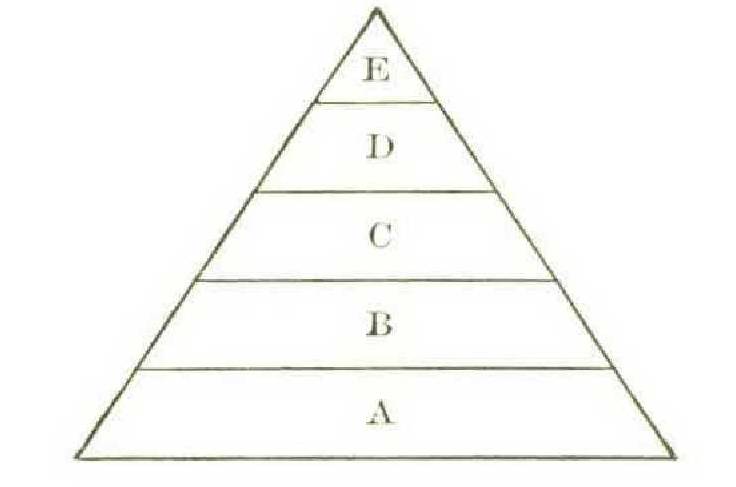
The unskilled men in A, the slightly skilled in B, the highly skilled artisans in C (such as the locomotive engineers), the highly educated professional men in D (such as civil engineers, electrical experts, and the like), and finally the exceptionally capable managers in E. In any one industry some of each kind are required, but not with the same intensity of demand; nor are they wanted in the same relative numbers in different industries.
The unskilled man in A has no choice of occupations that he can enter; he can do only the work demanded of his class. And yet, as compared with the demand for them, the number of laborers in this strata is enormously large. Moreover, in the A class there is the least capacity to set the future gain above the present indulgence. Thus we find increasing numbers in the very group whose activity is restricted to a given kind of work. Among those least competent to add to production, there is the greatest supply relatively to the demand for them. Their share is small, not only because their industrial efficiency is small, but because the supply of them is excessive.
As we go up in the scale of industrial efficiency, we find the numbers in the strata of the more highly skilled diminishing, while the intensity of the demand for them increases. Hence wages increase the higher we go. In the top strata, containing the most efficient managers, we find the highest wages paid throughout the whole industrial field. When a blundering or incompetent manager costs a company millions in losses, a fifty-thousand-dollar man, who adds millions in gains, is a cheap laborer. In this struggle up the scale from A to E we find the real social conflict. It is a contest between different kinds of laborers, — a contest of varying grades of industrial capacity with each other. It is a frce-to-all race, in which the most competent win. The great industrial manager, being the most highly skilled laborer, obtains enormous wages for exceptional services to production. This exposition gives us, in brief, the economic reason why, in a country of phenomenal resources like the United States, men of exceptional industrial ability can acquire exceptionally large fortunes legitimately.
Such an outcome is not confined to one field of activity. Great capacity which has shown its effects in literature, art, music, oratory, or statescraft, will none the less come to the fore in industry. In this country, where our resources are almost untouched, and where chances are open to all, great managerial power can no more be prevented from accumulating large fortunes than great oratory or great learning can be prevented from winning success and fame. It is as silly to carp at great industrial capacity as it would be to carp at great literary ability. Great wealth, like high office, is power; we cannot object to the one any more than to the other. As a race, we have been working, in the domains of law and government, for centuries, not to abolish high office, but to regulate it by proper checks and balances so that it may work for the good of the many; and, in the domain of economics, it is equally our task, not to attack large fortunes in themselves, but intelligently and without hysterics to set about the creation of checks and balances by which great power in the form of wealth may be so controlled that it will do no injury to the many.
In adjusting our actions to the facts in connection with the accumulation of vast wealth, we must keep one other point clearly in mind. In the general and indiscriminate condemnation of great gains this following consideration is frequently overlooked. Industrial managers could not themselves legitimately accumulate large fortunes, unless by their operations they had in some way abridged the sacrifices of production, or given the public a better article or a better service, or one at a lower cost, or had in one way or another created a vast new wealth, out of which they have been able to take only a part. A few illustrations of this principle may not be amiss.
In southeastern Europe, Baron Hirsch amassed a princely fortune by insight into the means of new and improved transportation for the region of the lower Danube. The resources of inaccessible districts in the Balkan States were as if they did not exist: cut off from markets, there was no employment of capital, and laborers lived a pitifully mean existence. With the vision of a prophet this man of exceptional managerial power wove webs of railways throughout those districts capable of improvement, and brought a market and employment to these men in skirts and turbans, such as had never before stimulated their industry or rewarded their labor. A new surplus wealth came into existence; out of the carriage of the new goods Baron Hirsch obtained a profit on his railways. The toll he took from the new millions made up a large reward to him, but it was only the fraction of a vastly larger gain which he gave to those communities by his judgment and capacity. And it may be added here, by way of parenthesis, that he would have increased the wealth of this region far more than he did, if he had not been hampered at every turn by t lie* ignorant interference of governmental control of rates, especially in connection with through transit.
Coming nearer home, another instance can be found when the first Vanderbilt, at a time when his outlook was far beyond that of his contemporaries, foresaw the possibilities of opening up the empire between the Great Lakes and the Atlantic seaboard. On the thin, stony soil of New England farmers were growing wheat and corn, but at a high cost in effort and outlay; while the rich loam of the prairies from Indiana to Dakota was as little known as the Soudan of to-day. The valley of the Genessee, in western New York—later known as a fertile wheat region, and now celebrated for its dairy products— was then scarcely touched by the plough. For opening up the uncounted resources of this splendid region, Mr. Vanderbilt risked all the capital he had, or all he could control, in a scheme to connect New York with Buffalo. He bought short railways already built, constructed connecting links, until the line crept up the Hudson to Albany, thence westward along the easy grades of the Mohawk, past the Genessee, to the Great Lakes. What was the result ? He made possible the settlement and cultivation of whole states, he gave an outlet to markets for the products of field and mine, not only along the course of his railway, but in all the territory reached by the Great Lakes. Immigrants and capital poured in, while goods moved both in and out, permitting the profitable investment of untold millions in all the industries of this vast interior. And the day laborer in New England could transport his sustenance of a year from the rich prairies to his place of work for the price of one day’s toil. If Mr. Vanderbilt accumulated fifty or sixty millions of dollars by this great labor-saving machine, it was possible only because he had enriched the country a thousand - fold more. The penetration which saw a great opportunity gave him a profit in proportion to the extent of the enterprise. It was not a case of monopoly; any one else, equally capable, would have been free to do the same thing. The truth is, his kind of insight and ability was rare, — and it remains rare to-day.
Without multiplying instances, it is perfectly possible to see that these captains of industry may accumulate millions, not only without robbing others, but in the process of benefiting others, especially those who are in search of employment. Men of this character serve precisely the same function as the inventors of laborsaving devices. When a Howe invented the sewing machine, he abridged human effort in obtaining clothing. He secured a fortune out of the new surplus of wealth made possible by his addition to the efficiency of the human race in its productive efforts. The same is true of the invention and manufacture of harvesters and agricultural implements. The farmer voluntarily chooses the machine, because it lowers the cost of getting the wheat into his bags. If it had not been a gain to the farmer, the machine would not have been introduced. The profits made by makers of such devices, therefore, are not stolen from the farmer.
If it be said that these gains are not made at the expense of the consumer, but at the expense of the laborer, it must be recalled that in this free land it is open to any laborer to get the high returns of managerial capacity, if he can prove his competency; and he need not continue to receive low wages, if he can increase his industrial efficiency in the processes of production.
II
It is, of course, perfectly understood how unpopular such exposition as this which has been already given may be. Moreover, it is likely to be said—even though there is not a word of truth in it — that these utterances have been influenced by pressure upon academic liberty. In spite of the evident dangers of misrepresentation, however, it is always worth while to put forth the truth according to one’s convictions and investigations. If criticism is carping, and scant of logic and impartiality, its day will not belong.
While one must, therefore, set forth only what appears to be scientifically sound, and that which appears to be true, as distinct from popular prejudice or misconception of the facts, still, no one can be oblivious to other sides of the case than that presented above. Why should there be so widespread a conviction, honestly held, that the rich are harpies preying upon the poor, and gaining large fortunes unrighteously ? Obviously, in replying to such a question, not everything involved in it can be here treated; but some of the main considerations may be touched upon.
In the first place, it is no more likely to be true that all managers are good and just than that all workmen are honest and faithful. There are, and will be, good and bad managers, just as there are, and will be, good and bad workmen. The error of the popular prejudice against the possessors of large fortunes consists in making the line between the good and the bad coincident with the line between the successful and the unsuccessful in money-getting. In truth, the line between the good and the bad cuts through both classes. It is as foolish to suppose that all money-makers are wicked as to suppose that all men with brown eyes are wicked. An evil man will show his bad qualities, whether rich or poor. If a manager of great capacity is of this sort, then when he comes into control of capital he may unscrupulously grind his workmen, cheat his creditors, buy franchises by bribing city councils, corrupt legislatures, — and cynically defy the outraged public opinion of the community. Such a man is not unknown to us. He is to honest industry what the grippe is to sound health, — he weakens the whole system. By unfair methods, by dishonesty, by bribery and corruption, large fortunes, just as high office, may be illegitimately accumulated. A man may thus add no new wealth to the community, but merely transfer wrongly to himself wealth which others have produced. Because of such gains, however, it is not a mark of maturity to condemn sweepingly all gains. We must discriminate; and we must know the facts before we pass judgment.
Discrimination,also, should be properly exercised in making a clear distinction between the way in which a fortune is accumulated, and the way in which it is used after it is won. The one may be right, the other may be wrong. Great wealth may be honestly gained by adding to the efficiency of production; and then an unprincipled owner of this new wealth may put the power resident therein to mean or vicious uses. Many of us can recall a railway magnate of unsavory reputation who, in all probability, gained a considerable part of an immense fortune quite legitimately by reason of his remarkable insight into industrial problems; and yet, if we are to believe the evidence of the press, he used his gains in wrecking railways, — selling the stock short, impoverishing the weaker shareholders, buying the stock for a song, and then putting up the price of the securities again by restorative management. Is it any wonder, therefore, that undiscriminating people sweepingly condemn all large fortunes as dangerous to the common weal ? Dishonorable use of wealth is probably no more common than dishonorable conduct in public office. But, while it is possible for large fortunes to be rightly earned, no one wishes to defend or apologize for the improper use of that which has been well come by.
Best of all, for the man who has not only honorably won his wealth, but who has spent it honorably, we have good ground for admiration and high acclaim. When a certain New England youth left the elmshaded streets of Danvers, he was poor in purse, but rich in high purposes, kindly sympathies, and an untried capacity for accumulating wealth. He has been dead these many years; but the great wealth of George Peabody nourishes the literary life of his native town with books and libraries; vast accumulations of scientific material relating to the early history of this continent, placed in Cambridge by George Peabody’s munificence, will serve thousands of students in all the years to come; and year after year, to the present day, a commission of the best and wisest of our public men have gathered to distribute a splendid fund devoted by this rich philanthropist to the elevation of the negro, to the growth of education in the South, and to the security of our institutions.
While such lives as George Peabody’s give the lie to undiscriminating condemnation of all large fortunes, yet there exists a condition in our political development which may justly give us great concern. Things are going on in our local and national councils which give plausible grounds to the agitators who speak against existing institutions in curses as bitter as quinine. To buy the easy passage of legislation of a “boss” is the common method of business men who look for short cuts to their objective. In some persons, who control legislative votes, resides the power to blackmail rich corporations by rumors of examination, to furnish favors, and to exact campaign contributions, which would do credit to a Spanish governor in a distant colony. Even if the thing desired is something quite proper and necessary in itself, it becomes the usual thing, to save time and annoyance, to hand a purse to an attorney of dubious standing and instruct him to secure the passage of the ordinance or bill. More than that, the belief has become widespread that the national councils contain men who are the representatives of private financial interests, and that remedial legislation for the benefit of the general consumer is blocked by the long purses of the rich for the protection of their private interests. The bribing morals of such members of the rich element among us are largely responsible for the corrupt municipal council and the venal legislature. Correct the bribing morals of those who possess the means to bribe, and there would be “nothing in it” for the debased councilman or legislator.
If we have no moral responsibility in the use of wealth, then we shall have abuses arising from the disposal of wealth, just as from the disposal of power in any other form. Millionaire wealth, I repeat, is millionaire power. The right or wrong of it is not in the wealth, or power, itself, but in the controlling spirit behind this wealth. It is not the knife of the assassin we detest, but the assassin himself who wields the knife. If we insist on venting our displeasure on the existing system of distribution, by all means let us direct our vituperation, not against wealth, but against the turpitude which makes a wrong use of a power that has endless possibilities for good. A gun fired against a brutal foe in defense of family and country may be glorious; but the same gun fired for vanity and for selfish conquest over a weak people is damnable.
As in most questions which are complex, we need discrimination and knowledge of the facts before judgment is passed. One must have little patience with the narrow-mindedness which energetically works in season and out of season to get sweeping legislation to level the inequalities of wealth, or to prevent the existence of large fortunes. It is like establishing ordinances against knives, or razors, because someone may make a bad use of them. There will be inequalities of wealth just as long as there are differing industrial capacities in men. It would be as futile to attempt to regulate accumulations of wealth as to legislate on the weather. The extreme bitterness against wealth is in large part made up of envy. It is like the “yawp” of a dog running alongside an express train, indignant that it cannot run as fast, or make as big a noise, as the train.
Instead of destruction, the higher way always is by construction. The wrong is not in the gun, but in the man who wrongly directs the gun. The one thing that we can all do, and do strenuously, is to work all together for a higher standard of morals and character in the person who controls the power of wealth. We can refuse social recognition, or public office, and the esteem of his fellows, to the debased manager of power, be it power in the form of wealth, or brains, or inherited prestige. The indictment of all wealth without discrimination is folly, for large fortunes may be honorably won, and honorably spent; fortunes honorably won may be dishonorably spent; fortunes dishonorably won may be honorably spent; and fortunes may be dishonorably won, and dishonorably spent. Here is our whole subject in a nutshell.