Song-Forms of the Thrush
SEVERAL years ago, while reading in an old number of the Atlantic Monthly an admirable description by Wilson Flagg of the song of the hermit thrush, I came upon the following sentence : “ I have not been able to detect any order in the succession of these strains, though some order undoubtedly exists and might be discovered by long-continued observation.” This suggested a question : Had any one ever attempted to solve the old naturalist’s problem ? So far as I could remember, no one among the hundreds of observers who had exhausted their vocabularies in descriptions of thrush songs had made the effort, not even Solomon Cheney in his delightful Wood Notes Wild, nor Schuyler Mathews, whose musical notations of thrush songs were so accurate and so sympathetic. The thought flashed upon me that here was an unoccupied field, a territory into which perhaps only the most sanguine would dare to venture, but still a region unexplored and alluring in possibilities. Such a temptation was irresistible, and when spring brought once more the liquid sound of wood thrush notes, with the rarer whispered songs of migrating hermits, olive backs, and veeries, I began my task, not without some misgivings as to my success, but sure of one thing, — that, even if the problem proved insoluble, the search itself would be a delightful occupation.
Spring and summer, then, I listened to thrushes in Ohio, New England, and Canada; tramping beside sluggish western streams or along ravines carved out of the Ohio plains, scrambling through New England woods and pastures, climbing mountains in Canada, or rowing along the rocky shores of northern lakes. At the outset I encountered a difficulty, that I never could wholly overcome, in the problem of determining the form of the phrases I heard. I had to learn to ignore all sorts of conflicting sounds, from the notes of rival singers to locomotive whistles, to adjust a pitch pipe to match a tone held in the memory while the bird himself was uttering a different one, and to accustom myself to the occasional sudden introduction by any singer of new variations in his song. But the thrushes’ delivery was slow, their phrases were repeated continually, and the tones themselves were so clear that before long the matter of recording became somewhat less perplexing, although never very easy.
But in the process of learning to identify the songs by the pitch-pipe a new difficulty appeared in the absence of any recognized way of representing the sounds actually uttered by the thrushes. The birds’ pitch was of course entirely free, whereas the musical staff provided for only a conventional series of tones differing by fixed intervals; and when the pitch-pipe faithfully recorded intermediate quarter or eighth tones — that is, a trifle sharp or flat —there was no way of representing them. I experimented for a while with various devices, hoping that I might discover some way to record the actual sounds, but I finally abandoned the problem as practically insoluble. As the study of the birds’ songforms progressed I came, however, to console myself for the lack of exactitude by the discovery that thrushes tended steadily to approximate the intervals of the human scale. They were rarely just on the key, but they were generally close to it, never failing to suggest the conventional pitch.
Having determined, then, while recognizing the imperfections of my method of recording, to use it as a fairly satisfactory one, I amassed a great number of thrush song-forms, and from these I derived the following facts, noted from wood thrushes in Ohio, Massachusetts, and Quebec. From the beginning, I was greatly surprised to discover how few really distinct phrases the wood thrushes used. Very many had no more than three, the great majority used but four, and only a few had as many as five or six. The finest singers I heard were usually those with only four phrases, which they uttered with such beauty of modulation, and such deliberate excellence, as to suggest the thought expressed by Thoreau: “ He confines himself to his few notes, in which he is unrivaled, as if his kind had learned this and no more anciently.”
These phrases, whether in the eastern or western parts of the wood thrush range, were all very much alike. I have not recorded over twenty different forms, yet only once did I hear precisely the same set used by two birds. In this case they were near neighbors along the river bank, father and son, perhaps, I thought. All the other sets of phrases which I recorded were individual and unmistakable, often coinciding in two phrases or three, only to differ sharply in one or two others.
Here is a typical example of a thrush song with four phrases. Of course it does not pretend to give the actual sounds, or to enable one unfamiliar with the bird to reproduce the song, for the timbre, the unique, individual wood thrush voice, is not to be hinted at by such means. All it does is to symbolize roughly the tones of the musical scale, to which the thrush approximated.
THE RAVINE WOOD THRUSH.
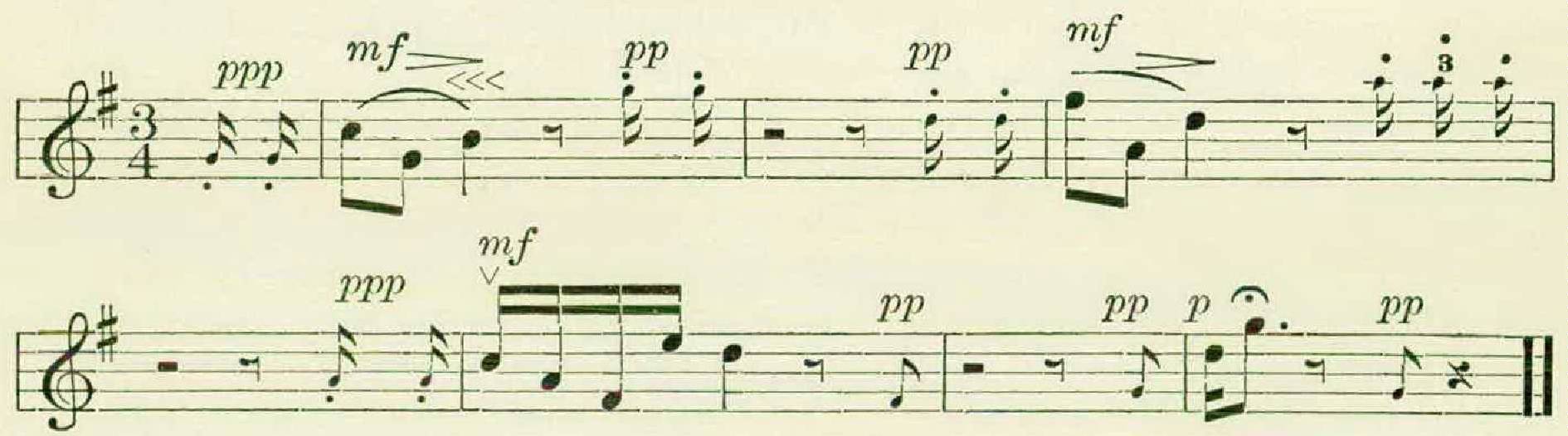
It will be seen that these four phrases were assignable without undue stretching of the truth to the key of G natural. Each began with two or three softly uttered grace notes, continued with three or more loud tones, and concluded with one or more soft staccato notes, sometimes
tinkling or buzzing, and either much higher or much lower than the loud ones preceding. The sotto voce part of the song was inaudible except at close range, but on a few occasions I heard it developed into a whisper song decidedly unlike the well-known flute notes. It will also be observed that these four phrases seemed to form part of a broken melody. The first was introductory in character, uttered with the bird’s richest tones, round and liquid, with an organ tremolo or pulsation on the last note quite unmatched for vibrant beauty by any other bird of the region. The next phrases seemed to continue the musical progress, the second being a cadence into the key of D, the third an arpeggio leading back into G again ; and each of these was sharper and more metallic in quality than the first one, the third being especially rapid and brilliant, equal in dexterity to any of the brown thrasher’s roulades, and far finer in tone. The last phrase, which was thin and reedy, seemed to be a sort of conclusion to the song.
With much the same words the songs of all the other forty odd wood thrushes I studied might be described; for whether they consisted of three themes only, or as many as six or seven, they always had one or more phrases corresponding in musical character to those shown above, and the vocal quality was adjusted after the same manner. The introductory phrases were always rich, full, and round, the continuing ones were less steady in tone, more brilliant, but liable to contain squeaky notes, and the final one was generally soft and reedy. The thrushes did not always hold so clearly to the key as did the “ravine” wood thrush, for now and then one would introduce accidental notes, and occasionally one would sing persistently off the pitch ; but the tendency was to adhere to some one key.
Here are some other examples,, beginning with a thrush who, during months of observation, never used more than three phrases. For convenience we will call him
THE RIVERBANK WOOD THRUSH.

In this simplest of songs the same elements may be seen as in the one previously recorded : introductory, suspending, and final.
Here is another singer, with four phrases, who signalized himself by introducing flats, thereby making a modulation into the minor of his original key.
THE POOL WOOD THRUSH.
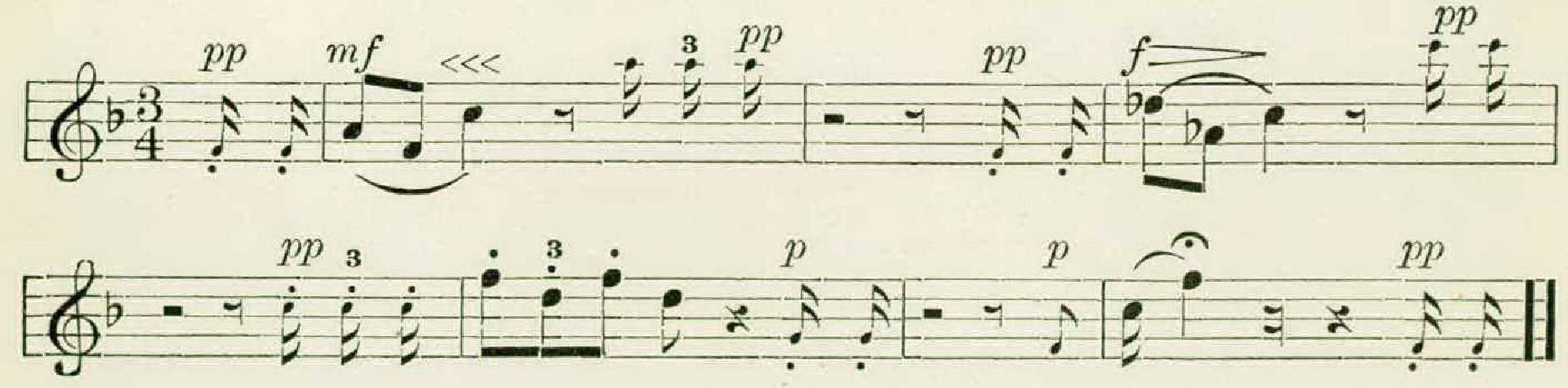
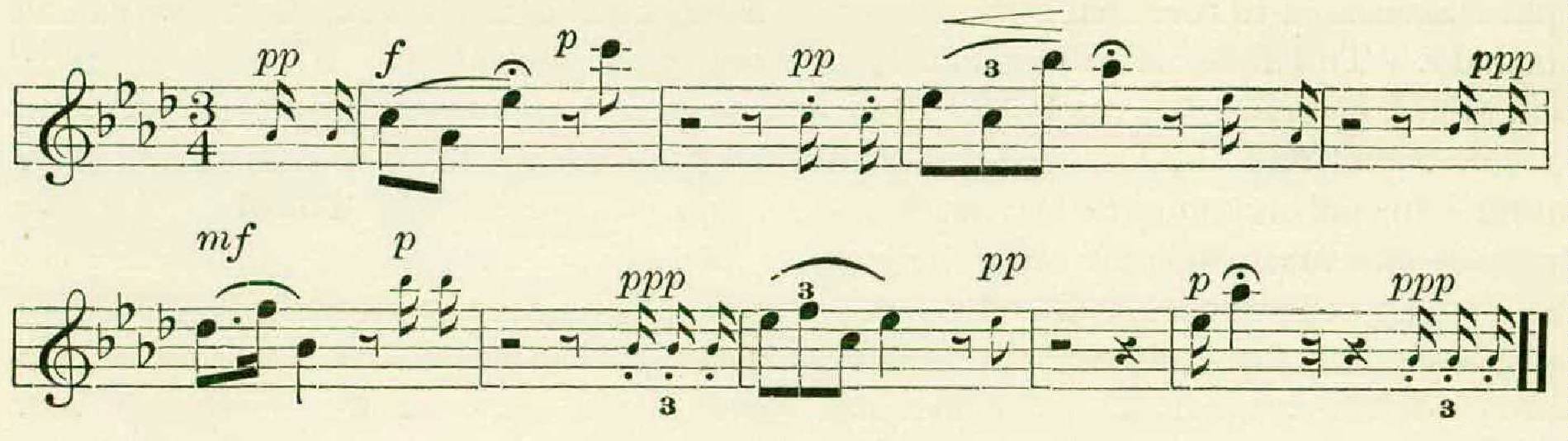
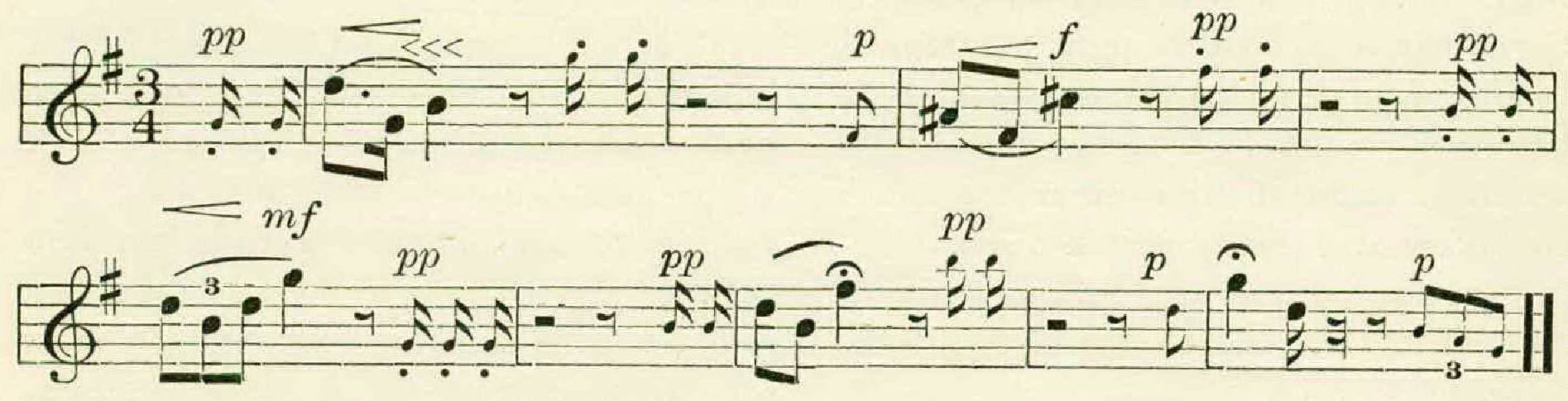
Following are the songs of two performers, each with five phrases, one of whom, the “ pasture ” wood thrush, in-
troduced a phrase in an entirely unrelated key, a daring performance for one of his kind.
THE ROADWAY WOOD THRUSH.
THE PASTURE WOOD THRUSH.
But what of the order in which these thrushes sang ? That problem proved relatively simple, once the phrase-forms had been identified, for the slowness and precision of the thrushes made it easy to record long series. I collected many such, running into the hundreds for some birds, taken at various times and under all sorts of conditions ; and from a study of these it appeared that the wood thrushes, while singing with free choice, tended to use their themes so as to produce as much variety as possible without violating the musical character of the phrases themselves. Further, each one had a favorite order, or set of orders, from which he would vary, but to which he would return unfailingly. Here, for instance, is the phrase sequence of a thrush noticeable for his regularity.
THE SWAMP WOOD THRUSH.
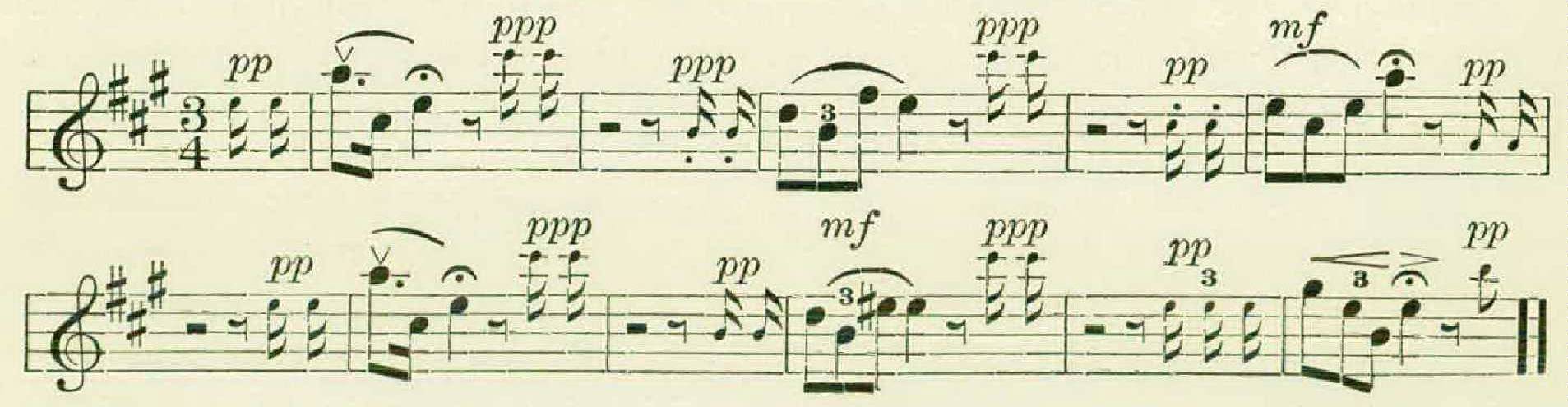
This “ swamp ” thrush had no low introductory phrase, and his whole song was rather higher pitched than usual; and this, together with his sharp ringing utterance, made his song sequence a striking one. Now and then he would interject a phrase out of place, but he would immediately return to his alternation, — 1,2,3 ; 1,2,4 ; 1,2,3 ; 1,2,4. The other thrushes whose songs are shown above were not quite so regular, but each had his favorite sequence.
The “ravine” thrush sang 1,2,3 ; 1,2,4, much like the “ swamp ” thrush. The “ pool ” thrush used his four phrases a little more freely, seeming to begin each new series with the first phrase, but using the others in varied combinations, as follows : 1,2,4,3 ; 1,4,2 ; 1,4,2 ; 1,2,3 ; 1,2,3 ; 1,2,3,4.
The “ riverbank ” thrush, with only three phrases, used them after the following manner : 1,2,3 ; 1,2,3 ; 1,3 ; 1,2,3 ; 1,2,3 ; 1,2,3 ; 1,3,2 ; 1,3,2; 1,3,2,3.
The “ roadway ” thrush used his five phrases in varying orders, always seeming to lead off with the low phrase, but using his fifth or conclusion phrase very little, as follows: 1,2,4,3,4 ; 1,2,4,3 ; 1,2,4,3,4; 1,2,3,4,3; 1,2; 1,4,2; 1,4,2,3,2 ; 1,2,3,4,5.
The “ pasture ” thrush used his five phrases more equally, but seemed to have certain favorite orders, as follows : 1,2,3,4; 1,5,2,3,4; 1,4 ; 1,2,3,4; 1,5,2,3,4. Examples might be furnished of an indefinite number of these song orders. A thrush would often sing apparently at random for a moment, but soon one of the familiar sequences would reappear, the one thing never done by thrushes in full song being to repeat the same phrase twice in succession.
It was contrast which lent its great charm to the wood thrush song as compared with the far more elaborate strains of sparrows or bobolinks, — contrast of tone and timbre as well as in the succession of phrases. Only the catbird and brown thrasher offered anything similar, and their delivery was so jerky and their tone quality at best so inferior that in emotional effect the simpler wood thrush far surpassed.
Take the song of a fine singer, such as the “lagoon ” thrush, neighbor of the “riverbank” and “pool” thrushes, but distinctly superior. With deliberation he uttered a sudden clear, round, vibratory phrase, the little staccato notes following “ like the jingling of steel,” as Thoreau says.
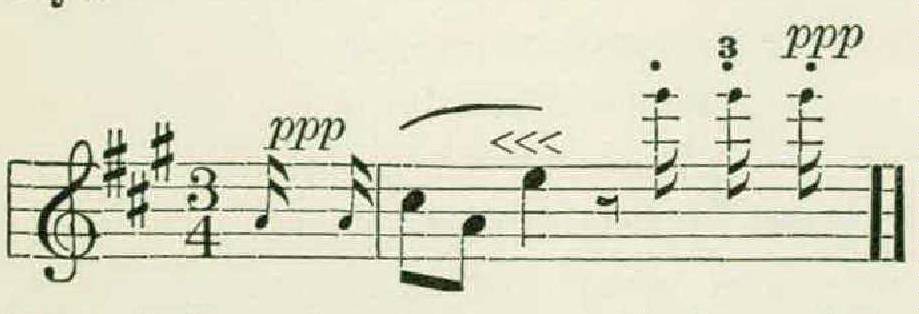
Then followed a pause, not indicated in the foregoing notations, but always to be understood between any two wood thrush phrases, and after it another phrase, thin and tinkling in timbre, apparently at the other end of the gamut from its predecessor.
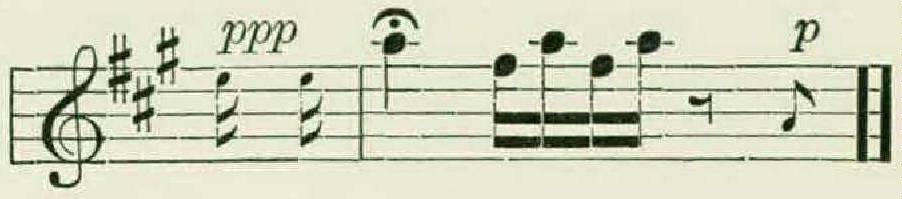
Another pause, and there was heard a sudden modulation into the key of the dominant, in a ringing, brilliant, rather reedy voice.
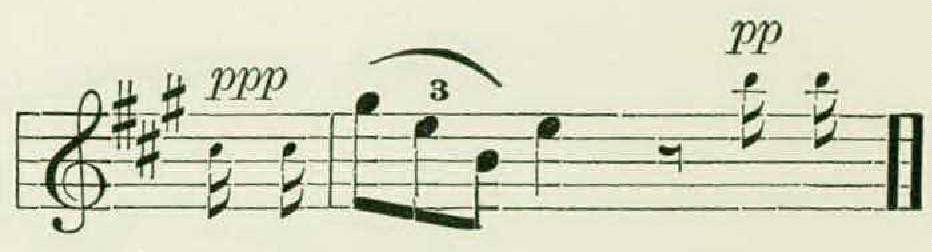
After that came the low rich phrase, then the second, and then, in place of the third one, a new figure in a clear mellow flute tone in the middle of the bird’s register, the little tinkling grace notes after it seeming to shoot up like sparks.
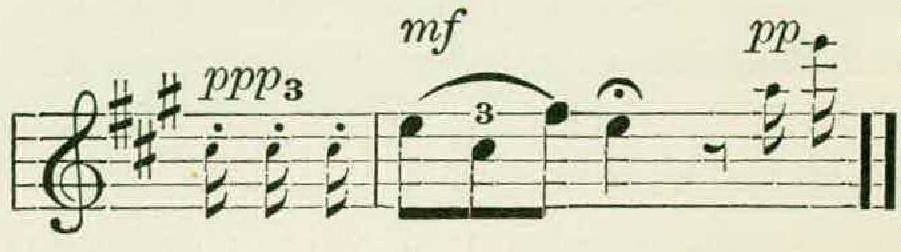
Then would come the first again, then the third, and so on, the four phrases being employed so as to produce continual variety and contrast.
Is there any apparent reason for the order relations which the birds seemed to prefer ? Yes and no. The singers did not hesitate to leave progressions unfinished, and did not feel bound to abstain from any particular successions, but still they seemed to prefer to use their phrases in a way comporting with their character. They did not sing them at random, nor did they use the conclusion phrase to begin combinations; but seemed, as the above examples have shown, to prefer such successions and variations as an orchestral composer would employ. It was this apparent deliberate choice which marked off the wood thrush from such singers as the bobolinks, the orioles, the sparrows, or finches, which repeated like an involuntary expression of joy the same melody the day through. The wood thrush with his few figures used them, and them only, not inventing recklessly, but employing his well-learned themes with apparent purpose.
When I turned from the wood thrush to study the song of his smaller cousin, the hermit thrush, I found a far harder task confronting me. Hermit thrushes sang with untiring persistence, sometimes for an hour or more at a stretch, and at all times of the day, but they were generally much shyer than the wood thrushes, harder to approach, and more restless, often changing from tree to tree while in song. Then, too, they were seldom at all gregarious, being found at considerable distances one from another, whereas wood thrushes seemed to prefer to nest in little colonies; so I had to tramp through wide stretches of New England and Canadian pastures and forests, and row many miles along the shores of Canadian lakes, in order to learn to know even a few of these singers very well. Only on very rare occasions did I succeed in taking notes from a few yards ; as a rule, my studies were necessarily carried on at a respectful distance from the invisible performers, as they perched in the thick green of hemlocks or spruces, or among the foliage of great sugar maples.
Each thrush, it appeared, had from eight to eleven separate phrases, and these, unlike the figures of the wood thrush, were in several different keys, and were all approximately of the same form. This typical hermit thrush theme consisted of a long opening note, followed by two or more groups of rapid notes higher on the scale, as in the following example: —
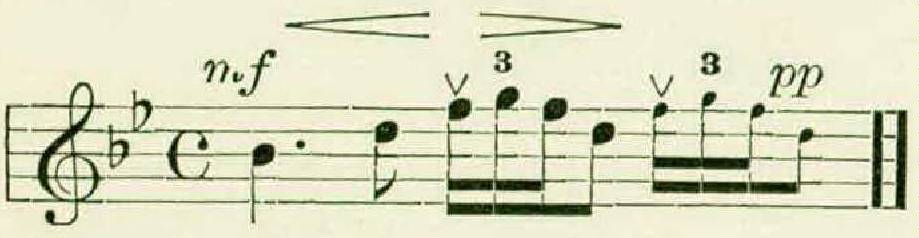
Each of the eight or more phrases would be similar to the foregoing, and each would generally begin on a different note, which, as it was deliberate, loud, and penetrating, was not difficult to determine with the pitch-pipe. The rapid figures, however, were altogether too lively to be analyzed in this way, and had to be guessed at from their apparent intervals. It was my impression, not ventured as an unqualified statement, that the songforms adhered rather closely to the major or minor scale ; at all events, after listening to scores of birds and taking voluminous notes upon two or three singers, that was the way it appeared. Of course the birds sang off the pitch with freedom, just as did the wood thrushes ; but nevertheless, the impression produced was of an approximation to the conventional scale.
Assuming that such was the case, it followed that each phrase was in a key of its own, which was determined generally by the opening note; and from a mass of observations the fact soon appeared that the opening notes of these phrases formed part of a definite scale. A certain bird, for instance, as in the case to be noted below, had nine phrases, and these were always in the following keys:—
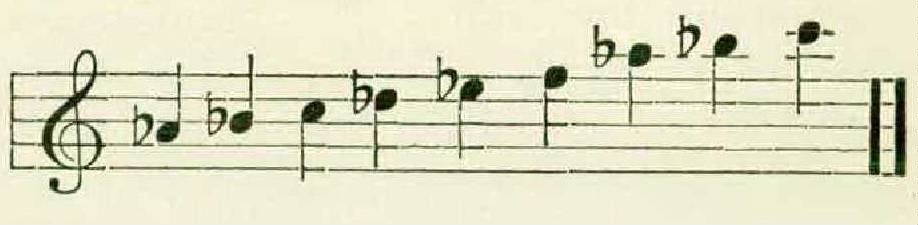
Others were in sharps, but, however arranged, these opening notes always formed some scale. No doubt the actual sounds did not conform entirely; some were a shade too low, others too high, but the pitch-pipe never failed to record a series surprisingly close to some conventional scale. This meant that all of the hermit thrush utterances were related in a much more elaborate manner than were any of the wood thrush phrases. In some cases it followed that the bird sang in just those keys marked by the opening notes. Here is an example of this sort: —
CAMP HERMIT THRUSH.
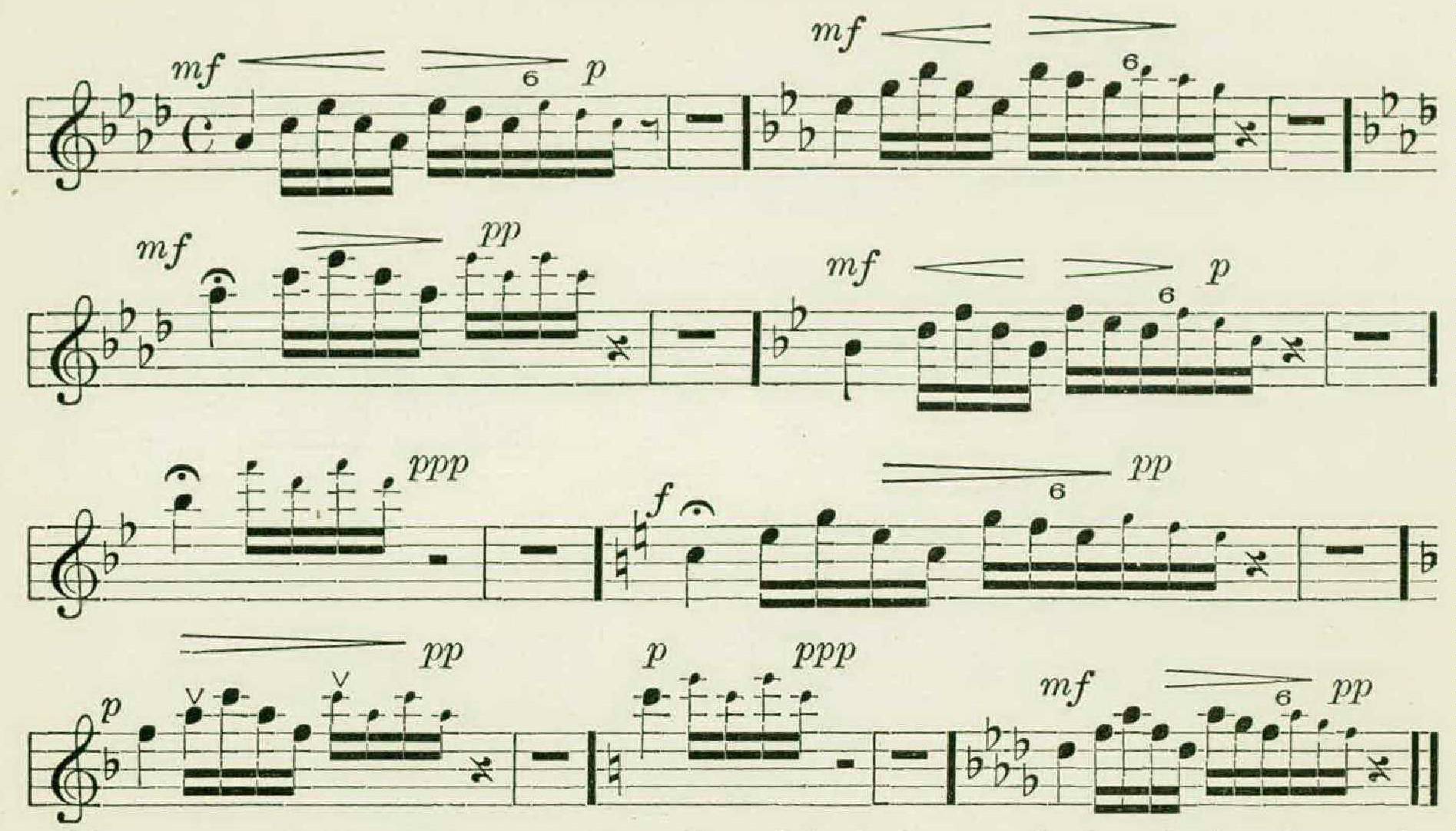
The contrast in form between this and the wood thrush’s song is obvious. Instead of from three to five unlike phrases forming part of a broken melody, there were nine phrases, all similar in form, not melodic, but thematic in character. That songs so unlike in form should be confused seems scarcely comprehensible.
By no means all hermit thrushes exhibited the regularity of the singer figured above. A neighbor of the “ camp ” thrush, whose voice often rang out with his in response or in rivalry, had a more complicated system, fascinating in its variety. Following out the system of nomenclature which I have used for purposes of identification, I will call him the “ sugar woods ” thrush.
SUGAR WOODS THRUSH.
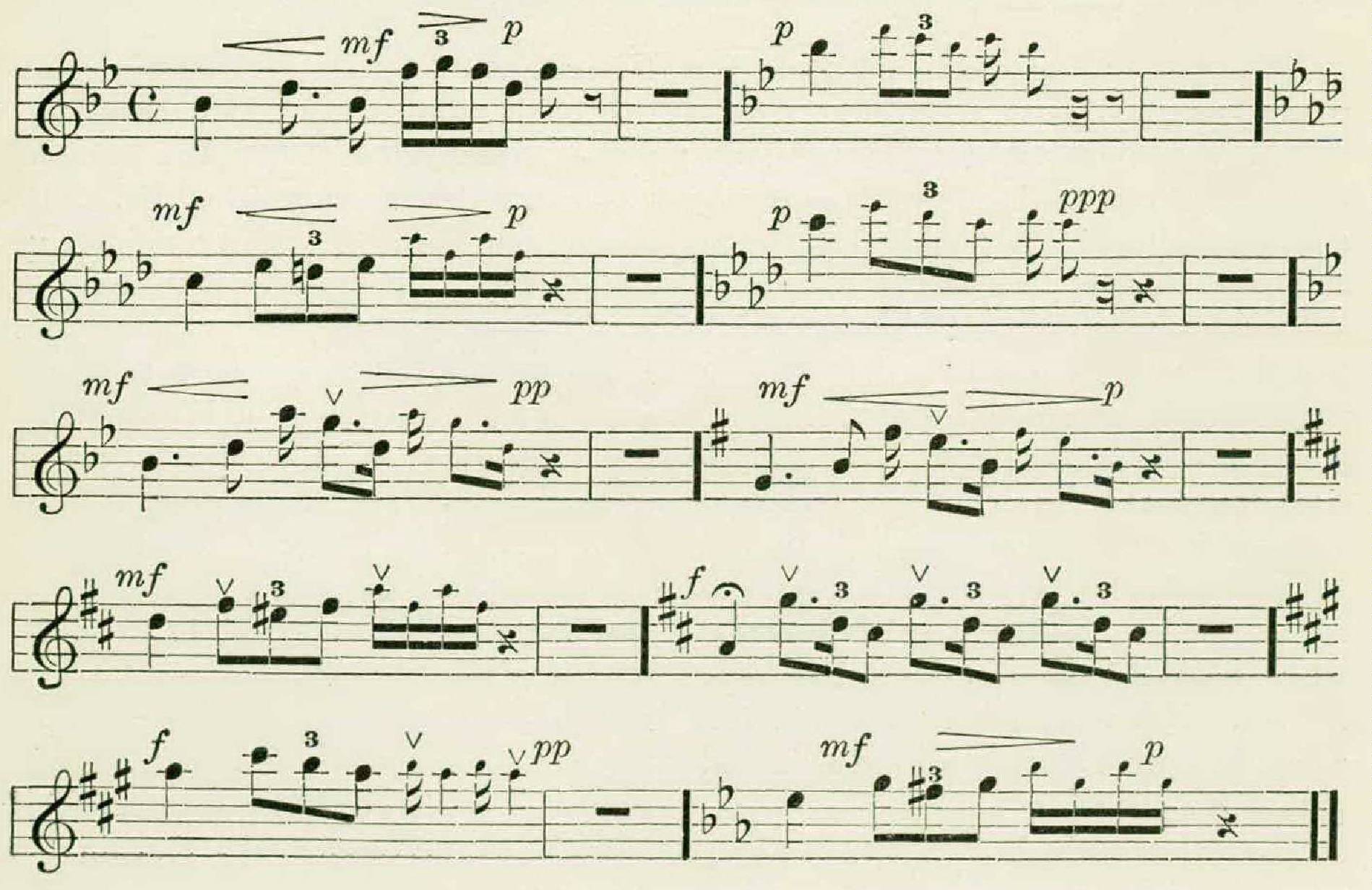
Here there were ten phrases in six keys, of which two were minor, and in four cases the opening note was not the keynote.
A still more elaborate variety was that of a Canadian thrush, some of whose phrases were so long as almost to merit the name of melodies. A striking feature of them was their frequent syncopation, and the fact that in one case the long opening note was omitted, — an unusual occurrence.
LAKE THRUSH.
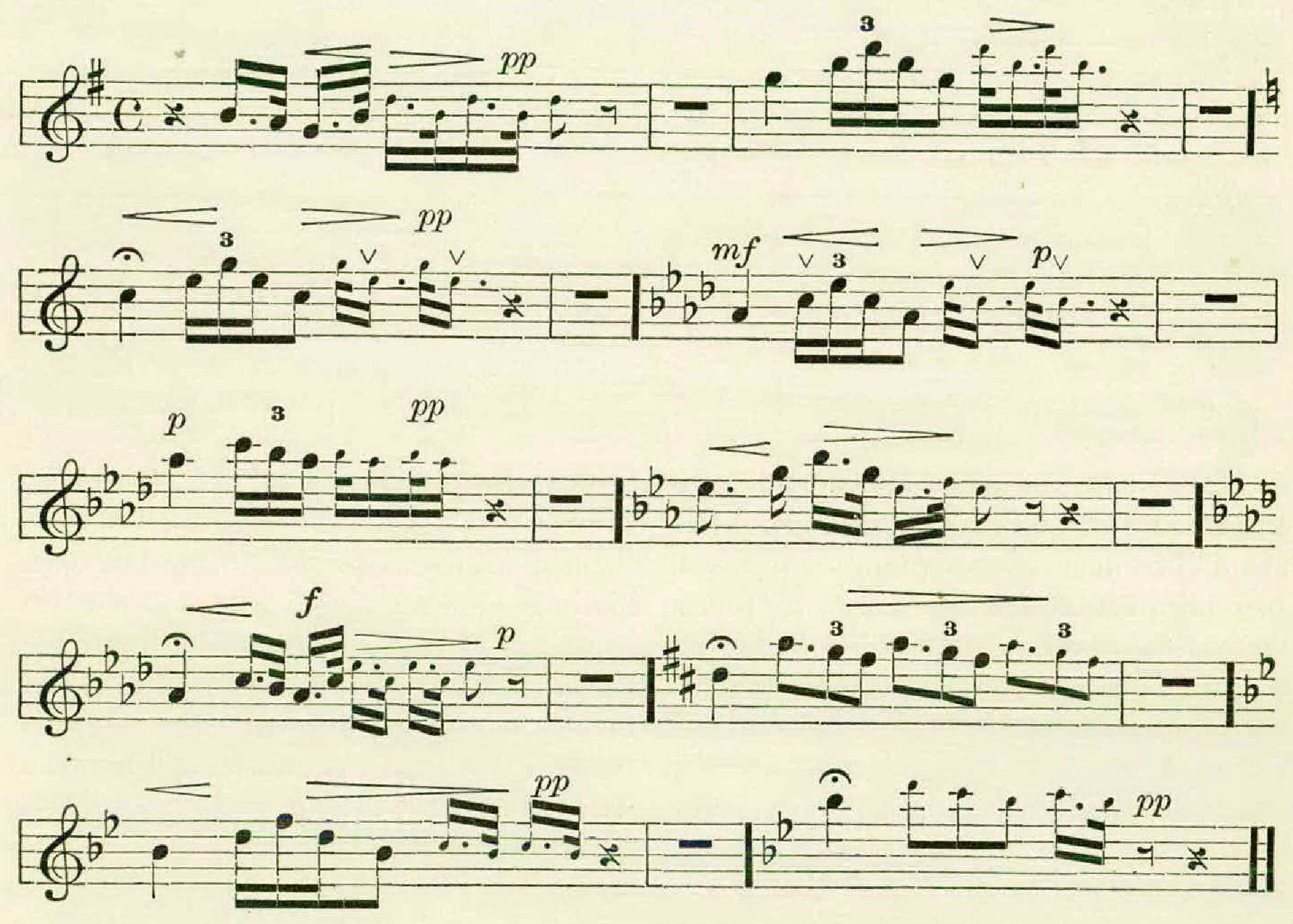
Just what Burroughs meant when he wrote years ago that the hermit thrush’s song was “ interspersed with the finest trills and the most delicate preludes,” is not clear to me. I have heard the birds sing at such short range that their loud notes fairly pierced, yet I have never detected any soft notes like those of the wood thrush, to which, indeed, the foregoing description seems to apply. Possibly it may refer to the hermit’s whisper song, which consists of the bird’s highest phrases at the top of his register, — sung sotto voce in a rather hurried manner, with occasional hints at one of the lower figures. But when the bird was in full song, these high phrases played a limited part only.
The order of the hermit thrush’s song
I found much harder to determine than that of the wood thrush, since there were more phrases, all of which were similar in form, and some of which differed by only a half tone. The ear could not be relied upon with certainty to distinguish in all cases between a C natural or a D flat phrase, and it was hard to adjust a pitch-pipe rapidly enough. Still, by unending patience, a good many records were obtained, and these when studied showed a similar result to that found in the records of the wood thrush. The hermit thrush, while bound to no order, tended to use certain favorite sequences and to avoid others. With the “ camp ” thrush this was not very obvious, but in the long run it appeared that the bird adhered to successions like that in the notation, liking to jump by fifths and octaves, and seeming to avoid with great care the utterance of successive phrases at or near the same pitch.
The “ sugar woods ” thrush, however, surpassed the “ camp ” thrush in the interest of his song order, for he had certain definitely marked preferences. After the first phrase in B flat major he sang the octave phrase more than half the time, and the E flat phrase most of the remainder ; after the phrase in D major, he sang the phrase beginning with A, the eighth in the notation, the phrase in B flat major, the phrase in E minor beginning on G,— the sixth in the notation, — and no others. So each might be taken in succession, and it would be found that the bird had a certain favorite order, with a limited range of variation. Now and then he would sing his ten phrases in succession, but far oftener his choice of alternatives prevented such a conclusion and led to repetitions. The notation above represents, however, an actual sequence. The matter may be summed up by saying that beneath an apparently haphazard utterance, clear signs were found of permanent preferences in each bird. Like the wood thrush, the hermit tried to produce continual variety, without repetition of phrases near the same pitch, and without violent contrasts. It will be seen that most of the sequences are in related keys ; and when the bird varies from flats to sharps the change is made easy by the form. See, for instance, how the “ sugar woods ” thrush, having sung a minor phrase beginning with B flat, — the fifth, — follows it with one beginning with G natural, which is a rather harsh sequence in itself, but rendered inconspicuous here by the fact that it is a precise echo of the B flat phrase.
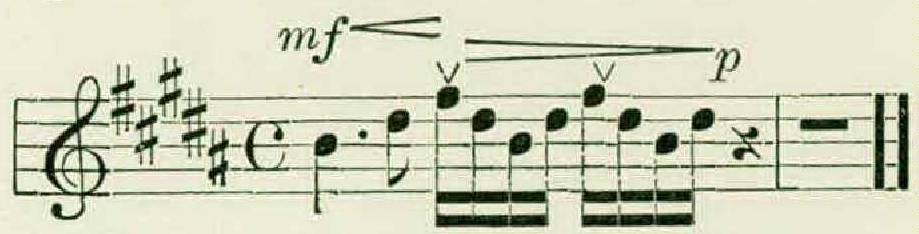
The contrasts of pitch were aided by those of timbre. The lowest phrases were generally round and hollow, not very loud, but exquisitely finished in delivery, uttered with deliberation and spirit, clear and rich, after pauses even longer than the wood thrush’s. Here is an example from a Massachusetts bird, the “ pasture ” hermit thrush, neighbor of the “ pasture ” wood thrush before described :
After this first phrase would come a pause, then, in a far more penetrating voice, a middle phrase, brilliant and metallic, but sometimes, it must be confessed, reedy to the point of harshness.
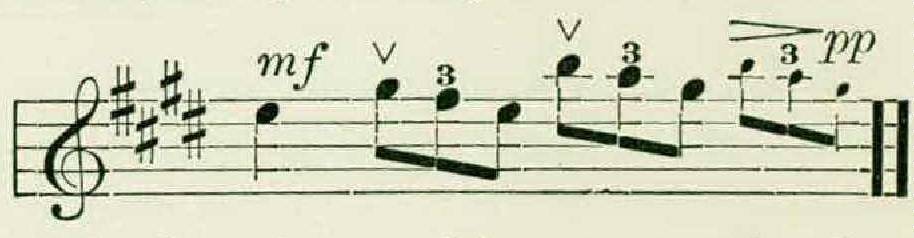
Following that would come another low phrase, round in the opening note, ringing in the rapid figures.
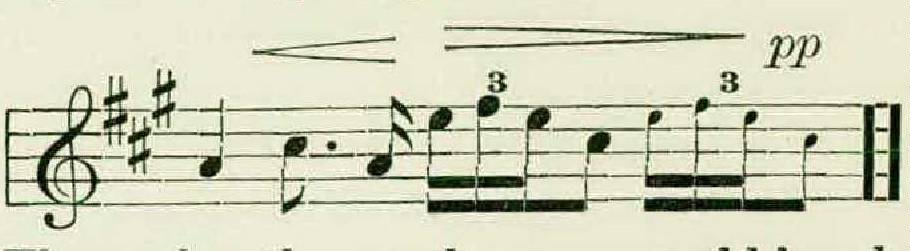
Then, after the usual pause, would break out a phrase an octave higher, in a thin, metallic utterance, contrasting sharply with the preceding one, and by its change in timbre suggesting a jump of two octaves rather than one.
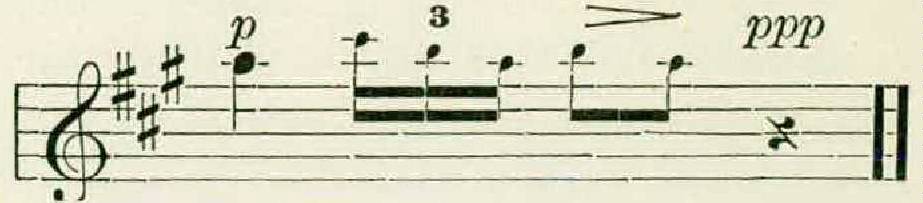
Then down would come the bird again to a middle phrase, this one clear and penetrating, the opening note swelling a little, the rapid triplets falling like tongued flute notes.
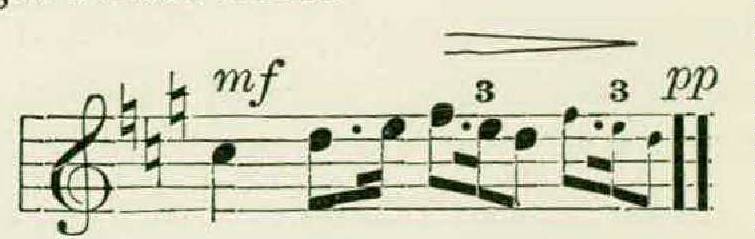
After that a pause, and then a high phrase in metallic tones.
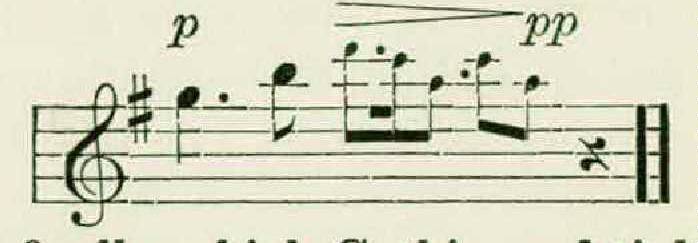
And finally a high C, thin and tinkling, a “ spray ” of notes, as Bradford Torrey calls it somewhere.
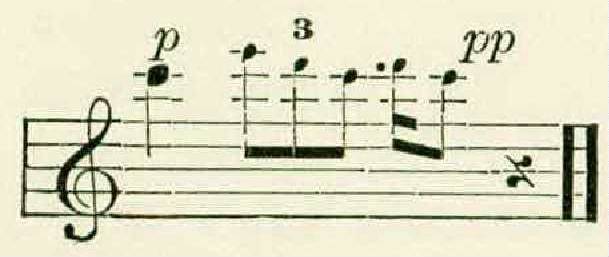
And so it would go on, a half hour at a stretch, continual contrast in pitch and timbre, continual progression, continual variation in the order, piquing the interest with never-failing change, long after a sparrow or a bobolink would have become utterly familiar.
Why the hermit thrushes should use sets of musical themes whose initial notes fall into a scale, why they should employ these themes so as to secure pleasing contrast, or why they should prefer certain sequences to others, does not appear. Whatever the true explanation may be, the effect upon the listener is that of personality ; every one of the little olive and russet singers seems to be exercising æsthetic judgment.
A few times during this search it was my good fortune to hear these two thrushes simultaneously, — twice on a mountain side in Canada, and several times in the brook valleys of the Berkshire hills in Massachusetts. On one memorable occasion fine singers of the two species, those called here the “pasture ” wood thrush and the “ pasture ” hermit thrush, sang in full voice not over fifty yards apart; and while I drank in the sounds, it seemed to me that the superior beauty of the wood thrush’s best tones was undeniable. There was a liquid fullness, and that pulsation like an organ tremolo on the final note of the first two phrases, which was not equaled by his rival. The hermit’s low phrases were clear and ringing, but lacked the color of the larger bird’s. In the middle and upper registers the two were more nearly on an equality, and, in fact, could scarcely be distinguished except for the form ; but here, also, it seemed to me that the wood thrush was rather sweeter and more flowing. On the other hand, the hermit’s voice was more penetrating, more vibrant with overtones ; its sweetness was piercing instead of liquid, and at any distance it rang with a silvery chime; while the wood thrush’s short phrases sounded, by comparison, muffled and dull.
Although birds differ very much in vocal quality, and some hermits are vastly superior, not only in penetration but in sweetness, to a great many wood thrushes, yet on the whole the contrast of these two birds seemed typical; and were it a question of vocal sweetness alone, the hermit thrush would have to be ranked below his larger cousin. But in songform, in execution, and in general effect, the contrast was undeniably, it seemed to me, in favor of the hermit thrush. The wood thrush had a clear, liquid modulation, sudden and striking, and a brilliant arpeggio, but the hermit had a more elaborate figure, greater delicacy of utterance, and a manner of delivery which no wood thrush equaled. His long opening note in each phrase swelled gradually, the first group of rapid notes came louder, like a sparkling shower, and the next one diminished, fading away into a silvery whisper. When the two sang together, the wood thrush’s phrases seemed beautiful, but fragmentary, the hermit thrush’s a finished performance. He did not sing louder than the wood thrush, but his voice and delivery marked him out amid the full chorus of early summer, which at that time made the fields and woods vocal. Over the chirping of sparrows or warblers, the tinkle of wrens, the bubble and sparkle of bobolinks, the flowing warble of robins or grosbeaks, through the chiming of veeries, even through the liquid notes of the wood thrush, the steady, swinging phrases of the hermit thrush pierced their way, now high and clear, now low and ringing, always individual, strong, delicate, and aspiring. He was the master artist of the Northern woods.
Theodore Clarke Smith.