A Basket of Chips
IN the season when trees are bare and grass is brown the varied blossoms and bird songs are but a memory, or, if the mind be prophetic rather than retrospective, an anticipation. True, a few days of unusual mildness may induce a modest chickweed or veronica to open a sleepy eye here and there, particularly in the more protected park or lawn of the city, or a song sparrow or Carolina wren, or perhaps a tufted titmouse, meadow lark, or even a cardinal, to try its voice; but these are straggling and incidental occurrences that merely serve to accentuate the general emptiness of winter.
Still, though the musical spirit may be dormant or fled to another clime, the woods and fields are not absolutely silent. For the birds are not limited vocally to those æsthetic utterances that bring us so much delight. Many are the notes at their command, expressive of other emotions than the pure love of music, which so palpably governs them in their singing. Surprise, anxiety, alarm, contentment, happiness, — these and other states, doubtless, have their appropriate utterances. Mere chattering, for companionship’s sake, may be heard, too. Often, as it seems, a mere habit — as though a human were to hum unconsciously to himself without reference to mental state or occupation — is the only cause of some of the little notes or phrases that thinly clothe the wintry woods.
It is, therefore, worth while sometimes to take a winter’s walk and gather a few of these “ chips,” as most of them are called. They may be drier and colder than the full-clad tree of song from which they are cut, but they have much power for warmth to the spirit, and the pursuit is full of interest.
Strictly speaking, such birds as kinglets, chickadees, and wrens do not chip; but then, very strictly speaking, neither do sparrows, — not even chipping sparrows, — so we need not balk at the term.
It must be confessed, too, that if we listen very closely, the chickadee 1 does not utter his name as he roves singly or in a merry band through the trees, gleaning such sustenance as the season permits. His common phrase, which has been thus anglicized, consists of two kinds of utterances, — a high note of a somewhat thick soprano quality, and a series of low notes, often very musical in tone. These low notes are very peculiar. They vary in pitch, apparently with the varying stress with which they are uttered, but by breaks, instead of gradually. The first I ever listened to attentively were confined to the three notes of the first inversion of the chord of D minor,
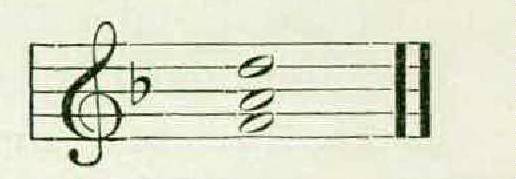
passing irregularly from each to the next above or below. For a while I heard these same notes in the dee part of each chick-a-dee that I noted closely, and concluded that it was likely that all the dee notes were similarly constructed, and that this probably accounted for the mournful tinge that attaches to this utterance despite its sprightliness. But I subsequently heard tones of other pitch that upset my supposed fact and its corollary, the major triad of F
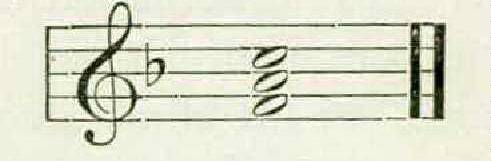
being among the chords represented.
Chickadee has also a very high, fine note, which he has, perhaps, borrowed from, or lent to, the kinglet, and which may often be heard from the trees through which he is passing. This note, which is much higher than his chick note, he commonly uses as a preface to the clear notes of his song. He is also fond of introducing his dee note into his songs, giving an effect somewhat suggestive of the vocal efforts of the red-winged blackbird. Only last Christmas eve I heard this incongruous mixture as a chickadee flitted over a partly frozen stream. I also heard from the same bird a very clear, pretty song consisting of treble B flat, a second B flat an octave higher (the kinglet note), and treble G. This song
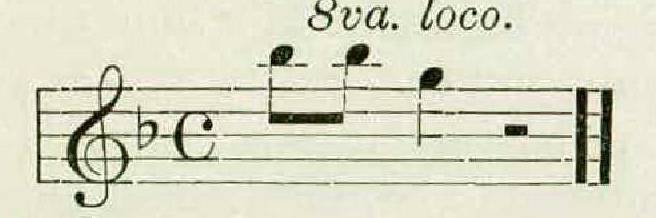
really has no more place in the present article than a flower would have had in the basket of Christmas greens I was gathering at the time ; still, had I met with a flower during my quest it would probably have gone into my basket.
Our bright little friend with attractive garb and unfailing good spirits is a sociable youngster, fearless of man, and on excellent terms with his avian neighbors, through constant association with which he has become a very good linguist, and so is able to express himself to several of his associates in their own languages. Sometimes he utters a quacking chip like that of the English sparrow; certain of his notes suggest a speaking acquaintance with the house wren ; and very frequently he may be heard reproducing the phœbe’s song, though without the phœbe’s silvery quality of voice. Anent the last a word of explanation is necessary. When Thoreau wrote of the “ phœbe note ” of the chickadee he probably had in mind the two long, clear whistles often uttered by the Northern chickadee; and these two tones have been referred to by other writers since as the phœbe note of the chickadee. But the chickadee of the South has another utterance, one of his various calls — not a song — in which he imitates almost perfectly, though with coarser, harsher tone, the phœ - be’ which announces the spring arrival of the earliest flycatcher. This is more properly entitled to be called his phœbe note. Sometimes he mixes this with his chicka-dee, producing a combination somewhat like chick-er-a-be’.
I cannot interpret these varied fragments of sounds other than as notes of content, sociable chattering, or semi-conscious utterances of habit, with a secondary object — or maybe it is primary — of serving to keep united the jolly little bands that go a-roving through the woods. That none are expressive of disagreeable emotions I am confident; for never have I seen the chickadee disturbed by fear or anger.
The tufted titmouse, in passing like the chickadee through the woods in a foraging band, makes his presence manifest by notes that are very suggestive of the chick-a-dee of his cousin, — that is, when the band is in a noisy mood, for frequently only the first of the dual notes is heard. The full utterance usually consists of a high note, followed by several slightly upward gliding chest notes, bringing to mind a brood of young pigs.
A lively crew it is that goes by, — flitting from tree to tree by a route laid out by some avian geographer or surveyor. Each voyager hastily snatches a bit from a limb, and hurries on with it to join his companions, fearful lest the strenuous pace (quite as needless in their case as in that of humanity) should cause it to be left behind, should it linger to select or enjoy a choice morsel; and each, all the while, calls to his mates his tse-day-dayday. As they pass they fill the trees before us with life, and for some distance the stir of their presence is yet to be perceived. When, however, as often occurs, the chest notes are omitted, there is merely an unobtrusive sound of icy tinkles, as though a few minute icicles were suspended and lightly clinked together.
This double-register utterance constitutes the characteristic conversational or call note of the tufted titmice, by means of which, probably, they come or keep together, but it does not exhaust their vocabulary. Indeed, I am strongly inclined to believe that if any species of bird be studied carefully, it will be found to have many unsuspected little quips and quirks of conversation. The fact that it is impossible to write the song of any species, because of individual variety, is becoming well known ; and it seems probable that much of the same individuality is to be found in the chips and calls. And why should not the wild birds have something of the variety of articulations possessed by domestic fowls, — a slighter, earlier manifestation of man’s articulatory powers ? It never surprises me when I hear a familiar bird utter a strange note; nor am I inclined to question another’s record of a song or call that has no correspondence with my own recorded experience.
Hence, when on a day of mid-May I heard a peculiar cry, which may be interpreted (as well as syllables will permit) ts-yănh’, the last syllable very nasal and with a metallic ring, and traced the unusual woodland sound to a tufted titmouse in a neighboring tree, it seemed quite natural that I should thus have stumbled upon a word of the titmouse language that I had not happened to hear before.
Nor was I surprised at another time, early in spring, to hear from a tufted titmouse another utterance that was new to me. This could hardly be called a word or call, but was probably intended for a musical performance designed to form an important factor in the courtship then in progress. The bird —doubtless a male — perched on a twig in some brush, was stooping with elevated and rapidly quivering wings, uttering a high-pitched, bell-like, vibratory note, very attractive to my ear, as, I have no doubt, it was also to that of his lady-love. The usual note of the white-breasted nuthatch has been written yank and hank. My own observation would lead me to adopt the seeond of these terms as most closely representing the sound, but with the substitution of an h for the k, and with the explanation that the n represents nearly the sound of the French nasal, so that the call is a close rhyme for vin. When I first heard the call it suggested to my mind an old woman saying querulously, “ Hanh, hanh ? ” But whether the tone of the first nuthatch I met was particularly light and uncertain, or whether the first impression has been altered by familiarity, there is now to my ears a sturdier ring to the note. It has a muffled quality, also, as though the bird were carrying in its mouth the nut it is designing to hatch. Sometimes it suggests one of the notes of a distant crow or the subdued chimp of a song sparrow. Again I imagine it to resemble a note from a far-off bluebird. There is a ventriloquial effect to it that seems to separate it from that little bluish bird that is so carefully inspecting the bark of the tree in the foreground.
Much has been said of the propensity of the nuthatch to progress head up or down indifferently, but his tendency is generally upward, though he does not hesitate to reverse his position for convenience’ sake. Nor is he peculiar in the latter regard, as is supposed by many observers. I have seen the brown creeper move a short distance down a tree trunk with his tail pointed toward the zenith, and I am a competent witness to a somewhat related feat on the part of a downy woodpecker that was on the under side of a horizontal limb, and dropped off with his back toward the ground, but righted himself by an aerial somersault before he had fallen a foot.
The mention of the downy woodpecker floods my mind with memories. I never before fully realized how thoroughly the little elf is identified with my rambles through the separate domains of Nature, — how many doors of my storehouse are ready to fly open at the sound of his strident voice. A sturdy, solitary, independent descendant of Thor, pursuing his own way up or down the tree trunk, hammering persistently at the end of a broken limb, or resting quietly after meals composedly making his toilet, — all the while utterly unmoved by the many alarms that perhaps send composite bands of tree and song sparrows, juncos, goldfinches, and other birds, from the field where they are feeding to seek shelter in his tree. I admire his isolation and independence as I admire the chickadee’s good-fellowship and sociability ; and though the harsh call that tells of his presence, and the clattering, scrambling descent of the gamut, his nearest approach to a song, have little of musical beauty, they are such sounds as properly harmonize with his cynical philosophy. How many days of solitary, undisturbed commingling with Nature are bound up in those jagged-edged tones ! — Days spent in the heart of the wilderness, though but a few minutes’ walk from my home in the suburbs of Washington ; for the wilderness is not measured by miles, and he who seeks it in the right spirit will always find its heart. It needs not a railroad journey across a continent to enjoy the charm of the primeval forest. It often requires but the briefest walk to step into a domain where epoch and race no longer exist, — another world where a spell of enchantment seizes and enthralls us. We belong to no country, no age. Our identity falls from us like a discarded mantle, and we blend with our environment.
To mingle with the universe.”
In the world we have left we are tied by a million bonds to a particular spot on the earth’s surface, to a particular point in the earth’s history, but here, in the land of woodpeckers and titmice, there is no such bondage, and we roam free and untrammeled. This little purling brook, this lichen-covered rock, these massive oaks and beeches, these dark, quiet pools may belong to any one of many ages or climes: they own no special master. Amid their unchanged beauties might meet on equal terms, as tenants, the savage of a prehistoric era and one of that noble race that shall inherit the earth when the present era shall have passed into the dark gloom of barbarism. We are in the presence of an eternal Now, and for the hour are one with it. Our occupation, even though it be but the gathering of chips, is transformed by its touch into a pursuit of prime importance, to which we may lend ourselves zealously without compromise of dignity. In fact, it must be confessed, the little local issues of ephemeral politics, shifting commercial and industrial systems, fluctuating empires, varying religions, which have such prominence in that remote world we have left, seem petty and ignoble objects of thought and attention in the majestic presence of this world of immutability we have entered.
To return to our birds, — the whitebreasted nuthatch has a Canadian cousin that spends the winter with us, whose breast is red, instead of white ; a trim little sprite, that seems designed for a perpetual example of staccato. He darts about in a series of quick, short jerks, uttering all the while a little pit-pit-pitpit-pit, of very light notes, suggestive of dripping water. These notes he sometimes expands into a hanh-hanh closely resembling that uttered by his cousin, but distinguished by a brassier sound, that recalls the tones of the tiny toy trumpet whose music used to delight our childish ears for a full hour of a Christmas morning.
The first red-breasted nuthatch of my acquaintance gave me a surprise : he flew down to a stream to drink, and, as he lifted his bill skyward and chewed the water, after the peculiar manner of birds, he uttered a funny little series of faint, spueaky notes that suggested the thought that the delicate machinery of his throat needed oiling. The purpose, if any, of these notes was not apparent.
One would think that the nuthatch method of earning a living would cause nearsightedness. Constantly and actively moving up or down the trunks and limbs of trees, with the focus of the gaze only an inch or two from the eyes, these birds might well be excused if objects a few feet away were but a blurred mass. Yet I have seen the red-breasted nuthatch dart out twenty feet from the limb on which he sat preening his feathers and capture a flying insect. The eyesight of birds and other creatures, however, teaches us to be cautious in judging others by ourselves. To say nothing of the eagle gazing at the sun without blinking, or the hawk on the top of a tall tree descrying the grasshopper in the meadow grass, we must remember that the eyes of birds are set so far back in the head that they cannot come to a focus; they must either see double or use only one eye at a time. Still further are we removed from the certain and proved ground of experience if we descend to the fish, whose eyes stare simultaneously in opposite directions. And when, as in the case of the flounder and others, each eye can be projected slightly and turned backward and forward independently of what, according to our experience, ought to be its mate, we can but focus our own interdependent eyes upon the peculiar creature in a helpless stare.
The brown creeper, like the nuthatches, looks at his food at close range. Clinging even more closely than they to the tree trunk, he progresses upward in the same jerky fashion, seeking his prey in the crevices of the bark, and uttering the while faint, high-pitched, and elusive notes. Usually his presence in the vicinity is indicated by a constantly repeated note that should be marked on a miniature staff with the point of a needle; though this is often replaced by a silvery, tremulous trill that might be a section cut from the reduced song of a chipping sparrow. Again, when flying from the upper part of one tree trunk to the base of another, he frequently transmits to the bird world a musical telegram, in which only such characters are used as c, e, h, i, and others that are represented solely by dots.
The chips thus far collected have been gathered in the woods, the usual place to pick up chips, it is true, but by no means the only one, particularly in the case of birds. Out in the brown meadow or idle winter field, where grasses and weeds furnish a full supply of provender to those birds whose bills are adapted to the fare they offer, are many more, blown about by the wind, perhaps, but easy to gather for our basket.
Here, close to protecting cover, — a bushy brook, or the edge of a wood, or, perhaps, a tangle of blackberry and brier, — we shall find many a motley throng of birds banded together by the gregarious spirit, rather than by community of interest, busily attacking the crop that the farmer can best spare. There may have been a heavy fall of snow, and only the tallest of the plants that retain their seeds through the season, such as amaranth and broom-sedge, are within reach ; yet bountiful meals may still be had, and the enforced diet but gives greater zest to the variety attainable when the white cover has been removed.
But howsoever limited the choice of food, there is abundant variety in the notes that besprinkle the frosty air. There are the long-drawn, tremulous tseets of the white-throated sparrows ; the dry chips of the song sparrows, replaced by louder, more resonant chimps when danger seems nigh; the goldfinches’ light, staccato notes, uttered in groups of four or five with a tendency to rise at the end, and once in a while giving way to a sweet, sympathetic ah-ee, that suggests the idea of a most musical yawn ; and, perhaps, an occasional note from one or two big, overgrown fox sparrows that have lingered thus far north, either a high, chirpy chip or a tseet very much like that of the whitethroats. And underlying all, leaving no interstices, are the many bits of sound contributed to the general chorus by the loquacious tree sparrows and juncos. The former fill the air with liquid splinters, each of which sounds like a nasal e-lick’, and which have been aptly likened to the clink of a tiny stone chisel; the juncos, true genii of winter in this latitude, are a well-equipped battery of wintry notes, — icy tinklings, electric snappings, and peculiar muffled tones, such as accompany a stone skipping over a frozen pond.
It may be that in the cover to which these birds are making frequent trips en masse to escape a real or more often imaginary hawk, or other bugaboo, there is a cardinal. If so, it is easy to detect his loud, commanding clink above the twittering uproar of the frightened mob. Or we may hear from him a peculiar utterance, — a series of percussive notes, to-to-to-to-to, followed by a whirring sound that recalls the drum roll sometimes made by a horse with his lips.
It is, perhaps, from frequent association with the cardinal that the juncos have acquired a to-to-to that is the cardinal’s own on a smaller scale, and that is often used by them as the expression of some emotion incident to their winter’s sojourn in the South. Their commonest note, however, is the little crystalline tinkle. This bit of frosty music characterizes every winter ramble ; for the juncos have appropriated our season of bare woods and fields and made it their own. Go where you will, the juncos, with their clean, neutral wintry colors, are there before you. That walk must indeed be barren of birds that does not yield sight or sound of at least one of these spirits of snow and ice. Sometimes I have come upon an immense flock of them in a corner of a pine wood, — for they are ubiquitous, and are as likely to be found in dense woods as in the open,—splitting its silence into tiny slivers with their multitudinous snappings and tinklings.
What trim little birds they are ! And how demure their Quaker garb ! They seem to have been colored by the same artist that painted the field of snow and the gray sky that meets it at the horizon. I am glad we do not have them with us in summer, for they belong so wholly to the winter.
But this last supply of chips has quite filled our small basket, and we must defer the gathering of more to that future day that may or may not dawn. A pleasant and profitable expedition it has been, for we have filled our souls as we have filled our basket, and have breathed the tonic air of purity and peace. Our spiritual lungs will be better able to resist the miasmatic atmosphere of the world to which we must return, — a world whose responsibilities and duties we cannot shirk, if we would, but can only leave behind for a brief respite.
Yet, as we make our way from world to world, let us linger a moment to note this band of cedar birds resting motionless in the top of a tall tree, and seemingly all unconscious of the whining tone of a single pitch that oozes from their many throats. We have not yet passed the confines of this land of loitering, and may stop to listen and see without fear of reproach.
How still they are! Has not some whimsical taxidermist passed this way and filled the tree with samples of his skill ? It is hard to believe that these sleek, fawn-colored bodies, rigid and upright, and that penetrating tone of complaint, are in any way related. The sound seems like a dog’s whine, disembodied, and hovering for the moment above our heads. Only for the moment, for at some imperceptible signal the entire flock has suddenly risen with a single movement, and is on its way to a distant tree to hold another solemn meeting in a different part of the field.
And now we, too, must be going. Bidding farewell to this land of eternity, we must step across the boundaries into the region where time and locality govern, and resume our trivial duties, temporarily abandoned, of guiding the Ship of State and making a living.
Henry Oldys.