The Nightingale's Song
To hear a nightingale sing had been for years one of my heart’s unfulfilled desires; had I not heard him praised in books, poems, and songs, especially songs ? Every one knows of more nightingale songs than he can count. People who had heard the nightingale sing always seemed to take particular pleasure in raving about his song, looking upon me with pity because I could not be counted among the fortunate number. Finally, I began to pity myself, and to wonder if it was possible that I had heard one sing after all without knowing it. I tried to remember all the unfamiliar birds I had listened to in foreign lands, and to question those people (who, most of them, did not know one bird note from another) how nightingales did sing, and how I should identify one if I should be happy enough to hear him. So much did those people’s accounts of the same thing differ, it might have been a dozen birds that they were describing instead of one.
One said that it was a “ sad, plaintive song; ” another declared it was most “joyous and brilliant, full of trills and roulades, and very intricate; ” while a third dashed all my hopes by saying that “ the nightingale after all was a very much overrated bird, and if he did n’t know enough to pick out a romantic spot and to sing by moonlight when all the other birds were asleep, no one would ever think of noticing him.” My only consolation after this last remark was the knowledge that the lady who made it was neither musical nor romantic, and I am sure that a street piano played on Sixth Avenue at high noon would have pleased her far more than all the nightingales and moonlight in creation. I asked no more questions, but one day, while reading that charming little book Elizabeth and her German Garden, I came across a bar of the nightingale’s notes written in one of the chapters. I studied them well, resolved never to forget them; and in the end they proved a great help to me.
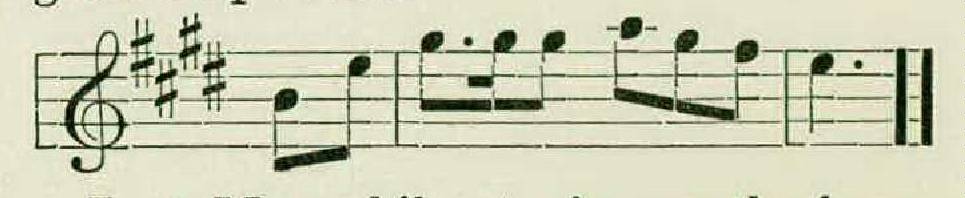
Last May while staying on the beautiful Riviera I was told that the nightingales had been singing in the lovely oldfashioned garden of the hotel in Menton, which was a quiet spot and away from the road. Any one can imagine what my feelings were after my long waiting, to know that the desired bird was so near, had actually been singing the night before, and was likely to sing the next night. But, alas, I spent the greater part of every evening rushing to my balcony thinking that I heard my nightingale, and getting many a chill during the small hours waiting for the song that never came, until hope was quite gone and I had given up my night watches, convinced that it was best to resign myself to my fate, and to become indifferent.
One morning early, so early, in fact, that it was not yet morning, I arose to open my window and breathe some of the wonderful, fresh Riviera air all laden with the perfume of thousands of flowers, and to stop one moment to enjoy the beautiful scene which, as I was never fond of early rising, was rare to me. To the east rose the grand, rugged, frontier mountains, like a huge fortress between France and Italy, and over them hung great masses of gray clouds that made them look unlimited in height; and in contrast to their severity lay the Mediterranean at their feet, reflecting the yachts and the fishing boats that rose up like ghosts in the white, thin mist that was over all. It was that hour just before dawn that makes everything familiar look strange and eerie, and I turned to go in, for I believe every one at heart, if he will only confess it, is a bit superstitious. I am, and I am sure that I never admired “ three-o’clock-in-the-morning courage” more than I did then.
At that moment the bells in the quaint little town struck four, then all was silent again, — the moon, the morning star over the mountains, and the anchor lights in the harbor keeping watch. Just then I heard something like a soft low whistle close by. I stopped to look through the blinds. I won’t say I was frightened, but it certainly did startle me, for I thought that some one was whistling to me, and I peered intently through the blinds to see, if possible, who that impudent some one was. There was no one in the garden below nor anywhere in sight. But it came again, and a third time in a plaintive musical phrase very distinct and slow. In spite of myself my hair began to rise, for there was something about it almost supernatural and unearthly when it was repeated with almost a break on some notes not unlike a sob. I made up my mind to solve the mystery, and at last located the sound in an old olive tree by the garden wall, where a branch was trembling as if some one had just shaken it. On the branch I saw a live little shape, and when the notes came again I remembered the bar that I had so carefully committed to memory, and then it was I realized that at last one of my heart’s desires was fulfilled, and that the nightingale was found.
So excited was I, and so anxious not to lose one note of his song, that I took pen, ink, and paper, lay on the floor of the balcony out of sight, so as not to frighten the bird, and listened for one hour and a half, writing down note for note every phrase he sang, correcting my mistakes as he repeated (which he did very many times), putting down every variation (he is fond of variations) and every accent, even taking the pitch with a French pitch tuning fork. It is true that no other bird sings like him. Our swamp thrush has a more brilliant quality, and even sings one of the nightingale’s phrases, but he has not quite such a pathetic quality, nor the art that makes the nightingale unique in his almost masterly use of accents, light and shade, and perfect rhythm.
His deliberate sostenuto is a strong characteristic, and his phrases are given with such a perfect legato, and yet with such clear separateness, that to write them down is an easy task. There is none of the incoherency which makes many other bird melodies impossible to put on paper, as he uses one scale of distinct whole and half tones, whereas they sing quarter tones in many cases, and sing two or three octaves above the G-clef, which multiplies the difficulties.
He sang in the upper soprano octave where a person naturally whistles. His song was in the key of three sharps, and he went from that key to the key of one sharp, with something like a modulation, and returned to his first key, that of three sharps, without abruptness. His quality resembles a light tone of the wooden flute, yet it is absolutely pure and very penetrating. I do not presume to say that every nightingale sings the same phrases as did this one ; still I am sure that I have written conscientiously and correctly, without any help of the imagination, every phrase that I heard him sing.
He sings seven or eight different phrases, the second and longest being his favorite, and with which he finishes his song. The first phrase is really part of the second.
I write the song which must be read an octave above where it is written. The similarity to Elizabeth’s phrase will be noticed, although not in the same key. Each phrase is repeated five or six times until he wearies of it, then he goes to the next.
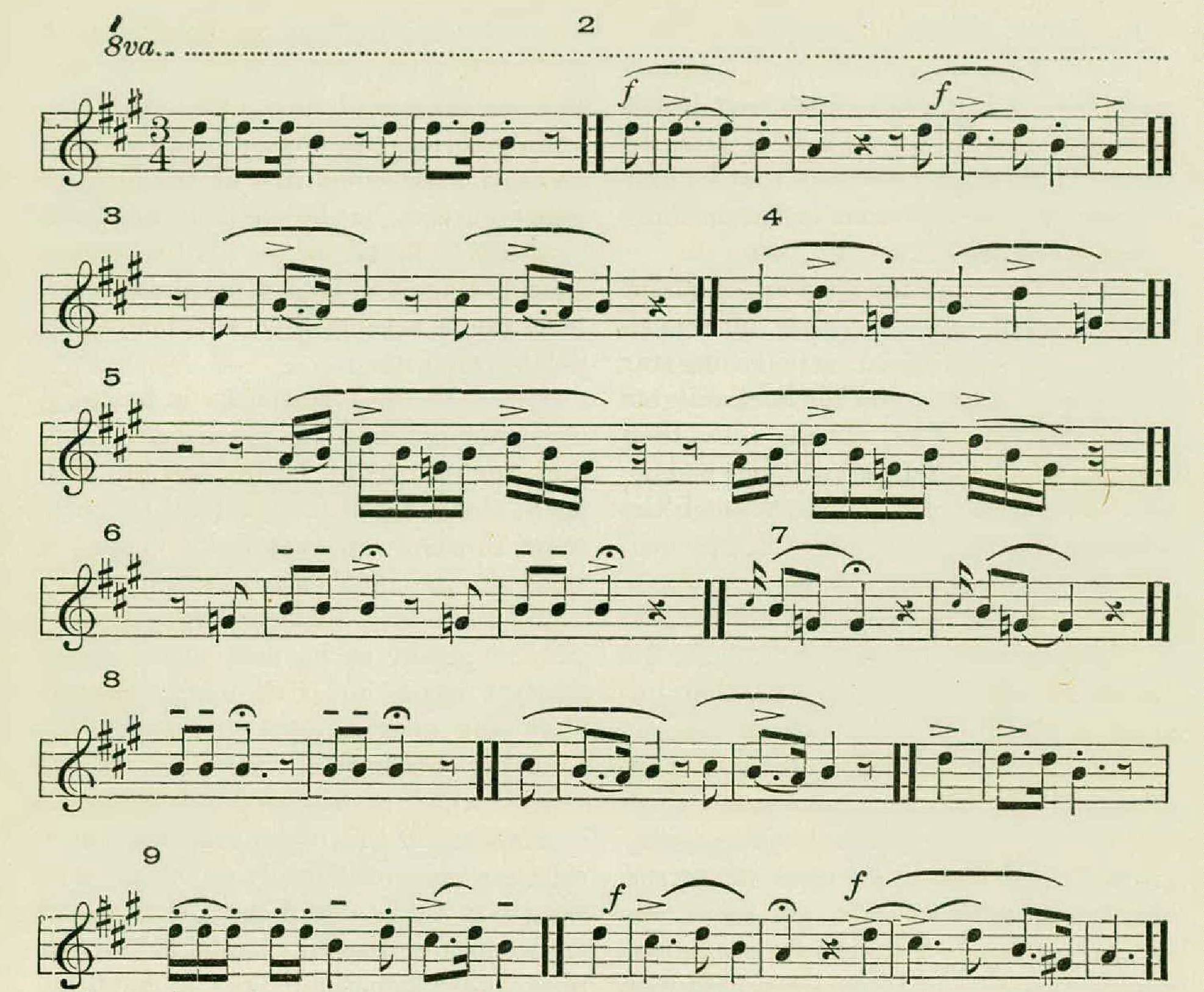
To notice the similarity between Elizabeth’s nightingale and the Riviera nightingale one must play the phrase of the former in the same key of three sharps, and compare it with the second phrase thus : —
Elizabeth’s phrase.
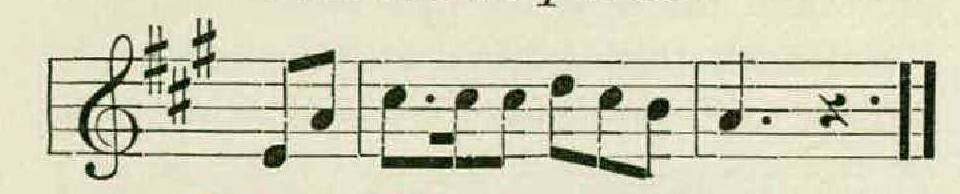
No. 2. Riviera nightingale.
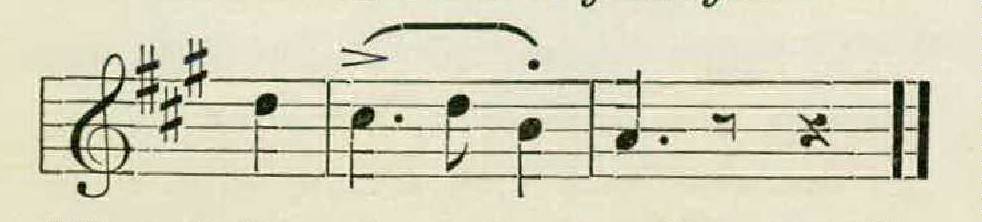
All variations have been written. No. 5 is sometimes written with the D sharped thus : —
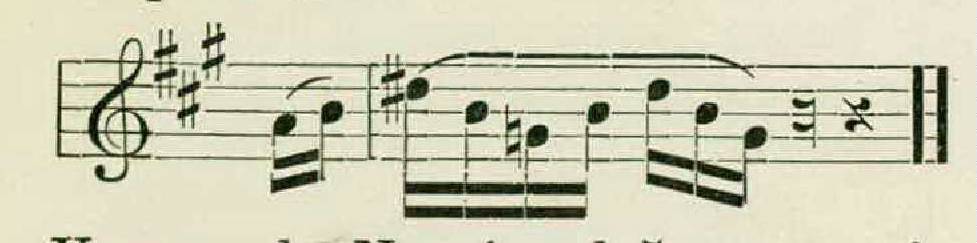
Very rarely, Nos. 4 and 5 are sung in the key of three sharps instead of descending to one sharp as written. No. 6 is sometimes sung with the G sharped thus:—
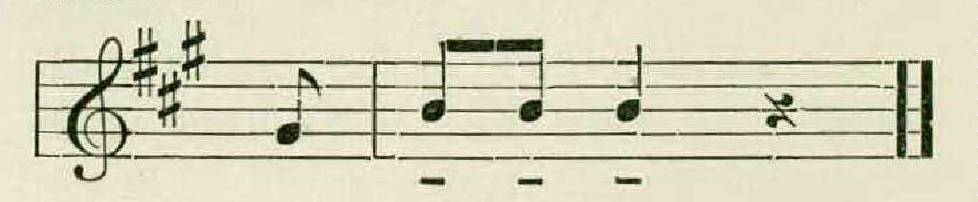
As I wrote and listened the morning star over the mountains began to pale, and the cloud masses became purple, then crimson, and finally golden. At last the sun rose gloriously above them all, gilding everything it touched, and bringing out into strong relief every tree and flower in the quaint Menton garden, against blue sea and sky which made a vivid background. The nightingale still sang on in spite of the jealous canaries in their cage below, who began to sing their loudest, as if they wanted to drown every other song. But above them all I could hear the pure, penetrating notes which floated into my room where I had gone to rest a little.
Suddenly, I heard three sharp shots close by the garden wall, and the bird was silent. My heart stood still — for I feared the worst. In vain I listened for his song, but it never came again, and I began to feel sick and spiritless, as if I had lost a friend.
When I asked the waiter at breakfast “What people were shooting at so near the house,” he replied very carelessly, “Les petits oiseaux, madame, pour manger, peut-être! ” That was too much for my weak patience, and I replied to him in English; what I said I will leave unwritten.
I went into the garden, sure then of the worst, yet resolved that if the singer was gone the song should not be forgotten. At that moment, as if in answer to my thought, I heard a faint note far away. It was repeated again. Was it he ? Or was it some other bird who had missed him and was calling to him ? No, it must have been he, for that surely was his favorite phrase, even with the little break on the second note which must be his alone. I felt immediately comforted, took heart again, and returned to the house to keep my promise, and to begin to write what is here set down.
Llinos Eglinton.