An American at Home in Europe
IV.
HOUSES I HAVE HUNTED IN ITALY : ROME, FLORENCE, PERUGIA, AND VENICE ; A PALAZZINA AT VERONA ; CONCLUSION IN THE RIVIERA.
I THINK I shall write an article, some time, on Travelers’ Drivers. On comparing the accounts of famous journeys, these gentry would probably be found to occupy a remarkable place in the foreground, in nearly every instance. They would be found to agree in a general raciness of character, in a tendency to quaint sayings, in untrustworthy information and tricky bargaining. But has attention enough been given to the extent to which they redeem their faults and make good return for value received in helping the traveler fill up his pages ?
Within a fortnight after the return from the English journey, as heretofore chronicled, I set off for Italy on another house-hunting trip. In the first part of it I had a driver ; but I must postpone my account of him till the article mentioned. I shall only say here that he told me that, in the place to which we were going, houses not only were cheap, but were positively given away.
I had left behind Pisa, its monuments showing in the distance like the great structures of some traveling show suddenly turned to stone ; and I had left behind the clean little ex-ducal city of Lucca. At Lucca, the Sunday bells had been chiming in the early morning. You look down from the green ramparts into the gardens of many pretty villas, with marble lions on their gateposts. In one, a whole troop of Bernini statues, the kind that are all on the move in every part, seemed rehearsing as for private theatricals among themselves. Yet I had not asked the price of any dwelling at Lucca, and I had not even looked at one at Pisa. The country was flat, and the impression of the sixty-three days of winter rain the statistics set down to it, as against only thirty-six at Nice, was perhaps unduly strong, at this opening stage. There was no resolution arrived at to leave the Villa des Amandiers; in many respects we could hardly hope to find its equal. Still, it is scarcely in human nature to rest content with any situation, no matter how pleasant, if a chance remains of finding something better elsewhere. It seemed, in a certain sense, almost a matter of duty, too, to spend the next year in Italy; and so I had set off to spy out the land. The drive was a rather hard pull of sixteen miles up to the Baths of Lucca, in the mountains. The Baths of Lucca is a little summer resort, rather fallen off from a once greater popularity, that we had thought might possibly do for the winter also. Its decline from popularity would not harm it in our eyes and for our especial purposes, but quite the contrary.
The place proved to be a mere secluded vale with a tumbling stream. Now it would recall the Catskills, and now, with its smooth, very civilized walk between the two principal villages, something at Pau or Dinan. There was a lush deep greenness about it, an English look here and there, — the doing in part of English proprietors who had left behind their hedges, — and some bits of green lawn, that most refreshing of rarities in these latitudes. The landlady at the inn told us she had lately had her house quite full of only English and American women, — not a man among them.
A small principal street with shops ; a few gray towers ; a crowd of peasants, all men, at the bridge ; the neat bathestablishment ; a casino, with a cheerful frieze of musical instruments sculptured round it; small hotels, and the apartments to let. In spite of my driver’s information, the prices did not seem high. You could have had a furnished house, a quiet, restful place, with a grassplot before it, in the centre of things, for 800 francs for the season, and for not much more, I judged, for the rest of the year. That was the best there was. The neatest and most taking, on the whole, was an apartment at 400 francs, in the house of the Signora E— O—. It had four good bedrooms, a salon, and quite a vast diningroom, all very nicely furnished. From the back, you looked out upon a strip of garden, and high up to the third village of the group, cresting the slope above. It was hot that day, a humid oppressive heat, though it was but the 11th of May. It would no doubt be cool enough in winter, by way of recompense ; but I should think life at the end of so long a drive could not fail to be almost hermit-like.
I kept on southward to Rome by way of Civita Vecchia. The most surprising feature to note, after an absence of sixteen years, was the prosperous appearance of those once half-waste and feverstricken districts, the Maremme and the Campagna. Excellent new buildings and fences, haymakers at work, grainfields and vineyards, fine cattle and sheep, gave tangible sign of the rise of the new Italy, and the extent to which the old order changes. The fresh young kingdom, having made an Italy, had next to make Italians; and it is making them even in the plain about the gates of Rome which immemorial tradition has taught us to shrink from as poisonous. In crossing the Campagna by the branch roads to Frascati and Albano, or flying out to charming Tivoli by the steam tramway, continually laden with merry excursionists, you find it full of fragrant hay, and of flocks and herds and their able-bodied keepers. The people, both men and women, look as well and content, the children as chubby and thriving, as could be wished for even in districts of far better repute.
I did not fail to seek for suitable quarters in these suburban villages on the foothills of the Alban and Sabine mountains, within a radius of twentyfive miles of Rome: Frascati, more spruce and modern ; Albano, older and dingier ; Tivoli, apparently protected forever from the commonplace by its site on the grand cliffs, and its temple of the Sibyl looking down upon the foaming milk of the cataracts. Yet what think you is the latest from Tivoli ? The cataracts have been trained to turn the strong motors that are to make all Rome a blaze of electric light worthy of the splendid new court on the Quirinal.
Villas and apartments were few and far between. As a rule they were furnished, so that it began to look as if the ownership of a sufficient outfit of furniture of one’s own might not be such a great advantage, after all; and, without regard to relative conditions of climate and comfort, but considering only the standard left behind me, they were dear. The 350,000 inhabitants of Rome reserve these suburban villages to themselves for their summer outings, and competition keeps up the prices. A rude unfurnished villa, near the bridge, at Ariccia, the property of some Roman prince, would have been 1500 francs.
What most nearly tempted me was a large old house at Castel Gandolfo, with a garden at the rear looking across the wide Campagna to misty Rome. It was pleasantly furnished, it is true, but in front all the population of the main street crowded up against its doorsteps ; and when the local omnibus was off duty, it also seemed to be laid up there. Would it have been put down to a lowpriced figure, on that account ? Perhaps, but I doubt it. And even if it had been, who can say whether it would have been quite worth it at any figure ? Some put their comfort in one thing, and some in another. For myself, an important part of it is some “elbow-room,” the option to be decently let alone. It is not to disrelish one’s fellow-creatures to feel in this way, Heaven forbid ! On the contrary, it is to issue forth with sympathies all the fresher and readier to enter helpfully into their concerns, not to collide with them and to have their small miseries under one’s eyes at every instant. The country all about was full of charm : smooth roads and pleasant footpaths shaded by ancient trees ; the old papal palace at the top of the ridge ; the Campagna on one side and Lake Albano on the other ; and a little further on, beyond Ariccia, the smaller Lake Nemi, as virginal and lonesome as if it were in a forest of America. Yes, other things being propitious, I should have chosen above all Castel Gandolfo.
The new districts of Rome, the great modern upheaval of which we hear so much, are not immediately obvious to the new-comer upon his arrival ; except that of course he sees the new quarter of the Quirinal, the latest grand hotel, the fine bustling new thoroughfare of the Via Nazionale, for all these are on his way in descending from the station. What a delicious glimpse of emeraldgreen garden through an archway of the royal palace ! What splendid colossal cuirassiers on guard ! It is such a pity that anything unpleasant should have had to grow out of the coming of the court to Rome, whether intentionally or otherwise. The royalties are, as royalties go, so good a pair, Queen Margherita so really sweet and charming a woman ; and Italian unity is a cause to be so worthily and genuinely enthusiastic about. By reason of this stimulus, there had been a tremendous overbuilding and over-speculation in land. Political movements, the war of tariffs with France, brought on the collapse. In the year 1889 alone, there was a falling-off of exports to the amount of $30,000,000; and $30,000,000 would pay for a good deal of building, either in Italy or elsewhere. Mr. Crawford is well using this dramatic latter-day episode in his novel, Don Orsino.
A certain great Prince Borghese, whose ancestor was enriched in an earlier building of Rome, found himself bankrupted by the same causes. There were said to be whole settlements of new buildings, out at the Porta Pia and the Porta Sahara, standing doorless, windowless, and roofless, falling to pieces before they were even finished. One would not wish to profit by the misfortunes of his neighbors ; but, since this situation existed through no fault of ours, I had a shrewd idea that we might yet be driven to install ourselves, at a mere nominal rent, in a grand suite of brand-new apartments, making some slight sacrifice of taste for the occasion.
There was little change in the better portion of old Rome, — the portion that long tradition has assigned as the Strangers’ Quarter. Ten chances to one, your friends who go abroad write their letters to you from the Corso, or the Via del Babuino, or the Piazza di Spagna, or a street or two up at the top of this vast staircase, on the Pincian. These last were much the best; but, in all, the apartments were furnished chiefly for the use of temporary sojourners, and were well charged for, even by American standards. Quarters for a permanent householder were scarcely, or not at all, to be had. If you will look on the map, you will see, too, that in the precinct below you could not have a great amount of sun at any price, for the principal streets run in such a way that it could not possibly enter the windows. On the Pincian it was different. I should not have minded at all living at number blank Via Sistina or number blank San Trinità de’ Monti. Sun ; a wide view down the Spanish Steps ; a sculptured house, with flowers on its loggia in front; and in five minutes’ walk, or so, you could be by the fountain at the Villa Medici, looking off from under the oaks at the famous sunset view of St. Peter’s, or watching the defile of carriages in the park. But one of these apartments was 400 francs a month, and the other 180 ; and this, you see, was not within the conditions. I allowed myself to be turned back here only with great reluctance, by default of the proper sort of bills “ To Let.”
The search in Rome was long, not only because, as elsewhere, the househunting would naturally lapse into sightseeing, but still more from the surprising lack of lodgings offering. I began to traverse the city vigorously in all directions, leaving the question of salubrity to be settled after a choice in other respects attractive had been made. But I found that foreigners long resident in Rome, acquaintance to whom I brought letters, scouted the idea of any well-settled portion of Rome being unhealthy. There was one who told me he had even repeatedly driven across the Campagna, being out as late as eleven o’clock at night, while spending his summers at Albano, and had never come to any harm. If everybody could only settle the problem of living in Rome as he had ! An American of intelligence, literary culture, and wealth, he had taken an ancient palace of Bramante, and become almost more Roman than the Romans themselves. I do not know that I envied him his severe entrance court, with a few dull shrubs on the staircase, — no glowing oranges, no rosy oleanders, prodigal of fragrance, here ! —nor even his spacious chambers, bright with color and good taste ; but when it came to his library, I distinctly did, and do, envy him that. What a room, mes amis, what a room ! Many a public library of much pretense could have been contained within it. Books from the floor to the lofty ceiling; a music-gallery at one end, a platform at the other. It might once have been a state banquetinghall; and yet, vast as it was, it was so skillfully arranged as to have an air of comfort and even cosiness. If one could not walk up and down there and compose immortal works of genius, it would not be for want of a fascinating promenade.
The palaces of lesser size were not to be had, or at least accommodations in them suited to a small family. I had prepared myself to put up with a certain amount of gloom in consideration of the historic grandeur, but even this sacrifice was not permitted. The apartments were all very large and expensive, and, furthermore, would be let only for a term of years. I was directed to the Palazzo Altemps, one of the gray old sort, with heavily barred windows below, ancient statuary, and its staircase disappearing under a cavernous arch, with a “ Hark ! from the tombs ” effect. There was nothing. The portiere, the janitor, had nothing; nor did he even know of anything. (There was a discouraging suggestion in the way people — your friends and all — so rarely knew of anything.) But stay ! yes, he did ; and he began to pilot me into a respectable dark alley, where, he said, there was a flat of six rooms on an inner court. At Bernini’s Palazzo Odescalchi, a colossal doorkeeper, in blue livery, conducted me to a business office on the lower floor, and there a bustling young administrator told me he had nothing but an apartment on the second story for 5000 francs, or $1000 a year. The only thing I recollect in the department of palaces was a dark appendage of the Palazzo Borghese in a back street near the river. At first sight of its entrance, with two big brass knockers and without a concierge, you would say, “ Here is a quiet, small, studio sort of building which might be made to serve ; ” but it developed, as you went on and upward, into fourteen chambers and two terraces. It remained nearly as dark within as without, and it had not a single fireplace, which might be taken as an indication either that the winters were very mild, or that the inmates did not mind being very uncomfortable, as you pleased.
In the Forum of Trajan they were making over a modern building, and the eight rooms on the third floor were 900 francs. The shadows of the broken columns in the forum were falling west, toward the left hand, and that showed the house faced due north. The square, moreover, seemed too stirring, scrambling, and noisy ; it did not pay the least attention to the ruins in its midst. How many streets I traversed looking longingly at the southern exposures! In vain : others had been there before me. Yon know well that in Italy, if the sun does not come into your house, the doctor will. But I suppose it is hardly reasonable to expect anywhere that the inhabitants should keep their best locations free for the convenience of the desultory traveler. Do we not all know, at home, persons who have watched, perhaps even years, for some choice spot, and thereafter have guarded it with jealous care ?
In the wide piazza before St. Peter’s, north again ! If you had felt like clambering up to the fifth story of a good large house, stuccoed and yellow-washed, you could have had six rooms for the monthly rental of 90 francs. This was proportionately dearer than Paris. The staircase was marble, wide, bright, and easy, but not very clean, and a janitor worked at shoemaking in a varnished pine box at the foot of it. It is true that the rear windows must have got some southern sunshine, as the front was north, but these were in the minor chambers, and opened above a large court where washing hung out. They caught also a glimpse of the green of Mount Janiculus. Fancy having a view of Mount Janiculus from some of your windows, and of all the soft, beautiful greatness of St. Peter’s from the others ! I need not dwell upon it. I might make a similar exclamation everywhere, for each Separate quarter had its monument of world-wide fame which irresistibly became a centre for the quest. Not to yield to any mere unworthy prejudice, I tried even the vicinity of the Colosseum. The Colosseum closed the end of the street, and the omnibus passed the door for St. John Lateran. Though the houses were good and new, the appointments were rude and harsh and the rooms few in number; such as might have been adapted to superior working people or very minor clerks.
Then at last I sought the fresh-built Rome in which people had ruined themselves. I went from the Dan of Porta Pia to the Beersheba of Prati di Castello, from the Land’s End of St. John Lateran to the John O’Groat’s of the Villa Ludovisi. I say nothing against the twelve-room apartment in the six-story house, pink and yellow, on the Via Principe Amadeo, except that it was twice too big for us, and that it was 3000 francs. The royal house of Savoy has honored each of its members with a wide, trim, vacant, characterless street, here on the resuscitated Esquiline. I ruled out entirely the abandoned roofless and doorless dwellings, which were few. However cheap they might be in themselves, they surely were not practical for the case of just such a family as ours.
“ Why do you not go to the Villa Ludovisi ? ” was a question that was often ashed me, and to the Villa Ludovisi I did go, as I have said. It is in the north part of the town, back of Hawthorne’s famous church of the Cappuccini. It was once the gardens of Sallust, and then a seventeenth-century villa, with a collection of pictures and statues. The region was a dusty chaos of preparation. The clink of the mason’s hammer and the pitfalls of mortar-beds were your entertainment. It was all as ugly as possible, and was not even cheap ! In the first place, there were scarce any bills out at all; and in the next place, if you found, say, a mezzanino—the French entresol, or half-story — in some huge, windy, granite tenement house, it was straightway 170 francs a month. The Prati di Castello was worse, for there they asked as much for the same number of rooms —eight — in the same kind of a house, and it was the top story instead. Surely demand had again overtaken the supply, or else the prices of life had been so forced up in Rome that people could not come down even when ruined.
You cross to that side of the Tiber by crude iron truss bridges that do grievous wrong to the rich old bridge of St. Angelo, covered with statues. The banks of the Tiber look as if they were undergoing a sack by Alaric or the Constable of Bourbon. Only the reconstruction is worse than the demolition. It would be childish to object to reforms which are much needed, to letting in light and air, to sanitation and convenience ; but what is truly regrettable is that these should be piesided over by some influence wholly at war with the great and beautiful traditions of the past. Whence comes this latter-day design, this poor, thin, cold, ephemeral architecture, with scarce a stringcourse, and without a deep shadow or a sky-line ? It produces rows of monotonous factory - like stuccoed buildings riddled with small windows, and these are formed into cold, bare streets and squares without a single touch of interest. Wherever the style comes from, it is at least curious to note the wide extension it is getting : it is the same sort of thing you see at present, in Madrid and large modern provincial cities in France, such as Lyons and Marseilles. One is almost driven to the conclusion that the Latin temperament is in full reaction against its past: it has been old and artistic so long that it takes a perverse pleasure in being new and ugly. Rome might justly be compared to a pretty woman who should be ignorant of her own strong point of charm, and should try in every way to suppress it. Rome, being above all things ancient, has come to pride herself above everything else on being modern.
No, we did not see on Palatinus the white porch of our home, and we did not speak on terms that were to become those of every-day companionship to the noble river that rolls by the walls of Rome. We had been prepared to stand even a considerable advance on the prices as fixed by what has been heretofore described, — to allow ourselves, in short, the luxury of seeing Rome ; not only its monuments, but something of its society. I think we should have taken the small apartment on the fine Via Nazionale that had been a senator’s, if we could have fitted into it. I have been told, however, that even the society, the foreign colony, in Rome is no longer what it was in the great day of tradition. People do not find Rome “the city of the soul ” to the same extent as formerly. fhey come, stay a short time as sight-seers, and move on elsewhere. The place I liked best of all, and which was also the nearest within our means, was in front of the glorious Campidoglio. It looked out on the two vast staircases, the one at the left to the old brick church of Aracœli; the central one to the great Dioscuri mastering their horses, to thoughtful Marcus Aurelius on his charger, and to Michael Angelo’s capitol, a treasure-house of sculpture. I have had a large photograph of that scene hanging on my wall nearly all my life, and I should have been glad enough to realize it. On that oldest of the hills of Rome, besides all the rest, you could find painters’ bits, where the officers of the Guardia Civile sat by the brick angles of Aracœli: and, going on a step, you could look down from the other side upon the chief district of ruins, and across it to the distant blue of the Alban Mountains. That place seemed to combine everything. It made provision even for the infant son — the first that had offered — in the fact that a little street zigzagged up and became a pretty park near all that is left of the Tarpeian Rock. There had been no bill out. I had got in the way, by that time, of applying even where there were no bills. But what think you? The apartment could not be seen; I could judge of it only by hearsay; and it would not be vacant before October, and perhaps not even then.
I had not thought of going farther south than Rome, on this occasion. Inclement north winds would pursue you in the winter even at Capri and Palermo. If you took up your abode in the fascinating island of Capri, you might find yourself, furthermore, cut off from the mainland by raging gales for a week at a time. You have to go down as far as Catania, on the slopes of Etna, to be really comfortable in winter, and that is too far. By that time you are well on the way to Malta and Egypt, and, if climate be the object, you might as well continue.
Tunning northward, then, I shall only say of Siena, where there is something of an English colony, that the people I chanced to have known who had tried it had spoken in an aggrieved way of penetrating cold and dampness there. That this cannot logically be given as a sufficient objection will be seen later on, but for the moment it was an objection. Perugia I crossed off at once. If we were to pedestrianize to all the other Umbrian towns round about, — of which there is so grand a view from the chief piazza,—we could never endure, on each occasion, to have to descend and ascend again the glaring road up that interminable hill. Of the town, too, and the sitting statue of Pope Julius, it may be said that it is the beautiful genius of Hawthorne that has made them, and not they themselves. There was a quaint incident in progress at the time, making what was possibly an unaccustomed stir of life. The carabinieri had killed the dog of some innocent poor fellow, in the belief that the animal was mad. The owner, having no journal at his command, was distributing on all sides printed handbills, vindicating the memory of his pet, and calling down opprobrium upon the ruthless slayers.
Florence is another of those places which are supposed to have been ruined by the advent of the royal court. A period of over-inflation was caused by the coming of the court, which collapsed after its departure for Rome. Such is the story, and you are constantly hearing that you can have lodgings there for a song. You would think it was a sort of Tadmor of the wilderness. But observe that the court departed for Rome now some twenty years ago, and there has been plenty of time since for things to equalize themselves. Florence is certainly cheaper than Rome, but the cheapness is relative, after all. The population do not flock in mass to put their dwellings at your disposal, as the unsophisticated may have supposed, and beg you to take them at any price. If, In the Space at my disposal, I should detail all my experience there, it would lapse into a mere catalogue. I saw none of the real bargains such as I have had occasion to mention in several of the French towns. And yet how more than ever relative it is when you think of all the different tastes and requirements ! I am aware that it is quite inexcusable to put my own so much in the foreground. It is one thing if you want to have the Uffizi, the Duomo, and the academy that contains Michael Angelo’s David within constant reach, and quite another thing if you have seen the great galleries almost enough, and are almost satisfied until climate alone.
English influence is apparent in Florence. It is recalled to you by the three churches, and by the racing-shells you see dart out from under an arch of the Ponte Vecchio. There is a bright spruceness about the approaches to some of the apartments. More care seems given to “modern conveniences” than in Rome; fixed bath-tubs are not wholly unknown, and kitchens are often at the top of the house, to let off smoke and odors inoffensively. The villino at Florence supplies to a small extent the need of detached houses. On the Viale, the boulevard around the town, and various other broad avenues it crosses, are places so devoted to villinos in their shady dooryards that you might half fancy yourself in New Haven or Cleveland. The villinos are occasionally arranged for two families, and the proprietor desires to remain below and keep the garden. One of them did not wish to receive a child, not the most winning, tranquil, and exceptional one on earth. It was the very first hint of such limitations. Would it be credited when reported back to the Villa des Amandiers? Would there be Junonian wrath, maternal scorn and resentment there ?
American influence, of course, is counted with the English, in Florence ; though here too the permanent colony seems not to be what it has been in other days. To sum up, a fairish apartment would cost from 1200 to 1800 francs a year, which I would put as the figure for which you could make yourself very comfortable indeed in or about Nice. At those prices, you would be located remote from the centre, in the Via Montebello, near the public gardens ; or in the chief part of a villino by the Mugnone, a little tributary of the Arno; or in the centre, on a fourth story in the handsome Via Cavour. A first story in the same Via Cavour was 2800 francs. It is true that it had an escutcheon over the doorway, and sixteen rooms, of which two were kitchens. It is hard to see why there should be two kitchens, especially in these days when Mr. Edward Atkinson, with his new Aladdin oven, promises to spare us soon the need of even one.
Turning to the country, I did not find it so pleasing in vegetation, and what was stranger yet, I did not find it a whit more Italian than what I had left behind. How often have I been driven to think that it is the Riviera which is the true Italy ! This warm and sunny zone, which was formerly all Italian territory, corresponds more nearly than any other to the enthusiastic descriptions of past travelers and poets, and has fixed our conceptions of what Italy should he. The view of Nice from the Col de Villefranche seemed to me finer than that of Florence from Fiesole. The climb to Fiesole is much like that from Nice to Cimiez, only longer, steeper, dustier, and far more shut in by baffling high walls. When Boccaccio and his friends were telling their tales at the Earl of Crawford’s villa, on this road, they could hardly have wanted to go into Florence very often, even apart from the great plague, unless they had excellent horses. When the lofty village is reached, it is a steep climb again to the point of view at the Franciscan monastery.
Surely the stars in their courses, thus far, were fighting for the Villa des Amandiers. It has been replied to persons who lament the difficulty of getting literary fame that if it were not difficult it would not be fame. So, too, I suppose, if it were not so difficult to unearth, in the storied lands of Europe, or anywhere else, an inexpensive home with sufficient charm almost to defy the usual traditions of wealth and luxury, it could not be half as much appreciated when found. It would be a defeat of the “ Haves ” by the “ Have-nots,” a reversal of the present laws of political economy which prevail on one side of the ocean as well as on the other. It has been abundantly seen by this time that the object was one to be attained only by a long and arduous quest and with the aid of good luck.
There was an instructive difference in the causes, though the result — the shortage of desirable dwellings — was everywhere pretty much the same. My next important attempt was at Venice. I venture to say, you would, on general principles, have wagered readily on there being better chances in Venice than anywhere else, — in red old Venice, mouldering on its labyrinthine miles of canals, the city that had once held 200,000 people, and then dwindled to but 96,000. But go bouse-hunting there, and you will find, with unwelcome surprise, that it has perhaps the fewest openings of all. Apart from the liberal provision of dear furnished lodgings for the strangers who come to pass a month or two in the spring and autumn, there is very little to choose from. Nor is this any mere fiction of interested house-agents. Venice has got back now to a population of about 140,000, and, making allowance for the buildings that may have disappeared in the mean time, is none too large for her inhabitants. Her day of prosperity has returned. Her position as a chief port of the new kingdom of Italy, the revival of a natural commercial advantage, and other favoring conditions have made her a great shipping mart, a manufacturing town, and a most popular bathing-resort. It has a decidedly American ring when people cite to you the manufacturing concerns that have lately moved there, and the large number of hands each employs. So that there are very few houses to be had. The Grand Canal begins to take a commercial look ; large signs are thrust out upon the palaces in a way that recalls the march of trade up Fifth Avenue in New York, A few Englishmen and Americans who purchased cheap on this thoroughfare, years ago, have unwittingly joined a. shrewd business speculation to their unique choice of residence. Among such residents were the Brownings. The Rezzonico palace is forever identified with their name. No royalty whatever has nobler accommodations than has Browning’s son, the artist, in this palace, which is possibly kept up now with even greater perfection than it was in its historic day. A vast ballroom and interminable suites of reception-rooms hung in figured silks strike with astonishment. Again, as before in the library I have mentioned in Rome, one wonders at the nigglingtaste of the American rich, who will not do this grand and simple sort of thing, but lavish millions on houses that are like a puzzle of Chinese boxes, covered with a chaos of chimney - stacks and dovecotes. A smooth beauty within contrasts with the fortress-like massiveness without; for it is a cyclopean sort of Renaissance, and not the gay, rosy Byzantine-Gothic with which Ruskin and the painters have almost identified our ideal of Venice. Huge embossed heads stare from the rugged quoins, and the walls are so thick that comfortable beds can be made up on the window-sills.
I will describe two of the abodes I looked at in Venice, one large and one small, which may serve as typical of the rest. Everybody, at first, wishes to be upon the Grand Canal; after a sufficient time, there is greater willingness to try some of the more sheltered small campi and quays of the interior. The first, then, was an apartment in a large sober palace on the Grand Canal. Need I say that it looked northward ? It had belonged to an American consul-general, who, having given up his post, had proposed to settle down in Venice, as the place that pleased him best in all the world, but after a little had changed his mind ; and it was recommended to me by a competent judge as the very best and most reasonable thing he knew of in the place. That the tendency of rents was upwards will be seen from the fact that the price for the ensuing year was 1600 francs, but it was specified that the lease would be renewed only at the rate of 1700, thereafter.
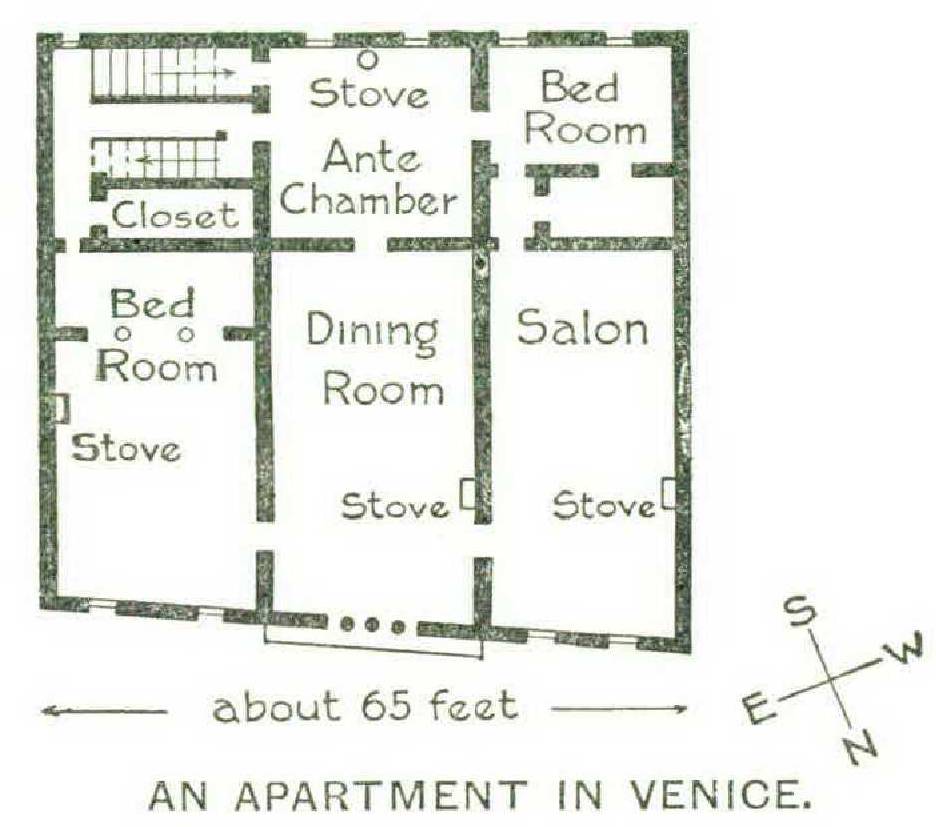
The apartment was the one immediately above the piano nobile, or principal story, and scarcely less large and lofty than that. The piano nobile itself is hardly ever to let. As there is also a high ground floor, devoted to the water-entrance, the storage of the surplus furniture of gondolas, and to sleeping-chambers for the gondoliers and others, you have already a length of bare stone staircase to climb equal to that of a third or fourth story in Paris. A large antechamber, with a carved and gilded wooden altar from some old church against one wall, opened into a great dining-room, and this in turn, on either side, into a salon and principal bedroom. I paced off the distance, and none of the three could have varied much from thirty-six feet by twenty-one. The length of the bedroom was broken by an archway, making a pleasant alcove. I went at once to open the casement windows, which fitted the ogival arches without. They were so high above the floor that a platform was built to reach to them. A balcony all along the front was found to be too narrow to enter comfortably, and was intended chiefly for external ornament.
“ La bella situazione ! ” exclaimed commendingly the elderly factotum who had come with me to do the honors. It was perfectly easy to agree with him.
“Cospetto ! ” he added, which is about like saying, “ Good gracious ! I should say so.”
I have sometimes, since, fancied our being there, rather shut in for want of solid land to walk about on, and looking out at the rich red Byzantine palace and the charming little house, with a bit of garden before it, opposite, and at the tramway steamers darting swiftly to the station of San Toma ; or again, in winter, looking out at the rain pelting incessantly into the leaden canal, or the snowflakes falling upon it, or the bitter winds harrying it. I turned back to see what was in the rooms. All the floors were of polished Roman cement, the usual flooring; the doors were of some rather elegant hard wood ; while the walls and ceiling had lost whatever ancient distinction they had had, and were covered with cheap paper of ordinary design. Three monumental stoves (for wood) in tiles or plaster, tinted, partly took away the bareness of the rooms; and the dining-room was furthermore helped out by two great canvases, some twelve feet square, showing, all in tones of faded green, two ancient Palladian villas with their gardens. At the first blush, the problem of furnishing such a huge place seemed terrifying; but I am convinced, on reflection, that it need not have been. Hangings would have done much for the vacant walls, and in our day charming hangings need no longer be dear. On the whole, our effects would have gone very well there. We should at least have been a standing protest, for the time, against the Anglo-Saxon vice of dreadful over-furnishing and stuffiness.
The problems of heating and lighting were much more formidable. Our lamps could have penetrated the ample obscurity with but a feeble gleam. You could hardly dine a friend under such circumstances; and the evenings promised to be dull at home, when we were not listening to the music and taking ices at Florian’s, in the brilliant piazza of St. Mark’s. But all that makes default just in the time of the year when you would need it the most. Going back to Venice in midwinter expressly to verify these conclusions, I found men shoveling the snow into mountainous heaps all over the piazza of St. Mark’s, as they might after an American blizzard ; the shopping thoroughfare of the Mereeria was ankle-deep in slush ; and one of our consuls of the time told me he had never known any other climate where the damp cold penetrated so thoroughly to the marrow.
The southern sun came into the kitchen and some of the minor rooms at the rear from a court. You see no kitchen on the plan I have made. The kitchen was down a half-story, with a whole series of other small rooms for which we should have had no use at all. It had only two charcoal holes for the cooking, and the water must be pumped up daily from below. These half-stories are frequently managed in the height of the others ; for, naturally, there is no need of all the rooms being as lofty as those in which you might have received the queen of Cyprus or the ambassadors of the Ottoman Porte. Another half-story up led to a great attic, brick-floored, which would have made a magnificent romping-ground for children. Still higher, on top of the roof, there is often a wooden lookout, from which you can command all the red tiles of the city and across to the snowy Venetian Alps. It is an excellent idea for the preservation of privacy, in Venice, that they manage to give each apartment its own separate entrance. The palace is entered on all sides, from all sorts of dark little streets. The drawback to the plan is that all but the principal tenant are cut off from arrival by the grand waterportal, which is something in which one would take a good deal of pride, if he had it.
I have not room for the subject of landlords. One was a Parisian grande dame with an exceedingly shrewd air ; another, a Venetian widow, who held that she did not know how to bargain, and I rather think it was so. Another was a stately ecclesiastic in silk stockings, who offered me his apartment of twenty vast rooms, in absolutely neat, perfect condition, and absolutely vacant of everything, for 2500 francs ; but it must be taken for six years at least, and he would much prefer nine. There is a curious habit of estimating the rent of quarters by the day, long as the period is for which they mean you to take them. I repeatedly heard rents divided up into ten francs, two francs and a half, and the like, per day. The Jewish element, again, is very strong and prosperous ; it is said that one third of the property in Venice is owned by Jews.
I am sure it would be much easier to imagine a palace in Venice than a small private house. I had not forgotten my wish for a small house apart, even in the queen city of the Adriatic, and I pursued it persistently, — the more so as the apartments had proved so large and cheerless. “ Parva domus magna quies.” I found something at last on the Calle della Donna Onesta that I hoped might be made to do. North again ? No, south this time. It was curiously interlocked with another house at the back, in mediæval fashion, so that the rear windows of two of its three chief stories were blocked. You would hardly expect the luxury of a dooryard in Venice, and there was none, but there was an alley at the right, which gave side windows. The rent was very low, — but forty francs a month, — which would allow a margin for improvements to make us very comfortable. It was a good wide Dutch-looking house, of red brick, with stone string-courses, a door in the middle, entered immediately from the level, and green shutters upon all the windows. A hundred yards or less
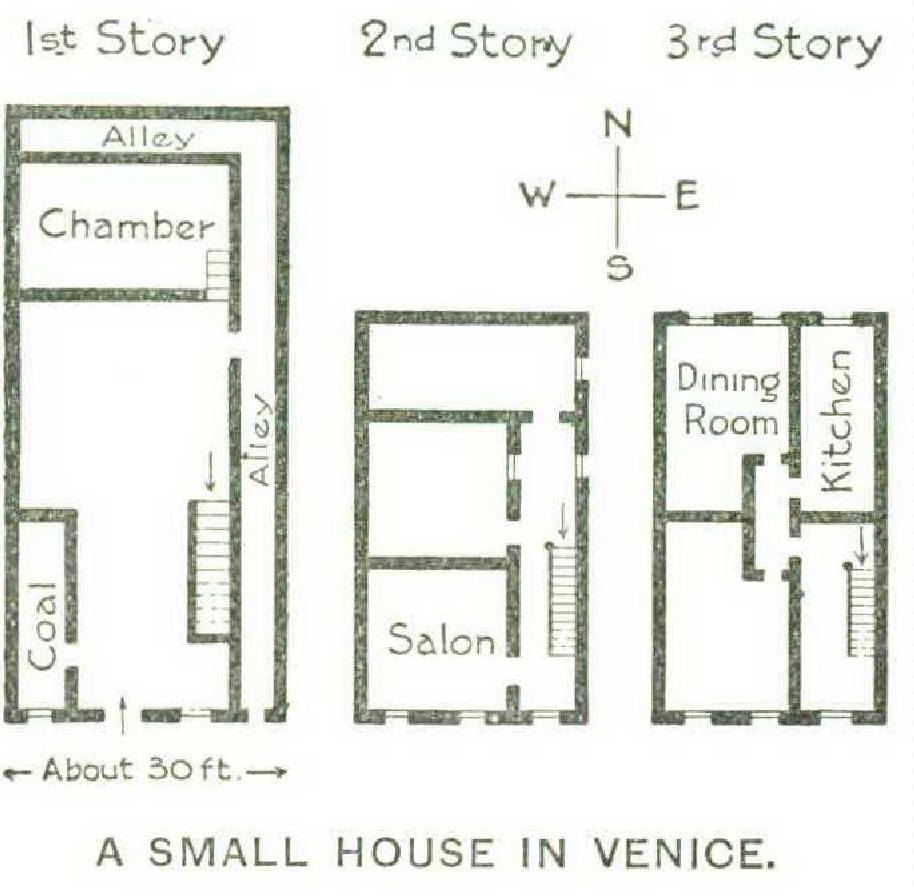
separated it from the Grand Canal, and there was a rather pretty glimpse of it from the corner. You could have made a satisfactory water-color of it, to send home. Who of us are free from some small vanity of wishing to impress others with our actions?
This little house had absolutely no modern improvements, — not a trace of them. There was not a fireplace in it; but the cheap rental would have allowed us to make one, and also to pay for plenty of fuel. All the water was brought from the public well in the small Campo San Toma, but a few blocks away. The said well was kept under lock and key a good part of the day: it was only between the hours of seven and nine A, M., and three and five P. M., that the servants could go there with their clinking copper buckets, and gossip around it, and form the traditional genre groups. We should have continued to send, of course, from time to time, for the picturesrpieness of it; but one of my first steps was to go to the office of the company, at the Traghetto San Benedetto, and see what the acquadotto water, the good water from the river Brenta, could be put in for. I found the expense was not great. The same thing could be done also for the gas. as the conduits were near, if they did not pass the door. There is a pleasant incongruity in talking of putting in gas and water in Venice; but as the romantic things can become almost commonplace by too long familiarity with them, so the commonplace things of life abroad take on a certain romance.
It would have been my idea to dash the walls of the entrance story, which was all one large, bare, rather damp room, with warm pinkish color, and suspend bold hangings there. It was floored with broken red marble. After having once been something better, it had become a bake-shop, I think, for I discovered the oven at the back. I should have put something rather elaborate in the way of a brass knocker on the green entrance door, a specimen of the artistic brass work you find among the makers of gondola fittings over on the other side ; and it would have been becomingly Venetian to have had some touch of yellow window curtains alongside the green shutters. A good platform staircase led to the several stories, and the corridor was of a pleasant, country - like width. As the kitchen was at the top of the house, we should have done well to make our dining - room next it. There were no traditions as to arrangement, and we could have divided up the rooms to suit ourselves. We should have had a boat of our own, and kept the oars and the awning in the ample spaces of the entrance floor. We should have rowed to the Rialto, which was but a short distance away, and brought back our marketing ourselves. A huge provision of everything was spread out there ; and I was told, by an informant of much experience, that one could live nowhere else in the world so cheaply as in Venice. The wondrous Archives, the Academy of Fine Arts, were but a few steps distant; we had only to go to the ferry, close by, to be set down in ten minutes by the tram-boats at the piazza of St. Mark’s. All the rich opportunities of Venice, in pictures, in libraries, and in “subjects,” and the cosmopolitan people who came there, were at hand. And in our own house, “ away from the pulling and the hauling,” not the roar of a single cab could break the smooth, restful silence, should we remain in the great water city.
We did not do it. Would the child D——fall into the canal before our door? Were the bad smells, from the tide in the canals and all the things floating in them, really as harmless as their apologists maintained ? Would the enervating lassitude of the long period of summer heat yield to habit, or, if not, what considerable part of our income should we spend in avoiding it ? And should we escape the pulling and the hauling very much, after all ? The last I saw of our fancied home, as I looked back upon it, the bare-headed mothers of the vicinity were taking counsel together before it, and a group of urchins, of the irrepressible variety that swarms out from the dense neighborhood of the school of San Rocco, — these rococo urchins were wrangling over a division of fish they had caught, in its very doorway.
All was duly noted for final reference, and the question was settled within half a day after leaving Venice. Verona was en route, and Verona was a charming provincial city where I had once passed some time. The visit was more one of reminiscence and sentiment than anything else ; yet there had been a house there that I used to fancy I should like to live in. I drove to see it. There is a brisk stir of modern life in the city of Romeo and Juliet, as elsewhere. The approach to the pleasant hill of San Lorenzo, under the white forts of the Austrian domination, had been cut across by the station of a new railway to Lake Garda; and besides, there was no sign now, any more than in former times, that the house had ever been vacant. But there was another one, a place so quaint and original, so charmingly situated, and, on top of all the rest, so fascinatingly cheap that it seemed hardly possible to hesitate any longer. It was the Palazzina Giusti, a pavilion standing on an upper terrace of the large garden of that name, to which many travelers obtain admission as among the rare spectacles of the interesting town. You have only to look in Baedeker to learn something about it. A rhetorical mention of it has even crept into that wonderful tale, Guy Livingstone. “ The cypresses in the trim old garden,” says the book, “ soaring skyward till the eyes that follow grow dizzy, — the trees that were green and luxuriant years before the world was redeemed.” This is slightly incorrect, though there is the stump of one dating back fourteen hundred years, and there are a great number that are four or five hundred years old. The palazzina dominated ancient parterres and statues, and the stairway, climbing to it through an alley of venerable cypresses, disappeared in the mouth of an enormous head cut in the solid rock. On the other side it had an exit, its practical gate for every day, on a street that had once been holy; while beyond this, close by, passed the old brick city wall, with its basis in the time of the Romans, and scars upon its battlements from the conflicts of the Middle Ages. It was to be our walled town par excellence, and went far to still the craving of that peculiar taste. The ruddy notch-battlemented walls, with a still green promenade within them, ran up hill and down dale in the most taking way, and, antiquated though they now were, sentryposts of bersaglieri still mounted guard at their towers.
The pavilion seemed even more attractive to me than the main palace of the ancient Counts Giusti, below. “Palazzina ” would sound well at a distance. I asked the amiable gardener if it was inhabitable and had lately been inhabited.
“ Yes,” he replied, lifting his arm towards it with the same comprehensive gesture we were to see him employ later, as he directed some inquiring friends where to find us. — " yes, it was occupied by the widow of a German officer, with her daughters. They left it only because the peculiarly healthy situation gave them such good appetites, signore, and such a florid state of robustness that they were actually uneasy about it, and felt obliged to go away.”
This unique credential was unnecessary. At least the house was inhabitable.
Returning to our home at Villefranchesur-Mer, by way of Turin and a pass over the little-traveled Alpes Maritimes, I think it was a whiff of the breath of orange blossoms, coming up the valley, six or eight miles above Ventimiglia, that first subtly gave the new conclusions pause. It was the land of Mignon’s song once more, and its potent charm promised to be but the stronger for having been a moment forgotten.
The Villa des Amandiers was at its best. The shadow of the cliff no longer fell upon the long walk, except in the measure agreeable for shade. The wild flowers that bad sprung up there in the winter had given place to new series in their turn, — to iris, narcissus, poppy, primrose, and crocus. Each one lasts a very long time; there is no sudden forcing out with fierce heat, and as sudden drying up. The farmer was grafting orange buds upon wild stock. To come out in the fresh morning, and watch the opening blossoms on my own small trees along the terrace, sometimes seemed worth more than all the antiquities of Rome. Cherry-time, too, was at hand. We had bought a horse for jogging about the pleasant country, and meant to explore as far as the small Alpine resorts to which many of the well-to-do of Nice retire in summer,—San Dalmazzo and Saint-Martin-Lantosque and Berthemont. Winter hardships were over, and the long, pleasant season of dining out on the terrace was all before us. Why move at all ? We summed up Rome and Venice and Florence and the rest, and decided that those were all places to go to only as travelers ; we were within such easy striking distance of them. I even ran over to Corsica, and traversed all the island, finding nothing there to tempt ns. One passes agreeable hours with the wild scenery ; it might be a pretty diversion to stay for a little under the shade of the fresh vivid green chestnut forests at the Springs of Orezza, which is a very much ruder Baths of Lucca. But the voyage is a rough and trying one; the climate is much too open to the suspicion of fevers. Ajaccio is crude and ill-favored as compared to the leading towns of the Riviera, while anything else would be impossible. I trust you have remarked the acquittal, of late, of the hardened bandit Bellacoscia, and the excellent example it sets to the youth of a country where lawlessness is still held in great admiration.
We decided, then, to remain, saying only that, at the proper time, we must seek another location where in winter we could have all the sun there was to its latest ray, — which is by no means easy to find. But hardly was the decision to stay well matured when an opposite decision was precipitated by an untoward circumstance. The rift in our armor, as it were, the drawback and latent threat in our situation, all along, was the little abode that stood vacant on our terrace, immediately opposite our door. I have spoken already of this peculiar French manner of arranging things. It was never meant to be occupied except by inmates of the large villa, or by some one very agreeable to them. I had ornamented it as part of our general motif. It had had such tenants as an artist known to fame, a picturesque old abbé, and a young officer of chasseurs. We were rather looking forward to the arrival of some such tenants again, for the pleasant novelty and plenty of practice in the language. Without warning or redress, the agent popped into it a numerous family, who found it to their liking as a place for passing the summer. It was not the fault of these worthy neighbors if they conducted all their domestic operations on the terrace : they could hardly do otherwise ; there was no room for them inside. They invited the hostlers and care-takers left in his house below by the commandant, who had by this time gone away with his troops to manœuvre in the mountains ; and the merriment in which they indulged would surely have been innocent enough could it only have been half a mile away. It was useless to offer to pay the additional rent of this cottage. We could not enter into a competition of trampling down the grass, for it was ours ; nor of high clamor; nor of casting out vegetable parings and débris, which would very likely have been taken only for pleasant sociability. There was nothing for it but to beat a retreat.
I had first to get a certificate of change of residence from the respected mayor of our commune, setting forth also that I would take with me to Verona my household effects, as per a detailed list annexed. This that they might not have to pay duty, as entering into commerce. This was legalized by the name, seal, and fee of the Italian consul-general at Nice. We got up at daybreak, that morning, the villa was dismantled, and everything was on board by eleven o’clock, and the car sealed up with a lead seal. It cost about twentyfive dollars for the things, on the " carload " plan, and the transport took nine days, which we passed in a little journey. Thus ended the pleasant chapter at the Villa des Amandiers. Whether it were only my own individual experience or not, I found the French railway officials short and gruff, and the Italian polite.
Arrived at Verona, I presented myself, with a proper Sponsor, at the stately city hall, opposite the great Roman amphitheatre, the grand guardhouse of the Venetian rule, and the battlemented gate of the Visconti. I furnished the assistant of the mayor with numerous particulars about myself and the members of my small family, which were duly recorded, and we were granted permission to select our domicile in Verona. I then proceeded with my papers to the custom-house, in a suppressed convent, next the nice old brick - and - marble church of San Fermo, translated into Italian in full the list of all my effects from the French, swore, signed, countersigned, and duplicated; hurried away to do a good deal more of the same thing at the branch custom-house at the railway ; and was finally free to take my goods away from the latter, finishing just at the closing hour of three. They were all in good condition. Going back to Nice with them, another time, they were very much broken, probably on account of being tossed about by the French customs-people at the frontier.
One of the amusing minor features of the hegira was the transformation our name underwent in the various papers. I have kept them all. A common form of the family name was “ Bisoph,” to which I am well used. But a family name was not often deemed necessary, or rather was entirely mixed up with the others. Thus I was “ Signor William Henry,” or simply “ William,” or, again, “ Villiam Enrico. " One’s ancestors enter into every public transaction here, and, having given my father’s and mother’s name, I find the former’s curiously attached to mine in this way: I am set down, in the extreme form of the evolution, as Signor “ Bishop d’Elias.” Surely that is a very pretty distance already from the original. There is an idea in it for those anxious for highsounding pedigrees which would afterwards have the sanction of grave official documents.
I suppose there was hardly ever a greater tugging, straining, and swearing, since the hauling of war material to the battlements for those tyrant princes the Scaligers or for Theodoric the Great, than in getting our two bulky drayloads of effects up the steep incline and along the grass-grown secluded lane to our gateway. The ancient fortifications closed in on one side, and garden walls, almost as lofty, on the other. At one place, there had even to be a partial unloading ; an old arch, sprung across the way at an awkward angle, seemed to bar it entirely, and the abutments were passed only by the merest hair’s-breadth.
It was then the 24th of July, and though I had been inclined to think this new post of ours — upon a bold foothill, with the grand snow mountains in sight over towards Lake Garda and in all the views northward — could hardly be any warmer than what we had just left, how hot, how very hot it was, with a heat of a totally different quality, as we were deposited, with all our belongings, upon our large brick terrace, and left to the task of settling the house ! Our welcomed privacy here was somewhat at the expense of refreshing draughts. We stretched an awning over the terrace, but it was a large space to cover, and the awning was always being thrown out of gear, or split and carried away by thunderstorms, while the very high rear wall was a veritable reverberator of heat.
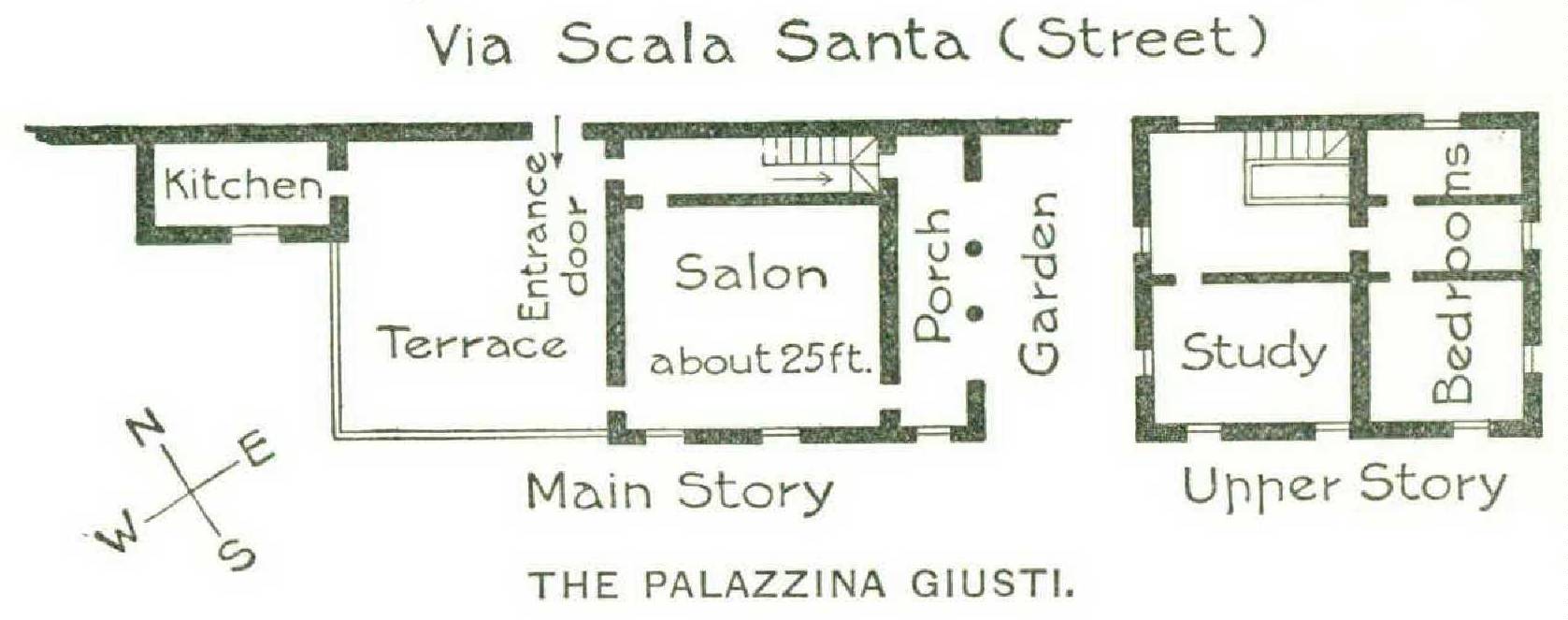
But the delightful prospect should be and was a compensation for almost anything. All Verona, every ruddy tower and church spire, was under our eyes, to be studied and grown familiar with at leisure; the windings of the Adige; the pretty villages ; and, beyond, Mantua and the other cities of the plain that were to be the theatre of our wanderings. And under the parapet, as if the principal pasture for our eyes, the labyrinths, statues, and parterres of the green Giusti garden which had brought us, were not enough, a part of the immediate foreground was a convent garden, into which the nuns, in pretty costumes of blue and gray, used to come out for their recreation, and till the ground, and chatter and make merry like a flock of sparrows. Above is a diagram of the palazzina.
Below it was all one fine large room, of which we made both salon and dining-room, when we did not dine upon the terrace, and I must concede that that was but seldom. The story above was divided into four rooms, of one of which we made a cosy sitting-room and study. It contained a curious goblinlike little iron stove; but in the winter, this proving insufficient, the proprietor replaced it with a prodigious affair of bricks and mortar which it took six men to bring up from the palace below. It was a good deal like moving a chimney. A mason spent half a day afterwards in plastering up the crevices. We had a similar one in the parlor, and both burned wood at two francs the hundredweight.
The kitchen was across the terrace, a small building by itself. It had a very wide Dutch window that would have suited a painter. Into the squares of the grating that protected the window all Verona was wrought like a vivid pattern of tapestry. The cooking here was done by means of a crane and tripods, over fagots of wood, upon a broad hearth of precisely the kind that Cinderella huddles before in the picture. Contrary to all expectation, S—, the housekeeper, was able to find much good in these primitive appliances, and to say that the wood made a readier and hotter fire than coal.
The servant question was naturally one pressing for immediate solution. A stately sort of dame in a Spanish mantilla, who had been employed by the Franceschine nuns below, came to us, but was totally incapable of comprehending that we could not wait for her ten days. What was to become of us in the mean time was no affair of hers; the only important fact was that the place suited her, and she would be glad to take it in ten days. A certain Giacinta was secured to come in by the day for the cooking and other heavier work. She was a stout, smiling, willing girl, faithful according to her lights, but easy-going and shiftless in her methods. She had a most extraordinary equanimity of temper; with her everything went always well. The question of wages gave her no great concern ; no rivalry upset her; no extra demand, no tugging of heavy supplies up the steep from the market, ever appeared to her inconvenient or inopportune. Then we got for a nursemaid a thin, very blonde, and Germanlooking girl from the province of Mantua, inclined to be cross-grained and moody, but much more efficient. Upon her trunk was neatly lettered, by some friend, probably a clerk, “La gentilissima Signorina Melania So-and-So.” Melania’s pay was ten francs a month with board, and Giacinta’s was twenty francs without. These were the Italian prices ; there was nothing exceptional about them; strange as it may seem, they were even liberal. We knew of well-to-do families where there was more work — heavy washing and the like — and the pay was less. The ladies of Verona complain of their servants, like their sex the world over, so that it appears paragons are not produced even under these primeval rates. The custom was, if either side were dissatisfied, to give eight days’ notice; or this might be commuted, on the employer’s side, into eight days’ pay.
Keeping house again in a new language was a considerable part of the opening trials ; and, as usual, it was not even a language, but a dialect, and even two dialects, one of each province represented. We got sausage sometimes for salad, and cheese for ice. Once Melania quarreled violently in the kitchen, and came to us and gave in her resignation. We were serenely unconscious of what she said, and she, nonplused by such a situation, seeing day after day that we had no idea she was going, felt obliged, in sheer despair, to remain.
We were rather far from the most advantageous marketing; that is. the central market in the Piazza delle Erbe, where the quaint mediæval surroundings seemed all arranged for grand opera rather than business. But nothing in Verona was dear compared to our late experiences. From a few items judge of all; ex pede, Herculem. Eggs were now fifteen sous, or cents, a dozen, milk was but four sous a litre, and the best filet of beef but three francs a kilo — two and one fifth pounds —as against five francs in France. The meat, which had been a constant problem in France, was here always tender and good. How forbear grateful recollections of the thick, juicy mutton-chops at less than half the price at Nice, even if they could have been had at Nice at all ! This again may be matter of only individual experience, but I have never seen anywhere else such delicious mutton. The sheep were an equal delight to the eye, feeding in pastoral groups on the wide stretch of greensward that continued the glacis of the fortifications all around the city. A " fixed-price ” system was agreeably applied more or less, here, even in the market; that is to say, upon a pile of fine tomatoes there would be affixed a small placard with the words “ two sous a kilo,” the same upon potatoes, and so on.
I have not yet stated the rent of the palazzina; it was thirty francs a month. What with the expense of moving and all, it could not be counted at that figure the first year; but after the first year, why, it practically amounted to an abolition of rent. With a house and two servants for sixty francs a month, was not the problem of living solved? Was not this a more artistic and rational kind of Thoreauism ? It seemed the very last word of cheapness. And a house in what surroundings ! You could go down to Verona and get books. Besides the excellent public library, there was another and a full reading-room at a pleasant sort of club, a literary society founded as early as 1808. One was isolated from nothing important, either ancient or modern, in this fine city of between sixty and seventy thousand people. In the first enthusiasm of realizing all this, and when our preliminary difficulties were somewhat settled, it seemed reasonable to exclaim : " Oh, let us stay here forever ! Let us thoroughly master the Italian tongue, go back to America when need be, but roam no more, and call this our home.” There was a grand apartment, with frescoes in the style of the old masters, down in a wing of the Giusti palace, for about 1200 francs a year, if you wanted it. For what would be a very modest scale of expense in America one could here keep horses and live like a sort of Sardanapalus. It was the good commercial plan of making the most of one’s fortune by reducing his divisor, if he cannot increase his dividend. Nothing is more strictly philosophical than to bring the cost of the necessities of life as low as possible, since it is from its superfluities that the principal pleasure is derived.
It is true that the full enjoyment of the Giusti garden was not included in the price named. On the contrary, we were asked a sum equal to just twice and a half our house-rent. We arranged a sort of modus vivendi for a great reduction upon this demand; but this question was never entirely settled, and was open to future adjustment, if we had stayed. Our doors eastward gave Upon a fine portico with light stone columns, and for the keystones of the arches grotesque heads which laughed down upon us. They had seen worse cares and trials than ours, in the three hundred years or so they had been keeping up their gayety there. They had seen notably the doings of that young nobleman who, fleeing from the machinations of Eugène Beauharnais, Napoleon’s viceroy in Italy, had concealed himself a long time in the cavernous cisterns under our terrace, and only got his food when it was let down to him through the ancient well-curb communicating with it. The portico gave upon the upper walk of the garden, planted mainly in the naturalistic type, in contrast with the geometries of Le Nôtre below. What charming promenades we have had amid the laurels, the graceful acacias, and the sempre-verde of many patterns of this our principal retreat ! How merrily has the baby D—run round the catalpatree just before our door, to stir his blood in the frosty autumn mornings! How warily has he shunned the hedge of May roses that guarded the edge of the precipice! And how truly—then coming to his first accents of speech in the foreign tongue — has he summed up all the winsome prospect in his " Guarda che bella ! ”
I cannot say just how old our palazzina was, but I have had one of those little marriage-books such as are still in fashion in Italy, which was printed to celebrate the marriage of a Count Giusti in the year 1620, and this gave a little account of it that was naturally quite interesting to us. It was in the form of a dialogue between a Stranger, Forestiero, and a Citizen, Cittadino, who had undertaken to show him the property of a Cavalier esteemed the glory of the nobility and the pattern of every grace and virtue. After having visited in detail the palace and the main part of the garden, they arrive at the upper level.
“Forestiero. Is it not drawing near our time to return ?
“ Cittadino. First let us look upon the delights of the palazzina. . . . Here flourishes a second garden. . . . We see tigs of such mien and flavor that one would rather take them for the ambrosia of the gods than for mere mortal fruits. Here are not wanting the fragrant salvia, the cooling mint, the valued rosemary, as well also as the cinara, either neglected of the ancients or unknown of them. . . . And now we are to enjoy this grand new prospect from the palazzina within.
“ Forestiero. Fine chambers are these, truly; wondrously provided with seemly ornamentation and comfort. But what well is this I remark here on the interior terrace ? How can water be raised to such a height?
“ Cittadino. The entire surface of this terrace is vaulted beneath, to hold a great supply of rain-water, which can be distributed at will among the fountains below. They disdain to receive water, so fair are they, from any other source than heaven direct.
“ Forestiero. This height is certainly nothing else than Mount Pindar itself. Here laurel abounds on every side, and the Muses disport with Apollo. The flowers parallel the stars in heaven, except that they have the advantage in being of a thousand colors, while the stars are of but one. . . . Oh, happy he that, far from every calking care, might breathe this air, and, beneath this timehonored shade, go on quietly weaving verse in which the apt rhymes and noble thought would be worthy of the scene all around! ”
Why then did we not stay ? Why are we not still in the Palazzina Giusti ? I fear I shall give but insufficient reasons. The novelty wears off after a while; there are moods in which you would look little more at the rich ByzantineGothic churches San Zeno or Santa Anastasia than at a backwoods meetinghouse. We were high and secure above the outer world, but the deserted streets by which we had to descend through a rather poor quarter were often unpleasantly neglected and malodorous. The municipality would send and clean them at times, but did not seem to be able to keep it up. If one should persist in an out-and-out New England squeamishness, of course he could not travel in Europe at all; but still, even so, he may draw the line somewhere.
Then I shall have to cite climate again, — endless gossip de la pluie et du beau temps, perhaps you will say. At first it was hot, hot, suffocating, unendurable. We were even alarmed by the uncompromising fierceness of the heat, and went away and passed most of the month of August at Bosco Chiesanuova, a mountain village devoid of most conveniences, but amusing in spite of itself. The mellow autumn came on, lovely as everywhere. We walked our garden paths now with pleasure, and promised ourselves ample atonement. In the property of the Franceschine, every formal little fruit tree seemed of pure gold ; the thin vines on the trellises were of gold; and it was astonishing what good subjects for a painter were lost when the nuns, in their white bonnets and grayblue gowns, moved about amid this yellow tracery. At that season, too, we began our excursioning. Another reason why the first year could not have been very cheap is that we were forever excursioning. Venice, of course ; then Mantua, the city of “ the lean apothecary ; ” Palladio’s Vicenza, where also, I should think, one might live charmingly, on the lines here indicated ; the brilliant old battlefields of Rivoli and Arcole, and the sad modern one of Custozza; and Lake Garda, with a taste of an Austrian town over the border at Riva. It is no very long railway ride southward to Parma or northward to Innspruck and into Germany, all of which, again, should be added to the advantages of Verona.
Our fires were lighted in October, and were burning wood plentifully by the end of the month. Mists now began to rise from the plain and constantly veil the distance ; an occasional London fog hid the garden, so that we could not see five feet from our windows. On Thanksgiving Day there was a light fall of snow, and the next day an old-fashioned snowstorm. If of an evening we ventured down to the theatre or the cafés, how bitterly piercing was the wind on our late return homeward ! The bersaglieri at the tower near our gate used to challenge us. “ Who goes there ? ” they would cry, and “Friends!” we would respond in true penny-dreadfulnovel style. It surely was not reasonable of them to think we could capture their town, with its garrison of six thousand men ; they must have done it only to relieve the monotony of guard duty.
The middle of December a hard winter set in, — a winter of the Russian or Canadian sort, such as, we were told, they had not had in forty years. Our water-pipes froze up, and remained so. The snow lay like caps and mantles of ermine on the old statuary ; it lay deep on the steps of the Roman arena, and on the roofs and barges along the river, and in continuous ridges along the horsecar tracks, giving the town a crude, shrunken appearance. The Palazzina Giusti, which had first been untenable on account of heat, now became untenable on account of cold. When we left it, that same terrace which had once been almost an inferno of heat was hidden under Siberian mounds of snow broken only by the paths shoveled through them for the removal of the furniture.
The fact is that the longing for Nice had much to do with this impatience of hardships which otherwise should have had nothing very formidable about them for Americans. We returned to Nice proper, this time. As all the earlier journeys had pointed towards it, so all the later ones pointed back to it. It was just on the eve of Christmas that we reached it, a day of warm sunshine and unclouded blue. The feeling of content and comfort it was, after the recent inclemencies, to go about without a muffling greatcoat, dry-shod, to breathe again the fragrance and see the oranges and roses in the gardens, was a sensation not soon to be forgotten. Indeed, I must count that violent contrast, that miracle, as one of the memorable things in my life. Whenever I think of it, it is a grateful memory which justly overcomes that of a hundred inconveniences at Nice. For inconveniences there are : if one should consider only its merits, he might rise to the warmest enthusiasm ; but if he should consider only its defects, he could find it as insufferable as many other places less favored by nature. These defects, however, tend steadily to disappear. Every year, there is progress towards better hygienic conditions and other improvements. Nice is even much nearer the outer world than it used to be. The North German Lloyd has all at once put on good and quick steamers to Genoa, and now to run over direct from New York to any part of the Riviera is as simple and agreeable a matter as possible.
I do not quite know whether these added facilities ought to be taken most as a temptation to go, or to remain yet longer since it has become so easy to go. We have lived in three different houses at Nice since the last change, and have finally arrived at one in a measure palatial, with some corresponding change in the scale of expense. But the transatlantic reader, at least, will hardly take the word “ expense ” with more than an amused smile, I fancy, as applied to the greater part of the list [ have mentioned, however it may be in the future. Rents have been twice advanced, and tariff legislation — notably the economic battle with Italy — has raised the cost of provisions, so that some of the prices I have given are already passing from date. Further experience did not depart greatly from the lines indicated. The chief defect of the experiment has already been hinted at. Your cheap habitation, — and I fear the same thing must be true everywhere, — no matter how artistic and original it may be in itself, will, except by some great piece of good fortune, throw you into too close proximity with people paying the same cheap rents, and they will have totally different views of living, which may go far to spoil your own. The trial is well worth making, but nobody can expect to fly in the face of political economy, and escape the necessity of murmuring at times that “ every prospect pleases, and only man is vile.”
William Henry Bishop.