Crude and Curious Inventions at the Centennial Exhibition
X.
V. WEAVING.
HAVING considered the subjects of basket and wattle work and of spinning, we may advance a step and examine what the Centennial Exhibition showed us in the way of weaving. We are met here by the difficulty which attends all attempts at rigid classification: no precise line can be drawn between wattling, plaiting, and weaving.
The making of mats was probably the first exertion of ingenuity which culminated in the art of weaving. The wattle has already been described: it has rigid sticks in one direction, which are interlaced with pliable withes; the structure is for the side of a house, a panel of fence, or the revetment of a fortification, as the case may require. The mat is of more pliable material, and forms a carpet for the floor, a screen, a sail, an awning, or a garment. Where stiffness is required the woof may be of splints; where thickness and softness are desired the woof is of bundles of soft grass or rushes, with a single or double series of warps interwoven to keep the filling in place. This does not yet, however, come up to the technical idea of weaving, which, strictly considered, involves the idea of the twisting of the yarn or bunch of fibre of which the weft and the woof are composed. The distinction cannot be drawn from the manner of making, either with or without the use of frames, for, except among rude tribes, mats and woven fabrics are equally made in frames, and the Japanese mat loom shown at the Centennial is a more complicated and ingenious device than the cotton-cloth loom of the African Gold Coast in the English colonies exhibit. There is also but little to choose between the Angola loom, which makes cotton yarn into what we should call toweling, and the Maori frame, in which the New Zealand flax is made up into the characteristic mats of the island.
It was a pity that our friends from abroad, who gave so handsomely of their best productions to our celebration, omitted in most instances the crude and the common. Many of the coarser implements of the natives of the various countries were not brought, because they had so rude an appearance that they would reflect upon the state of progress of the nation exhibiting. This was especially noticeable in the Brazilian exhibit, and the reason above was assigned for their absence. Notwithstanding this discrimination against the crude and primitive, diligent search in the nooks and corners discovered many things which were not prominently displayed, and specimens of various plaited goods and matting among the number.
The conditions of mat - making are simple, and the principal differences are in the material. The matta or rush mat of the Romans was the same as the modern, and the plaited rushes and grass mats, panniers, and baskets of the Spanish collection in the Main Building were the same, doubtless, as when the Celtiberians traded with the Carthaginian and Greek colonists upon their shores.
The National Museum, which as yet forms a part of the Smithsonian collection, had numerous specimens of mats from our Northwestern territory. Mats of cedar bark are plaited by the females of the Makah Indians of Cape Flattery; other tribes, who can obtain bulrushes and flags, make their mats of these materials, which do not grow in the vicinity of the cape. The inner bark of the cedar is prepared by first removing the outer bark and then peeling off the liber in long strips, which are dried in the sun, folded, and used as an article of barter. The strips are split into strands from an eighth to a quarter of an inch in width, and are then plaited into a mat six feet long by three feet wide. They are used principally for wrapping, protecting cargoes in canoes, and for sale to the whites as a substitute for carpets. A more durable mat is made from the divided fibres of spruce root.
The Killéyute tribe makes mats of a species of coarse grass.
The Ahts of Vancouver’s Island use mats of cedar fibre, the inner bark being beaten into strings which are twisted into twine. A number of these cords are stretched in parallelism, being arranged between two sticks like a warp, and strings are tied across them at intervals, forming a sort of woof; but this is not weaving. Such a mat is frequently used as a cape, and is sometimes edged with fur. Hats are also made by plaiting cedar-bark strings with white-pine bark.
Africa has its mats, cloth, skins, and bark cloth. The attendants of Dr. Livingstone slept in fumbas, or double mat bags of palm leaf, six feet long by four wide, and left, open only at the end. The mats of the Hottentots are used for screens and for covering their huts: they are made of reeds cut to an even length of six feet and strung upon parallel cords of acacia bark, each reed being pierced through the centre with a needle or an acacia thorn. The Cape of Good Hope and Orange Free State exhibits were not large, but very interesting.
The mats of Madagascar are of rushes and fine grass, and are used for beds, carpets, and wall-hangings. They are plaited by hand.
Ihe mat used for a floor covering in India is wattled, rather than plaited, from a kind of long grass known as mâdoor-katee.
The collection of the Dutch colonies was somewhat exceptional in that it furnished specimens of crude materials and implements which looked, if possible, still ruder from their vicinity to the admirable engineering models and plans of the Netherlands. The Javanese mats are of several species of pandanus, a grass called mandong, and various palms; they are woven on frames which are also used for coarse linen goods.
The mat fabric (ataps) of the Dyaks is of strips from the dried leaves of the nipa palm, one of the indispensables of Bornean existence. Of this leaf are the mats which form the walls of the houses, being stretched from post to post; also the doors and screens in their community dwellings. These leaves form the thatch of houses and the deck awning of boats, and a single leaf on occasion furnishes a sail. Hats are made of this material, as we noticed in a previous article. The plant looks like a gigantic fern, and has leaves fifteen or twenty feet in length. Dyak mats are also made of rattan cut into narrow strips, stained of various colors, and interwoven in patterns, with borders. This mat bears the same relation to a grass or leaf rug that floor-cloth, does to carpet. The natives are very curious in regard to the forms of knives for splitting rattan. The handle is held under the arm, the blade pro-
jecting in front, and the rattan strip is manipulated by both hands.
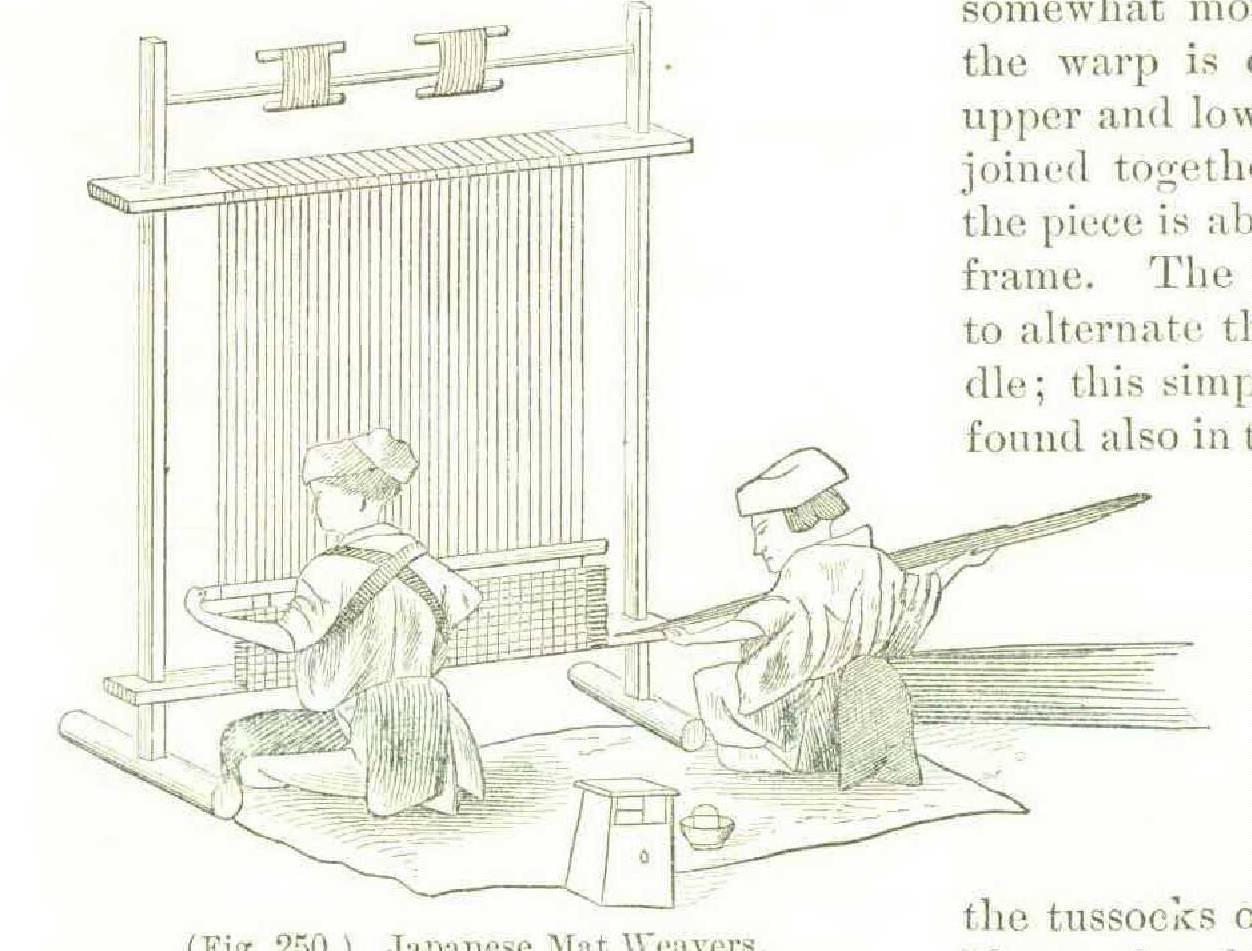
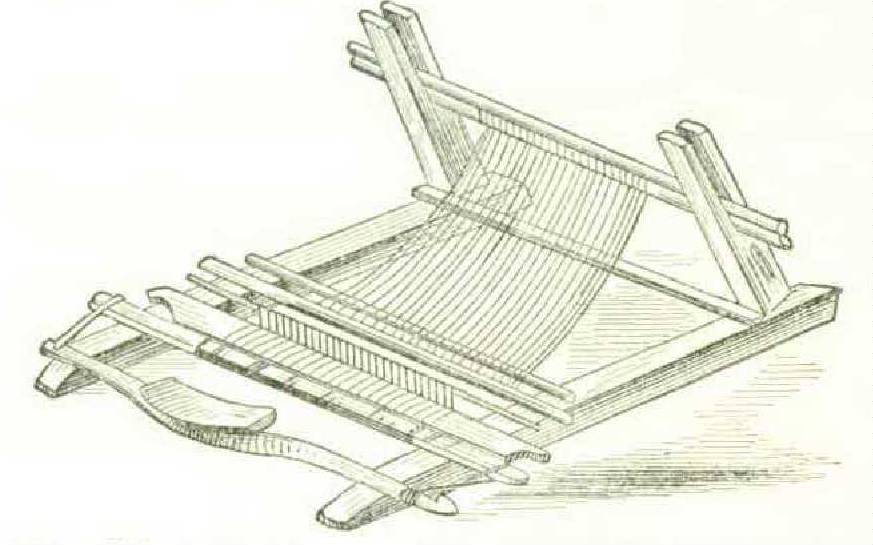
The Japanese mats used for screens are woven in an upright frame, which is equivalent to a loom, an arrangement being had to open the shed by alternately drawing forward and pushing hack one set of warp threads, an assistant pushing a leaf split into the shed as it opens. The plant looks like the rush, and is grown in artificial ponds, where the eub
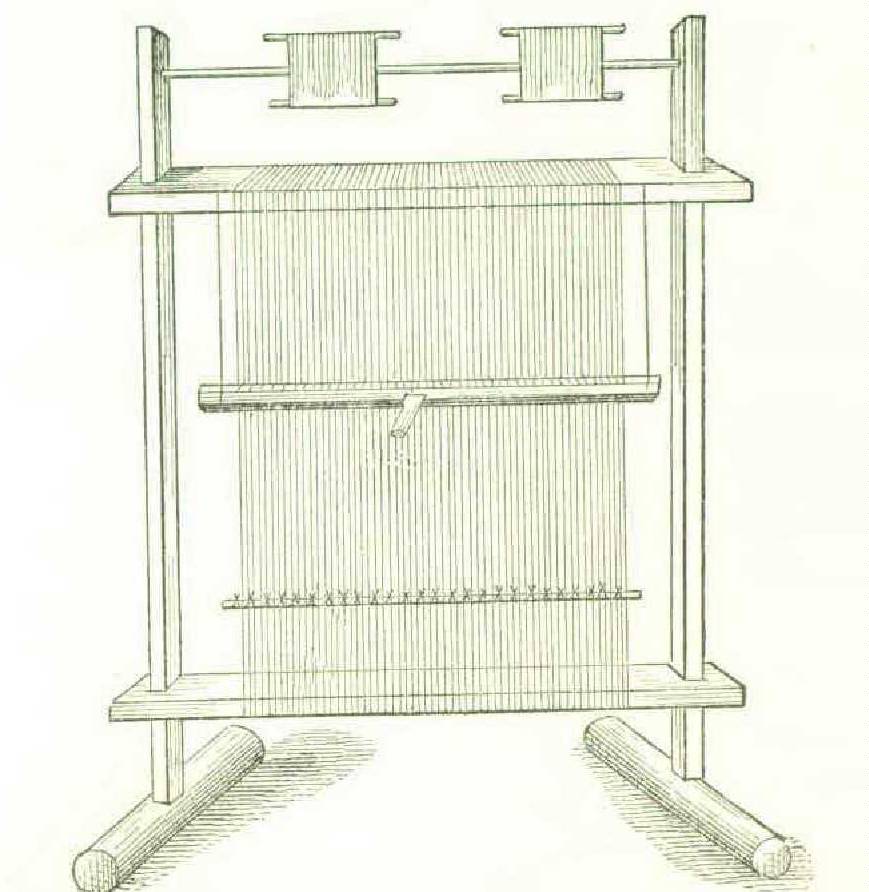
tiva,tor has command of the height of the water. Being cut in gavels and gathered into sheaves, the leaves are taken to a lawn and laid out in parallel order to dry, after which they tire ready for the weavers. Figure 251 shows the frame somewhat more clearly. The length of the warp is once over and under the upper and lower beams, the ends being joined together, so that the length of the piece is about twice the height of the frame. The bar in front is connected to alternate threads, —a primitive huddle; this simple form of harness may he found also in the African and some other looms, as we shall notice presently.
The Japanese snowcloak is a skeleton of network, with a bunch of vegetable fibre tied up in each mesh, so as to make a shaggy garment in which the tussocks overlap those beneath them like a thatch. The Maories make a shaggy cape of the New Zealand flax. The less ingenious Australian takes the skin of the emu, and makes a garment which yields to neither of the others in shagginess.
The South Sea Islands were not well represented, as they are mostly independent and unenterprising. The Sandwich Islands had a fair show. Fiji, acquired so late as 1874 by Great Britain, was not included in her colonial exhibit, although the Seychelles, Gold Coast of Africa, and Trinidad were not overlooked. The mats of the Kingsmill islanders are made of strips of the pandanus leaf, dyed brown and yellow, and plaited in diamond or square patterns. A small cape of the same, with a slit like a poncho, goes over the head, and a conical hat of pandanus leaf completes the costume. Mats were shown from the Sandwich Islands; their most curious ones are used as armor, and have been noticed with a breast and back plates of teeth strung in rows. The mantles of the great chiefs of the Sandwich Islands are a sort of net-work, with interwoven feathers. The royal mantle of Kamehameha was four feet long and eleven feet wide, and was ornamented with the yellow feathers of the honeybird, which has one yellow feather under each wing. It took the collection of nine reigns to complete it.
The mats of Fiji are plaited from coir, plantain leaf, grass, the pandanus, rushes, etc. They are of very diverse character, each island of the perhaps ninety inhabited ones of the group showing a kind peculiar in materials or in quality. They are used for carpets, sails, beds, etc. The sail mats are of the fibre of the cocoa-palm leaf. They are from two to four feet wide and twenty feet long, the usual length of a sail, which is made of a number of breadths sewed together. Floor mats and sleeping mats are used as carpets and mattresses, the former being twenty by sixteen feet, with an ornamental border.
The Australians weave circular mats (paing-koont) of reeds twisted into rope, coiled round and fastened in the manner of our rope door-mats. They are sewed with thread made of the chewed root of the bulrush. The Australian sea-grass (zostera) cloak is a mat: the long and tough fibres are laid parallel and lashed together at intervals, being allowed to hang like a long pile, and forming a deep fringe at the edges.
The Maori mats are elaborately made of the New Zealand flax (Phormium tenax), one of the Asparagaceœ. The long leaves yield a strong and silky fibre. The frame on which they are woven has four marginal bars inclosing a space of the size of the mat required, and standing on four short legs which raise it horizontally a little above the ground. The warp threads are stretched across it, being tied to opposite sides of the frame. The doubled weft is then passed in by hand over and under the warp threads alternately and tied at the selvage. To make a shaggy rain-mat, at certain equidistant intersections of the warp an undressed leaf of the flax plant is worked in, just like the knots of colored yarn in tapestry weaving, the rows of leaves thus forming flounces which overlap each other and shed the rain; each row shows about eight inches to the weather, and six rows are sufficient for the mat, which is known as E Mangaika. A number of kinds of mats are made to suit various tastes, or such as befit the rank of the wearer. In one, the leaves are dyed of various colors and rolled up so as to look like porcupine quills, being then fastened in regular rows into the material of the mat. They rattle as the wearer walks, and give him infinite satisfaction. In mats of the highest style for the chiefs, dog’s hair is knotted into the mat, to give it the appearance of a hide. The colors are so disposed as to make a pattern, markings like those of a zebra being a favorite style. These mantles are about six by four feet. The method of inserting colored knots of hair or fibre is similar to the Gobelin tapestry method, A mat of this kind represents the four years’ work of a woman, much depending upon the precision of the markings or matchings; in other words it is a question of quality and patience, and much time is consumed both in Xew Zealand and in the faubourg St. Marcel.
By the process of spinning, short fibres are so tightly twisted together as to make a practically continuous length. Simple as the process seems it is not universally known, and there is a still greater number of tribes to whom the idea of weaving such threads into mats has not occurred. The reason of the lack of spun material is doubtless to be found in the great abundance of grasses and well-splitting leaves, which leave nothing to be desired for mat-making. The oldest records—the Bible, Hesiod, Homer, Herodotus, the mural paintings and tablets of Egypt and Assyria, the collected remains of the lacustrians of Switzerland — all point to the existence in early times of well - executed textile fabrics. Those of the lake dwellers are coarser than either of the others; one fabric examined has a twisted cord for a warp, while the weft is of smaller twisted threads laid in pairs at intervals. It is but a small advance upon a wattle, but each of the threads bends somewhat to the tightness of the thread crossing it. The linen of Egypt needs no hesitating approval. The coincident voices of the ancient writers and the fabrics recovered from the tombs evince the skill of the Nile people in the weaving of linens. Their word byssus was adopted by the Greeks and Latins for linen; this was woven as fine as three hundred and sixty threads to the inch, as recorded by Herodotus; a piece in the British Museum has one hundred and forty threads to the inch in the warp and sixty-four in the woof. The coa vestis of the Roman female dancers was of so fine and transparent a texture as to exhibit the wearer’s form as in a mist. The references in ancient authors to the gorgeous fabrics of Babylon are numerous and familiar, but are outside of our subject.
Of the crude looms shown in the various foreign exhibits at the Centennial, some were vertical and others horizontal. So it was in ancient times. The old Egyptian looms were of both kinds, and in some the woof was beaten upward, in others downward. Beni-Hassan shows the horizontal and Thebes the vertical. The loom of Palestine was vertical, that of India usually horizontal. The Greeks and Romans had both forms also. A complicated harness which permitted of twill weaving was known in Greece and Italy in old times, and the technical terms are recognizable in the languages. The Egyptians wove checker patterns; also dyed and printed their linen cloths. The mediæval English loom was horizontal.
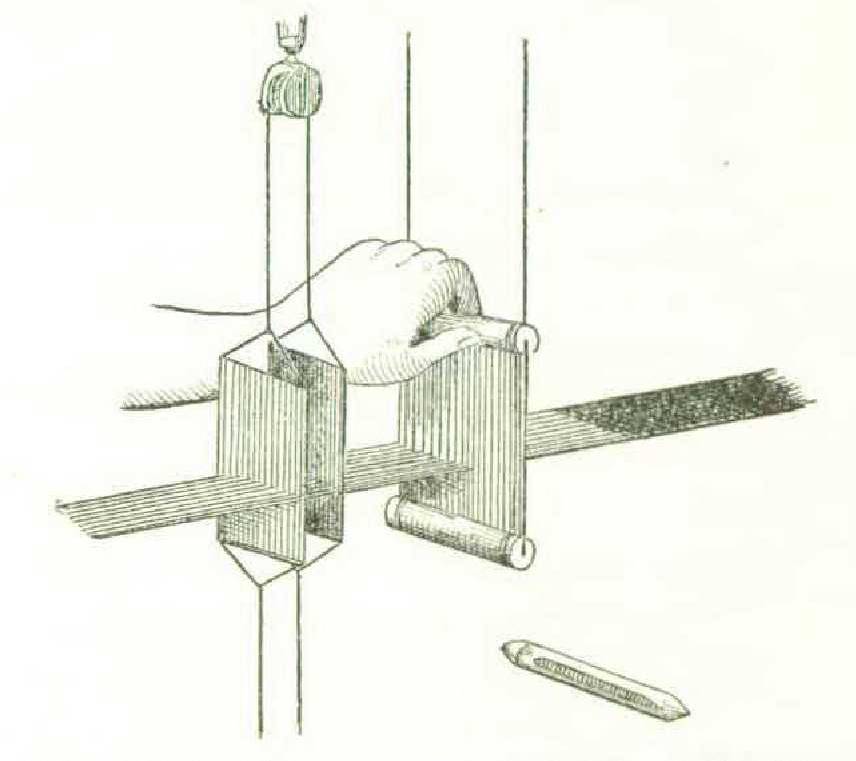
The western coast of Africa furnished three looms to the Exhibition, from the Gold Coast, Liberia, and Angola respectively. Those from the two former were so similar that one may stand for both, and their vicinage is such that their correspondence is very natural.
Figure 252 shows the native cotton loom of the Gold Coast of Africa. It weaves a two-inch cotton stuff with four colors in the warp (red, blue, yellow, and white) and two in the weft (red and white) on separate shuttles. The batten is of wood below, bamboo above, and has seventy-four dents of bamboo splits. The two leaves of the harness work over a pulley above, and are operated by the feet beneath.
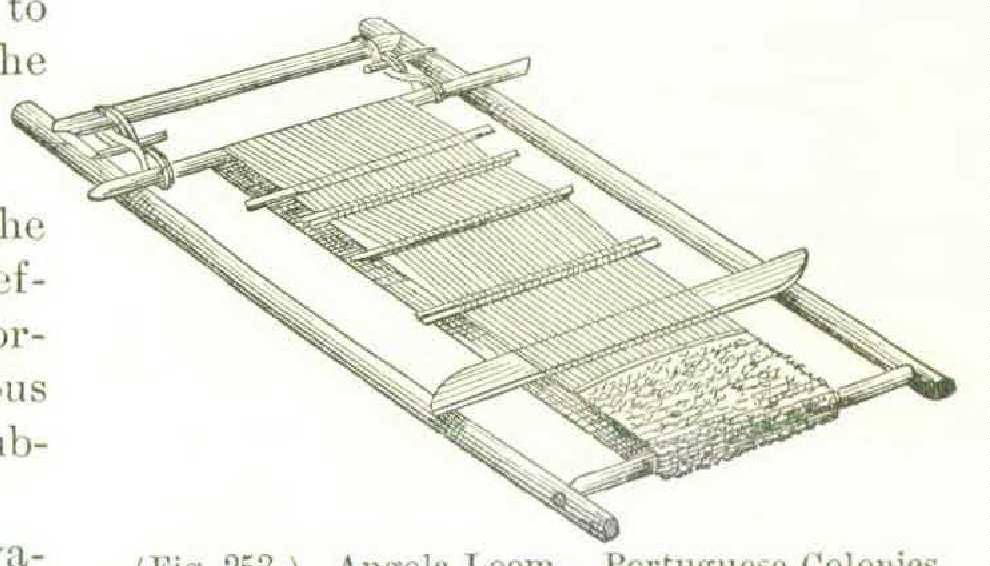
The loom of Loanda and of Angola (Figure 253) is worked by men, the women doing the spinning with spindle and distaff. The frame consists of a few simple sticks, the warp being carried around the ends of the cross-bars and secured, as with the Japanese mat loom (Figures 250, 251). The web is five feet long and fifteen or eighteen inches wide, occupies a month in making, and is sold for fifty cents.
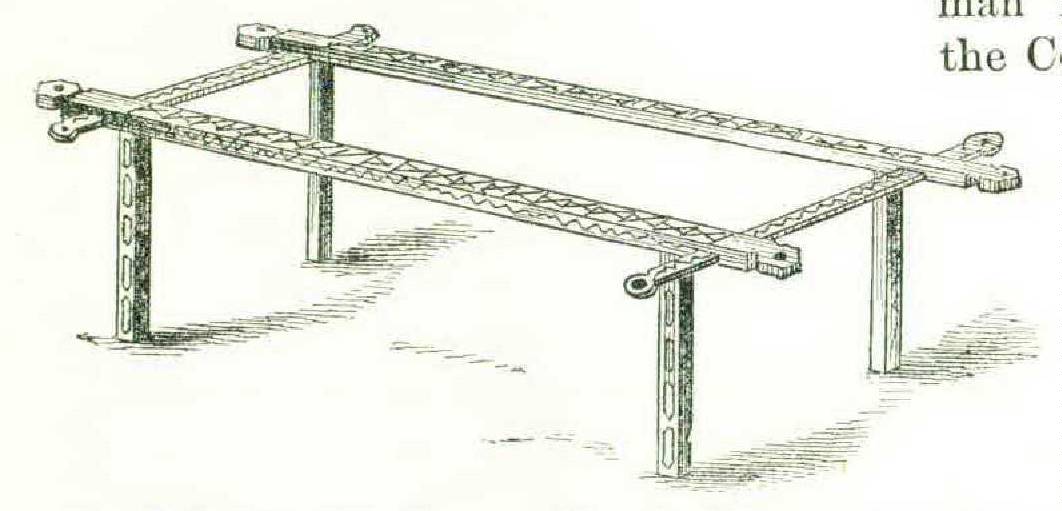
In some parts of Loanda-land such a piece is called a hongo, and is employed as currency. Several pieces are stitched together to form a denguis or robe. The frame is either suspended, so as to make the warp vertical, or it is laid horizontally on a stool, such as shown in Figure 254. The harness consists of a single heddle, which pulls the threads in the heddle loops alternately above and below the general straight line of the warp threads, and thereby opens the shed for the passage of the shuttle, which is merely the spindle on which the yarn was wound in spinning. The harness lifts three warp threads and leaves eight, and so on, so that the woof is alternately floated over eight threads of the warp and then below. The woof threads are then cut in the direction of the warp, and form a soft pile for toweling. A wooden sword is used to beat up after each crossing of the warp.
The shaggy goods of Angola, like the Turkish toweling, recall the description of the erudite Pliny: “ The gausapa [a thick cloth, shaggy on one side] has been brought into use in my father’s memory, and I myself recollect the amphimalla [napped on both sides] and the long, shaggy apron [ventrale] being introduced, but at the present day the laticlave [broad-striped] tunic is beginning to be manufactured into an imitation of the gausapa.”
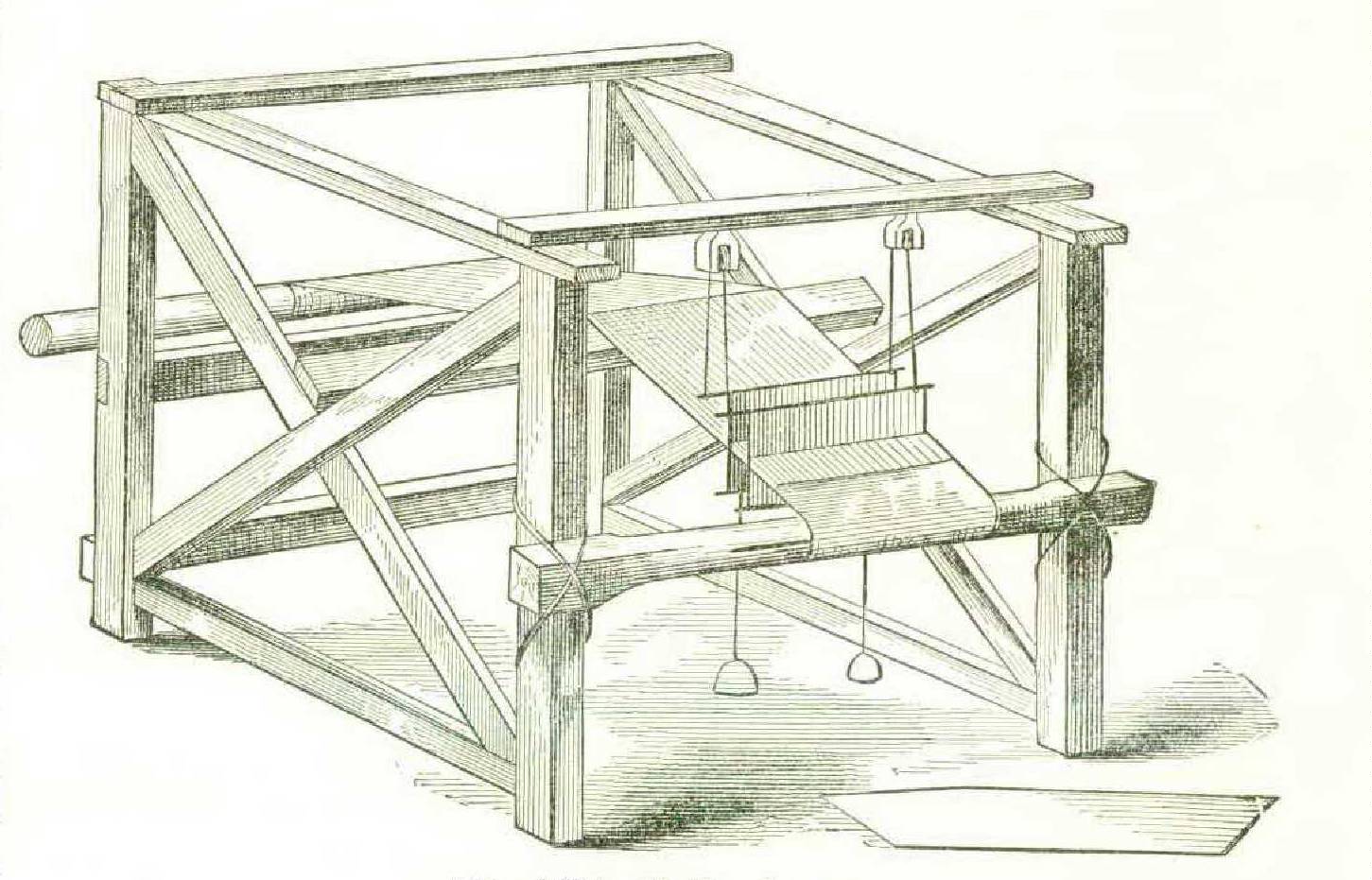
Figure 254 is an Egyptian wooden stool for holding a loom or a tambour frame. It has extension bars at the ends, and is very handsomely inlaid with ivory and mother-of-pearl.
It is not the least interesting feature of these crude appliances that in looking at them we view the machines or implements which were common among the most civilized peoples twenty or thirty centuries since. Take, for instance, a Roman loom of the better kind, somewhat in advance of the African loom just described, but not superior to the Asiatic looms which we shall consider presently. A description of the Roman loom would answer for some at the Centennial.
Quite a number of the crude looms at the Centennial, notably those from Africa, Java, and South America, had no shuttle, but the woof was wound on a rod or reed which reached through the shed and allowed the yarn to reel off as one hand of the weaver pushed it through to be grasped by the other.
The Malagasy loom seems to be without heddles, the shed being opened by a sword-shaped stick for the insertion of the rod around which the woof is wound. Weaving in Madagascar is with silk, cotton, hemp, and the leaves of the rofia. These leaves are split, tied together in lengths like the filling for our rag carpet, and then woven by the women.
The loom of Muscat is very rude, the warp, instead of being on a frame or roller, being stretched along the ground, and held by the weight of stones laid upon it. The weaver sits on the ground with his legs in a hole, so as to bring him into a convenient position for working the loom. The Singhalese have a similar arrangement. Nothing but a coarse, serviceable cotton cloth is made upon it. Woven asbestos towels are mentioned in the Mahawanzo Singhalese chronicle as being sent by Asoka (B. C. 250) as a present to the king of Ceylon. Carpets of woolen fabric are referred to in the same record, of a date equivalent to the second century B. C.: and in another place the chronicle speaks of a cotton cloth seven miles long, laid down for pilgrims to walk upon. The same remarkable work mentions bleaching, and dyeing cloths of every color, and describes a feat, still occasionally practiced in Ceylon, of taking cotton from the bush at day-break, and spinning, weaving, dyeing, and making it up into clothes before sunset.
Until of late years the spun and woven India cotton goods have been unexcelled in fineness. The city of Mosul, in India, has given its name (muslin) to the fabric, and Dacca on the Brahmapootra has long been celebrated for the manufacture. One pound of the finest Dacca thread is two hundred and fifty miles in length. The muslin may have from one thousand to eighteen hundred threads in a piece of a yard wide, and receives various fanciful names: “dew of night,” “ web of woven air,” etc. A piece brought to England, ten yards long and one yard wide, weighed three ounces two pennyweights, and would pass through a small ring. The Hindoo woman cards her cotton with the jawbone of a boalee fish, separates the seeds by means of a small iron roller worked backward and forward on a flat board, brings it to a downy fleece by a small bow, and makes it into rolls which are held in the left hand while the delicate iron spindle — with a small ball of clay attached to give it weight in turning — is twirled by the right. The Hindoo’s loom has a yarn-beam, cloth-beam, huddle, swinging batten, shuttle with an eye, treadles, and temple. A very fine piece may occupy the weaver for four months, and be worth from four hundred to five hundred rupees, equal to half as many dollars. The preparation and spinning of the fibre form the greater part of the work.
Figure 255 shows the loom of Java and adjacent islands. The piece in the loom was a cotton gingham, woven in squares of color, red predominating. The width of the stuff is about twenty inches. The loom has a single heddle, and a reed for heating up. The Javanese print cotton goods with wooden blocks, in imitation of Indian chintz and palampoor. The latter, locally known in Java as batik, is dyed by the resist process, in which the parts of the cloth to remain white are treated with melted wax run out of the spout of a copper vessel. In India a hair pencil is used; the process is very old there, and was described as an Indian art by Pliny. The Javanese have also a mode of clouding yarn by dyeing it in skeins which are tightly tied in places to prevent their taking color.
The Dyaks of Borneo have a loom for cotton fabrics. They beat the picked cotton with wands, and spin it on a rude wheel from a distaff. The Sooloos of the Eastern Archipelago manufacture a fine stuff from the fibres of the plantain. Their loom is composed of a few sticks, and the woof is secured around their waists.
The art of weaving is unknown in most of the islands distant from the coast of Asia: the nearest approach to it in the Navigator’s Islands is a belt of coir, woven by the warriors as a defense against the shark’s-teeth gauntlets. A number of parallel threads of plaited coir are stretched between two sticks, and cross strings are plaited in, over, and under alternate threads in the manner of a mat. These webs are thirty-six by eighteen inches. A whole plaited suit of armor for body, legs, and arms, and made in a similar manner by the Samoans, is in the United Service Museum of London.
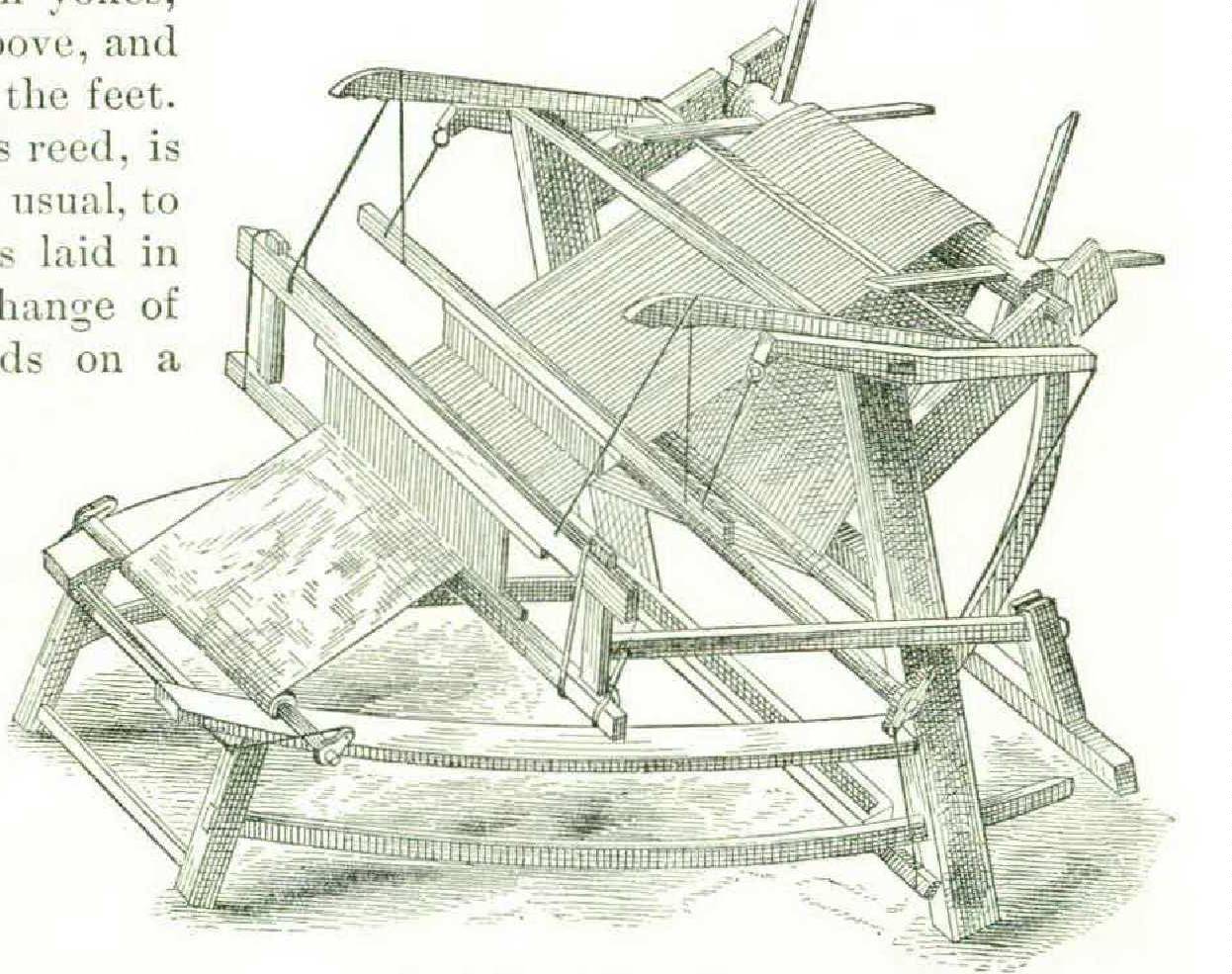
The Siamese loom was exhibited in the navy department of the Government Building, and is quite an advance upon the preceding examples. It is, however, incapable, without laborious and patient manipulation, of making the gor-
geous tissues which so much delight these people who face the Malay seas.
The warp of dyed thread is wound upon the roller in stripes, and passes through one pair of heddles, making the simple changes to raise alternate warps. The heddles are suspended from yokes, depending from a beam above, and are apparently worked by the feet.
The lay or batten, with its reed, is in front of the heddles, as usual, to beat up the weft which is laid in the shed between each change of heddles. The cloth winds on a beam.
The most peculiar thing about the work is the weft, which is dyed in patches of colors, so that when laid in the web it forms a regular pattern of considerable intricacy, not of flowers or graceful lines, but geometrical. The problem is not the same as with weaving printed warps to make the cheap pile carpet, — improperly called “ tapestry,” —since in that the whole set of warp threads is symmetrically arranged, side by side, as they are to he in the carpet, and are then printed, the color being laid on in such amplitude lengthwise of the warp as to allow of the yarn being taken up in the loops over the pile wires; the warp makes the loops as in Brussels carpet. In the Siamese fabric, which is in the loom, the woof is dyed or printed, and apparently by the resist process. There
are three possible ways of doing the work: (1) by laying up the woof into a fabric and dyeing it to pattern, after which it is unraveled and wound on to the loom shuttle and woven as before, but into a new silken warp, where the woof shows its various colors in its previous symmetry; (2) by laying the woof back and forth over pegs, and dyeing and treating it as above; (3) by calculating how the spots should come, and printing it so as to fall in right order. The latter is unlikely; the second supposition is the most probable. No one was in attendance who knew anything about it; the beautiful and rich collection was
presented to the United States, and landed in San Francisco, where, the report goes, it was tied up with several yards of red tape, on some question of entry or duty, and finally arrived at the Government Building, in a sadly broken and dilapidated condition, a week or two before the close of the Exhibition.
The Chinese loom (Figure 257) was shown in the Mineral Annex to the Main Building. In it the harness and batten are suspended from levers. It has but one heddle, which raises one half the warps from below, these passing under a lower roller from the yarn-beam. A hen the heddle drops, the other set of warps
is the higher, and thus the other shed is made. It worked very badly, but that seems to be the method.
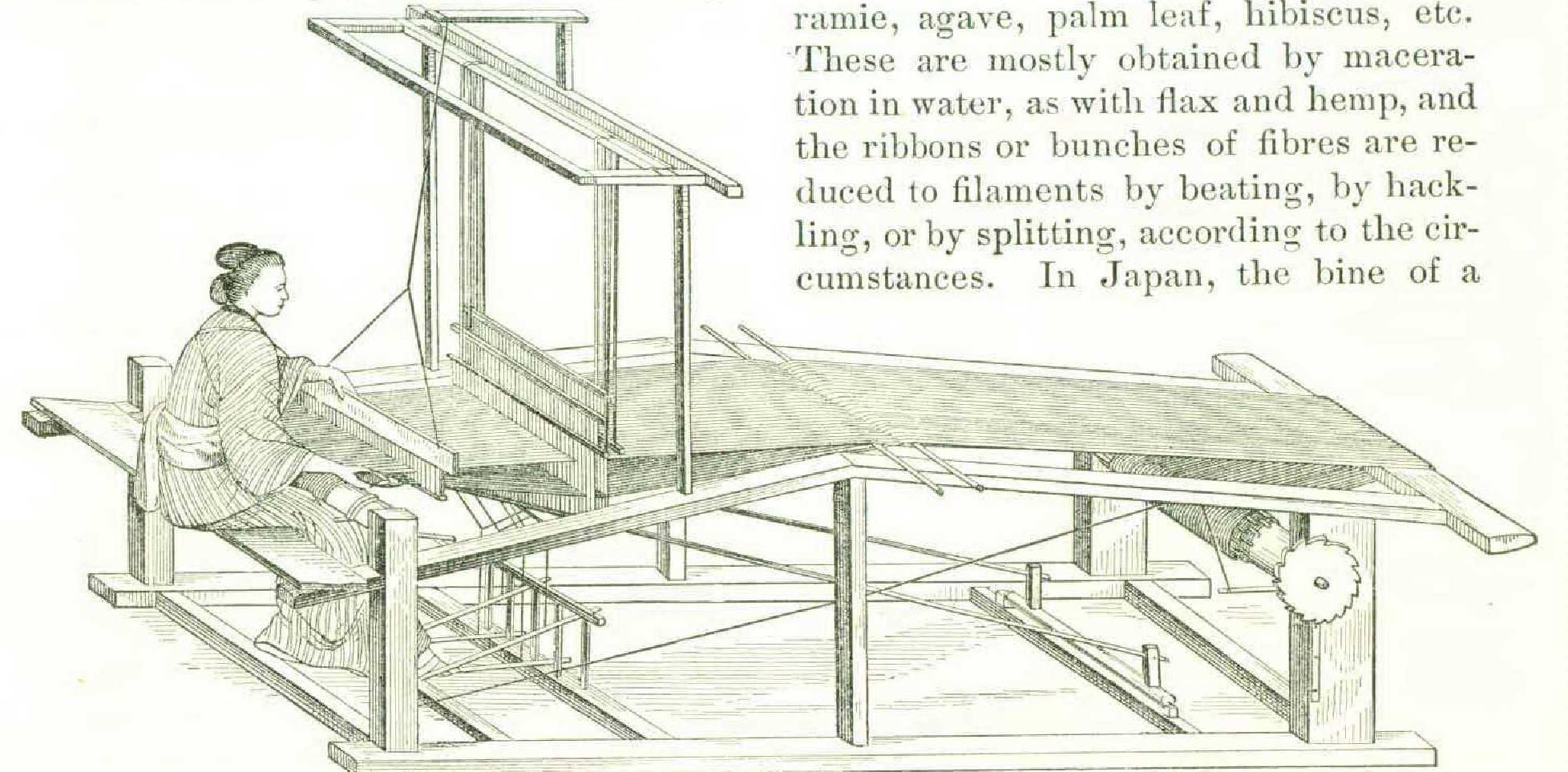
Figure 258 shows the most perfect of the Japanese looms at the Centennial. It is not claimed that it is the best loom they have, for their richly-flowered silks prove that there is little beyond their ability to do, though they lack the automatic devices which render the European and American machine so laborsaving.
The Japanese cotton loom has all the main features of the twill loom, having four heddles moved by treadles, a swinging batten to beat up the woof, yarn and cloth beams. The different features and parts are shown with clearness in the perspective view. The let-off of the yarn-beam is operated by a cord near the foot of the weaver.
The Japanese — and indeed the same is true of many Oriental and African peoples— use a greater variety of fibre than we do. Our list is soon exhausted: cotton, flax, hemp, wool, silk, include almost all. It is true we are more or less familiar with jute, coir, manila, alpaca, but they are not commonly known except in their worked condition. Besides the barks of broussonelia and ficus, which supply Polynesia and Central Africa with clean shirts, there are many plants and vines which have excellent fibre, such as the New Zealand flax, ramie, agave, palm leaf, hibiscus, etc. These are mostly obtained by maceration in water, as with flax and hemp, and the ribbons or bunches of fibres are reduced to filaments by beating, by hackling, or by splitting, according to the circumstances. In Japan, the bine of a
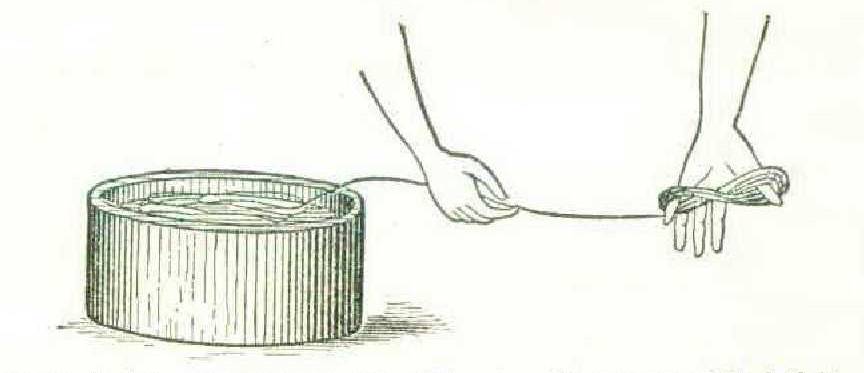
leguminous plant is rotted in water, fermented, boiled, divided by hand into filaments, hung upon racks to dry, then made into hanks, woven, and calendered. Two figures are given to illustrate the peculiar features of the process.
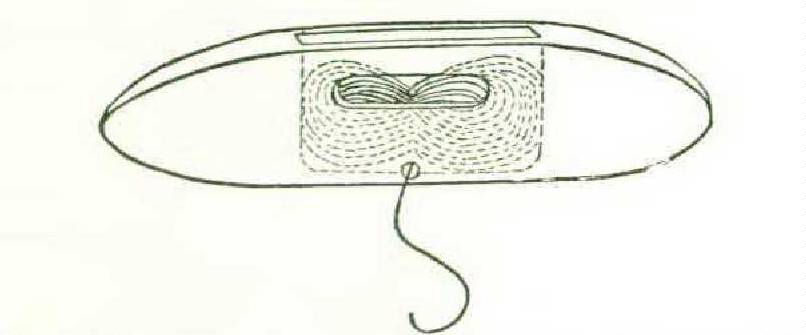
After the filaments have their final division, they are placed in a vessel of water and drawn thence by hand, being coiled into a figure-of-8 skein upon the thumb and finger (Figure 259) so as
to fit into the cavity of a shuttle and pay out without kinking. This shuttle (Figure 260) is thrown through the shed of the loom, flat side downward, .and runs out the thread as it goes. For some reason the skein is preferred to a bobbin, though the latter is not unknown to the Japanese. The loom is like the cotton loom: it has two heddles worked by treadles, a suspended batten,
and a cloth-beam. The warp is of a limited length, and is attached to a bar at the rear which is slacked as weaving progresses ; the warp is not wound on a beam. Figure 261 shows a method of
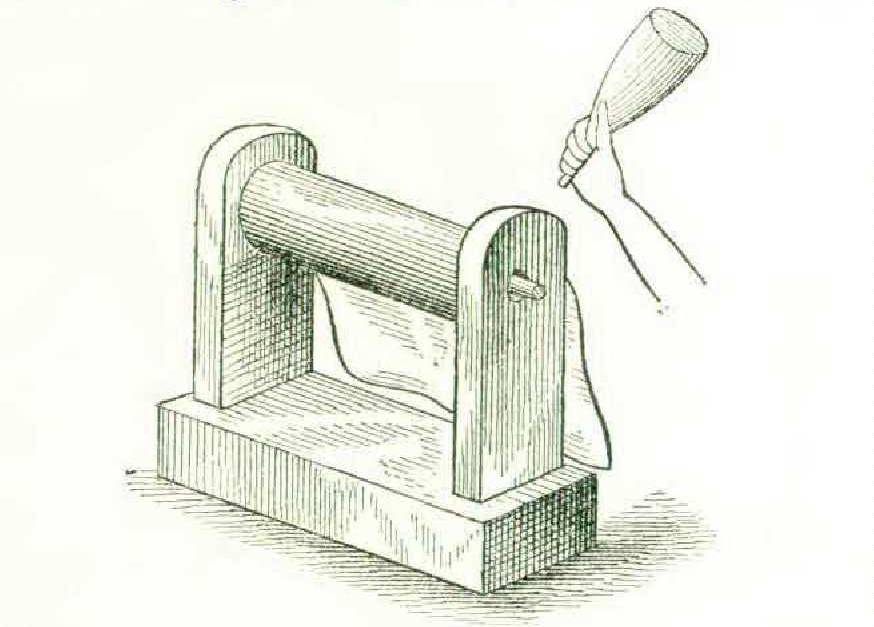
calendering the cloth by means of a mallet while the fabric passes over the roller. Calendering-machines are used also in China.
Following still eastward, for the order of the present series of looms is rather geographical than from the simplest to the more complicated, we reach the American continent. No uncivilized tribes were more abundantly illustrated at the Centennial than the North American Indian, the collection of the Smithsonian Institution being liberally drawn upon for the purpose. The group of Pueblo Indians has attained great, excellence in weaving, and the blankets of the Mohaves are water-proof. In the Pimo loom the warp is attached to two sticks, and stretched upon the ground by means of stakes. Each alternate thread of the warp is passed around a piece of cane, which, being lifted, opens a passage for the shuttle in manner of a sley. The operative sits in tailor fashion, and, raising the sley with one hand, with the other passes the stick upon which the woof is wound. The thread is beaten up with a sharp, smooth-edged instrument of hard wood.
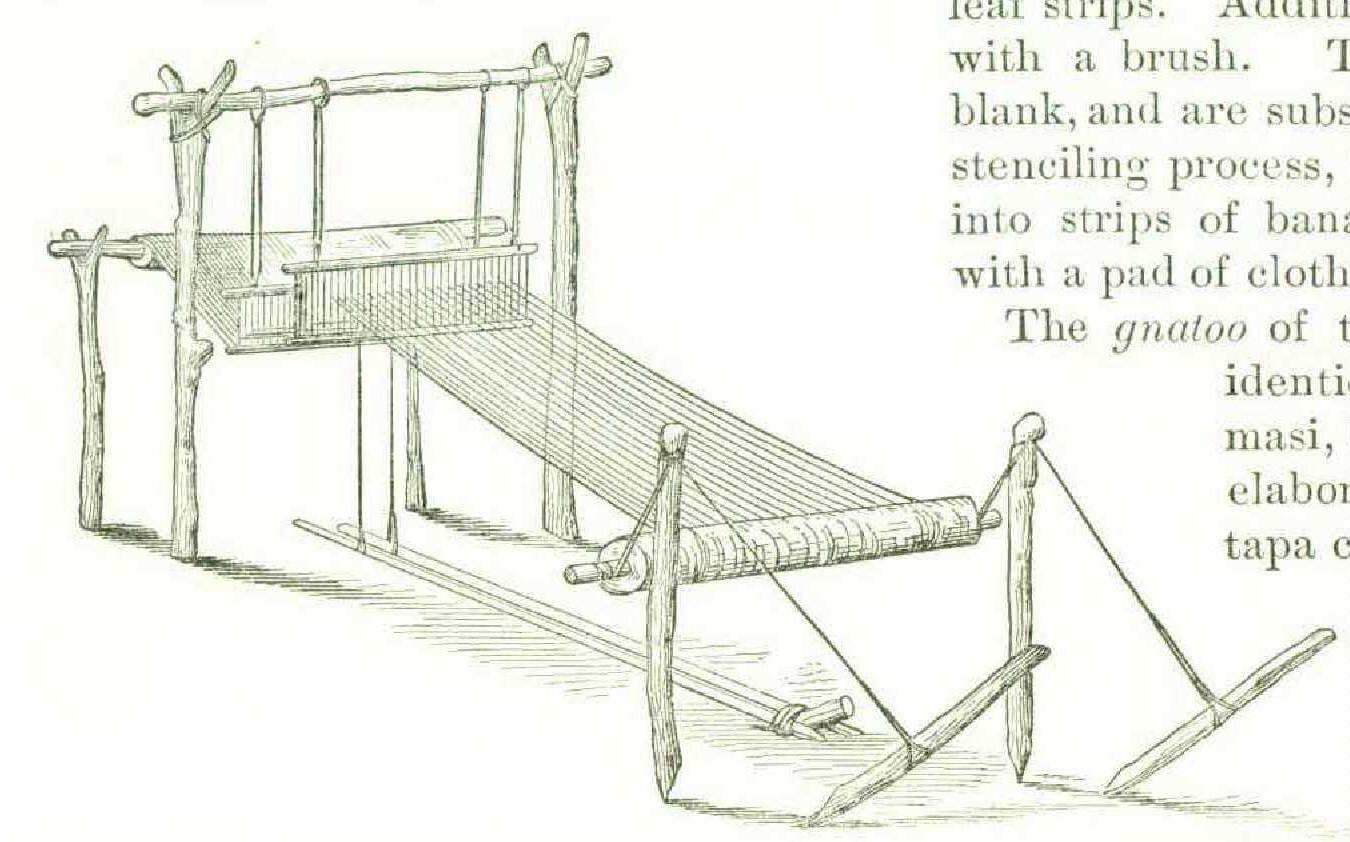
Two looms from South America were in the Main Building. Figure 262 is the native loom of Paraguay. The frame is all of round sticks, just as cut from the forest. The cloth-beam rests on crotches driven into the ground. The two heddles and the batten are hung from a bar similarly supported. The warp-beam is suspended from a pair of upright posts which are stayed back to stakes in the ground, so as to give the proper tension to the warp. The heddles of bamboo are worked by treadles. The piece in the loom has a cotton warp and a worsted filling. The Chaco Indians of La Plata weave a coarse woolen and cotton cloth. Hand looms have been exhumed from the Peruvian graves. The fabrics are cotton or llama wool.
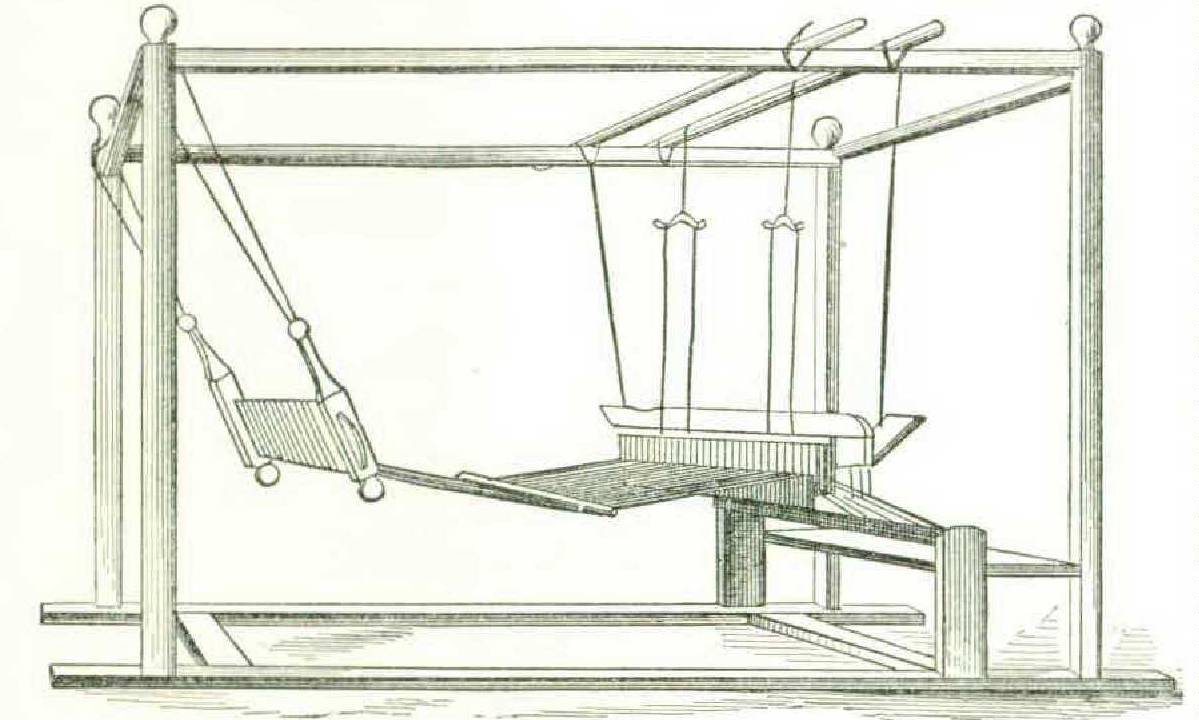
Figure 263 is a Chilian loom, having two heddles supported by cords running over rollers. There is no batten, but the woof is beaten up by a wooden sword, which is shown lying upon the floor. The woof is wound upon a long bobbin which reaches across the web. The fabric in the loom is a striped cotton warp with white cotton filling. The Araucanians use a rude loom; the poor Fuegians have none.
The loom being unknown in Polynesia, and skins not to be procured, recourse has been had to the liber of the broussonetia papyrifera or malo tree. The cloth is called by the Fijians masi, by the Hawaiians tapa. The inner bark yields a cloth of beautiful color and delicate texture. The bark is cut in long strips, soaked in water, and the outer bark removed by scraping with a shell. The liber is then beaten on an elastic wooden block with a square mallet (iki) shaped like a razorstrop. The sides of the mallets have longitudinal grooves in different flutings. and by means of them the masi maker obtains various patterns, changing the position of the mallet at each blow. One side of the mallet is left flat. A strip of bark two inches in width is spread by this means to eighteen inches, its length being slightly reduced at the same time. The material is beaten to the thinness of tissue paper; several strips are beaten together to make a sufficient
thickness, the natural gluten of the bark identical. The uniting them, as with the papyrus of Egypt formerly. Like the papyrus, also, long cloths are made by uniting different sheets of masi, the edges being soaked in arrow-root starch (taro) and pounded with the iki. One sheet of masi lias been seen five hundred and forty feet long. When left of single web only, they are thin enough for mosquito curtains.
These goods are printed in Fiji in the following manner : a piece of twenty or thirty feet square, having been united with other strips in the manner described, is printed, a part at a time, by laying it on a stamp and rubbing a pigment upon it. The stamp is a convex board, on which are fastened thin strips of bamboo a quarter of an inch wide, and a finger’s length apart. Curved pieces made of the under ribs of cocoa-nut leaflets are arranged by the side of the strips. The cloth is laid upon this and rubbed with a red dye (lauci aleurites triloba), which adheres where the cloth is supported by the bamboo and palmleaf strips. Additional figures are made with a brush. The borders are left blank, and are subsequently printed by a stenciling process, the pattern being cut into strips of banana leaf and put on with a pad of cloth steeped in black dye. The gnatoo of the Tonga Islands is identical with the Fijian masi, but seems to be more elaborately prepared. The tapa cloth of the Sandwich Islands, shown in the Main Building, is similar, but it is not certain that the species of the different trees are bark cloth of Tahiti and of Samoa is like that of Tonga; the Kingsmill islanders have a bark cloth (tapula) like a tippet, which they wear like a poncho, putting the head through a hole cut in the garment. The process in the Tonga Islands is as follows: a circular incision is made with a shell in the bark of the tree just above the root, and the sapling is broken off. Being left a couple of days to become dry, the bark is stripped off and is put to soak in water for twenty-four hours; after the outer bark is scraped away with shells, the inner bark is rolled up lengthwise and soaked in water for a day. The too-too, or beating operation, then commences, and is performed with the mallet, which is the same throughout all Polynesia, having ridged sides to spread the bark and a smooth side to flatten the surface. A strip of bark three feet long and two or three inches wide is moved by the left hand to and fro, while it is beaten with the mallet in the right, and in half an hour it is about square, the length being slightly reduced. In this condition it is called fetagi. The printing process is similar to that of Fiji, but not identical. The pattern used by the Tonga islanders is made of dried leaves of the pacongo, embroidered with fibres of the cocoa-nut husk. A number of such patterns are attached to the convex side of a board, and the cloth is laid thereon and smeared with the dye, which sticks principally to that part raised by the stamp; another piece, of smaller size, is then laid upon the former one and rubbed, the two adhering from the mucilaginous quality of the dye; a third piece in the same way. When the gnatoo is shifted, pieces are attached to the patches, and the design is matched. Piece after piece is added, till the cloth is perhaps six feet in breadth and forty or fifty in length. It is carefully folded, and is baked under-ground to darken the color and remove the smell of the coca dye, and afterwards spread on a grass plat or on the sea-sliore; and the finishing operation (toogi-hea) commences by staining the cloth a brilliant red on the lines of junction of the printed portion. Sundry dots and other ornaments are then added; it is exposed over night to the dew and one day to the sun, and baled till required for use.
The manufacture of a cloth from bark, so common throughout Polynesia, is practiced in some other parts of the world.
The Monbuttoo cloth is made from the bark of their fig (Urostigma kotschyana). When the trunk is about one foot in diameter, two circular incisions, five feet apart, are made around the trunk, and the bark peeled off entire. It grows again from the edge of the upper incision, and the operation may be repeated in three years. By maceration and pounding this is made like a thick, close fabric, known as rokko, from the tree, and constitutes the clothing of the men.
The bark cloths of the rokko are prized by the Niam-niams of the Upper Nile more than the handsomest of skins. The Lake Nyassa natives make a cloth of the inner bark of a species of Cæsalpineœ. It is stripped, steeped, and beaten, like the Polynesian broussonetiœ. The mbûgû is the bark cloth of the fig-tree, prepared in Uganda and Unyoro. It is stripped, steeped, and pounded, as before described, the mallet being grooved to give it ribs like corduroy. It is sewn into garments. In Madagascar, also, a cloth is made of the bark of a tree by beating it with a wooden mallet.
The Mosquito Indians prepare a cloth from the inner bark of the Ula, a caoutchouc tree.
Edward H. Knight.