Music
ONE of the questions which the growth of music during the last half-century has brought into peculiar prominence is that of large and small concert-halls. Since the various departments of music — the symphony, the opera, the oratorio, and vocal and instrumental chamber-music — have followed such widely divergent paths, this question has assumed greater and greater importance. It may be safely said that almost all music may be completely heard in any hall of good acoustic properties, no matter what the size of such a hall may be. Of course this proposition, like all others in art, must not be submitted to the reductioad absurdum, but within reasonable limits (and they are by no means narrow) it is safely to be asserted. But it must be borne in mind that merely being distinctly heard is but one of the many conditions that are indispensable for music to produce its full effect upon the hearer. Leaving aside the question of favorable and congenial surroundings, which applies with equal force to the other arts, there is this point in which music essentially differs from its sister arts. So long as we can distinctly see a picture or a statue, so long as the light is of such quantity and quality as to make its outlines and colors easily discernible to the eye, the conditions for our enjoyment of it are fulfilled ; but it is not enough for the outlines and colors of music (to use a not too forced metaphor) to he clearly discernible to the car. When the observer stands in the best place to view a picture:, the diminution of his enjoyment that would result from his lessening or increasing the distance between it and himself is caused solely by the undue prominence of unessential details on the one hand, or by the growing indistinctness of outline and light and shade on the other. In either case it is a matter of more or less distinct vision. But the change in our enjoyment of music that results from greater nearness to or distance from the point of departure of the sound has (except in very extreme cases) a far other cause. The best argument that we know of on this subject is in Berlioz’s A Travers Chants. Whatever may be thought of Berlioz’s genius, or his rank as an artist, there can be no doubt about his having had one of the most delicate ears for all effects of tone that ever existed, and his qualifications for discussing subjects relating to musical sound are unquestioned. He says : —
“ People are always ready to answer, when the question comes up of the sonority of an opera-house or concert-room, that every note can be heard very well. But I can also hear very well from my study the cannon that is fired on the esplanade of the Invalided, and yet that noise, which is moreover outside all musical conditions, does not in any way strike, move, or shock my nervous system. Well, it is just this stroke, this emotion, this shock, that sound absolutely must give the organ of hearing in order to act upon it musically, and which we do not receive from even the most powerful masses of voices and instruments, when we listen to them from too great a distance. Some scientists think that the electric fluid cannot traverse a distance greater than a certain number of thousands of leagues; I don’t know how true this may be, but I am sure that the musical fluid (I beg leave to thus designate the unknown cause of musical emotion) is without force, heat, or vitality at a certain distance from its point of departure.1 We hear, but we do not vibrate. Now, we must ourselves vibrate with the instruments and voices, and by them, in order to experience true musical sensations. Nothing is easier to demonstrate. Place a small number of wellorganized persons, gifted with some knowledge of music, in a room of moderate size, not too much furnished or carpeted ; play worthily before them some true masterpiece, by a true composer, truly inspired, a work quite free from the insufferable conventional beauties that pedagogues and bigoted enthusiasts admire — a, simple, piano forte trio, Beethoven’s trio in B-flat, for instance; what will happen? The listeners will, little by little, find themselves Seized with an unaccustomed agitation, they will experience an intense, profound enjoyment, which will now excite them strongly, now plunge them into a delicious calm, a veritable ecstasy. . . . There you have a musical effect! There you see the listener seized and intoxicated by the art of tones, and raised to an incommensurable height above the common regions of life....Now suppose that in the midst of the same piece, played by the same artists, the room in which it, is played could gradually enlarge, and that, in consequence of this progressive enlargement of the room, the audience is, little by little, removed to a greater distance from the performers. Well, suppose our room to have reached the size of an ordinary theatre ; our listener, who but the moment before felt his emotions rising, begins to regain his previous tranquillity ; he still hears, but he hardly vibrates anymore; he admires the composition, but by reasoning, and no longer from feeling nor in consequence of an irresistible impulse. The room grows still larger, the listener is farther and farther from the musical focus. He is as far distant as he would be if the three performers were grouped together in the middle of the stage of the Opera,2 and he himself were sitting in one of the first boxes in the balcony, opposite the stage. He still hears, not a note escapes him, but he is no longer reached by the musical fluid, which cannot reach so far ; his agitation is dissipated, he grows cold again, he even experiences a sort of disagreeable anxiety, which is the more painf ul because he makes greater efforts to fix his attention and not lose the thread of the musical discourse. But his efforts are in vain; insensibility paralyzes them ; he begins to be bored, the great master tires him, annoys him, the masterpiece is no longer anything more than a little ridiculous noise in his ears, the giant a dwarf, art a deception; he grows impatient, and stops listening.”
In the passage just quoted Berlioz merely considers the influence of distance from the point of departure of the sound upon the intensity of the musical impression that the sound produces upon the listener. It stands to reason (as Berlioz goes on to say, though we will not quote his words) that this diminution of musical force is in part to be referred to another cause, namely, to the greater diffusion of the sound in large halls than in small ones. This latter cause will affect the musical impression produced upon any listener in a large.hall, no matter at what distance from the performers he may he ; even if he sit very near the musical focus, his car will receive the “ musical fluid ” much less condensed in a large hall than in a small one. Of course it is a fair subject for debate, how intense it is desirable to have this musical impression, how concentrated the musical fluid should be when it reaches the ear. We are, however, spared the necessity of discussing this point here, from the fact that the principal musicians in both Europe and America are of one opinion on the subject, however much at variance they may be on other points relating to the art of music.
It may be taken for granted that, in general, those compositions for which a large mass of performers (either vocal or instrumental) is required are more suited to large halls than works which require a more modest number of executants. Wagner’s prelude to Tristan und Isolde, or Liszt’s Tasso, will produce their full effect upon the listener in a hall where a Haydn symphony would lose much of its brilliancy. But here we come to a point concerning which the musical public at large has, it must be admitted, very unmusical ideas. There is no lack of musical persons who will readily admit that a large hall is no proper place for piano-forte sonatas, string quartettes, or other chamber music; if a Rubinstein or a Von Bülow is forced by outside circumstances to give chamber-concerts in large halls, they are glad enough to go to hear him, yet they will at the same time he as ready to appreciate how much they lose from the size of the hall, as any musician can be. But when it is a question of listening to symphonies or concert overtures, the public seems to lose sight of distinctions which are yet of great importance. A symphony is a symphony, it is said, and the largest hall must of necessity suit the largest form of orchestral composition. The fallacy of this doctrine is easily shown. Largeness of form in a composition does not necessarily imply largeness of orchestral means. Compare the scores of the two following compositions, one in the largest symphonic form, and the other in a comparatively small musical form.
Beethoven’s Symphony in A major is scored for
Wagner’s Prelude to Tristan und Isolde is scored for
Wood.{
2 Flutes, 2 Oboes, 2 Clarinets, 2 Bassoons
3 Flutes, 2 Oboes, 1 English Horn, 2 Clarinets, 1 Bass Clarinet, 3 Bassoons.
Brass.{
2 Horns, 2 Trumpets
4Horns, 3Trumpets, 3 Trombones, 1 Bass Tuba,
1 pair of Kettle-drums.
1 set of Kettle-drums (3).
Strings.{
First Violins, Second Violins, Viola, Violoncelli, Basses.
A fair proportion of the strings to the rest of the orchestra would be : ten violins on a part for the Beethoven symphony, and fifteen violins (at least) on a part for the Wagner piece. Doubling3 the remaining string-parts in a corresponding ratio, we should have in one case an orchestra of fifty-five performers, and in the other case an orchestra of eighty-seven performers. This is at least a prima facie evidence that Wagner’s prelude is suited to a larger hall than Beethoven’s symphony. When we compare the masses of brass instruments in the two scores, this difference is all the more striking. Of course it is possible to put a larger force of strings upon the symphony; this is often done ; but it must be remembered that this will destroy the dynamic balance of the score. If we are to have as large a mass of strings in the symphony as in the Wagner piece, the wind-parts (with the possible exception of the trumpets) will be covered up. The orchestra of the Royal Opera in Berlin is the only one we know of in which the flutes and reeds in classical scores are so arranged as to counterbalance a large mass of strings in strong passages. Each pair of wooden wind instruments is reënforced by a second pair (ripieni) which play only in the tutti passages.4 If this method were adopted in all large orchestras, the question of playing classical orchestral works in large halls would be solved satisfactorily at once; but it is not. In America, where we have the largest concert-halls, it is very rarely that we have even a large body of strings. We continually hear works given by orchestras of fifty or sixty performers in halls that would require an orchestra of very unusual size. The reader will notice that we have hinted that the usual four pairs of wooden wind instruments are unable to cope with a large mass of strings in strong passages. This brings us to a very delicate point, which is too little noticed. The strings, especially the violins, are the part of an orchestra which most loses in intensity of tone by being heard in a large hall; or, as Berlioz would say, the musical fluid generated by the strings loses its power at the shortest distance from its point of departure. Thus it happens that, although the dynamic balance of the strings and reeds in an orchestra of fifty-live performers,5 playing at its mean degree of loudness (that is, mezzoforte) may be perfect in a small or moderate-sized hall, this equilibrium will be destroyed in a large hall. The violins lose the telling quality of their tone before the wind instruments do. Many delicate passages for the strings are thus covered up by the wind. We have listened attentively, often score in hand, to Beethoven’s Eighth Symphony (in F major), but we have never yet even heard the violins in the following passage, when the symphony was given in a large hall.
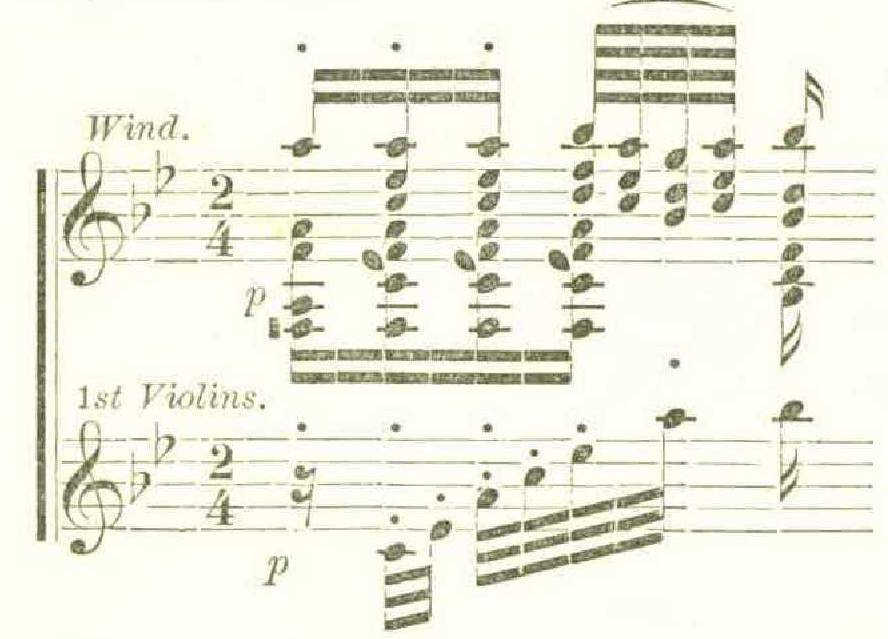
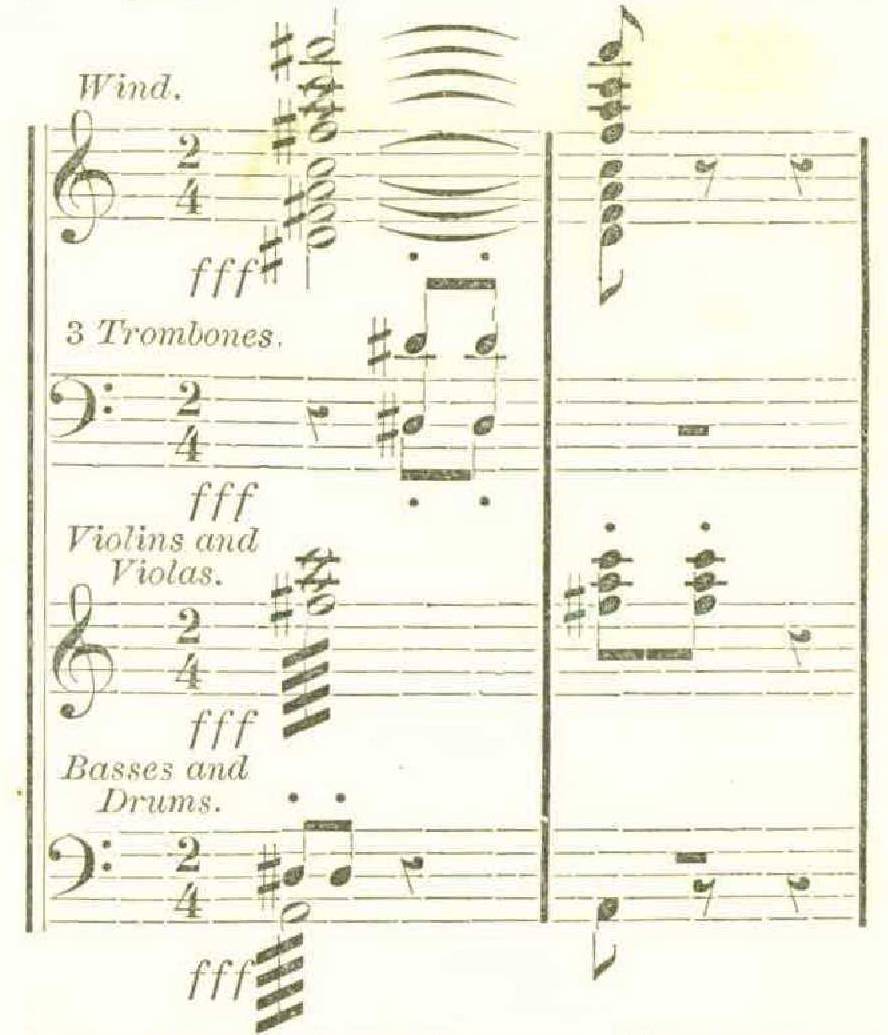
This is but one of many similar passages. An increase in the number of violins would undoubtedly set this right. The strings in an orchestra can play as piano as need be, and in all the degrees of loudness, ranging from the softest pianissimo to mezzo-forte; no mass of strings, no matter how large, need cover up even a single flute. But when we pass beyond the mezzo-forte to forte and fortissimo this mutual dynamic relation of the instruments changes. Although the quality of tone of the violins is, of itself, inferior in penetrating power to that of many other instruments, the accent that can be obtained by a strong stroke of the bow upon stringed instruments is unrivaled in intensity except by the instruments of percussion. This stirring force of accent gives the strings a commanding power of tone in strong passages, which one would hardly expect from instruments that can be so readily subdued to a scarcely audible pianissimo. To any one unacquainted with this power the following passage in Schubert’s C major Symphony would look like an anti-climax, as it stands in the score. Yet we have heard these last chords on the strings, as played by Mr. Thomas’s orchestra (with certainly not more than ten violins on a part), come out with the most startling effect. Reasoning from the examples here given, we find that an orchestra which is suited to a small hall not only loses it specific intensity of effect (the force of its musical fluid) in a large hall, but also that the dynamic equilibrium of its component instruments is often shaken. Taking an orchestra of from fifty to sixty performers as the standard for the performance of classical works in small or moderate-sized halls, when the same works are given in large halls the number of executants should be increased in the ratio of the cubic contents of the two halls. This does not refer to orchestral works of the present day, in which the greater brilliancy of instrumentation fits them for performance in large halls with no larger orchestra than would result from a sufficient doubling of the string parts (only in some few cases of the fiutcs and reeds) to counterbalance the mass of brass instruments with a single player on each part. The very full scores of Wagner, Liszt, and Berlioz, with their large masses of brass instruments, find their proper sphere in large halls. With a body of strings sufficient to counterbalance this brass, they cannot fail to produce their full effect. But when orchestral works of the classic period arc transplanted from the smaller halls for which they were intended by the composers, into large concert-halls, a mere increase in the number of strings is not enough; every part should be doubled in a corresponding ratio. Were it possible for us to get at the exact statistics of the dimensions of some of the most noted concert-rooms in Europe (such as the Gewandhaus in Leipzig, the concert-room of the Schauspielhaus in Berlin, or the hall of the Paris Conservatoire), we could furnish the curious reader with an array of figures that would prove beyond a doubt that the number of executants necessary for a correspondingly effective performance of classical orchestral works in our large halls far exceeds the limits of any orchestral means we have habitually at command in this country. But these statistics we have found, after much fruitless searching, to be beyond our present reach. We only know that the halls we have mentioned are very much smaller than the large music-halls in which we hear (or try to hear) orchestral works in this country ; so much smaller, in fact, as to make any idea of compensating for the difference by increasing our orchestras little better than chimerical.
— We wish that, singers who are tired of songs of the Arditi, Blumenthal, or Arthur Sullivan stamp may get as much enjoyment as we have from a pair of little lyric compositions by J. Massenet, of Paris. The Poème d’Avril6 and the Poème du Souvenir7 are two sets of love-songs to words selected from Armand Silvestre’s poem, Mignonne. It is too faint praise to say that they are the most perfect things of their kind that we have yet seen from the pen of a Frenchman. We have not forgotten what charming songs Charles Gounod has at times written, and are willing to believe that Berlioz’s La Captive (did we but know it) might greatly raise French song-writing in our estimation. But Schubert, Schumann, and Franz have given such overwhelming evidence of the infinite superiority of the German Lied that, with very few scattered exceptions, all that lias been done in France in this direction sinks into comparative insignificance. Yet these songs of M. Massenet would seem to prove that Germany, although still facile princeps, is no longer to have the absolute monopoly of this class of music. M. Massenet is indeed as like Robert Franz as it is possible for a very French Frenchman to be like a thoroughly Teutonic German. We know nearly nothing of anything else that M. Massenet has written, though the fame of his Marie Madeleine and its Paris triumph has certainly reached this side of the water; but these two poèmes of his are decidedly the work of no common music - maker. It takes more than mere knack to write such music; the man who wrote the Poème du Souvenir has earned his right to the name of composer — a name that many men go by, but which they for the most part deserve as the individual who sings the praises of patent soap and readymade clothing in printed verse deserves the name of poet. Describing beautiful music in prose is a lamentably ungainly business at best; so we will attempt no such thing here. All we can rationally do is to heartily recommend M. Massenet’s little works to the class of singers for whom they were evidently intended.
— We see with great pleasure that Mr. Carl Prüfer is reprinting several of Carl Maria von Weber’s piano-forte compositions from Franz Liszt’s admirable German edition.8 Those who have read Lenz’s little pamphlet on modern piano-forte virtuosos will remember how the great Hungarian pianist first made acquaintance with Von Weber’s piano-forte works. Indeed, Herr Lens is at no pains to disguise the fact that he himself acted as master of ceremonies on that auspicious occasion. Von Weber, like Schubert and some few other composers, seems to have taken all his noted admirers by storm; their admiration for his genius sprang up in a single night; witness Hector Berlioz’s idolizing love for Von Weber’s works, which began after his first hearing of the Freischütz (or as much of the Freischütz as the reverent listener could pick out from M. Castil Blaze’s Robin desBois),and ended only with his own life. Liszt’s passion for the great romanticist was no less sudden, and just as lasting. As the king of pianists, Liszt evidently felt himself authorized to tell the world one thing about Von Weber’s piano - forte works, which indeed other pianists had not failed to recognize, namely, that they were often very clumsily written for the instrument, however beautiful they might be. In fact, we find, in comparing Von Weber’s piano-forte compositions with his orchestral writing, that the great composer was by no means so familiar with the resources of the instrument as he was with those of the orchestra. His pianoforte works abound in passages where inordinate difficulty of execution is accompanied by no corresponding brilliancy of effect; where the performer’s fingers are pressed beyond all reasonable limits of human endurance, thus robbing the performance of much of its energy. The effect of many passages in actual performance falls far short of the brilliancy suggested by the printed notes. Von Weber was somewhat of a come-outer in piano-forte writing. His compositions in general aimed at a very different class of effects from those of his great German predecessors; they were as thoroughly original and new as were his operas and overtures. But, although when he had an orchestra at command he could easily and naturally realize his most daring conceptions, in his pianoforte writing we find him often groping after effects, the means to realize which were not in his power. It needed the technique of a Liszt or a Henselt to bring them into actual life; and by technique we do not mean, in this instance, the mere physical power of performing difficult feats on the key-board, but the technical knowledge of the resources of the instrument, and the capabilities of the human hand, by which a piano-forte writer is enabled to adapt his musical ideas to the nature of the pianoforte, and produce the most brilliant effects With the minimum of physical exertion. In Liszt’s edition of Von Weber’s piano-forte works, the editor has translated, as it were, these awkward passages into a more effective piano-forte language. He has in no wise tampered with Von Weber’s original version ; the notes are printed just as the composer wrote them, but Liszt’s emendations are printed in parallel lines in smaller type, so that the performer can choose which version to follow. Liszt has also given sufficiently full directions as to fingering and the use of the pedal. Mr. Prüfer’s reprint is very elegantly engraved and printed, and cannot be too highly recommended to all who would have Von Weber’s pianoforte works in the most practicable shape. The misprints in the edition are very few, which is a rare virtue. The numbers already published are the Polacca in E-flat, Op. 21, The Rondo (Perpetuum Mobile) from the sonata Op. 62, the Invitation to the Waltz, and the Polacca in E major, Op. 72.
— Mr. Prüfer has also published a very handsomely printed collection of small pianoforte pieces of medium difficulty by Lange, Lichner, Behr, Spindler, and writers of that stamp.9 The twenty numbers of the collection are sold either separately or bound in one volume with red board covers, like the Leipzig Breitkoff und Härtel editions.
- It must not be supposed from this that Berlioz was bad physicist enough to discard the undulatory theory in favor of a “ musical fluid " as a theory of sound, us Chomet did. He merely uses the term that came first to hand, to denote the cause, of mu sical emotion.↩
- The old opera-house in the Rue Le Pelletier.↩
- We use the term “ doubling ’’ here and afterwards in its musical, not in its mathematical sense, to denote increasing the number of performers on a single instrumental part.↩
- This was the case in 1842, and we suppose the custom has been kept up. And even here this strengthening of the flutes and reeds was not done for the purpose of counterbalancing a large mass of strings in classical works, but to counteract the very strong bodies of brass instruments in the scores of Meyerbeer’s and Spontini’s operas. The effect, however, in classical works was very satisfactory.↩
- Vide supra.↩
- Poème d'Avril. (Tirè de Mignoime.) Poésies D'ARMAND SILVESTRE, mises en musique par J. MASSENET. Op. 14. Paris : G. Hartmann.↩
- Poème du Souvenir. Scènes D'ARMAND SILVESTRE, mises en musique par J. HASSENET. Paris : G. Hartmann.↩
- C. M. v. Weber’s Polacca in E-flat, Op. 21, and other piano -forte works. Fingered by F. LISZT Boston ; Carl Prüfer.↩
- Pianists' Favorites of Modern Compositions Boston: Carl Prüfer.↩