Liernur's Pneumatic System of Sewerage
THE important problem of town sewerage seems to be seeking its solution by the aid of all the natural elements. Water and earth have had their trials and have been more or less successful, and now an ingenious Dutch engineer has called air into requisition, and promises to solve all the difficulties which have been but partially overcome by previous systems.
Captain Charles T. Liernur, of Holland, a military and civil engineer of much experience (long a railroad engineer in America), has devised a system for which he claims great results, and which, theoretically at least, seems to possess advantages far beyond those of any other that has been applied to densely populated town areas. This system lias, as yet, been too incompletely tested, and some of its important supplementary details have been too little experimented with, for one to say definitely that it is an assured success which is entirely to drive from the field the water sewerage now in such general use; but its claims are set forth with such positive assurances of merit, and its various parts seem to have been so well considered, that it is worthy of more than passing notice as merely a curious mechanical contrivance.
As every important invention in connection with the removal of the fæcal matter of towns should be approached in a hopeful spirit, and encouraged by the fullest opportunity for its development, it will be best first to state what are, and what are to be, the mechanical details of Liernur’s process, and wht its adherents believe that it will accomplish.
The initial principle of the system lies in the suction to a central public reservoir of the accumulation of fæcal material deposited in receptacles at separate houses, these being connected with this reservoir by air-tight pipes. The reservoir being exhausted of its air, the accumulations are drawn toward it by pneumatic pressure. No matter how large may be the area occupied by the sewered houses, each district has its central reservoir, and these reservoirs are in turn and in like manner themselves discharged into a main vacuum chamber at any convenient point, being connected with this by a similar system of pneumatic pipes. The deposits at each house are first removed to central points in their districts, and the whole mass is by a second or even by a third operation drawn to the main depot, where it is to be disposed of according to the requirements of the conditions of health, and most conveniently for agricultural use.
The invention has grown gradually from small beginnings, and it has been in one or two instances applied over large areas with very satisfactory results. As the system in a town of even the largest size is merely an aggregation of smaller systems, to describe one of these latter will suffice for an understanding of its principles.
We will assume, then, a level town area of from one hundred to one hundred and fifty houses of medium size. In the centre of this area, in the middle of a street, and far enough below the surface to be secured against frost, there is sunk an air-tight iron reservoir having two openings at its surface, to either of which an air-pump connection, or the connecting pipe of an exhausted receiver may be attached. The air-pump attachment, used to create a vacuum, opens into the top of the reservoir, while the attachment of the exhausted receiver, being intended to suck out the liquid contents, is connected with a pipe reaching nearly to the bottom.
When the air-pump is applied for the exhaustion of the air of the reservoir, it creates a partial vacuum, which extends through the whole series of pneumatic pipes connected with it, and the pressure of the air entering at the remote open ends of the pipes drives forward toward the vacuum - centre all of their liquid accumulations.
After the reservoir has become filled, the pipe reaching to its bottom is attached to the previously exhausted receiver, into which the liquid is drawn. Main pipes, under ground, running through the streets, or through the spaces between the backs of houses, and with branches to or under the houses themselves, allow the accumulations of the house closets to flow to the reservoir whenever a vacuum is established and is, by the opening of stop-cocks, brought to bear upon them. The closets of each house, which may be placed one over the other on the different stories, are connected with the branch pipe described, having a vertical or nearly vertical fall to the point of junction. When the cocks are opened, so that these branch pipes are brought into direct communication with the vacuum, every house pipe, being open at its upper end, becomes a source of pressure, and the air in seeking to fill the vacuum carries before it whatever matters may be accumulated within it.
In the earliest introduction of the system, each house branch was supplied with a cock, so that after the reservoir had been exhausted of air the opening of each of these, for a moment, caused the contents of its pipe to be thrown rapidly forward toward the street reservoir; but as there was no means of knowing the exact time needed for the emptying of the contents of each pipe, either there was necessarily incomplete work, or more air was admitted than the work required. Later, there was substituted for these stop-cocks an arrangement of self-acting air-traps which entirely overcame the difficulty. These traps give equal barometric resistances, and by their aid the accumulations of each house, be they great or small, far or near, are discharged with absolute uniformity and regularity by the opening of a single cock in the main pipe with which the house branches are connected. These automatic traps, depending for their action on this equal barometric
resistance, are not merely effective for the purpose for which they were intended: they are also interesting as a most ingenious and curious invention. Their action may be easily explained.
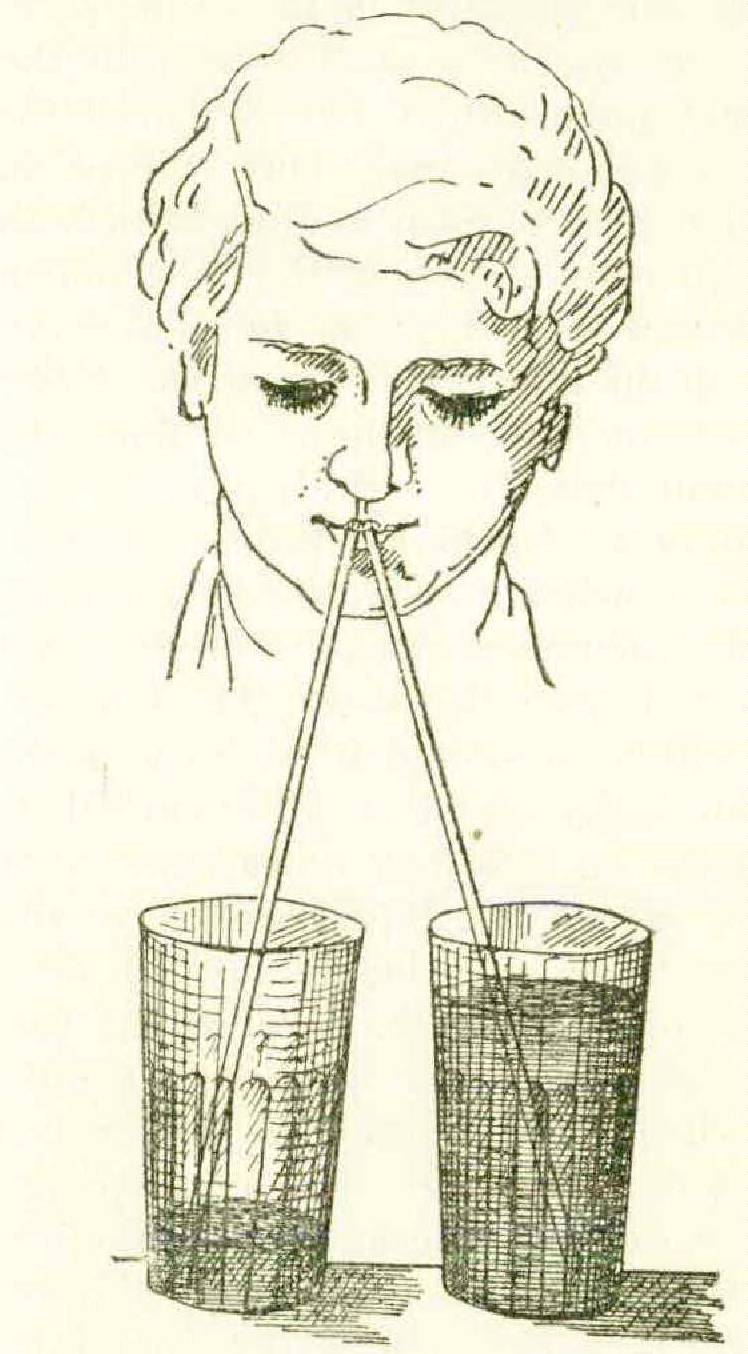
The accompanying diagram (Figure 1) shows two tumblers containing water. One is nearly filled and the other has but an inch of water at its bottom; the difference in height between the two levels of the water we will assume to be two inches. The barometric resistance (against suction) is greater, by the pressure due to a column of two inches of water, in the one than it is in the other. Into each of these two tumblers a glass tube is inserted, and the ends of both tubes are taken into the mouth at the same time. We will assume that the vertical height between the surface of the water in one of the tumblers and the mouth is four inches, and between the surface of the water in the other tumbler and the mouth is six inches; consequently in one case there is a column of four inches of water to be lifted, and in the other a column of six inches. Now if one sucks very gently on both tubes, that is, if both are slowly exhausted by the same mouth, water will flow only from the tumbler which is the fuller, or from which the shorter column is to be lifted, until the level of its water is reduced to the level of the water in the other tumbler; then, the height to be overcome being equal, there will be an equal flow from each tumbler until both are exhausted. No matter how much water there may be in one vessel nor how little in the other; if the same slow draft is made on both at the same time, the flow will always be entirely from the one standing at the higher level, and after the equilibrium is established there must be an absolute equality of level preserved until both are exhausted. The same effect will be observed if we experiment with a dozen tumblers, all having their contents at different elevations; that one in which the liquid stands at the highest level will be discharged first; when this reaches the level of the second, these two will be discharged together; when these descend to the level of the third, the three will deliver equally; and so on until the whole series, offering an equal resistance to an equal force, deliver their contents at the same rate.
Captain Liernur has applied this principle of barometric resistances to his pneumatic tubes by giving to each (for convenience, before it leaves the premises by which it is supplied) a break, or abrupt change in elevation, of exactly one foot. It is necessary that there should be always a distinct fall, or inclination toward the direction of the flow of the pipe, so that its liquid contents may move forward without halting at any point to deposit silt, which might in time obstruct them. Practically, it is said to be best to give an inclination of one foot in a length of fifty feet. This is the minimum; the maximum may be whatever circumstances require. In a level district all the pipes of the system may have this minimum inclination, but where the town is built on irregular surfaces one pipe may lie at this slight pitch, and the very next one may, without detriment, have an inclination of forty-five degrees or more. All tend toward the same central point, and may have more or less fall in that direction. But each pipe has its flow interrupted by the trap or vertical step referred to.
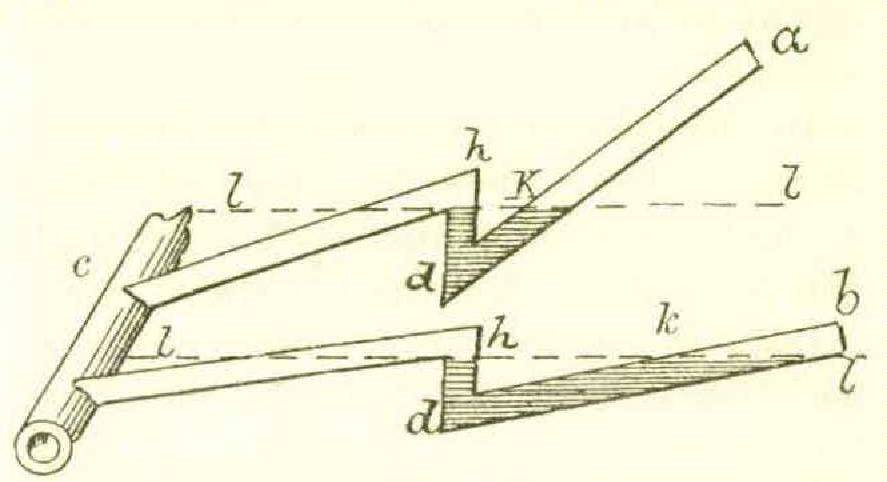
Figure 2 shows two such pipes, leading from two different houses and delivering to the same street main: a is a pipe with a very steep inclination, and b is a pipe at the minimum inclination. The dotted lines l l show the height to which the liquid must rise in the pipes toward a and b before it can begin to flow over the high points h. If the production of either house is more than enough to fill the depression in the pipe below the dotted lines, any addition to the quantity will simply cause a discharge by gravitation over the angle h, and the liquid will flow on by its own force toward the reservoir. This flow will of course continue so long as there is an addition to the volume at the higher end, but the amount of liquid standing below the level of the dotted lines must always remain there until some artificial force is applied to move it. Now suppose the suction of a vacuum to be applied at the main pipe c, the pressure of the air is brought to bear on the surfaces of the liquid at the points k, forcing the whole mass forward over the high points h. The flow begins at the same instant in both pipes, but as there is a larger volume in the pipe having the more gradual (and longer) slope, and as the vertical descent of the two surfaces must be exactly the same, the amount flowing out of the pipe b will be greater than that flowing out of the pipe a, until k has descended to the lowest point d, when in both pipes there are equal columns to be overcome (from h to d), each twelve inches high, and, as the pressure is equal, these are drawn over simultaneously. This principle is applied in practice even to one hundred and fifty pipes subjected to the force of the same vacuum, so that those of a whole district are exhausted at the same moment.
In addition to the difference of inclination, there is also a great difference in the quantity of material to be treated, and these different quantities are equally well managed by the same system.
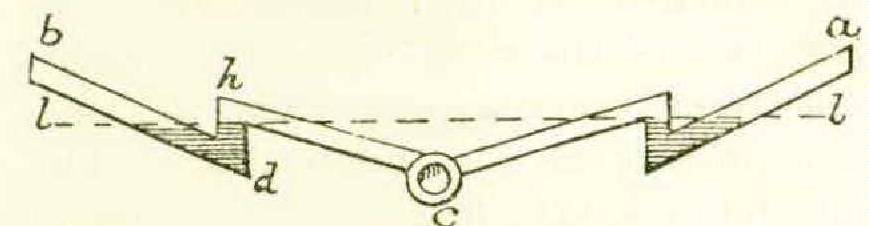
In Figure 3, c is the main pipe connected with the vacuum chamber. We will suppose a to be the outlet pipe of a large hotel, and b that of a small cottage in which only two persons are living. The pipe a receives an amount of liquid which will fill the space below the lines l l in an hour. During the remaining twenty-three hours of the day its sewage matter flows on directly toward the central reservoir; but the accumulation in the pipe b is only sufficient during twenty-four hours to fill the vertical part of the pipe between h and d. Of course this matter will lie level in the angle, and will rise but a part of the distance between d and h. When the vacuum is applied, the atmospheric pressure at b bears down upon the small supply and tends to raise it toward h, but at the same time an equal pressure in the pipe a is forcing forward the contents of that pipe and pouring them over the height. The contents of b cannot reach the point h until the quantity in the pipe a is reduced to the same amount, that is, until the whole pipe between d and a and d and b is emptied; then there will stand in the two pipes two columns, each twelve inches high, ready to pass over at the same moment.
This device has enabled Liernur to do away with every faucet or stop-cock in his whole system of pipes, except a single one in the main. By opening this the force of the vacuum is brought to bear equally and instantly upon the house pipes of the whole system, with a quick pneumatic shock whose suddenly applied force is deemed important. It is thus made certain that there can at no point be a useless escape of air, until every one of the pipes has been exhausted of its contents; of course, at the angle, a small quantity will fall back after the air begins to flow over.
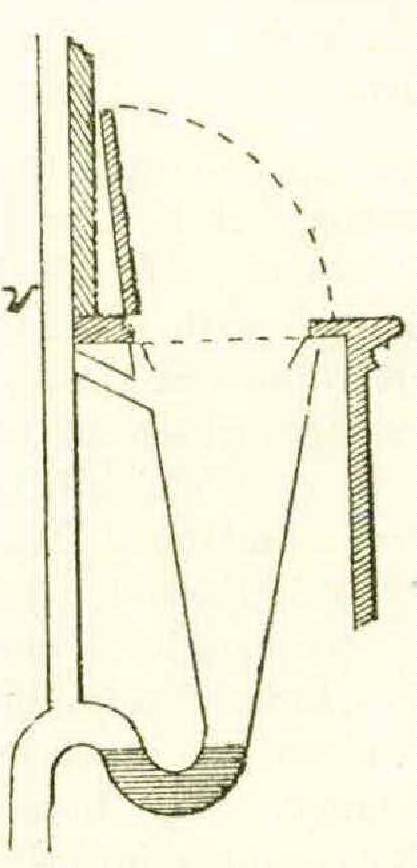
The arrangement of house closets is very simple: they are, wherever practicable, for economy’s sake placed vertically one over the other on the different floors, in order that they may reach the outflow through the same down-pipe. The closet, as originally made, is a simple funnel of iron or earthenware with a bend trap at the bottom, as shown in Figure 4, a pan of enameled iron or whitened earthenware being inserted at the top for better appearance. From the highest point of the main pipe, outside of the trap, there rises a ventilating pipe v, reaching above the top of the house, and this pipe has a branch for the ventilation of the funnel, which it enters near its top, at a point behind the pan. The action of this branch is to afford an outlet for gases forming in the funnel and to cause a down draught when the lid is opened, so that there may never he an escape of foul air into the room. It is recommended, when practicable, to place these closets next to the outer wall of the house and to supply each with an open window, or in some manner to give a thorough ventilation. The pipes descending from the closets, the service pipes of the different houses, and the mains in the streets (in each district) are all five-inch cast-iron pipes, secured at the joints in the same manner as gas pipes.
So far as the emptying of the closets is concerned, it is claimed that the system, as described, is entirely complete and satisfactory. The next problem was to apply it to the solid matters of the kitchen waste pipe. The amount of water flowing from the kitchen, from bath-tubs, etc., is much greater than it would be economical to treat by the pneumatic process, and a separate outflow is provided for them to the same system of sewers that is used for the removal of storm and subsoil waters.
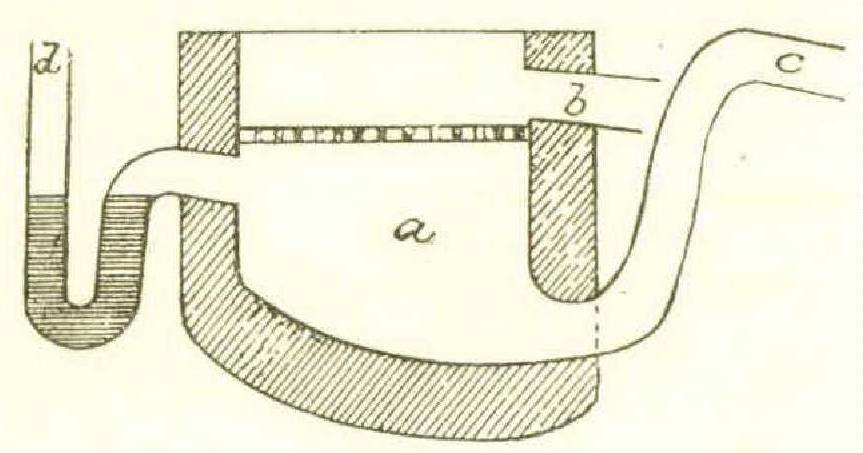
Figure 5 shows the arrangement of the kitchen drain apparatus. A is a reservoir, say one foot square, furnished four inches below its top with a grate or screen fine enough to prevent the escape of any coarse matters which might obstruct the street sewer, or which it is worth while to preserve as manure. The bottom of the reservoir is curved, and is connected with a pneumatic sewer pipe; the outlet c takes, immediately, the rise of twelve inches needed to preserve the barometric resistance. The house drain d discharges its contents into the reservoir below the screen; it has a bend trap deep enough to give a decided resistance to atmospheric pressure. The flow from the house passes into the reservoir a, and its excess of water rises through the screen and flows off at b. During the day, more or less solid matter is accumulated below the screen, and when the pneumatic pressure is brought to bear, by opening the main pipe near the vacuum chamber, it is, simultaneously with the closet pipes, emptied of its contents, and at the same time whatever matters have adhered to the bottom of the screen are forcibly withdrawn by the pressure of air descending through it. In this way, while the chief volume of water or other liquid matters is got rid of at once through the sewers, the more valuable solid material, which would create inconvenience in the sewers, and which has a manurial value, is added to the products of the closets for treatment with them during the subsequent processes of the system.
A locomobile engine having somewhat the appearance of a steam fire-engine, carrying a steam-engine and air-pump, and followed by a tender in the form of an iron tank, to which its air-pump may be attached, is used during the construction of the work, before the different street reservoirs are connected with a main central pumping station. The air - pump is attached to the opening at the top of the street reservoir, from which it exhausts the air, making about a three-quarter vacuum. The reservoir is then closed, and the air-pump exhausts the tank of the tender. This is then closed and its supply pipe is connected with the pipe reaching to the bottom of the reservoir, when, the valves being opened and the air being admitted to the top of the street reservoir, the contents of the latter are sucked into the tank, which may then be driven away to the point of discharge.
This locomobile serves to demonstrate the practicability of the system, and is an indispensable accompaniment of the earlier steps of construction. But its purpose is only a temporary one, and as fast as may be the street reservoirs are connected with the central station, by pipes which it is often necessary to make larger than five inches, owing to the quantity of liquid to be discharged through them. Each central station may answer for a district of say fifty thousand or sixty thousand inhabitants.
At this station a fixed engine and large receiving tanks serve for the numerous street reservoirs the same purpose that these (with the locomobile) originally served for the houses of their separate districts. The tanks at this station have sufficient capacity to receive the contents of the whole set of street reservoirs with which they are connected, and the engine has a sufficient power to maintain the required vacuum in these and in the main pipes. By precisely the process heretofore explained the contents of the reservoirs are drawn to these tanks, and are made ready for their subsequent treatment.
The receiving tanks at the central station, which may be one or more in number, are large enough to store the contents of all the street reservoirs of the district. They are located in the basement, and each has an indicator by which the engineer can see when it is filled. We will now assume that all of the street reservoirs have been emptied, and that the tanks in the basement are filled. These tanks communicate by suction tubes with a similar tank elevated above the main floor of the building, which has also an indicator showing the level of its contents. This upper tank is exhausted of its air by the airpump, and the communication between it and the bottom of one of the tanks in the basement being open, it fills itself with the liquid, which is now ready to be treated by the poudrette apparatus. For this purpose it is allowed to flow into a vertical tank, in the bottom of which there are coils of pipe connected with the exhaust pipe of the steamengine.
The steam, on its escape from the exhaust valve, passes through a superheating chamber where the products of combustion on their way to the chimney, flowing around the coil, give the steam an additional heat. This reheated steam passing through the coils in the evaporating tank produces a furious ebullition and a rapid evaporation of the water of its contents. The vapors thus formed, being at the next stage of the process condensed, tend to produce a partial vacuum over the boiling liquid, so that this rapid evaporation may even take place at a temperature below that of boiling water. The condenser into which these vapors pass is a copper drum, the temperature of which they raise probably to two hundred degrees Fahrenheit. This drum revolves slowly, its lower part passing through the semi-desiccated, pappy liquid drawn from the evaporator first described. As it makes its slow revolution it carries up a film of the pappy liquid, which the heat within renders perfectly dry, so that near the end of the rotation it may be scraped off by a stationary knife, and fall into a receiver below in a perfectly desiccated state, ready to be packed in bags or barrels for agricultural use.
This desiccated poudrette contains all or nearly all of the organic refuse of the household, not only the contents of the closets, but the particles of unused food, grease, and other solid constituents of the kitchen waste. The chief difference in condition between this poudrette and guano, or the manufactured poudrette of commerce, is that the matters it contains have had no opportunity to pass into a state of decomposition. Ordinarily, within thirty-six hours from the time of their production in the house they have all been transported to the central station without exposure to the air, desiccated, and packed away. As during the evaporating process a small quantity of sulphuric acid is added to the liquid, any ammonia produced by incipient fermentation is rendered nonvolatile.
Concerning the value of this Liernur poudrette I have no other evidence than the report of Professor Voelcker’s analysis given in Mr. Adam Scott’s description of the system, in the Sanitary Record of November 21, 1874.
An analysis by Professor Voelcker, chemist of the Royal Agricultural Society, dated August 15, 1874, of a sample submitted to him by Sir Philip Rose, Bart., showed it to contain: —
Moisture 8.84
Organic matter1 62.96
Oxide of iron and alumina 3.29
Phosphoric acid 1.76
Lime 0.86
Chlorine 6.22
Sulphuric acid 6.02
Alkaline salts 8.20
Silica 2.05
100.00
So far as I have been able to learn there has been no sufficient practical test made of the value of this poudrette, but when we consider the substances from which it is produced, it seems impossible that it should not have a great value, and Liernur and his advocates bring ample theoretical evidence in support of its claims. If it is true that the waste of the constituents of food which characterizes the domestic habits of all our towns is leading to the ultimate impoverishment of our fields, we can hardly regard with too much interest any process that promises to restore so nearly the entire amount consumed and squandered in our households.
Mr. Scott, in the article referred to, thus describes the practical working of the system: —
‘‘The air-pump engine is set in motion, and maintains during the day a three-quarter vacuum in certain central reservoirs, placed below the floor of the building, and at the same time in the central pipes. Workmen perambulate the town, visiting each tank once a day. To drain the houses commanded by one tank, they alternately open the connecting cock of the central pipe and the stop-cock of any main pipe; the first to obtain a vacuum in the tank, the second to utilize this by emptying the closetpipes connected with that particular main. After all the mains of the tanks in question have been operated upon, and their contents collected in the tank, the workman turns the discharging cock to send the whole mass to the central building for immediate conversion into poudrette. He then proceeds to the next tank, there to repeat the operation. ”
One of the minor objections anticipated by its inventor to the general introduction of this system is to be found in the fact that an influential class in every community where the water system has been introduced may object to any less fastidious substitute for the water-closet. To meet this objection there has been devised an apparatus, in which water is used, that seems completely to compass the requirements, but the practical need for its use is too slight for it to be considered as an essential part of the system. And indeed it is better that at every step of the process there should be as little extraneous water as practicable thrown into the pipes. The natural product of liquid matters in every household is sufficient to insure the proper pneumatic action, and all additions beyond this create an increased demand for fuel for the final evaporation.
It is claimed by the advocates of the pneumatic sewerage that all other systems thus far tried, in addition to their danger to the public health, are necessarily and always very expensive, there being no offset in the way of profit that can possibly lessen the taxable charges required for their construction and operation. It is claimed also that these taxable charges are an excuse for the raising of rents, and consequently for the crowding of the working classes into smaller and less commodious and healthful quarters than they might have were the town free from the necessity for making this excessive yearly outlay.
It is no doubt too early in the history of pneumatic sewerage for figures based on actual experience to be adduced in support of its economy, but the published estimates, which so far as one can judge are based entirely on similar uses of steam, cost of laying pipes, etc., and which are apparently reliable and correct, show that so far from being a source of expense, the fæcal matters of the town may constitute a reliable source of income. Such estimates have too often to be modified, in the light of subsequent experience in actual practice, to be relied upon with great confidence, but there seems to be a sufficient margin to cover any unforeseen contingencies and still to leave an important amount to be credited against the costs of work-ing.
It is stated that the cost of the work in Amsterdam, including royalties, engineering, plant, machinery, and the necessary changes in houses, was not quite £2 10s. per inhabitant. To be on the safe side, Mr. Scott estimates that the cost in an English town would be £4 per inhabitant, and he applies his calculation to a town area of 250 acres, with a population (75 per acre) of 18,750, placing the total cost of the works at £75,000. So far as the Liernur system alone is concerned, without referring to the storm-water sewerage, the cost would be, pro rata, the same for a small town as for a large one, provided the population is of the same density.
“ Using the figures and proportions given by Captain Liernur, the following would be the estimate of working expenses per day:—
€ s. d.
Coal, — Power of air-pump engine required, 80 indicated horse-power. Consumes, at 5 lbs. per horse-power per hour, in twelve hours, 4800 lbs. coal. Of the caloric due to this there is converted into work eight per cent., or caloric due to 384 lbs., leaving the calorics of 4800—384=4416 lbs. on hand for evaporating purposes. There are, however, to evaporate 54 ounces per day for 18,750 persons, making 63,281 lbs. water, requiring with drying apparatus a double effet, 63,281÷12=5273 lbs, of coal, for which there is left the above 4416. There is hence wanted 5273—4416=867 lbs. additionally to the 4800 lbs. of the air-pump engine, making in all 4800+857=5657, or say 2½ tons of coal per day, which, at 25s. per ton gives 3 2 6
Oil 0 4 0
One machinist and eleven laborers to 2 0 0
Administration, repairs, and sundries et 6 0 0
Making per year, £6×365 2190 0 0
To this would have to be added, —
For interest on capital of £75,000 borrowed from local board, including redemption, at four per cent. per annum £3000
For renewal fund of machinery, at eight per cent. on £3000 240
—3240 0 0
Total expenses 5430 0 0
“ The income would be, however, the poudrette manure of 18,750 persons, which, at 10s. per head, gives annually the sum of £9375, leaving, after deducting above expenses, nearly £4000 annually as clear profit, after paying every charge.”
This calculation is based on an estimate of ninety per cent. of water and ten per cent. of solid matter in the liquid as it is received at the central station. By an application of the same data to liquid containing ninety-five per cent. of water, the cost of evaporation with coal at twenty-five shillings per ton would be £1081 in addition, which would reduce the net profit from £3940 to £2869. It is to be observed that with us his data would have to he materially changed, the cost of coal and labor being much greater, interest being at least six per cent, instead of four per cent., and the agricultural value of the product being certainly no larger.
What has been thus far given covers my knowledge of the Liernur system as derived from the various publications concerning it. It seemed worthy of further investigation, and I devoted some time to its study during a recent visit to Europe.
At Captain Liernur’s office, in Frankfort-on-the-Main, I was shown the working drawings of every part of the system, and had all its details clearly explained by its very intelligent inventor, who to a thorough familiarity with modern sanitary engineering adds the most unbounded and enthusiastic belief in the merits of his own invention. I learned that steps are now being taken for an important trial in the city of St. Petersburg, at the hands of a company, who, upon its success being demonstrated, hope for a concession for the sewerage of the whole town. The conditions there existing are the same as in other places where actual trials have been made, save that the intense cold and the consequent necessity for placing the apparatus deep below the surface of the ground must increase the cost of construction, and, so far as house-pipes are concerned, may present many difficulties to be overcome. The use of the system at military barracks in Austria and Hungary was described as having been successful and profitable, but I was directed, for an ocular demonstration of pneumatic sewerage in actual operation, to visit Amsterdam and Leyden, in Holland, where the earliest trials were made, and Dortrecht, where the whole invention in its entirety is being adopted.
At Dortrecht, Liernur’s partner, Mr. Do Bruyn Kops, is constructing works for a large part of the town, to be subsequently extended over the whole. The central station was nearly finished, and contained a thirty-five horse-power steam-engine, and an air-pump suited to its capacity; basement tanks capable of holding two days’ product of the whole town; an elevated tank through which to transfer the liquid to the poudrette apparatus; and the apparatus itself, which was complete and had been in use. The superheating effect of the escaping products of combustion had been found insufficient, and a separate furnace with a small fire had been provided to raise the heat of the steam to the required point. The attempt to manufacture poudrette had not been entirely successful, that is, the product was rather moist and pasty than dry, and some modifications were being made in the machinery which rendered it impossible for the station to be at work during my visit. Pending these repairs the street reservoirs were being emptied by the locomobile, but as I was to see this in operation in Amsterdam, it was not thought worth while to bring it out. From the station we visited the poorest quarter of the town in which the pipes had been laid, passing through a district that still depended for its cleansing upon a sluggish canal, — a canal of the most offensive description, its surface constantly bubbling with the gases of the decomposing filth it contained. Similar canals had been filled up in front of the house connected with the pneumatic system, and this of itself should be a sufficient improvement to satisfy the Dortrecht authorities with their outlay. We visited closets in houses and in yards, and so far as I could judge from the manner of those who exhibited them, these were perfectly satisfactory in their operation. Equally unobjectionable closets in the houses of people of a corresponding class I have never before seen, and my general impression of the condition of the work in this town was that it may be in a fair way to prove all that its inventor claims for it, except possibly in the manufacture and value of the poudrette.
The next day we went to Amsterdam, where (and at Leyden) the first experiments with the system were made. It is now in universal use in nine considerable sections of the town, and is being gradually extended. The poudrette apparatus is not in use there; indeed, the only set thus far put up is the one now being experimented with at Dortrecht. At all the stations in Amsterdam the liquid is run into barrels and transported to the country by canal-boats, being sold, thus far, for a nominal sum, very much less than would be its value here.
At the first station which we visited the engine was out of order, and we could see nothing; but at the second station it was demonstrated in my presence that the working of the air-pump and its effect on the street reservoirs of its district are entirely satisfactory. The liquid was transferred from house pipes to several street reservoirs, from these to the basement tanks at the station, and from these to the elevated tank from which the barrels are supplied, with certainty and regularity. In one case it was necessary to carry a main pipe, by a siphon, under a canal, and the transferring of the liquid through this was entirely successful. Indeed, if the object were only to transport in a quiet, inoffensive, and entirely hidden manner the products of private houses to a depot whence they can be inoffensively shipped to the country, my investigation seemed to prove clearly that entire success had been attained.
I hoped before leaving Holland to be able to see the Dortrecht poudrette works in successful operation; but a further trial, although it showed a great improvement, left something still to be desired, and the apparatus was not in satisfactory working at the time of my leaving the country.
In Amsterdam we visited a great number of houses of all classes, — a large children’s hospital, private houses of the best class, tenement houses occupied by working people, an old ladies’ home, and in one case a nest of sailor boarding-houses, which were said to be the worst in the whole town. This examination was of course made under the guidance of one who was interested in the success of the system, and it is possible that, had I been conducted by one opposed to it (and there are such), I might have been shown instances of failure. As it was, I can only say that under all the circumstances and conditions, both where the greatest attention was given to cleanliness and where the greatest neglect seemed to prevail, I found the condition of affairs in all cases good, and among the lower classes infinitely better than would be found in similar establishments in London or in New York, where the water system and the common vault prevail, though to the eye a wellkept water-closet is preferable.
Subsequently I took occasion to talk with several gentlemen of intelligence in Holland about the success and the prospects of the system. Of these, none were opposed to it, and some favored it very strongly. Mr. Van der Poll, the Dikegraaf of the Haarlem Lake Polder, who is an engineer of high standing and of sound judgment, gave it as his opinion that it must inevitably come into universal use in all the towns of Holland, although he was not prepared to say that it is better than water sewerage for places where a good and suitably located outfall can be had. Another friend was glad to get my opinion, for the reason that so much passion had been shown in all discussions of the subject in Amsterdam that it was impossible for disinterested persons to weigh the evidence for or against it. It was stated that there had been very serious opposition, and that the early introduction and working had been embarrassed by the fiercest opposition of the chief official who was directed with its execution, but that in spite of this, and of all the drawbacks attendant upon the education of the people in a new process, and all the mistakes inseparable from the practical development of a new invention, it had Steadily made its way in popular favor, and had especially won the approval of the city offcials, under whose direction it is now carried on. (An official told me this.) In one instance a large speculator in real estate, one who buys blocks of ground and builds houses for sale, had been originally a very strong opponent, protesting most earnestly against the introduction of the system in districts in which he was interested. He is said now to petition for its introduction in each new district in which he buys property.
These statements are made with the reiterated qualification that my investigation was made under the guidance of one who is pecuniarily interested in the invention, and who had it in his power to mislead me, but who, I am glad to say, impressed me as a frank and fairminded gentleman, who made no attempt to conceal defects, or to bias my judgment. Since my return I have learned that Dr. Folsom, Secretary of the Massachusetts Board of Health, found his inspection of the working of the system in Amsterdam very unsatisfactory.
The question that naturally suggests itself is whether Liernur’s pneumatics are to solve the whole sewerage problem. It would no doubt be safe to answer this, at once, in the negative, but it should be a negative with many qualifications. The whole problem is now so entirely unsolved, and is so embarrassed with intricacies and difficulties at every turn; it is of such vital consequence when regarded from the point of view of the public health; and it appeals so directly to the strongest interest of every householder, that no one interested in the subject can fail to give very careful attention to any suggestion of relief which promises so much as Liernur’s does promise, and which is in all its details so complete and so wellbalanced, and is apparently so successful in each department of its mechanical action.
On the other hand, we have been so long relying on the system of water carriage, and we have so long ascribed to it every advantage, only to find it riddled and honey-combed with faults, as time has brought us better acquainted with it; and a large class has placed such implicit confidence in the dry-earth system, only to find it almost impossible of introduction in an average community, that no one who has been long interested in the general question can be expected to glow with enthusiasm over any new process that may be brought to notice. Liernur has struck out a new path, but it is a new path in an old field, in which we have learned to look out for pitfalls and ambushes at every step. We may well hope (and I unreservedly believe) that there is much in his invention that is of intrinsic value, and that it will perhaps accomplish all that we have so long sought. At the same time its success is certainly not to be achieved through a blind enthusiasm, ready to accept it as the final cure of the great and universal disease in our domestic economics against which it proposes to contend.
While, therefore, it is to-day unquestionably the most interesting new fact in sanitary engineering, and is worthy of the most careful experiment and even the most expensive investigation at the hands of local governments, the investigation and the experiment should be made with a clear understanding that the time given to them and the money spent upon them may bring but little return. The difficulties we are contending with are so grave, and the dangers to life and health and usefulness are so threatening, that we may well afford to tax ourselves as largely as may be necessary in order to demonstrate whether this new process, for which so much is claimed and which has so many firm adherents among those who have been living under its daily operation for some years, is or is not to open the door for our escape. Much that has hitherto been written about it has been of that enthusiastic and confident character that made its success appear at first blush a foregone conclusion. It seems to be better that, however great our individual confidence may be, — and I repeat that my own is very great, — we should undertake this trial resolutely and determinedly, but should at the same time be quite prepared for entire or partial failure.
The more ardent advocates of the system lay great stress upon its economical features, and seem to depend very much upon the prospect of profit for the reënforcement of their arguments. Let us rather take the wiser course of throwing the questions of profit and economy entirely into the background, where they belong. This is a subject that reaches much further than any pecuniary interest, and it is one whose pecuniary interest centres much more in the lengthened life and full, healthful efficiency of our populations than in any question of the cost of constructing works, or of proceeds from the sale of manure. If it is found that with our price of machinery, labor, fuel, interest, and manure we can sell the product of Liernur’s poudrette apparatus or the liquid drawn from Liernur’s vacuum tanks at a price that will give a profit, or even will help materially to defray the expense of the system, it will be so much gained; but our people are quite prepared to take such a view of the sanitary question as makes all this far less than secondary. If the elements of fertility can be saved for return to our fields, and so continue and increase our prosperity, the benefit resulting will be immeasurable; but this benefit is, to the common understanding, too vague and theoretical to have much influence on the minds of the average denizens of towns.
Any prudent community, interested in the reformation of its present healthdestroying process, will naturally and properly set aside all considerations of this character, and make their investigations of Liernur’s pneumatic sewerage, or of any other system that may promise them relief, with an almost sole view to the completeness of its sanitary advantages, and to its practicability from a mechanical and commercial point of view.
All that it is safe to say about the system now, in its relation to our own condition, is that it is, as regarded in the light of what we know about the water system and fhe dry-earth system, sufficiently promising to justify the most energetic investigation. So far as I know, its opponents have adduced nothing against it that may not be remedied by practicable mechanical improvements, and its advocates, who are many, speak of its advantages with a confidence that, often at least, has grown from favorable experience of its practical working.
George E. Waring, Jr.
- Containing nitrogen 9.35, equal to ammonia 11.35.↩