The Revere Catastrophe
THE history of railroad development in New England now covers a period of more than forty years. During all that time there have been but two accidents within the limits of the six States which have left a deep and lasting impression on the public wind; two only which have become, as it were, names as familiar as household words. The first of these happened at the Norwalk bridge, in Connecticut, on the 8th of May, 18uo; the second, in front of the railroad station at Revere, in Massachusetts, on the 26th of August , 1871. The Norwalk disaster was described in The Atlantic for December, and the present paper will relate almost exclusively to that at Revere. This was, properly speaking, not an accident at all; it was essentially a catastrophe, the legitimate and almost inevitable final calamity of an antiquated and insufficient system. As such it should long remain a subject for prayerful meditation to all those wlio may at any time be entrusted with tlic immediate operating of railroads. It was terribly dramatic, hut it was also frightfully instructive; and while the lesson was by no means lost, it yet admits of further and advantageous study. For, like most other men whose lives are devoted to a special calling, the managers of railroads are apt to be very much wedded to tlicir own methods, and when any new emergency necessitates a new appliance, they not infrequently, as Captain Tvler well puts it in one of Ids reports, “display more ingenuity in finding objections than in overcorning them.” As the statistics of the subsequent years show clearly enough, the Revere disaster was fruitful of new safeguards to travel in New England; and yet at the same time, in spite of that experience, there are to-day roads in Massachusetts, even, the managers of which cling with an almost touching faith to the simple rules and antiquated . appliances of twenty years ago. Their minds, like those of their English brethren, display a truly marvelous fertility in puerile objections.
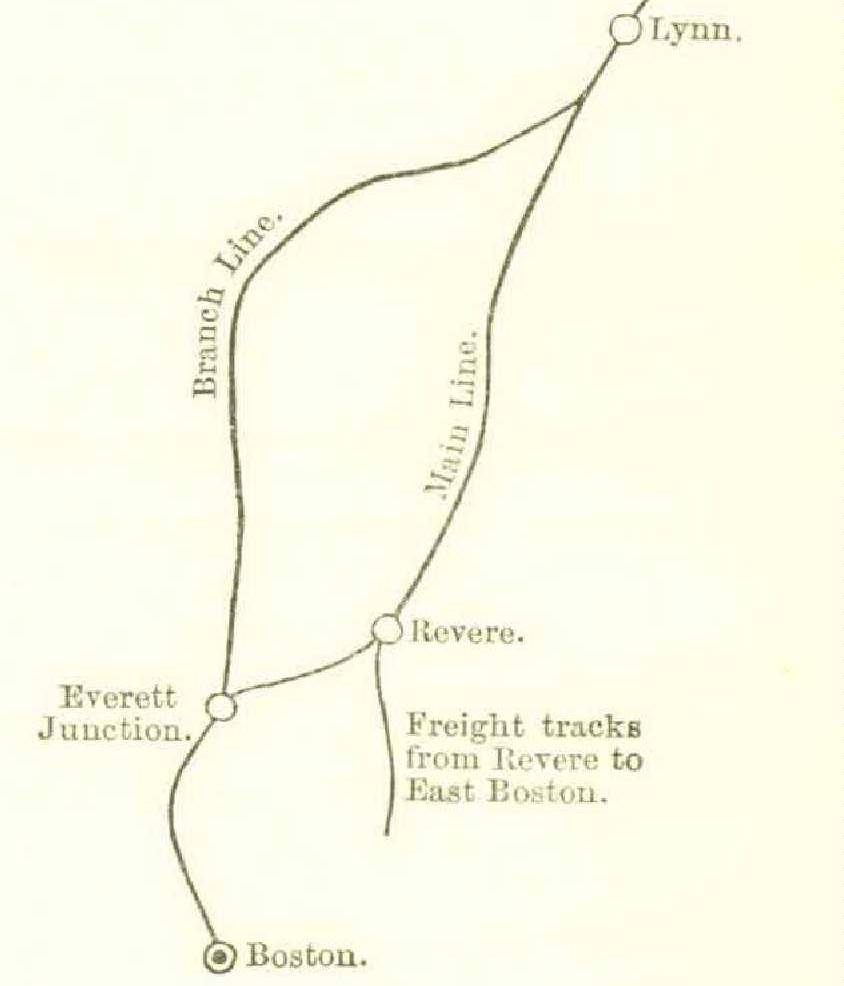
The Eastern Railroad of Massachusetts connects Boston with Portland, in the State of Maine, by a line which' is located close along the sea-shore. Between Boston and Lynn, a distance of eleven miles, the main road is in large part built across the salt marshes, but there is a branch which leaves it at Everett, a small station some miles out of Boston, and thence, running deviously through a succession of towns on the higher ground, connects with the main track again at Lynn; thus making what is known in England as a loop-road. At
the time of the Revere accident this branch was equipped with but a single track, and was operated simply by schedule, without any reliance on the telegraph; and indeed there were not even telegraphic ollices at a number of its stations. Revere, the name of the station in front of which tlm accident took place, was on the main line about five miles from Boston and two miles from Everett, where the Saugus branch, as the looproad was called, began. The accompanying diagram shows the relative position of the several points and of the main and branch lines, a thorough appreciation of which is essential to a correct understanding of the disaster.
Lynn.
Main Line.
Branch Line.
Revere.
Freight tracks from Revere to East Boston.
Everett Junction.
Boston.
The travel over the Eastern Railroad is of a somewhat exceptional nature, varying in a more than ordinary degree with the different seasons of the year. During the winter months the corporation had, in 1871, to provide for a regular passenger movement of about seventy-five thousand a week, but in the summer what is known as the excursion and pleasure travel not infrequently increased the number to one hundred and ten thousand, and even more. As a natural consequence, during certain weeks of each summer, and more especially towards the close of August, it was no unusual thing for the corporation to find itself taxed beyond its utmost resources. It is emergencies of this description, which periodically occur on every railroad, which always subject to the final test the organization and discipline of companies and the capacity of superintendents. A railroad in quiet times is like a ship in steady weather; almost anybody can manage the one or sail the other; it is the sudden stress which reveals the undeveloped strength or the hidden weakness; and the truly instructive feature in the Revere accident lay in the amount of hidden weakness everywhere which was brought to light under that sudden stress. During the week ending with that Saturday evening upon which the disaster occurred, the rolling stock of the road had been heavily taxed, not only to accommodate the usual tide of summer travel, then at its full flood, but also those attending a military muster and two large camp-meetings upon its line. The number of passengers going over it had accordingly risen from about one hundred and ten thousand, the full summer average, to over one hundred and forty thousand; while instead of the one hundred and fifty-two trains a day provided for in the running schedule, there were no less than one hundred and ninety-two. It had never been the custom with those managing the road to place any reliance upon the telegraph in directing the train movement, and no use whatever appears to have been made of it towards straightening out the numerous hitches inevitable from so sudden an increase in that movement. If an engine broke down, or a train got off the track, there had accordingly throughout that week been nothing done, except patient and general waiting, until it was gotten in motion again; each conductor or station-master had to look out for himself, under the running regulations of the road, and need expect no assistance from headquarters. This, too, in spite of the fact that, including the Saugus branch, no less than ninety-three of the entire one hundred and fifteen miles of road operated by the company were supplied only with a single track. The whole train movement, both of the main line and of the branches, intricate in the extreme as it was, thus depended solely on a schedule arrangement and the watchful intelligence of individual employés. Not unnaturally, therefore, as the week drew to a close the confusion became so great that the trains reached and left the Boston station with an almost total disregard of the schedule; while towards the evening of Saturday the employés of the road directed their efforts almost exclusively to dispatching trains as fast as cars could be procured, thus trying to keep the station as clear as possible of the throng of impatient travelers which continually blocked it up.
According to the regular schedule four trains should have left the Boston station in succession during the hour and a half between 6.30 and eight o’clock p. M.: a Saugus branch train for Lynn at 6.30; a second Saugus branch train at seven; an accommodation train, which ran eighteen miles over the main line, at 7.15; and finally the express train through to Portland, also over the main line, at eight o’clock. The collision at Revere was between these last two trains, the express overtaking and running into the rear of the accommodation train; but it was indirectly caused by the delays and irregularity in movement of the two branch trains. It will be noticed that, according to the schedule, both of the branch trains should have preceded the accommodation train; in the prevailing confusion, however, the first of the two branch trains did not leave the station until about seven o’clock, thirty minutes behind its time, and it was followed forty minutes later, not by the second branch train, but by the accommodation train, which in its turn was twenty-five minutes late. Thirteen minutes afterwards the second Saugus branch train, which should have preceded, followed it, being nearly an hour out of time. Then at last came the Portland express, which got away practically on time, at a few minutes after eight o’clock. All of these four trains went out over the same track as far as the junction at Everett, but at that point the first and third of the four were to go off on the branch, while the second and fourth kept on over the main line. Between these last two trains the running schedule of the road allowed an ample time-interval of forty-five minutes, which, however, on this occasion was reduced, through the delay in starting, to some fifteen or twenty minutes. No causes of further delay, therefore, arising, the simple case was presented of a slow accommodation train being sent out to run eighteen miles in advance of a fast express train, with an interval of twenty minutes between them.
Unfortunately, however, the accommodation train was speedily subjected to another and very serious delay. It has been mentioned that the Saugus branch was a single track road, and the rules of the company were explicit that no outward train was to pass on to the branch at Everett until any inward train then due there should have arrived and passed off it. There was no siding at the junction, upon which an outward branch train could be temporarily placed to wait for the inward train, thus leaving the main track clear; and accordingly, under a strict construction of the rules, any outward branch train while awaiting the arrival at Everett of an inward branch train was to be kept standing on the main track, completely blocking it. The outward branch trains, it subsequently appeared, were often delayed at the junction, but no practical difficulty had arisen from this cause, as the employé in charge of the signals and switches there, exercising his common sense, had been in the custom of moving any delayed train temporarily out of the way on to the branch or the other main track, under protection of a flag, and thus relieving the block. On the day of the accident this employé happened to be sick, and absent from his post. His substitute either had no common sense or did not feel called upon to use it, if its use involved any increase of responsibility. Accordingly, when a block took place, the simple letter of the rule was followed; and it is almost needless to add that a block did take place on the afternoon of August 26th.
The first of the branch trains, it will be remembered, had left Boston at about seven o’clock, instead of at 6.30, its schedule time. On arriving at Everett this train should have met and passed an inward branch train, which was timed to leave Lynn at six o’clock, but which, owing to some accident to its locomotive, and partaking of the general confusion of the day, on this particular afternoon did not leave the Lynn station until 7.30 o’clock, or one hour and a half after its schedule time, and one half-hour after the other train had left Boston. Accordingly, when the Boston train reached the junction its conductor found himself confronted by the rule forbidding him to enter upon the branch until the Lynn train then due should have passed off it, and so he quietly waited on the outward track of the main line, blocking it completely to traffic. He had not waited long before a special locomotive, on its way from Boston to Salem, came up and stopped behind him; followed presently by the accommodation train, and then by the next branch train, and finally by the Portland express. At such a time, and at that period of railroad development, there was something ludicrous about the spectacle. Here was a road utterly unable to accommodate its passengers with cars, while a succession of trains were standing idle for hours, because a locomotive had broken down ten miles off. The telegraph was there, but the company was not in the custom of putting any reliance upon It. A simple message to the branch trains to meet and pass at any point other than that fixed in the schedule would have solved the whole difficulty; but no! there were the rule’s, and all the rolling stock of the road might gather at Everett in solemn procession, but until the locomotive at Lynn could be repaired, the law of the Medes and Persians was plain; and in this case it read that the telegraph was a new-fangled and unreliable auxiliary. And so the lengthening procession stood there long enough for the train which caused it to have gone to its destination and come back again to take its place in the block, dragging the disabled locomotive from Lynn behind it.
At last, at about ten minutes after eight o’clock, the long-expected Lynn train made its appearance, and the first of the branch trains from Boston immediately went off the main line. The road was now clear for the accommodation train, which had been standing some twelve or fifteen minutes in the block, but which from the moment of starting again was running on the schedule time of the Portland express. This its conductor did not know. Every minute was vital, and yet he never thought to look at his watch. He had a vague impression that he had been delayed some six or eight minutes, when in reality he had been delayed fifteen; and, though he was running wholly out of his schedule time, he took not a single precaution, so persuaded was he that every one knew where he was.
The confusion among those in charge of the various engines and trains was, indeed, general and complete. As the Portland express was about to leave the Boston station, the superintendent of the road, knowing by the non-arrival of the branch train from Lynn that there must be a block at the Everett junction, had directed the depot-master to caution the engineer to look out for the trains ahead of him. The order was a verbal one, was delivered after the train had started, the station-master walking along by the side of the slowly-moving locomotive, and was either incorrectly transmitted or not fully understood; the engineer supposing it to apply to the branch train which had started just before him, out of both its schedule time and schedule place. Presently, at the junction, he was stopped by the signalman of this train. The course of reasoning he would then have had to pass through to divine the true situation of affairs was complicated indeed, and somewhat as follows. “ The branch train,” he should have argued to himself, " is stopped, and it is stopped because the train which should have left Lynn at six o’clock has not yet arrived; but, under the rules, that train should pass off the branch before the 6.30 train could pass on to it; if, therefore, the “ wild” train before me is delayed, not only the 6.30 but all intermediate trains must likewise be delayed, and the accommodation train went out this afternoon after the 6,30 train, so it, too, must be in the block ahead of me; unless, indeed, as is usually the case, the signal-master has got it out of the block under the protection of a flag.” This line of reasoning was, perhaps, too intricate; at any rate the engineer did not follow it out, but, when he saw the tail-lights immediately before him disappear on the branch, he concluded that the main line was now clear, and dismissed the depot-master’s caution from his mind. Meanwhile, as the engineer of this train was fully persuaded that the only other train in his front had gone off on the branch, the conductor of the accommodation train was equally persuaded that the head-light immediately behind him in the block at the junction had been that of the Portland express, which consequently should be aware of his position. Both were wrong.
Thus when they left Everett the express was fairly chasing the accommodation train, and overtaking it with terrible rapidity. Even then no collision ought to have been possible. Unfortunately, however, the road had no system, even the crudest, of interval signals; and the utter irregularity prevailing in the train movement seemed to have demoralized the employés along the line, who, though they noticed the extreme proximity of the two trains to each other as they passed various points, all sluggishly took it for granted that those in charge of them were fully aware of their relative positions. Thus, as the two trains approached the Revere station, they were so close together as to be on the same piece of straight track at the same time, and a passenger standing at the rear end of the accommodation train distinctly saw the head-light of the express locomotive. The night, however, was not, a clear one, for the east wind had prevailed all day, driving a mist in from the sea which lay in banks over the marshes, lifting at times so that distant objects were quite visible, and then obscuring them in its heavy folds. Consequently it did not at all follow, because the powerful reflecting headlight of the locomotive was visible from the accommodation train, that the dim tail-lights of the latter were also visible to those on the locomotive. Here was another mischance. The tail-lights in use by the company were ordinary red lanterns without reflecting power.
The station-house at Revere stood at the end of a tangent, the track curving directly before it. In any ordinary weather the tail-lights of a train standing at this station would have been visible for a very considerable distance down the track in the direction of Boston, and even on the night of the accident they were probably visible for a sufficient distance in which to stop any train approaching at a reasonable rate of speed. Unfortunately, the engineer of the Portland express did not at once see them, his attention being wholly absorbed in looking for other signals. Certain freight tracks to points on the shore diverged from the main line at Revere, and the engineers of all trains approaching that place were notified by signals at a masthead close to the station whether the switches were set for the main line or for these freight tracks. A red lantern at the masthead indicated that the main line was closed; in the absence of any signal it was open. In looking for this signal as he approached Revere the engineer of the Portland express was simply attending closely to his business, for, had the red light been at the masthead, his train must at once have been stopped. Unfortunately, however, while peering through the mist at the masthead he overlooked what was directly before him, until, when at last he brought his eyes down to the level, to use his own words at the subsequent inquest, “ the tail-lights of the accommodation train seemed to spring right up in his face. ”
“When those in charge of the two trains at almost the same moment became aware of the danger, there was yet an interval of some eight hundred feet between them. The express train was, however, moving at a speed of some twenty-five or thirty miles an hour, and was equipped only with the old-fashioned hand-brake. In response to the sharply given signal from the whistle these were rapidly set, but the rails were damp and slippery, so that the wheels failed to catch upon them, and when everything was done which could be done, the eight hundred feet of interval sufficed only to reduce the speed of the colliding locomotive to about ten miles an hour.
In the rear car of the accommodation train there were at the moment of the accident some sixty - five or seventy human beings, seated and standing. They were of both sexes and of all ages; for it was a Saturday evening in August, and many persons had, through the confusion of the trains, been long delayed in their return from the city to their homes at the sea-side. The first intimation the passengers had of the danger impending over them was from the sudden and lurid illumination of the car by the glare from the head-light of the approaching locomotive. One of them, who survived the disaster though grievously injured, described how he was carelessly watching a young man standing in the aisle, laughing and gayly chatting with four young girls who were seated, when he saw him turn and instantly his face in the sudden blaze of the head-light assumed a look of frozen horror which was the single thing in the accident indelibly impressed on the survivor’s memory; that look haunted him. The car was crowded to its full capacity, and the colliding locomotive struck it with such force as to bury itself two thirds of its length in it. At the instant of the crash a panic had seized upon the passengers, and a sort of rush had taken place to the forward end of the car, into which furniture, fixtures, and human beings were crushed in a shapeless, indistinguishable mass. Meanwhile the blow had swept away the smoke-stack of the locomotive, and its forward truck had been forced back in some unaccountable way until it rested between its driving wheels and the tender, leaving the entire boiler inside of the passenger car and supported on its rear truck. The valves had been so broken as to admit of the free escape of the scalding steam, while the coals from the fire-box were scattered among the débris, and coming in contact with the fluid from the broken car lamps kindled the whole into a rapid blaze. Neither was the fire confined to the last car of the train. It has been mentioned that in the block at Everett a locomotive returning to Salem had found itself stopped just in advance of the accommodation train. At the suggestion of the engineer of that train this locomotive had there coupled on to it, and consequently made a part of it at Revere. When the collision took place, therefore, the four cars of which the accommodation train was made up were crushed between the weight of the entire colliding train on one side and that of two locomotives on the other. That they were not wholly demolished was due simply to the fact that the last car yielded to the blow and permitted the locomotive of the express train fairly to imbed itself in it. As it was, the remaining ears were jammed and shattered, and, though the passengers in them escaped, the oil from the broken lamps ignited, and before the flames could be extinguished the cars were entirely destroyed,
This accident resulted in the death of twenty-nine persons, and in more or less severe injuries to fifty-seven others. No person not in the last car of the accommodation train was killed, and one only was seriously injured. Of those in the last car more than half lost their lives ; many instantly by crushing, others by inhaling the scalding steam which poured forth from the locomotive boiler into the wreck, and which, where it did not kill, inflicted frightful injuries. Indeed, for the severity of injuries and for the protractedness of agony involved in it, this accident has rarely, if ever, been exceeded. Crushing, scalding, and burning did their work together.
It may with perfect truth be said that the disaster at Revere marked an epoch in the history of railroad development in New England. At the moment it called forth the deepest expression of horror and indignation, which, as usual in such cases, was more noticeable for its force than for its wisdom. An utter absence of all spirit of justice is, indeed, a usual characteristic of the more immediate utterances both from the press and on the platform, upon occasions of this character. Writers and orators seem always to forget that, next to the immediate sufferers and their families, the unfortunate officials concerned are the greatest losers by railroad accidents. For them, not only reputation but bread is involved. A railroad employé in any way implicated in the occurrence of an accident from that moment lives under a stigma. And yet, from the tenor of public comment it might fairly be supposed that they plotted to bring disasters about, and took a fiendish delight in them. Nowhere was this ever illustrated more perfectly than in Massachusetts during the last days of August and the early days of September, 1871. Grave men — men who ought to have known better—indulged in language which would have been simply ludicrous save for the horror of the event which occasioned hut could not justify it. A public meeting, for instance, was held at the town of Swampscott on the evening of the Monday succeeding the catastrophe. The gentleman who presided over it very discreetly, in his preliminary remarks, urged those who proposed to join in the discussion to control their feelings. Hardly had he ceased speaking, however, when Mr. Wendell Phillips was noticed among the audience, and immediately called to the platform. His remarks were a most singular commentary on the chairman’s injunction to calmness. He began by announcing that the first requisite to the formation of a healthy public opinion in regard to railroad accidents, as other things, was absolute frankness of speech, and he then proceeded as follows: “ So I begin by saying that to my mind this terrible disaster, which has made the last thirty-six hours so sad to us all, is a deliberate murder. I think we should try to get rid in the public mind of any real distinction between the individual who, in a moment of passion or in a moment of heedlessness, takes the life of one fellow-man, and the corporation that in a moment of greed, of little trouble, of little expense, of little care, of little diligence, takes lives by wholesale. I think the first requisite of the public mind is to say that there is no accident in the case, properly speaking. It is a murder; the guilt of murder rests somewhere.” Mr. Phillips’s definition of the crime of “ deliberate murder” would apparently somewhat unsettle the criminal law as at present understood, but he was not at all alone in this bathos of extravagance. Prominent gentlemen seemed to vie with each other in their display of ignorance. Mr. B. F. Butler, for instance, suggested his view of the disaster and the measure best calculated to prevent a repetition of it, which last was certainly original, inasmuch as he urged the immediate raising of the pay of all engine-men until a sufficiently high order of ability and education should be brought into the occupation to render impossible the recurrence of an accident which was primarily caused by the negligence, not of an engineer, but of a conductor. Another gentleman described with much feeling his observations during a recent tour in Europe, and declared that such a catastrophe as that at Revere would have been impossible there. As a matter of fact the official reports not only showed that the accident was one of a class of most frequent occurrence, but also that sixty-one cases of it had occurred in Great Britain alone daring the very year the gentleman in question was journeying in Europe, and had occasioned over six hundred cases of death or personal injury. Perhaps, in order to illustrate how very reckless in statement a responsible gentleman talking under excitement may become, it is worth while to quote in his own language Captain Tyler’s brief description of one of those sixty-one accidents which “ could not possibly ” but yet did occur. As miscellaneous reading it is amusing. “ As four London & North-Western excursion trains on September 2, 1870, were returning from a volunteer review at Penrith, the fourth came into collision at Ponruddock with the third of those trains. An hundred and ten passengers and three servants of the company were injured. These trains were partly in charge of acting guards, some of whom were entirely inexperienced, as well in the line as in their duties; and of engine-drivers and firemen, of whom one, at all events, was very much the worse for liquor. The side-lamps on the hind van of the third train were obscured by a horse-box, which was wider than the van. There were no special means of protection to meet the exceptional contingency of three such trains all stopping on their way from the eastward, to cross two others from the westward, at this station. And the regulations for telegraphing the trains were altogether neglected. ”
The annals of railroad accidents are indeed full of cases of “rear-end collision,” as it is termed. Their frequency may almost be accepted as a very accurate gauge of the pressure of traffic on any given system of lines, and because of them the companies are continually compelled to adopt new and more intricate systems of operation. At first, on almost all roads, trains follow each other at such great intervals that no precautions at all, other than flags and lanterns, are found necessary. Then comes a succeeding period when an interval of time between following trains is provided for, through a system of signals which at given points indicate danger during a certain number of minutes after the passage of every train. Then, presently, the alarming frequency of rear collisions demonstrates the inadequacy of this system, and a new one has to be devised, which, through the aid of electricity, secures between trains an interval of space as well as of time. This last is known as the “ block-system,” of which so much has of late years been heard. Its essential principle lies in the division of the road into segments or blocks, through the establishment of telegraphic stations at such intervals as may be deemed necessary, varying from a few hundred yards to several miles; and no train is permitted to pass one of these stations until a preceding train has been signaled back as having passed the next station farther on; that is, no two locomotives are allowed to be on one segment of the road at the same time. Yet rear-end collisions occur notwithstanding all the precautions implied in a thoroughly perfected “block-system.” There was such a case on the Metropolitan road, in the very heart of London, on the 29th of August, 1873. It happened in a tunnel. A train was stalled there, and an unfortunate signal officer in a moment of flurry gave. “ line clear” and sent another train directly into it.
A much more impressive disaster, both in its dramatic features and as illustrating the inadequacy of every precaution depending on human agency to avert accident under certain conditions, was afforded in the case of a collision which occurred on the London & Brighton Railway upon the 25th of August, 1861; ten years almost to a day before that at Revere. Like the Eastern Railroad, the London & Brighton enjoyed an enormous passenger traffic, which became peculiarly heavy during the vacation season, towards the close of August;
and it was to the presence of the excursion trains made necessary to accommodate this traffic that the catastrophes were in both cases due. In the case of the London & Brighton road it occurred on a Sunday. An excursion train from Portsmouth on that day was to leave Brighton at five minutes after eight A. M., and was to be followed by a regular Sunday excursion train at 8.15 or ten minutes later, and that again, after the lapse of a quarter of an hour, by a regular parliamentary train at 8.30. These trains were certainly timed to run sufficiently near to each other; but, owing to the existing pressure of traffic on the line, they started almost simultaneously. The Portsmouth excursion, which consisted of sixteen carriages, was much behind its time, and did not leave the Brighton station until 8.28; when, after a lapse of three minutes, it was followed by the regular excursion train at 8.31, and that again by the parliamentary train at 8.35. Three passenger trains had thus left the station on one track in seven minutes! The London & Brighton Railway traverses the chalky downs for which that portion of England is noted, through numerous tunnels, the first of which after leaving Brighton is known as the Patcham Tunnel, about five hundred yards in length, while two and a half miles farther on is the Croydon Tunnel, rather more than a mile and a quarter in length. The line between these tunnels was so crooked and obscured that the managers had adopted extraordinary precautions against accident. At each end of the Croydon Tunnel a signal-man was stationed, with a telegraphic apparatus, a clock, and a telegraph bell in his station. The rule was absolute that when, any train entered the tunnel the signal-man at the point of entry was to telegraph “ train in,” and no other train could follow until the return signal of “ train out ” came from the other side. In face of such a regulation it was difficult to see how any collision in the tunnel was possible. When the Portsmouth excursion train arrived, it at once entered the tunnel and the fact was properly signaled to the opposite outlet. Before the return signal that this train was out was received, the regular excursion train came in sight. It should have been stopped by a self-acting signal which was placed about a quarter of a mile from the mouth of the tunnel, and which each passing locomotive set at “ danger,” where it remained until shifted to “ safety ” by the signal-man, on receipt of the message, " train out.” Through some unexplained cause, the Portsmouth excursion train had failed to act on this signal, which consequently still indicated safety when the Brighton excursion train came up. Accordingly the engine driver at once passed it, and went on to the tunnel. As he did so, the signal-man, perceiving some mistake and knowing that he had not yet got his return signal that the preceding train was out, tried to stop him by waving his red flag. It was too late, however, and the train passed in. A moment later the parliamentary train also came in sight, and stopped at the signal of danger. Now ensued a most singular misapprehension between the signalmen, resulting in a terrible disaster. The second train had run into the tunnel and was supposed by the signal-man to he on its way to the other end of it, when he received the return message that the first train was out. To this he instantly responded by again telegraphing “ train in,” referring now to the Second train. This dispatch the signal man at the opposite end conceived to be a repetition of the message referring to the first train, and he accordingly again replied that the train was out. This reply, however, the other operator mistook as referring to the second train, and accordingly he signaled “ safety ” and the third train at once got under way and passed into the tunnel. Unfortunately the engineer of the second train had seen the red flag waved by the signal man, and, in obedience to it, Stopped his locomotive as soon as possible in the tunnel and began to back out of it. In doing so, he drove his train into the locomotive of the third train advancing into it. The tunnel was twenty-four feet in height. The engine of the parliamentary train struck the rear carriage of the excursion train, and mounted upon its fragments and then on those of the carriage in front of it, until its smokestack came in contact with the roof of the tunnel. It rested finally in a nearly upright position. The collision had taken place so far within the tunnel as to be beyond the reach of daylight, and the wreck of the trains had quite blocked up the arch, while the steam and smoke from the engines poured forth with loud sound and in heavy volumes, filling the empty space with stifling and scalding vapors. When at last assistance came, and the trains could be separated, twenty-three corpses were taken from the ruins, while one hundred and seventysix other persons had sustained more or less severe injuries.
A not less extraordinary accident of the same description, unaccompanied, however, by an equal loss of life, occurred on the Great Northern Railway upon the 10th of June, 1866. In this case the tube of the locomotive of a freight train burst at about the centre of the Welwyn Tunnel, some five miles north of Hatfield, bringing the train to a stand-still. The guard in charge of the rear of the train failed from some cause to go back and give the signal for an obstruction, and speedily another freight train from the Midland road entered and dashed into the rear of the train already there. Apparently those in charge of these two trains were in such consternation that they did not think to provide against a further disaster; at any rate, before measures to that end had been taken, an additional freight train, this time belonging to the Great Northern road, came np and plowed into the ruins winch already blocked the tunnel. One of the trains had contained wagons laden with casks of oil, which speedily became ignited from contact with the coals scattered from the fire-boxes, and there then ensued one of the most extraordinary spectacles ever witnessed on a railroad. The tunnel was filled to the summit of its arch and completely blocked with ruins. These had ignited, and the whole cavity, more than half a mile in length, was converted into one huge furnace, belching forth smoke and flame with a loud roaring sound through its several air shafts. So fierce was the fire that no attempt was made to subdue it, and eighteen hours elapsed before any steps could be taken towards clearing the track. Strange to say, in this disaster the lives of but two persons were lost.
Rear-end collisions have been less frequent in this country than in England, for the simple reason that the volume of traffic has pressed less heavily on the capacity of the lines. Yet here, also, they have been by no means unknown. In 1865 two occurred, both of which were accompanied with a considerable loss of life; though, coming as they did during the exciting scenes which marked the close of the war of the Rebellion, they attracted much less public notice than they otherwise would. The first of these took place in New Jersey on the 7th of March, 1865, just three days after the second inauguration of President Lincoln. As the express train from Washington to New York over the Camden & Amboy road was passing through Bristol, about thirty miles from Philadelphia, at half-past two o’clock in the morning, it dashed into the rear of the twelve o’clock, or “ owl train,” from Kensington to New York, which had been delayed by meeting an oil train on the track before it. The case appears to have been one of very culpable negligence, for though the owl train was some two hours late, those in charge of it seem to have been so deeply engrossed in what was going on before them that they wholly neglected to guard their rear. The express train accordingly, approaching round a curve, plunged at a high rate of speed into the last car, shattering it to pieces; the engine is even said to have passed completely through the car and to have imbedded itself in the preceding car. It so happened that most of the sufferers by this accident, numbering about fifty, were soldiers on their way home from the army upon furlough. The second of these two disasters occurred on the 16th of August, 1865, upon the Housatonic road, in the State of Connecticut. A new engine was out upon an experimental trip, and in rounding a carve it ran into the rear of a passenger train, which, having encountered a disabled freight train, had coupled on to it and was then backing down with it to a siding in order to get by it. In this case the impetus was so great that the colliding locomotive utterly destroyed the rear car of the passenger train and penetrated some distance into the car next to the last one, where its boiler burst. Fortunately the train was by no means full of passengers; but, even as it was, eleven persons were killed and some seventeen badly injured.
The great peculiarity of the Revere accident, and that which gave a permanent interest to it, lay in the revelation it afforded of the degree in which a system had outgrown its appliances. At every point a deficiency was apparent. The railroads of New England had long been living on their early reputation, and now, when a sudden test was applied, it was found that they were years behind the time. In August, 1871, the Eastern Railroad was run as if it were a line of stage-coaches in the days before the telegraph. Not in one point alone, but in everything, it broke down under the test. The disaster was due not to any single cause but to a combination of causes, running down from the highest official to the meanest subordinate. In the first place the capacity of the road was taxed to the utmost; it was vital, almost, that every wheel should be kept in motion. Yet, under that very exigency, the wheels stopped almost as a matter of necessity. How could it be otherwise? Here was a crowded line, more than half of which was equipped with but a single track, and placing no reliance upon the telegraph. With trains running out of their schedule time and out of their schedule place, engineers and conductors were left to grope their way along as best they could in the light of rules the essence of which was that when iIn doubt they were to stand stock still. Then, in the absence of the telegraph, a block occurred almost at the mouth of the central station; and there the trains stood for hours in stupid obedience to a stupid rule, because the one man who, with a simple regard to the dictates of common sense, was habitually accustomed to violate it happened to be sick. Trains commonly left a station out of time and out of place; and the engineer of an express train was sent out to run a gauntlet the whole length of the road with a simple verbal injunction to look out for some one before him. Then, at last, when this express train through all this chaos got to chasing an accommodation train much as a hound might course a hare, there was not a pretense of a signal to indicate the time which had elapsed between the passage of the two, and employés, lanterns in hand, gaped on in bewilderment at the awful race, concluding that they couhl not at any rate do anything to help matters, but on the whole they were inclined to think that those most immediately concerned must know what they were about. Finally, even when the disaster was imminent, when deficiency in organization and discipline had done its worst, its consequences might yet have been averted through the use of better appliances; had the one train been equipped with the Westinghouse brake, already largely in use in other sections of the country, it might and would have been stopped; or had the other train been provided with reflecting tail-lights in place of the dim hand-lanterns which glimmered on its rear platform, it could hardly have failed to make its proximity known. Any one of a dozen things, every one of which should have been but was not, ought to have averted the disaster. Obviously its immediate cause was not far to seek. It lay in the carelessness of a conductor who failed to consult his watch, and never knew until the crash came that he was leisurely moving along on the time of another. Nevertheless, what can be said in extenuation of a system under which at this late day a railroad is operated on the principle that each employé under all circumstances can and will take care of himself and of those whose lives and limbs are entrusted to his care?
There is, however, another and far more attractive side to the picture. The lives sacrificed at Revere were not lost in vain. Four complete railroad years have now passed by since that catastrophe occurred, and during that time not less than one hundred and thirty millions of persons have been carried by rail within the limits of Massachusetts. Of this vast number the life of not a single one has been lost through causes for which any railroad company was responsible. This certainly is a record of which any community might well be proud; and it is due more than anything else to the great disaster of August 26, 1871. More than once, and on more than one road, have accidents occurred which, but for the improved appliances introduced in consequence of the experience at Revere, could hardly have failed of fatal results. Not that these appliances were in all cases very cheerfully or very eagerly accepted. Neither the Miller platform nor the Westinghouse brake won its way into general use unchallenged. Indeed, the earnestness and even the indignation with which presidents and superintendents then protested that their car construction was better and stronger than Miller’s; that their antiquated handbrakes were the most improved brakes, better, much better, than the Westinghouse; that their crude old semaphores and targets afforded a protection to trains which no block-system would ever equal, — all this certainly was comical enough, even in the very shadow of the great tragedy. Men of a certain type always have protested and will always continue to protest that they have nothing to learn; yet, under the heavy burden of responsibility, learn they still do. They dare not but learn. On this point the figures of the annual returns speak volumes. At the time of the Revere disaster, with one single honorable exception, — that of the Boston & Providence road, — both the atmospheric train-brake and the Miller platform, the two greatest modern improvements in car construction, were practically unrecognized on the railroads of Massachusetts. That was four years ago, in September, 1871. Even a year later, but ninety-three locomotives and four hundred and fifteen cars had been equipped even with the train-brake. In September, 1873, the number had, however, risen to one hundred and ninety-four locomotives and seven hundred and nine cars; and another twelve months carried these numbers up to three hundred and thirteen locomotives and nine hundred and ninety-seven cars. The adoption of the Miller platform and of systems of signals to secure intervals between trains was not less rapid. So the world advances through the lessons of bitter experience; but to-day not a human being is carried on a Massachusetts railroad who does not enjoy an appreciably greater immunity from danger for which he is wholly indebted to those who died or suffered in the terrible experience at Revere in August, 1871.
Charles Francis Adams, Jr.