The Sanitary Drainage of Houses and Towns
II.
“ THE house is the unit of sanitary administration.”
Whatever means may be adopted by the board of health of town or village for the removal of the wastes incident to the life of its population; whatever facilities for such removal may be offered by the natural surroundings of isolated country houses; and whatever the public or the individual may do toward rendering the natural character of the ground dry and salubrious, the first aim of the householder himself should be to secure a perfect means for carrying safely beyond the walls of his domicile everything of a dangerous character that is generated or produced within it, and to secure his living-rooms against the entrance of any manner of foul air, impure water, or excessive dampness.
It would not be possible here to consider the very great variety of circumstances attending the location and arrangement of different houses. It will suffice for our general purposes to assume that all liquid or semi-liquid drainage from the house should be delivered either into a public sewer, into a private cess-pool or vault, or directly into a natural water-course. If we arrange a safe means for discharging our outflows into one or other of these, for the exclusion from the house of gas arising from their decomposition, and for preventing filtration from them into the source of our domestic water, we shall, so far as exterior surroundings are concerned, accomplish the most important aim. General rules and principles, of which the modifications needed in particular cases will quite naturally suggest themselves, are all that can here be given.
The individual householder has these problems to solve: —
1. To secure his house against, excessive damp in its walls, in its cellar, and, where practicable, in its surrounding atmosphere.
2. To provide for the perfect and instant removal of all manner of fluid or semi-fluid organic wastes.
3. To provide a sufficient supply of pure water for domestic use.
4. To guard against the evils arising from the decomposition of organic matter in or under the house.
5. To remove all sources of offense and danger which may affect the atmosphere about the house.
6. (And almost more important than all the rest.) To prevent the insidious entrance into the house, through communications with the sewer, cess-pool, or vault, of poisonous gases resulting from the decomposition of the refuse of his own household, or of other households with which a common sewer or drain may bring him into communication.
The first item implies a dry cellar, an impervious foundation wall, and, if the soil be heavy and liable to be wet, or if it be underlaid too closely with rock or clay, “thorough drainage,” of the sort employed in the agricultural improvement of land. So far as this matter of drainage is concerned, it will suffice to refer to the well-known works on agricultural drainage; but the drying of the cellar and foundation receives so little attention at the hands of both owners and architects, that explicit directions seem advisable. If the house is founded on well-drained gravel or on a dry bed of sand (which is the best of all foundations) no further draining will be necessary; but even here it is always advisable to cover the floor of the cellar with an impervious concrete, to prevent the exhalation of moisture that arises from even the dryest, soil; and in all cases where the foundation wall is not built with hard and impervious stone, it should be furnished with a course of some impervious material, whether hydraulic cement, asphalted brick, bluestone, slate laid in cement, or sheet-lead. Even with this precaution, if the foundation wall below the impervious course is of brick or soft stone, the inner surface of the wall should be well washed with pure hydraulic cement, which will lessen the escape of the moisture that penetrates the stones during driving rain-storms, or soaks into them from the earth.
If the ground is at all inclined, even in the wettest seasons, to be wet or springy, whatever other precautions are taken, a drain should be laid all round the cellar inside of the wall, and at least a foot lower than its lowest bed-stone, and carried away to a free and sufficient outlet. This drain may be made of gravel or broken stones, but ordinary land - drainage tile with open joints is usually cheaper and always better, especially as preventing the ingress of vermin. For the largest private house, the smallest-sized land-drain tile will be sufficient. If the soil is unduly wet, at any season, similar drains should cross the cellar at intervals of not more than fifteen feet. All of these drains should have a slight but continuous fall toward the outlet, and should be securely covered by having earth well rammed over them, the whole cellar bottom being then coated with concrete. For small houses, where cobble-stones or gravel are plenty, if the foundation rests on a layer of this porous material a foot or more deep, and if a good outlet be provided at the lowest point, the tile is not needful.
The complete, drainage of the house, that is, the instant removal of the impurities incident to human life, is the crowning work of the whole system of sewerage. In towns, street drains, main sewers, outlets, and the whole paraphernalia of the system have for their main purpose the furtherance of the ultimate object of the sanitary drainage of the house; and the effect of sewerage on the health and decency of the population must depend very much upon the manner in which each house is provided with the necessary drainage system and is connected with the public sewer.
In the country, whatever the final means of removal, the house drainage, whether partial or complete, must be equally guarded. If there is only a kitchen drain, this should be perfectly well made and arranged.
When we consider its immediate proximity to the windows of the room in which the family of the average farmer passes most of its time, the kitchen drain probably heads the list of all the agents by which our ingenious people violate the universal sanitary law; and it doubtless carries more victims to the grave than do all other sources of defilement combined; for with an enormous majority of our population this one pipe still represents the whole drainage of the house.
Receiving daily supplies of organic matter ready to pass into dangerous decomposition, drenched with sufficient water to soak far into the ground, and kept warm enough for putrefaction to proceed rapidly throughout a large part of the year; sending its exhalations into the kitchen and living-room windows, and with a favorable summer breeze throughout the whole house; and leaking, too often, through a light surface soil, or through a porous stratum in a clay soil, into the adjacent well; it attacks the family through the lungs and through the stomach with an almost unremitted assault, soon achieving, in the case of those who live mainly in close, stove-heated rooms and sleep on the ground floor with a window opening over the back - yard, its various measures of debility, disease, or death.
No house drain can be made which may not be carelessly obstructed by the admission of substances for which it is not intended. Shedd enumerates, among the articles that have been found in such drains, “ sand, shavings, sticks, coal, bones, garbage, bottles, spoons, knives, forks, apples, potatoes, hay, shirts, towels, stockings, floor-cloths, broken crockery,” etc.
House drains in towns should of course be laid at the expense of the owner; but, as they are a part of the system by which the health of the community is to be protected, and as the obstruction of a single house drain may establish a centre of infection for a large district, the work should be done in accordance with an established rule and under the immediate supervision of the engineer having charge of the sewerage work.
Latham gives a velocity of three feet per second as the least that should be allowed for the outlet drain of a house. A four-inch drain to secure this flow should have a minimum inclination of one in ninety-two; a six-inch drain, one in one hundred and thirty-seven; a nineinch drain, one in two hundred and six; and to attain a velocity of three feet per second at these inclinations they must run at least half full; that is, the fourinch drain must discharge 7.85 cubic feet per minute; six-inch, 17.66 cubic feet per minute; and nine-inch, 39.76 cubic feet per minute. It is very seldom indeed that even a large boardinghouse discharges a flow equal to 7.85 cubic feet per minute, and in practice, while too large outlets should always be avoided for house drains, any such drain should have considerably more than the minimum rate of fall indicated above.
The main outlet drain from a house may be small, and even for the largest private dwelling need not be more than four inches in diameter, if proper precaution is taken to prevent its being choked by the accumulation of kitchen grease; while, without such precaution, were it even a foot in diameter, this same influence would cause it to be ultimately obstructed by gradual accumulation. In other words, with a proper grease trap, a four-inch drain will furnish an ample outlet, while without such grease trap no drain can be relied upon to remain permanently effective.
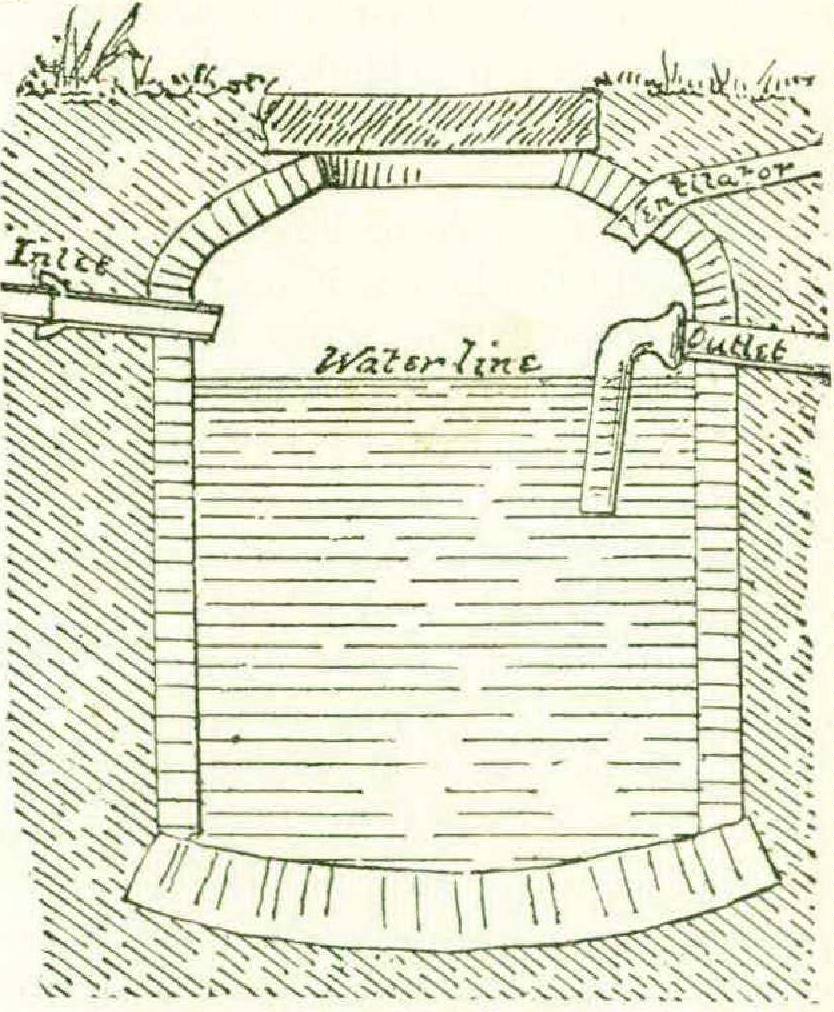
There are various forms of grease trap, some with open gullies for ventilation at the surface of the ground, and all of them depending upon the congealing of the grease and its accumulation at the surface of water which has its outlet at a point below the surface. The best form that has come to my notice is that shown in the accompanying diagram.
The removal of organic wastes is the chief purpose of all house drains, whether a wooden pipe from the kitchen sink or the soil pipe of a house fitted with all the modern plumbing appliances. It is this part of the work that first suggests itself when the question of house drainage arises, and it is too often to this only that attention is given.
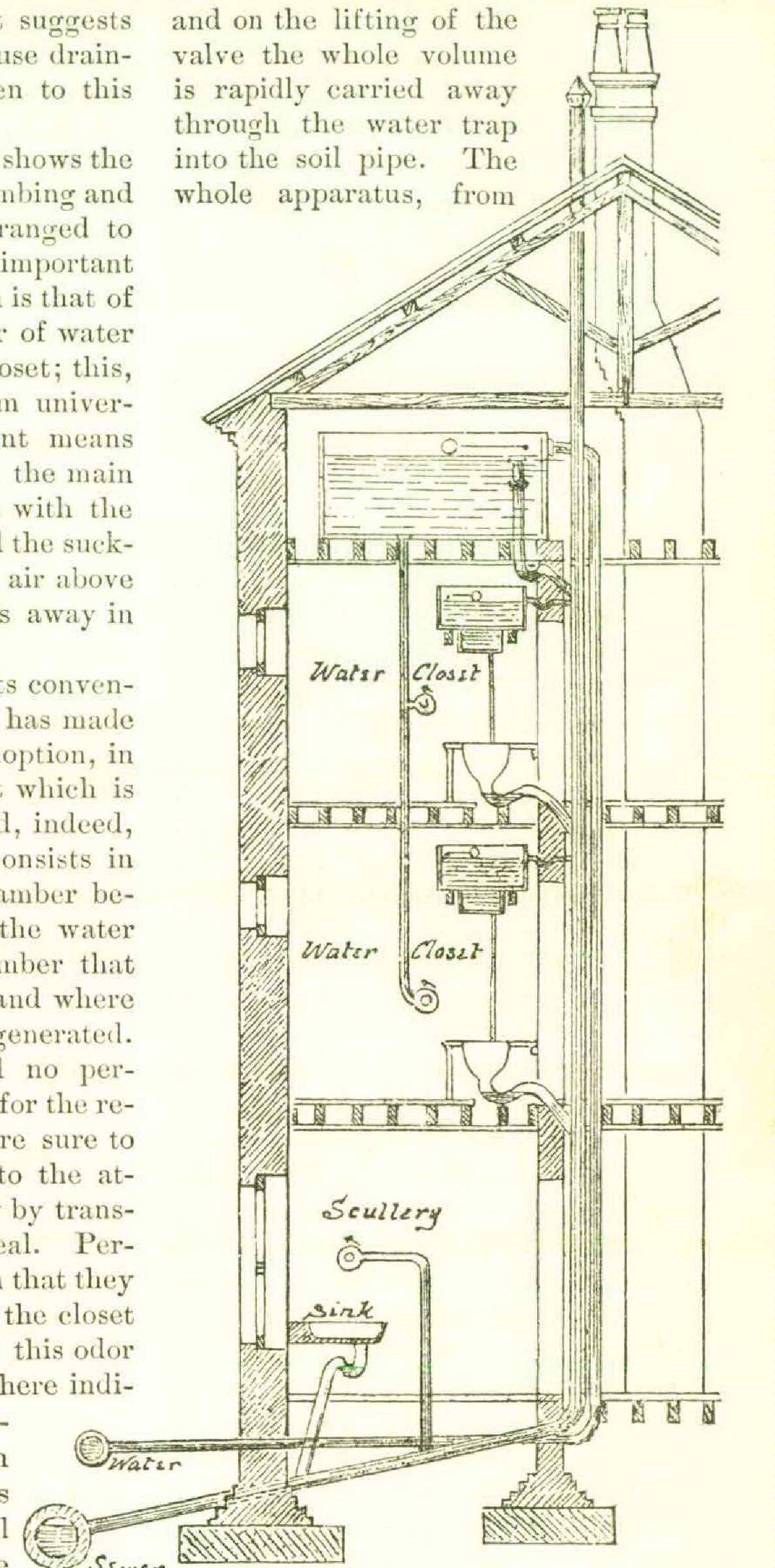
The accompanying diagram shows the simplest form in which the plumbing and draining of a house can be arranged to render it absolutely safe. An important feature of the plan here shown is that of providing a separate reservoir of water for the supply of each water-closet; this, though not unusual, is far from universal, and it is the only efficient means for preventing the tainting of the main water-supply pipe of the house with the gases formed in the basins, and the sucking into the main of the foul air above the trap when the water falls away in the pipes.
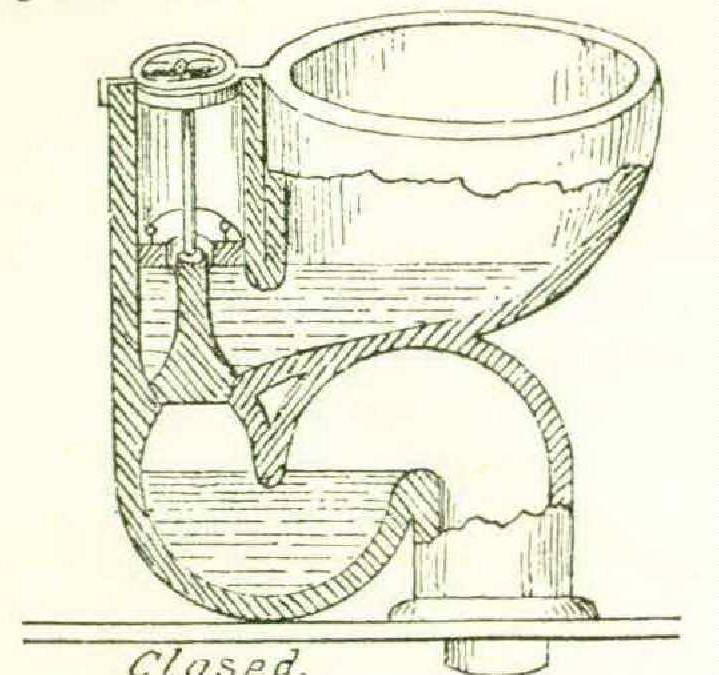
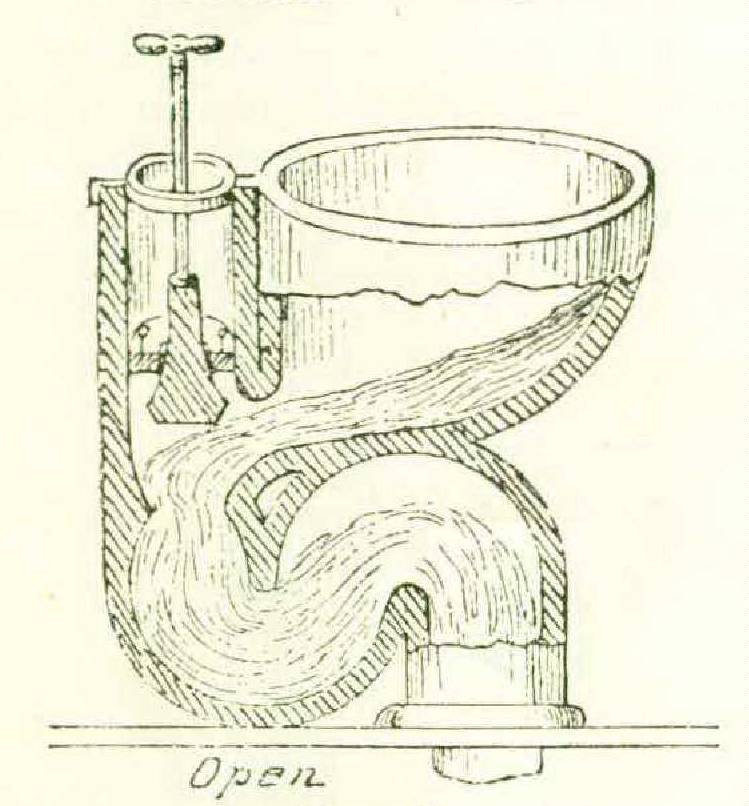
The water-closet, owing to its convenience and seeming cleanliness, has made its way to almost universal adoption, in spite of a very serious defect which is still generally disregarded, and, indeed, unrecognized. This defect consists in the use of an unventilated chamber between the scaling-pan and the water trap of the soil pipe, — a chamber that is always more or less foul, and where fæcal gases are constantly generated. No means are provided, and no perfect means could be provided, for the removal of these gases, which are sure to find their way more or less into the atmosphere of the house, if only by transmission through the water seal. Persons living in the country claim that they can always detect the odor of the closet on entering a city house, and this odor is very often due to the cause here indicated. It is only very recently that an invention has been made which entirely overcomes this defect; although several other forms of closet using large volumes of water and not depending upon a sealing-pan seem to escape it. The Jennings closet, shown herewith, has the peculiarity that it, contains directly under the seat the whole charge of water to be used for the flushing at each operation of the closet.
Fæcal matters are immediately immersed and so at once somewhat disinfected, and on the lifting of the valve the whole volume is rapidly carried away through the water trap into the soil pipe. The whole apparatus, from
the seat to the soil pipe, is a single piece of earthenware, and the valve is held so firmly in its place by its own weight and by that of the water bearing upon it, that if proper vent is given to the soil pipe itself, so that the pressure of sewer air cannot be brought to bear upon it, there is no probability of the least escape into the room.
Referring to the diagram which shows the general arrangement of plumbing, etc., it is to be said that from a sanitary point of view the most important feature there shown is a complete ventilation of the drain leading to the sewer, so that by no possibility can there be a forcing back into the house of gases formed in the sewer or in the main drain. As already stated, a small water trap, no matter how deep, does not suffice to secure this. A water trap having a bend of even two feet would resist a pressure of only about one pound to the square inch, while the sudden filling of the sewer, by rising tide or falling rain, to such an extent as to reduce its air space one half, would bring to bear a pressure of fifteen pounds to the square inch; and whether the filling be sudden or gradual, the degree to which the increased pressure would affect any given outlet would depend on the facilities offered elsewhere for the air to find vent. In our ordinary town sewage works, it is never safe for the householder to depend on other vents than his own connecting drain being available; he must in self-defense assume that his own drain is the only channel of escape, and make it impossible that air escaping there should find its way into the house.
Where severe frosts are not to be guarded against, this may be accomplished by discharging the water of the house into a receptacle that is open at its surface, and from which a drain passes to the sewer with some form of trap; into this surface opening, for greater cleanliness, a rain-water pipe from the roof should discharge. Under this arrangement, if sewer gas is forced from the drain it will escape into the outer air. The chief objection to the plan lies in the fact that such escape would too often take place where it would be offensive, and sometimes too near an important window. A much better plan is to have the drainage discharged into some form of covered grease trap, similar to the one shown in Figure 1, and to carry a ventilator not less than four inches in diameter, and by the straightest available course, from the grease trap to a point well above the highest dormer windows. If in addition to this there is an opening for fresh air in the cover of the grease trap, so that there shall ordinarily be an upward current through the ventilating pipe, the arrangement will be quite complete.
Some of the minor devices of modern plumbing seem as objectionable as they are convenient: for example, the ordinary fixed wash-basin having a plug at its bottom effects a complete separation between the water in the basin and the foul, soap-slimed escape pipe below it; but the more convenient shut-off cock placed some distance below the basin is a most ingenious arrangement for tainting the water in the basin, which is in free communication with the water in the unclean escape pipe. How readily impurities are diffused through still water is shown by the rapid clouding of the contents of a tumbler to which a used tooth-brush has been returned; the invisible solution from an unclean waste pipe spreads with equal ease.
It is now quite usual, also, to ventilate the lower chamber of the ordinary watercloset, and this is to a certain extent effective for the purpose intended; but it does not accomplish a proper ventilation of the soil pipe, and it alone should by no means be depended on. Indeed, this lower chamber is always objectionable, sending forth such a whiff of fetid air, whenever the water pan is emptied, as could come only from a confined, dark, and wet vessel where the most offensive matters are undergoing decomposition. The cheap and simple siphon-closet, with a copious flow of water, or, better, the Jennings closet previously described, are types of the only satisfactory forms. It would be beyond the scope of this article to describe and illustrate the minor points of complete house drainage, but it is believed that enough has been said to set forth the general principles which should govern the construction and arrangement of each of these. So far, therefore, as the town house is concerned, nothing further need here be said.
In the country and in villages, where each house has to be provided not only with the ordinary interior arrangements, but also with means for the disposal of its drainage after this has passed beyond its own walls, a serious further difficulty arises. The usual practice, where plumbing is introduced, and very often where only the water of the kitchen drain is to be provided for, is to discharge the whole mass into a cess-pool not very far away, and often very near to the well, trusting to the permeability of the earth to afford an outlet through the uncemented wall. The objections to this have been sufficiently stated, and the remedy is not in all cases an easy one.
There is no royal road of escape from the responsibility that the production of effete matters entails upon us. If they can be run by a cemented drain into a water - course, or elsewhere, far enough away from human habitations to be unobjectionable, this course may be allowed; but in the great majority of instances it is absolutely necessary to provide for their defecation in some inoffensive manner or for their inoffensive removal by carts to the country. The one thing that should never be allowed in a village, and which should even be regarded with great caution in the case of an isolated house, is the ordinary leaching cess-pool.
English engineers who have paid much attention to this subject seem to have settled on the intermittent action of the soil, with the accessory, in the warmer and more dangerous seasons, of the action of the roots of plants, as the best means for defecating sewage. The methods of applying this system will be better understood by a description of specific
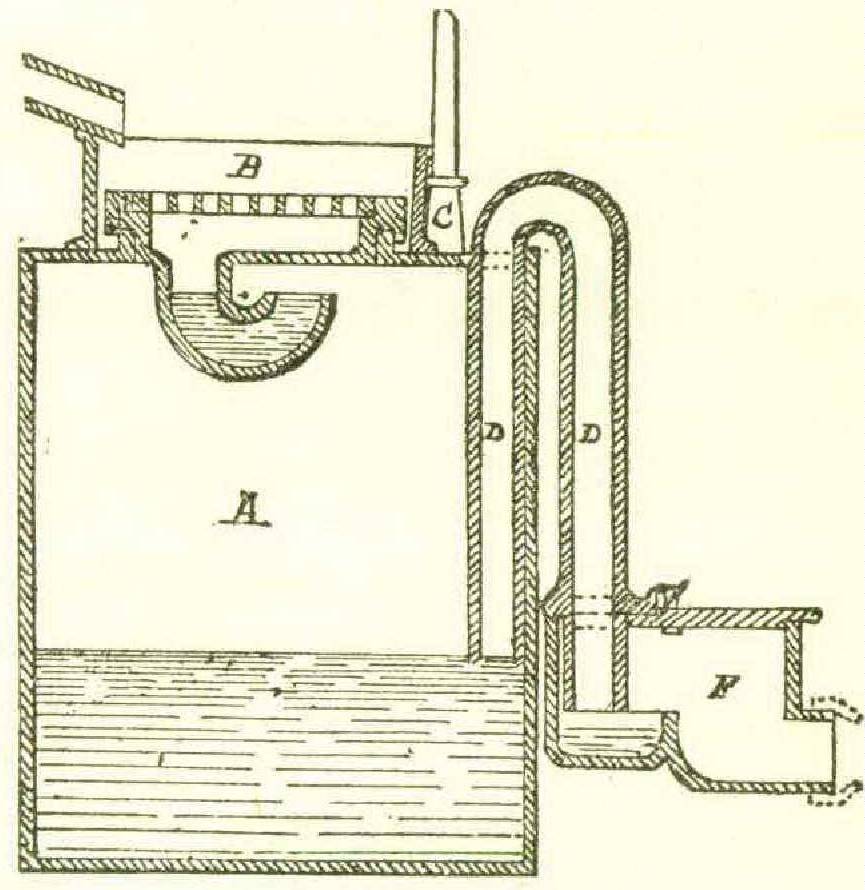
processes. The accompanying illustration, Figure 4, shows the construction of Field’s patent self-acting flush-tank, which is intended to be placed immediately outside of the walls of the house and to receive all of its liquid wastes. It is made entirely of earthenware or cast iron. The liquids pass through the grating of the pan B, and are discharged through a trap that prevents the contained air of the vessel from escaping at the surface. C is a ventilating pipe to carry this contained air to the top of the house. A is a vessel holding a certain amount of water which has no escape save through the siphon D. When the chamber is entirely filled, the pouring in of a few extra quarts of water, which is sure to occur sometime during the day, brings the siphon into action, and it flows copiously until the chamber is empty to the depth below which solid matters are permitted to accumulate, to be occasionally cleared out on raising the pan B.
The purpose of this apparatus is to prevent the constant trickling away of the small stream usually flowing from the house with too little movement to carry forward obstructing matters, such as are sure sooner or later to clog any ordinary house drain. It also furnishes a sufficiently strong flow to secure a wide distribution of the liquid instead of allowing it to soak slowly into a small area of soil. From its intermittent action, also, it fills the ground for a short time, and then as the liquid subsides fresh atmospheric air enters the soil and assists, by its oxidizing action, in the work of purification. Whether the irrigation be on the surface or by means of underground pipes, this copious intermittent discharge is in every way preferable to the steady small flow.
This flush-tank would be a great improvement on the system which I have had in successful operation at my own place during the past five years, and which has been more satisfactory than any other plan that I have seen applied.
The house drainage is discharged into a tightly cemented tank four feet deep and four feet in diameter, entering near its top, which is arched over and closed by a tightly fitting stone cap, and thoroughly ventilated. This tank is similar to that shown in Figure 1. Its outlet pipe, starting from a point one foot below the surface of the water and about two feet below the capstone, passes out near the surface of the ground and is continued by a cemented vitrified pipe to a point about twenty-five feet farther away. Here it connects with a system of openjointed drain tiles, consisting of one main fifty feet long, and eight lateral drains six feet apart and each about twenty feet long. These drains underlie a part of the lawn and are only about ten inches below the surface. During the whole growing season their course is very distinctly marked by the rank growth of grass over and near to them, the difference of growth in their immediate vicinity being so great that were the work to be done over again I should place the lines but three feet apart. The slope of the ground is very slight, probably not more than fifteen inches between the extreme ends of the systems, yet, judging by the growth, the distribution is very uniform through all the pipes, — main and laterals.
I supposed, when I first adopted Mr. Moule’s suggestion to make this disposition of the house sewage, that some other arrangement would be necessary for the winter season, but even during the winter of 1874-75, — the coldest for many a long year, —the liquid has been perfectly disposed of, and has apparently found its outlets equally in all parts of the drainage.
Successful though this experiment has been, I am now arranging to adopt a small Field’s flush-tank, in the belief that the system will be improved by having the discharge made intermittent, so that the flow of water being more copious will saturate the ground for a greater distance, and that, with considerable intervals during which there is no flow, there will he a complete aeration of the ground.
Field’s apparatus is intended only for the use of private establishments. For mills, hotels, and even villages, a modified and much larger apparatus (being the adaptation of the well-known engineer, Mr. J. Bailey Denton) is capitally suited to the intermittent surface irrigation of large fields, enabling the agricultural use and purification of considerable quantities of sewage which are yet too small in their regular flow to be properly applied without such device.
The importance of a close attention to these details of household drainage cannot be overestimated. In a paper on The Health of the Farmers of Massachusetts, Dr. Adams, of Pittsfield, says, “ There is no dwelling in the State, of any class, which possesses an absolute immunity from these causes ” (the vicinity of putrescent animal and vegetable matter); “for they are often so hidden and subtile as to elude the search not only of tlie landlord, but also of the most vigilant health officer.”
The securing of pure drinking-water for the household can hardly claim full attention here, except so far as drinkingwater wells are concerned; although the extent to which water coming from public works is contaminated by an injudicious arrangement of supply pipes and soil pipes is often alarming, as was suggested in the preceding article.
Quite generally, country houses and houses in villages and towns depend entirely upon drinking-water wells for their supply, and the degree to which these wells are rendered dangerous by what is called “ surface water ” — that is, rainwater passing over or through a surface soil made foul by house slops, kitchen refuse, etc. — is more than alarming. The purity of the water in any well depends almost entirely on the ability of the earth through which it descends to deprive it, by filtration, of its organic impurities. It is always a question between the amount and character of the filtering material, and the amount and character of (the impurity. In a deep, porous soil, where the water-table lies at a great depth, and where the rainwater descends vertically to the line of saturation below, there is little danger, unless the grossest fouling of the surface in the immediate vicinity is constant and long-continued; but where the water level is near the surface of the ground, where the soil has an impervious stratum a few feet below the surface, or where the well is supplied through rock fissures or gravel seams which open near to the surface of the earth, the most scrupulous cleanliness is needed to prevent contamination.
Fresh earth is a capital purifying filter, and the rapidity with which its filtering power is renewed depends upon the freedom with which air circulates within it, the purification being in nearly all cases a process of oxidation. In a deep and porous soil, as the water of a rain-storm settles away, it is immediately followed by the entrance of air from the surface, and the oxidation may be complete; but in clay and in other impervious soils, the entrance of air being much more slow and difficult, the impurities accumulate and the foulness increases and too often becomes permanent. In soil of this character the curbing of the well should be laid in cement for some distance below the surface, and wet clay should be closely puddled round the curbing, to prevent the trickling down of water beween this and the solid earth. The greater the distance between the surface of the ground and the point at which water first oozes from the earth into the well, the greater the safety.
The above refers only to the fouling of wells by the leaching down of impurities thrown upon or accumulating in the surface soil. A much more frequent and much more serious source of mischief is their contamination by foul water leaking from badly made house drains or flowing laterally from cess-pools or vaults, — our own or our near or distant neighbors’, — or the trickling down through gravel seams in heavy soils or porous fissures in rock of the surface liquid of adjacent or remote barn-yards. When porous strata in rock or earth bring the site of the cess-pool into communication with the site of the well, the danger is immediate and constant until the cess-pool is made absolutely tight. The more insidious process is that of the gradual fouling of the semi-porous earth lying between the source of the impurity and the drinking-water well. In such cases the exudation is usually quite or nearly constant; there is no opportunity for the air to restore the filtering power of the soil, and it becomes saturated with impurity inch by inch, until, perhaps after a month or perhaps after several years, the saturation reaches the well; then every drop oozing in from this source carries with it its atom of filth. While the supply of water in the ground is copious, and while there is more or less circulation through the water veins, the foulness may be too much diluted to do harm; but in dry seasons, when the supply recedes to a depth of only a few feet at the bottom of the well, the contribution of drain water continuing the same, the dose becomes sufficient to produce its poisonous effect.
The dangerous character of the water of such wells is often manifested by no odor or taste of organic matter; the chemical changes in this matter seem to have been carried so far as to yield little more than vivifying nitrates to the water, their organic character having entirely disappeared. Indeed, some of the most dangerous well-waters are especially sparkling and refreshing to the taste. But the chemical processes which have effected this change appear to have had no effect on the germs of disease, — if germs they be, —which retain their injurious character to such a degree that the worst results have often come of the use of water that was especially sparkling and pleasant as a beverage.
The bad effects of organic decomposition are nowhere more manifest than when it takes place in an unventilated cellar.
That large part of the American people who were born and bred in the country will appreciate the following quotation from Judge French, describing childhood’s experiences with New England cellars: “ You creep part way down the cellar - stairs, with only the light of a single tallow candle, and behold by its dim glimmer an expanse of dark water boundless as the sea. On its surface, in dire confusion, float barrels and boxes, butter firkins, washtubs, boards, planks, hoops and staves, without number, interspersed with apples, turnips, and cabbages, while halfdrowned rats and mice, scrambling up the stairway for dear life, drive you affrighted back to the kitchen.” This will seem to many like exaggeration, but probably throughout all America one halt of the population which lives over cellars at all, lives over cellars which, at some time during the year, approach the condition described.
All this nastiness and wet and confined moldiness and stagnation must inevitably foul the air of the whole house, rendering it impure to a degree that makes us wonder how human beings, if they can live at all, can live in even tolerable health in such abodes.
A medical correspondent of the Massachusetts Board of Health gives an account of the cellar of a house in Hadley, built by a clergyman, which had an uncovered well within it, and into which a sink drain with its deposit-box had full opportunity to discharge its gases, there being no proper ventilation to the drain or box. The cellar was also used for the storage of vegetables, and its windows were never taken out. There was no escape for the damp and foul air of the cellar save through the crevices of the floors into the rooms above.
“ After a few months’ residence in the house, the minister’s wife died, of fever, so far as I can learn. He soon married again, and within one year of the death of the first wife the second died, from, as I understand, the same disease. His children were also sick. He lived in the house about two years. The next occupant was a man named B——. His wife was desperately sick. A physician then took the house. He married, and his wife died of the fever. Another physician was the next occupant, and he, within a few months, came near dying of erysipelas. All this time matters had remained as before described with reference to ventilation.” After this a school-teacher took the house, and made some unimportant changes. “ The sickness and the fatality of the property became so marked that the property became unsalable. When last sold every sort of prediction was made as to the risk of occupancy, but by a thorough attention to sanitary conditions no such risks have been encountered.”
It is hardly necessary to recur to extreme instances of cellar foulness, such as those above described, to convince any person of ordinary intelligence that in a confined and dimly-lighted atmosphere, like that of an ordinary cellar, all decomposition of organic matter must result in the production of gases unfit for human breathing.
We especially need a condition of air that can be maintained only under the influence of light and free ventilation. The great difficulty with our cellars is that as they have a more or less complete communication with the house through open doors, imperfectly laid floors, etc., and as the law of the transfusion of gases is constantly operating even though the means of communication may be imperfect, their unceasing tendency day and night is to communicate their impurities to the air of the house. Where floors are deafened and where, the ceiling of the cellar is lathand-plastered, the danger is much less than where there is only a single thickness of boards with imperfect joints to check the communication; but no matter how perfect the separation may be, everything like the decomposition of vegetable or animal matter should be studiously avoided, and there should bo at all times a free (though slight) circulation of air in the cellar.
To live in a house standing amid offensive and dangerous surroundings is under no circumstances either necessary or excusable. It has been well said that no man is so poor that he need have his pig-trongli at his front-door, or that he need throw his slops under his diningroom window. No place is so small that it need contain a fermenting manure heap within dangerous proximity to the house; either the fermentation must be arrested or the accumulation must be entirely avoided. No yard is so flat that the slops of the house may not be drained away to a sufficient distance for safety. In short, there are in this world no circumstances unfit for wholesome living which may not be either overcome or run away from.
To live wrongly is a danger and a disgrace to the individual. To permit such wrong living is more than a danger and a disgrace to the community; it is a criminal menace to its own health and life. No special rules and regulations need be given here for the avoidance of palpable sources of danger; all that is necessary is studiously to avoid the retention of accumulations of organic filth of whatever description.
In the living of every family there is a certain necessary production of waste organic matter. In the economy of nature all such waste is destined to return to its elementary condition and to become a part of the air or soil or sea, awaiting its renewed use in feeding plant life. Man has learned how to avail himself of nature’s organic products to supply his demand for food and clothing. He seems not yet to have learned how to hand back to the realm of nature the refuse that is not useful to him, in such a way as to avoid the injury with which its neglect threatens him. Were each man dependent only on the conditions in and about his own house, it would be safer than it now is to leave the needed reformation to individual action; but unfortunately all in the community are dependent for life and health more completely than they realize on the condition and surroundings of their poorest and most ignorant neighbor.
The public has long asserted and exercised its right to abate nuisances, but its definition of the term “nuisance” begins at a point far removed from the stricter sanitary limit. Our communities seem not yet to realize that they have a clear right to the health and strength of their individual members, and especially to insist that no man shall, by incurring the risk of disease in his own family, endanger others to whom his disease may be communicated. The stamping-out process must extend to the very bottom of society, and if we apply ourselves to the stamping out of causes, the effect (infectious disease) will nut demand our attention.
If slops thrown out at the kitchen door of the poorest house in the town threaten the health of those living in that house, all who may eventually suffer from the sickness beginning in that family have as clear a right to prevent the cause as they would have to put the family in quarantine were they suffering from small-pox.
The art of purveying has been brought very near to perfection, and it may well be left to the commercial instincts of those whose business it is; but the hardly less important art of scavenging has received from the outset nothing but the sheerest neglect. It is as yet hardly in its infancy; if we can hide our filth away underground, shove it down the gutter to our neighbors’ premises, or secrete it in one of those fermenting retorts, a public sewer (as usually constructed), we think we have done all that our own safety requires of us, and the safety of others we have not yet learned to regard. But our own safety is by no means secured; we are always in danger from our neglected wastes, and in proportion as we and others use the common sewer do they endanger us and we them.
That precursor of the sewer, the receptacle in our own yards, is certainly less dangerous than its modern substitute, but it is usually very far from being a safe neighbor to even an isolated house. As houses accumulate, the risk from it increases.
I was recently conversing with an intelligent builder about the construction of a contemplated cess-pool.
“ It is useless to suppose that in such heavy ground a filtering cess-pool can very long answer a good purpose.”
“I don’t know how that is, but my own cess-pool in similar ground has been in constant use for eight years without being cleaned out, and it works all right yet.”
“ How do you know that it is not leaching into your well? ”
“ Because I put my well a good distance away from it, on the up-hill side.”
“ How about your neighbor’s wells, down the hill below you? ”
“ Oh, I don’t know anything about them; that’s their lookout.”
The fact is that the whole hill-side near the top of which this man lives is supplied with alternate cess-pools and wells, and there is every reason to suppose that the porous strata through which the cess-pools are emptied are the very strata from which the wells are filled.
It is not to be understood that the ordinary outhouse vault is necessarily a source of danger; there is enough to he said against this arrangement on the score of convenience and of decency to serve as an argument for its abolition; but if it be cemented perfectly tight, and if its contents be daily disinfected with carbolic acid, sulphate of iron, or other suitable chemical addition, there is no fear of either the poisoning or the dangerous fouling of the air.
So, too, if it be used only for its legitimate purposes, if no liquid matter of any sort be poured into it, and if it have a copious daily sprinkling of ashes or dry earth, it will be equally free from sanitary objection.
But if these precautions are not adopted and carried into effect under a rigid supervision, there is certainly no single appurtenance of the life of an ordinary household so fraught with danger and annoyance to all who live within reach of its influence.
In all towns and villages where this expedient is allowed to remain in use, the strongest and most persistent effort of the board of health, reinforced with full power for the infliction of penalties, should be devoted to the regular, frequent, and efficient supervision and inspection of every out-of-door closet of whatever description. The removal of contents should never be left to the uncontrolled action of the proprietor, but should be carried on by well-directed workmen in the employment of the board, or at least under its direct inspection.
However perfect the ventilation of sewers or cess-pools, the safety of individual families and of all to whom they may communicate disease demands a careful attention to the ventilation of the house drain. It is chiefly through this drain that cess-pool and sewer gas finds its way into the house, and the house drain itself will be relatively more foul than will the public sewer which takes the wash of streets. Dust and foul matters of various sorts are very apt to accumulate with the congealed grease that so frequently coats the sides of the drain. Therefore, so far as the house itself is concerned, its greatest source of danger lies in the return to its rooms of the emanations from its own offscourings, entering through the water traps or through leaks in the pipes, whether such return be caused by their own expansive force or by the pressure of the sewer air behind them.
It is by no means enough to establish even the most perfect water trap in the line of a house drain. It is of at least equal importance that there should be a free vent for the escape of all air from the sewer and all gases generated within the house drain or in the soil pipe, not into the attic of the house nor at its eaves, near sleeping-room windows, but well up through and above the highest point of the roof.
House-drain ventilators are often introduced into chimneys, but they are nearly as often removed after a short trial. So long as there is a constant upward draft in the chimney, this disposition of the gases is good enough, but when no fires are used the chimney frequently becomes a down - cast shaft, or when gusts of wind drive the smoke or the soot-smelling air into rooms, the ventilator gas is sure to accompany it.
House drains are even more liable to changes of temperature, and therefore more subject to a varying pressure of the air within them, than are sewers themselves.
Ventilating pipes should be made of some permanent material. Earthenware is the best, but lead and cast-iron are good and reasonably durable. Zinc — and consequently the zinc coating of galvanized iron—is very subject to decay under the action of the corrosive gases issuing from soil pipes.
What is known under the general term “sewer gas” is the emanation from waste matters undergoing decomposition in the absence of free air and light, and in the presence of water, whether in a sewer, a house drain, a cess-pool, a vault, or a foul, wet, and unventilated cellar. It frequently exists in the case of a detached country house, and is never absent from a town sewer, though it is possible in the ease of these, by perfect ventilation, greatly to lessen its production, and so to dilute it as to prevent its doing serious harm.
Poisonous sewer gas cannot be clearly defined. It is known chiefly by its effect ; even its odor is rarely a marked one, and danger is believed to lurk not so much in those foul stenches which appeal to our senses, as in the odorless, mawkish exhalations which announce themselves first by headache and debility. This gas, in its most dangerous form, is believed to be some product of organic matter undergoing decomposition in the presence of superabundant water, and in the absence of light and free ventilation.
It may be present without detection ; and, in addition to its frequent passing of the usual water traps, it is largely drawn into our living - rooms by the draught of heated chimneys when their demand for air is not abundantly supplied through other and easier channels of ingress.
Furthermore, soil pipes, as frequently constructed, crack or open their joints, by the frequent expansion and contraction that alternate floods of hot and cold water occasion, and thus give vent to their gases.
It is well known that leaden waste pipes decay and frequently become so perforated as to allow the escape of gas into the house. This decay always takes place from the inside, and generally at the upper sides of a pipe running in a horizontal or oblique direction; that is, in the horizontal pipe leading from a closet to the descending soil pipe more often than in the descending soil pipe itself. If there is a bend in the pipe the perforation occurs in its upper part. It usually occurs first in the highest pipes in the house. The perforation is very much the most rapid in the entire absence of ventilation. If the ventilation is by means of free and clear openings above and below, the corrosion amounts to very little.
The fact that the point of attack lies in that part of the pipe which is not covered with water, and more especially in the higher portions, —to which heated sewer gas at once rises, and where it accumulates, — indicates clearly that the corrosive action is due to the resultant gases of fæcal decomposition and not to the liquid contents of the pipe. As the corrosion begins on the inside of the pipe, and at a point where perforation would not ordinarily cause leakage, it is very likely to be overlooked, even when sought for by a plumber applying the usual tests for leakage.
The diseases resulting to the inmates of the house from this condition of the pipes, and from other means for the admission of sewer gas, are those usually caused by excrementitious poisoning: namely, typhoid fever, diphtheria, diarrhœa, cerebro-spinal meningitis, scarlet fever, etc.; and it is always safe to advise any one in whose house such diseases appear, to uncover his soil pipes and have them thoroughly examined. Dr. Fergus says, “ For some years back I have insisted on the careful examination of the soil pipes wherever I have had cases of diphtheria or typhoid, and in every case where I could get this carefully carried out I have detected sewer gas getting into the house through perforated pipes or in some other way.”
One of the other ways he believes to be by the transfusion of the gas through the water of the trap, which he seems clearly to have detected. In experiments with glass pipes having bends or water traps it was found that the light gases passed through by the top of the bend, and the heavy gases by the bottom. “The action of the gas was curious. It was found, first, to saturate the surface of the water next to it in the trap; then to sink down in a fine stream, and then gradually travel through to tlie other or house side of the trap, when it again spread out and began to diffuse itself both into the atmosphere above it and downward through the water also.”
Dr. Carpenter, of Croydon, England, says: “ The demands of air for fires and for respiration must be supplied from some source, and as the easiest means of access is often the communication between the house and the sewer, the poisonous gases which are lightest, and therefore in the highest parts of the drains nearest at hand, are first drawn in.”
He gives the following means by which its admission is obtained : through the water-closet trap when the soil pipe itself is unventilated; through defective joints or fissures in the soil pipe, resulting from bad workmanship, accident, or decay; through the waste pipes of house - maids’ sinks, butlers’ sinks, kitchen sinks, and untrapped bath outlets; through the overflow pipe from wash-basins, etc. He especially emphasizes the emptying of the traps by siphon-like suction, or, where the trap is not constantly used, by the evaporation of the sealing water. He thinks that not one trap in ten thousand is properly protected, and that without protection they are worse than useless.
The healthful arrangement of the water supply and drainage of the house in its minutest details should be a chief care of the architect, whereas, in practice, it is almost invariably left to a plumber, doing the work too often by contract, and having no conception of what is needed, — only of what has hitherto been done.
Evils resulting from the admission of sewer gas into living-rooms are popularly called “accidents,” but they are accidents which may always be foreknown and the prevention of which is perfectly understood; they are no longer accidents, but gross faults of commission.
Until lately, in applying the water system, it has been considered sufficient to interpose what is called a water trap
— usually an inverted siphon, in which water is supposed to be always standing
— between the house and the waste pipe leading to the sewer. These traps, as commonly constructed, are in every way defective: even a light wind blowing into the mouth of the sewer often increases tlie pressure sufficiently to send the sewer gas bubbling through them into the house; a great rush of water into the sewer during heavy rains, by lessening the air-space, often similarly forces the traps. The same effect is produced in a marked degree by the rise of the tides into the mouths of outlet sewers in sea-side towns, the air being compressed into a smaller space and forced to find a vent. Even did these difficulties not exist, the fact that water transmits aeriform matter would always remain as an objection; sewer gas is absorbed by the water of the end of the trap which is toward the sewer, and is given off to contaminate the air at the end which lias a communication with the interior of the house.
The ordinary soil pipe has a trap at its lower part, and, if unventilated, its air stagnates often for hours together. When the pipe is used, every gallon of water poured down causes a displacement of some of the contained gas, which will seek its easiest means of escape, probably into the house. When a current is set up in the siphon-shaped trap below, its contents necessarily vibrate back and forth for a certain time, giving an impulsion to the confined air above that will tend to force it through fissures or feeble traps.
Instances of fatal disease arising from imperfect plumbing have been and still are numberless, many of them as glaring as the following, described by Hakerman, who says that in the prisons at Brest the apartments which were supplied with water-closets were filled with sewer gas when the southwest wind drove the air through the sewers and forced the traps. In these apartments the cholera raged with great intensity, while those parts of the prison not supplied with closets remained free from it.
Dr. Furgus asserts that diarrhœa, cholera, diphtheria, and dysentery have increased fourfold since the introduction of the water-closet system with its numerous inlets for sewer gas into houses and water-supply cisterns.
In 1872 the Medical Officer for Edinburgh reported that wherever waterclosets were introduced, “in the course of one year there were double the number of deaths from typhoid and scarlet fever, and any epidemic fever occurring in these houses assumed a character of malignant mortality.” In our own cities it is known that the fatal prevalence of typhoid, and it is believed that frequent epidemics of diphtheria and cerebro-spinal meningitis, are due to faulty drainage alone.
In doing away with cess-pools and substituting sewers, unless proper precautions are taken, we simply make an elongated cess-pool, rarely sufficiently cleansed, and often grossly foul, and communicating with the interior of every dwelling-house. If typhoid excreta are thrown into a sewer a mile away from us, we have no security against the danger that its poisonous organisms will float in the gas of the sewer and enter our own living-rooms. Grave as this difficulty is, it may be almost entirely removed by a proper arrangement of the drainage works of the house itself.
How slight a change in temperature in a sewer or cess-pool suffices to force a water trap may be seen by experimenting with the simple apparatus illustrated herewith.
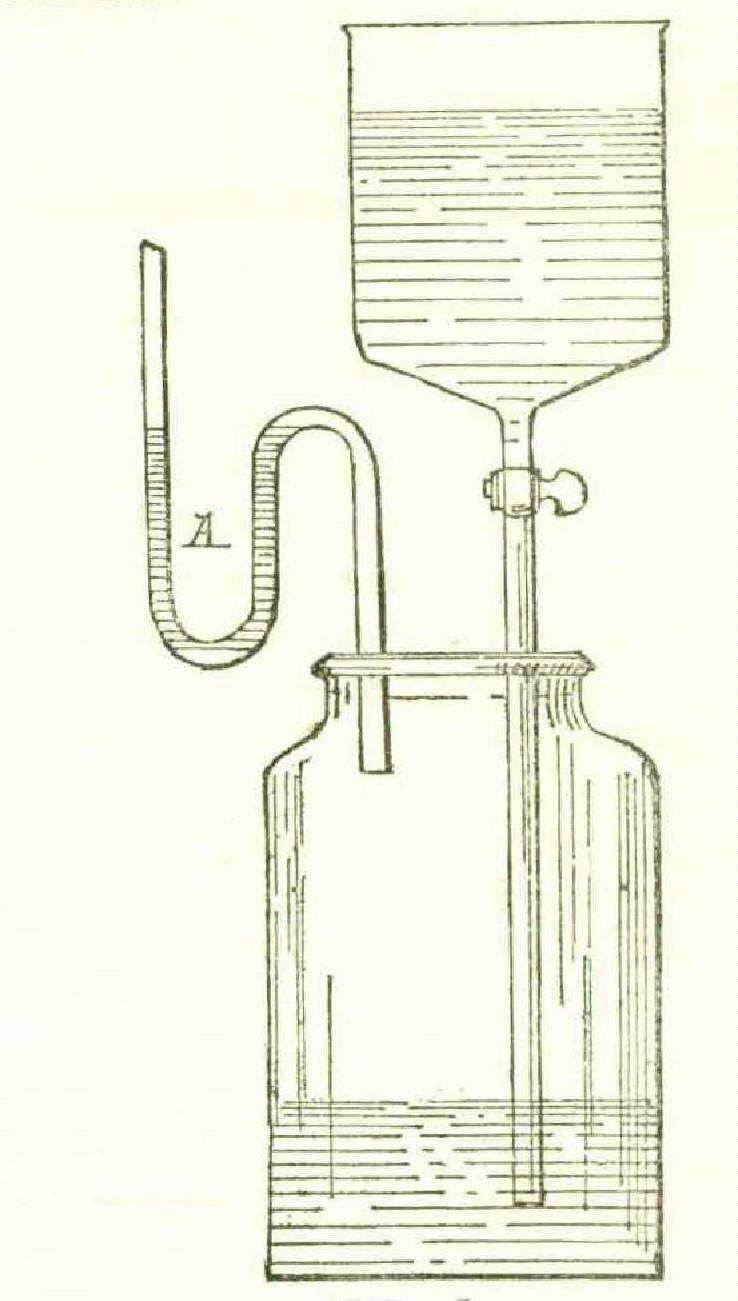
The bend in the pipe A, filled with water, represents the common trap of house plumbing; the flask is filled with air. If the hand be simply placed upon the flask, the bodily heat will expand the air sufficiently to throw the water quite out of the pipe, although its upper arm may be several inches long. In like manner, on opening the cock in the pipe leading from the vessel above, containing water, the contents of this vessel will flow into the jar and bring to bear upon its contained air such a pressure as will force the water out of the bent tube. This represents precisely the condition of things when the quantity of water in the sewer is materially increased by sudden rains or by the rise of the tide into the outlet.
Another cause of changing pressure upon the air of the sewer is the frequent ebb and flow of the volume of sewage, now only a thread of water along the floor, and now an amount sufficient to fill it to half its height.
The ventilation of soil pipes is not only needful to carry away sewer gas which would otherwise be forced through the traps or transmitted by their water, but also to prevent the formation of a vacuum when large volumes of water are poured down them. The vacuum thus formed is quite sure to suck open one or more of the water traps, •— which, until it is filled at its next use, will remain free for the passage of the gas from the pipe into the house.
A soil pipe in untrapped communication with a sewer has been described by Dr. Carpenter as an elongated bell-glass, affording a certain depot for the lighter products of decomposition and putrefaction; if the soil pipe has a free ventilation by a direct channel to the outer air above, these gases will escape harmlessly, but unless such outlet is provided, they will themselves seek out (or create) defective spots through which to find their way to the interior of the house.
Unused water-closets are especially dangerous, as the water in the trap, which was their only feeble barrier to the communication between the inside of the sewer and the inside of the house, is soon removed by evaporation; and as ordinarily arranged, the overflow pipes of little used bath-tubs and stationary wash-basins have their traps empty and open during a large part of the time.
In the very complete sewerage work of Croydon, Dr. Carpenter early insisted upon the compulsory ventilation of soil pipes, but his opinion and advice had to be reinforced by a long list of deaths traceable to the lack of ventilation before the authorities adopted the rule. The work was systematically carried out by Mr. Latham, who was then a director of the Croydon board, and who has since become a leading authority in matters of sanitary engineering. Although he had himself given full credence to Dr. Carpenter’s belief, he was astonished at the result. “ Typhoid was sprinkled here and there before him; but as the work progressed it entirely disappeared from behind him and has not returned.”
It is especially important that soilpipe ventilators should be as nearly straight and vertical as possible ; a crooked ventilator pipe will not “ draw ” any more than will a badly built chimney flue, nor even so well, as it lacks the heat of a fire to set up a current.
Incidentally to the seclusion of sewer air from our houses, we have to consider the subject of general ventilation, — a subject that has been more bemuddled and befogged by quasi scientific treatment than any other connected with domestic life, unless it be the much vexed and generally misunderstood subject of sewerage itself.
The best practical statement I have met about ventilation was contained in the remark of a mining engineer in Pennsylvania: “ Air is like a rope; you can pull it better than you can push it.” All mechanical appliances for pushing air into a room or a house are disappointing. What we need to do is to pull out the vitiated air already in the room; the fresh supply will take care of itself if means for its admission are provided.
It has been usual to withdraw the air through openings near the ceiling, that is, to carry off the warmer and therefore lighter portions, leaving the colder strata at the bottom of the room, with their gradual accumulation of cooled carbonic acid undisturbed. Much the better plan would be to draw this lower air out from a point near the floor, allowing the upper and warmer portions to descend and take its place.
An open fire, with a large chimney throat, is the best ventilator for any room; the one half or two thirds of the heat carried up the chimney is the price paid for immunity from disease; and large though this seems from its daily draft on the wood-pile or the coal-bin, it is trifling when compared with doctors' bills and with the loss of strength and efficiency that, invariably result from living in unventilated apartments.
The admission of fresh air to supply the place of that which is withdrawn is an imperative necessity, and in tightly built modern houses cracks and crannies for this purpose are wanting. It is not unusual in modern houses supplied with furnaces, especially where there is no public sewerage, to find such an arrangement of closet and kitchen drains as permits the escape of some of their dangerous gases immediately into, or in the vicinity of, the cold-air box which supplies the furnace, and the flues which furnish the interior of the house with its heated air.
In a house warmed by a furnace the supply from the registers is usually suflicient to feed the chimney, and if the furnace chamber draws its air from the outer atmosphere, from an unfouled locality, and by all means not from a cellar, the only objection lies in the character of ordinary furnace heating. Concerning this it need be said here only that iron heated by hot water is better than iron heated by the direct action of fire, and that, if water-pipes be not used, wrought iron is a much safer material than cast - iron for the transmission of the heat.
In all houses which are connected with public sewers or cess-pools, especial pains should be taken to supply enough fresh air for the fires through some efficient means of communication with the outer atmosphere. Otherwise, there is danger that they will feed themselves from badly trapped communications with the drain.
Sunlight is the handmaiden of ventilation and fresh air. Indeed, ample sunlight and the avoidance of a damp soil may be taken as the very fundamental conditions of healthy living.
In the lying - in hospital in Dublin the mortality of new-born infants during twenty-five years preceding its ventilation was one in six. In the twentyfive years following the supply of pure air by better ventilation, it was one in one hundred and four.
It seems almost incredible that such striking changes should have taken place so recently, but it is to be remembered that it is only about one hundred years since oxygen was discovered, and hardly fifty years since the physiology of respiration was made known; while the fact of injury from breathing foul air is indeed a very recent discovery.
Popular attention is now being resolutely drawn to these important sanitary considerations, and we may reasonably hope that we have fairly entered on an era in which the improvement of sanitary conditions will be an important attendant of advancing civilization.
George E. Waring, Jr.