Free-Trade--Revenue Reform: A Plain Statement of What the Advocates of Free Trade Expect to Accomplish in the Reform of the Revenue System
IN a reply to the address given by David A. Wells in Cincinnati on the 27th April, Honorable E. D. Mansfield makes the following demand : “ Let the ablest men of the freetrade party prepare a brief plain tract, which shall state in plain terms what their principles are and what effect they expect them to have on American industry.”
As it does not require a very able man to meet this demand, so often made, the writer will undertake to answer it; but before so doing, he must apologize for his frequent repetition of elementary truths. Such repetition is made necessary by the form of the demand, which either assumes or implies an ignorance of the principles of free exchange somewhat difficult to conceive in view of the frequent statements made heretofore, both in this and in other countries.
I will reply separately to the two distinct demands.
First. What are our principles ?
It is admitted by every one that the different conditions of climate and soil, with which the Creator has endowed the several countries of the world, make the cost of certain products vary essentially, as they are well or ill fitted to such conditions. Hence the interdependence of nations, rather than independence, appears to have been ordained, and through commerce and the exchange of product for product abundance has become the rule and scarcity the exception. Through commerce, civilization has been promoted, and by its further development war will surely be abolished.
Furthermore, the exchange of commodities which constitutes commerce cannot be maintained, unless both parties gain by the transaction ; or, in other words, unless both parties satisfy a desire in an easier manner than would be possible for either, unless the exchange was made. The object both of production and exchange is consumption, and the end sought is the most abundant and varied consumption possible at a given time. Omitting to consider the exceptional cases of merely avaricious accumulation, the end and aim of those who labor, of those who accumulate capital, and of those who possess inherited wealth, is an ample consumption of articles of necessity, comfort, and luxury. Luxurious consumption is, on the whole, but a question of degree. The luxuries of one age become the necessities or comforts of a later time, and we only classify commodities according to the standard of the day. The most ample consumption of every article called for by men, at the cost of the least possible effort to obtain it, is the end sought by the free-trade economist. It is not our province to prescribe the use that shall be made of the things demanded, with any moral purpose in view. If spirituous liquors, tobacco, or snuff are demanded, it is the function of trade and commerce to provide an abundant supply, and the economist will promote such exchange as will give an abundance of these things in the same manner as he would provide an abundant supply of food, fuel, and clothing. In so far as he attempts to promote the moral welfare of the community, he will endeavor, as a citizen, to restrain abuses and not to prescribe uses.
The capital, or, in other words, the product of labor saved for future use, even of the richest countries, is not more than equal to two or three times the value of the annual product, and such capital is, of necessity, mainly controlled by a few. Hence, any material obstacle to immediate consumption, interposed by means of a tariff tax, for the purpose of causing a more rapid accumulation of capital, can only effect this end by concentrating such accumulation in the hands of a few persons; and as consumption treads close on the heels of production, the ultimate effect of such a policy must be to deprive the poorest class of a portion of the means of subsistence, as it is the inevitable law of all taxation upon commodities in general use, that such taxation, whether under an excise or a tariff act, is made a part of the cost by those who import or by those who produce such commodities. Hence, such taxes are borne by consumers in the exact proportion of their consumption, and the burden, hardly felt by the rich or the moderately prosperous, becomes an actual privation to those whose earnings are needed for subsistence as fast as they accrue. The effect of any legislative attempts to prescribe the use which a man may make of his time and his labor or its products can only be to make the rich richer and the poor poorer, and such is the result of the attempt to benefit the laborer by means of a protectivetariff tax.
The theory of protection is to enforce temporary scarcity and a distribution of annual product under the force of law, in such manner that a few are supported at the expense of the many.
The theory of free exchange is to promote the greatest abundance, and a distribution meddled with by statutes only so far as the protection of the ignorant from fraud makes statutes necessary.
Abundant consumption being the main object in view, how has it been secured ?
From the earliest historic dates, mainly by means of exchange: without exchange, scarcity would be the common rule. The free-trader alleges that there must be the utmost possible liberty in making exchanges ; the protectionist affirms that exchange must be restricted ; both claiming to secure the same end, namely, abundance. It would be useless to state further the reasons for an exchange of commodities. The most extreme protectionists admit that some foreign exchanges are reasonable and proper ; the free-trader claims that all ioreign exchanges are expedient and profitable. The whole question is therefore within the limits of some or all.
Hence, the question is narrowed down to this point ; it some exchanges which men choose to make are fit and profitable, why are not all exchanges equally so ? Why shall some be promoted and others prevented or made more costly ?
The answers of the protectionist to this question are various and inconsistent. We will endeavor to state them fairly, and to prove that they are not true answers. The most plausible argument for obstructing the importation of foreign commodities is that we may be independent, especially in time of war; or that we may stimulate the production by our own people of things needed in time of war. The rejoinder to this answer is : First, that the needs of war are iron, coarse clothing, and abundant food, the home supply of which is now, and has been for years, ample for all possible war demand. Second, that in modern times it has not been possible to deprive any people of a full supply of munitions of war. The South did not succumb in our late war for any want of war material. Lastly, that the best preparation for war is ability to pay taxes ; and unless the obstruction to commerce imposed for war purposes can be proved to give that result, it cannot be defended.
The next argument of the protectionist is, that it is necessary for every country to have a diversified industry, and that such diversified industry will not be established of itself, but must be forced into existence by the temporary deprivation of foreign fabrics. This is a very specious plea, but it has no foundation in fact. It is true that every nation, worthy of the name, must have a diversified industry, and it is equally true that no nation can possibly exist without it.
The entire force of the protective argument consists in substantially limiting the term “ manufactures” to the production of iron and steel in their crude or primary forms, and to the production of textile fabrics from cotton, wool, and flax. These factures (for they have no real title to be called manufactures, being to a much greater extent the product of capital in the form of machinery, than of the hand) constitute but a very small part of the industry of the country, and give employment to but a small portion of the laborers engaged in the true work of manufacturing ; the whole number of persons now employed in all the iron mines and rolling mills, steel works, cotton, wool, and flax mills combined, being less than the number of immigrants who annually land upon our shores, which latter class are at once absorbed in productive industry. Now, upon the absurd supposition that the establishment of a free-trade policy would close all the iron works and textile factories in the land, there would be no more difficulty in absorbing these laborers in other employments than there now is in finding work for the immigrants, except so far as long continuance in a somewhat monotonous class of employments might have disqualified them for those requiring greater versatility. Such closing of these works could only be brought about, in the event of a greater immediate abundance of iron, and steel, and of cotton and woollen cloth imported ; and in such an event a greater consumption would ensue, and the force now engaged in making these commodities would then be employed in using them. The great bugbear of a community, exclusively engaged in farming, with a consequent glut of farm-products, can have no existence except in the feeble imagination of a foolish doctrinaire, who has not the common sense to place himself at a city streetcorner and examine the wagons and carts with their contents as they pass. Let any one try this experiment. First, let him consider the wagon, harness, and the horse’s shoes. Let him ask himself if they are manufactured and whether they could be imported to any extent, and also whether a farming community can exist without them. If he will then not only observe but think a little, he will at once perceive that there must be more men engaged in making carts, wagons, and other vehicles, harnesses, and horseshoes, in the United States than there are in all the woollen mills combined ; and as their products are bulky and the transportation of them costly, these manufacturers must live near the farmer, and thus yield him the best home market.
If he thinks a little more, our observer will perceive that the manufacture of wagons, carts, vehicles, harnesses, and horseshoes is one which develops intelligence and skill, while the daily necessity of tending a loom or a card for eleven hours is certainly not a very stimulating employment. At the same time, he may remember that the only knowledge of a tariff which these men have is in the form of a tariff tax on the iron, steel, lumber, and leather, which are their raw materials.
Next, if that cart or wagon happens to be loaded with agricultural tools and machinery, the observer may remember that the farmer cannot exist except these manufactures are supplied to him by a force of intelligent workmen far outnumbering all the miners, iron puddlers, and workers in the rolling mills combined ; and these men, again, have no practical knowledge of the tariff, except as a tax upon their raw material.
Or perhaps the wagon contains cases of clothing, which is certainly a manufacture and gives employment to a much larger force of working people than all the cotton mills of the country can find places for ; and these working men and women only find in the tariff a heavy tax on the thread, cloth, twist, buttons, and the like, which constitute their raw materials.
It may be that the wagon contains a furnace, cooking-stove, tin pipes, force pump, and other fittings for the manufacture of a dwelling-house ; into all of which the tariff tax upon iron, steel, copper, lead, tin, and borax has entered heavily as an element of cost ; while scarce one of these manufactures could ever be imported under any circumstances.
Or the wagon may be loaded with boots and shoes, in the manufacture of which we excel all nations so far as it can be performed by machinery. The observer may admit that a few foreign boots and shoes may be imported, of the finer sorts, but he may also easily discover that were it not that the cost of boots and shoes is greatly enhanced by the tariff tax upon hides, leather, lumber, lastings, and linen thread, which constitute the raw material of this facture, we should exchange boots and shoes for wool, lumber, coal, fish, potatoes, and other foreign luxuries, of which the importation and therefore the consumption is obstructed by the tariff.
In short, the more the observer will study the carts and wagons and their contents, the more surely he will realize the fact that under no possible circumstances can any large portion of manufactured commodities be imported, even if there were no duties upon them, and that the employees in the specially protected branches form but a regiment in the great army of working people whose consumption gives the great home market to the farmer.
Then, if the observer will consider the evidence, he will find that those who seek protection from the government do so upon the avowed statement that they are infants who have not learned their business, while the most skilful men engaged in cotton, wool, iron, and steel factures ask no such protection ; rather demand to be relieved from the futile attempt of governmental aid ; declaring that their branches of industry belong to the land, and cannot be harmed by the foreign competition of those who, though long skilled in their respective employments, are at the disadvantage of thousands of miles of distance, and to whom the Almighty has not granted the use of such boundless natural resources as he has to us ; and that they can only be destroyed by the ignorant home competition of the protected infants.
If our observer leaves the street corner and passes on to the railroad station, he will observe first the locomotives and the cars constructed entirely of iron, steel, and wood, all of which materials are at the moment enhanced in cost by a high duty. The protectionist will tell him that the increased cost is temporary, and intended to continue only until the iron and steel makers and the lumber dealers have learned their business and can stand alone. The observer may then infer that in the mind of the protectionist the locomotive-builders, boiler-makers and car-makers are not manufacturers, but that the iron and steel makers and the owners of the forests are so ; and that although the former far outnumber all the latter, their consumption of material must be obstructed in order that the latter may be supported. If our observer will then notice the steel rail, he will find that the consumption of steel rails has been obstructed for the ostensible benefit of a little force of workmen in steel works, and on further investigation he will find that the entire force of laborers in all the steel works of the United States would only be sufficient to run one large machine shop, and that the capital invested would be barely sufficient to build and equip a hundred or a hundred and fifty miles of railroad. It may be that he will then perceive that if steel were free from tax, the increased consumption might require the whole force of steel makers to become steel users. The present effect of the tariff tax upon steel rails may be found in this fact. The best steel rails now cost in Detroit, for use in the United States, $ 100 to $ 105, gold, per ton ; at Windsor, on the opposite side of the lake, for use in Canada, $ 70 to $ 75, gold, per ton. Difference, $ 30 per ton, or at one hundred tons to the mile, $ 3,000 per mile. The cost of steel rails in Canada is now about the same as the cost of the best iron rails in the United States. It is perfectly safe to say, that if the railroads of the United States could obtain 1,250,000 tons of steel rails — about a year’s supply — at $ 75 per ton, the saving of $ 30 per ton in one year would constitute a fund more than equal to the capital invested in steelrail mills, and nearly if not quite equal to the entire investment in all the steel works in the United States; and such sum invested at six per cent would also yield an income sufficient to pension all the men now employed in such steel works at more than two dollars per day, for the term of their natural lives ; or if applied to the pension of all the men in the steel-rail mills, it would give them at least $ 2,000 a year. This from one year’s saving.
If the plea for protection in order to diversify employment be thoroughly examined, it will appear that the employments which can be stimulated by the exclusion of the foreign-made articles of a similar character are very few in number, that they are most of them of a character which does not develop self-reliant men and women, and that protection to them means obstructed consumption to the very much larger force of working people in whose industry their products are but raw materials. It will be affirmed by the advocate of protection, that although the relative price of the steel, as an example, now made and used in the United States is higher than that made and used in Great Britain, yet that the actual price is less than it would have been had not the steel works of the United States been forced into existence by means of the tariff; and a similar assertion is made in regard to other commodities. The necessary inference from this assertion is, that foreign steel makers charged us an exorbitant profit betore our works were constructed, and that such profit would not have caused any extension of steel making in England. Or in other words, that the laws of demand and supply, and the effect of large profits in inducing competition, are all suspended when an exchange of commodities between two nations is undertaken. And this assertion of the protectionist leads also to another necessary inference, namely, that commerce between nations is something different or distinct from the aggregate of individual transactions, and governed by an entire distinct set of laws. The free-trader affirms, on the other hand, that if a demand for steel existed sufficient to give employment to the steel works of Europe at a large profit, before those of the United States were built, new works might have been built there to meet that demand, and the United States might not have been obliged to pay a heavy bounty to new beginners. An ample supply and consumption of steel is one of the most imperative necessities in a civilized community, and any restriction upon such consumption must be as injurious as a restrictive tax upon the use of steam. Surely no one would tolerate a tax upon all steam-engines for several years, even if assured of a great improvement in the application of steam power at the end of such period. Neither would a tax upon horses be tolerated, the proceeds to be paid to horse breeders to enable them to improve the stock.
The next argument of the protectionist is, that, because wages are high in this country, the cost of all our product must be also high, and, conversely, that the labor of other countries is pauper labor, and therefore the cost of their product must be low. Hence, it is alleged, we must exclude the product of pauper labor, lest our own be degraded. The free-trader may admit all the alleged facts, but must deny the conclusion, since it is almost universally true that high wages are paid only for that intelligence and skill which results in low cost of products, and also that pauper or ignorant labor is costly and dear. It has been well said that intelligent and highly paid laborers cannot afford to do work which paupers can do for them. We pay for the product of pauper labor when imported with commodities produced by our most skilful and best paid laborers. The further rejoinder to this argument is, — that even if the skilful foreign laborer receives such low wages as to make it fit to call him a pauper, it does not follow that the thing he produces will be at low cost, since wages form but an uncertain and very varying criterion of cost. The conditions of production may be such, that in one place low wages will be paid even for skilful work, yet the commodity be at high cost ; as, for instance, the coal mines of England are now worked at such great depths as to cause a ton of coal at the pit’s mouth to represent many times the amount of labor measured in hours that the ton of coal represents in Pennsylvania. To supply the iron works in Wales, the coal must be mined hundreds of feet below the surface and hoisted up at great cost, while in Western Pennsylvania coal has simply to be picked out and loaded upon the car, which runs down an inclined plane by its own gravity, and dumps itself at the mouth of the furnace. Hence one man in Pennsylvania may do as much work, if measured in tons of coal, as three men in Wales, and if paid three times the rate of each Welshman’s wages, yet his coal will stand at no higher cost in money.
Let us take woollen cassimere as an example. In a yard of substantial cassimere, now (July, 1871) sold in the United States at $ 1.65, the cost of the labor of manufacturing is about twentytwo cents. It is alleged that the wages of the operatives in our woollen mills are one third more than those paid in Europe. Even admitting this to be true, the difference in cost would only be five and a half cents per yard, or only four per cent upon the value of the cassimere ; and before the foreign goods could be sold here, the cost of packing, transportation, exchange, and other charges would have to be paid, and would certainly absorb the larger part of so small a difference. It may be alleged that in some parts of Germany the wages of operatives in woollen mills are only one half what they are here, and such is probably the fact; but it is also true that in such localities the number of operatives employed upon a given amount of machinery is nearly or quite double the number employed on the same machinery here; therefore the cost of labor on the yard of cloth does not vary materially. The true disadvantage of our woollen manufacturers at the present time is in the oppressive impost upon wool, dyestuffs, and oil, and upon all the supplies entering into the cost of goods ; and also in the duties on iron, steel, leather, lumber, and all other materials entering into the cost of machinery. The opinion was lately given by a very skilful German manufacturer of cassimeres, after a careful comparison of the cost of making goods in Rhode Island and Germany, that if the Rhode Island manufacturer had his wool and other materials free, it would be more likely that American cassimeres would be exported to Germany than that German cassimeres would come here, the use of machinery and the economy of labor being much greater here than there.
If we take cotton cloth as an example, we find that the protectionist alleges that the wages of our operatives are twenty-five per cent higher than those paid in England, and that, if we admit their product of cotton cloth, our own laborers will be degraded to their level ; but this allegation will not bear examination. The average manufacture of cotton goods in this country consists of cotton cloth of the weight, of three and a half to four yards to the pound, and the cost of the labor of manufacturing does not exceed three cents a yard. Even if the allegation lie true that wages are twenty-five per cent higher here than in England, her advantage in labor is but six tenths of a cent per yard upon goods now worth twelve cents, or a difference of five per cent; from which must be taken the cost of transportation and other charges before foreign goods can be sold here. On the other hand, we have the advantage of being nearer the cotton-field. An inequality so great on coarse fabrics as to give us the advantage over England even in her own colonies. The real advantage of the English cotton-spinner is in his economy in business ; in machinery at one half or two thirds the cost of ours, because of the absence of all taxes on the material of which it is made ; in the absence of all tariff taxes upon food, fuel, and upon the clothing of his operatives ; and lastly, in his freedom from any local taxes upon his machinery: the whole tax system of Great Britain being upon the principle of avoiding taxation upon tools and machinery or upon processes of labor. Hence our foreign competitor has the world for a market ; while we are restricted to the home market almost entirely, by the obstruction which a high tariff interposes to foreign imports and therefore to foreign exports. If we next take the article of railroad iron, we find that the annual consumption of railway bars in this country for new track and for repairs is equal to the full capacity of all the rolling-mills of Great Britain combined, being about one million and a quarter tons a year. If Great Britain should undertake to sell to us our full supply, she could neither lay down new rails at home nor sell any to any other nation, without a vast increase in her iron product and in her rolling-mills. It is easy to see what the effect of such an attempt would be ; her coal-mines are now worked to an almost dangerous point, her force of iron-miners and ironworkers is employed to its full capacity, and could only be increased very slowly and by means of a heavy advance in wages ; and any material advance in wages would at once take away any advantage which Great Britain has over us, even admitting that she now has any. And what would be the further effect of an advance in the cost in England of the crude forms of iron resulting from such increase of wages ? Should we not be at once put upon an equality, ay, even at a great advantage over her in the production of all kinds of machinery, tools, and implements in which pig-iron and raw steel are the raw material ? She would at once lose the advantage of cheaper machinery, and we should be protected and our domestic industry fostered by elevating the condition of the laborers who compete with us, not by the degradation of our own.
According to the absurd allegation of the protectionist, our cotton-mills will all be stopped and the operatives reduced to pauperism, if British cotton goods are admitted at very low or revenue rates of duty. Of course, an injury would be done to the cotton interest or to any other, if the duties were exceptionally removed; but let us attempt to foretell the effect upon cotton industry of the enactment of a general revenue tariff at low rates. We spin nearly two fifths as much cotton in the United States as is spun in Great Britain. Even now (July, 1871), when her existing mills are on full speed, operatives are scarce and the tendency is to a rise in wages ; suppose we shut up our mills under the compulsion of a free-trade tariff, and ask England to spin and weave up into cloth, another million bales of cotton on seven million new spindles, in the construction of which she must first expend about one hundred million dollars, and to operate which she must find one hundred and twenty thousand new operatives. What would be her reply ? Should we not find it, at the first moment, in such an advance in English wages to a par with our own as would forever equalize them, and then forever after leave us unimpaired our great advantage over Great Britain in being the producers within our own borders of a superabundant supply of cotton and of food ?
Well and truly did an Englishman of eminent sagacity once say to me: “You will find the best protection to your manufactures to consist in freetrade ; and we have only to dread your rivalry when you adopt that policy. While you persist in your present system, you do not succeed in excluding us from your market, but you do sueceed in limiting your own exports to the crudest forms of raw material.”
The next plea for protection in the United States is based on the high rate of interest upon capital, and the alleged very low rates in Europe. Even admitting a considerable disparity, it has never existed to the extent claimed, the rates quoted from Europe being on business paper of short date. But admitting that the rates of interest in this country are high, what does it prove, except that capital is well employed ? Shall it then be diverted to employments which require great concentration of capital, like cotton, wool, and iron mills, to the detriment and cost of all the other employments which cannot be protected, and which now pay such high rates for its use ?
The last plea of the protectionist which we shall attempt to state is, that this is a new country, possessed of enormous natural resources which need to be developed. Let us put this plea in a different form. In old times, about one hundred years since. Great Britain attempted to put a stop to the rapid increase in the product of iron and steel and of woollen cloth (the cottongin had not then been invented) in the Colonies of America, and this attempt was one of the causes of our War of Independence. Her manufacturers then urged Parliament to protect their old and well - established manufactures against the stalwart infant just born here. Then our natural resources were considered a power and a force ; now, forsooth, we must believe they are a source of weakness, and cannot be developed except by means of a bounty granted at the cost of those who own no share in them ; that is to say, at the cost of that great preponderating mass of the community Who work for wages, and as producers and consumers pay nearly all the taxes on commodities, whether levied under a tariff or under any other system. The principle, or rather the want of principle, in the doctrine of protection may be stated in the following form ot a true petition: —
“ Whereas we, the undersigned, are desirous of establishing certain branches of industry in the United States, for which we have now neither the capital nor the skill, we ask that our countrymen shall be compelled to purchase our products at such prices as it may be found necessary for us to impose, while we are learning our trade and accumulating wealth at the cost of our said neighbors.
“ Therefore, we demand that the force of law shall be exerted to deprive our said neighbors of their present supply of iron, salt, coal, cloth, and other commodities, in order that they may be forced to purchase of us their necessary supply at such prices as the limited competition among ourselves may enable us to impose upon them.”
Signed by the so-called “ Friends of American Industry.”
On the other hand, the principle upon which the free-traders act may be formulated as follows : —
“The function of statute law is to provide for justice and liberty, and to promote education. Its limit is to restrain abuses, and not to prescribe the uses to which any man shall apply his time, his labor, or his product, so long as he does not infringe upon the rights of his fellow-men.
“It is not within the proper function of legislators to attempt to control or direct the efforts of any person in his right attempt to obtain a good subsistence.”
Signed by “ Those who would promote abundance.”
We will now attempt to answer the second demand upon us, as to what effect we expect to have upon American industry, when we give to our principles the force of statute law. We may state, in general, that we expect to limit our work mainly to the repeal of restrictive statutes, and thus, in restoring freedom to industry, to give it the utmost possible results.
Inasmuch as our prosperity is great even under restrictive statutes, we expect it to become far greater when Intelligent workmen shall have full liberty to co-operate with capital in developing that complete harmony of interest which is the natural order.
The question as to the effect we expect the success of our policy will have upon American industry is doubtless asked upon the supposition that it is an embarrassing question, and one to which we cannot make “a plain answer which plain men can understand.”
But our answer is very simple and plain. We seek only the abatement of the most oppressive taxes, and we expect the same benefit which any abatement of taxes would give, only in larger measure, as we shall remove not only the burden of taxes now paid to government and not needed, but also the bounty paid to special interests. But the greatest benefit expected is in the reduction of the cost of manufacturing. It is often mistakenly alleged that because a duty is imposed upon a given article, the maker of that article secures an extra profit upon the home manufacture equal to the duty. If such were the fact, the injury of a protective tariff would not be as great as it is, as such profit, although secured by an individual, might become in his hands a part of the reproductive capital of the nation. The most obnoxious effect of protection is, that it increases the general cost of production, with very little if any permanent profit to any one.
A statement of the cost of any article in money is merely the measure of its cost ; the actual cost is the amount of food, fuel, shelter, and clothing consumed by the operatives, and of the so-called raw material consumed in the process of manufacture ; therefore tariff taxes on these elements only result in high cost to all, with little or no benefit, or even great injury, to the classes especially intended to be benefited. We have now in force the highest protective tariff ever enacted, and under it the largest importation of specially protected articles ever known ; namely, factures of cotton, wool, iron, and steel. The reason is not far to seek ; the attempt at universal protection has increased the general cost of all our products, and has made our market the best one in the world for foreigners to sell in and the worst to buy in.
As the result of our measures must be decreased cost of materials, we expect to enhance the prosperity of manufacturers of every kind, and to make a much more ample consumption possible to all consumers.
We also expect, by the reduction of tariff taxes and the free admission of ships to American registry to restore the art of ship-building to the country, especially of ocean steamships; and to give such ships and steamers an opportunity for profitable use in carrying abroad the abundant export of manufactures (using the word in its largest and truest sense), which will follow reduction of cost, as well as in bringing back the large import of foreign comforts and luxuries, which the mass of the people, especially mechanics and factory operatives, will he much better able to purchase than they now are.
It is very easy to explain how these results will be attained. Let us again take the woollen manufacture as an example.
The cost of woollen cloth consists of wool, dyestuffs, and other supplies, and the subsistence which the labor of the operatives enables them to purchase. Our manufacturers, being now crippled by the tariff taxes upon wool and dyestuffs, can only make a portion of the goods needed for home consumption ; hence, woollen goods of various descriptions now form an unduly large part of our imports, being in value over $ 50,000,000 per annum at the present rate of importation. At the same time our protective policy has given a very great stimulus to the construction of woollen-mills in Canada, where they can be much more cheaply built and operated than in the United States, not being there burdened by high tariff taxes. These Canadian goods, thus made at low cost, are freely smuggled across our border, and of course can be sold at much lower prices than our own goods.
When the free-trade tariff is enacted, and wool, oil, and dyestuffs are relieved from tariff taxes, a much greater demand will exist for home-grown wool to mix with an abundant supply of foreign, and domestic wool may then be expected to bring better prices, as it always has done when wool has been free. At the same time the farmers and wool-growers will have an ample supply of home made woollen goods at low cost, which cannot now be afforded, because the cheap foreign wools needed to mix with home-grown are either entirely excluded, or made to cost excessively dear, by the tariff tax.
It is claimed as a merit, in the present tariff on wool and woollens, that wool is, or has lately been, at a lower absolute price than ever before. This has been an absolute injury to the wool-grower, and of no benefit to the manufacturer, as it is the relative, and not the absolute price, which is of consequence ; and our foreign competitors have had their supply of foreign wool at about one half the price paid here, ever since the wool tariff imposed a tax of about one hundred percent upon many of the most useful varieties.
The representatives from Ohio were among the most strenuous advocates of the present tariff on wool. The result to Ohio may be found in the following official statement of the State Auditor : —
Number of sheep in Ohio,—
In 1863 .... 7,688,845
“ 1869 . . . 6,272,640
“ 1870 .... 5,052,028
“ 1871 . . . 4,302,904
The decrease of sheep in Michigan since the passage of the wool tariff is said to be still greater.
We may take the probable result upon the iron and steel manufacture. When the duties are removed from pigiron and railway bars, the first effect will be to cause a moderate increase in the importation of steel rails, thus making it possible to construct many more miles of railroad than can otherwise be built. All our skilfully managed iron-furnaces may be much aided by the abatement of duties, as the duties upon coal will of course be removed with those upon iron. Our well-managed furnaces now make pigiron at less cost than any English iron can be laid down at or near them ; they will therefore gain largely from the increased construction of railways, built from imported iron or steel rails, as every new mile of railroad creates a vastly increased demand for iron for other purposes.
The ultimate effect will be, as we have before stated, an increase in the cost in England of English iron, accompanied or caused by a large increase in English wages ; and as this will take from the English machinemakers and iron-ship builders the great advantage which our tariff now gives them, of having their supply of raw material at less cost than our machinists and ship-builders have theirs, we may presently expect to have a greatly increased use of iron in this country, arising from the renewal of our exports of machinery, locomotives, etc., which we enjoyed when we were free from the burden of a high tariff, in 1858 and 1860.
The manufacture of steel and of steel rails may be expected to increase very rapidly in this country, when a free-trade policy is established, as it will no longer be necessary to pay a heavy tax upon foreign pig-iron, now paid by the steel-rail makers, who find it necessary to import it.
The boot and shoe manufacture will, of course, be very greatly aided by the removal or reduction of the duties on hides, leather, worsted lastings, and other materials, while at the same time the manufacture of worsted lastings and other lustred worsted goods, which has thus far been a hard struggle and almost a dead failure, owing to the tariff tax on lustred or combing wool, may be successfully established.
As to the vast number of branches of American industry seldom named in discussions upon the tariff, and which are now oppressed and crippled by tariff taxes on their materials, even the protectionist cannot doubt their increased prosperity under a free-trade policy. We refer to the manufactures which cannot be imported to any great extent, under any circumstances, but which constitute over nine tenths of our widely diversified industry, and give employment, at the highest rates of wages, to our most intelligent operatives. We need name only a few for illustration, such as the manufacture of dwelling - houses, cooking - stoves, furnaces, pumps, carriages, harnesses, tin-ware, agricultural tools, books, hats, clothing, wheat flour, cheese, steamboats, canalboats, cars, locomotives, bricks, coaloil, clocks, fire-engines, furniture, marble-work, mattresses, printing-presses, wooden - ware, newspapers, and the thousand other employments which must exist in the midst of every great farming country, and which give to the farmer by far the largest market for his produce. All this gain to American industry could be fully realized and enjoyed. if absolute free trade were only possible.
Unfortunately, the necessity for a large customs revenue makes it at present impossible to get the full advantage which the abolition of customhouses would give us. Perhaps this is not to be regretted, as abrupt changes are dangerous, and time must he given to those who have been unwisely tempted by the protective delusion to make bad investments, to adjust themselves to the need of managing their own affairs, and to the practice of that skill and economy for which no government bounty can long be a substitute.
For the present, a tariff for revenue which shall interfere as little as possible with the industrial pursuits of the people must be imposed. The construction of such a tariff, to yield at once $ 120,000,000 revenue, is very easy. The form of such a tariff has been given many times, but it seems to be necessary to repeat it again.
The present necessity for a customs revenue is only to pay the ordinary expenses of the government, with a moderate payment of the principal of the public debt in each year.
The whole interest upon the public debt is now more than paid by the excise taxes upon whiskey, tobacco, beer, banks, and stamps. The customs revenue is therefore needed for the same purposes to which it was applied before the war, and for no other, unless we choose to include a moderate annual payment upon our debt. As the expenses of the government are now somewhat greater per capita than in 1860, it is perhaps better to make a larger estimate, and to provide for a customs revenue of $ 120,000,000, which sum, excluding pensions and Indians. is on a basis of two dollars expenditure for every one in 1860.
This sum can be very easily raised from duties upon tea, coffee, sugar, wines, liquors, and fancy goods at substantially the rates now imposed, with duties upon silk fabrics at about thirtyfive per cent (the highest rate possible to be levied without inducing smuggling and fraud), and with the addition, for the present, of rates of duty upon manufactures of wool, worsted, cotton, linen, china, and glass, levied as far as possible at specific rates, but equal to twenty per cent ad valorem. All chemicals, drugs, dyestuffs, together with wool, pig-iron, raw steel, hides, lumber, leather, coal, and other so-called raw materials being added to the free list. Such a tariff would interfere as little as it is possible for any tariff to interfere with domestic industry and home manufactures, and would leave them free to expand and to attain a prosperity of which our present exorbitant tariff now deprives them. So far as revenue shall be derived from textile fabrics under such a tariff, it will be paid mainly upon the finer or least necessary kinds of goods, such as linens, silks, and fine worsted, cotton and woollen goods, or such as depend mainly upon style and fashion for their sale.
The more staple and necessary supply of cotton, woollen, and worsted goods would be so much reduced in cost of manufacture by the enactment of such a tariff, that, although under it, wages in factories might and probably would advance in this country, it would not be possible to import any large portion of the supply needed for home consumption, while the renewal of our exports would insure that stability which has been so long wanting.
This renewal of the export of manufactures might be expected to take place, even though higher wages paid by us should cause our goods to cost a little more than those made by our foreign competitors, since free buyers are always free sellers. If we want foreign wool, and can give a fair price, paying therefor in cotton cloth, the seller of the wool can afford to pay a little more for our cotton cloth rather than to take gold and pay the expense of its transshipment to London, there to be expended for cotton cloth.
It is claimed by some persons who have no very clear perception of the general effect of a tax upon commodities, that the taxes upon tea and coffee are especially onerous to the mass of the people. It is alleged that their consumption does not vary materially as between rich and poor. It is undoubtedly true, that the revenue received from all articles upon which taxes are levied is paid by consumers in the exact proportion in which they consume them, and this is one of the faults of the system of indirect taxation. It applies to all the articles upon which taxes are imposed under the tariff. If the cost to the consumer of tea, coffee, and sugar is increased by the tariff tax, so is the cost of iron, steel, leather, lumber, woollen cloth, and other necessaries of life. The free-trader, who is forced by existing circumstances to advocate a tariff for revenue, therefore chooses such articles as the consumer can best spare a portion of; it being the evil of taxation that it inflicts privation. The free-trader, therefore, selects luxuries and comforts to be taxed, rather than articles of necessity. It is better for the consumer to give up one pound of tea or coffee out of five, than to be deprived of iron or steel tools and implements or of an ample supply of clothing.
Moreover, the taxes upon tea, coffee, and sugar are borne equitably by the rich ; but the taxes upon iron, steel, copper, lead, tin, and upon many other necessities, fall much more heavily or almost exclusively upon the working people, who consume them in their various occupations, or whose tools are made of the materials named.
It has been very clearly demonstrated that tariff taxes amounting to about $ 85,000,000 can be abated next winter, without impairing our ability to pay our interest and expenses or to reduce the debt at least $ 25,000,000, and probably $ 75,000,000 per annum, after such reduction. The increased prosperity which such abatement would insure would at once cause a great increase in the receipts of revenue from those articles on which we continued to impose tariff taxes. When we relieve the people from the tariff taxes on their tools, their railroads, their clothing, their fuel, and their houses, they will at once be able to consume more foreign luxuries in the shape of tea, coffee, sugar, spices, wines, and the like. Then may follow further abatements, until we shall reduce our tariff to the simplest and least oppressive form.
We claim that so long as we must tax any commodities, we should select such as represent results rather than such as enter into the processes of labor, or, in other words, the things, like tea, coffee, and sugar, which are ready for use as imported, rather than those which are the material upon which further labor is to be expended, especially those commonly called raw material. (We are obliged to use the term “raw material,” although the term has no claim to scientific accuracy.)
It is not easy to estimate the result of such an abatement of taxation in money, but it would be safe to assume that if we remove duties to the amount of $ 85,000,000, consumers will have in addition at least $ 25,000,000 bounty now paid to manufacturers, and at least $ 60,000,000 actually lost by the increased cost of production or by the unskilful methods of those who have attempted branches of industry for which they have neither means nor skill, and which in many cases we cannot afford to attempt at all.
At this moderate estimate of a saving of $ 170,000,000 a year, there cannot be any doubt that the effect of the proposed free-trade measures would be very beneficial to American industry, especially to those branches commonly called manufactures.
I cannot but regret that the call for plain answers to these questions should require so long a reply, or that it should have appeared to be necessary to repeat so many elementary principles ; but the condition of many persons in matters of this kind is not very unlike that of many of the graduates of our model schools and some of our universities ; they can solve many questions in the higher branches, and are considered very accomplished, but are quite deficient in the old-fashioned arts of reading, spelling, and arithmetic.
The questions at issue between the advocates of free-trade and of protection are obscured by those who, like a recent writer (see Scribner’s Magazine for July), impute to the advocates of free trade many ideas which exist only in their own imagination. It is alleged that we find in free-trade a panacea for all the ills of society, yet no such claim can be found in the works or words of any writer or speaker having the least title to be quoted as an authority. Free-trade is but one chapter in political economy, and political economy is itself but a subordinate science. It claims only to explain the laws which govern the production and distribution of wealth, in regard to which, while it is the function of government to insure justice and equity, yet it may be alleged that they form but a subordinate element in the science of government; but inasmuch as a good subsistence, abundant production, and an equitable distribution are the necessary basis for a powerful and prosperous state, the economist claims that lie is no statesman who ignores the higher laws in regard thereto which it is the function of political economy to discover and apply.
If the controlling idea be to make the most rapid payment of the public debt, without any regard to the sources or methods by which the means are gained for that purpose, even a qualified success does not prove such a policy a wise one, but simply indicates that the inherent force of the people and the elasticity of the resources of the country, directed and controlled by a thorough knowledge of economic principles, could have been made to produce, in a manner less onerous and far less oppressive upon the productive industry of the country, even better results than have yet been obtained.
At the present time this country is so vigorous and production so great, that a vicious currency and an enormous tariff simply appear to create uneasiness, but do not seriously impede prosperity. Yet a true statesman would now see that, under the pretext of protection to labor, the force of law was being perverted to promote private gain, and that hence that respect for law which constitutes the true foundation of the liberty of a free people is being endangered.
The issue is joined between those who, under cover of the alleged need of revenue for the rapid payment of the debt of the United States, now tax the people for their own private gain, pretending to benefit them ; and those who claim that some just and right principles have been established by men who have studied the science of political economy, and have been tested by the experience of other nations.
As one of these well - established principles, we claim to include freetrade or free exchange, qualified only by the necessity or expediency of obtaining a large revenue from customs. But as we recognize the fact that wise statesmanship will regard the need of caution in inaugurating changes, and will avoid the risk of the destruction of such capital as previous protective legislation has caused to take a specific form, we have called our movement one of revenue reform rather than one for absolute free-trade.
In the preceding portion of this artiticle we have stated that the national revenue derived from whiskey, tobacco, beer, stamps, and banks is sufficient to pay the interest upon our national debt, and that we therefore need a revenue from customs only for the regular or normal expenses of the government, the payment of pensions, and for the reduction of debt. The sum required from customs for these purposes may now be assumed to amount to $ 120,000,000, and we have proved that this sum can be obtained from the existing duties upon tea, coffee, sugar, spices, and liquors, with duties upon certain other articles not exceeding an average rate of twenty per cent.
To bring the tariff to this point is now the problem of revenue reform, and must satisfy us for a few years to come ; but lest it shall be charged that we compromise the principle of free exchange, let us see what may be the problem to be worked out if our budget now presented is refused.
We base all our action upon the following propositions : —
1. No tax can be imposed which does not cause more or less privation to those who pay it.
2. Tariff is only another name for tax, and a tariff causes more or less privation in the same manner that any other tax causes privation.
3. All taxes upon commodities, whether excise or tariff, are paid by the consumers of such commodities, in the proportion of their consumption.
Hence we affirm that discrimination should be used in the selection of commodities to be taxed, according to the purpose to which the article is to be applied. We must therefore repeat that we would tax those articles which represent the result for which labor is exerted, rather than those which enter into the processes of labor. We would deprive the people under the necessity of taxation of one pound of sugar in five, rather than of one shovel in five ; of one pound of coffee in ten, rather than of one horseshoe in ten ; of one gallon of whiskey in two, rather than of one plough in two ; of one silk dress in three, rather than of one bale of hemp in three ; of one cigar in four, rather than of one steel rail in four ; because we know that in a true theory,, and therefore in practice, it is the fact, that if we do not cripple the workman by taxes on his tools, he can earn more sugar, tea, coffee, whiskey, tobacco, and the like, even though they are heavily taxed, than he can possibly earn if his tools and implements are heavily taxed and these articles are absolutely free.
In Great Britain the tariff has been gradually brought down from a schedule of over twelve hundred articles to six, and with each abatement or repeal the consumption of tea, coffee, sugar, liquors, and tobacco has so increased as to keep the customs revenue up to the full or a greater sum than that which accrued from the whole list prior to such repeal.
If we, therefore, consider our national revenue from the stand-point of what article is taxed, rather than where or how, we may find that the abatement of all customs duties will very soon be possible, except upon those things which represent such luxuries as may almost be said to represent the vices of the people.
In the calendar year ending December 31, 1870, the revenue under the excise and tariff laws was as follows, —
Internal revenue . $ 180,708,207
Customs revenue 196,825,994
Sales of land . . 2,989,288
Miscellaneous 28,685,344
Total .... $ 409,208,833
as will more fully appear from the following reply of Dr. Edward Young, Chief of the Bureau of Statistics, to my inquiry : —
WASHINGTON, August 15, 1871.
EDWARD ATKINSON, ESQ.
DEAR SIR : In reply to your request of July 3d, for a statement in detail of the sources of national revenue, I now send you the following statement for the calendar year 1870, the figures for the last fiscal year not having been finally corrected : —
Internal.
Tariff.
Spirits and wines, including distillers’ tax $ 54,286.371 $ 8,071,699
Tobacco, cigars, and snuff, including dealers’ tax 32,348.707 4,227,707
Fermented liquors, including brewers’ tax 6,910,757 347,687
Silks and satins ....... 15,410,770
Stamps upon notes, deeds, patent medicines, matches, etc., other than upon beer and tobacco 15,071,783
Banks and bankers ...... 3,342,104
Sugar and molasses ....... 39,142,037
Tea . 9,073,745
Coffee . 11,944,272
Income. ........ 35,439,955
All other internal taxes, of which it is estimated that $ 29,996.474 have been repealed, and that $ 2,388,315 on gas are now in force, the remainder, $ 873,741, consisting of penalties 33,258,530
All other tariff imposts, —
Manufactures of cotton . . $ 9,460,004.55
“ “ wool . . 25,580,610.33
“ “ hemp and jute . 910,705.01
“ “ flax . . 6,186,162.61
Metals, and manufactures of . . 18,349,782.55
Miscellaneous .... 48,120,812.00
108,608,077
$ 180,708,207 $ 196,825,994
The figures as finally corrected in the warrant department, with the addition of a few other miscellaneous items of custom-house receipts, will be somewhat larger than the above.
Aggregate internal and tariff ....... $ 377,534,201
Miscellaneous receipts, —
Sales public lands ....... $ 2,989,288
Premium on gold sales ..... 7,703,333
Sundries. 20,982,011
31,674,632
Total revenue ......... $ 409,208,833
The item of sundries, $ 20,982,011, under the head of miscellaneous receipts, includes premium on sales of United States securities, and on sales of coin interest upon the sinking fund.
The aggregate receipts for the fiscal year ending June 30, 1871, were as follows : —
From customs .......... $ 206,270,408
“ internal revenue ........ 143,098,154
“ sales of public lands ........ 2,388,647
“ miscellaneous sources ....... 31,566,736
Total . $ 383,323,945
The revenue from customs is now accruing at a somewhat higher rate, the increase during the last fiscal year over the preceding being mainly upon silk manufactures, woollen manufactures, cotton manufactures, railroad iron, etc.
The increase in the value of merchandise imported in the fiscal year 1871 over 1870 was in excess of eighty-three millions of dollars ; but, owing to the reduction of duty on tea, coffee, sugar, etc., during the last half of the year just closed, the increase from customs has not been correspondingly large.
Yours very respectfully,
EDWARD YOUNG, Chief of Bureau,
The true free-trade lesson from these figures is to be found in the fact that our pleasant vices may not only be considered as a permanent resource for the payment of the interest on our debt, but that it also appears that, if we choose to pay our interest from other taxes, we find that spirits and wines, tobacco, beer, silks, and stamps, yield a revenue amply sufficient to pay all our regular expenses, and will continue to do so as we increase in population and wealth ; therefore, when we have paid our debt, — which date will be in less than twenty years, even by our present foolish and costly method, or in less than that time, if we adopt a wise method scarcely to be felt as a burden, — we may absolutely abolish our custom-houses, except so far as they form a necessary part of our machinery for collecting a tax upon spirits, beer, tobacco, silks, and satins.
A tax of three dollars per head upon our population is ample for all our necessary expenses in time of peace, other than interest and pensions ; and the tax imposed by the present laws upon spirits, beer, tobacco, silks, and satins yields three dollars per head.
The advocates of protection are now most earnest advocates for the present system of rapid reduction of debt. Let them continue ; the country prospers, even in spite of bad laws ; but we are learning the lesson how to pay our way when our debt is paid, with no interference in our business pursuits except those which may be restricted without injury, and with no privations except such as do no harm.
The opportunity will be offered this winter for the passage of a simple and effective tariff bill, such as has been indicated, and which would doubtless give what is called incidental protection to a considerable extent. This would be submitted to now, by the advocates of free-trade, as a necessary evil growing out of the circumstances of the case. An act of this character, consistent in all its parts and moderate in all its rates, would soon be universally accepted, and would be likely to stand unchanged for many years.
But if the advocates of a high tariff shall fail to mark the handwriting upon the wall, and shall persist in their attempt to maintain the present oppressive system, or anything approaching it, they will lose the opportunity now offered them, and will then be entitled to no further consideration or forbearance. The next issue would be free-trade qualified by no other consideration than the need of a moderate customs revenue, to be raised from the six articles which now pay the larger portion ot our impost ; namely, tea, coffee, sugar, spices, liquors, and silk goods.
It is now evident that the tariff question must be settled upon principles of justice, and not upon the protective theory, which is based upon the privation of the many for the benefit of the tew. Protection differs only from communism in this, that it attempts to enforce an inequitable distribution of our annual product under due process of law, while communism, or socialism, invokes the force of law under the mistaken idea that a more equitable division may be had by statute. The two ideas are identical in principle, tend to promote the same antagonism, and are equally mischievous and futile in their application. The reform of the system of taxation is a most essential element in the great problem in social science which is now shaking Europe to its very centre ; and unless we are wise in our day and generation, and shall soon remedy the abuse of law by which men are now deprived of liberty and restricted in matters with which statute law should never meddle, we may have in the near future to solve these problems only with grave difficulty and many threatenings of civil commotion.
It is constantly alleged that the advocates of revenue reform are aggressive and partisan in their action. So far as the present political parties are concerned, they belong to both. So far as the present dominant party is concerned, while giving it all credit for what has been done, they demand that the same method of abatement shall be applied to all taxation, including the tariff, which has been applied so successfully and wisely to the internal-revenue system ; namely, the abatement of the chief burdens upon industry, and the maintenance of those taxes which produce the largest revenue with the least interference with business pursuits and the least bounty to private interests.
As to the reforms which have been accomplished, they claim that, although not then known as a special body of men named and identified as Revenue Reformers, they have taken a leading part throughout, and that not a single burden of any importance has been removed as yet, the removal of which had not long been previously urged by them ; and they also claim that the public mind has been brought to a determination to have the cotton tax removed, the whiskey tax reduced, the stamp system adopted on tobacco and beer, and the tax on manufactures abated, mainly by the arguments presented by them, and especially by their chief exponent, David A. Wells. Their present agitation is intended to continue, and carry on the same reform to its just completion.
Having thus defined our principles and indicated our proposed method, it becomes fit for us to present a
REVENUE-REFORM BUDGET.
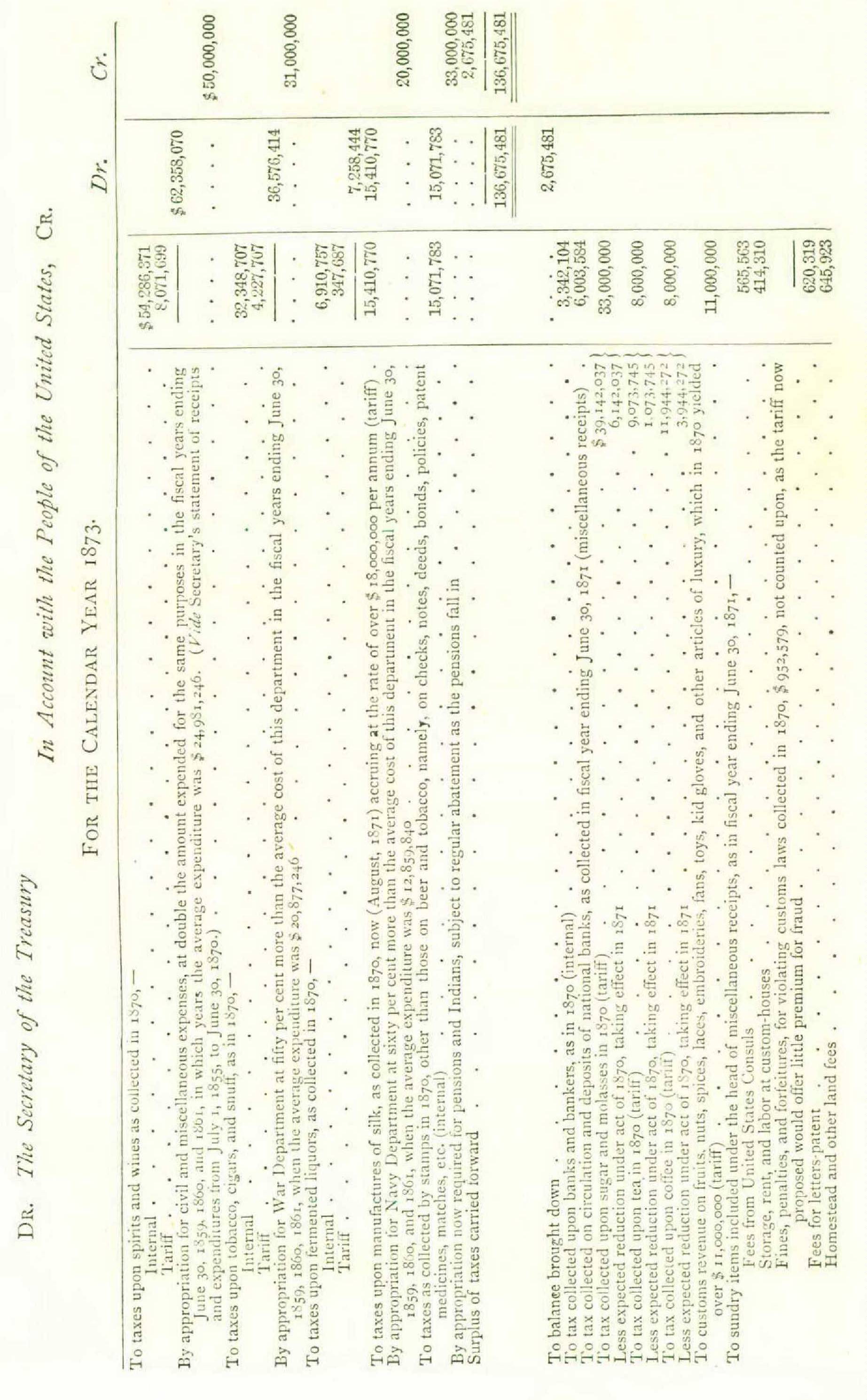
As this matter cannot be presented in too many aspects or enforced by too many methods, I beg to submit the following form of a budget to be enacted in the first year after we exert our power, say for the calendar year 1873. (See table, pp. 478, 479.)
The abatement of taxes proposed under this budget covers the reduction of the internal taxes made by the act of 1870; the reduction of the duties on tea, coffee, and sugar, as made by the act of 1870 ; the entire repeal of the income tax ; but leaves still to be accomplished by the next session of Congress the repeal of about $ 85,000,000 tariff taxes now in force upon necessary articles of food, fuel, clothing, and materials required in the mechanic arts.
If an allowance for contingencies is demanded, our previous experience would warrant the expectation that the taxes hereinafter proposed will yield seven dollars rather than six dollars per head, because of the enhanced prosperity and rapid increase in product and wealth sure to ensue from the abatement of the heavy burdens now crippling our industry. This increase of one dollar per head would yield $ 42,000,000, to be applied to reduction of debt, and would carry the aggregate revenue to over $ 300,000,000 in the year 1873.
I have made no account of the premium on sales of gold, which form a large portion of the so-called “ miscellaneous receipts,” as no Free-Trader, Revenue Reformer, or advocate of tax repeal would count upon that which marks the discredit of his country as a permanent source of revenue. There is no tax so vicious and no burden so heavy as that imposed by the use of an inconvertible paper currency. It is a thief which picks our pockets night and day, and it is the prime cause of the fraud, corruption, and peculation which mark this time.
If it shall be said that this aggregate of appropriations and of proposed expenditure is less than is now being expended, and less than has been called for, the Revenue Reformers reply that it is as much their function to examine into the purposes to which the sums raised by taxation shall be applied as it is to prescribe the method by which the taxes shall be levied ; and that they intend not only to apply to the reduction of debt the sums which can be saved in the cost of the civil service, when the vast and cumbrous list of tariff taxes shall have been repealed, which now scarcely pay the cost of collection, and which now constitute one of the prime causes why our civil and miscellaneous expenses are double what they were in 1859, 1860, and 1861, but they also claim that the pension list needs to be scrutinized, the cost of the Indian Department examined, and that in general the cost of the ordinary expenses shall be, not eighty per cent in currency, but only twenty-five per cent in gold, more than in 1858, 1859, and 1860, or in proportion only to the increase of population. It is true that our expenses have been greatly reduced since the war, but great reduction remains to be accomplished.
We have admitted these large sums for civil service, war, and navy into our first budget, aggregating $ 101,000,000, or nearly eighty per cent more than the average cost of these departments of the government for the fiscal years ending June 30, 1859, 1860, and 1861, for the reason that the vicious and debased paper currency now in forced circulation has caused the same increase in the cost of conducting the business of the government that it has caused in the cost of the subsistence of the great mass of the people ; and we affirm that, when in the process of revenue reform we shall have restored a just and honest specie standard of value, although we shall not then be able to count upon the premium on sales of gold as being available for the payment of our debt, we shall save far more in the cost of our ordinary expenses, and shall thus have a greatly larger sum to apply to that purpose than we have now.
It will be observed that our budget is made upon the rule previously laid down, namely, that discrimination should be used as to what we tax rather than as to where or how we collect the impost ; the latter being simply a question of executive detail. In our estimates we have taken as our basis of income the actual receipts, either in the years 1870 or 1871, as stated in the official reports and from the latest published data. Every statement can be verified, either by reference to the official documents published by the Treasury Department, or to the able chief of the Bureau of Statistics (Dr. Edward Young), whose impartial services are always at the command of those who seek the truth in these matters. It has once been the function of the writer, in a review of the fiscal record of the Republican party, to assign to the cost of the war all the expenses of the War and Navy Departments over and above a fair estimate for the peace establishment. But the statement of expenses since the final end of the war, assuming that date to have been reached only when the Fifteenth Amendment to the Constitution was ratified, will not warrant such a division of expenses as between war and peace. Much as the present administration has accomplished in the honest and effective collection of the revenue, and great as has been the relief from the most onerous of the war taxes, the duty is still upon the Republican party, if it would not yield its power, to complete the work so well begun. Let not its record be, that though competent in time of war, and great when the country was in danger, it has been found wanting in time of peace. It has yet much to do in the reduction of expenses, and in the repeal of onerous and useless taxes ; and not until it has brought the country back to as economical a standard as that which prevailed before the war, will it be held to have done all that ought to be expected.
The Republican party has met the demand of war, and has applied the vast resources of this country to that demand without stint, and it may be said almost without time to take thought as to its method. It is for the same party now to consider whether it will permit the problem of revenue reform to be worked out to its completion as it has been begun in and by it ; or whether it will allow the rapacious and unscrupulous men who always attach themselves to any party in power for the sole purpose of gaining their private ends, to pervert its force and thus to transfer to its opponents the duty which it may fail to meet ; giving them the opportunity which they seek, and which they may use, in spite of “ new departures,” to the detriment of the cause for which the war was fought out.
Our budget is one which no party can ignore, because it is simple, sensible, and right. It calls for no income tax, and it repeals all the taxes on what are called raw materials ; all the taxes upon metals ; upon drugs and dyestuffs ; upon wool, hemp, and jute ; upon lumber, coal, hides, leather, and salt ; in fact, it repeals all taxes upon all the materials which enter into the processes of our industry: while it would impose, under and by means of one simple and effective bill (in place of the twelve inconsistent and complicated acts which now constitute our tariff law), very moderate duties for revenue upon articles which are substantially ready for final consumption, and which therefore represent the results for which labor is exerted. To take a small portion of that which men seek as the end of their labor, rather than to impair the means whereby they gain their subsistence., is the problem which the advocates of revenue reform now seek to solve.
Objection has been taken to the title of “ Revenue Reformers.” If our opponents desire a more descriptive title, let them call us the “Tax Repealers, if they dare.
If it shall be said that we repeal too much, and that we ought to pay more than $ 30,000,000 in the first year alter we enact our laws, let it be remembered that by the simple force of the increase in our population, the rate per capita which in the first year will yield $ 30,000,000 toward payment will, if maintained for twenty years, and even in less time, pay off the entire debt. And let it also be remembered that abatement of bad taxes means increase of revenue from right ones retained, and that no attempt at reduction yet made in this country but has disappointed the framers ot the act, the revenue, from the taxes maintained, increasing with every relief from burdens. When we have once established a system of revenue upon the basis of the budget herein proposed, it will be very certain that all agitation will cease ; and that until our debt is finally paid, no cry either of protection or freetrade, of revenue reform or tax repeal, will suffice to induce any substantial change. The country will have a simple and stable, if not a peifect system of taxation, and the prosperity to all, both farmers and manufacturers, which must ensue, cannot foil to assure its continuance.
Even if it could be proved that protection increases wealth, it must still be condemned. Accumulated wealth, necessarily held by a small portion of the community, is the least sure sign of prosperity. Abundant production and equitable distribution are the ends to be sought, and only that wealth is of permanent value which promotes these ends.
He who by invention incienses our power to direct the unchanging forces of nature, so that our annual product is increased and a more ample consumption made possible, adds most to our prosperity ; even though his invention destroys the value of half our wealth previously accumulated.
The dream of the communist will be realized only when, through effort, invention, and intelligence, production will be so ample and so sure that all will have enough and it will not pay to be rich.
Edward Atkinson.