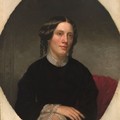
Oldtown Fireside Stories: The Widow's Bandbox
“LORDY massy! Stick yer hat into the nor’east, Horace, and see ’f ye can’t stop out this ’ere wind. I’m e’eny most used up with it.”
So spake Sam Lawson, contemplating mournfully a new broad-brimmed straw hat in which my soul was rejoicing.
It was the dripping end of a sour November afternoon, which closed up a “ spell o’ weather ” that had been steadily driving wind and rain for a week past, and we boys sought the shelter and solace of his shop, and, opening the door, let in the wind aforesaid.
Sam had been all day in one of his periodical fits of desperate industry. The smoke and sparks had been seen flying out of his shop chimney in a frantic manner, and the blows of his hammer had resounded with a sort of feverish persistence, intermingled with a doleful wailing of psalm-tunes of the most lugubrious description.
These fits of industry on Sam’s part were an affliction to us boys, especially when they happened to come on Saturday ; for Sam was as much a part of our Saturday-afternoon calculations as if we had a regular deed of property in him ; and we had been all day hanging round his shop, looking in from time to time in the vague hope that he would propose something to brighten up the dreary monotony of a holiday in which it had been impossible to go anywhere or do anything.
“ Sam, ain’t you coming over to tell us some stories to-night ? ”
“ Bless your soul and body, boys ! life ain’t made to be spent tellin’ stories. Why, I shall hev to be up here workin’ till arter twelve o’clock,” said Sam, who was suddenly possessed with a spirit of the most austere diligence. “ Here I be up to my neck in work, tilings kind o’ cornin’ in a heap together. There’s Miss Cap’n Broad’s andirons, she sent word she must have ’em tonight ; and there’s Lady Lothrop, she wants her warmin’-pan right off, — they can’t non’ on ’em wait a minit longer. I’ve ben a drivin’ and workin’ all day like a nigger-slave. Then there wras Jeduth Pettybone, he brought down them colts to-day, and I worked the biggest part o’ the morn in’ shoein’ on ’em ; and then Jeduth he said he could n’t make change to pay me, so there wa’n’t nothin’coinin’ in for’t ; and then Hepsy she kep’ a jawin’ at me all dinner-time ’bout that. Why, I warn’t to blame now, was I ? I can’t make everybody do jest right and pay regular, can 1 ? So ye see it goes, boys, gettin5 yer bread by the sweat o’ your brow ; and sometimes sweatin’ and not gettin’ yer bread. That are’s what I call the cuss, the ’riginal cuss, that come on man for hearkenin’ to the voice o’ his wife, —that are was what did it. Jtallers kind o’ riles me up with Mother Eve when I think on’t. The women hain’t no bisness to fret as they do, ’cause they sot this ’ere state o’ things goin’ in the fust place.”
“ But, Sam, Aunt Lois and Aunt Nabby are both going over to Miss Mehitabel’s to tea. Now you just come over and eat supper with us and tell us a story, do.”
“ Gone out to tea, be they ? ” said Sam, relaxing his hammering, with a brightening gleam stealing gradually across his lanky visage. “ Wal, that are looks like a providential openin’ to be sure. Wal, I guess I ’ll come. What 7s the use o’ never havin’ a good time ? Ef you work yourself up into shoestrings you don’t get no thanks for it. and things in this world’s ’bout as broad as they is long: the women’ll scold, turn ’em which way ye will; a good mug o’ cider and some cold victuals over to the Deacon’s ’ll kind o’ comfort a feller up, and your granny, she’s sort o’ merciful, she don’t rub it into a fellow all the time like Miss Lois.”
“ Now let’s see, boys,” said Sam, when a comfortable meal of pork and beans had been disposed of, and a mug of cider was set down before the fire to warm. 111 s’pect ye ’ll like to hear a Down East story to-night.”
Of course we did, and tumbled over each other in our eagerness to get the nearest place to the narrator.
Sam’s method of telling a story was as leisurely as that of some modern novel-writers. He would take his time for it, and proceed by easy stages. It was like the course of a dreamy, slowmoving river through a tangled meadow flat, — not a rush nor a bush but was reflected in it ; in short, Sam gave his philosophy of matters and things in general as he went along, and was especially careful to impress an edifying moral.
“Wal, ye see, boys, ye know I was born down to Newport,—there where it’s all ships and shipping, and sich. My old mother she kep’ a boardin’house for sailors down there. Wal, ye see I rolled and tumbled round the world pretty consid’able afore I got settled down here in Oldtown.
“ Ye see my mother she wanted to bind me out to a blacksmith, but I kind o’ sort o’ didn’t seem to take to it. It was kind o’ hard work, and boys is apt to want to take life easy. Wal, I used to run off to the sea-shore, and lie stretched out on them rocks there, and look off on to the water ; and it did use to look so sort o’ blue and peaceful, and the ships come a sailin’ in and out so sort o’ easy and natural, that I felt as if that are’d be jest the easiest kind o’ life a fellow could have. All he had to do was to get aboard one o’ them ships and be off seekin’ his fortin at t’ other end o’ the rainbow, where gold grows on bushes and there’s valleys o’ diamonds.
“ So nothin’ would do but I gin my old mother the slip, and away I went to sea, witli my duds tied up in a handkercher.
“ I tell ye what, boys, ef ye want to find an easy life, don’t ye never go to sea. I tell ye life on shipboard ain’t what it looks to be on shore. I had n’t been aboard more ’n three hours afore I was the sickest critter that ever ye did see, and I tell you, I did n’t get no kind o’ compassion. Cap’ns and mates they allers thinks boys hain’t no kind o’ business to have no bowels nor nothin’, and they put it on ’em sick or well. It’s jest a kick here and a cuff there and a twitch by the ear in t’ other place ; one a shovin’ on ’em tins way and another hittin’ on ’em a clip, and all growlin’ from mornin’ to night. I believe the way my ears got so long was bein’ hauled out o’ my bcrtli by ’em : that are’s a sailor’s regular way o’ wakin’ up a boy.
“Wal, by time I got to the Penobscot country all I wanted to know was how to get back again. That are’s jest the way folks go all their lives, boys. Its all fuss, fuss, and stew, stew, till ye get somewhere; and then it’s fuss, fuss, and stew, stew to get back ag’in ; jump here and scratch yer eyes out, ancLjump there and scratch ’em in ag’in.
“ Wal, I kind o’ poked round in Penobscot country till I got a berth on the Brilliant that was lyin’ at Camden, goin’ to sail to Boston.
“ Ye see the Brilliant she was a tight little sloop in the government service : ’twas in the war times, ye see, and Commodore Tucker that is now (he was Cap’n Tucker then), he had the command on her, — used to run up and down all the coast takin’ observations o’ the British, and keepin’ his eye out on ’em, and givin’ on ’em a nip here and a clip there, ’cordin’ as he got a good chance. Why, your gran’ther knew old Commodore Tucker. It was he that took Dr. Franklin over Minister to France, and dodged all the British vessels, right in the middle of the war, I tell you that are was like running through the drops in a thundershower. He got chased by the British ships pretty consid’able, but he was too spry for ’em. Arter the war was over, Commodore Tucker took over John Adams, our fust Minister to England. A drefful smart man the Commodore was, but he most like to ’a’ ben took in this ’ere time I’m a bellin’ ye about, and all ’cause he was sort o’ softhearted to the women. Tom Toothacre told me the story. Tom he was the one that got me the berth on the ship. Ye see I used to know Tom at Newport, and once when he took sick there my mother nussed him up, and that was why Tom was friends with me and got me the berth, and kep’ me warm in it too. Tom he was one of your racl Maine boys, that’s hatched out, so to speak, in water like ducks. He was born away down there on Harps well P’int; and they say if ye throw one o’ them Harpswell babies into the sea he ’ll take to it nateral and swim like a cork ; ef they hit their heads ag’in a rock it only dents the rock, but don’t hurt the baby. Tom he was a great character on the ship. He could see further and knew more ’bout wind and water than most folks ; the officers took Tom’s judgment, and the men all went by his say. My mother she chalked a streak o’ good luck for me when she nussed up Tom.
“ Wal, we wus a lyin’ at Camden there, one arternoon, goin’ to sail for Boston that night. It was a sort o’ soft, pleasant arternoon, kind o’ still, and there wa' n’t nothin’ a goin’on but jest the hens a craw-crawin’, and a histin’ up one foot and boldin’it a spell ’cause they didn’t know when to set it down, and the geese a sissin’ and a pickin’ at the grass. Ye see Camden was n’t nothin’ of a place, — ’t was jest as if somebody had emptied out a pocketful o’ houses and forgot ’em ; there were n’t nothin’ a stirrin’ or goin’ on, and so we was all took aback, when ’bout four o’clock in the arternoon there come a boat alongside with a tall elegant lady in it, all dressed in deep mournin’; she rared up sort o’ princess-like and come aboard our ship and wanted to speak to Cap’n Tucker. Where she come from or what she wanted or where she was goin’ to, we none on 11s knew; she kep’ her veil down so we could n’t get sight o’ her face. All was she must see Cap’n Tucker alone right away.
“Wal, Cap’n Tucker he was like.' the generality o’ cap’ns. He was up to ’bout everything that any man could do, but it was pretty easy for a woman to come it over him. Ye see cap’ns, they don’t see women as men do ashore. They don’t have enough of ’em to get tired on ’em ; and every woman’s an angel to a sea-cap’n. Anyway, the cap’n he took her into his cabin, and he sot her a chair, and was her humble servant to command, and what would she have of him ? And we was all a winkin’ and a nudgin’ each other and a peekin’ to see what was to come of it ; and she see it, and so she asks, in a sort 0’ princess’ wray, to speak to the cap’n alone, and so the doors was shut, and we was left to our own ideas and a wonderin’ what it was all to be about.
“Wal, you see, it come out arterwards all about what went on; and things went this way. Jest as soon as the doors was shut and she was left alone with the cap’n, she busted out a cryin’ and a sobbin’ fit to break her heart
“ Wal, the cap’n he tried to comfort her up; but no, she would n’t be comforted, but went on a weepin’ and a wailin’ and a wringin’ on her hands till the poor cap’n’s heart was a’most broke, for the cap’n was the tenderest-hearted critter that could be, and could n’t bear to see a child or a woman in trouble noways.
“ ‘ O cap’n,’ said she, ‘ I ’m the most unfortunate woman. I’m all alone in the world,’ says she, 'and I don’t know what ’ll become of me ef you don’t keep me,’ says she.
“ Wal, the cap’n thought it was time to run up his colors, and so says he : ‘ Ma’am, I’m a married man, and love my wife,’ says he, ‘ and so I can feel for all women in distress/ says he.
“ O, well then,’ says she, £you can teel for me, and know how to pity me. My dear husband’s just died suddenly when he was up the river. He was taken with the fever in the woods. I nussed him day and night,’ says she, ‘but he died there in a miserable little hut far from home and friends,’ says she, * and I’ve brought his body down with me, hopin’ Providence would open some way to get it back to our home in Boston. And now, cap’n, you must help me.’
Then the cap’n see what she was up to, and he hated to do it and tried to cut her off of askin’, but she wa’ n’t to be put off.
“‘Now, cap’n,’ says she, ‘ ef you’ll take me and the body of my husband on board to-night, I kl be willing to reward you to any amount. Money would be no object to me,’ says she.
“ Wal, you see, the cap’n lie kind o’ hated to do it, and he hemmed and hawed, and he tried to ’pologize. He said ’t was a government vessel, and he didn’t know as he had a right to use it. He said sailors was apt to be superstitious ; and he did n’t want ’em to know as there was a corpse on board.
“ * Wal,’ says she, ‘ why need they know ?’ For you see she was up to every dodge, and she said she’d come along with it at dusk, in a box, and have it just carried to a state-room, and he needn’t tell nobody what it was.
“Wal, Cap’n Tucker he hung off, and he tried his best to persuade her to have a funeral, all quiet, there at Camden. He promised to get a minister, and ’tend to it, and wait a day till it was all over, and then take her on to Boston free gratis. But ’t was all no go. She wouldn’t hear a word to ’t. And she reeled off the talk to him by the yard. And when talk failed she took to her water-works again, till finally the cap’n said his resolution was clean washed away, and he jest give up hook and line; and so rt was all settled and arranged that when evening come she was to be alongside with her boat and took aboard.
“ When she come out o’ the cap’n’s room to go off, I see Tom Toothacre a watchin’ on her. He stood there by the railin’s a shavin’ up a plug o’ baccy to put in his pipe. Pie did n’t say a word, but he sort o’ took the measure 0’ that are woman with his eye and kept a follerin’ on her.
“ She had a fine sort o’ lively look, carried her head up and shoulders back, and stepped as if she had steel springs in her heels.
“ ‘ Wal, Tom, what do yc say to her ? ’ says Ben Bowdin.
“ ‘ 1 don’t say nothin’,’ says Tom, and he lit his pipe ; ’t ain’t my bus’ness,’ says he.
“ ‘ Wal, what do you think ? ’ says Ben. Tom gin a hist to his trousers.
“ ‘ My thoughts is my own,’ says he, ‘and I calculate to keep ’em to myself/ says he. And then he jest walked to the side o’ the vessel and watched the woman a gettin’ ashore. There was a queer kind o’ look in Tom’s eye.
“ Wal, the cap’n he was drefful sort o’ oneasy arter she was gone. He had a long talk in the cabin with Mr. More, the fust officer, and there was a sort o’ stir aboard as if somethin’ was a goin’ to happen ; we couldn’t jest say what it was.
“ Sometimes it seems as if when tilings is goin’ to happen a body kind o’ feels ’em cornin’ in the air. We boys was all that way; of course we did n’t know nothin’ ’bout what the woman wanted, or what she come for, or whether she was cornin’ ag’in ; ’n fact we didn’t know nothin’ about it, and yet we sort o’ expected suthin to come of it; and suthin did come, sure enough.
“ Come on night, just at dusk, we see a boat coinin’ alongside, and there, sure enough, was the lady in it.
“‘There, she’s cornin’ ag’in/ says I to Tom Toothacre.
“ ‘ Yes, and brought her baggage with her/ says Tom, and he pointed down to a long, narrow pine box that was in the boat beside her,
“Jest then the cap’n called on Mr. More, and he called on Tom Toothacre, and among ’em the}' lowered a tackle and swung the box aboard and put it in the state-room right alongside the cap’n’s cabin.
“The lady she thanked the captain and Mr. More, and her voice was jest as sweet as any nightingale, and she went into the state-room after they put the box in, and was gone ever so long with it. The cap’ll and Mi'. More they stood a whisperin’ to each other, and every once in a while they’d kind o’ nod at the door where the lady was.
“ Wal, by and by she come out with her handkcrchcr to her eyes, and come on deck and begun talkin’ to the cap’n and Mr. More, and a wishin’ all kinds o’ blessin’s on their heads.
“ Wal, Tom Toothacre did n’t say a word, good or bad, but he jest kep’ a lookin’ at her, watch in’ her as a cat watches a mouse. Finally we up sail and started with a fair breeze. The lady she kep’ a walkin’ up and down, up and down, and every time she turned on her heel, I saw Tom a lookin' arter her and kind o’ noddin’ to himself.
“‘What makes you look arter her so, Tom ? ’ says I to him.
“ ‘ ’Cause I think she wants lookin’ arter,’ says Tom. * What’s more,’ says he. 1 if the cap’n don’t look sharp arter her the Devil ’ll have us all afore mornin’. I tell ye, Sam, there’s mischief under them petticuts.’
“ ‘ Why, what do ye think ? ’ says I.
“‘Think! I don’t think, I knows ! That are’s no gal, nor widder neither, if my name’s Tom Toothacre ! Look at her walk, look at the way she turns on her heel ! I’ve been a watchin’ on her. There ain’t no woman livin’ with a step like that ! ’ says he.
“‘ Wal, who should the critter be, then ? 3 says I.
“ ‘ Wal,’ says Tom, ‘ ef that are ain’t a British naval officer, I lose my bet.
I’ve been used to the ways on ’em, and I knows their build and their step.’
‘“And what do you suppose she’s got in that long box ? ’ says I.
■‘‘What has she got?’ says Tom. ‘Wal, folks might say none o’ my bisness ; but I s’pects it’ll turn out some o’ my bisness, and yourn too, if he don’t look sharp arter it,’ says Tom. ‘It’s no good, that are box ain’t.3
“ ‘ Why don’t you speak to Mr. More ? ’ says I.
“‘Wal, you see she’s a chipperin’ round and a matin’ herself agreeable to both on ’em, you see; she don’t mean to give nobody any chance for a talk with ’em ; but I’ve got my eye on her for all that. You see I liain’t no sort o’ disposition to sarve out a time on one o’ them British prison-ships,3 says Tom Toothacre. ‘It might be almighty handy for them British to have the Brilliant for a coast vessel,3 says he, ‘but, ye see, it can’t be spared jest yet. So, madam,’ says he, ‘ I’ve got my eye on you.3
“ Wal, Tom was as good as bis word, for when Mr. More came towards him at the wheel, Tom he up and says to him, ‘ Mr. More,’ says he, ‘ that are big box in the state-room yonder ivants lookin’ into.’
“ Tom was a sort o’ privileged character, and had a way of speaking up that the officers took in good part, ?cause they knew he was a fust-rate hand.
“Wal, Mr. More he looks mysterious and says he, ‘Tom, do the boys know what’s in that are box ? ’
“ ‘ I bet they don’t,3 says Tom. * If they had, you would n't a got ’em to help it aboard.3
“ ‘ Wal, you see, poor woman,’ says Mr. More to Tom, ‘she was so distressed. She wanted to get her husband’s body to Boston, and there wa’ n't no other way, and so the cap’n he let it come aboard. He did n’t want the boys to suspect what it really was.”
Husband’s body be hanged ! 3 said Tom. ‘ Guess that are corpse ain’t so dead but what there ’ll be a resurrection afore morniii’, if it ain’t looked arter,’ says he.
“ ; Why, what do you mean, Tom ? ’ says Mr. More, all in a blue maze.
“ 1 I mean that are gal that’s ben a switchin’ her petticuts up and down our deck ain’t no gal at all. That are’s a British officer, Mr. More. You give my duty to the cap’n, and tell him to look into his widder’s bandbox and see what he’ll find there.’
“ Wal, the mate he went and had a talk with the cap’n, and they ’greed between ’em that Mr. More was to hold her in talk while the cap’n went and took observations in the state-room.
“ So, down the cap’n goes into the state-room to give a look at the box. Wal, he finds the state-room door all locked to be sure, and my lady had the key in her pocket; but then the cap’n he had a master key to it, and so he puts it in and opens the door quite softly, and begins to take observations.
“Sure enough, he finds that the screws had been drawed from the top o’ the box, showin’ that the widder had been a tinkerin’ on’t when they thought she was a cryin’ over it ; and then, lookin’ close, he sees a bit o’ twine goin’ from a crack in the box out 0’ the winder, and up on deck.
“ Wal, the cap’n he kind o’ got in the sperit o’ the thing, and he thought he kl jest let the widder play her play out, and see what it would come to. So he jest calls Tom Toothacre down to him and whispered to him. ‘Tom,’ says he, ‘ you jest crawl under the berth in that are state-room and watch that are box.’ And Tom said he would.
“ So Tom creeps under the berth and lies there still as a mouse, and the cap’n he slips out and turns the key in the door, so that when madam comes down she should n’t s’pect nothin’.
“ Putty soon, sure enough, Tom heard the lock rattle, and the young widder come in, and then he heard a bit o’ conversation between her and the corpse.
“ ‘ What time is it ? ’ come in a kind o’ hoarse whisper out o’ the box.
“ ‘ Well, ’bout nine o’clock,’ says she.
“ £ How long afore you ’ll let me out? ’ says he.
“ ‘ O, you must have patience,’ says she, ‘till they’re all gone off to sleep ; when there ain’t but one man up. I can knock him down,’says she, ‘and then I ’ll pull the string for you,’
“ ‘ 1 he devil you will, ma’am ! ’ says Tom to himself, under the berth.
‘ \\ ell, it ’s darned close here,’ says the fellow in the box. “ He did n't say darned, boys, but be said a wickeder word that I can’t repeat, noways,” said Sam, in a parenthesis; “ these ’ere British officers was drefful swearin’ critters.”
“1 You must have patience awhile longer,’ says the lady, ‘till I pull the string.’ Tom Toothacre lay there on his back a laughin’.
‘“Is everything goin’ on right?’ says the man in the box.
“ £ All straight,’ says she ; ‘ there don’t none of ’em suspect.’
“ ‘ \ ou bet,’ says Tom Toothacre, under the berth ; and he said he had the greatest mind to catch the critter by the feet as she was a standin’ there, but somehow thought it would be better fun to see the thing through ’cording as they’d planned it.
“ Wal, then she went off switchin’ and mincin’ up to the deck ag’in and a flirtin’ with the cap’n ; for you see ’t was ’greed to let ’em play their play out.
“ Wal, Tom he lay there a waitin’, and he waited and waited and waited, till he ’most got asleep; but finally lie heard a stirrin’ in the box, as if the fellah was a gettin’ up. Tom lie jest crawled out still and kerful and stood up tight ag’in the walk l’utly soon he hears a grunt, and he sees the top o’ the box a risin’ up and a man jest gettin’ out on’t mighty still.
“Wal, Tom he waited till he got fairly out on to the floor, and had his hand on the lock o’ the door, when he jumps on him and puts both arms round him and gin him a regular bear’s hug.
“Why, what’s this ? ’ says the man.
“i Guess ye ’ll find out, darn ye,’ says Tom Toothacre. ‘ So, ye wanted our ship, did ye ? Wal, ye jest can’t have our ship,’ says Tom, says he ; and I tell you he jest run that are fellow up stairs lickety-split, for Tom was strong as a giant.
“ The fust thing they saw was Mr. More hed got the widder by both arms and was tying on ’em behind her.
‘ Ye see, madam, your game’s up,’ says Mr. More, ‘but we’ll give ye a free passage to Boston, tho’,’ says he, ‘ we wanted a couple o’ prisoners about these days, and you ’ll do nicely.’
“ The fellers they was putty chopfallen to be sure, and the one in women’s clothes, ’specially ; cause when he was found out, he felt foolish enough in his petticuts, but they was both took to Boston and given over as prisoners.
“Ye see, come to look into matters, they found these two young fellows, British officers, had formed a regular plot to take Cap’n Tucker’s vessel and run it into Halifax ; and ye see, Cap’n Tucker he was so sort o’ spry, and knew all the Maine coast so well, and was so cute at dodgin’ in and out all them little bays and creeks and places all ’long shore, that he made the British considerable trouble, ’cause whenever they did n’t want him, that’s where he was sure to be.
«So they’d hatched up this ’ere plan. There was one or two British sailors had been and shipped aboard the Brilliant a week or two aforehand, and’t was suspected they was to have helped in the plot if things had gone as they laid out; but I tell you, when the fellows see which way the cat jumped, they took pretty good care to say that they had n’t nothin’ to do with it. O no, by no manner o’ means. Wal, o’ course, ye know, it could n’t be proved on ’em and so we let it go.
“But I tell you, Cap’n Tucker he felt pretty cheap about his widder. The worst on’t was, they do say Ma’am Tucker got hold of it, and you might know if a woman got hold of a thing like that she’d use it as handy as a cat would her claws. The women they can’t no more help hittin’ a fellow a clip and a rap when they’ve fairly got him, than a cat when she’s ketched a mouse, and so I shouldn’t wonder if the Commodore heard something about his widder every time he went home from his v’yges the longest day he had to live. I don’t know nothin’ ’bout it, ye know, I only kind o’ jedge by what looks, as human natur’ goes.
“ But Lordy massy, boys, ’t wa’n’t nothin’ to be ’shamed of in the cap’n. Folks’ll have to answer for wus things at the last day than tryin’ to do a kindness to a poor widder now I tell you. It’s better to be took in doin’ a good thing, than never try to do good ; and it’s my settled opinion,” said Sam, taking up his mug of cider and caressing it tenderly, — “it’s my humble opinion that the best sort o’ folks is the easiest took in, ’specially by the women. I reely don’t think I should a done a bit better myself.”
Harriet Beecher Stowe.