Sea-Hours With a Dyspeptic
I. — PRELUSIVE.
THERE are a good many fictions in the world. I will mention one: — the propeller Markerstown. The bulletins and placards of her owners soar high in the realms of fancy; like Sirens, they sing delightful songs,— and all about “ the A 1 fast-sailing, commodious, firstclass steam-packet Markerstown.” Such is the soaring fiction : now let us look at the sore fact. The “A 1 ” is, I take it, simply the “Ai ! ” of the Greek chorus new-vamped for modern wear, — a drear wail well suited to the victims of the Markerstown. As to sailing qualities: — we know, of course, that all speed is relative. For a sea-comet, the Markerstown would be somewhat leisurely, though answering well for an oceanic fixed star, having no perceptible motion. One man on board — the Captain — was accommodated: the kidnapped all suffered. Whether the Markerstown should be reckoned as first-class or last-class is a question depending simply on where the counting begins, and which way it runs.
“ Steam-packet ” she was indeed, though not in the most desirable way. Her steam was “ packit ” (Scotticè) too close for safety, but lay quite too loose for speed. The kidnapped were all “ packit,” and “ weel packit.” How I came to be one of them, and how by this mystic union I halved my joys and doubled my griefs, as the naughty ones say of wedlock, will soon appear.
One brilliant fancy-flight I forgot to mention. The craft in question was boldly proclaimed as “ new.” New, indeed, she might have been : so were once the Ark, the Argo, the Old Téméraire, the Constitution, and sundry other hulks of celebrity. Yet it is not mere rhetoric to say, that, if the eyes of the second and third Presidents of these United States never, in their declining years, beheld the good ship Markerstown, it was only from lack of wholesome curiosity.
This pleasing list of attractions was wont to make an occasional trip—should I not rather say saunter ? — to the NewWorld Levant, the Yankee Eöthen. The time consumed was theoretically a day and a half, but practically a day or two longer. Tired as I was of the sluttish land, the clean sea had an inviting look. Dusty car and ringing rail wore no Circean graces, when the long-haired mermaid, decked in robes of comely green, looked out from her bower beneath the waves, and beckoned me to come. What more welcome than her sea - green home ? What sight finer than the myriad diamond-sparkles in her eye ? What sound sweeter than the murmurs of her soothing, never-ceasing voice ? What perfume so rare as the crisp fragrance breathing from her robes ? What so thrilling, so magnetically ecstatic, as her tumultuous heaving, and the lithe, undulating buoyancy of her mazy footfalls?
It is proper to state here, as an act of justice to others, and to save myself from the charge of lunacy, that the Markerstown was a mere interloper. Our covetous, good old uncle had set his eye on the regular steamer of the line, and his greedy fingers had taken her away to Dixie, where her decks were now swarming with blue coats and black heels. The peaceful Markerstown, being exempt by reason of physical disqualifications, tarried behind as home-guard substitute for her warlike sister. Ignorant of the change, I secured my passage, paid for my ticket, sent down my trunks, and presented myself at the gangway one sweltering afternoon in the latter part of June, a few minutes before the hour set for sailing. There was nothing in the aspect of things to indicate a speedy departure. On the contrary, the tardy craft had just arrived, and was intensely busy in letting off steam and discharging cargo. The mate was quite sure — and so was I — that she would n’t weigh anchor before early next morning. The prospect was not enrapturing. Confusion, dirt, pandemoniac noise, long delay, and over all a blistering sun, were ill suited to bring peace to the embezzled seeker after pleasure.
As a relief from the horrid din on deck, I made my way to the cabin. It was a place well named, being cabined, cribbed, confined, in quite an unprecedented degree. It was then and there that I first saw the subject of this sketch, —the Peptic Martyr. Unknowingly, I was face to face with my Man of Destiny. Shipmate, Philosopher, Martyr, Rhapsodist, Mentor, Bon-Vivant, Dūspeptos,—these are but a few of the various disks which I came at last to see in this gem of first water. Even now, in memory, the subject looms vast before me, and the freighted pen halts. Bear with me: let us pause for one moment. Matter like this asks a new strophe.
II.—THE BURDEN OF THE SONG.
DŪSPEPTOS was sitting on a common mohair sofa, surrounded by some halfdozen or more of his fellow-victims. It is stated that Themistocles, before his ocean - raid at Salamis, sacrificed three young men to Bacchus the Devourer. The Markerstown, in sailing out upon the great deep, immolated at least twelve, old and young, as a festive holocaust to Neptune the Nauseator. Here in their sacrificial crate were the luckless scapegoats, sad-eyed prey of the propeller. It was easy to see, at the first glance, that the Martyr was the central sun round which clustered the planets of propitiation. Born king, he asserted his kingship, and all yielded from the beginning to his sway. Ears and mouths opened toward him the liege. Upon the magnet of his voice hung the eager atoms. There was a filmy, distant look in the eyes of the listeners, as of men rapt with the mystic utterances of a seer. My entrance unheralded broke up the monologue, whatever it was. But seeing the true sacrificial look on my brow, all at once, from chief to sutler, confessed a brother. To me then turning, Dūspeptos, king of men, spoke winged words : —
“ ’Pears t’ me, stranger, you look kind o’ streaked. Ken I do anythin’ for ye? Wal, I s’pose th’ old tub ’s caught you too, so we ken jest count y’ in along o’ this ’ere crowd, Reg’lar fix, now, a’n’t it? ’T ’s wut I call pooty kinky. Dern’d ’f I ’d ’a’ come, ’f I ’d ’a' known th’ old butter-box was goin’ to be s’ frisky. Lively’s a young colt now, a’n’t she? Kicks up her heels, an’ scampers off te’ble smart, don’t she? ’S never seen an ekul yit for punctooality an’ speed. When she doos tech the loocifer, an’ cooks up her steam in her high old pepper-box, jest you mind me, boys, there ’ll be a high old time. Wun’t say much, but there ’ll be fizzin’, sure, — mebby suthin’ more, — mebby reg’lar snorter, a jo-fired jolly good bust-up. Mebby th’ wun’t be no weepin’ an’ gahnishin’ o’ teeth about these parts along towards mornin’. Who knows ? Natur’ will work. Th’ old scow’s got to go accordin’ to law,—that’s one sahtisfahction, sartin. ’S a cause for all these things. An’ ef she doos kind o’ rip an’ tear, she ’s got to go b’ Gunter. She’s bound to foller her constitootion as she understan’s it, an to stan’ up for the great principul of ekul freedom for all. Hope they ’ll be keerful to save some o’ the pieces. ’S a good deal o’ comfort ’n these loose fragments. ’S nuthin’ like the raäl odds an’ ends — the Simon-pure, ginooine article — to bind up the broken heart an’ make the mourners joyful. No tellin’ how much good they do in restorin’ gratitood to Providence, an’ smoothin’ things over, kind o’make matters easy, you know. Interestin’, too, to hev in the house,— pleasin’ ornaments on the mantel-piece to show to friends an’ vis’ters. They allers like to hear the story ’n connection with the native specimens, an’ everybody feels happified an’ thankful. Yes, after all, th’r’ is a master lot of solid comfort in a raid substantial accident right in the buzzum of a family,— none o’ your three-cent fizzles, but a trueblue afflictin’ dispensation. ’S a heap o’ pleasin’ an’ valooable associations aclusterin’ round.”
Here the vocal one paused for an instant, to draw breath, and rally for another raid. Feeling his little army now well in hand, he burned for fresh conquests. In glancing triumphantly around, his eye fell on a certain benign smile then flitting over the face of his predestined Satellite. Complacently nodding thereto, straightway the Peptic spoke
“I s’pose this ’ere group’s all insured, everythin’ right an’ tight an’ all square up t’ the hub. Suthin’ hahnsum for the widders an’ orphans. These little nesteggs allers sort o’ handy, — grease the ways, an’slick things up ship-shape. Survivors bless the rod, an’ fix up everythin’ round the house in apple-pie order. I hev known men that was so te’ble pertickler allers to save the Company, that nuthin’ ever did, n’ ever could happen. An’ the despairin’ friends kep’ waitin’ an’ waitin , but t was no sort o’ use; they never got a red. ’T ’s wut I call bein’ desput keerful, an’ sailin’ pooty consid’able close to the wind. ’T ’s like old Deacon Skillins’s hoss, down to Mudville, that was so dreffle conscientious he could n’t eat oats. No accountin’ for tastes. Free country, anyhow. Ef anybody likes to be fussy an’ ructious ’n little things, why, there’s nuthin’ to hender him from hevin’ his own way. But it don’t exackly hev an hon’able look to common-sense folks.
“ Ef the clipper’s a free-agent, she ’ll blow up, sure, jest to git out o’ sin an’ misery. But ef so be she ’s bonyfihd predestined, she ’ll hev to travel in the vale o’ puhbation a spell longer, ’cause her cup a’n’t full yit, not by a long chalk. S’posin’ she doos start out mellifluous, what then ? Don’t imagine, my feller-sinners, that the danger’s all over, — no, it’s only jest begun. Things ahead ’s a good deal wuss. Steam ’s pooty bad, but ’t a’n’t a circumstahnce to the blamed grease. ’T’s the grease that doos the mischief, an’ plays the dickens with human natur’. Down in th’ army, they say, biscuits kills more ’n bullets; an’ it’s gospil truth, every word on’t, perticklerly ef the biscuits is hot, an’ pooty wal fried up in grease. Fryin’ ’s the great mortal sin, the parient of all misery. The hull world’s full of it, but the sea ’s a master sight fuller ’n the land. Somehow 'nother, grease takes kind o’ easy to salt water,—sailors wun’t hev nothin’ but a fry. Jest you give ’em plenty o’ fat, an’ they wun’t ask no favors o’ nobody. These ’ere puhpellers ’s the wust sinners of ’em all, an’ somehow hev a good deal more ’n their own share o’ fat. They kind o’ borrer from mackerellers an’ side-wheelers both together, an’ mix’t all up’t oneet. My friends, ef you a’n’t desput anxious to see glory from this’ere deck, be virtoous, an’ observe the golden rule : Don’t tech, don’t g’ nigh the p’is’n upus-tree of gravy ; beware o’ the dorg called hot biscuits; take keer o’ the grease, an the stomach ’ll take keer of itself. Fact is, my beloved brethren, I ’ve ben a fust - chop dyspeptic for the best part o’ my life, an’ I ’m pooty wal posted in what I’m talkin’ about. What I don’t know on this ’ere subjick a’n’t wuth knowin’.”
III. — RECITATIVE.
How much farther the Martyr’s appeal might have gone can never be known, as the height of his great argument was cut short at this point by the appearance of the Pontifex Maximus in person on the stage of action. The fated victims were to be made ready for the coming sacrifice. The oracle, it seems, had declared that Neptune would not smile, unless two were cribbed together in one pen, — that the arrangement of these pairs should be left with the lot of the bean, — and that as the beans went, so must go the victims. Inexorable Fate would allow no reversal of her decrees. Soon the beans were rattling in the hat of the Pontifex, and, mirabile! pen No. 1 fell to Duspeptos and his Satellite elect.
The immediate effects of this bean whether white, black, Pythagorean, Lima, kidney, or what not — were threefold : 1. A pump-handle hand-shaking; 2. A very thorough diagnosis of the weather, including a rapid sketch by Dūspeptos of the leading principles of caloric, pneumatics, and hygrology; 3. An exchange of cards. That of which I was the recipient consisted of a sheet of pasteboard, rather begrimed and wrinkled, of nearly the same dimensions as the Atlantic (Monthly, not Ocean). The name and address occupied the middle of one side of the document, while all the remaining space was filled in with manifold closest scribblings in lead-pencil, apparently notes, memoranda, and the like. These were not at all private, so the new-found partner of my bosom assured me. In fact, I should do well to look at them, and make myself master of their contents. My friends also might find profit therein. Stray hints might undoubtedly be gathered from them which would lay open to my eyes the secret things of Nature and life. Thrusting it into my pocket for the moment, I feasted myself in imagination with the treasure that was mine, anticipating the happy hour that should make my hope fruition. Then we, first elect of the bean, set ourselves to determine the status quo ante helium. And here came in once more the , fabaceous maker and marker of destiny, saying that blind justice decreed, that, inasmuch as sound is wont to rise, he who was noondav Sayer and midnight Snorei should couch below, while the Hearer should circle above, — plainly a wise provision, that the good things of Providence might not be wasted. Both Damon and Pythias agreed, that, for once at least, the oracle was not ambiguous.
All things being at last arranged, the Rhapsodist took his leave for the present, going, as he informed me, on an errand of mercy for his stomach. The magazine aboard ship being of dubious character, he had prevailed on himself to supply his concern with a limited number of first-class cereals with his own imprimatur,—copyright and profits to be in his own hands. As some consolation for his absence, I was favored with a brief oral treatise on Fats, considered both dietetically and ethically, with an appendix, somewhat à la Liebig, on the nature, use, and effects of tissue-making and heat-making food, nitrogen, carbon, and the like. By way of improvement, a brilliant peroration was added, supposed to be addressed through me to the mothers of America, urging them to bring up the rising generation fatless. Thus only might war cease, justice prevail, love reign, humanity rise, and a golden age come back again to a world-wide Arcadia. Fat and Anti-Fat! Eros and Anteros, Strophe and Antistrophe. Or, better, the old primeval tale,—Jove and the Titans, Theseus and the Centaurs, Belleroplion and the Chimæra, Thor and the Giants, Ormuzd and Ahriman, Good and Evil, Water and Fire, Light and Darkness, The world has told it over from the beginning,
And do you ask what manner of man was the Fatless one ? You shall see him. His most striking feature was a fur cap, — weight some four pounds, I should judge. I think he was born with this cap, and will die with it, for 90° Fahrenheit seemed no temptation to uncover. Boots came second in rank, but twelfth or so in number, — weight probably on a par with the leaded brogans of the little wind-driven poetaster of old. Between these two extremes might be found about five feet ten of humanity, lank, sapless, and stooping. The seedy drapery of the figure hung in lean, reproachful wrinkles. The flabby trousers seemed to say: “ Give! give ! ” The hollow waistcoat murmured : “ Pad, oh! pad me with hot biscuits ! ” The loose coat swung and sighed for forbidden fruit: “Fill me with fat! ” A dry, coppery face found pointed expression in the nose, which hung like a rigid sentinel over the thin-lipped mouth,—like Victor Hugo’s Javert, loyal, untiring, merciless. No traitorous comfits ever passed that guard; no death-laden bark sailed by that sleepless quarantine. The small ferret - eyes which looked nervously out from under bushy brows, roaming, but never resting, were of the true Minerva tint, —yellowgreen. The encircling rings told of unsettled weather. While elf-locks and straggling whiskers marked the man careless of forms, the narrow, knotted brow suggested the thinker persistent in the one idea: —
Deliberation sat and peptic care.”
Not over beds of roses had he walked to ascend the heights. Those boots in which he shambled along his martyr-course were filled with peas. He had learned in suffering what he taught in sing-song. The wreath of wormwood was his, and the statue of brass. Io triumphe !
His gait was a swift, uncertain shuffle, a compromise between a saunter and a dog-trot. The arms hung straight and stiff from the narrow shoulders, like the radii of a governor, diverging more or less according to the rate of speed. When the scourge of his Dæmon lashed him along furiously, they stood fast at fortyfive degrees. His eyes peered suspiciously around, as he lumbered on, watchful for the avenger of fat, who, perhaps, was even now at his heels. A slouchhat, crowning hollow eyes and haggard beard, filled him with joy: it marked a bran-bread man and a brother. He smiled approvingly at a shrivelled form with hobbling gait; but from the fat and the rubicund he turned with severest frown. They were fleshly sinners, insults to himself, corrupters of youth, gorged drones, law-breakers. He was ready to say, with the statesman of old: “ What use can the state turn a man’s body to, when all between the throat and the groin is taken up by the belly? ” He had vowed eternal hostility to all such, and from the folds of his toga was continually shaking out war. He was of the race sung by the bard, who
Their best and dearest friend, plum-porridge,
Fat pig and goose itself oppose,
And blaspheme custard through the nose.”
Every chance-comer was instantaneously gauged as dyspeptic or eupeptic, friend or foe. On the march, Javert was on the alert, snuffling up the air, until some savory odor crossed his path, when he would shut himself up, like a snail within his shell. Yet he was not sleeping, for no titbit ever passed the portals beneath. Perhaps, however, they were themselves trusty now, having made habit a second nature. I cannot imagine them watering at sight of any dainty.
I have heard it said that certain orders of beings are able to improvise or to interchange organs, just as need calls. Thus a polyp, if hard put to it, may shift what little brain and stomach happen to be in his possession. You may say that he carries his heart in his hand. He can take his stomach, and dump it down in brain-case or thorax, just as he fancies, — can organize viscera and victory anywhere, at any moment; and all works merrily. The Fatlcss was similar, yet different. His stomach changed not its local habitation, was never victorious ; yet, from cap to boot, it was ubiquitous and despotic. Brain and heel alike felt themselves to be mere squatters on another’s soil, and had a vague idea that the rightful lord might some day come to oust them, and build up a new capital in these far-away districts. Sometimes they went so far as to style themselves his proconsuls and lieutenants, but they were never suffered to do more than simply to register the decrees of the central power. Dūspeptos was king only in name,—roi fainéant. Gaster was the power behind the throne,—the Mayor of the Palace,—the great Grand-Vizier. Nought went merrily, for he ruled with a rod of iron. Every day his strange freaks set the empire topsy-turvy. Every day there was growling and ill-feeling at his whimsical tyranny,—but nothing more. Secession was as impossible as in the day of Menenius Agrippa.
Looking at it another way, Gaster might be called the object-glass through which Dūspeptos looked out upon the world, —a glass always bubbly, distorted, and cracked, generally filmy and smoky, never achromatic, and decidedly the worse for wear. I think that the world thus seen must have had a very odd look to him. His most fitting salutation to each fellow-peptic, as he crossed the field of vision, would have been the Chinese form of greeting: “ How is your stomach ? Have you eaten your rice ?” or, perhaps, the Egyptian style: “ How do you perspire?” With him, the peptic bond was the only real one ; all others were shams. All sin was peptic in origin : Eve ate an apple which disagreed with her. The only satisfactory atonement, therefore, must be gastric. All reforms hitherto had profited nothing, because they had been either cerebral or cardiac. None had started squarely from Gaster, the true centre. Moral reform was better than intellectual, since the heart lay nearer than the head to the stomach. Phalansteries, Pantisoeracies, Unitary Homes, Asylums, Houses of Refuge, — these were all mere makeshifts. The hope of the world lay in Hygeian Institutes. Heroes of heart and brain must bow before the hero of the stomach. Judged by any right test of greatness, Graham was more a man than was Napoleon or John Howard. He that ruled his stomach was greater than he who took a city. Béranger’s Roi d’Yvetot, who ate four meals a day,— the Esquimaux, with his daily twentypound quantum of train-oil, gravy, and tallow - candles, — the alderman puffing over callipash and callipee, — the backwoodsman hungering after fattest of pork, — such men as these were no common sinners: they were assassins who struck at the very fountain of life, and throttled a human stomach. Pancreatic meant pancreative. Gastric juice was the long-sought elixir. The liver was the lever of the higher life. Along the biliary duct led the road to glory. All the essence of character, life, power, virtue, success, and their opposites,—all the decrees of Fate even,— were daily concocted by curious chemistry within that dark laboratory lying between the œsophagus and the portal vein. There were brewed the reeking ingredients that fertilize the fungus of Crime; there was made to bloom the bright star-flower of Innocence ; there was forged the anchor of Hope ; there were twisted the threads of the rotten cable of Despair; there Faith built her cross; there Love vivified the heart, and Hate dyed it; there Remorse sharpened his tooth; there Jealousy tinged his eye with emerald; there was quarried the horse-block from which dark Care leaped into the saddle behind the rider ; there were puffed out the smokewreaths of Doubt; there were blown the bubbles of Phantasy ; there sprouted the seeds of Madness ; and there, down in the icy vaults, Death froze his finger for the last, cold touch.
IV. — HARMONICS.
AH! but the card? you ask. Yes, here it is.
NAPHTALI RINK,
51 Early Avenue. (At the Hygienic Institute.)
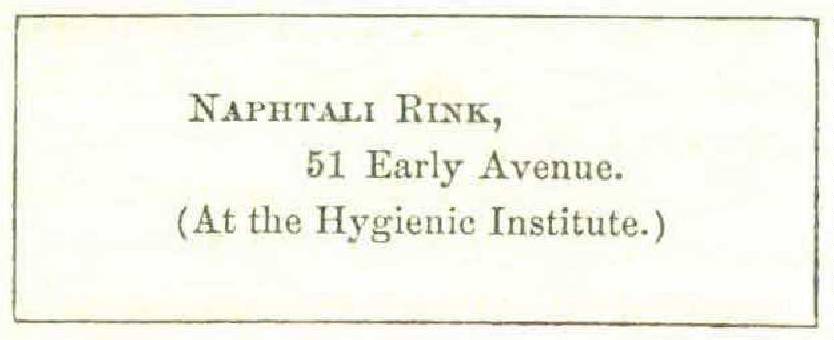
Of course, this is only in miniature, and represents every way but a very small part of the document, the address being but a drop in the superscriptive surge, —a rivulet of text meandering through a meadow of marginalia. Inasmuch as Dūspeptos courted the widest publicity for these stomachic scraps, no scruples of delicacy forbid me to jot down here some few of them. He thought them fitted for the race, — the more readers the better: perhaps it may be, the more the merrier. If called upon to classify them, I should put them all under the genus Gastric Scholia. The different species and varieties it is hardly worth while to enter upon here. There were intuitions, recollections, and glosses, apparently set down in a fragmentary way from time to time, in a most minute and distinct text. Very probably they were hints of thoughts designed to be worked up in a more formal way. Whether the quotations were taken at first or second hand I cannot say ; but internal evidence would seem to indicate that many of them might have been clippings from the columns of “ The Old Lancaster Day-Book.” It is, perhaps, worthy of note that Mr. Rink was, in fact, a man of rather more thought and general information than one might suppose, if judging him merely by his uncouth grammar, and the clipped coin of his jangling speech: —
That spoiled the hymns when Cromwell’s army sang.”
Now, then, O reader, returning from this feast of fat things, I lay before you the scraps.
“ Character is Digestion.”
“ There’s been a good deal of highfangled nonsense written about genius. One man says it’s in the head; another, that it comes from the heart, etc., etc. The fact is, they ’re all wrong. Genius lies in the stomach. Who ever knew a fat genius ? Now there’s De Quincey, —he says, in his outlandish way, that genius is the synthesis of the intellect with the moral nature. No such thing; and a man who sinned day and night against his stomach, and swilled opium as he did, could n’t be expected to know. If there’s any synthesis at all about it, it’s the synthesis of the stomach with the liver.”
“ What a complete knowledge of human nature Sam Slick shows, when he says, ‘ A bilious cheek and a sour temper are like the Siamese twins : there’s a nateral cord of union atween them. The one is a sign with the name of the firm written on it in long letters.’ ”
“ The French are a mighty cute people. They know a thing or two about as well as the next man. There’s a heap of truth and poetry in these maxims of one of their writers: ‘ Indigestion is the remorse of a guilty stomach ’; 4 Happiness consists in a hard heart and a good digestion.’ ”
“ The old tempter—the original Jacobs — was called in Hebrew a nachash, so I’m told. But folks don’t seem to understand exactly what this nachash was. Some say it was a rattlesnake, some a straddle - bug. Old Dr. Adam Clarke, I ’ve heard, vowed it was a monkey. They ’re all out of their reckoning. It’s as plain as a pikestaff that it was nothing but Fried Fat cooked up to order, and it’s been a-terapting weak sisters ever since. That’s what’s the matter.”
“ Let me make the bran-bread of a nation, and I care not who makes its laws.”
“ It makes me master-sick to hear all these fellows who’ve just made out to scrape together a few postage-stamps laying down their three-cent notions about the way to get on in the world, the rules for success, and all that. Just as it a couple of greenbacks could make a blind man see clean through a millstone! They ’re like these old nursing grannies : No. 1 thinks catnip is the only thing ; No. 2 believes there’s nothing like sage-tea and mustard-poultice; No. 3 swears by burdock. The truth is, — and men might as well own up to it first as last, — success depends on bile.”
“ Shakspeare was a man who was pretty well posted in human nature all round, — knew the kitchen about as well as the parlor. He knocks on the head the sin of stuffing, in ‘ All’s Well that Ends Well,’ where he speaks of the man that 1 dies with feeding his own stomach.’ In ‘ Timon of Athens ’ there’s a chap who ‘ greases his pure mind,’ probably with fried sausages, gravy, and such like trash. The fellow in ‘ Macbeth ’ who has ‘ eaten of the insane root’ was meant, I calculate, as a hard rap on tobacco-chewers (and smokers too) ; he called it root, instead of leaf, just to cover up his tracks. What a splendid thought that is in ‘ Love’s Labor’s Lost ’: ‘ Fat paunches have lean pates ’ ! Everybody knows how Julius Cæsar turned up his nose at fat men. The poet never could stand frying ; he calls it, in ‘ Macbeth,’ 1 the young fry of treachery.’ Probably he’d had more taste of the traitor than was good for him. Has a good slap somewhere on the critter that ‘ devours up all the fry it finds.’ I reckon that Shakspeare always set a proper valuation on human digestion ; ’cause when he speaks of a man with a good stomach,—an excellent stomach,—he always has a good word for him, and kind of strokes down his fur the right way of the grain ; but he comes down dreadful strong on the lout that has no stomach, as he calls it. In ‘ Henry IV.,’ he says, 1 the cook helps to make the gluttony.’ I estimate that that one sentence alone, if he’d never writ another word, would have made him immortal. If I had my way, I’d have it printed in gold letters a foot long, and sot up before every cook-stove in the land. But just see what a man he was ! This very same play that tells the disease prescribes the cure, that is, ‘the remainder-biscuit,’ — a knock-down proof to any man with a knowledge-box that Graham-bread was known and appreciated in those days, and that Shakspeare himself had cut his own eye-teeth on it.”
“ A broken heart is only another name for an everlasting indigestion.”
“ History is merely a record of indigestions, — a calendar of the foremost stomachs of the age. The destinies of nations hang on the bowels of princes. Internal wars come from intestine rebellion. The rising within is father to the insurrection without. The fountain of a national crisis is always found under the waistcoat of one man. There’s Napoleon I., —what settled him for good was just that greasy mutton-chop stewed up in onions, which he took for his grub at Leipsic. If he’d only ordered a couple of slices of dry Graham-toast, with a cup of weak black tea, he’d have saved his stomach, and whipped 'em, sure; and matters and things in Europe would have had a different look all round ever since.”
“ Emerson is a man who once in a while gets a little inkling of the truth, I see he says that the creed lies in the biliary duct. That’s good orthodox doctrine, I don’t care who says it.”
“Buckwheat-cakes are now leading us back to barbarism faster than the printing - press ever carried us forward towards civilization.”
“ Temperament means nothing more nor less than just quantity and quality of bile. That old sawbones, Hippocrates, came mighty near hitting the nail square on the head more ’n two thousand year ago, but he felt kind of uncertain, and did n’t exactly know what he was driving at. The old heathen made out just four humors, as he called ’em,—the sanguineous, phlegmatic, choleric, and melancholic. If he’d only made one step more on to the other side of the fence, he’d have cracked the nut, and picked the kernel, certain. Those four different humors are only four different ways of modifying bile with fat.”
“ Every man is dyspeptic. Tell me his dyspepsy, and I’ll tell you what he is.”
“In sick-headache, a heaping tablespoonful each of salt and common mustard, stirred into a pint of hot water, and drank without breathing, will generally produce an immediate effect. (Mem. But Graham-biscuit is better in the long run.) ”
“ Society is the meeting of a gang of incurables, who come together to talk over their dyspepsies. And everybody takes his turn in furnishing fodder to keep the thing going hot-foot.”
“ Professor Bache says sea - sickness comes from the head, 'cause a man gets dizzy in trying to get used to the teetering of the ship. All nonsense. The Professor may be posted in the survey of the coast, but he don’t know the lay of the land in the interior. Sea-sickness comes from the stomach: just offer a man a mouthful of fried salt pork.”
“ It’s stated that some old bookworm of a Dutchman, with a jaw-breaking name that I can’t recollect, has an idea, that, ‘ if we could penetrate into the secret foundations of human events, we should frequently find the misfortunes of one man caused by the intestines of another.' There’s not the least doubt of it, — true of one man or a million.”
“ Fate is Fat: Fat is Fate.”
V. — NOCTURNE.
Romanza (affettuoso).
The Choral Gamut (con espressione).
WAS that seething sun never again to plunge his lurid face beneath the waves of old Ocean ? Had some latter - day Joshua arisen, and with stern fiat nailed him in mid - heavens, blazing forever? To me as slowly rolled the westering orb down that final slope as ever turned the wheel of Fortune to Murad the Unlucky. Perchance the sun-god had turned cook, and now, burning with ’prentice zeal, and scoffing at Dūspeptos and all sound hygiene, was aiming to make of this terrestrial ball one illimitable fry turned over and well done, — a fry ever doing and never done, which should simmer and fizzle on eternally down the ages. An abstract fry —let me here record it — suits me passing well; yet I like not the owncrete and personal broil. I trip gayly to a feast, prepared to eat, but not, as in the supper of Polonius, to be eaten. I have very little of the martyr - stuff about me. It is well, it is glorious, to read of those fine things ; but does any man relish the application of the Hoc age ? To beatified Lawrence I gladly pay meet tribute of tears and praise. Let the luckless one ask of me no more ; let him all only upon the succulent; let him recruit among the full ranks of the adipose. Be it mine to lay these spareribs athwart no gridiron more fervid than the pavement of his own monumental Eseurial. Suum cuique.
So, albeit in a melting mood, I gazed listlessly upon the brazen firmament, with no fellow-feeling for those hot culinary bars. The broiling glow was not at all tempting : I think it would have staggered even the gay salamander that is said to accept so thoroughly the gospel of caloric. And what was the Markerstown without the Great Captain ? What was the Victory with no Nelson ? Hence, like the patriarch, I went out to meditate at the eventide. But, alack! there were no camels, no Rebekah, no comfort. Even in subterranean grots there was nothing drawn but Tropic’s XXX. Every watercock let on a geyser. But by-and-by Apollo Archimagirus, wearying of gastronomy, stayed his hand, moistened the fierce flames, jerked the half-fried earth out into free space, pocketed his stew-pan, and Hung himself supperless to bed. No more, for the nonce at least, should that new Lycidas—the cosmical gridiron — flame in the forehead of the evening sky. Anon came twilight, dusk, darkness, and all the pleasant charities of deep night. Behind the veil of night are sometimes done evil deeds. The snail has been known to start before his time. Laying down these general postulates, I drew therefrom, late in the sultry gloom, this particular inference: Cæsar’s shallop might possibly breast the deep before dawn ; and if Cæsar was not on hand, she would carry his fortunes, but not him. Forthwith, groping through the obscurity, I found my fears without foundation. The shallop was quiescent in a remarkable degree, and thoroughly tethered.
Deep darkness reigned throughout the little kingdom. Silence brooded over all, save now and then when some vocal nose, informed by murky visions of the night, brayed out its stertorous tale to the unheeding air. At times a shrill, sharp pipe, screaming with gusts of horror, split my unexpectant ear. With this wrangled fitfully the cracked clarionet of some peevish brother. Ever and anon some vast nostril, punctually thundering, hurled forth the relentless growl of the bassoon,— a very mountain of sound, which crushed all before it, and made the shuddering timbers crack and reel. A pensive flute vainly poured, in swift recurring gushes, its rhythmic oil upon the roaring billows. From some melodious swain came a freakish fiddling, which leaped and danced like mad, now here, now there, like an audible will-o’-the-wisp. A dolorous whistle chimed harmonics, and with regular sibilation came to time, quavering out the chromatic moments of this nasal hour. High over all floated a faint whisper,—a song-cloud rising from the dreammist of a peaceful breast,—a revelation timidly exhaled to the disembodied spirits of the air. Its hazy lullaby breathed down as from distant heights, and murmured of celestial rest. Its soul was like a star, and dwelt apart.
Save this feeling symphony, all was still. No light shone upon the tuneful beaks. Like Theseus, I picked my way along, guided by an Ariadne’s thread. My Ariadne was a slumbering orchestra deftly spinning out a thick proboscischord of such stuff as dreams are made of. Taking this web in my ear, I safely traversed the labyrinth, and meandered at last into pen No. 1. In placing my foot on the edge of the under-world crib, I unwittingly pressed some secret spring which straight swung wide the portals of a precipitate dawn.
VI. — THE PEPTIC SYMPHONY.
A. — Andante (smorzando).
B. — Adagio (crescendo).
C. — Allegro (sforzando).
Instantaneously rose resplendent
THE MIDNIGHT SUN.
The Luminary. — Hullo !
The Satellite. — Ah ! got back ? Is that you, Mr. Rink ?
The Luminary. — Wal, ef’t a’n't me, ’t’s my nose. Mebby y’ a’n't aware, young man, that you planted your shoeleather on my olfactory ?
The Satellite. — Indeed, no, Sir. I thought I felt something under my foot, as I was getting up. So it seems it was your nose. Beg your pardon, Sir,—entirely unintentional. Hope I -
The Luminary. — Who ’s your shoemaker? What do you wear for cowhide ?
The Satellite. — An excellent artist, a long way from Paris. I have on at this moment a very neat thing in English gaiters, of respectable dimensions, toecorners sharp as Damascus blade, threefourths of an inch in sole, one and a half inches in heel, with a plenty of half-inch cast-steel nails all round,—quite a neat thing, I assure you.
The Luminary. — Whew !
The Satellite. — But I hope, Sir, I have n’t injured your nose ?
The Luminary. — Can’t tell jest yit. Anyhow, you gev me a proper sneezer, a most pertickler hahnsome socdolager, I vum ! Landed jest below the peepers. But hold on till mornin’, an’ see how breakfast sets. I allers estimate the nose by the stomach. Ef I find my stomach’s all right, ’t ’ll be a sure sign that the smellers are pooty rugged.
The Satellite. — That’s rather an odd idea. I was aware that the nose is a natural guide to the stomach, but did n’t know that the reverse would hold good. What is the-
The Luminary.—Poor rule that wun’t work both ways. Six of one and half a dozen of the other. Do you s’pose the nose could afford to work free gratis for the stomach, with plenty to do an’ nothin’ to git? No, Sir, not by a jugful! People that want favors must n’t be stingy in givin’ on ’em. It’s on the scratchmy-back-an’ -I-’il-tickle-your-elbow system. The stomach’s got to keep up his cend o’ the rope, or he ’ll jest go under, sure. One good turn deserves another, you know.
The Satellite. — Yes, a very pretty theory, and certainly a just one. Quite on the Mutual-Benefit principle. Still, I should be inclined to doubt whether there are facts sufficient to sustain it.
The Luminary. — Wal, my hearty, you jest belay a bit up there; clew down your hatches ship-shape, git everythin’ all trig, an’ lay to. Why, my Christian friend, I intend to post you up thoroughly. Your edication ’s been neglected. Facts? Facts? Bless your noddle, there’s plenty on ’em, ef a man knows beans. Now I’m jest a-goin’ to let daylight into that little knowledge - box o’ yourn, an’ fill it with good, wholesome idees, clean up to the brim, an’ runnin’ over, — good, honest, Shaker measure. I ’ll give ye more new wrinkles afore mornin’ than ever you dreamed of in your physiology, valooable hints, an’ nuthin’ to pay.
Being now securely camped on my mountain-height, I peered out upon the horizon beneath, and signified to the Luminary that the gas might at once be turned on full blaze.
Looks through the horizontal misty air,”
so gleamed, no longer nebulous, but now full-orbed, the bright star Diætetica, — a central sun, holding within its ample bosom the star-dust of whole galaxies, infinite gastric constellations.
The Luminary.—“ Any fool ’ll allow that there ’s nerves, an’ plenty on ’em, all over the body. All these nerves come from the stomach. Fact is, they ’re the stomach’s errand-boys. They run round an’ do his chores jest as he says, an’ then trot back ag'in. He ’s an awful hard master, though,—likes to shirk, an’ makes ’em lug round all his baggage an’ chicken - fixin’s. When he gits grumpy, which is pooty consid’able often, he ’s death on some on ’em, —jest walks into ’em like chain-lightnin’ into a gooseberry-bush. When he’s gouty, he kicks up a most eternal touse with the great-toe nerve, an’ slaps it right into him fore an’ aft, the wust kind. Folks hev asked me why the gout pitches into the great toe wuss than the rest on ’em. It’s jest as nateral as Natur’. I cal’late it’s a special Providence for the benefit of the hull human family, to hang out a big sign jest where folks ken see it, to show up the man who ’s ben an’ sinned ag’inst his stomach. When he limps round in flannel, he ’s a conspicoous hobblin’ adver tisement, a fust-cut lecturer on temperance, an’ the horrible example to boot. Now you know the way the stomach an’ nerves fay in.
“Wal, then ag’in, there’s another set, — the stomach’s own blood - relations. He ’s head o’ the family, an’ they all work in together nice an’ handy, jest as slick as grease. Lam ary one on ’em, an’ you got to lam the whole boodle. Jest like a hornet’s nest: shake a stick at ary one o’ the group, an’ they all come buzzin’ round te’ble miffy in less ’n no time. There’s the nose,— he wears a coat jest as well ’s the stomach : he ’s the stomach’s favorite grandson, the Benjamin of the flock. Say anythin' to him, an’ the stomach takes it up ; say anythin’ to the stomach, an’ he takes it up. All in a family-way, ye see. Love me, love my dorg. There’s no disputin’ the fact, that you can’t kill ary one on ’em without walkin’ over the dead body of the others. You can’t whip ary one on ’em except over the others’ shoulders. Now you know who the nose is, who his connections are, an’ what’s his geneology. He’s descended from the stomach in the second degree, an’ will be heir to all the property, ef so be he’s true to himself an’ the family. Ef he a’n’t, th’ old man ’ll cut him off with a shillin’, sure-
“ Now dyspepsy ’s of two kinds,—the mucous an’ the nervous; an’ as I ’m a sinner, every mother’s son an’ daughter has got one on ’em. The nervous, as you will naturally s’pose from my remarks, is a sort o’ hired help, — friend o' the family, like a poor relation, — handy to hev in the house, an’ all that. The other allers takes pot-luck with the family, runs in an’ out jest as he pleases, — chip o’ the old block, one o’ the same crowd, you know. Ft’s considered ruthcr more hon’able, in course, to hev this one. None o’ the man-waiter or sarvaut-gal about him. A chap with the mucous looks kind o’ slick an’ smooth, an’ feels his oats pooty wal; but a codger with the nervous is sort o’ thin an’ wild-like. Wholesalers generally hev the fust, an’ retailers the second; though, ’easionally, I hev known exceptions. A bank-president invariably has the second; an’ I never seen an apple-woman without the other. All accordin’ to Natur’, ye see. But either on ’em ’ll do. Take jest whichever you can git,—that’s my advice,—an’ thank Providence. They ’ll either on ’em be faithful friends, never desert ye, cling closer than a brother, never say die, stick to ye, in p’int o’ fact, like a sick kitten to a hot brick. It’s jest as I said,—every critter ’s got one on ’em. But there’s no two men alike, so there’s no two dyspepsies alike. There never was, an’ never will be. ’T ’s exackly like the human family, divided into two great classes, black an’ white, long-heel an’ short-heel. Jes’ so . . . . nervous .... mucous .... Magna Charta .... Palladium of our liberties .... ark of our safety .... manifest destiny .... Constitootion of our forefathers .... fit, bled, an’ died .... independence forever .... one an’ inseparable .... last drop o’ blood . . . .”
How it was I don’t quite know ; but I think that at this point the Luminary must have sunk below the horizon. Possibly his Satellite may have suffered an eclipse in this quarter of the heavens. I can barely recall a thin doze, in which these last eloquent fragments, transfigured into sprites and kobolds, wearing a most diabolical grin, seemed to be chasing each other in furious and endless succession through my brain, or playing at hide-and-seek among the convolutions of the cerebrum. After a while, they wearied of this rare sport, scampered away, and left me in profound sleep till morning.
VII.-MATINS.
WHANK ! — tick-a-lick ! —ker-thump ! — swoosh ! — Whank ! — tick-a-lick ! — ker-thump ! — swoosh ! — Those were the sounds that first greeted my opening ears. So, then, we were fairly under way, advancing, if not rejoicing. Our freighted Icarus was soaring on well-oiled wings: how soon might his waxy pinions droop under the fierce gaze of the sun ! At least it was a satisfaction to know that thus far the gloomy forebodings of the Seer had not been fulfilled. On looking out through a six-inch rose-window, I saw joyous daylight dancing over the boundless, placid waters, — not a speck of land in sight. We must have started long since ; but my eyes, fast sealed under the opiate rays of the Luminary, had hitherto refused to ope their lids to the garish beams of his rival. Soon I heard beneath a rustling snap, as of a bow, and suddenly there sped forth the twanging shaft of the
First Victim. — I say !
Second Victim. — Very sensible, but brief. Give us another bit.
First Victim. — How are ye this mornin’ ?
Second Victim. — Utterly glorified. Delicious sleep, — splendid day, — balmy air, with condiments thrown in. I hope you are nicely to-day ?
First Victim. — Wal, no, can’t say I be. Feel sort o’ seedy like, — feel jest’s ef I ’d ben creouped up in a sugar-box. Could n’t even git a cat-nap, — did n’t sleep a wink.
Second Victim. — That ’s bad, indeed ; but the bracing air here will soon-
First Victim.— Air! That ’ere docksmell nigh finished me. No skim-milk smell about that, but the ginooine jam, —an awful pooty nosegay ! ’T was reg’lar rank p’is’n. Never see anythin’ like it. Oh, ’t was te’ble ! Took hold o’ my nose dreflle bad ; I ’m afeard my stomach ’ll be a goner. ’T wa’n’t none o’ yer sober perfumes nuther, but kind o’ half-seas-over all the time, an’ pooty consid’able in the wind. Judge there’s ben a large fatality in cats lately. Ugh ! that blamed dock-smell! Never forgit it the longest day I live. Don’t b’licve I breathed oneet all night.
Second Victim. — Yes, it was slightly aromatic, I confess, — ‘ Sabæan odors from the spicy shores of Araby the Blest,’ — you know what Milton says. But there ’s one great comfort: this thick night-air is so very healthy, you know. I think you made a very great mistake, Mr. Rink, in not inhaling it thoroughly. I kept pumping it in all night, from a sense of duty, at forty bellows-power.
First Victim. ( Rising, and dragging up to the mountain-crib the artillery of a ghostly face, and training it point-blank at Second Victim.) — Young man, don’t trifle!
Second Victim. — Pardon me, Sir, I am not trifling. I have sound reasons for what I say. Your education, Sir, has apparently been neglected. Wait one moment, and I ’ll give you a new idea, which will contribute materially to your happiness. You will at once admit, I take it, that oxygen and carbonic acid stand at opposite poles in their relations to the respiratory system; also, that said dock-smell was a mixture of carbonic acid of various kinds, and of different degrees of intensity; and, lastly, that animal and vegetable life are complements of each other, — correlatives, so to speak.
First Victim. — Sartin : that’s Natur’ an’ common sense.
Second Victim. — Now, then, plants naturally absorb carbonic acid and give off oxygon diming daylight. At night, the process is reversed : then they absorb oxygen and give off carbonic acid. In a similar, but reverse way, man, who was plainly intended to inhale oxygen and exhale carbonic acid in his waking hours, should, in his sleeping hours, in order to be consistent with himself and with Nature, inhale only dense carbonic acid and exhale oxygen. Men and plants make Nature’s see-saw : one goes up as the other goes down. Hence it follows as a logical sequence, that the truly wise man, who seeks to comply with the laws of Nature, and to fulfil the great ends of his existence, will choose for his sleepingapartment the closest quarters possible, and will welcome the fumes which would be noisome by day. For my part, therefore, I feel profoundly grateful even for one night of this little crib. It has already done much for me. I feel confident that it has contributed greatly to my span of life. I am deeply beholden to the owners, to the captain, yea, to all the crew. And for the blessed docksmell I shall ever be thankful: —
One glance at its array,”
It will not be amiss to say to you, Mr. Rink, that this theory is sanctioned by one of the leading ornaments of the French Academy. He has advocated it, in an elaborate treatise, with an eloquence and power worthy of its distinguished author. He shows, in passages of singular'purity, that beasts, whose instincts teach them far more of the laws of Nature than our reason teaches us, always retire to sleep in a place where they can obtain the closest, healthiest air. In the last communication sent to me on this subject by the learned Professor, he proves conclusively that-
First Victim. (His artillery now rumbling down the heights on the full gallop.) — I snum, that’s awful! Wal, I never see, — ’t beats the Dutch! No kind o’ use talkin’ with sech a chap. Never see so much nonsense in one head ’s that critter ’s got in his.
VIII. — JENTACULAR.
A BARROW - TONE full of groan and creak, trundling along through the wellknown bravura commencing, —
“ In Köln, a town of monks and bones,” etc.
Yes, the aroma was highly complicate, but not, like the poet, of imagination all compact. It was not Frangipanni, though in part an eternal perfume; nor was it Bergamot, or Attar, or Millefleurs, or Jockey-Club, or New-Mown Hay. No, it was none of these. What was it, then ? you ask. I dissected it as well as I could, though not with entire success; but I will tell you the members of this body of death, so far as I found them. I do not for a moment doubt that it was made up of at least the two-and-seventy several parts which bloomed in the bouquet plucked by the bard in Hermann’s land ; yet my feeble sense could not distinguish all. There was unquestionably a fry,— nay, several; the fumes of coffee soared riotous ; I could detect hot biscuits distinctly ; the sausage asked a foremost place; pancakes, griddle-cakes, doughnuts, gravies, and sauces, all struggled for precedence; the land and the sea waged internecine war for place, through their representative fries of steak and mackerel; and as the unctuous pork — no nursling of the flock, but seasoned in ripe old age with salt not Attic — rooted its way into the front rank, I thought of the wisdom of Moses. All these were, so to speak, the mere outlying flakes, the feathery curls, of the balmy cirro-cumulus, whose huge bulk arose out of the bowels of the ship itself. Up and down, in and out, here and there, into every chink and crevice, rolled the blue-white incensecloud, dense as the cottony puff at the mouths of the guns in Vernet’s “ Siege of Algiers.” Or you might say that these were but the flying-buttresses, the flori ated pinnacles, the frets, and the gargoyles of a great frowzy cathedral lying vast and solid far below.
The Captain sat at the head of the table ; next him was the fixed star Dūspeptos, with Satellite stationary on the right quarter.
Eupeptos. — Coffee, — that ’s good. John, fill my cup. Have it strong, mind, — no milk.
Dūspeptos. (Placing hand remonstratingly on arm of Eupeptos.)—My friend, man’s life a’n’t more ’n a span, anyhow ; yourn wun’t be wuth more ’n half a span. Don’t ye do it.
Eupeptos. (Gayly.) — Dum vivimus, vivamus. Try a cup, Mr. Rink.
Dūspeptos. — No, Sir. Thousan’ dollars ’d be no objick at all. There’d be a dead Rink layin’ round in less ’n half a shake. I ’d want a permit from the undertaker fust, an’ hev my measure for a patent casket to order. This child a’n’t anxious to cut stick yit awhile.
Eupeptos. — I ’m very much of Voltaire’s way of thinking about coffee. I don’t know but I would agree with Mackintosh, that the measure of a man’s brains is the amount of coffee he drinks. I like it in the French style, all but the lait; that destroys the flavor, besides making it despicably weak. Have a hot biscuit, Mr. Rink ? I ’m afraid they ’re like Gilpin, — carry weight, you know. But try one, won’t you ?
Dūspeptos.—I’m shot ef I do. Don’t hev any more o’ yer nonsense, young man, or I ’ll git ructions.
Eupeptos.— All right. Advance, pancakes ! Here ’s a prime one, steaming hot, crisp and fizzling. Allow me to put it on your plate, Sir ?
Dūspeptos. — Not by a long chalk. Hands off, I tell ye, or there ’ll be a free fight afore shortly. You’d better make up yer mind to oncet thet this ’ere thing a’n’t goin’ to ram nohow.
Eupeptos. — Sorry I can’t suit you. Better luck next time. Ah ! here’s the very thing. Waiter, pass the fried steak, salt mackerel, and fried potatoes to Mr. liink.
Dūspeptos. — Wun’t stan’ it, — I snore I wun’t ! I tell ye, I’m gittin’ masterriled. Jest you take yer own fodder, an’ keep quiet.
Eupeptos. — Pardon me, Sir, but my eye has just fallen on yonder dish of dough-nuts, faced by those incense-breathing griddle-cakes. Look slightly soggy, but not disagreeable. This sea-air, you know, gives a man a tremendous appetite for anything, and the digestion of an ostrich. Risk it, won’t you ?
Dūspeptos. (With determined air, clenching knife and fork pointing skywards.) — Stranger, le’ ’s come to a distinct understandin’ on this subjick afore we git much older. You know puffickly wal what I am, — a confirmed dyspeptic for twenty-five year. An’ I a’n’t ashamed on it, nuther ; but I ’m proud to say I glory in it. You know puffickly wal what my notions is about all this ’ere stuff, an’ still you keep stickin’ it into my face. Now, ef you want me to lambaste ye, I ’m the man to do it, an’ do it hahnsome. But ef yer life a’n’t insured clean up to the hub, an’ ef yer ’ve got any survivin’ friends, I advise ye not to tote any more o’ that ’ere grub in this direction. I give ye fair warnin’,— yer ’ve raised my dander, an’ put my Ebenezer up. I’d jest as lieves wallop ye as eat, an’ ten times lieveser.
Eupeptos. — Really, Sir, no offence intended. I saw that your taste was delicate, and offered you these various titbits in the hope that some one of them might prove acceptable. But pray, Sir, do not starve yourself on my account. What in the world can you eat ? Do not, I beseech you, by undue fasting, deprive the world of so distinguished -
Duspeptos. (Mollifying.) — Fact is, I knew jest how’t was goin’ to be. They allers fry everythin’ an’ cook it up in grease, so no respectable man can git any decent vittles t’ eat. So I jest went out an’ laid in plenty o’ my own provender,— suthin’ reliable an’ wholesome, ye know. Brought aboard a firkin o’ Graham-biscuit,— jest the meal mixed up with water, — no salt, no emptins, no nuthin’. ’T ’s the healthiest thing out o’ jail. It’s Natur’s own food, an’ the best eatin’ I know. Raäl good flavor, git ’em good, besides bein’ puffickly harmless an’ salubrious. I cal’late I ’ve got enough to run the machine, an’ keep it all trig up to concert-pitch, till I git ashore, ef so be th’ old tub don’t send us to Davy Jones’s locker. Here, try one, — I 've got a plenty, — an’ you ’ll say they ’re fustrate. Leave them ’ere pancakes, an’ all that p’is’n truck. Arter you take one o’ these, you ’ll never tech nuthin’ else.
Eupeptos. — Thank you, Sir, but if it’s all the same to you, please excuse me this time. I have other fish to fry. In fact, Sir, I am entirely destitute of equanimity, and have no particle of stability in my disposition. Not a drop of Scotch blood in my veins.
Dūspeptos. — There ’s no oats about these ; an’ ef there was, ’t would n’t hurt ye none. It ’s jest the kernel an’ the shell mixed up together.
Eupeptos. — Dangerous combination. I have no military ambition,—would n’t give a rush for a spread eagle, — don’t like the braying by a mortar.
Dūspeptos. — Wal, I mout as wal vamose, ’s long as I’ve hove in my rations. Already gone risin’ a good halfounce. above my or’nary ’lowance. ’T wun’t do to dissipate, even ef a feller a’n’t to hum an’ nobody ’s the wiser. Natur’ allers makes ye foot the bill all the same on sea an’ shore.
Eupeptos. ( Trolling in a low voice the celebrated barcarole,
“ My bark is by the shore,” etc.) —
Stay, oh, stay, gentle stranger ! See yon sausage fatly floating! Be not dogged to go, but come ! Prithee, return once more to the festive board ! Lo ! this — the fattest of the flock — shall be thy portion, most favored Benjamin !
Dūspeptos. (—Muttering in the distance.)— That feller’s a raäl jo-fired numbskull. He don’t know any more about the fust principles o’ human natur’ than the babe unborn. Reg’lar goney. Dunno whether he ’a jokin’ or in sober airnest. Good mind to sail into him anyhow. Guess ’t ’ll do, though, to leave him to Natur’. He ’ll stuff himself to death fast enough .... pitchin' into p’is’n .... sexton .... six-board box .... coroner’s verdick .... run over by a fry .... engineer did his dooty ....
IX. — FINALE (con motivo.)
BUT time would fail me to tell you of the myriad golden spangles so thickly stitched into the hurrying web of those fustian hours. Oh ! that dim crepuscular time, when, with toe set to toe squarely on the scratch, we stood up to one another, with eyes glaring through the gloaming, and gave and took manfully, fighting out anew the old battles of the Bourbon vs. China, of King James vs. Virginia, of Graham vs. Greece! I could tell you of the siesta of the new Prometheus, when, perched on the Mount Caucasus of a bleak chain-cable, he gave himself postprandially, in full livery of seisin, to the vulturous sun. Wasted, yet daily renewed, enduring, yet murmuring not, he hurled defiance at Fat, scoffed at the vain rage of Jupiter Pinguls, and proffered to the world below a new life in his fiery gift of stale bran-bread. Would you could have heard that vesper hymn stealing hirsute through the mellow evening-air! It sung the Peptic Saints and Martyrs, explored the bowels of old Time, and at last died away in dulcet cadence as it chanted the glories of the coming Age of Grits. Again, in the silent night-watches, did sage Mentor become vocal, going over afresh the story of the Nervous and the Mucous, classifying their victims, generalizing laws, discriminating the various dyspepsics of the nations, and summing up at last the inestimable benefits conferred by our modern dyspepsy on the character, the literature, and the life of this nineteenth century.
Once more—for the last time—did the sable robe in wrap us. Once more the night - blooming cereus oped its dank petals; and amid its murky fragrance I sank to rest. When I woke, the whank ! —tick-a-lick! — whank ! —tick-a-lick ! — had ceased, and we were safely moored. I leaped lightly to the shore, and, reverently stooping, saluted with fond gratitude my Mother Earth. Rising, I beheld for the last time the gaunt form of the Martyr standing on the deck,— a bar sinister sable blazoned athwart the golden shield of the climbing sun. And once more he lift up his voice : —
“Hullo! What! up killick an’ off a’ready ? Ye ’r’ bound to go it full chisel any way,—don’t mean to hev grass grow under your heels, that’s sartin. Wal, ’t ’s the early bird thet ketches the worm ; an’ it’s the early worm thet gits picked, too, — recollember that. I cal’late you reckon the Markerstown’s about played out, an’ a’n’t exackly wut she’s cracked up to be. It’s pooty plain thet that ’ere blamed grease has ben one too many for ye, arter all yer lingo. Ef a man will dance, he’s got to pay the fiddler. You can’t go it on tick with Natur’ ; she’s some on a trade, an’ her motto is, ‘ Down with the dosh.’ Ef you think you can play ’possum, an’ pull the wool over her eyes, jest try it on, that ’s all; you ’ll find, my venerable hero, thet you ’re shinnin’ a greased pole for the sake of a bogus fo’pence-ba’penny on top.
“ Now, young man, afore you hurry up your cakes much further, I’ve got jest two words to say to ye. Don t cut it too fat, or you ’ll flummux by the way, an’ leave nuthin’ but a grease-spot. Don t dawdle round doin’ nuthin’ but stuffin’ yerself to kill. Don’t act like a gonus, — don’t hanker arter the flesh - pots. Wake up, peel your eyes, an’ do suthin’ for a dyspeptic world, for sufferin' sinners, for yerself. Allers stick close to Natur’ an’hyg’ene. Drop yer nonsense, an’ come over an’ j’in us, an’ we ’ll make a new man of ye,—jest as good as wheat. You ’re on the road to ruin now; but we ’ll take ye, an’ build ye up, give ye tall feed, an’ warrant ye fust-cut health an’ happiness. No cure, no pay. An’ look here, keep that ’ere card I gev ye continooally on hand, an’ peroose it day an’ night. I tell ye it ’ll be the makin’ on ye. An’ don’t forgit the golden rule:—Don’t tech, don’t g’ nigh the p’is’n upus-tree of gravy; beware o’ the dorg called hot biscuits; take keer o’ the grease, an’ the stomach ’ll take keer of itself. Ef you ’re in want o’ bran-bread at any time, let me know, an’ I ’m your man, — Rink by name, an’ Rink by natur’. An’ ef so be you ever come within ten mile o’ where I hang out, jest tie right up on the spot, without the slightest ceremony or delayance, an’ take things puffickly free an’ easy like. Wal, my hearty, I see ye ’re on the skedaddle. Take keer o’ yerself, — yourn till death, N. Rink.”