The Geological Middle Age
I SHALL pass lightly over the Permian and Triassic epochs, as being more nearly related in their organic forms to the Carboniferous epoch, with which we are already somewhat familiar, while in those next in succession, the Jurassic and Cretaceous epochs, the later conditions of animal life begin to be already foreshadowed. But though less significant for us in the present stage of our discussion, it must not be supposed that the Permian and Triassic epochs were unimportant in the physical and organic history of Europe. A glance at any geological map of Europe will show the reader how the Belgian island stretched gradually in a southwesterly direction during the Permian epoch, approaching the coast of France by slowly increasing accumulations, and thus filling the Burgundian channel; a wide border of Permian deposits around the coal-field of Great Britain marks the increase of this region also during the same time, and a very extensive tract of a like character is to be seen in Russia. The latter is, however, still under doubt and discussion among geologists, and more recent investigations tend to show that this Russian region, supposed at first to be exclusively Permian, is at least in part Triassic.
With the coming in of the Triassic epoch began the great deposits of Red Sandstone, Muschel-Kalk, and Keuper, in Central Europe. They united the Belgian island to the region of the Vosges and the Black Forest, while they also filled to a great extent the channel between Belgium and the Bohemian island. Thus the land slowly gained upon the Triassic ocean, shutting it within ever-narrowing limits, and preparing the large inland seas so characteristic of the later Secondary times. The character of the organic world still retained a general resemblance to that of the Carboniferous epoch. Among Radiates, the Corals were more nearly allied to those of the earlier ages than to those of modern times, and Crinoids abounded still, though some of the higher Ecliinoderm types were already introduced. Among Mollusks, the lower Bivalves, that is, the Brachiopods and Bryozoa, still prevailed, while Ammonites continued to be very numerous, differing from the earlier ones chiefly in the everincreasing complications of their inner partitions, which become so deeply involuted and cut upon their margins, before the type disappears, as to make an intricate tracery of very various patterns on the surface of these shells. The most conspicuous type of Articulates continues as before to be that of Crustacea; but Trilobites have finished their career, and the Lobster-like Crustacea make their appearance for the first time. It does not seem that the class of Insects has greatly increased since the Carboniferous epoch ; and Worms are still as difficult to trace as ever, being chiefly known by the cases in which they sheltered themselves. Among Vertebrates, the Fishes still resemble. those of the Carboniferous epoch, belonging principally to the Selachians and Ganoids. They have, however, approached somewhat toward a modern pattern, the lobes of the tail being more evenly cut, and their general outline more like that of common fishes. The gigantic marsh Reptiles have become far more numerous and various. They continue through several epochs, but may be said to reach their culminating point in the Jurassic and Cretaceous deposits.
I cannot pass over the Triassic epoch without some allusion to the so-called bird-tracks, so generally believed to mark the introduction of Birds at this time. It is true that in the deposits of the Trias there have been found many traces of footsteps, indicating a vast number of animals which, except for these footprints, remain unknown to us. In the sandstone of the Connecticut Valley they are found in extraordinary numbers, as if these animals, whatever they were, had been in the habit of frequenting that shore. They appear to have been very diversified ; for some of the tracks are very large, others quite small, while some would seem, from the way in which the footsteps follow each other, to have been quadrupedal, and others bipedal. We can even measure the length of their strides, following the impressions which, from their succession in a continuous line, mark the walk of a single animal.1 The fact that we find these footprints without any bones or other remains to indicate the animals by which they were made is accounted for by the mode of deposition of the sandstone. It is very unfavorable for the preservation of bones ; but, being composed of minute sand mixed with mud, it affords an admirable substance for the reception of these impressions, which have been thus cast in a mould, as it were, and preserved through ages.
These animals must have been large, when full-grown, for we find strides measuring six feet between, evidently belonging to the same animal. In the quadrupedal tracks, the front feet seem to have been smaller than the hind ones. Some of the tracks show four toes all turned forward, while in others three toes are turned forward and one backward. It happened that the first tracks found belonged to the latter class; and they very naturally gave rise to the idea that these impressions were made by birds, on account of this formation of the foot. This, however, is a mere inference; and since the inductive method is the only true one in science, it seems to me that we should turn to the facts we have in our possession for the explanation of these mysterious footprints, rather than endeavor to supply by assumption those which we have not. As there are no bones found in connection with these tracks, the only way to arrive at their true character, in the present state of our knowledge, is by comparing them with bones found in other localities in the deposits of the same period in the world’s history. Now there have never been found in the Trias any remains of Birds, while it contains innumerable bones of Reptiles; and therefore I think that it is in the latter class that we shall eventually find the solution of this mystery.
It is true that the bones of the Triassic Reptiles are scattered and disconnected;2 no complete skeleton has yet been discovered, nor has any loot been found; so that no direct comparison can be made with the steps. It is, however, my belief, from all we know of the character of the Animal Kingdom in those days, that these animals were reptilian, but combined, like so many of the early types, characters of their own class with those of higher animals yet to come. It seems to me probable, that, in those tracks where one toe is turned backward, the impression is made not by a toe, but by a heel, or by a long sole projecting backward; for it is not pointed, like those of the front toes, but is blunt. It is true that there is a division of joints in the toes, which seems in favor of the idea that they were those of Birds ; for when the three toes are turned forward, there are two joints on the inner one, three on the middle, and four on the outer one, as in Birds. But this feature is not peculiar to Birds; it is found in Turtles also. The correspondence of these footprints with each other leaves no doubt that they were all by one kind of animal; for both the bipedal and the quadrupedal tracks have the same character. The only quadrupedal animals now known to us which walk on two legs are the Kangaroos. They raise themselves on their hind legs, using the front ones to bring their food to their mouth. They leap with the hind legs, sometimes bringing down their front feet
to steady themselves after the spring, and making use also of their tails, to balance the body after leaping. In these tracks we find traces of a tail between the feet. I do not bring this forward as any evidence that these animals were allied to Kangaroos, since I believe that nothing is more injurious in science than assumptions which do not rest on a broad basis of facts; but I wish only to show that these tracks recall other animals besides Birds, with which they have been universally associated. And seeing, as we do, that so many of the early types prophesy future forms, it seems not improbable that they may have belonged to animals which combined with reptilian characters some birdlike features, and also some features of the earliest and lowest group of Mammalia, the Marsupials. To sum up my opinion respecting these footmarks, I believe that they were made by animals of a prophetic type, belonging to the class of Reptiles, and exhibiting many synthetic characters.
The more closely we study past creations, the more impressive and significant do the synthetic types, presenting features of the higher classes under the guise of the lower ones, become. They hold the promise of the future. As the opening overture of an opera contains all the musical elements to be therein developed, so this living prelude of the Creative work comprises all the organic elements to be successively developed in the course of time. When Cuvier first saw the teeth of a Wealden Reptile, he pronounced them to be those of a Rhinoceros, so mammalian were they in their character. So, when Sommering first saw the remains of a Jurassic Pterodactyl, he pronounced them to be those of a Bird. These mistakes were not due to a superficial judgment in men who knew Nature so well, but to this prophetic character in the early types themselves, in which features were united never known to exist together in our days.
The Jurassic epoch, next in succession, was a very important one in the history of Europe. It completed the junction of several of the larger islands, filling the channel between the central plateau of France and the Belgian island, as well as that between the former and the island of Bretagne, so that France was now a sort of crescent of land holding a Jurassic sea in its centre, Bretagne and Belgium forming the two horns. This Jurassic basin or inland sea united England and France, and it may not be amiss to say a word here of its subsequent transformations. During the long succession of Jurassic periods, the deposits of that epoch, chiefly limestone and clays, with here and there a bed of sand, were accumulated at its bottom. Upon these followed the chalk deposits of the Cretaceous epoch, until the basin was gradually filled, and partially, at least, turned to dry land. But at the close of the Cretaceous epoch a fissure was formed, allowing the entrance of the sea at the western end, so that the constant washing of the tides and storms wore away the lower, softer deposits, leaving the overhanging chalk cliffs unsupported. These latter, as their supports were undermined, crumbled down, thus widening the channel gradually. This process must, of course, have gone on more rapidly at the western end, where the sea rushed on with most force, till the channel was worn through to the German Ocean on the other side, and the sea then began to act with like power at both ends of the channel. This explains its form, wider at the western end, narrower between Dover and Calais, and widening again at the eastern extremity. This, ancient basin, extending from the centre of France into England, is rich in the remains of a number of successive epochs. Around its margin we find the Jurassic deposits, showing that there must have been some changes of level which raised the shores and prevented later accumulations from covering them, while in the centre the Jurassic deposits are concealed by those of the Cretaceous epoch above them, these being also partially hidden under the later Tertiary beds. Let us see, then, what this inland sea has to tell us of the organic world in the Jurassic epoch.
At that time the region where LymeRegis is now situated in modern England was an estuary on the shore of that ancient sea. About forty years ago a discovery of large and curious bones, belonging to some animal unknown to the scientific world, turned the attention of naturalists to this locality, and since then such a quantity and variety of such remains have been found in that neighborhood as to show that the Sharks, Whales, Porpoises, etc., of the present ocean are not more numerous and diversified than were the inhabitants of this old bay or inlet. Among these animats, the Ichthyosauri ( Fish - Lizards) form one of the best-known and most prominent groups. They are chiefly found in the Lias, the lowest set of beds of the Jurassic deposits, and seem to have come in with the close of the Triassie epoch. It is greatly to be regretted that all that is known of the Triassie Reptiles antecedent to the Ichthyosauri still remains in the form of original papers, and is not yet embodied in text-books. They are quite as interesting, as curious, and as diversified as those of the Jurassic epoch, which are, however, much more extensively known, on account of the large collections of these animals belonging to the British Museum. It will be more easy to understand the structural relations of the latter, and their true position in the Animal Kingdom, when those which preceded them are better understood. One of the most remarkable and numerous of these Triassie Reptiles seems to have been an animal resembling, in the form of the head, and in the two articulating surfaces at the juncture of the head with the backbone, the Frogs and Salamanders, though its teeth are like those of a Crocodile. As yet nothing has been found of these animals except the head, — neither the backbone nor the limbs; so that little is known of their general structure.
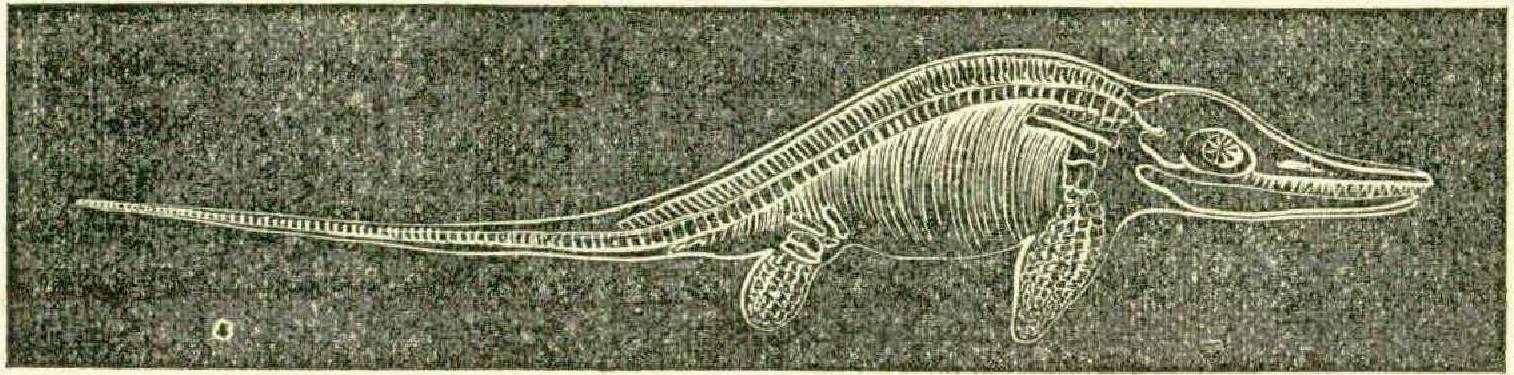
The Ichthyosauri (Figure 1) must have been very large, seven or eight feet being the ordinary length, while specimens contain a number of conical teeth, of reptilian form and character; the eyeball was very large, as may be seen by the socket, and it was supported by pieces of bone, such as we find now only in the eyes of birds of prey and in the bony fishes. The ribs begin at the neck and continue to the tail, and there is no distinction between head and neck, as in most Reptiles, but a continuous outline, as in Fishes. They had four limbs, not divided into fingers, but forming mere paddles. Yet fingers seem to be hinted at in these paddles, though not developed, for the bones are in parallel rows, as if to mark what might be such a division. The back-bones are short, but very high, and the surfaces of articulation are hollow, conical cavities, as in Fishes, instead of ball-and-socket joints, as in Reptiles. The ribs are more complicated than in Vertebrates generally : measuring from twenty to thirty feet are not uncommon. The large head is pointed, like that of the Porpoise; the jaws they consist of several pieces, and the breast-bone is formed of a number of bones, making together quite an intricate bony net-work. There is only one living animal, the Crocodile, characterized by this peculiar structure of the breastbone. The Ichthyosaurus is, indeed, one of the most remarkable of the synthetic types : by the shape of its head one would associate it with the Porpoises, while by its paddles and its long tail it reminds one of the whole group of Cetaceans to which the Porpoises belong; by its crocodilian teeth, its ribs, and its breast-bone, it seems allied to Reptiles; and by its uniform neck, not distinguished from the body, and the structure of the back-bone, it recalls the Fishes.
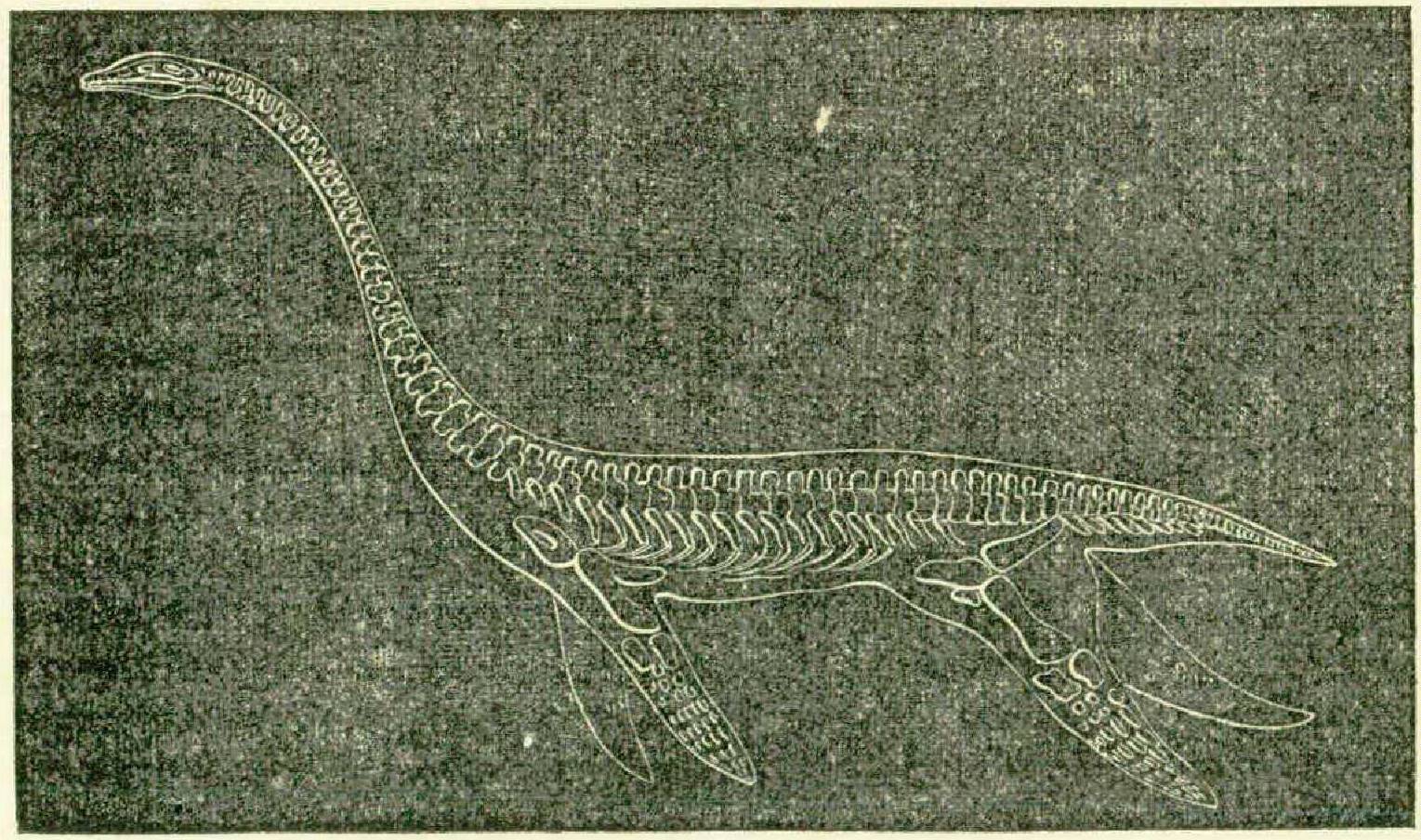
Another most curious member of this group is the Plesiosaurus, odd Saurian (Figure 2). By its disproportionately long and flexible neck, and its small, flat head, it unquestionably foreshadows the Serpents, while by the structure of the back-bone, the limbs, and the tail, it is closely allied with the IchthyosaurusIts flappers are, however, more slender, less clumsy, and were, no doubt, adapted to more rapid motion than the fins of the Ichthyosaurus, while its tail is shorter in proportion to the whole length of the animal. It seems probable, from its general structure, that the Ichthyosaurus moved like a Fish, chiefly by the flapping of the tail, aided by the fins, while in the Plesiosaurus the tail must have been much less efficient as a locomotive organ, and the long, snake-like, flexible neck no doubt rendered the whole body more agile and rapid in its movements. In comparing the two, it may be said, that, as a whole, the Ichthyosaurus, though belonging by uralists, on account of its large winglike appendages. From the extraordinary length of its anterior limbs, they have generally been described as wings, and the animal is usually represented as a flying Reptile. But if we consider its whole structure, this does not seem probable, and I believe it to have been an its structure to the class of Reptiles, lias a closer external resemblance to the Fishes, while the Plesiosaurus is more decidedly reptilian in character. If there exists any animal in our waters, not yet known to naturalists, answering to the descriptions of the “Sea-Serpent,” it must be closely allied to the Plesiosaurus. The occurrence in the fresh waters of North America of a Fish, the Lepidosteus, which is closely allied to the fossil Fishes found with the Plesiosaurus in the Jurassic beds, renders such a supposition probable.
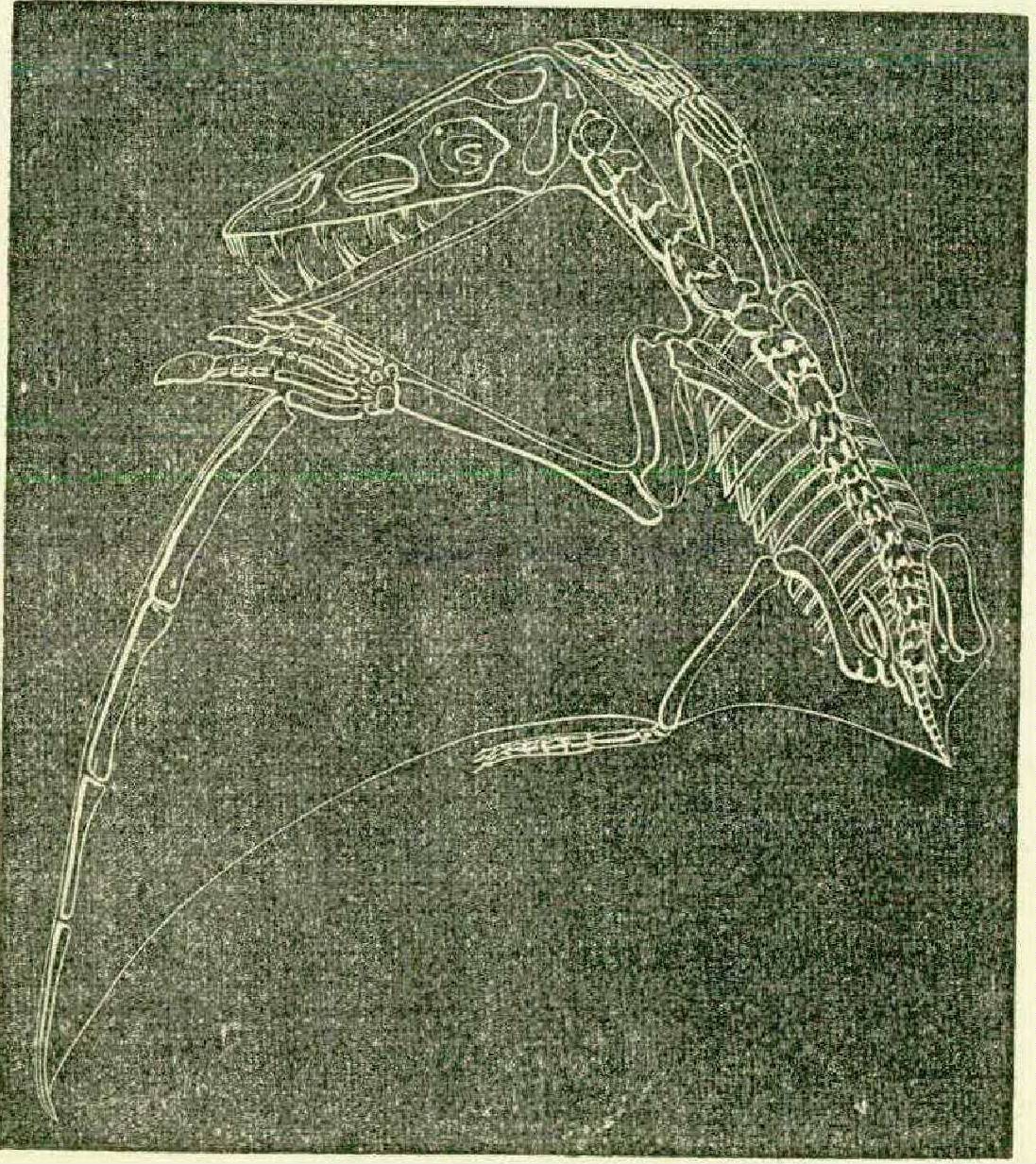
Of all these strange old forms, so singularly uniting features of Fishes and Reptiles, none has given rise to more discussion than the Pterodactylus,’ (Figure 3,) another of the Saurian tribe, associated, however, with Birds by some natessentially aquatic animal, moving after the fashion of the Sea-Turtle. Its socalled wings resemble in structure the front paddles of the Sea-Turtles far more than the wings of a Bird ; differing from them, indeed, only by the extraordinary length of the inner toe, while the outer ones are comparatively much shorter.
But, notwithstanding this difference, the hand of the Pterodaetylus is constructed like that of an aquatic swimming marine Reptile ; and I believe, that, if we represent it with its long neck stretched upon the water, its large head furnished with powerful, well-armed jaws, ready to dive after the innumerable smaller animals living in the same ocean, we shall have a more natural picture of its habits than it we consider it as a flying animal, which it is generally supposed to have been. It has not the powerful breast-bone, with the large projecting keel along the middle line, such as exists in all the flying animals. Its breast-bone, on the contrary, is thin and flat, like that of the present Sea-Turtle; and if it moved through the water by the help of its long flappers, as the Sea-Turtle does now, it could well dispense with that powerful construction of the breast-bone so essential to all animals which fly through the air. Again, the powerful teeth, long and conical, placed at considerable intervals in the jaw, constitute a feature common to all predaceous aquatic animals, and would seem to have been utterly useless in a flying animal at that time, since there were no aerial beings of any size to prey upon. The Dragon-Flies found in the same deposits with the Pterodaetylus were certainly not a game requiring so powerful a battery of attack.
The Fishes of the Jurassic sea were exceedingly numerous, but were all of the Ganoid and Selachian tribes. It would weary the reader, were I to introduce here any detailed description of them, but they were as numerous ami varied as those living in our present waters. There was the Hybodus, with the marked furrows on the spines and the strong hooks along their margin,— the huge Chimera, with its long whip, its curved bone over the back, and its parrot-like bill, — the Lcpidotus, with its large square scales, its large head, its numerous rows of teeth, one within another, forming a powerful grinding apparatus, — the Microdon, with its round, flat body, its jaw paved with small grinding teeth,— the swift Aspidorhynehus, with its long, slender body and massive tail, enabling it to strike the water powerfully and dart forward with great rapidity. There were also a host of small Fishes, comparing with those above mentioned as our Perch, Herring, Smelts, etc., compare with our larger Fishes; but, whatever their size or form, all the Fishes of those days had the same hard scales fitting to each other by hooks, instead of the thin membranous scales overlapping each other at the edge, like the common Fishes of more modern times. The smaller Fishes, no doubt, afforded food to the larger ones, and to the aquatic Reptiles. Indeed, in parts of the intestines of the Ichthyosauri, and in their petrified excrements, have been found the scales and teeth of these smaller Fishes perfectly preserved. It is amazing that we can learn so much of the habits of life of these past creatures, and know even what was the food of animals existing countless ages before man was created.
There are traces of Mammalia in the Jurassic deposits, but they were of those inferior kinds known now as Marsupials, and no complete specimens have yet been found.
The Articulates were largely represented in this epoch. There were already in the vegetation a number of Gymnosperms, affording more favorable nourishment for Insects than the forests of earlier times ; and we accordingly find that class in larger numbers than ever before, though still meagre in comparison with its present representation. Crustacea were numerous, — those of the Shrimp and Lobster kinds prevailing, though in some of the Lobsters we have the first advance towards the highest class of Crustacea in the expansion of the transverse diameter now so characteristic of the Crabs. Among Mollusks we have a host of gigantic Ammonites; and the naked Cephalopods, which were in later times to become the prominent representatives of that class, already begin to make their appearance. Among Radiates, some of the higher kinds of Echinodenns, the Ophiurans and Eehinoids, take the place of the Crinoids, and the Aealephian Corals give way to the Astræan and Meandrina-like types, resembling the ReefBuilders of the present time.
I have spoken especially of the inhabitants of the Jurassic sea lying between England and France, because it was there that were first found the remains of some of the most remarkable and largest Jurassic animals. But wherever these deposits have been investigated, the remains contained in them reveal the same organic character, though, of course, we find the land Reptiles only where there happen to have been marshes, the aquatic Saurians wherever large, estuaries or bays gave them an opportunity of coming in near shore, so that their bones were preserved in the accumulations of mud or clay constantly collecting in such localities,—the Crustacea, Shells, or SeaUrchins on the old sea-beaches, the Corals in the neighborhood of coral reefs, and so on. In short, the distribution of animals then as now was in accordance with their nature and habits, and we shall seek vainly for them in the localities where they did not belong.
But when I say that the character of the Jurassic animals is the same, I mean, that, wherever a Jurassic sea-shore occurs, be it in France, Germany, England, or elsewhere throughout the world, the Shells, Crustacea, or other animals found upon it have a special character, and are not to be confounded by any one thoroughly acquainted with these fossils with the Shells or Crustacea of any preceding or subsequent time,—that, where a Jurassic marsh exists, the land Reptiles inhabiting it are Jurassic, and neither Triassic nor Cretaceous,—that a Jurassic coral reef is built of Corals belonging as distinctly to the Jurassic creation as the Corals on the Florida reefs belong to the present creation, — that, where some Jurassic bay or inlet is disclosed to us with the Fishes anciently inhabiting it, they are as characteristic of their time as are the Fishes of Massachusetts Bay now.
And not only so, but, while this unity of creation prevails throughout the entire epoch as a whole, there is the same variety of geographical distribution, the same circumscription of faunæ within distinct zoological provinces, as at the present time. The Fishes of Massachusetts Bay are not the same as those of Chesapeake Bay, nor those of Chesapeake Bay the same as those of Pamlico Sound, nor those of Pamlico Sound the same as those of the Florida coast. This division of the surface of the earth into given areas within which certain combinations of animals and plants are confined is not peculiar to the present creation, but has prevailed in all times, though with ever-increasing diversity, as the surface of the earth itself assumed a greater variety of climatic conditions. D'Orbigny and others were mistaken in assuming that faunal differences have been introduced only in the last geological epochs. Besides these adjoining zoological faunæ, each epoch is divided, as we have seen, into a number of periods, occupying successive levels one above another, and differing specifically from each other in time as zoological provinces differ from each other in space. In short, every epoch is to be looked upon from two points of view : as a unit, complete in itself, having one character throughout; and as a stage in the progressive history of the world, forming part of an organic whole.
As the Jurassic epoch was ushered in by the upheaval of the Jura, so its close was marked by the upheaval of that system of mountains called the Cote d’Or. With this latter upheaval began the Cretaceous epoch, which we will examine with special reference to its subdivision into periods, since the periods in this epoch have been clearly distinguished, and investigated with especial care. I have alluded in the preceding article to the immediate contact of the Jurassic and Cretaceous epochs in Switzerland, affording peculiar facilities for the direct comparison of their organic remains. But the Cretaceous deposits are well known, not only in this inland sea of ancient Switzerland, but in a number of European basins, in France, in the Pyrenees, on the Mediterranean shores, and also in Syria, Egypt, India, and Southern Africa, as well as on our own continent. In all these localities, the Cretaceous remains, like those of the Jurassic epoch, have one organic character, distinct and unique. This fact is especially significant, because the contact of their respective deposits is in many localities so immediate and continuous that it affords an admirable test for the development-theory. If this is the true mode of origin of animals, those of the later Jurassic beds must be the progenitors of those of the earlier Cretaceous deposits. Let us see now how far this agrees with our knowledge of the physiological laws of development.
Take first the class of Fishes. We have seen that in the Jurassic periods there were none of our common Fishes, none corresponding to our Herring, Pickerel, Mackerel, and the like, — no Fishes, in short, with thin membranous scales, but that the class was represented exclusively by those with hard, flint-like scales. In the Cretaceous epoch, however, we come suddenly upon a horde of Fishes corresponding to our smaller common Fishes of the Pickerel and Herring tribes, but principally of the kinds found now in tropical waters; there are none like our Cods, Haddocks, etc., such as are found at present in the colder seas. The Fishes of the Jurassic epoch corresponding to our Sharks and Skates and Gar-Pikes still exist, but in much smaller proportion, while these more modern kinds are very numerous. Indeed, a classification of the Cretaceous Fishes would correspond very nearly to one founded on those now living. Shall we, then, suppose that the large reptilian Fishes of the Jurassic time began suddenly to lay numerous broods of these smaller, more modern, scaly Fishes? And shall we account for the diminution of the previous forms by supposing that in order to give a fair chance to the new kinds they brought them forth in large numbers, while they reproduced their own kind less abundantly ? According to very careful estimates, if we accept this view, the progeny of the Jurassic Fishes must have borne a proportion of about ninety per cent, of entirely new types to some ten per cent, of those resembling the parents. One would like a fact or two on which to rest so very extraordinary a reversal of all known physiological laws of reproduction, but, unhappily, there is not one.
Still more unaccountable, upon any theory of development according to ordinary laws of reproduction, are those unique, isolated types limited to a single epoch, or sometimes even to a single period. There are some very remarkable instances of this in the Cretaceous deposits. To make my statement clearer, I will say a word of the sequence of these deposits and their division into periods.
These Cretaceous beds were at first divided only into three sets, called the Neocomian, or lower deposits, the GreenSands, or middle deposits, and the Chalk, or upper deposits. The Neocomian, the lower division, was afterwards subdivided into three sets of beds, called the Lower, Middle, and Upper Neocomian by some geologists, the Yalengian, Neocomian, and Urgonian by others. These three periods are not only traced in immediate succession, one above another, in the transverse cut before described, across the mountain of Chaumont, near Neufchatel, but they are also traced almost on one level along the plain at the foot of the Jura. It is evident that by some disturbance of the surface the eastern end of the range was raised slightly, lifting the lower or Yalengian deposits out of the water, so that they remain uncovered, and the next set of deposits, the Neocomian,is accumulated along their base, while these in their turn are slightly raised, and the Urgonian beds are accumulated against them a little lower down. They follow each other from east to west in a narrower area, just, as the Azoic, Silurian, and Devonian deposits follow each other from north to south in the northern part of the United States. The Cretaceous deposits have been intimately studied in various localities by different geologists, and are now subdivided into at least ten, or it may be fifteen or sixteen distinct periods, as they stand at present. This is, however, but the beginning of the work ; and the recent investigations of the French geologist, Coquand, indicate that several of these periods at least are susceptible of further subdivision. I present here a table enumerating the periods of the Cretaceous epoch best known at present, in their sequence, because I want to show how sharply and in how arbitrary a manner, if I may so express it, new forms are introduced. The names are simply derived from the localities, or from some circumstances connected with the locality where each period has been studied.
Table of Periods in the Cretaceous Epoch.
Maestrichtian . . Senonian . . . . } Chalk.
Turonian . . . . Cenomanian . . . } Chalk Math
Albian . . . . . Aptian . . . . . . } Green Sands.
Rhodanian . . . . .
Urgonian . . . . . } Neocomian . . . . . Wealden. Valengian . . . . }
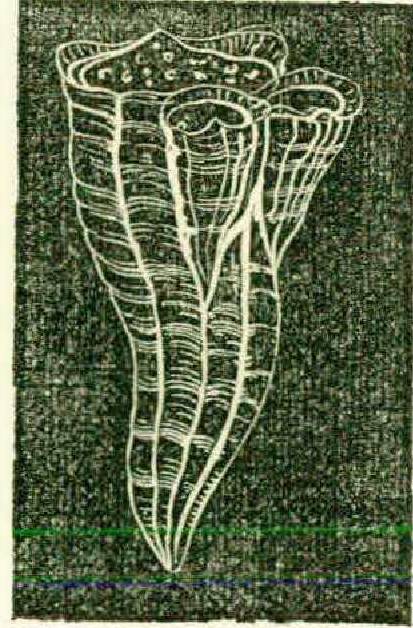
One of the most peculiar and distinct of those unique types alluded to above is that of the Rudistes, a singular Bivalve, in which the lower valve is very deep and conical, while the upper valve sets into it as into a cup. The subjoined woodcut represents such a Bivalve. These Rudistes are found suddenly in the Urgonian deposits; there are none in the two preceding sets of beds; they disappear in the three following periods, and reappear again in great numbers in the Cenomanian, Turonian, and Senonian periods, and disappear again in the succeeding one. These can hardly be missed from any negligence or oversight in the examination of these deposits, for they are by no means rare. They are found always in great numbers, occupying crowded beds, like Oysters in the present time. So numerous are they, where they occur at all, that the deposits containing them are called by many naturalists the first, second, third, and fourth bank of Rudistes. Which of the ordinary Bivalves, then, gave rise to this very remarkable form in the class, allowed it to die out, and revived it again at various intervals ? This is by no means the only instance of the same kind. There are a number of types making their appearance suddenly, lasting during one period or during a succession of periods, and then disappearing forever, while others, like the Rudistes, come in, vanish, and reappear at a later time.
I am well aware that the advocates of the development-theory do not state their views as I have here presented them. On the contrary, they protest against any idea of sudden, violent, abrupt changes, and maintain that by slow and imperceptible modifications during immense periods of time these new types have been introduced without involving any infringement of the ordinary processes of development; and they account for the entire absence of corroborative facts in the past history of animals by what they call the “ imperfection of the geological record.” Now, while I admit that our knowledge of geology is still very incomplete, I assert that just where the direct sequence of geological deposits is needed for this evidence, we have it. The Jurassic beds, without a single modern scaly Fish, are in immediate contact with the Cretaceous beds, in which the Fishes of that kind are proportionately almost as numerous as they are now ; and between these two sets of deposits there is not a trace of any transition or intermediate form to unite the reptilian Fishes of the Jurassic with the common Fishes of the Cretaceous times. Again, the Cretaceous beds in which the crowded banks of Rudistes, so singular and unique in form, first make their appearance, follow immediately upon those in which all the Bivalves are of an entirely different character. In short, the deposits of this year along any sea-coast or at the mouth of any of our rivers do not follow more directly upon those of last year than do these successive sets of beds of past ages follow upon each other. In making these statements, I do not forget the immense length of the geological periods; on the contrary, I fully accede to it, and believe that it is more likely to have been underrated than overstated. But let it be increased a thousand-fold, the fact remains, that these new types occur commonly at the dividing line where one period joins the next, just on the margin of both.
For years I have collected daily among some of these deposits, and I know the Sea-Urchins, Corals, Fishes, Crustacea, and Shells of those old shores as well as I know those of Nahant Beach, and there is nothing more striking to a naturalist than the sudden, abrupt changes of species in passing from one to another. In the second set of Cretaceous beds, the Neocomian, there is found a little Terebratula (a small Bivalve Shell) in immense quantities : they may actually be collected by the bushel. Pass to the Urgonian beds, resting directly upon the Neocomian, and there is not one to be found, and an entirely new species comes in. There is a peculiar Spatangus (SeaUrchin) found throughout the whole series of beds in which this Terebratula occurs. At the same moment that you miss the Shell, the Sea-Urchin disappears also, and another takes its place. Now, admitting for a moment that the later can have grown out of the earlier forms, I maintain, that, if this be so, the change is immediate, sudden, without any gradual transitions, and is, therefore, wholly inconsistent with all our known physiological laws, as well as with the transmutation-theory.
There is a very singular group of Ammonites in the Cretaceous epoch, which, were it not for the suddenness of its appearance, might seem rather to favor the development-theory, from its great variety of closely allied forms. We have traced the Chambered Shells from the straight, simple ones of the earliest epochs up to the intricate and closely coiled forms of the Jurassic epoch. In the so-called Portland stone, belonging to the upper set of Jurassic beds, there is only one type of Ammonite; but in the Cretaceous beds, immediately above it, there set in a number of different genera and distinct species, including the most fantastic and seemingly abnormal forms. It is as if the close coil by which these shells had been characterized during the Middle Age had been suddenly broken up and decomposed into an endless variety of outlines. Some of these new types still retain the coil, but the whorls are much less compact than before, as in the Crioceras ; in others, the direction of the coil is so changed as to make a spiral, as in the Turrilites ; or the shell starts with a coil, then proceeds in a straight line, and changes to a curve again at the other extremity, as in the Ancyloceras, or in the Scaphites, in which the first coil is somewhat closer than in the Ancyloceras; or the tendency to a coil is reduced to a single curve, so as to give the shell the outline of a horn, as in the Toxoceras; or the coil is entirely lost, and the shell reduced to its primitive straight form, as in the Baculites, which, except for their undulating partitions, might be mistaken for the Orthoceratites of the Silurian and Devonian epochs. I have presented here but a few species of these extraordinary Cretaceous Ammonites, and, strange to say, with this breaking-up of the type into a number of fantastic and often contorted shapes, it disappears. It is singular that forms so unusual and so contrary to the previous regularity of this group should accompany its last stage of existence, and seem to shadow forth by their strange contortions the final dissolution of their type. When I look upon a collection of these old shells, I can never divest myself of an impression that the contortions of a death-struggle have been made the pattern of living types, and with that the whole’ group has ended.
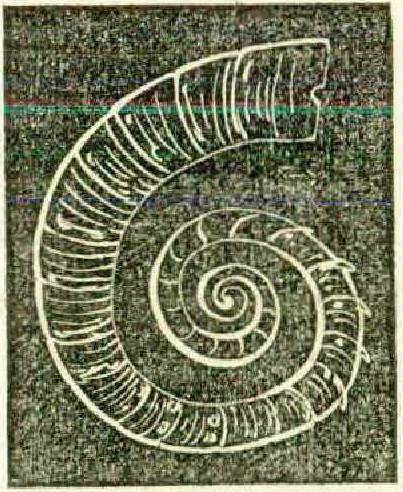
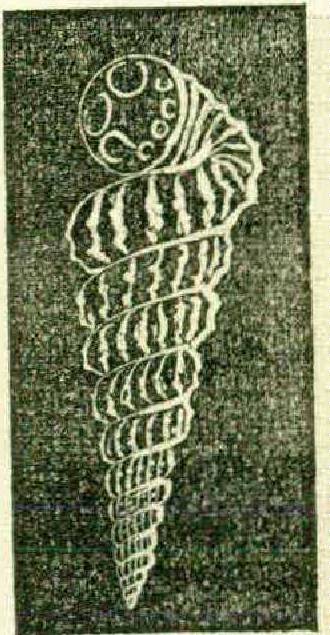
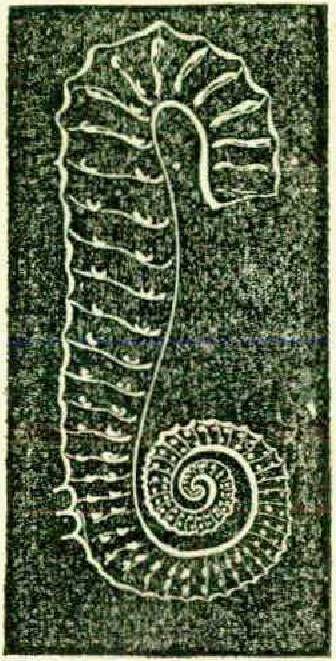
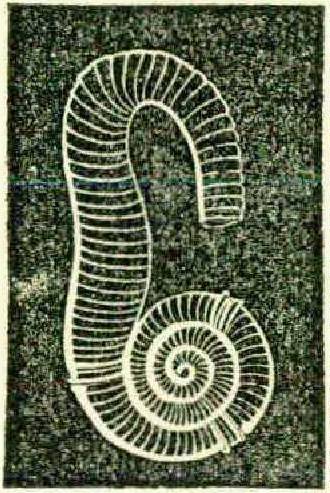
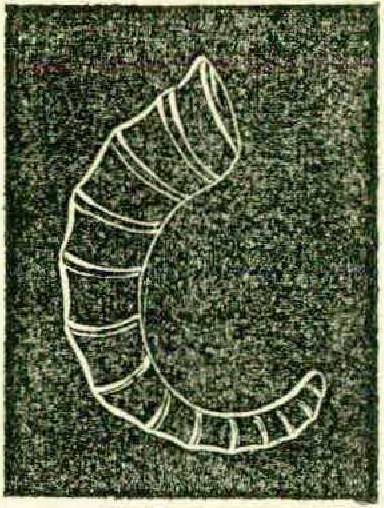
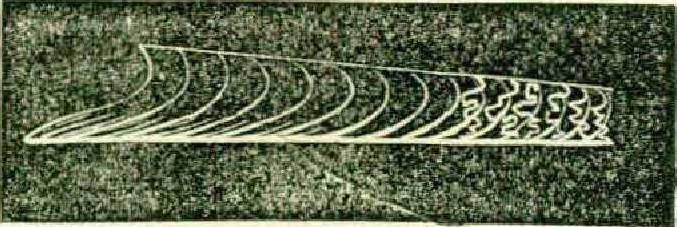
Now shall we infer that the compact, closely coiled Ammonites of the Jurassic deposits, while continuing their own kind, brought forth a variety of other kinds, and so distributed these new organic elements as to produce a large number of distinct genera and species ? I confess that these ideas are so contrary to all I have learned from Nature in the course of a long life that I should be forced to renounce completely the results of my studies in Embryology and Paleontology before I could adopt these new views of the origin of species. And while the distinguished originator of this theory is entitled to our highest respect for his scientific researches, yet it should not be forgotten that the most conclusive evidence brought forward by him and his adherents is of a negative character, drawn from a science in which they do not pretend to have made personal investigations, that of Geology, while the proofs they offer us from their own departments of science, those of Zoology and Botany, are derived from observations, still very incomplete, upon domesticated animals and cultivated plants, which can never be made a test of the origin of wild pocies.3
In my next article I shall show the relation between the Cretaceous and Tertiary epochs, and see whether there is any rea-
son to believe that the gigantic Mammalia of more modem times were derived from the Reptiles of the Secondary age.
of phenomena, showing it to be a norm, not a single instance of the other has ever been known to occur either in the animal or in the vegetable kingdom.
- For all details respecting these tracks see Hitchcock’s Ichnology of New England. Boston, 1858. 4to.↩
- See the Investigations of Hermann von Meyer on Triassic Reptiles.↩
- The advocates of the development-theory allude to the metamorphosis of animals and plants as supporting their view of a change of one species into another. They compare the passage of a common leaf into the calyx or crown-leaves in plants, or that of a larva into a perfect insect, to the passage of one species into another. The only objection to this argument seems to be, that, whereas Nature daily presents us myriads of examples of the one set↩