Methods of Study in Natural History
XIV.
IF I succeeded in explaining my Subject clearly in the last article, my readers will have seen that the five Orders of the Echinoderms are but five expressions of the same idea; and I will now endeavor to show that the same identity of structural conception prevails also throughout the two other Classes of Radiates, and further, that not only the Orders within each Class, but the three Classes themselves, Echinoderms, Acalephs, and Polyps, bear the strictest comparison, founded upon close structural analysis, and are based upon one organic formula.
We will first compare the three Orders of Acalephs, — Hydroids being the lowest, Discophone next, and the Ctenophoræ highest. The fact that these animals have no popular uames shows how little they are known. It is true that we hear some of them spoken of as JellyFishes ; but this name is usually applied to the larger Discophore, when it is thrown upon the beach aud lies a shapeless mass of gelatinous substance on the sand, or is seen floating on the surface of the water. The name gives no idea of the animal as it exists in full life and activity. When we speak of a Bird or an Insect, the mere name calls up at once a characteristic image of the thing ; but the name of JellyFish, or Sun-Fish, or Sea-Blubber, as the larger Acalephs are also called, suggests to most persons a vague idea of a fish with a gelatinous body,—or, if they have lived near the sea-shore, they associate it only with the unsightly masses of jelly-like substance sometimes strewn in thousands along the beaches after a storm. To very few does the term recall either the large Diseophore, with its purple disk and its long streamers floating perhaps twenty or thirty feet behind it as it swims, — or the Ctenophore, with its more delicate, transparent structure, and almost invisible fringes in parallel rows upon the body, which decompose the rays of light as the creature moves through the water, so that hues of ruby-red and emerald-green, blue, purple, yellow, all the colors of the rainbow, ripple constantly over its surface when it is in motion, — or the Hydroid, with its little shrub-like communities living in tide-pools, establishing themselves on rocks, shells, or sea-weeds, and giving birth not only to animals attached to submarine bodies, like themselves, but also to free Medusæ or Jelly-Fishes that in their turn give birth again to eggs which return to the parent-form, and thus, by alternate generations, maintain two distinct patterns of animal life within one cycle of growth.
Perhaps, of all the three Classes of Radiates, Acalephs are the least known. The general interest in Corals has called attention to the Polyps, and the accessible haunts of the Sea-Urchins and StarFishes have made the Echinoderms almost as familiar to the ordinary observer as the common sea-shells, while the Acalephs are usually to be found at a greater distance from the shore, and are not easily kept in confinement. It is true that the Hydroids live along the shore, and may be reared in tanks without difficulty; but they are small, and would be often, taken for sea-weeds by those ignorant of their true structure.
Thus this group of animals, with all their beauty of form, color, and movement, and peculiarly interesting from their singular modes of growth, remains comparatively unknown except to the professional naturalist. It may, therefore, be not uninteresting or useless to my readers, if I give some account of the appearance and habits of these animals, keeping in view, at the same time, my ultimate object, namely, to show that they are all founded on the same structural elements and have the same ideal significance. I will begin with some account of the Hydroids, including the story of the alternate generations, by which they give birth to Medusæ, white the Medusæ, in their turn, reproduce the Hydroids, from which they spring. But first, a few words upon the growth of Radiates in general.
There is no more interesting series of transformations than that of the development of Radiates. They are all born as little transparent globular bodies, covered with vibratile cilia, swimming about in this condition for a longer or shorter time ; then, tapering somewhat at one end and broadening at the other, they become attached by the narrower extremity, while at the opposite one a depression takes place, deepening in the centre till it becomes an aperture, and extending its margin to form the tentacles. All Radiates pass through this Polyp-like condition at some period of their lives, either before or after they are hatched from the eggs. In some it forms a marked period of their existence, while in others it passes very rapidly and is undergone within the egg; but, at whatever time and under whatever conditions it occurs, it forms a necessarypart of their development, and shows that all these animals have one and the same pattern of growth. This difference in the relative importance and duration of certain phases of growth is by no means peculiar to the Radiates, but occurs in all divisions of the Animal Kingdom. There are many Insects that pass through their metamorphoses within the egg, appearing as complete Insects at the moment of their birth; but the series of changes is nevertheless analogous to that of the Butterfly, whose existence as Worm, Chrysalis, and Winged Insect is so well known to all. Take the Grasshopper, for instance : with the exception of the wings, it is born in its mature form ; but it has had its Wormlike stage within the egg as much as the Butterfly that we knew a few months ago as a Caterpillar. In the same way certain of the higher Radiates undergo all their transformations, from the Polyp phase of growth to that of Acaleph or Echinoderm, after birth; while others pass rapidly through the lower phases of their existence within the egg, and are born in their final condition, when all their intermediate changes have been completed. We have appropriate names for all the aspects of life in the Insect: we call it Larva in its first or Worm-like period, Chrysalis in its second or Crustacean-like phase of life, and Imago in its third and last condition as Winged Insect. But the metamorphoses of the Radiates are too little known to be characterized by popular names; and when they were first traced, the relation between their different phases of existence was not understood, so that the same animal in different stages of growth has frequently been described as two or more distinct animals. This has led to a confusion in our nomenclature much to be regretted ; for, however inappropriate it may be, a name once accepted and passed into general use is not easily changed.
That early stage of growth, common to all Radiates, in which they resemble the Polyps, has been called the Hydra state, in consequence of their resemblance to the fresh-water Hydra to be found in quantities on the underside of Duck-Weed and Lily-pads. For any one that cares to examine these animals, it may be well to mention that they are easily found and thrive well in confinement. Dip a pitcher into any pool of fresh water where Duck-Weed or Lilies are growing in the summer, and you are sure to bring up hundreds of these, fresh-water Hydræ, swarming in myriads in all our ponds. In a glass bowl their motions are easily watched ; and a great deal may be learned of their habits and mode of life, with little trouble. Such an animal soon completes its growth : for the stage which I have spoken of as transient for the higher Radiates is permanent for these; and when the little sphere moving about by means of its vibratile cilia has elongated a little, attached itself by the lower end to some surface, while the inversion of the upper end has formed the mouth and digestive cavity, and the expansion of its margin has made the tentacles, the very simple story of the fresh-water Hydra is told.
But the last page in the development of these lower Radiates is but the opening chapter in that of the higher ones, and I will give some account of their transformations as they have been observed in the Acalephs.
On shells and stones, on sea-weeds or on floating logs, there may often bo observed a growth of exquisitely delicate branches, looking at first sight more like a small bunch of moss than anything else.
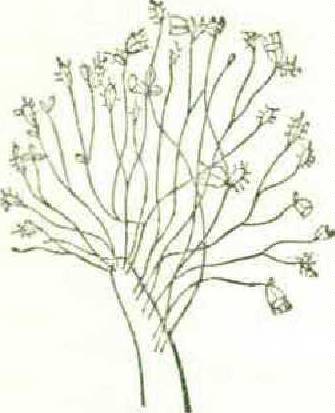
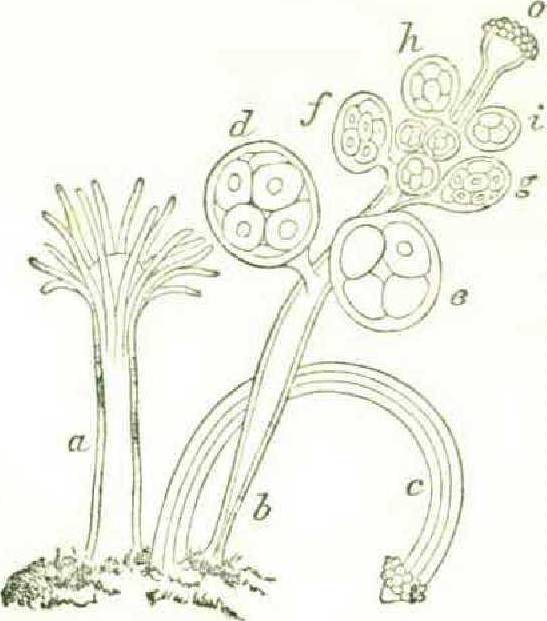
But gather such a mossy tuft and place it in a glass bowl filled with sea-water, and you will presently find that it is full of life and activity. Every branch of this miniature shrub terminates in a little club-shaped head, upon which are scattered a number of tentacles. They are in constant motion, extending and contracting their tentacles, some of the heads stretched upwards, others bent downwards, all seeming very busy and active. Each tentacle has a globular tip filled with a multitude of cells, the so-called lasso-cells, each one of which conceals a coiled-up thread. These organs serve to seize the prey, shooting out their long threads, thus entangling the victim in a net more delicate than the finest spider’s web, and then carrying it to the mouth by the aid of the lower part of the tentacle. The complication of structure in these animals, a whole community of which, numbering from twenty to thirty individuals, is not more than an inch in height, is truly wonderful. In such a community the different animals are hardly larger than a good-sized pin’s head; and yet every individual has a digestive cavity and a complete system of circulation. Its body consists of a cavity inclosed in a double wall, continuing along the whole length of each branch till it joins the common stem forming the base of the stock. In this cavity the food becomes softened and liquefied by the water that enters with it through the mouth, and is thus transformed into a circulating fluid which flows from each head to the very base of the community and back again. The inner surface of the digestive cavity is lined with brownish-red granules, which probably aid in the process of digestion ; they frequently become loosened, fall into the circulating fluid, and may be seen borne along the stream as it passes up and down. The rosy tint of the little community is due to these reddish granules.
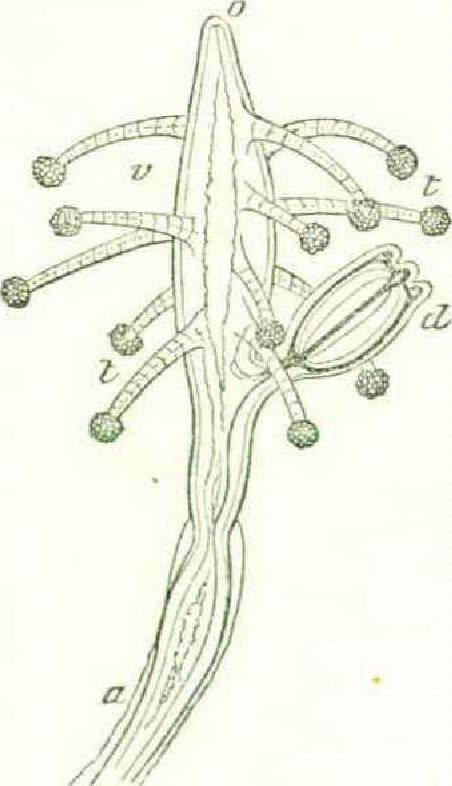
This crowd of beings united in a common life began as one such little Hydralike animal as I have described above,— floating free at first, then becoming attached, and growing into a populous stock by putting out buds at different heights along the length of the stem. The formation of such a bud is very simple, produced by the folding outwardly of the double wall of the body, appearing first as a slight projection of the stem sideways, which elongates gradually, putting out tentacles as it grows longer, while at the upper end an aperture is formed to make the mouth. This is one of the lower group of Radiates, known as Hydroids, and long believed to be Polyps, from their mode of living in communities and reproducing their kind by budding, after the fashion of Corals. But if such a little tuft of Hydroids has been gathered in spring, a close observer may have an opportunity of watching the growth of another kind of individual from it, which would seem to show its alliance with the Acalepbs rather than the Polyps. At any time late in February or early in March, bulb-like projections, more globular than the somewhat elongated buds of the true Hydroid heads, may be seen growing either among the tentacles of one of these little animals, or just below the head where it merges in the stem.1 Very delicate and transparent in substance, it is hardly perceptible at first; and the gradual formation of its internal structure is the less easily discerned, because a horny sheath, forming the outer covering of the Hydroid stock, extends to inclose and shield the new-comer, whom we shall see to be so different from the animal that gives it birth that one would suppose the Hydroid parent must be as much surprised at the sight of its offspring as the Hen that has accidentally hatched a Duck’s egg. At the right moment this film is torn open by the convulsive contractions of the animal, which, thus freed from its envelope, begins at once to expand. By this time this little bud has assumed the form of a Medusoid or Jelly-Fish disk, with its four tubes radiating from the central cavity. The proboscis, so characteristic of all Jelly-Fishes, hangs from the central opening; and the tentacles, coiled within the internal cavity up to this time, now make their appearance, and we have a complete little Medusa growing upon the Hydroid head. Gradually the point by which it is attached to the parent-stock narrows and becomes more and more contracted, till the animal drops off and swims away, a free Jelly-Fish.
The substance of these animals seems to have hardly more density or solidity than their native element. I remember showing one to a friend who had never seen such an animal before, and after watching its graceful motions for a moment in the glass bowl where it was swimming, he asked, “ Is it anything more than organized water ? ” The question was very descriptive; for so little did it seem to differ in substance from the water in which it floated that one might well fancy that some drops had taken upon themselves organic structure, and had begun to live and move. It swims by means of rapid contractions and expansions of its disk, thus impelling itself through the water, its tentacles floating behind it and measuring many times the length of the body. The disk is very convex, as will be seen by the wood-cut; four tubes radiate from the central cavity to the periphery, where they unite in a circular tube around the margin and connect also with the four tentacles; from the centre of the lower surface hangs the proboscis, terminating in a mouth. Notwithstanding the delicate structure of this little being, it is exceedingly voracious. It places itself upon the surface of the animal on which it feeds, and, if it have any hard parts, it simply sticks the juices, dropping the dead carcass immediately after; but it swallows whole the little Acalephs of other Species and other soft animals that come in its way. Early in summer these Jelly-Fishes drop their eggs, little transparent pear-shaped bodies, covered with vibratile cilia. They swim about for a time, until they have found a restingplace, where they attach themselves, each one founding a Hydroid stock of its own, which will in time produce a new brood of Medusæ.
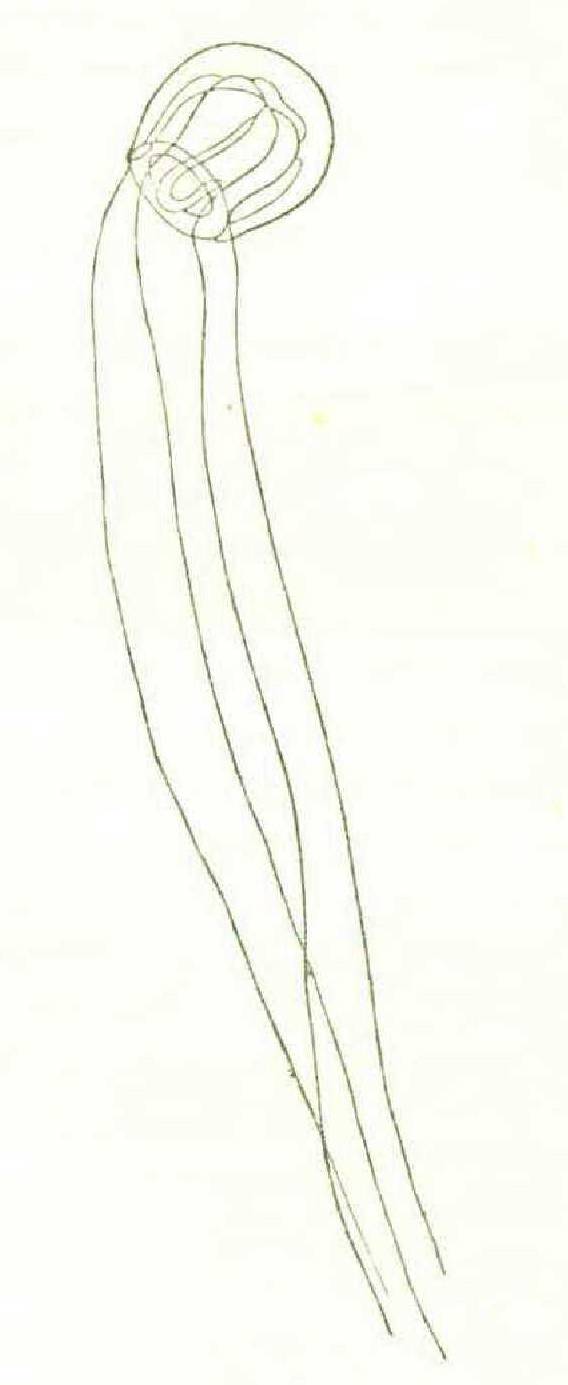
This series of facts, presented here in their connection, had been observed separately before their true relation was understood. Investigations had been made on the Hydroid stock, described as Coryne, and upon its Medusoid offspring, described as Sarsia, named after the naturalist Sars, whose beautiful papers upon this class of animals have associated his name with it; but the investigations by which all these facts have been associated in one connected series are very recent. These transformations do not correspond to our common idea of metamorphoses, as observed in the Insect, for instance. In the Butterfly’s life we have always one and the same individual, — the Caterpillar passing into the Chrysalis state, and the Chrysalis passing into the condition of the Winged Insect. But in the case I have been describing, while the Hydroid gives birth to the Medusa, it still preserves its own distinct existence; and the different forms developed on one stock seem to be two parallel lives, and not the various phases of one and the same life. This group of Hydroids retains the name of Coryne; and the Medusa born from it, Sarsia, has received, as I have said, the name of the distinguished investigator to whose labors we owe much of our present knowledge of these animals. — Let us look now at another group of Hydroids, whose mode ot development is equally curious and interesting.
The little transparent embryos from which they arise, oval in form, with a slight, scarcely perceptible depression at one end, resemble the embryos of Coryne already described. They may be seen in great numbers in the spring, floating about in the water, or rather swimming,— for the motion of all Radiates in their earliest stage of existence is rapid and constant, in consequence of the vibratile cilia that cover the surface. At this stage of its existence such an embryo is perfectly free, but presently its wandering life comes to an end ; it shows a disposition to become fixed, and proceeds to choose a suitable resting-place. I use the word “ choose ” advisedly ; for though at this time the little embryo seems to have no developed organs, it yet exercises a certain discrimination in its selection of a home. Slightly pearshaped in form, it settles down upon its narrower end ; it wavers and sways to and fro, as if trying to get a firm foothold and force itself down upon the surface to which it adheres; but presently, as if dissatisfied with the spot it has chosen, it suddenly breaks loose and swims away to another locality, where the same examination is repeated, not more to its own satisfaction apparently, for the creature will renew the experiment half a dozen times, perhaps, before making a final selection and becoming permanently attached to the soil. In the course of this process the lower end becomes flattened, and moulds itself to the shape of the body on which it rests. Once settled, this animal, thus far hardly more than a transparent oblong body without any distinct organs, begins to develop rapidly. It elongates, forming a kind of cup-like base or stem, the upper end spreads somewhat, the depression at its centre deepens, a mouth is formed that gapes widely and opens into the digestive cavity, and the upper margin spreads out to form a number of tentacles, few at first, but growing more and more numerous till a wreath is completed all around it. In this condition the young Jelly-Fish has been described under the name of Scyphostoma. As soon as this wreath of tentacles is formed, a constriction takes place below it, thus separating the upper portion of the animal from the lower by a marked dividing-line. Presently a second constriction takes place below the first, then a third, till the entire length of the animal is divided across by a number of such transverse constrictions, the whole body growing, meanwhile, in height. But now an extraordinary change takes place in the portions thus divided off. Each one assumes a distinct organic structure, as if it had an individual life of its own. The margin becomes lobed in eight deep scallops, and a tube or canal runs through the centre of each such lobe to the centre of the body, where a digestive cavity is already formed. At this time the constrictions have deepened, so that the margins of all the successive divisions of the little Hydroid are very prominent, and the whole animal looks like a pile of saucers, or of disks with scalloped edges and the convex side turned downward. Its general aspect may be compared to a string of Lilac-blossoms, such as the children make for necklaces in the Spring, in which the base of one blossom is inserted into the upper side of the one below it. In this condition our JellyFish has been called Strobila.
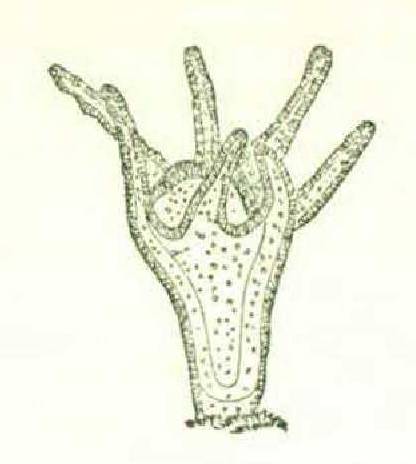
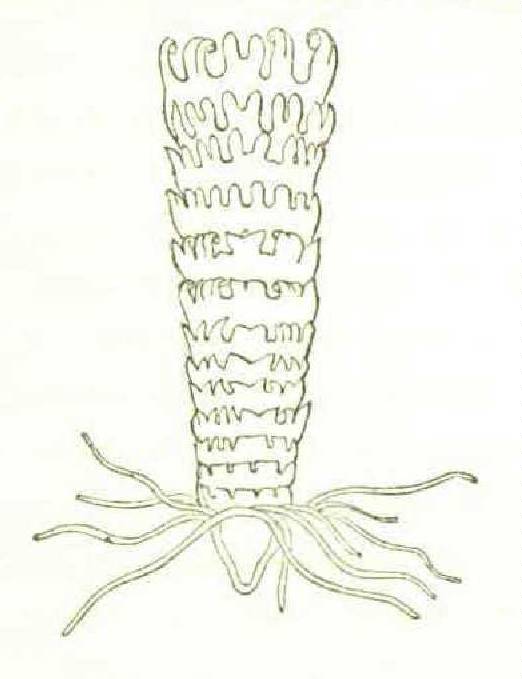
While these organic changes take place in the lower disks, the topmost one, forming the summit of the pile and bearing the tentacles, undergoes no such modification, but presently the first constriction dividing it from the rest deepens to such a degree that it remains united to them by a mere thread only, and it soon breaks off and dies. Tins is the signal for the breaking up of the whole pile in the same way by the deepening of the constrictions; but, instead of dying, as they part, they begin a new existence as free Medusæ. Only the lowest portion of the body remains, and around the margin of this tentacles have developed corresponding to those which crowned the first little embryo ; this repeats the whole history again, growing up during the following season to divide itself into disks like its predecessor.
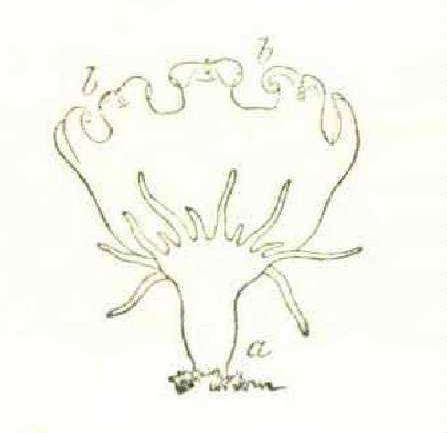
As each individual separates from the community of which it has made a part, it reverses its position, and, instead of turning the margin of the disk upward, it turns it downward, thus bringing the mouth below and the curve of the disk above. These free individuals have been described under the name of Ephyra. This is the third phase of the existence of our Jelly-Fish. It swims freely about, a transparent, umbrella-like disk, with a proboscis hanging from the lower side, which, to complete the comparison, we may call the handle of the umbrella. The margin of the disk is even more deeply lobed than in the Hydroid condition, and in the middle of each lobe is a second depression, quite deep and narrow, at the base of which is an eye. How far such organs are gifted with the power of vision we cannot decide; but the cells of which they are composed certainly servo the purpose of facets, of lenses and prisms, margin becomes almost an unbroken circle. The eight eyes were, as I have said, at the bottom of depressions in the centre of the several lobes; but, by the equalizing of the marginal line, the gradual levelling, as it were, of all the inequalities of the edge, the eyes are pushed out, and occupy eight spots on the margin, where a faint indentation only marks what was before a deep cut in the lobe. The eight tubes of the lobes have extended in like manner to the edge, and join it just at the point where the eyes are placed, so that the extremity of each tube unites with the base of each eye. Those parts of the margin filling the spaces between the eyes correspond to the depressions and must convey to the animal a more or less distinct perception of light and color. The lobes are eight in number, as before, with a tube diverging from the centre of the body into each lobe. Shorter tubes between the lobes alternate with these, making thus sixteen radiating tubes, all ramifying more or less.
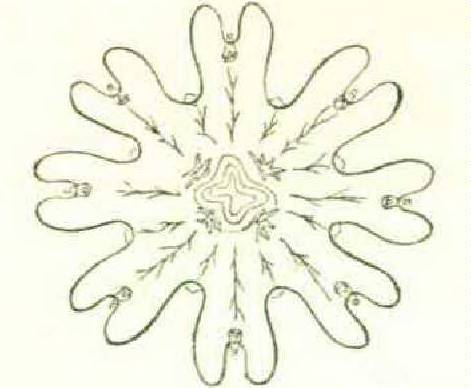
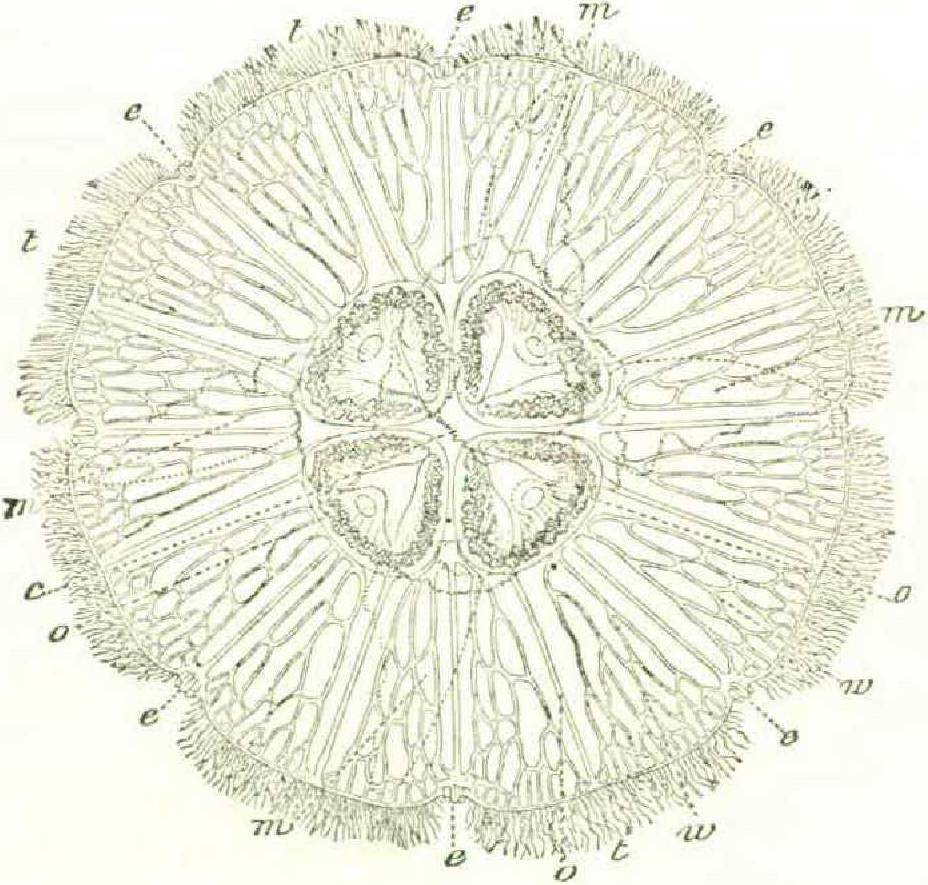
From this stage to its adult condition, the animal undergoes a succession of changes in the gradual course of its growth, uninterrupted, however, by any such abrupt transition as that by which it began its life as a free animal. The lobes are gradually obliterated, so that the dividing the lobes or scallops in the earlier stage, and to these radiate the eight other tubes alternating with the eye-tubes, now divided into numerous branches. Along each of these spaces is developed a fine, delicate fringe of tentacles, hanging down like a veil when the animal is at rest, or swept back when it is in motion. In the previous stage, the tubes ramified toward the margin ; but now they branch at or near their point of starting from the central cavity, so extensively that every part of the body is traversed by these collateral tubes, and when one looks down at it from above through the gelatinous transparent disk, the numerous ramifications resemble the fine fibrous structure of a leaf with its net-work of nervuleg.
On the lower side, or what I have called in a previous article the oral region of the animal, a wonderfully complicated apparatus is developed. The mouth projects in four angles, and at each such angle a curtain arises, stretching outwardly, and sometimes extending as far as the margin. These curtains are fringed and folded on the lower edge, so that they look like four ruffled flounces hanging from the lower side of the animal. On the upper side of the body, but alternating in position with these curtains, are the four ovaries, crescent-like in shape, and so placed as to form the figure of a cross, when seen from above through the transparency of the disk. I should add, that, though I speak of some organs as being on the upper and others on the lower side of the body, all are under the convex, arched surface of the disk, which is gelatinous throughout, and simply forms a transparent vaulted roof, as it were, above the rest of the body.
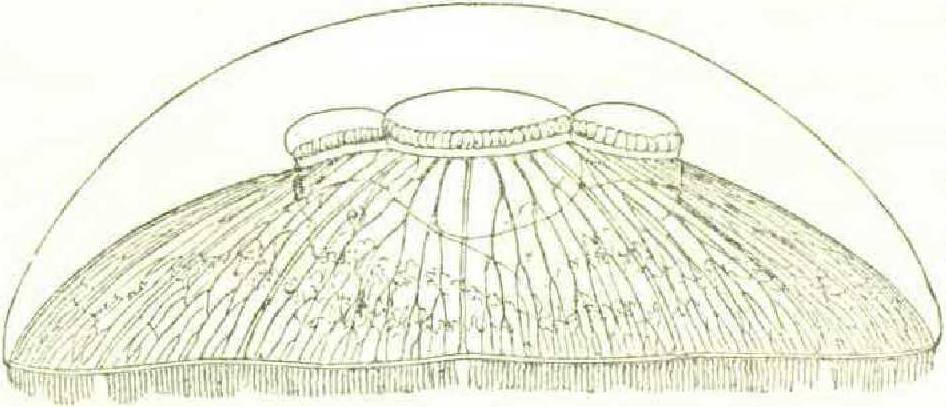
When these animals first make their appearance in the spring, they may be seen, when the sky is clear and the sea smooth, floating in immense numbers near the surface of the water, though they do not seek the glare of the sun, but are more often found about sheltered places, in the neighborhood of wharves or overhanging rocks. As they grow larger, they lose something of their gregarious disposition,— they scatter more; and at this time they prefer the sunniest exposures, and like to bask in the light and warmth. They assume every variety of attitude, but move always by the regular contraction and expansion of the disk, which rises and falls with rhythmical alternations, the average number of these movements being from twelve to fifteen in a minute. There can be no doubt that they perceive what is going on about them, and are very sensitive to changes in the state of the atmosphere ; for, as soon as the surface of the water is ruffled, or the sky becomes overcast, they sink into deeper water, and vanish out of sight. When approached with a dip-net, it is evident, from the acceleration of their movements, that they are attempting to escape.
At the spawning season, toward the end of July or the beginning of August, they gather again in close clusters. At this period I have seen them at Nahant in large shoals, covering a space of fifty feet or more, and packed so closely in one unbroken mass that an oar could not be thrust between them without injuring many. So deep was the phalanx that I could not ascertain how far it extended below the surface of the water, and those in the uppermost layer were partially forced out of the water by the pressure of those below.
It is not strange that the relation between the various phases of this extraordinary series of metamorphoses, so different from each other in their external aspects, should not have been recognized at once, and that this singular Acaleph should have been called Scyphostoma in its simple Hydroid condition. Strobila after the transverse division of the body had taken place, Ephyra in the first stages of its free existence, and Aurelia in its adult state,—being thus described as four distinct animals. These various forms are now rightly considered as the successive stages of a development intimately connected in all its parts, — beginning with the simple Hydroid attached to the ground, and closing in the shape of our common Aurelia, with its white transparent disk, its silky fringe of tentacles around the margin, its ruffled curtains hanging from the mouth, and its four crescent-shaped ovaries grouped to form a cross on the summit. From these ovaries a new brood of little embryos is shed in due time.
There are other Hydroids giving rise to Medusæ buds, from which, however, the Medusæ do not separate to begin a new life, but wither on the Hydroid stock, after having come to maturity and dropped their eggs. Such is the Hydractinia polyclina. This curious community begins, like the preceding ones, with a single little individual, settling upon some shell or stone, or on the rocks in a tidepool, where it will sometimes cover a space of several square feet. Rosy in color, very soft and delicate in texture, such a growth of Hydractinia spreads a velvetlike carpet over the rocks on which it occurs. They may be kept in aquariums with perfect success, aud for that purpose it is better to gather them on single shells or stones, so that the whole community may be removed unbroken. These colonies of Hydractinia have one very singular character: they exist in distinct communities, some of which give birth only to male, others to female individuals. The functions, also, are divided,—certain members of the community being appointed to special offices, in which the others do not share. Some bear the Medusæ buds, which in due time become laden with eggs, but, as I have said, wither and die after the eggs are hatched. Others put forth Hydroid buds only, while others again are wholly sterile. About the outskirts of the community are more simple individuals, whose whole body seems to be hardly more than a double-walled tube, terminating in a knob of lasso-cells. They are like long tentacles placed where they can most easily seize the prey that happens to approach the little colony. The entire community is connected at its base by a horny net-work, uniting all the Hydroid Stems in its meshes, and spreading over the whole surface on which the colony has established itself.
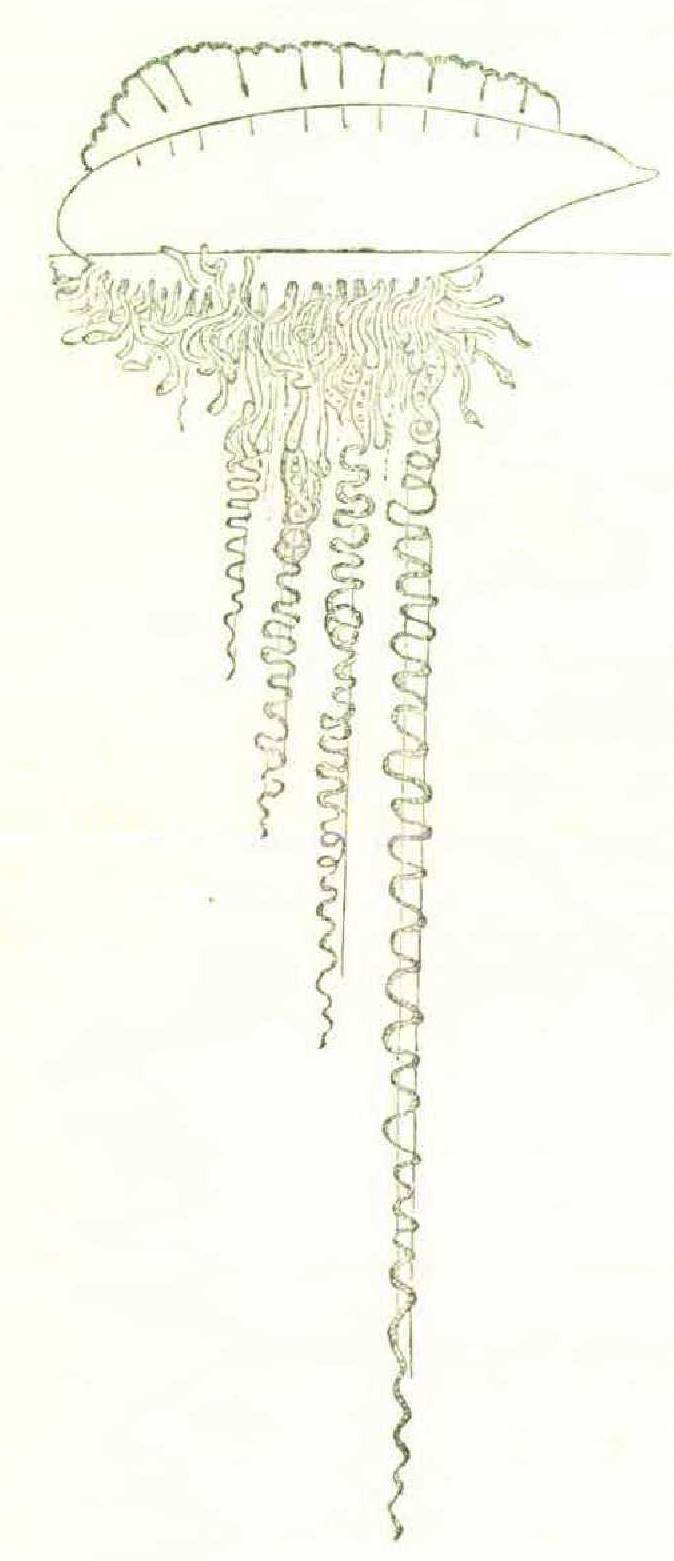
There is a very curious and beautiful animal, or rather community of animals, closely allied to the Hydractinia polyclina, which next deserves to be noticed. The Portuguese Man-of-War — so called from its bright-colored crest, which makes it so conspicuous as it sails upon the water, and the long and various streamers that hang from its lower side — is such a community of animals as I have just described, reversed in position, however, with the individuals hanging down, and the base swollen and expanded to make the air-bladder which forms its brilliant crested float. In this curious Acalephian Hydroid, or Physalia, the individuality of function is even more marked than in the Hydractinia. As in the latter, some of the individuals are Medusæ-bearing, and others simple Hydræ ; but, beside these, there are certain members of the community who act as swimmers, to carry it along through the water, — others that are its purveyors, catching the prey, by which, however, they profit only indirectly, for others are appointed to eat it, and these feeders may be seen sometimes actually gorged with the food they have devoured, and which is then distributed throughout the community by the process of digestion and circulation.
It would be hopeless, even were it desirable, to attempt within the limits of such an article as this to give the faintest idea of the number and variety of these Hydroids; and I will therefore say nothing of the endless host of Tubularians, Campanularians, Sertularians, etc. They are very abundant along our coast, and will well reward any who care to study their habits and their singular modes of growth. For their beauty, simply, it is worth while to examine them. Some are deep red, others rosy, others purple, others white with a glitter upon them, as if frosted with silver. Their homes are very various. Some like the fresh, deep sea-water, while they avoid the dash and tumult of the waves; and they establish themselves in the depressions on some low ledge of rocks running far out from the shore, and yet left bare for an hour or two, when the tide is out. In such a depression, forming a stony cup filled with purest sea-water, overhung by a roof of rock, which may be fringed by a heavy curtain of brown seaweed, the rosy-beaded, branching Eudendrium, one of the prettiest of the Tubularians, may be found. Others like the tide-pools, higher up on the rocks, that are freshened by the waves only when, the tide is full: such are the small, creeping Campanularians. Others, again, like the tiny Dynamena, prefer the rougher action of the sea; and they settle upon the sides of rents and fissures in the cliffs along the shore, where even in calm weather the waves rush in and out with a certain degree of violence, broken into eddies by the abrupt character of the rocks. Others seek the broad fronds of the larger sea-weeds, and are lashed up and down upon their spreading branches, as they rock to and fro with the motion of the sea. Many live in sheltered harbors, attaching themselves to floating logs, or to the keels of vessels; and some are even so indifferent to the freshness of the water that they may be found in numbers along the city-wharves.2
Beside the Jelly-Fishes arising from Hydroids, there are many others resembling these in all the essential features of their structure, but differing in their mode of development; for, although more or less Polyp-like when first born from the egg, they never become attached, nor do they ever bud or divide, but reach their mature condition without any such striking metamorphoses as those that characterize the development of the Hydroid Acalephs. All the Medusæ, whether they arise from buds on the Hydroid stock, like the Sarsia, or from transverse division of the Hydroid form, like the Aurelia, or grow directly from the egg to maturity, without pausing in the Hydroid phase, like the Campanella, agree in the general division and relation of parts. All have a central cavity, from which arise radiating tubes extending to the margin of the umbrella-like disk, where they unite either in a net-work of meshes or in a single circular tube. But there is a great difference in the oral apparatus; the elaborate ruffled curtains, that hang from the corners of the mouth, occur only in the Species arising from the transverse division of the Polyp-like young. For this reason they are divided into two Orders,— the Hydroids and the Discophoræ.
The third Order, the Ctenophoræ, are among the most beautiful of the Acalephs. I have spoken of the various hues they assume when in motion, and I will add one word of the peculiarity in their structure which causes this effect. The Ctenophoræ differ from the Jelly-Fishes described above in sending off from the main cavity only two main tubes, instead of four like the others; but each of these tubes divides and subdivides in four branches as it approaches the periphery. From the eight branches produced in this way there arise vertical tubes extending in opposite directions up and down the sides of the body. Along these vertical tubes run the rows of little locomotive oars, or combs, as they have been called, from which these animals derive their name of Ctenophoræ. The rapid motion of these flappers causes the decomposition of the rays of light along the surface of the body, producing the most striking prismatic effect; and it is no exaggeration to say that no jewel is brighter than these Ctenophoræ as they move through the water.
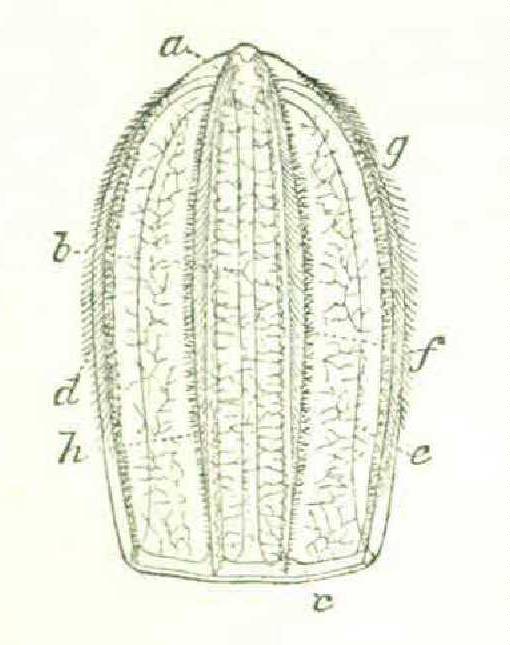
I trust I have succeeded in showing that the three Orders of the Acalephs are, like the five Orders of the Echinoderms, different degrees of complication of the same structure. In the Hydroids, the organization does not rise above the simple digestive cavity inclosed by the double body-wall; and we might not suspect their relation to the Acalephs, did we not see the Jelly-Fish born from the Hydroid stock. In the Hydroid-Medusæ and Discophoræ, instead of a simple digestive sac, as in the Hydroids, we have a cavity sending off tubes toward the periphery, which ramify more or less in their course. Now whether there are four tubes or eight, whether they ramify extensively or not, whether there are more or less complicated appendages around the margin or the mouth, makes no difference in the essential structure of these bodies. They are all disk-like in outline, they all have tentacles hanging from the margin, and a central cavity from which tubes diverge that divide the body into a certain number of portions, bearing in all the same relation to each other and to the central cavity. In the Ctenophoræ, another complication of structure is introduced in the combination of vertical with horizontal tubes and the external appendages accompanying them.
But, whatever their differences may be, a very slight effort of the imagination only is needed to transform any one of these forms into any other. Reverse the position of any simple Hydra, so that the tentacles hang down from the margin, and let four tubes radiate from the central cavity to the periphery, and we have the lowest form of Jelly-Fish. Expand the cup of the Hydra to form a gelatinous disk, increase the number of tubes, complicate their ramifications, let eyes be developed along the margin, add some external appendages, and we have the Discophore. Elongate the disk in order to give the body an oval form, diminish the number of main tubes, and let them give off vertical as well as horizontal branches, and we have the Ctenophore.
In the Class of Polyps there are but two Orders, — the Actinoids and the Halcyonoids; and I have already said so much of the structure of Polyps that I think I need not repeat my remarks here in order to show the relation between these groups. The body of all Polyps consists of a sac divided into chambers by vertical partitions, and having a wreath of hollow tentacles around the summit, each one of which opens into one of the chambers. The greater complication of these parts and their limitation in definite numbers constitute the characters upon which their superiority or inferiority of structure is based. Here the comparison is easily made; it is simply the complication and number of identical parts that make the difference between the Orders. The Actinoids stand lowest from the simple character and indefinite increase of these parts; while the Halcyonoids, with their eight lobed tentacles, corresponding to the same number of internal divisions, are placed above them.
We have the key-note to the common structure of the three Classes whose Orders we have been comparing in the name of the division to which they all belong: they are Radiates. The idea of radiation lies at the foundation of all these animals, whatever be their form or substance. Whether stony, like the Corals, or soft, like the Sea-Anemone, or gelatinous and transparent, like the Jelly-Fish, or hard and brittle, like the Sea-Urchins, — whether round or oblong or cylindrical or stellate, in all, the internal structure obeys this law of radiation.
Not only is tins true in a general way, but the comparison may be traced in all the details. One may ask how the narrow radiating tubes of the Acalephs, traversing the gelatinous mass of the body, can be compared to the wide radiating chambers of the Polyp ; and yet nothing is more simple than to thicken the partitions in the Polyps so much as to narrow the chambers between them, till they form narrow alleys instead of wide spaces, and then we have the tubes of the Jelly-Fish. In the Jelly-Fish there is a circular tube around the margin into which all the radiating tubes open. What have we to compare with this in the Polyps ? The outer edge of each partition in the Polyp is pierced by a hole near the margin. Of course when the partition is thickened, this hole, remaining open, becomes a tube; for what is a tube but an elongated bole ? The comparison of the Acalephs with the Echinoderms is still easier, for they both have tubes ; but in the latter the tubes are inclosed in walls of their own, instead of traversing the mass of the body, as in Acalephs, etc.
In preparing these articles on the homologies of Radiates, I have felt the difficulty of divesting my subject of the technicalities which cling to all scientific results, until they are woven into the tissue of our every-day knowledge and assume the familiar garb of our common intellectual property. When the forms of animals are as familiar to children as their A, B, C, and the intelligent study of Natural History, from the objects themselves, and not from text-books alone, is introduced into all our schools, we shall have popular names for things that can now only be approached with a certain professional stateliness on account of their technical nomenclature. The best result of such familiarity with Nature will be the recognition of an intellectual unity holding together all the various forms of life as parts of one Creative Conception.
- See lower wood-cut, p. 294, d.↩
- Those who care to know more of the habits and structure of these animals will find more detailed descriptions of all the various species, illustrated by numerous plates, in the fourth volume of my Contributions to the Natural History of the United States, just published.↩