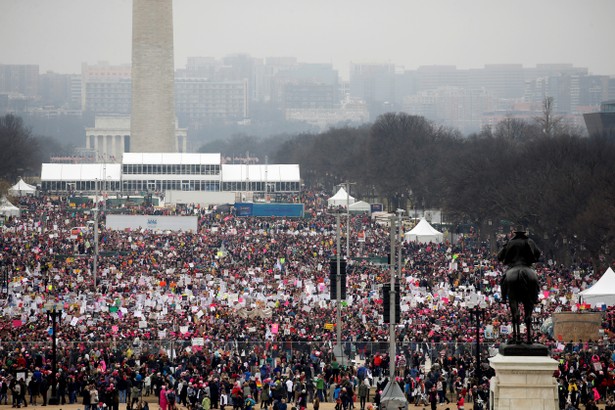
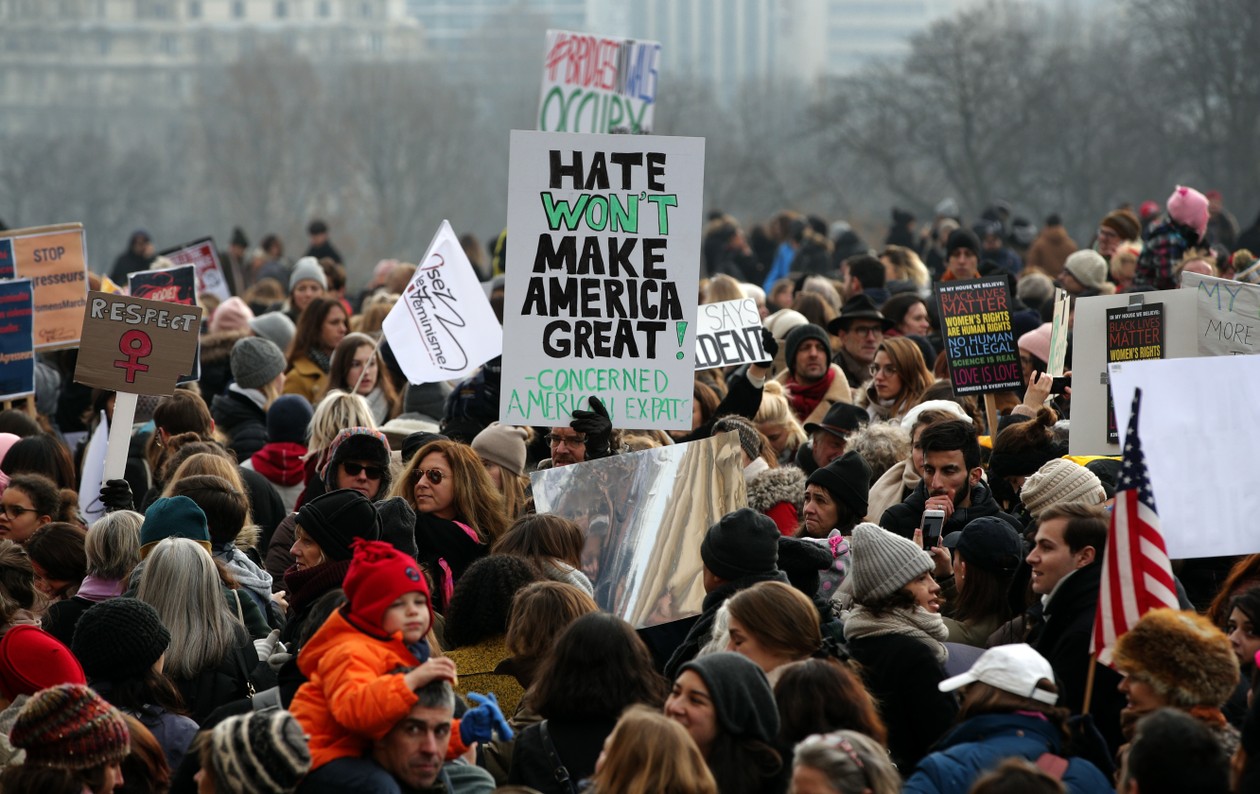
The Women’s March on Washington, a mobile protest organized in response to President Trump’s election, is under way in downtown Washington, D.C.
The event’s organizers are anticipating roughly 250,000 marchers, many of whom supported Hillary Clinton for president and are wary about the new administration’s policies towards women, as well as its approach toward the LGBT community, minorities, immigrant groups, and others. According to the march’s mission statement, participants aim to “send a bold message to our new government on their first day in office, and to the world, that women’s rights are human rights.” Six hundred similar marches are being held Saturday around the country. Others have been organized around the world.
In Washington, a morning rally will be held at 10 a.m. ET, and the march will begin at 1:15 p.m. ET. We’ll bring you the latest updates from the nation’s capital as the day goes on.
Marchers Leave Their Protest Signs in Front of Trump's D.C. Hotel
Bryan Woolston / Reuters
Protest signs were ubiquitous at the Women’s March on Saturday. Some posters called for action (“Speak up for humanity”), while others portrayed messages of female empowerment (“The future is female”). By the afternoon, it became clear that many demonstrators didn’t plan to keep theirs for posterity’s sake. Instead, they left them behind in a conspicuous place:
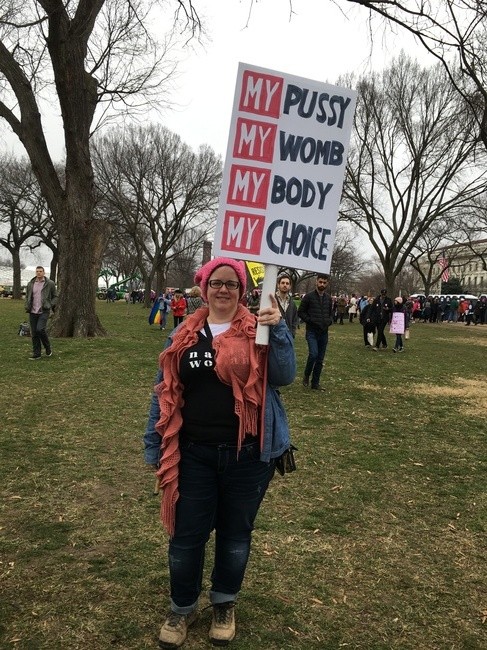
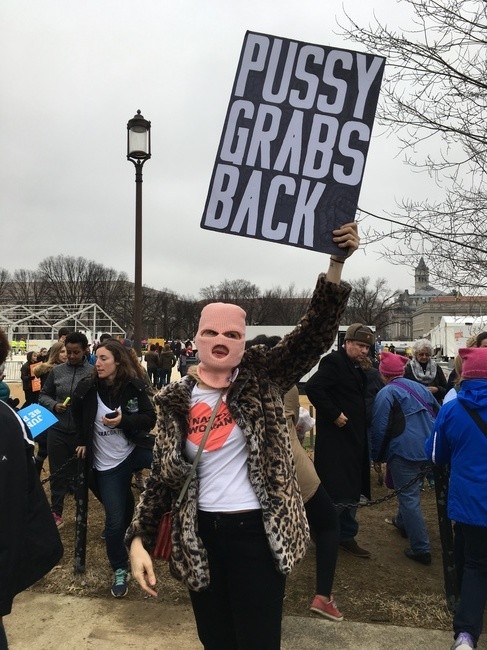
It wasn’t just the pussy-cat ears: Many of the signs in downtown D.C. employed the word made infamous by President Trump in the leaked Access Hollywood video in October. Women hoisted hand-sketched vaginas and drew cat shapes on their block letters. One even used the c-word. They are reclaiming “pussy,” they said.
Mary Trudeau, 47, came from Atlanta. “After the election I was so depressed,” she said. “I said, I have to go, I have to participate, because if I don’t I’ll feel like I just did nothing.”
Her sign was inspired by Trump’s words in the Access Hollywood video, she said. “Instead of it being a vulgar word, it being a word of empowerment for women. Everything about my person is for me to decide.”
Kerry Gaertner-Gerbracht Credit Olga Khazan / The Atlantic
Kerry Gaertner-Gerbracht had her 11-year-old daughter make her sign—she wanted to get involved. “Trump has brought the word to the national conversation,” Gaertner-Gerbracht said. “If this is what our president is saying, she should get comfortable with it, too.”
One element of Trump’s victory, she believes, was “the masculine fear of the vagina. It’s a very basic thing.”
Sinead Macleod. Credit Olga Khazan / The Atlantic
Sinead Macleod, a 24-year-old from New York, said it was important to show female genitalia and “reclaim the grossness—and the beauty.
“During the debates when [Clinton] went to the bathroom, he said that was gross,” she said. “There’s no reason to be ashamed of it.”
Macleod might have out-done the other protesters in terms of female-anatomy drawings. She has an IUD tattooed on one ankle, and vagina dentata on the other.
I'm close to the White House now, on the Ellipse, the public, lawn-like area beyond the South Lawn of the executive mansion. Protesters are pouring onto the grass from all angles, and a dance circle has broken out in the center of the lawn. There are children frolicking around, and demonstrators are cheering and waving their signs.
The White House is where the protesters planned to finish their march. But President Trump, who many of them are specifically marching against, isn't in the building. He left about an hour ago for a meeting in Langley, Virginia, with CIA officials.
Scarlett Johansson Asks Trump to Support 'Women in Our Fight for Equality'
Lucy Nicholson / Reuters
Various celebrities and activists are still speaking at the Women’s March rally, which began roughly five hours ago.
“President Trump, I did not vote for you. That said, I respect that you are our president, and I want to be able to support you, but first I ask that you support me,” American actress Scarlett Johansson said from the stage. “I ask you to support all women in our fight for equality in all things.”
She told her fellow protesters that she’s hoping people discontented with November’s election results will become more politically active in their communities. “Let this weight not drag you down, but help to get your heels stuck in,” she said.
Kamala Harris: 'We Are at an Inflection Point in the History of Our Country'
Shannon Stapleton / Reutres
California Democratic Senator Kamala Harris told protesters at the Women’s March that she believes “we are at an inflection point in the history of our country.”
Harris, who recently became only the second black woman and first Indian-American woman to serve in the U.S. Senate, compared the moment to when her parents met “when they were active in the civil-rights movement.” Elaborating on the comparison, Harris said that it is a moment where Americans must collectively ask the question of “what kind of country America is.” “Ladies and gentlemen, I believe the answer is ‘a good one,’” Harris said. “Imperfect though we may be, I believe we are a great country.”
The lawmaker also said that women are tired of “simply being thought of as a particularly constituency or demographic.” Together, “we are powerful and we are a force that cannot be dismissed or written off onto the sidelines.”
Encouraging activism, Harris said: “It’s going to get harder before it gets easier,” but added that she believes “we will keep fighting no matter what.”
The women I’ve talked to so far are driven by a variety of issues, but for some, the future of reproductive rights is the biggest concern.
Dena Delaviz, from Columbus Ohio, held a sign that read “Abortions = healthcare,” and said she was inspired, in part, by a T.V. appearance by Planned Parenthood director Cecile Richards. She can’t understand Republicans’ desire to defund the organization. “Planned Parenthood sees Republicans, too,” she said.
Kaitlin Bruinius, a student at Appalachian State University, said she is worried about losing access to free birth control. Without the Affordable Care Act’s birth-control provision, her monthly contraceptives would be $80, she said. “It makes it a lot easier, but [Trump] doesn’t understand how great it is. He’s going to take it away without being in our shoes.”
Pooja Prasad, a doctor in Prince William County, Virginia said Obama’s election seemed to have made it more acceptable to talk about birth control and STD tests with her teenage patients. In her area, many teens rely on Planned Parenthood. Now, “I’m afraid that I’m going to have to tell teenagers that they can’t go and get free birth control, free pap smears.”
But many of the attendees were also worried about losing health insurance coverage in general, not just for reproductive care.
Yedda Olson, a high-school teacher from Wisconsin, road tripped through the night. She said many of her students' families work in factories and rely on the Obamacare exchanges for insurance. Her former students want to stay on their parents' insurance until they're 26. "A lot of my former students are really worried about losing that," she said.
Cecile Richards: 'Reproductive Rights Are Human Rights'
Lucy Nicholson / Reuters
“Reproductive rights are human rights,” Planned Parenthood President Cecile Richards told protesters at the Women’s March.
She warned that the Republican-controlled Congress poses a threat to reproductive rights, and called on the assembled crowd to “call your members of Congress, call your senator, and say, ‘We cannot go back.’” She added: “One of us can be dismissed, two of us can be ignored, but together we are a movement, and we are unstoppable.”
Richards made a pledge to the crowd that the doors at Planned Parenthood will “stay open.”
“Planned Parenthood is not the problem,” she said. “We’re the solution.”
Snapshots From Women's Marches Around the Country and the World
There are roughly 600 sister protests to the Women’s March on Washington that are being held around the country Saturday—and more around the world. The demonstrations in the United States are reflective of the grassroots way that women organized after the election, and perhaps foreshadow a new strategy for Democrats ahead of the 2018 midterms. They remind one political reporter of another movement entirely:
The massive crowds in DC, Chicago, Boston etc. looks like Democrats are tapping the same energy of opposition as the tea party in 2009
The march through Chicago was canceled because the number of participants—some 150,000—grew too large. Instead, marchers are staying in place and extending the rally, which was scheduled to start at 10 a.m. local time. “There is no safe way to march. We are just going to sing and dance and make our voices heard here,” an organizer announced.
Michael Moore: 'We Have to Take Over the Democratic Party'
Shannon Stapleton / Reuters
Activist and filmmaker Michael Moore had a message for the crowd at the Women’s March: “We have to take over the Democratic Party.”
Moore took the stage to outline a plan of action to oppose the Trump administration, starting by urging the crowd to start calling their members of Congress “every single day” and calling upon young people and women to run for elected office themselves.
“The old guard of the Democratic Party has to go,” Moore said. “We need new leadership, we need young leadership, we need women’s leadership.”
Moore argued that public backlash over a move by House Republicans earlier in the month to gut the Office of Congressional Ethics prompted Republicans to quickly backtrack. He suggested that similar activism will get results in the future, though he failed to mention that the backtrack also followed a disapproving tweet from then-president-elect Donald Trump. “I’m telling you these calls work,” he said, “that’s how powerful you are.”
'We’re Here to Show We’re Present and Planning on Staying'
Madai Ledezma (right) and her daughter (left) head to the Women’s March on Washington. (Priscilla Alvarez / The Atlantic)
In the early morning hours of Saturday, a sea of color flowed into the nation’s capital. People descended from around the country to attend the Women’s March on Washington. Amid the crowds was a group of roughly 15 people donning butterfly wings inspired by Favianna Rodriguez, an artist based in California.
The imagery is meant to represent migration and beauty, said Alma Couverthie, the senior director of community organizing for CASA, a Maryland-based organization that focuses on Latinos and immigrants. CASA began planning for the march two weeks ago, with the additional purpose of representing immigrants.
Donald Trump, who made immigration a cornerstone of his campaign, has vowed to build a wall on the U.S.-Mexico border and deport millions of undocumented immigrants. March attendees were fearful about what immigration policies the new administration may implement.
“I think it’s going to affect us—all of us,” said Madai Ledezma, who’s undocumented, in Spanish. “If they deport me, I don’t know what her situation will be,” she said, looking at her daughter who she had brought to the march. Ledezma, who’s participated with CASA for three years, added: “Perhaps, in the future, [attending the march] will help her, so she can fight for those of us that don’t have a voice.”
Fatima Coreas was in attendance to represent mothers like Ledezma. “[I’m here] for Latina mothers, who have left everything behind; they migrated to the United States to search for a better life for their kids,” she told me in Spanish. Coreas has a connection to mothers who have migrated for their children—she came to the United States from El Salvador with her mother in 2007, and was shielded from deportation by the Obama administration’s Deferred Action for Childhood Arrivals program. “We’re here to show we’re present and planning on staying,” she said.
Ledezma and Coreas, with their wings securely fastened, promptly began chanting “Se ve, Se siente, el pueblo esta presente.” Translated to: “You see, you feel it, the town is present.” It didn’t take long before their chants dissipated into those of crowds around them: “This is what democracy looks like.” But it was no matter, as Ledezma said put it: the march is meant to represent everyone.
Roslyn Brock: 'Courage Will Not Skip This Generation'
People gather for the Women's March in Washington U.S., January 21, 2017. (Shannon Stapleton / Reuters)
“Courage will not skip this generation,” Chairman of the National Board of Directors for the NAACP Roslyn Brock told the Women’s March crowd. “Courage will not skip this generation.”
Brock reminded the crowd that black women are a powerful force in elections, saying that they “exercised the right to vote larger than any other group in this nation,” but added that “the silence has been deafening for black women and their families who also feel forgotten and locked out of a prosperous society.”
She called upon the crowd to organize, and fight. “We will march on till victory is won,” she declared, referencing Lift Every Voice And Sing, an 1899 poem later adopted as the black national anthem.
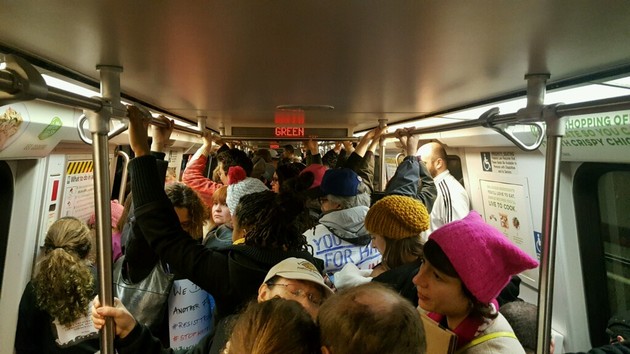
I’m riding on the Metro’s Green line from the station in Petworth, to the north, to the L’Enfant station, in the south, and the train is holding for 5 to 10 minutes at each stop. The conductor keeps repeating that "due to amazing, outstanding turnout, we are holding to make room for people." Riders aren't mad—at least not yet—even though the Women’s March rally is already under way. They keep cheering when he says "amazing turnout."
Gloria Steinem: 'We Must Put Our Bodies Where Our Beliefs Are'
Sait Serkan Gurbuz / AP
American political activist and feminist Gloria Steinem thanked the crowd assembled at the Women’s March rally, and thanked them for “understanding that sometimes we must put our bodies where our beliefs are.”
Reflecting on her life of activism, Steinem described the march as “an outpouring of energy and true democracy like I have never seen.” She added that the people gathered in Washington and across the country to march “is the upside to the downside.”
She suggested that Trump’s presidency will inspire a wave of continued activism. “When we elect a possible president, we too often go home. When we elect an impossible president, we’re never going home,” she said.
Steinem said that if a critical mass of people come together to oppose Trump, those people can prevail. “The Constitution does not begin with ‘I the president,’” she said, “it begins with ‘we the people.’”
America Ferrera: 'Our Safety and Freedoms Are on the Chopping Block'
Sait Serkan Gurbuz / AP
The rally for the Women’s March on Washington is under way, and features a long roster of speakers with some of the celebrity star power that may have been missing from President Donald Trump’s inauguration.
American actress America Ferrera just spoke, warning the crowd that the new administration is a threat that must be opposed. “Marchers, make no mistake,” she said. “We are every single one of us under attack. Our safety and freedoms are on the chopping block, and we are the only ones who can protect one another. If we do not stand together, march together, fight together for the next four years, then we will lose together.”
Ferrera ticked off a long list of what the anti-Trump protesters out in full force Saturday must stand together to oppose: “the demonization of our Muslim brothers and sisters,” attacks on LGBTQ rights and access to abortion, “the systemic murder and incarceration of our black brothers and sisters,” and building walls.
“It’s been a heart-rending time to be both a woman and an immigrant in this country,” she said. “Our dignity, our character, our rights have all been under attack, and a platform of hate and division assumed power yesterday. But the president is not America. His Cabinet is not America. Congress is not America. We are America.”
'We Can't Have True Freedom If We Can't Control Our Bodies'
Credit Priscilla Alvarez / The Atlantic
Suzanna Walters, 54, traveled from Boston to attend the march. “I’ve been coming to marches for a long time. We’re really witnessing the rise of fascism in America. ... It behooves all of us to get out here.” Walters is attending with a group dubbed Feminists Against Trump.
Joining her is Judith Levine, 64, from Brooklyn. Levine touted a sign saying “Abortion rights is equal to human rights.” “I was one of the people that fought to have abortion decriminalized,” she told me. “We can't have true freedom if we can't control our bodies.”
Saturday’s march was born, in part, out of Hillary Clinton’s loss in November. Politically progressive women considered Clinton a champion of women’s rights, and worried about what the Trump administration would bring.
On Friday, Clinton attended Trump’s inauguration wearing white, the color worn by suffragettes who themselves demonstrated in the streets. And this morning Clinton thanked the women marchers, many of whom are attending in her name.
Thanks for standing, speaking & marching for our values @womensmarch. Important as ever. I truly believe we're always Stronger Together.
Will the Women's March Have More Participants Than Trump's Inauguration Did?
Priscilla reported earlier this morning on the packed Metro cars she saw headed to downtown Washington for the march.
Based on video footage and photos on Twitter, it wasn’t just her route that’s crowded.
This is what the trains to the Women's March look like when they show up — in the Virginia suburbs, before they've even gotten to the city. pic.twitter.com/84cjhqTju7
Metro cars in Washington, DC are packed to overflow this morning, unlike for yesterday's inauguration. Pumped up women marchers. pic.twitter.com/EwI9LpT7vu
There’s been some speculation that the crowds for Saturday’s march could well exceed those at the inauguration ceremony for President Trump. According to The Washington Post, Metro ridership was down Friday compared with recent inaugurations, and “fewer riders flocked to the system than would even on a typical weekday.” I can report anecdotally—as other journalists have on Twitter—that the two Metro lines I took Friday morning to get to the inauguration weren’t packed at all.
As for non-Metro modes of transportation, roughly 1,200 bus parking permits were issued for Saturday versus some 200 for Friday. And the trains incoming from Baltimore seem sure to be crowded as well.
Updated on January 21 at 10:50 a.m. ET: A previous version of this post mistakenly reported that Metro ridership was down on Saturday. It was down on Friday.
"We Want to Make Sure Our Rights Are Not Taken Away"
Credit Priscilla Alvarez / The Atlantic
Lisa Gissendaner, 56, is here from Canton, Ohio. Originally, she intended to March in Cleveland but decided a week ago, with encouragement from friends, to join the march in DC. Gissendaner, who's here with the African American Policy Forum, told me she came to support women across the country and women of color.
"We want to make sure our rights are not taken away," she said, adding that she's also here to represent women who have been shot and killed by police. As we talked, she began stomping her foot on the ground. "In my shoe, are the names of my great nieces and nephews." She added: "Every foot forward is a step for them."
Nanette Nilssen, 61, and Sue Kvendru, 56, just got off a 17-hour bus ride from Minnesota. They've been planning for the march for weeks, attending regular meetings to make signs and coordinate. Nilssen, who supported Hillary Clinton, felt motivated to come because of her work. "I march for children because they need the [Affordable Care Act], they need a decent education. I've spent 25 years as a day-care provider," she said. Kvendru jumped in: "This is just the start."
"We sat back and let it happen. Now we have to organize and take it back," Kvendru said.
It's 8 a.m. ET in Washington, D.C., and the city is already bustling. Droves of march attendees are filling into Metro cars, touting their signs, donning Women's March sashes, and breaking into the occasional cheer. Alexanne Neff, 26, told me she traveled here from New Jersey to participate: "I'm tired of having to fight for women's rights and I wanted to be part of a really big voice."
The president is on a losing streak, and even some of his aides are dismayed by his choices.
This article was featured in the One Story to Read Today newsletter. Sign up for it here.
You’ve heard the joke: The White House is going to start talking about the Epstein files to distract from how badly the Iran war is going.
Except that this reverse “Wag the dog” is based on bizarre truth: First Lady Melania Trump did bring the disgraced financier up, unprompted, late last week in an effort to distance herself from the scandal (in a move that, predictably, only shifted it back into the spotlight once again). Meanwhile, as negotiations with Iran stumble forward, the Strait of Hormuz is still in Tehran’s hands and now President Trump has authorized a risky naval blockade that will likely send prices soaring further. Moreover, Trump’s poll numbers have continued to fall, Republicans worry that both houses of Congress could be lost in November, and the president threw away a remarkable amount of geopolitical capital trying to support his now-defeated illiberal buddy Viktor Orbán of Hungary. Oh, and Trump deeply offended adherents of the world’s two largest religions in one week’s time.
The car industry says it has an answer for drivers wary of going electric.
Two hours into a road trip in my Tesla, I start to get twitchy. By that point, the battery in my 2019 Model 3 has dipped to an uncomfortably low percentage. If I can’t reach the next plug, I’m in trouble. This is the kind of problem that Ram’s electric pickup truck—the first of a new breed of EV to arrive in the United States—is intended to solve. When the range starts to dwindle, the truck automatically fires up a hidden gas engine that refills the giant battery. The “electric” vehicle keeps on chugging down the highway, hour after hour; pit stops are once again decided by the need for bathroom breaks rather than battery range.
The Ram 1500 REV, set to debut later this year, is what’s called an “extended-range electric vehicle,” or EREV. In essence, it is an electric vehicle that burns gas. There’s nothing revolutionary about a half-gas, half-electric car, of course. Hybrids have been a mainstay in the United States since the Toyota Prius broke through two decades ago, and automakers have released more efficient plug-in hybrids—allowing drivers to charge up for about 30 miles of electric driving, just enough to accomplish daily errands without fossil fuels. An extended-range EV is a different kind of beast. The engine burns gasoline for the sole purpose of replenishing the battery—it never actually pushes the wheels. In the Ram, the battery can run for about 150 miles of electric driving, and the whole setup delivers enough range to travel nearly 700 miles between stops.
Thirteen thousand miles. Infinite contenders. One beautiful loaf.
This article was featured in the One Story to Read Today newsletter. Sign up for it here.
Here is the promise you and I must cling to across the thousands of words that follow: At some point within this text, I will reveal to you what—after 555 responses, 13,000 miles of travel, and months of monomaniacal research—I have determined to be the best free restaurant bread in America. I will not attempt to slither to the moral high ground, arguing that best is a meaningless measure, or insisting that all bread is dear in its own way. Even if you attempt to betray me—for instance, by merely scanning the text that follows for the phrase Here it is: the best free restaurant bread in America—I will uphold my end of the bargain.
A minimally speaking autistic man just wrote a best-selling book. Or did he?
On a recent morning at Rockefeller Center, NBC employees strolled through the crowd with copies of Upward Bound, the latest book-club pick from the Today show co-host Jenna Bush Hager. “It’s deeply heartfelt and moving,” Hager said, after holding up the debut novel from the 28-year-old Woody Brown, “and the reason it’s so authentic is that the author understands autism firsthand.”
That understanding is indeed profound. Brown’s autism is such that he can barely speak, and he communicates mostly by pointing to letters, one by one, on a laminated board. This is also how his novel, which is already a New York Times best seller, came to be. In the recorded interview that followed Hager’s introduction, Brown’s mother, Mary, sat beside him, holding the letter board and reading his tapped-out messages.
Is the president’s son-in-law carrying out the public’s business or pursuing his own private interests?
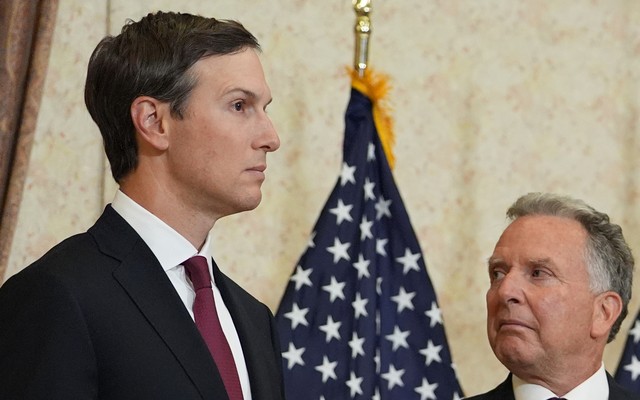
In 2021, shortly after he left his role as a senior White House adviser, Jared Kushner let it be known that he had loved his job but disliked the scrutiny and disclosure that came with being a top U.S. government official. He set up a private-equity firm and took a $2 billion investment from a Saudi fund led by Crown Prince Mohammed bin Salman. He proclaimed that he was embracing private life. “I’m an investor now,” Kushner said in a 2024 interview. If President Trump “calls you on November whatever and says, ‘I’d like you to come back to D.C.,’ you say, ‘Thanks, but I’m good’?” the interviewer, Dan Primack of Axios, pressed. “Yes,” Kushner responded.
But Kushner did come back. Two days before the United States and Israel attacked Iran this past February, he was in Geneva in a negotiation of the highest possible stakes. Over the weekend, he traveled with Vice President Vance to Islamabad to participate in failed peace talks with Iran. Without title or remit or any kind of official designation—only “presidential son-in-law”—Kushner has in the first 14 months of the second Trump administration sat down with world leaders including Vladimir Putin, Benjamin Netanyahu, and Volodymyr Zelensky, along with Saudis and multiple other actors from the Middle East.
The president’s attempts to interfere with the midterms demand vigilance, but a recent flimsy gambit is an argument against despair.
This is an edition of The Atlantic Daily, a newsletter that guides you through the biggest stories of the day, helps you discover new ideas, and recommends the best in culture. Sign up for it here.
Anxiety among election officials and experts had been building for months before Donald Trump issued his latest executive order purporting to ensure election integrity late last month. When the actual text emerged, the reaction wasn’t relief exactly—but a definite sense that things could have been much worse.
Americans have many reasons to be worried about whether the midterm elections will be free and fair. As I laid out in a cover story last fall, the president’s plan to subvert the 2026 election is multifaceted and already in swing. But last month’s order and the dismissive reaction it’s received from experts—along with this weekend’s decisive defeat of Hungarian Prime Minister Viktor Orbán, which shows how the competitive-authoritarian playbook that Trump has imitated can be beaten—also point to the reasons to resist doomerism.
If you are anything like me, you have spent a lot of time over the past few weeks opening letters, finding receipts, requesting PDFs, scanning documents, and going through your credit-card statements line by line. It’s tax season. And in the United States, taxes are a DIY affair.
This is the case even though Washington could probably do your taxes for you. If you earn a salary or an hourly wage, the Internal Revenue Service already knows how much money you make. It likely knows how much you owe or how big your refund should be too. Nine in 10 households take the standard deduction, making their liability easy to glean from payroll and banking data.
Yet Uncle Sam demands that Americans fire up TurboTax, head to a storefront preparer, hire an accountant, or sit down with a sharp pencil and a strong cup of coffee to get their taxes done each spring. The average filer spends 13 hours on their 1040—a time tax that many of our wealthy peer countries have reduced to a couple of minutes, if that. Prepopulated documents and return-free systems are common everywhere but here. Sweden lets residents file by text. Canada prefills paperwork. Japan sends households a document summarizing their tax contributions. If everything looks copacetic, many workers get to do a blissful nothing. Denmark, Estonia, Spain, and Norway have similarly simple processes.
Former U.S. Deputy National Security Adviser Matt Pottinger on the U.S.-Iran cease-fire, Trump’s Hormuz blockade, and China’s reaction to the Iran war. Plus: A seismic election in Hungary, and Labyrinths, by Jorge Luis Borges.
In this week’s episode of The David Frum Show, The Atlantic’s David Frum opens with his reaction to the recent election in Hungary and the defeat of Viktor Orbán. David counters Orbán defenders who claim that this loss proves Orbán was never a threat. Antidemocratic leaders often face institutional constraints, and it was those institutional constraints that compelled Orbán to accept a defeat after years of abuse of power.
Then, David is joined by former U.S. Deputy National Security Adviser Matt Pottinger to discuss the current state of President Trump’s war in Iran. David and Pottinger talk about the recent failed negotiations between the two sides in Pakistan, the blockade of the Strait of Hormuz, and what could happen next. They also discuss how the Iran war is viewed in China and how it has been a financial gain for Russia.
Hungary offers lessons in defeating right-wing populists.
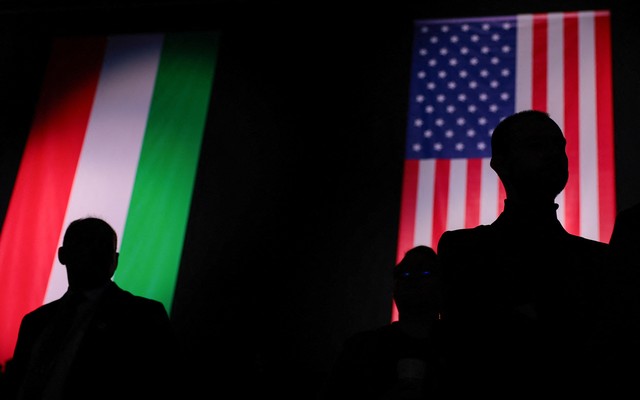
To the outside world, Hungarian Prime Minister Viktor Orbán began his rule as a pariah—an obstreperous, often lone dissenter from European Union policies, especially over migration. Then he became a prophet to new-style “national conservatives”—the anti-immigration, anti-elite right-wing movement that has reshaped the politics of the West. After resoundingly losing national elections held on April 12, Orbán has become a parable for how populism can be defeated.
His political demise was hardly inevitable. It had to be shrewdly engineered by politicians and voters who put aside their ideological differences to defeat him. In politics, there is no natural law of self-correction.
From 2010 until now, Orbán and his Fidesz party transformed Hungary into a new kind of state, which he proudly proclaimed as an “illiberal democracy.” He and his allies rewrote the constitution to entrench his power, centralizing control over civil society and countervailing institutions such as courts and universities. Péter Magyar, the presumptive next prime minister, triumphed against a tilted electoral system—gerrymandered districts, government influence over traditional media and even over the country’s billboards—designed to keep Fidesz in power. Magyar understood that such a regime does not simply collapse under the weight of its own contradictions and mismanagement.
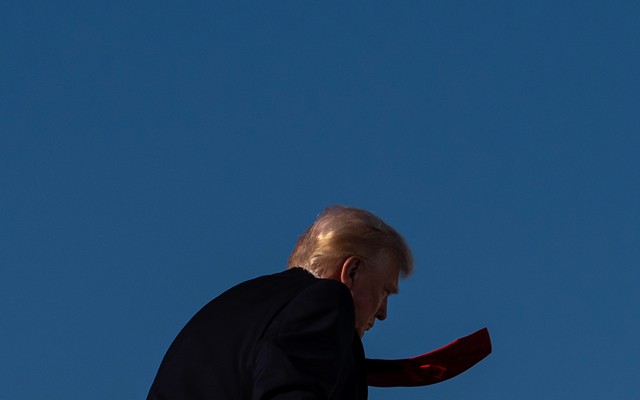
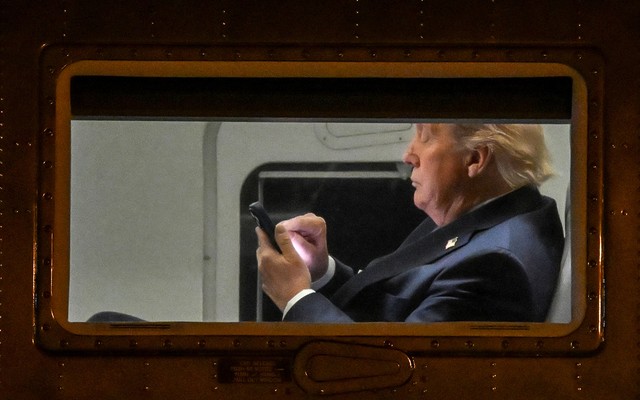
On many recent nights, Donald Trump has been posting obsessively on his Truth Social site into the wee hours. The president, of course, has never been one for a solid night’s sleep—or restrained and temperate commentary on social media—but his emotional state seems to be fraying: This weekend, he attacked Pope Leo XIV, presented himself as Jesus Christ, and then jabbed at his phone until dawn.
Judging from those posts, the commander in chief is in distress. No one can say for sure what is causing the president’s bizarre behavior. Perhaps Trump’s narcissistic insistence that he is always successful in everything he undertakes is feeling the sting and strain of multiple public failures, including the collapse of his campaign to dislodge the Iranian regime, plummeting approval ratings, the decline of the U.S. economy, and, on Sunday, the crushing defeat of one of his favorite fellow authoritarians, Hungary’s Viktor Orbán.