


Return to this issue's Table of Contents.
S E P T E M B E R 1 9 9 9
 E value stocks according to how much cash they put in your pocket. Stocks are less risky than bonds, so bonds should produce more cash. But let's be conservative and simply assume that stocks and bonds should produce the same amount of cash. In the past stocks produced more cash than bonds: stocks were too cheap. Are they still too cheap? To answer that question we need to construct a method to determine the flow of cash that stocks are likely to deliver. Then we need to put a present value on that flow -- what it's worth today to own an asset that will give you, say, $50,000 over the next fifty years. The second part is easy; we can use a simple financial formula. The first part -- estimating the cash flow -- is a little tougher. Ultimately we want to be able to draw conclusions about the entire market, but let's start by looking at a single firm, Wells Fargo & Company.
With antecedents in the famous stagecoach line of the Old West, the San Francisco-based bank merged last year with Norwest Corporation, which had headquarters in Minneapolis and tentacles throughout the country. The new company kept the Wells Fargo name and became the seventh largest bank-holding company in the United States, with more than 2,800 conventional branches and 3,000 mini-branches inside retail stores in twenty-one states. It finished the year with $137 billion in deposits and $2 billion in after-tax profits. Wells Fargo also happens to be one of the better investments of Berkshire Hathaway, the holding company chaired by the superinvestor Warren Buffett. Berkshire owns 67 million shares of Wells, worth $2.9 billion -- stock that originally cost Buffett just $392 million. Berkshire is the largest shareholder in the bank.
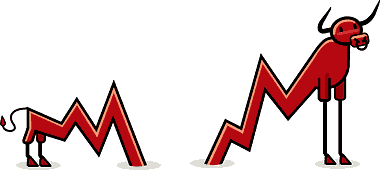
In April of this year a share of Wells Fargo stock cost $40 and paid an annual dividend of 75 cents, for a yield of 1.9 percent. If you had taken your $40 and put it in a long-term Treasury bond at that time, it would have paid you 5.5 percent interest, or $2.20 a year, for thirty years. The gap of $1.45 between the interest payment of $2.20 and the dividend payment of 75 cents seems very large. Can Wells Fargo really increase its dividends so much in the future that it will put more money in your pocket than the bond would?
The answer depends on how much the dividend grows. Let's look first at the past. Wells Fargo increased its dividend per share over the past five years at a rate of 16.5 percent annually, and over the past ten years at a rate of 14.5 percent. Those growth rates are solid, and Wells Fargo's story is not unusual. If Wells Fargo can sustain similar growth in the future, the dividend payments will become very big very fast. Growing at 16.5 percent a year, that 75-cent dividend will be $1.61 in five years, $3.45 in ten years, and $15.91 in twenty years. In thirty years it will rise to $73.26, whereas the payment from the Treasury bond will still be $2.20. In other words, in that thirtieth year the dividend payment to a Wells Fargo shareholder will be higher than the total of the bond's interest payments over thirty years -- and almost twice as great as the bond's $40 principal.
But, of course, growth at 16.5 percent cannot go on forever; indeed, if a firm constantly grew faster than the economy overall, the firm would ultimately swallow the whole thing up. Sooner or later a company matures, and thereafter it just keeps up with the growth of the economy (if that). Yes, 16.5 percent is unrealistic, but if we are willing to make some assumptions about the company's growth in the future, we can predict the amount of cash the company will generate in dividends -- and from that figure we can compute its proper value today.
Let's divide a company's life cycle into two stages: "adolescence" and "adulthood" (we won't try to analyze companies that are now fast-growing infants, like so many Internet companies). During adolescence a company grows at a rate higher than that of the economy as a whole. Once it becomes an adult, it grows at a rate that is a bit slower than that of the economy as a whole.
The value of a company's stock depends on its current dividend, together with how fast the company will grow during adolescence, how long adolescence will last, and how fast the company will grow during adulthood. (The best firms, like the best people, are those that keep their adolescent energy even as they reach an advanced age.)
Wells Fargo is hardly an adolescent, but a reinvigorated management and the merger with Norwest give it teenage vitality. So let's start by assuming that Wells will maintain the 16.5 percent growth rate of its dividends of the past five years for another five years. Then let's assume that it will abruptly mature and after that will grow at a rate about 0.5 percent slower than nominal GDP growth, or about 4.5 percent a year. Let's also assume that the prevailing Treasury-bond rate is 5.5 percent, as it was in the spring of this year. This rate is really not so vital, as we will see.
Under these assumptions we can easily total all the bank's future dividends and calculate what those dividends are worth today -- their discounted present value. The answer is $128 a share. Let's call that our first estimate of the perfectly reasonable price, or PRP, for Wells Fargo. If last April the market had smartened up and correctly priced the stock immediately, the share price would have risen from $40 to $128. The P/E ratio, which at the time was 33, would have increased to 105.
But this is just one scenario. Let's try some others. If we assume that the company can stay adolescent for ten years instead of five -- that is, maintain the 16.5 percent growth rate for a full decade before trailing off -- then the PRP becomes $214.
On the other hand, slower growth can lower the numbers -- although not enough to make the company look like a bad investment. Say that the company grows at a rate of only 14.5 percent during adolescence. If the high-growth period lasts five years before the company reverts to low-growth adulthood, the PRP is $117. If adolescence lasts ten years, the PRP is $181.
Now assume that the company's dividends in adulthood rise only with the level of inflation -- say, 2.5 percent -- rather than at a rate slightly below the rate of GDP growth. In that case, with a five-year adolescence at a growth rate of 16.5 percent the PRP is $42, with a ten-year adolescence $67.
Which is the most likely scenario? The choice is yours -- which is why you should study the stock. Our guess would be a ten-year adolescence at a growth rate of 14.5 percent followed by a reversion to growth that is 0.5 percent slower than the GDP's. That would cause the price of Wells to quadruple, and the P/E to rise to 149.
Is Wells Fargo special? Not at all. The stock market universe is filled with companies that have stories at least as compelling.
 N order to value the whole market, we need first to go back to the yardstick against which stock prices are measured: the U.S. Treasury bond, the main alternative for many investors who are thinking about buying stocks.
A bond is an IOU, a piece of paper indicating that the borrower promises to pay the lender back, with interest. The longest maturity of any Treasury bond you can buy today is thirty years. At the end of last year thirty-year Treasury bonds were paying interest of about five percent. In other words, if you lend the U.S. government $1,000, it will send you checks of $50 a year for the next thirty years, and then hand back the $1,000. In the past bonds with even longer maturities have been issued -- by companies, not by the U.S. government. The Walt Disney Company, the Coca-Cola Company, and IBM have all sold 100-year bonds.
If you are considering a long-term bond, you are probably thinking more about how much interest it will pay than about the money you will get back thirty years from now. That is perfectly reasonable. A claim today on $1,000 in thirty years is not worth very much. By the time you get the $1,000, its purchasing power will be reduced significantly. At an inflation rate of 2.5 percent $1,000 loses more than half its value in thirty years and about nine tenths of its value in a hundred years.
A stock has no definite maturity, and certainly comes with no promise to repay your original investment down the road. Sure, if a company is bought out or dissolved, the shareholders might be paid off, but if the company is successful, that event could be decades, or even a century, away. General Electric, for example, traces its beginnings to the Edison Electric Light Company in 1878 and continues to increase its profits at a rapid clip. GE's earnings were $9 billion last year, up from $4 billion in 1993.
So one way to think of a stock is as a bond with a really, really long maturity. Although no stock will last forever, a strategy of keeping your funds in the market as a whole through a mutual fund could be sustained for quite a long time. Extending the maturity toward a far-off horizon actually makes our analysis easier, because we can ignore the repayment of your original investment and focus on the cash flow. That, after all, is the key question in investing: How much money goes into your pocket?
Now suppose the government decided to offer a bond that lasted forever -- something called a perpetuity. If the interest rate on this bond were constant over time, it would be easy to price -- just like current long-term Treasuries.
Let's say that the rate on comparable investments, such as insured bank certificates of deposit, is 10 percent. Then a bond that paid $1.00 a year forever would cost $10 -- because that is how much you would have to invest elsewhere to get the same cash flow. If the interest rate on comparable investments was five percent, the perpetuity that paid $1 a year forever would cost $20, because that is how much you'd have to invest elsewhere to get that dollar.
Now suppose that in addition to the five percent "normal" bond, the government introduced a second kind of perpetuity, on which annual payments increased every year at some fixed rate -- say, two percent. Let's call this a growth bond. What interest rate should the growth bond pay today in order to pay exactly as much over its lifetime as the normal five percent bond would? Clearly, the initial rate on the growth bond should be lower than five percent -- because growth would make payments higher in the future. But how much lower?
That seems like a difficult math problem, but actually the solution is simple -- and it's treated in nearly every finance textbook. A normal bond and a growth bond are equivalent in present value if the sum of the growth bond's interest rate plus its growth rate is equal to the normal bond's interest rate. So if the normal bond is paying five percent and the growth bond's payments will rise by two percent a year, then the growth bond should start off paying three percent. It's that easy.
Of course, the timing of the payments is different. In the first year a $1,000 normal bond will pay $50 in interest, whereas the growth bond will pay $30. In the second year the growth bond will pay $30.60, and in the tenth year $35.85. And so on. If the sum of the growth bond's interest rate and growth rate is bigger than the interest rate of the normal bond, then the growth bond is paying its holders too much money. What does "paying too much" mean? Simply that the growth bond is underpriced.
Let's bring these mathematical calculations back to the world of stocks.
The stock will provide that cash flow if the sum of its dividend yield and the growth rate of its dividends (how much they increase, on average, per year) is equal to the interest rate on that normal Treasury bond. If the sum is greater than the Treasury rate, then the stock is paying too much.
Just like a growth bond, a stock that pays too much is underpriced. Again, think of bonds. If one bond that costs $1,000 is paying interest of $100 a year while all other bonds that cost $1,000 are paying interest of $50 a year, then, obviously, the bond that is paying $100 a year is too cheap at $1,000. Its price should rise to $2,000, making its return the same five percent.
Think of the stock market, as represented by the S&P 500. When the sum of the S&P's dividend yield plus the growth rate of its dividends exceeds the rate on a normal Treasury bond, then the market has not reached the perfectly reasonable price. The market is too cheap. It needs to rise some more.
Let's get down to the real numbers. We need look at only three things: the interest rate on long-term Treasury bonds, the dividend yield on stocks, and the expected long-term growth rate of stock dividends.
The first two numbers are easy to find in any newspaper. Earlier this year the rate on a thirty-year T-bond was roughly 5.5 percent, and the dividend yield for the typical stock in the Dow Jones Industrial Average was 1.5 percent -- both rates low by traditional standards. The third rate -- the growth of dividends per share -- is not listed in newspapers, but its history is easy to discover, using statistics developed by the Yale economist Robert Shiller. (If you would like to see the data yourself, they are available on the Web at www.econ.yale.edu/~shiller/chapt26.html.)
The figures are compelling. From 1977 to 1997 the growth rate for dividends was 6.1 percent. From 1946 to 1997 the rate was 6.2 percent. So the past two decades have not really been much different from the rest of the postwar period. The consistency of these numbers is important. There are two possible explanations for the apparent undervaluation of stocks back in the late 1970s. Either dividends grew far more than could possibly have been expected or people were too cautious about the risks of stocks. Since dividend growth over the past twenty years is almost precisely the same as over the past fifty years, the growth should have come as no big surprise.
But back to our calculations.
To start, let's assume that dividends will grow in the future at the same fairly steady rate as they have over the past half century -- by about 6.2 percent. You can see that stocks are paying too much when you add the yield of dividends (about 1.5 percent in 1998) to the growth rate (6.2 percent) and you get 7.7 percent, or 2.2 percentage points more than the T-bond rate (5.5 percent). Thus stocks put more money in your pocket than bonds, even though stocks are actually less risky than bonds over long periods.
Of course, applying the simple formula here is a problem, because the growth rate is bigger than the current interest rate. If firms grew that fast forever and the interest rate did not change, then the present value of future dividends would be infinite. One way to solve this problem is to rely on the simple model we used for Wells Fargo -- breaking up a firm's life into adolescence and adulthood.
Suppose, for example, that all the companies in the market will grow at six percent a year for the next ten years and then grow at 0.5 percent below the GDP growth rate after that. In that case the present value of future dividends that you buy when you buy $100 worth of a portfolio representing the entire S&P 500 is $172. In other words, the market would have to rise immediately by 72 percent under these extremely modest assumptions to reach the PRP.
If the growth rate that has prevailed since 1946 continues for another fifty years before tailing off, then buying $100 worth of stock today will get you dividends worth $270 in present value. But dividends have grown faster than GDP for some time. Perhaps we should be more aggressive. If dividends just keep up with GDP (rather than falling behind by half a point) after ten more years of six percent growth, then their present value climbs to $329. If the six percent growth lasts twenty years, the present value climbs to $360; if fifty years, to $460.
After weighing the historical evidence, we support an estimate based on one of the last two numbers. The PRP for the market overall should be 260 to 360 percent higher than it is now -- three and a half to four and a half times as high. Since the dividend yield for the Dow was around 1.5 percent earlier this year, the market should rise until the yield is about 0.4 percent.
It is easy to pull the same answer out of the growth-bond relationship. If the dividend yield is 0.4 percent and the Treasury bond yield is 5.5 percent, then the equation (cash returns from bonds = cash returns from stocks, or cash returns from bonds = dividend yield plus the growth rate of dividends) balances if that growth rate equals 5.1 percent: 5.5 = 0.4 + 5.1. This number is more than one percentage point below the average growth rate of dividends since 1946, so it seems to us perfectly reasonable.
But wait. These calculations have been based on numbers that don't allow for inflation. Inflation makes saving for tomorrow less attractive, because one dollar tomorrow can't buy as much as one dollar today. Although your dividends will be higher ten years from now, a new car or a trip to Europe will cost more, so shouldn't we take inflation into account?
Fine. Let's correct for inflation. Since the interest payment on a T-bond is the same every year, the bond's future payments are worth less and less as inflation erodes the value of the dollar. To account for this degradation, economists talk about the "real yield" of a bond, which is the nominal, or stated, interest rate minus the inflation rate.
So let's look at some numbers that correct for inflation. In its forecast at the beginning of this year the Congressional Budget Office predicted that inflation will rise at an average of about 2.6 percent a year through 2009. That means that the real yield on long-term Treasuries paying 5.5 percent is about 2.9 percent. For stocks the dividend yield is 1.5 percent. We don't need to adjust it for inflation, so long as we adjust the growth rate for inflation.
And how do we get the real growth rate for dividends? One source is the data developed by Robert Shiller. From 1946 to 1997 dividends per share grew at a real annual rate of 2.2 percent. From 1977 to 1997 the rate was 2.3 percent. From 1987 to 1997 it was 3.0 percent.
Add the middle real-growth rate to the dividend yield of 1.5 percent and you get a total of 3.8 percent, or 0.9 percent more than the real interest rate on bonds. Use the more recent figure for real growth and the difference is even larger.
If we assume that the real growth of dividends will continue at two to three percent, then we find, again, that stocks are paying too much. The only way this imbalance can be corrected is for stocks to rise in price.
But there is a serious problem with these numbers. The dividend payouts are far, far too low. Why?
Two reasons. First, when a firm pays out dividends to its shareholders, the shareholders are forced to pay tax immediately on the dividends. When the firm retains its earnings, the shareholders pay no tax. As we pointed out above, firms have been gradually learning that shareholders prefer not to pay taxes, and the fraction of earnings that is paid out in dividends has dropped dramatically -- from above 70 percent in the 1930s to less than 40 percent today. This downward trend absolutely does not reflect a decline in firms' ability to pay dividends.
Second, the data we have used so far are based on the dividends of the S&P 500. One intriguing characteristic of the recent bull market is that many of the firms that have soared are computer and Internet companies that pay no dividends. This change in the composition of the S&P 500 means that dividend statistics are currently biased downward. (Our assumption is that a firm like Microsoft, with $20 billion in cash, will put money in shareholders' pockets in the future.) A better measure might correct for this big-firm low-dividend bias by looking at the market as a whole.
To do this, we constructed an aggregate measure of dividend yield and growth rate of dividends for all companies from the Federal Reserve's Flow of Funds tables. These numbers make the market look even better. The dividend yield for U.S. companies last year, according to calculations from the Fed data, was 2.0 percent, and the growth rate of dividends averaged 9.4 percent over the preceding twenty years. Adding those two numbers, we get 11.4 percent, as against the six percent we have been using in our conservative calculations.
How much will prices have to rise? Until they reach our PRP, or perfectly reasonable price. And what, precisely, is that?
Let's step back. If a stock's dividend payout in dollars stays the same but the stock rises in price, its yield will decline. Take AT&T. Suppose it pays a dividend of $1.50 a share while shares are trading at $100. Its yield is 1.5 percent. Now assume that AT&T triples in price but its dividend stays the same; its yield becomes 0.5 percent.
Let's suppose that the entire market is represented by that single share of AT&T. After all, at the start of this year the stocks in the Dow Jones Industrial Average were offering a dividend yield of about 1.5 percent. If the entire market triples in price and the market's dividend payout in dollars stays the same, the yield will drop to 0.5 percent.
Add that yield to our conservative real growth rate of dividends (2.3 percent) and you get 2.8 percent -- approximately equal to the real T-bond interest rate. The equation balances.
At the start of this year, the Dow Jones Industrial Average was about 9,000. If the Dow, representing the entire market, tripled, then dividend yields would decline to their "perfectly reasonable" level -- the level at which stocks put the same amount into your pocket as bonds. If we use the dividend yield from the Fed data as our starting point, the market needs to quadruple to reach the PRP.
Recognize that our assumptions are modest. First, we are looking just at dividends. Second, we are using a conservative estimate for real dividend growth. It could easily be three percent or higher.
Give this powerful idea some time to sink in: By our simple, logical calculation, stocks may be undervalued by as much as three quarters. They need to triple or quadruple to get to where they should be: the PRP.
But firms earn far more than they pay out in dividends, and those earnings, too, count in figuring out how much money ends up in an investor's pocket. How much do they count? A lot.
The online version of this article appears in three parts. Click here to go
to parts one and three.
James K. Glassman is a fellow at the American Enterprise Institute and will shortly become the financial columnist for The Reader's Digest. Kevin A. Hassett is a resident scholar at the American Enterprise Institute. Their article in this issue will appear, in somewhat different form, in their book Dow 36,000: The New Strategy for Profiting From the Coming Rise in the Stock Market, to be published by Random House in September.
Illustrations by Christoph Nieman.
Copyright © 1999 by The Atlantic Monthly Company. All rights reserved.
The Atlantic Monthly; September 1999; Dow 36,000 - 99.09 (Part Two);
Volume 284, No. 3; page 37-58.